Lacey’s Regime TheoryLacey’s Regime Theory
Gerald Lacey -- 1930
Lacey followed Lindley’s hypothesis:
“dimensions and slope of a channel to carry a given discharge and silt load in
easily erodable soil are uniquily determined by nature”.
According to Lacey:
“Silt is kept in suspension by the vertical component of eddies generated at
all points of forces normal to the wetted perimeter”.
Regime Channel
“A channel is said to in regime, if there is neither silting nor scouring”.
According to Lacey there may be three regime conditions:
(i) True regime;
(ii) Initial regime; and
(iii) Final regime.
(1)True regime
A channel shall be in 'true regime' if the following conditions are satisfied:
(i) Discharge is constant;
(ii) Flow is uniform;
(iii) Silt charge is constant; i.e. the amount of silt is constant;
(iv) Silt grade is constant; i.e., the type and size of silt is always the same; and
(v) Channel is flowing through a material which can be scoured as easily as it
can be deposited (such soil is known as incoherent alluvium), and is of the
same grade as is transported.
But in practice, all these conditions can never be satisfied. And, therefore,
artificial channels can never be in 'true regime’; they can either be in initial regime
or final regime.
(ii) Initial regime
bed slope of a channel varies
cross-section or wetted perimeter remains unaffected
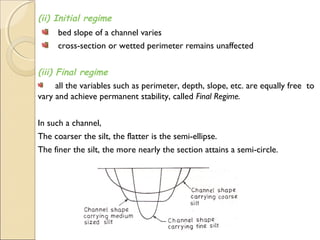
(iii) Final regime
all the variables such as perimeter, depth, slope, etc. are equally free to
vary and achieve permanent stability, called Final Regime.
In such a channel,
The coarser the silt, the flatter is the semi-ellipse.
The finer the silt, the more nearly the section attains a semi-circle.
Lacey’s Equations:Lacey’s Equations:
Fundamental Equations:
Derived Equations:
(Lacey’s Non-regime flow equation)
R
V
ffRV
2
2
5
or
5
2
==
52
140VAf =
2
1
3
2
8.10 SRV =
QP 75.4=
6
1
2
140






=
Qf
V
2
1
2
3
4980R
f
S =
6
1
3
5
3340Q
f
S =
2
1
4
31
SR
N
V
a
=
mminsizeiclegrain/partaverageisD
,76.1where
50
50Df =
The equations for determination of Velocity, Slope,
etc are function of the silt factor, whereas silt factor
is function of sediment size.
For upper Indus basin, f = 0.8 to 1.3
For Sindh plain, f = 0.7 to 0.8
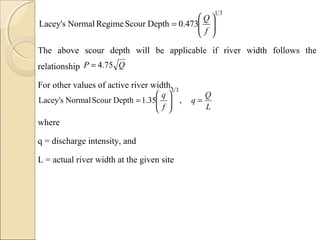
The above scour depth will be applicable if river width follows the
relationship
For other values of active river width,
where
q = discharge intensity, and
L = actual river width at the given site
31
473.0DepthScourRegimeNormalsLacey' 





=
f
Q
QP 75.4=
L
Q
q
f
q
=





= ,35.1DepthScourNormalsLacey'
31
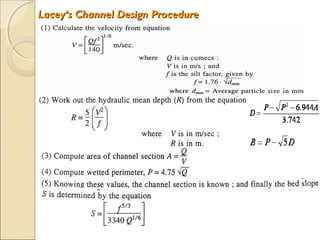
Lacey’s Channel Design ProcedureLacey’s Channel Design Procedure
Problem:
Design an irrigation channel in alluvial soil from following data using Lacey’s
theory:
Discharge = 15.0 cumec; Lacey’s silt factor = 1.0; Side slope = ½ : 1
Solution:
sec/689.0)
140
115
()
140
( 6
1
6
1
2
m
Qf
V =
×
==
2
77.21
689.0
15
m
V
Q
A ===
m18.41575.475.4 === QP
m36.1
742.3
)77.21(944.6)4.18(4.18
742.3
944.6 22
=
−−
=
−−
=
APP
D
m36.15)36.1(54.185 =−=−= DPB
m185.1
1
)689.0(
2
5
2
5 22
===
f
V
R
5245
1
)15(3340
)1(
3340 6
1
35
6
1
3
5
=
×
==
Q
f
S
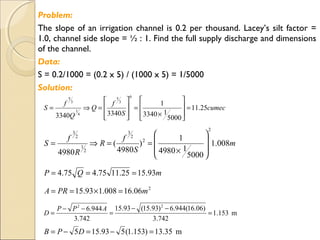
Problem:
The slope of an irrigation channel is 0.2 per thousand. Lacey’s silt factor =
1.0, channel side slope = ½ : 1. Find the full supply discharge and dimensions
of the channel.
Data:
S = 0.2/1000 = (0.2 x 5) / (1000 x 5) = 1/5000
Solution:
cumec
S
f
Q
Q
f
S 25.11
5000
13340
1
33403340
6
3
5
6
1
3
5
=








×
=








=⇒=
m
S
f
R
R
f
S 008.1
5000
14980
1
)
4980
(
4980
2
2
2
3
2
1
2
3








×
==⇒=
mQP 93.1525.1175.475.4 ===
2
06.16008.193.15 mPRA =×==
m153.1
742.3
)06.16(944.6)93.15(93.15
742.3
944.6 22
=
−−
=
−−
=
APP
D
m35.13)153.1(593.155 =−=−= DPB
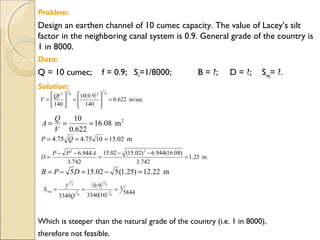
Problem:
Design an earthen channel of 10 cumec capacity. The value of Lacey’s silt
factor in the neighboring canal system is 0.9. General grade of the country is
1 in 8000.
Data:
Q = 10 cumec; f = 0.9; Sn=1/8000; B = ?; D = ?; Sreq= ?.
Solution:
Which is steeper than the natural grade of the country (i.e. 1 in 8000),
therefore not feasible.
( ) m/sec622.0
140
9.010
140
6
1
26
1
2
=





=





=
Qf
V
2
m08.16
622.0
10
===
V
Q
A
m02.151075.475.4 === QP
m25.1
742.3
)08.16(944.6)02.15(02.15
742.3
944.6 22
=
−−
=
−−
=
APP
D
m22.12)25.1(502.155 =−=−= DPB
( )
( ) 5844
1
103340
9.0
3340 6
1
3
5
6
1
3
5
===
Q
f
Sreq
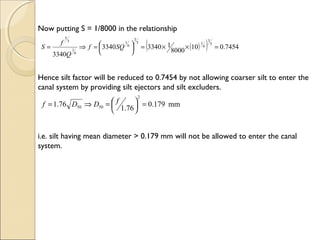
Now putting S = 1/8000 in the relationship
Hence silt factor will be reduced to 0.7454 by not allowing coarser silt to enter the
canal system by providing silt ejectors and silt excluders.
i.e. silt having mean diameter > 0.179 mm will not be allowed to enter the canal
system.
( )( ) 7454.010
8000
133403340
3340
5
3
6
15
3
6
1
6
1
3
5
=××=



=⇒= SQf
Q
f
S
mm179.0
76.1
76.1
2
5050 =



=⇒= fDDf
Lacey's Shock TheoryLacey's Shock Theory
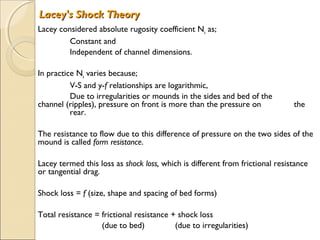
Lacey considered absolute rugosity coefficient Na as;
Constant and
Independent of channel dimensions.
In practice Na varies because;
V-S and y-f relationships are logarithmic,
Due to irregularities or mounds in the sides and bed of the
channel (ripples), pressure on front is more than the pressure on the
rear.
The resistance to flow due to this difference of pressure on the two sides of the
mound is called form resistance.
Lacey termed this loss as shock loss, which is different from frictional resistance
or tangential drag.
Shock loss = f (size, shape and spacing of bed forms)
Total resistance = frictional resistance + shock loss
(due to bed) (due to irregularities)
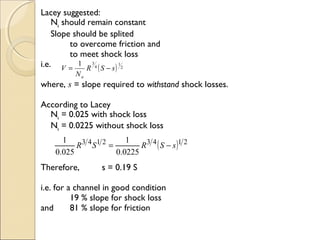
Lacey suggested:
Na should remain constant
Slope should be splited
to overcome friction and
to meet shock loss
i.e.
where, s = slope required to withstand shock losses.
According to Lacey
Na = 0.025 with shock loss
Na = 0.0225 without shock loss
Therefore, s = 0.19 S
i.e. for a channel in good condition
19 % slope for shock loss
and 81 % slope for friction
( ) 2
1
4
31
sSR
N
V
a
−=
( ) 21432143
0225.0
1
025.0
1
sSRSR −=
Drawbacks in Lacey’s theory:Drawbacks in Lacey’s theory:
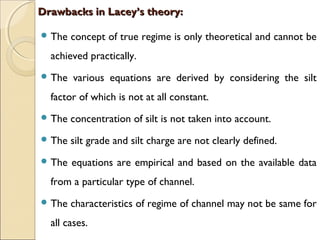
 The concept of true regime is only theoretical and cannot be
achieved practically.
 The various equations are derived by considering the silt
factor of which is not at all constant.
 The concentration of silt is not taken into account.
 The silt grade and silt charge are not clearly defined.
 The equations are empirical and based on the available data
from a particular type of channel.
 The characteristics of regime of channel may not be same for
all cases.
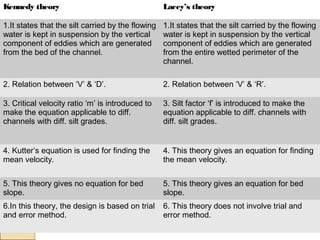
Kennedy theory Lacey’s theory
1.It states that the silt carried by the flowing
water is kept in suspension by the vertical
component of eddies which are generated
from the bed of the channel.
1.It states that the silt carried by the flowing
water is kept in suspension by the vertical
component of eddies which are generated
from the entire wetted perimeter of the
channel.
2. Relation between ‘V’ & ‘D’. 2. Relation between ‘V’ & ‘R’.
3. Critical velocity ratio ‘m’ is introduced to
make the equation applicable to diff.
channels with diff. silt grades.
3. Silt factor ‘f’ is introduced to make the
equation applicable to diff. channels with
diff. silt grades.
4. Kutter’s equation is used for finding the
mean velocity.
4. This theory gives an equation for finding
the mean velocity.
5. This theory gives no equation for bed
slope.
5. This theory gives an equation for bed
slope.
6.In this theory, the design is based on trial
and error method.
6. This theory does not involve trial and
error method.

Lacey Regime Theory - Irrigation Engineering

  • 1.
    Lacey’s Regime TheoryLacey’sRegime Theory Gerald Lacey -- 1930 Lacey followed Lindley’s hypothesis: “dimensions and slope of a channel to carry a given discharge and silt load in easily erodable soil are uniquily determined by nature”. According to Lacey: “Silt is kept in suspension by the vertical component of eddies generated at all points of forces normal to the wetted perimeter”. Regime Channel “A channel is said to in regime, if there is neither silting nor scouring”. According to Lacey there may be three regime conditions: (i) True regime; (ii) Initial regime; and (iii) Final regime.
  • 2.
    (1)True regime A channelshall be in 'true regime' if the following conditions are satisfied: (i) Discharge is constant; (ii) Flow is uniform; (iii) Silt charge is constant; i.e. the amount of silt is constant; (iv) Silt grade is constant; i.e., the type and size of silt is always the same; and (v) Channel is flowing through a material which can be scoured as easily as it can be deposited (such soil is known as incoherent alluvium), and is of the same grade as is transported. But in practice, all these conditions can never be satisfied. And, therefore, artificial channels can never be in 'true regime’; they can either be in initial regime or final regime.
  • 3.
    (ii) Initial regime bedslope of a channel varies cross-section or wetted perimeter remains unaffected (iii) Final regime all the variables such as perimeter, depth, slope, etc. are equally free to vary and achieve permanent stability, called Final Regime. In such a channel, The coarser the silt, the flatter is the semi-ellipse. The finer the silt, the more nearly the section attains a semi-circle.
  • 4.
    Lacey’s Equations:Lacey’s Equations: FundamentalEquations: Derived Equations: (Lacey’s Non-regime flow equation) R V ffRV 2 2 5 or 5 2 == 52 140VAf = 2 1 3 2 8.10 SRV = QP 75.4= 6 1 2 140       = Qf V 2 1 2 3 4980R f S = 6 1 3 5 3340Q f S = 2 1 4 31 SR N V a = mminsizeiclegrain/partaverageisD ,76.1where 50 50Df = The equations for determination of Velocity, Slope, etc are function of the silt factor, whereas silt factor is function of sediment size. For upper Indus basin, f = 0.8 to 1.3 For Sindh plain, f = 0.7 to 0.8
  • 5.
    The above scourdepth will be applicable if river width follows the relationship For other values of active river width, where q = discharge intensity, and L = actual river width at the given site 31 473.0DepthScourRegimeNormalsLacey'       = f Q QP 75.4= L Q q f q =      = ,35.1DepthScourNormalsLacey' 31
  • 6.
    Lacey’s Channel DesignProcedureLacey’s Channel Design Procedure
  • 7.
    Problem: Design an irrigationchannel in alluvial soil from following data using Lacey’s theory: Discharge = 15.0 cumec; Lacey’s silt factor = 1.0; Side slope = ½ : 1 Solution: sec/689.0) 140 115 () 140 ( 6 1 6 1 2 m Qf V = × == 2 77.21 689.0 15 m V Q A === m18.41575.475.4 === QP m36.1 742.3 )77.21(944.6)4.18(4.18 742.3 944.6 22 = −− = −− = APP D m36.15)36.1(54.185 =−=−= DPB m185.1 1 )689.0( 2 5 2 5 22 === f V R 5245 1 )15(3340 )1( 3340 6 1 35 6 1 3 5 = × == Q f S
  • 8.
    Problem: The slope ofan irrigation channel is 0.2 per thousand. Lacey’s silt factor = 1.0, channel side slope = ½ : 1. Find the full supply discharge and dimensions of the channel. Data: S = 0.2/1000 = (0.2 x 5) / (1000 x 5) = 1/5000 Solution: cumec S f Q Q f S 25.11 5000 13340 1 33403340 6 3 5 6 1 3 5 =         × =         =⇒= m S f R R f S 008.1 5000 14980 1 ) 4980 ( 4980 2 2 2 3 2 1 2 3         × ==⇒= mQP 93.1525.1175.475.4 === 2 06.16008.193.15 mPRA =×== m153.1 742.3 )06.16(944.6)93.15(93.15 742.3 944.6 22 = −− = −− = APP D m35.13)153.1(593.155 =−=−= DPB
  • 9.
    Problem: Design an earthenchannel of 10 cumec capacity. The value of Lacey’s silt factor in the neighboring canal system is 0.9. General grade of the country is 1 in 8000. Data: Q = 10 cumec; f = 0.9; Sn=1/8000; B = ?; D = ?; Sreq= ?. Solution: Which is steeper than the natural grade of the country (i.e. 1 in 8000), therefore not feasible. ( ) m/sec622.0 140 9.010 140 6 1 26 1 2 =      =      = Qf V 2 m08.16 622.0 10 === V Q A m02.151075.475.4 === QP m25.1 742.3 )08.16(944.6)02.15(02.15 742.3 944.6 22 = −− = −− = APP D m22.12)25.1(502.155 =−=−= DPB ( ) ( ) 5844 1 103340 9.0 3340 6 1 3 5 6 1 3 5 === Q f Sreq
  • 10.
    Now putting S= 1/8000 in the relationship Hence silt factor will be reduced to 0.7454 by not allowing coarser silt to enter the canal system by providing silt ejectors and silt excluders. i.e. silt having mean diameter > 0.179 mm will not be allowed to enter the canal system. ( )( ) 7454.010 8000 133403340 3340 5 3 6 15 3 6 1 6 1 3 5 =××=    =⇒= SQf Q f S mm179.0 76.1 76.1 2 5050 =    =⇒= fDDf
  • 11.
    Lacey's Shock TheoryLacey'sShock Theory Lacey considered absolute rugosity coefficient Na as; Constant and Independent of channel dimensions. In practice Na varies because; V-S and y-f relationships are logarithmic, Due to irregularities or mounds in the sides and bed of the channel (ripples), pressure on front is more than the pressure on the rear. The resistance to flow due to this difference of pressure on the two sides of the mound is called form resistance. Lacey termed this loss as shock loss, which is different from frictional resistance or tangential drag. Shock loss = f (size, shape and spacing of bed forms) Total resistance = frictional resistance + shock loss (due to bed) (due to irregularities)
  • 12.
    Lacey suggested: Na shouldremain constant Slope should be splited to overcome friction and to meet shock loss i.e. where, s = slope required to withstand shock losses. According to Lacey Na = 0.025 with shock loss Na = 0.0225 without shock loss Therefore, s = 0.19 S i.e. for a channel in good condition 19 % slope for shock loss and 81 % slope for friction ( ) 2 1 4 31 sSR N V a −= ( ) 21432143 0225.0 1 025.0 1 sSRSR −=
  • 13.
    Drawbacks in Lacey’stheory:Drawbacks in Lacey’s theory:  The concept of true regime is only theoretical and cannot be achieved practically.  The various equations are derived by considering the silt factor of which is not at all constant.  The concentration of silt is not taken into account.  The silt grade and silt charge are not clearly defined.  The equations are empirical and based on the available data from a particular type of channel.  The characteristics of regime of channel may not be same for all cases.
  • 14.
    Kennedy theory Lacey’stheory 1.It states that the silt carried by the flowing water is kept in suspension by the vertical component of eddies which are generated from the bed of the channel. 1.It states that the silt carried by the flowing water is kept in suspension by the vertical component of eddies which are generated from the entire wetted perimeter of the channel. 2. Relation between ‘V’ & ‘D’. 2. Relation between ‘V’ & ‘R’. 3. Critical velocity ratio ‘m’ is introduced to make the equation applicable to diff. channels with diff. silt grades. 3. Silt factor ‘f’ is introduced to make the equation applicable to diff. channels with diff. silt grades. 4. Kutter’s equation is used for finding the mean velocity. 4. This theory gives an equation for finding the mean velocity. 5. This theory gives no equation for bed slope. 5. This theory gives an equation for bed slope. 6.In this theory, the design is based on trial and error method. 6. This theory does not involve trial and error method.