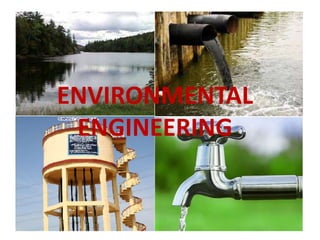
ENVIRONMENTAL
ENGINEERING
ENVIRONMENTAL ENGINEERING
1) INTRODUCTION
2) NEED FOR PROTECTED WATER SUPPLY
3) OBJECTIVE OF PUBLIC WATER SUPPLY SYSTEM
4) TYPES OF DEMAND
5) PERCAPITA DEMAND
6) FACTORS AFFECTING PERCAPITA DEMAND
7) PREDICTION OF POPULATION
INTRODUCTION
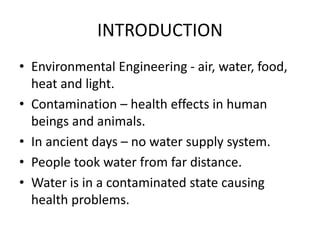
• Environmental Engineering - air, water, food,
heat and light.
• Contamination – health effects in human
beings and animals.
• In ancient days – no water supply system.
• People took water from far distance.
• Water is in a contaminated state causing
health problems.
INTRODUCTION
• People used lakes, rivers, ponds for their
water supply.
• In the time of less rain rainfall – scarcity of
water.
• During fire breakout – water is needed to put
down fire.
• A good public water supply system supplying
safe and wholesome water is needed.
WATER FOR
FIRE FIGHTING
FIRE HYDRANTS
NEED FOR PROTECTED WATER SUPPLY
• Water gets contaminated due to animal and
human waste, sewage – causing water borne
diseases – cholera, typhoid, dysentery.
• Public water supply protects the source of
water from impurities like bacteria, chemicals
etc.,(sewage and industrial effluents).
• Public Water Supply also purifies the
contaminated water to make it usable for
drinking and other purpose.
RAW WATER TREATMENT PLANT
OBJECTIVE OF PUBLIC WATER SUPPLY
1) To supply safe and wholesome water to
consumers. (unpolluted, free from toxic
substances, minerals, organic substances)
2) To supply water in adequate quantity. (providing
the required amount of water to the consumers
with good source and storage facilities)
3) To make water easily available to consumers to
encourage personal and household cleanliness.
(Providing water as near as possible to the
consumer)
Water Demands
The amount of water required by the community
for various purpose is called water demand.
Types of Demands:
1. Domestic Demand
2. Industrial and Commercial Demand
3. Public Demand
4. Fire Demand
5. Demand for compensating various losses.
DOMESTIC DEMAND
• The water required for actual house hold
activity – Domestic demand.
• Drinking, cooking, bathing, washing, flushing
of water closets etc.,
• In India , as per IS 1172-1983 Domestic water
demand is 135 litres/capita/day.
• In developed countries, this value is about
350 litres/capita/day.
DOMESTIC DEMAND
ACTIVITY DEMAND litres/capita/day
Drinking 5
Cooking 5
Bathing 50
Cloth washing 25
Utensils washing 10
House washing 10
Latrine and Urinals 30
Total 135 litres/capita/day
INDUSTRIAL AND COMMERCIAL
DEMAND
• Water required in Industries for various
processes is known as Industrial Demand
• Manufacturing process, cooling process,
steam generation, processing and sanitation.
• Water required for private offices, restaurants,
hostels, schools, cinema theatres is known as
Commercial Demand.
INDUSTRIAL AND COMMERCIAL
DEMAND
ACTIVITY DEMAND litres/capita/day
Factories 30 - 45
Offices 45
Restaurants / seat 70
Hotels / persons 180
Cinema / seat 15
PUBLIC DEMAND
• Water required for public purposes such as
washing of roads, cleaning of public sewers,
watering of parks, public gardens, fountains,
flushing of public water closets and urinals
etc., is known as Public demand.
ACTIVITY DEMAND litres/capita/day
Public gardens 1.5 l/sq.m/day
Street washing 1.0 l/sq.m/day
Sewer cleaning 4.5 l/capita/day
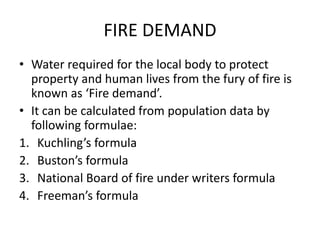
FIRE DEMAND
• Water required for the local body to protect
property and human lives from the fury of fire is
known as ‘Fire demand’.
• It can be calculated from population data by
following formulae:
1. Kuchling’s formula
2. Buston’s formula
3. National Board of fire under writers formula
4. Freeman’s formula
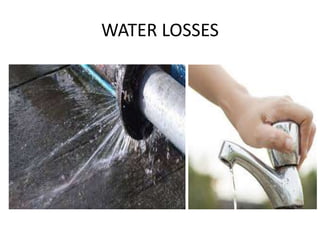
DEMAND FOR COMPENSATING
VARIOUS LOSSES
• Wastage in pipe line – defective pipe joints,
cracks, faulty valves and fittings.
• Careless and lazy habits of consumers and
inefficient management.
• Thefts and unauthorized water connections.
• Allowance of 15% of the total quantity of
water to compensate for losses, thefts and
wastage of water.
WATER LOSSES
Calculation of fire demand
• Calculation of fire demand:
1. Kuichling’s formula 𝑄 = 3182 √𝑃
2. Buston’s formula 𝑄 = 5663 √𝑃
3. National Board of fire under writers formula
𝑄 = 4637 √P(1-0.10√𝑃)
4. Freeman’s formula 𝑄 = 1136
𝑃
5
+ 10
and 𝐹 = 2.8√𝑃
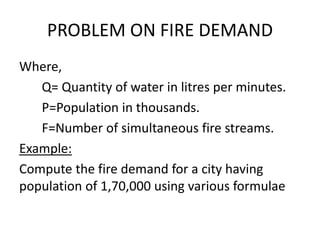
PROBLEM ON FIRE DEMAND
Where,
Q= Quantity of water in litres per minutes.
P=Population in thousands.
F=Number of simultaneous fire streams.
Example:
Compute the fire demand for a city having
population of 1,70,000 using various formulae
PROBLEM ON FIRE DEMAND
Given data:
Population = 1,70,000 ,𝑃 = 170 𝑖𝑛 𝑡ℎ𝑜𝑠𝑎𝑛𝑑𝑠
Solution:
1. Kuichling’s formula:
𝑄 = 3182 𝑃 = 3182 170 = 41488
𝑙
𝑚𝑖𝑛
𝑄 =
41488
1000𝑥60
= 0.6915 𝑐𝑢𝑚𝑒𝑐𝑠
PROBLEM ON FIRE DEMAND
2. Buston’s formula
𝑄 = 5663 𝑃 = 5663 170 = 73836.49
𝑙
𝑚𝑖𝑛
𝑄 =
73836.49
1000𝑥60
= 1.231 𝑐𝑢𝑚𝑒𝑐𝑠
PROBLEM ON FIRE DEMAND
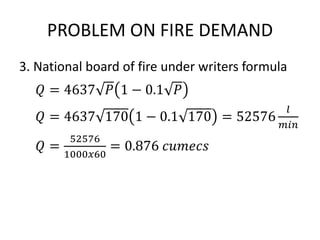
3. National board of fire under writers formula
𝑄 = 4637 𝑃 1 − 0.1 𝑃
𝑄 = 4637 170 1 − 0.1 170 = 52576
𝑙
𝑚𝑖𝑛
𝑄 =
52576
1000𝑥60
= 0.876 𝑐𝑢𝑚𝑒𝑐𝑠
PROBLEM ON FIRE DEMAND
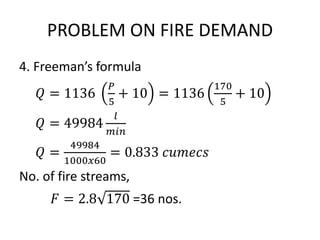
4. Freeman’s formula
𝑄 = 1136
𝑃
5
+ 10 = 1136
170
5
+ 10
𝑄 = 49984
𝑙
𝑚𝑖𝑛
𝑄 =
49984
1000𝑥60
= 0.833 𝑐𝑢𝑚𝑒𝑐𝑠
No. of fire streams,
𝐹 = 2.8 170 =36 nos.
PERCAPITA DEMAND
• The consumption of water for one person in
one day is known as percapita demand. If ‘Q’
is the total quantity of water required by a
town per year in litres for the population P
then,
Percapita Demand =
𝑄
𝑃𝑥365
l/day
FACTORS AFFECTING PER CAPITA
DEMAND
i) People’s habits
ii) Industrialisation
iii) Public Services
iv) Climate
v) Systems of supply
vi) Metering of water supply
vii) System of drainage
viii)Availability of
supplementary sources
ix) Distribution
pressure
x) Cost of water
xi)Quality of
water
WATER METER
FACTORS AFFECTING PER CAPITA
DEMAND (cont.)
i) People’s habit:
People with high standard of living require
more water than those belonging to middle
class and low income groups.
ii) Industrialisation:
The requirements varies from industries to
industry. Wet processing industries requires a
huge quantity of water for cooling purpose.
FACTORS AFFECTING PER CAPITA
DEMAND (cont.)
iii) Public Services:
Developed cities, towns and township
require more water for watering of parks,
gardens and roads.
iv) Climate:
People living in hot climate areas requires
more water.
FACTORS AFFECTING PER CAPITA
DEMAND (cont.)
v) Systems of supply:
Water requirement in continuous supply will be more
compared to intermittent supply. In continuous supply
wastage will be more.
vi) Metering:
If meters are used and consumer are charged
consumption of water will reduce.
vii) Systems of drainage:
The existence of sewerage system consumes more
water for cleaning, flushing of toilets and urinals.
FACTORS AFFECTING PER CAPITA
DEMAND (cont.)
viii) Availability of supplementary sources:
If supplementary sources like wells are used,
demand over municipal water supply will reduce.
ix) Distribution Pressure:
The consumption of water is more in high
drainage pressure due to more wastage in taps.
x) Cost of water:
If the cost of water is high, consumption is less.
FACTORS AFFECTING PER CAPITA
DEMAND (cont.)
xi) Quality of water:
If the quality of water is good and the
people will not use the other sources available
like wells and pumps hence the demand will be
more.
PREDICTION OF POPULATION
(FORECAST)
• Water supply project is designed to cater the
needs of community upto the end of the
design period. Design period – 20yrs to 40yrs
• It is forecast the population at the end of
design period.
Following are the important methods to forecast
population:
1. Arithmatical increase method
2. Geometrical increase method
PREDICTION OF POPULATION
(FORECAST)
3. Incremental increase method
4. Decreased rate of growth of method
5. Graphical comparison method
6. Graphical extension method
7. Zoning method
8. Ratio and correlation method
9. Growth composition analysis method.
THANK YOU

Environmental engineering

  • 1.
  • 2.
    ENVIRONMENTAL ENGINEERING 1) INTRODUCTION 2)NEED FOR PROTECTED WATER SUPPLY 3) OBJECTIVE OF PUBLIC WATER SUPPLY SYSTEM 4) TYPES OF DEMAND 5) PERCAPITA DEMAND 6) FACTORS AFFECTING PERCAPITA DEMAND 7) PREDICTION OF POPULATION
  • 3.
    INTRODUCTION • Environmental Engineering- air, water, food, heat and light. • Contamination – health effects in human beings and animals. • In ancient days – no water supply system. • People took water from far distance. • Water is in a contaminated state causing health problems.
  • 5.
    INTRODUCTION • People usedlakes, rivers, ponds for their water supply. • In the time of less rain rainfall – scarcity of water. • During fire breakout – water is needed to put down fire. • A good public water supply system supplying safe and wholesome water is needed.
  • 6.
  • 7.
    NEED FOR PROTECTEDWATER SUPPLY • Water gets contaminated due to animal and human waste, sewage – causing water borne diseases – cholera, typhoid, dysentery. • Public water supply protects the source of water from impurities like bacteria, chemicals etc.,(sewage and industrial effluents). • Public Water Supply also purifies the contaminated water to make it usable for drinking and other purpose.
  • 8.
  • 9.
    OBJECTIVE OF PUBLICWATER SUPPLY 1) To supply safe and wholesome water to consumers. (unpolluted, free from toxic substances, minerals, organic substances) 2) To supply water in adequate quantity. (providing the required amount of water to the consumers with good source and storage facilities) 3) To make water easily available to consumers to encourage personal and household cleanliness. (Providing water as near as possible to the consumer)
  • 10.
    Water Demands The amountof water required by the community for various purpose is called water demand. Types of Demands: 1. Domestic Demand 2. Industrial and Commercial Demand 3. Public Demand 4. Fire Demand 5. Demand for compensating various losses.
  • 11.
    DOMESTIC DEMAND • Thewater required for actual house hold activity – Domestic demand. • Drinking, cooking, bathing, washing, flushing of water closets etc., • In India , as per IS 1172-1983 Domestic water demand is 135 litres/capita/day. • In developed countries, this value is about 350 litres/capita/day.
  • 13.
    DOMESTIC DEMAND ACTIVITY DEMANDlitres/capita/day Drinking 5 Cooking 5 Bathing 50 Cloth washing 25 Utensils washing 10 House washing 10 Latrine and Urinals 30 Total 135 litres/capita/day
  • 14.
    INDUSTRIAL AND COMMERCIAL DEMAND •Water required in Industries for various processes is known as Industrial Demand • Manufacturing process, cooling process, steam generation, processing and sanitation. • Water required for private offices, restaurants, hostels, schools, cinema theatres is known as Commercial Demand.
  • 15.
    INDUSTRIAL AND COMMERCIAL DEMAND ACTIVITYDEMAND litres/capita/day Factories 30 - 45 Offices 45 Restaurants / seat 70 Hotels / persons 180 Cinema / seat 15
  • 16.
    PUBLIC DEMAND • Waterrequired for public purposes such as washing of roads, cleaning of public sewers, watering of parks, public gardens, fountains, flushing of public water closets and urinals etc., is known as Public demand. ACTIVITY DEMAND litres/capita/day Public gardens 1.5 l/sq.m/day Street washing 1.0 l/sq.m/day Sewer cleaning 4.5 l/capita/day
  • 17.
    FIRE DEMAND • Waterrequired for the local body to protect property and human lives from the fury of fire is known as ‘Fire demand’. • It can be calculated from population data by following formulae: 1. Kuchling’s formula 2. Buston’s formula 3. National Board of fire under writers formula 4. Freeman’s formula
  • 18.
    DEMAND FOR COMPENSATING VARIOUSLOSSES • Wastage in pipe line – defective pipe joints, cracks, faulty valves and fittings. • Careless and lazy habits of consumers and inefficient management. • Thefts and unauthorized water connections. • Allowance of 15% of the total quantity of water to compensate for losses, thefts and wastage of water.
  • 19.
  • 20.
    Calculation of firedemand • Calculation of fire demand: 1. Kuichling’s formula 𝑄 = 3182 √𝑃 2. Buston’s formula 𝑄 = 5663 √𝑃 3. National Board of fire under writers formula 𝑄 = 4637 √P(1-0.10√𝑃) 4. Freeman’s formula 𝑄 = 1136 𝑃 5 + 10 and 𝐹 = 2.8√𝑃
  • 21.
    PROBLEM ON FIREDEMAND Where, Q= Quantity of water in litres per minutes. P=Population in thousands. F=Number of simultaneous fire streams. Example: Compute the fire demand for a city having population of 1,70,000 using various formulae
  • 22.
    PROBLEM ON FIREDEMAND Given data: Population = 1,70,000 ,𝑃 = 170 𝑖𝑛 𝑡ℎ𝑜𝑠𝑎𝑛𝑑𝑠 Solution: 1. Kuichling’s formula: 𝑄 = 3182 𝑃 = 3182 170 = 41488 𝑙 𝑚𝑖𝑛 𝑄 = 41488 1000𝑥60 = 0.6915 𝑐𝑢𝑚𝑒𝑐𝑠
  • 23.
    PROBLEM ON FIREDEMAND 2. Buston’s formula 𝑄 = 5663 𝑃 = 5663 170 = 73836.49 𝑙 𝑚𝑖𝑛 𝑄 = 73836.49 1000𝑥60 = 1.231 𝑐𝑢𝑚𝑒𝑐𝑠
  • 24.
    PROBLEM ON FIREDEMAND 3. National board of fire under writers formula 𝑄 = 4637 𝑃 1 − 0.1 𝑃 𝑄 = 4637 170 1 − 0.1 170 = 52576 𝑙 𝑚𝑖𝑛 𝑄 = 52576 1000𝑥60 = 0.876 𝑐𝑢𝑚𝑒𝑐𝑠
  • 25.
    PROBLEM ON FIREDEMAND 4. Freeman’s formula 𝑄 = 1136 𝑃 5 + 10 = 1136 170 5 + 10 𝑄 = 49984 𝑙 𝑚𝑖𝑛 𝑄 = 49984 1000𝑥60 = 0.833 𝑐𝑢𝑚𝑒𝑐𝑠 No. of fire streams, 𝐹 = 2.8 170 =36 nos.
  • 26.
    PERCAPITA DEMAND • Theconsumption of water for one person in one day is known as percapita demand. If ‘Q’ is the total quantity of water required by a town per year in litres for the population P then, Percapita Demand = 𝑄 𝑃𝑥365 l/day
  • 27.
    FACTORS AFFECTING PERCAPITA DEMAND i) People’s habits ii) Industrialisation iii) Public Services iv) Climate v) Systems of supply vi) Metering of water supply vii) System of drainage viii)Availability of supplementary sources ix) Distribution pressure x) Cost of water xi)Quality of water WATER METER
  • 28.
    FACTORS AFFECTING PERCAPITA DEMAND (cont.) i) People’s habit: People with high standard of living require more water than those belonging to middle class and low income groups. ii) Industrialisation: The requirements varies from industries to industry. Wet processing industries requires a huge quantity of water for cooling purpose.
  • 29.
    FACTORS AFFECTING PERCAPITA DEMAND (cont.) iii) Public Services: Developed cities, towns and township require more water for watering of parks, gardens and roads. iv) Climate: People living in hot climate areas requires more water.
  • 30.
    FACTORS AFFECTING PERCAPITA DEMAND (cont.) v) Systems of supply: Water requirement in continuous supply will be more compared to intermittent supply. In continuous supply wastage will be more. vi) Metering: If meters are used and consumer are charged consumption of water will reduce. vii) Systems of drainage: The existence of sewerage system consumes more water for cleaning, flushing of toilets and urinals.
  • 31.
    FACTORS AFFECTING PERCAPITA DEMAND (cont.) viii) Availability of supplementary sources: If supplementary sources like wells are used, demand over municipal water supply will reduce. ix) Distribution Pressure: The consumption of water is more in high drainage pressure due to more wastage in taps. x) Cost of water: If the cost of water is high, consumption is less.
  • 32.
    FACTORS AFFECTING PERCAPITA DEMAND (cont.) xi) Quality of water: If the quality of water is good and the people will not use the other sources available like wells and pumps hence the demand will be more.
  • 33.
    PREDICTION OF POPULATION (FORECAST) •Water supply project is designed to cater the needs of community upto the end of the design period. Design period – 20yrs to 40yrs • It is forecast the population at the end of design period. Following are the important methods to forecast population: 1. Arithmatical increase method 2. Geometrical increase method
  • 34.
    PREDICTION OF POPULATION (FORECAST) 3.Incremental increase method 4. Decreased rate of growth of method 5. Graphical comparison method 6. Graphical extension method 7. Zoning method 8. Ratio and correlation method 9. Growth composition analysis method.
  • 35.