Environmental Engineering- II
By
Akash Padole
Department of Civil Engineering
Municipal Solid Waste Management
Contents
6.1 Solid waste:
Sources, Types, generation and collection, storage,
handling, transportation, processing, treatment and
disposal methods
Introduction to Hazardous wastes, E-wastes and Plastic
wastes.
Akash Padole 2
Definition: SWM
• Any useless, discarded, unwanted material that is not a
liquid or gas is referred as solid waste or refuse.
• It involves management of activities associated with
generation, storage, collection, transfer and transport,
processing and disposal of solid waste which is
environmentally compatible adopting principles of
economy, aesthetics, energy and conservation.
• It encompasses planning, organisation, administration,
financial, legal and engineering aspects involving
interdisciplinary relationships.
Akash Padole 3
Problems and Issues of Solid Waste
Management
• The waste characteristics in developing countries are
known to differ considerably from that in developed
countries due to differing food habits, culture,
traditions and socio-economic aspects.
• Urban centers in developing countries are mostly
modern outgrowths of ancient cities with narrow
winding streets requiring small slow-moving vehicles
for collection and transport.
Akash Padole 4
• In developed countries, due to exposure to industrial
and urban activities for well over a century, the
population became aware of the problem much
earlier.
• Suitable legislation and regulations gives an effective
working system to solid waste management.
• Environmental awareness has yet to manifest itself
and several towns continue to have the old
conservancy system of sanitation.
Akash Padole 5
Associated Risks
Disease transmission:
• Decomposing organic waste attracts animal, vermin,
flies, Mosquitoes.
• In case of scarcity of food, affected population
attracted to waste heaps for food mostly the
scavengers which likely to increase the risk of
dysentery and other illnesses.
Akash Padole 6
Pollution:
• Poor management leads to leachet pollution of
surface water and ground water. This causes the
problem if the waste contains toxic substances or if
nearby water is used for water supplies.
• Large quantity of dry waste are stored in hot climate,
it may create a fire hazard.
Effect on morale:
• The effect of living in an unhygienic and untidy
environment may lead to people become
demoralized and less motivated.
Akash Padole 7
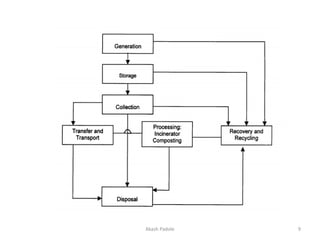
Functional Elements
• Waste generation
• Storage
• Collection
• Transfer and transport
• Processing and recovery
• Disposal
Akash Padole 8
Akash Padole 9
Waste Generation
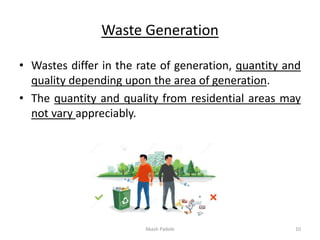
• Wastes differ in the rate of generation, quantity and
quality depending upon the area of generation.
• The quantity and quality from residential areas may
not vary appreciably.
Akash Padole 10
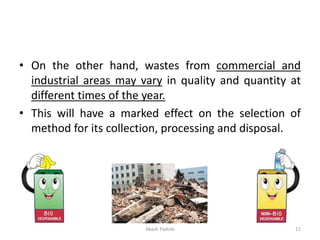
• On the other hand, wastes from commercial and
industrial areas may vary in quality and quantity at
different times of the year.
• This will have a marked effect on the selection of
method for its collection, processing and disposal.
Akash Padole 11
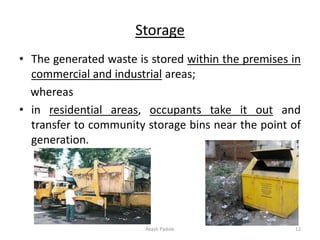
Storage
• The generated waste is stored within the premises in
commercial and industrial areas;
whereas
• in residential areas, occupants take it out and
transfer to community storage bins near the point of
generation.
Akash Padole 12
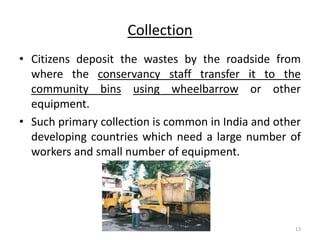
Collection
• Citizens deposit the wastes by the roadside from
where the conservancy staff transfer it to the
community bins using wheelbarrow or other
equipment.
• Such primary collection is common in India and other
developing countries which need a large number of
workers and small number of equipment.
Akash Padole 13
Transfer and Transport
• The material collected in community dustbins is
transferred to transport vehicles for transport
(usually over long distance) to the processing or
disposal site.
• The fleet of transport vehicles should have sufficient
capacity for average and peak loads and should be
utilized at optimum levels.
Akash Padole 14
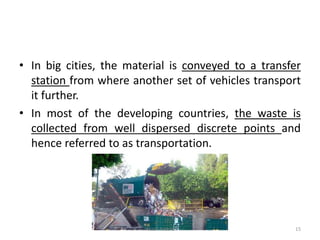
• In big cities, the material is conveyed to a transfer
station from where another set of vehicles transport
it further.
• In most of the developing countries, the waste is
collected from well dispersed discrete points and
hence referred to as transportation.
Akash Padole 15
Processing and Recovery
• A large quantity of waste must be processed
(otherwise it will take more energy to decompose)
before suitable disposal to reduce its potential
nuisance value.
• Occasionally recovery of useful constituents is also
carried out as an independent process.
Akash Padole 16
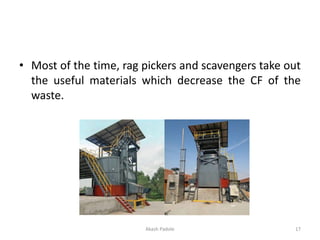
• Most of the time, rag pickers and scavengers take out
the useful materials which decrease the CF of the
waste.
Akash Padole 17
Disposal
• The waste may come for disposal either directly after
its transportation, or after processing.
• Disposal could be on land or water logged areas for
reclamation.
• The different functions are interdependent and
interrelated which could be better managed by a
systems approach.
Akash Padole 18
• Those activities associated with ultimate disposal of
solid wastes including those waste collected and
transported directly to the landfill site, semisolid
waste from waste water treatment plants,
incinerator residue, compost or other substances
from various solid waste processing plants that are of
no further use.
Akash Padole 19
Hazardous Wastes
• As per RCRA (Resource Conservation and Recovery
Act 1976) USA, "The Hazardous Waste is the one
which causes any one of the four characteristics:
Toxicity, Reactivity, Ignitability, Corrosivity
• Some of the common industries that generates
hazardous wastes are:
– Cement
– Chemical
– Petroleum
– Fertilizers
– Ferrous Industries Akash Padole 20
E – waste
• E-waste is also know as Electronic Waste.
• Electronic waste or E-waste describes discarded
electrical or electronic device.
• E-waste is growing very fast and its disposal is a big
headache or big question mark hence there should
be a proper management for E-waste which is based
on 3-R system.
• It is better to reuse, resale, salvage, recycle or
disposal of electronic waste.
Akash Padole 21
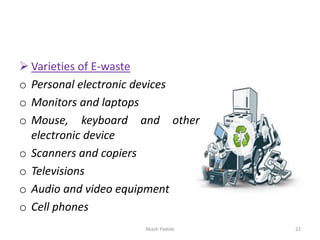
➢ Varieties of E-waste
o Personal electronic devices
o Monitors and laptops
o Mouse, keyboard and other
electronic device
o Scanners and copiers
o Televisions
o Audio and video equipment
o Cell phones
Akash Padole 22
Plastic Waste
• Plastic waste or Plastic Pollution, is ‘the accumulation
of plastic objects in the earth’s environment that
adversely affects wildlife, wildlife habitat, and
humans.
• Among all the constants, plastic waste stand second
in percentage i.e., 17% the first being the organic
waste having 32% of the total waste of M.S.W and
also the industrial waste.
Akash Padole 23
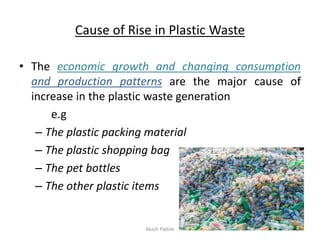
Cause of Rise in Plastic Waste
• The economic growth and changing consumption
and production patterns are the major cause of
increase in the plastic waste generation
e.g
– The plastic packing material
– The plastic shopping bag
– The pet bottles
– The other plastic items
Akash Padole 24
• Plastic pollution can afflict land, waterways and
oceans.
• It is estimated that 1.1 to 8.8 million tones of plastic
waste enters the ocean from coastal communities
each year.
• At the world level the consumption of plastic
material has increased from 5 million tons in 1950 to
about 100 million tons in 2017.
Akash Padole 25

05 Municipal Solid Waste Management

  • 1.
    Environmental Engineering- II By AkashPadole Department of Civil Engineering Municipal Solid Waste Management
  • 2.
    Contents 6.1 Solid waste: Sources,Types, generation and collection, storage, handling, transportation, processing, treatment and disposal methods Introduction to Hazardous wastes, E-wastes and Plastic wastes. Akash Padole 2
  • 3.
    Definition: SWM • Anyuseless, discarded, unwanted material that is not a liquid or gas is referred as solid waste or refuse. • It involves management of activities associated with generation, storage, collection, transfer and transport, processing and disposal of solid waste which is environmentally compatible adopting principles of economy, aesthetics, energy and conservation. • It encompasses planning, organisation, administration, financial, legal and engineering aspects involving interdisciplinary relationships. Akash Padole 3
  • 4.
    Problems and Issuesof Solid Waste Management • The waste characteristics in developing countries are known to differ considerably from that in developed countries due to differing food habits, culture, traditions and socio-economic aspects. • Urban centers in developing countries are mostly modern outgrowths of ancient cities with narrow winding streets requiring small slow-moving vehicles for collection and transport. Akash Padole 4
  • 5.
    • In developedcountries, due to exposure to industrial and urban activities for well over a century, the population became aware of the problem much earlier. • Suitable legislation and regulations gives an effective working system to solid waste management. • Environmental awareness has yet to manifest itself and several towns continue to have the old conservancy system of sanitation. Akash Padole 5
  • 6.
    Associated Risks Disease transmission: •Decomposing organic waste attracts animal, vermin, flies, Mosquitoes. • In case of scarcity of food, affected population attracted to waste heaps for food mostly the scavengers which likely to increase the risk of dysentery and other illnesses. Akash Padole 6
  • 7.
    Pollution: • Poor managementleads to leachet pollution of surface water and ground water. This causes the problem if the waste contains toxic substances or if nearby water is used for water supplies. • Large quantity of dry waste are stored in hot climate, it may create a fire hazard. Effect on morale: • The effect of living in an unhygienic and untidy environment may lead to people become demoralized and less motivated. Akash Padole 7
  • 8.
    Functional Elements • Wastegeneration • Storage • Collection • Transfer and transport • Processing and recovery • Disposal Akash Padole 8
  • 9.
  • 10.
    Waste Generation • Wastesdiffer in the rate of generation, quantity and quality depending upon the area of generation. • The quantity and quality from residential areas may not vary appreciably. Akash Padole 10
  • 11.
    • On theother hand, wastes from commercial and industrial areas may vary in quality and quantity at different times of the year. • This will have a marked effect on the selection of method for its collection, processing and disposal. Akash Padole 11
  • 12.
    Storage • The generatedwaste is stored within the premises in commercial and industrial areas; whereas • in residential areas, occupants take it out and transfer to community storage bins near the point of generation. Akash Padole 12
  • 13.
    Collection • Citizens depositthe wastes by the roadside from where the conservancy staff transfer it to the community bins using wheelbarrow or other equipment. • Such primary collection is common in India and other developing countries which need a large number of workers and small number of equipment. Akash Padole 13
  • 14.
    Transfer and Transport •The material collected in community dustbins is transferred to transport vehicles for transport (usually over long distance) to the processing or disposal site. • The fleet of transport vehicles should have sufficient capacity for average and peak loads and should be utilized at optimum levels. Akash Padole 14
  • 15.
    • In bigcities, the material is conveyed to a transfer station from where another set of vehicles transport it further. • In most of the developing countries, the waste is collected from well dispersed discrete points and hence referred to as transportation. Akash Padole 15
  • 16.
    Processing and Recovery •A large quantity of waste must be processed (otherwise it will take more energy to decompose) before suitable disposal to reduce its potential nuisance value. • Occasionally recovery of useful constituents is also carried out as an independent process. Akash Padole 16
  • 17.
    • Most ofthe time, rag pickers and scavengers take out the useful materials which decrease the CF of the waste. Akash Padole 17
  • 18.
    Disposal • The wastemay come for disposal either directly after its transportation, or after processing. • Disposal could be on land or water logged areas for reclamation. • The different functions are interdependent and interrelated which could be better managed by a systems approach. Akash Padole 18
  • 19.
    • Those activitiesassociated with ultimate disposal of solid wastes including those waste collected and transported directly to the landfill site, semisolid waste from waste water treatment plants, incinerator residue, compost or other substances from various solid waste processing plants that are of no further use. Akash Padole 19
  • 20.
    Hazardous Wastes • Asper RCRA (Resource Conservation and Recovery Act 1976) USA, "The Hazardous Waste is the one which causes any one of the four characteristics: Toxicity, Reactivity, Ignitability, Corrosivity • Some of the common industries that generates hazardous wastes are: – Cement – Chemical – Petroleum – Fertilizers – Ferrous Industries Akash Padole 20
  • 21.
    E – waste •E-waste is also know as Electronic Waste. • Electronic waste or E-waste describes discarded electrical or electronic device. • E-waste is growing very fast and its disposal is a big headache or big question mark hence there should be a proper management for E-waste which is based on 3-R system. • It is better to reuse, resale, salvage, recycle or disposal of electronic waste. Akash Padole 21
  • 22.
    ➢ Varieties ofE-waste o Personal electronic devices o Monitors and laptops o Mouse, keyboard and other electronic device o Scanners and copiers o Televisions o Audio and video equipment o Cell phones Akash Padole 22
  • 23.
    Plastic Waste • Plasticwaste or Plastic Pollution, is ‘the accumulation of plastic objects in the earth’s environment that adversely affects wildlife, wildlife habitat, and humans. • Among all the constants, plastic waste stand second in percentage i.e., 17% the first being the organic waste having 32% of the total waste of M.S.W and also the industrial waste. Akash Padole 23
  • 24.
    Cause of Risein Plastic Waste • The economic growth and changing consumption and production patterns are the major cause of increase in the plastic waste generation e.g – The plastic packing material – The plastic shopping bag – The pet bottles – The other plastic items Akash Padole 24
  • 25.
    • Plastic pollutioncan afflict land, waterways and oceans. • It is estimated that 1.1 to 8.8 million tones of plastic waste enters the ocean from coastal communities each year. • At the world level the consumption of plastic material has increased from 5 million tons in 1950 to about 100 million tons in 2017. Akash Padole 25