Compiled by:
Amar Narayan Tripathi
Roll no:1205213007
IT Final Year
IET Lucknow
 Machine learning is a subfield of computer
science that explores the study and
construction of algorithms that can learn
from and make predictions on data.
 Such algorithms operate by building a model
from example inputs in order to make data-
driven predictions or decisions, rather than
following strictly static program instructions.
 Supervised learning : Learn by examples as
to what a face is in terms of structure, color,
etc so that after several iterations it learns
to define a face.
 Unsupervised learning : since there is no
desired output in this case that is provided
therefore categorization is done so that the
algorithm differentiates correctly between
the face of a horse, cat or human.
 REINFORCEMENT LEARNING:
Learn how to behave successfully to achieve
a goal while interacting with an external
environment .(Learn via Experiences!)
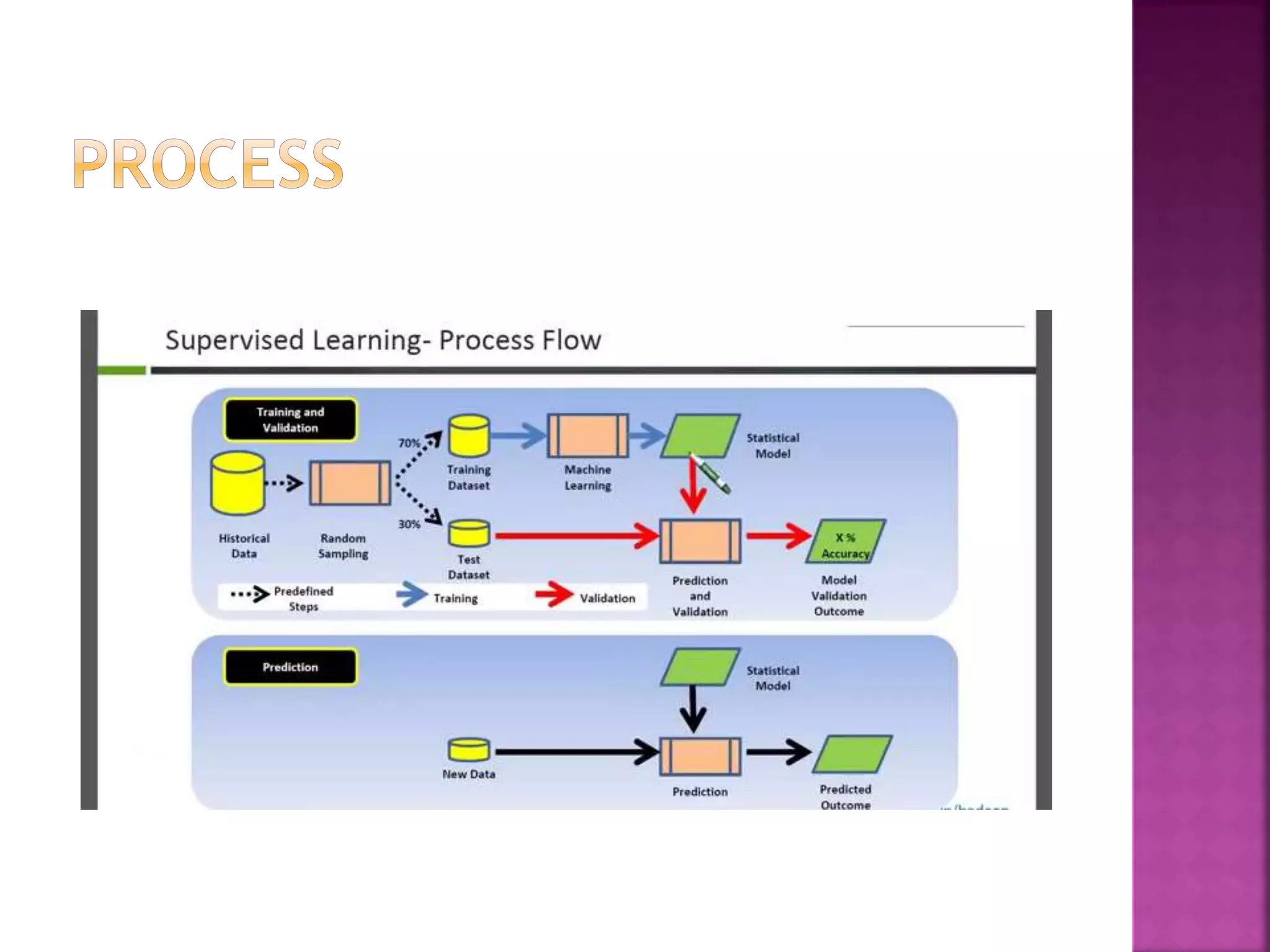
 Supervised learning is the machine learning
task of inferring a function from labeled
training data. The training data consist of a
set of training examples. In supervised
learning, each example is a pair consisting of
an input object and a desired output value. A
supervised learning algorithm analyzes the
training data and produces an inferred
function, which can be used for mapping new
examples.
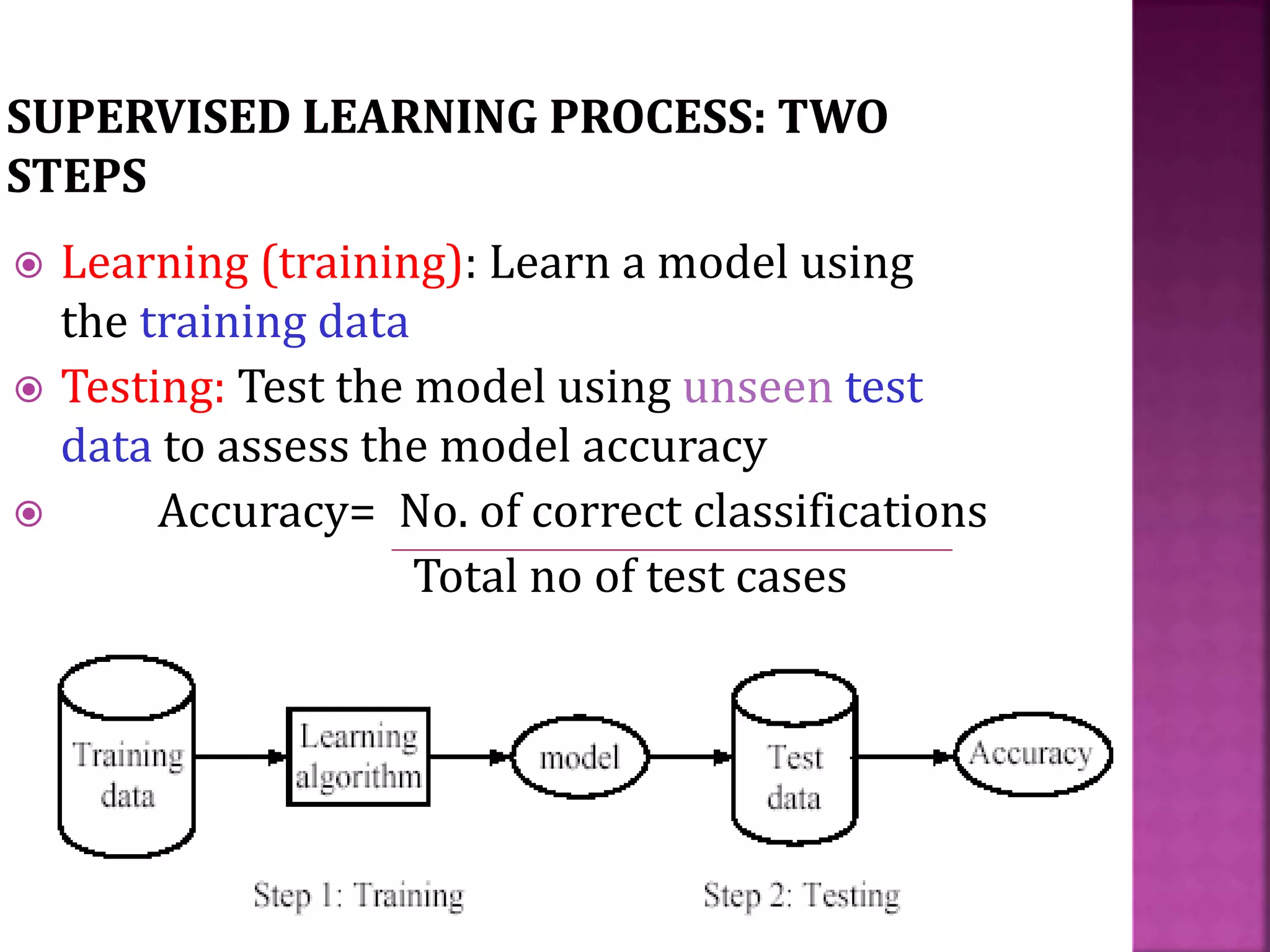
 Learning (training): Learn a model using
the training data
 Testing: Test the model using unseen test
data to assess the model accuracy
 Accuracy= No. of correct classifications
Total no of test cases
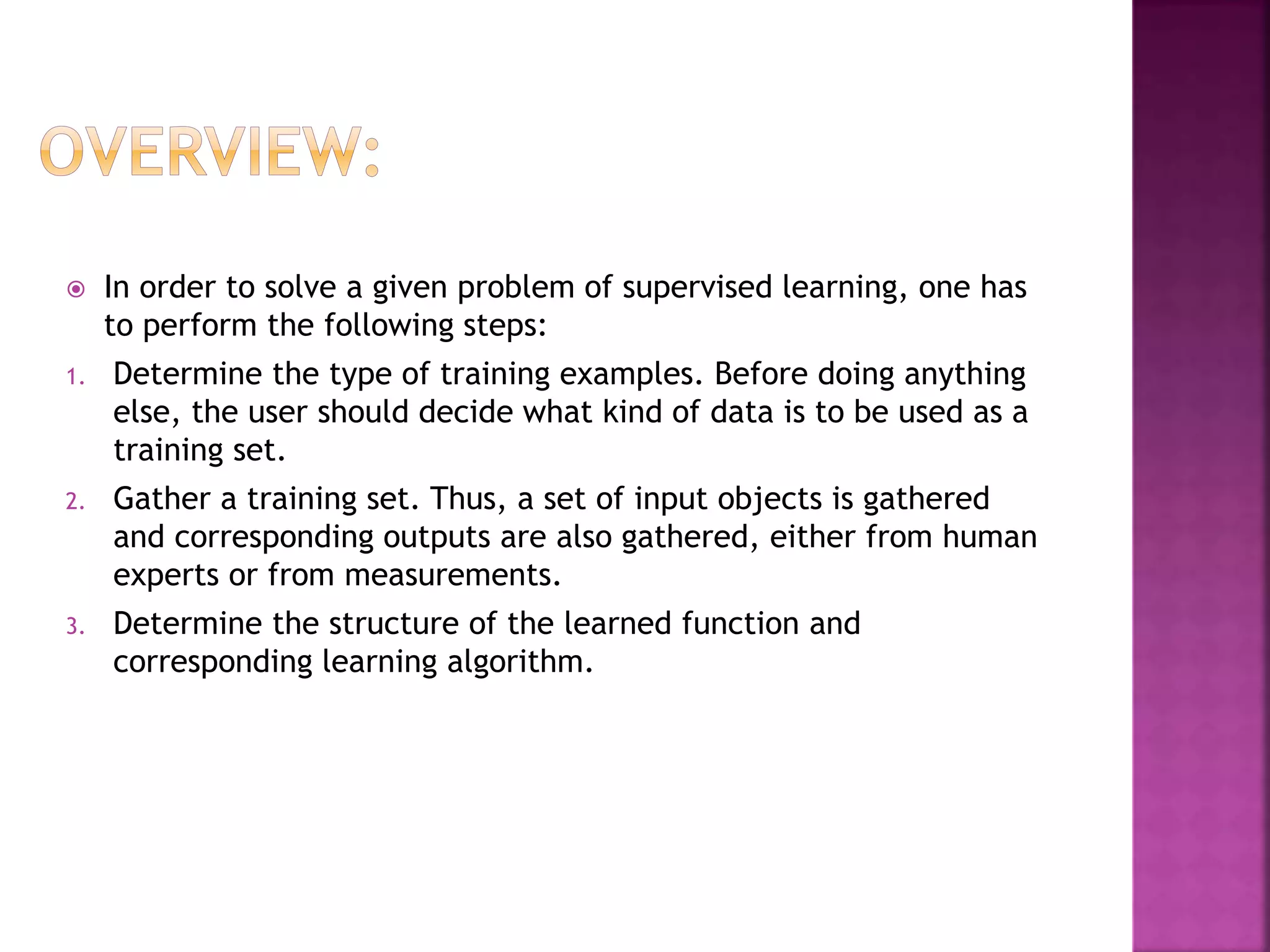
 In order to solve a given problem of supervised learning, one has
to perform the following steps:
1. Determine the type of training examples. Before doing anything
else, the user should decide what kind of data is to be used as a
training set.
2. Gather a training set. Thus, a set of input objects is gathered
and corresponding outputs are also gathered, either from human
experts or from measurements.
3. Determine the structure of the learned function and
corresponding learning algorithm.
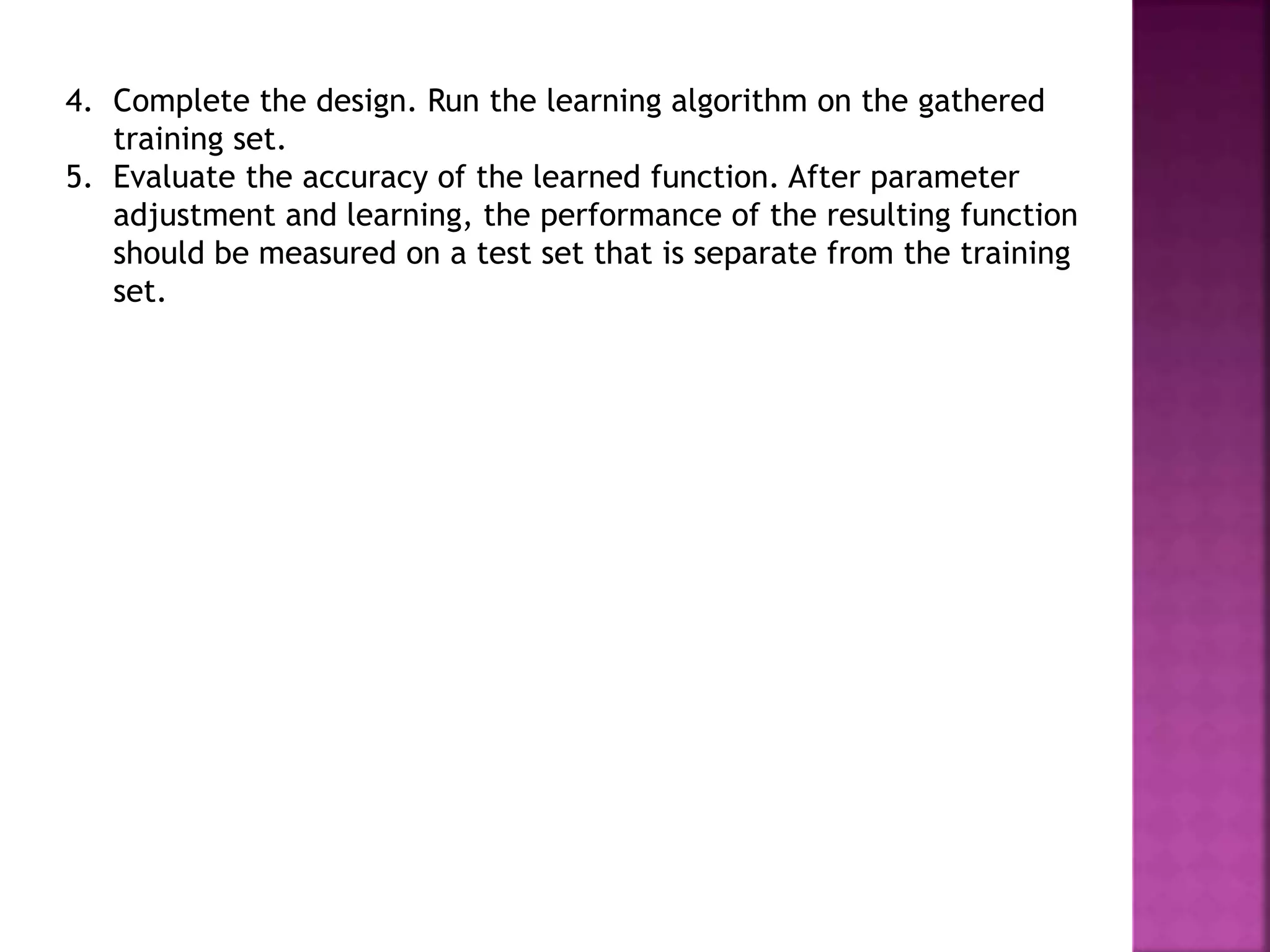
4. Complete the design. Run the learning algorithm on the gathered
training set.
5. Evaluate the accuracy of the learned function. After parameter
adjustment and learning, the performance of the resulting function
should be measured on a test set that is separate from the training
set.
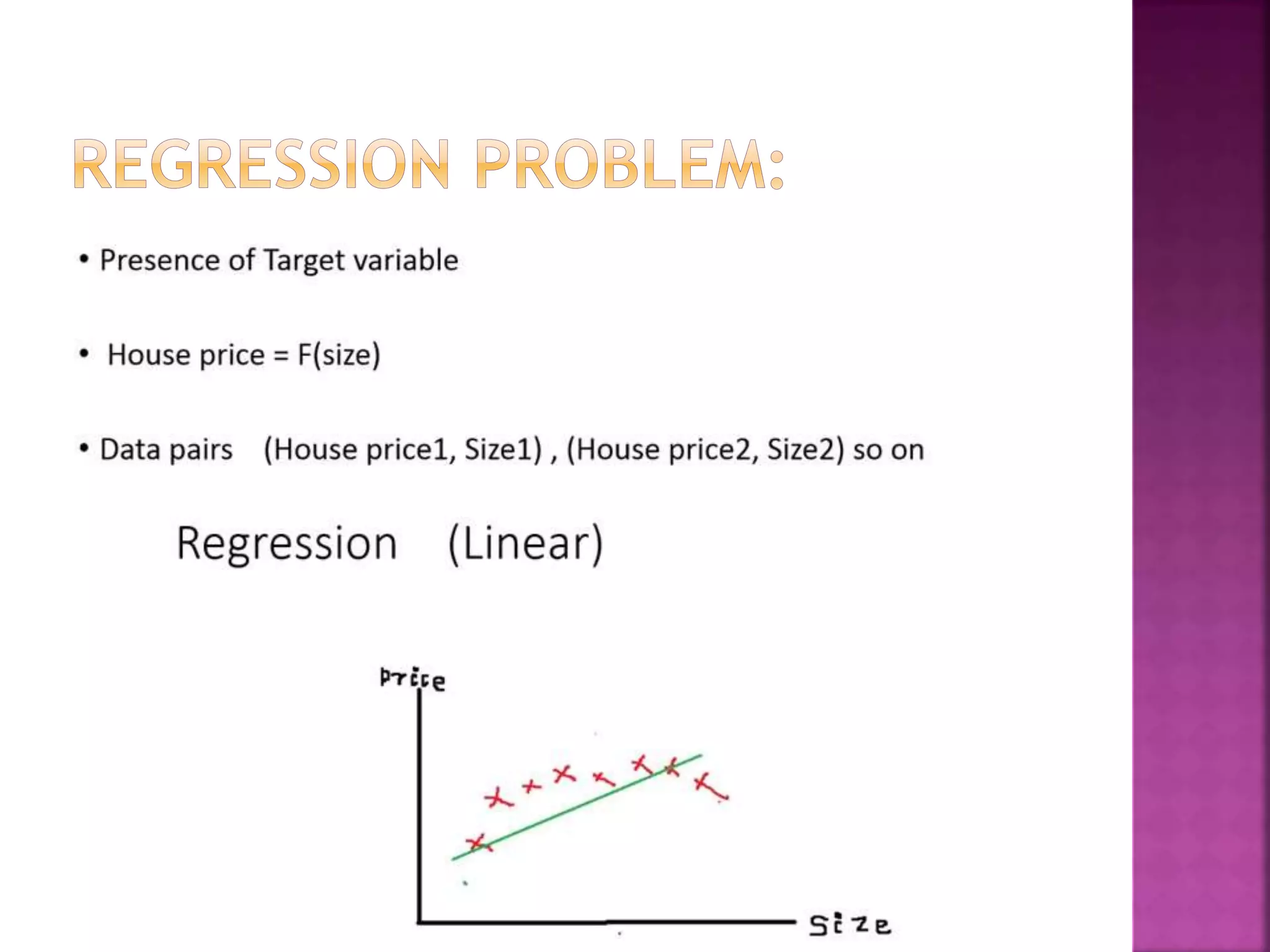
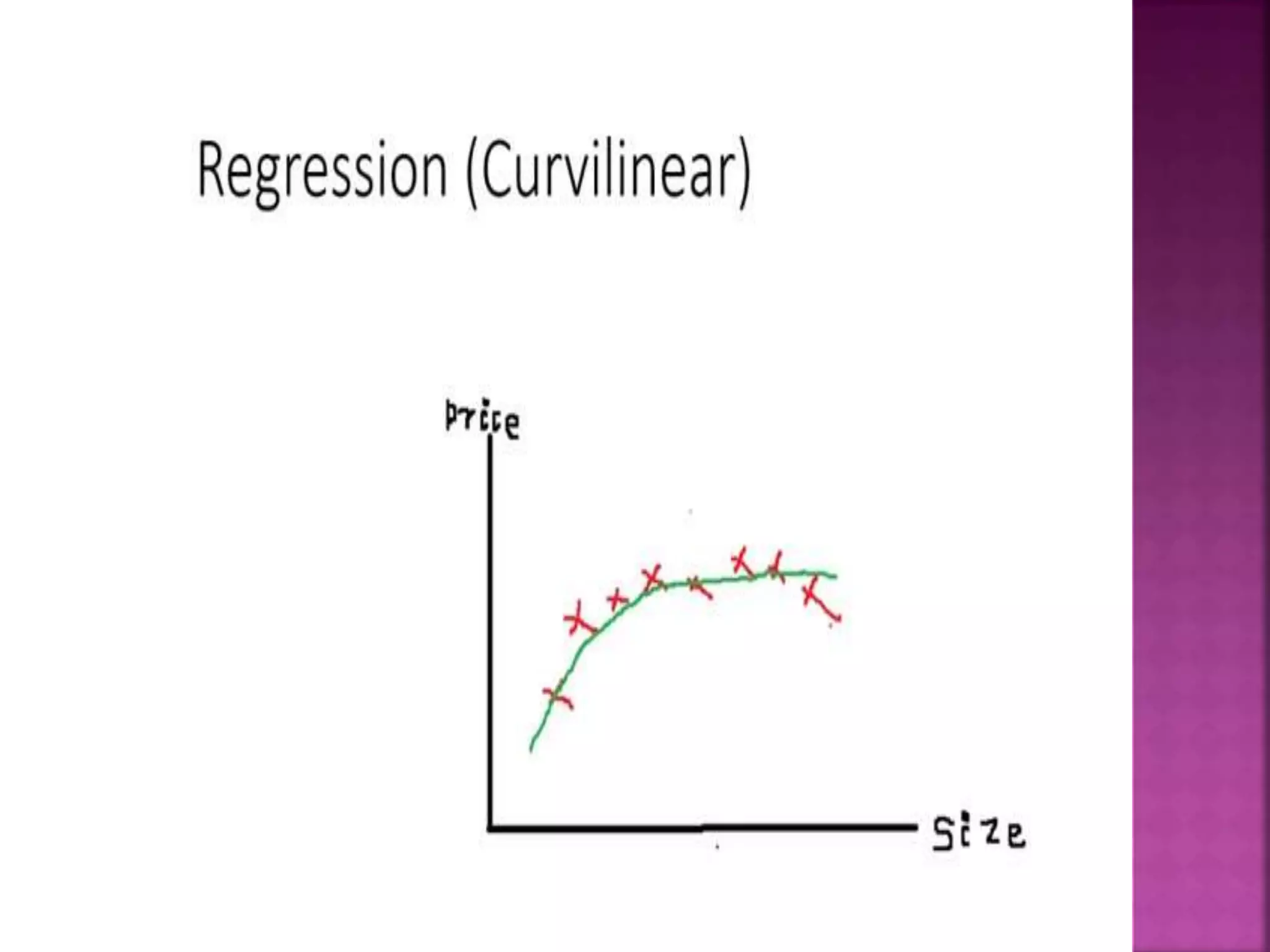
 Regression means to predict the output value
using training data.
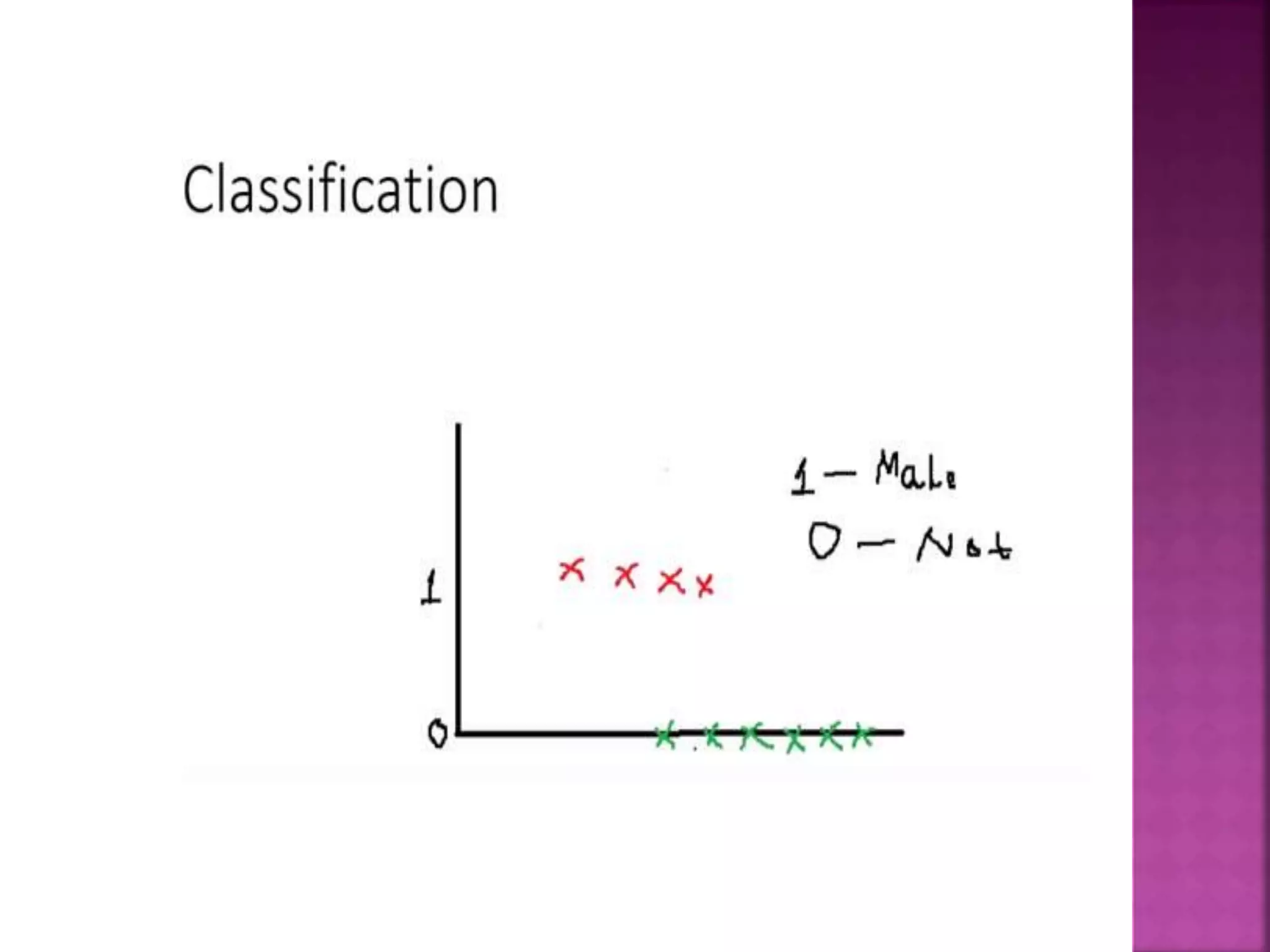
 Classification means to group the output into
a class.
 e.g. we use regression to predict the house
price from training data and use
classification to predict the Gender.
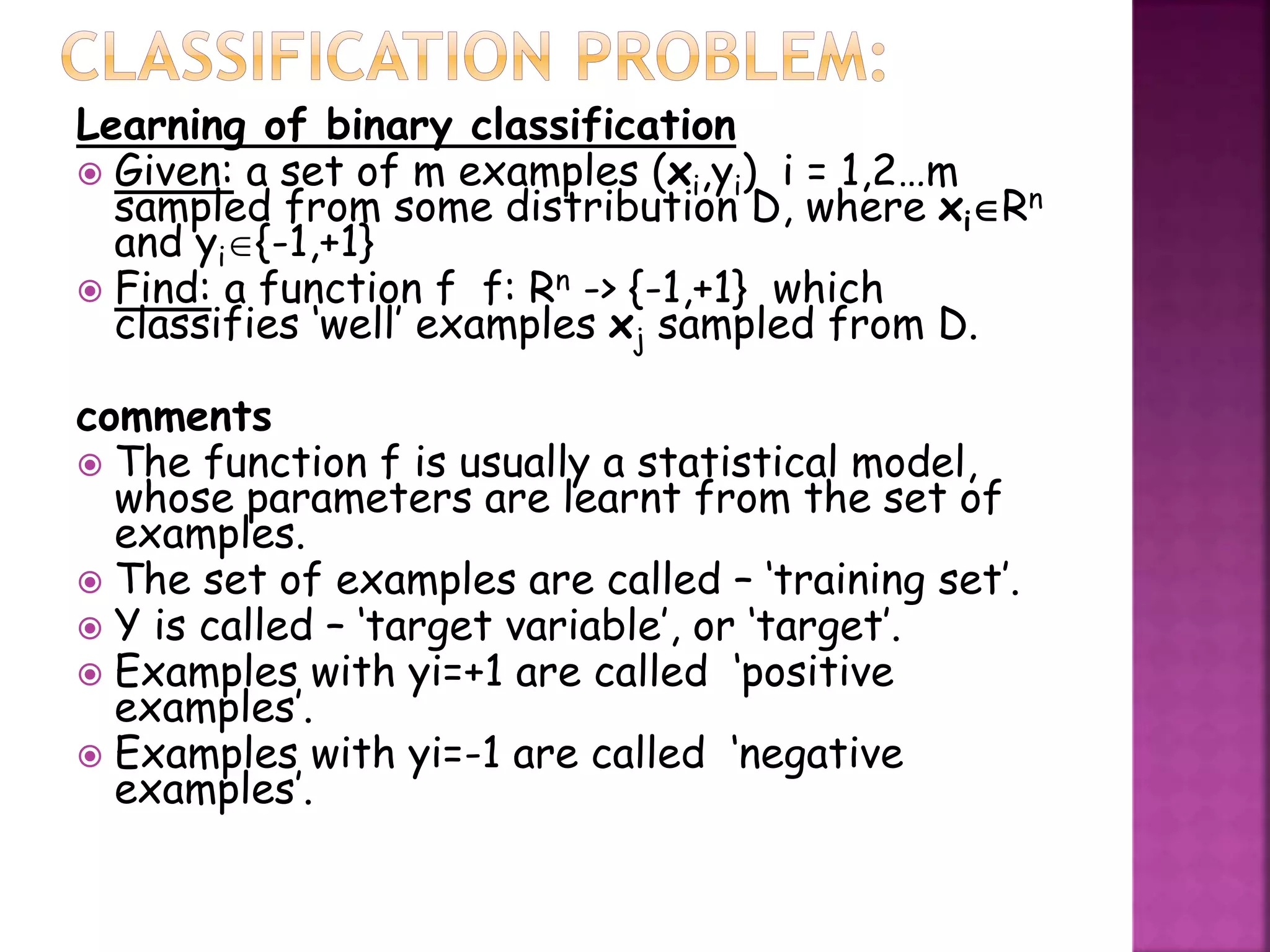
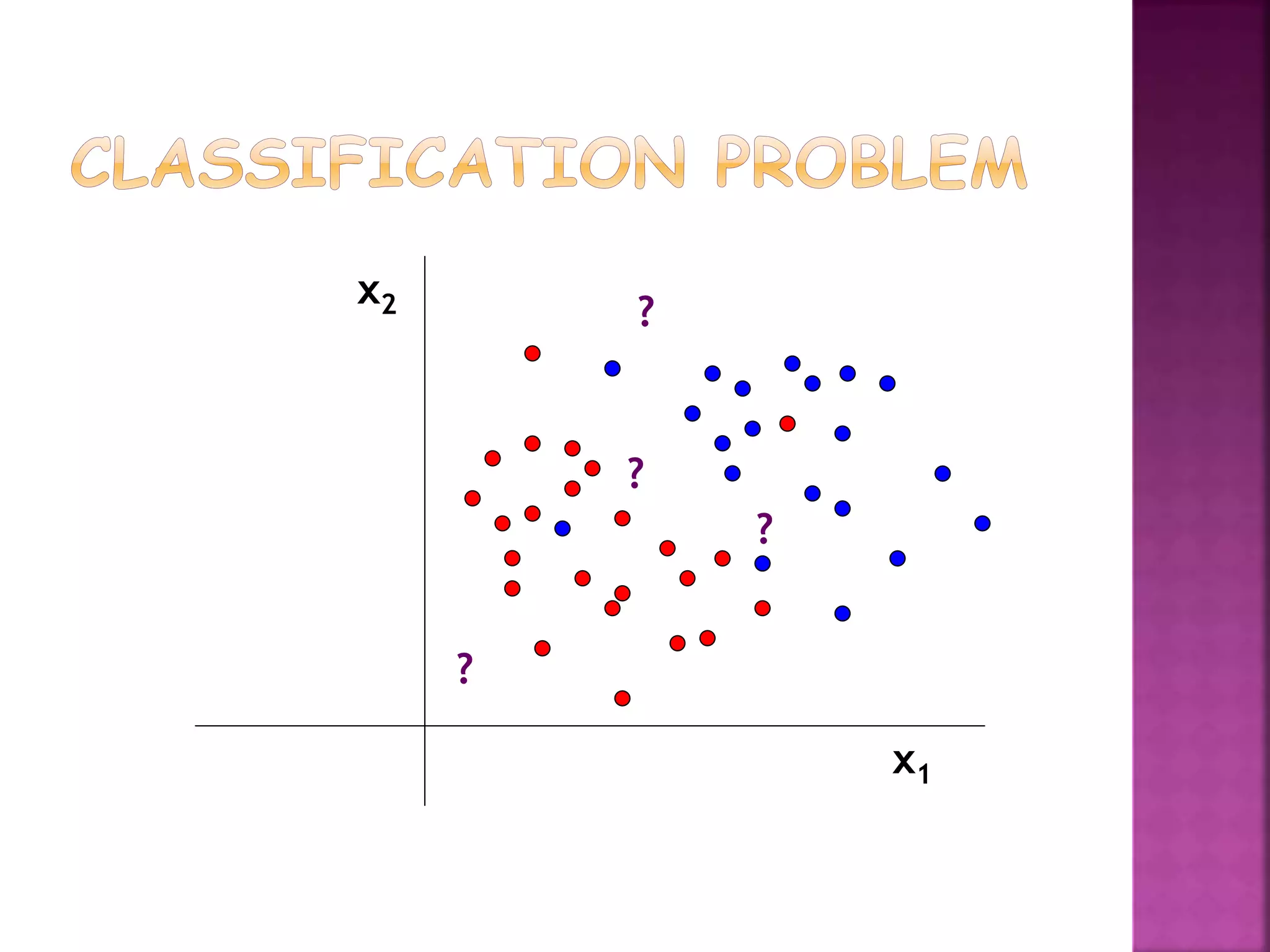
Learning of binary classification
 Given: a set of m examples (xi,yi) i = 1,2…m
sampled from some distribution D, where xiRn
and yi{-1,+1}
 Find: a function f f: Rn -> {-1,+1} which
classifies ‘well’ examples xj sampled from D.
comments
 The function f is usually a statistical model,
whose parameters are learnt from the set of
examples.
 The set of examples are called – ‘training set’.
 Y is called – ‘target variable’, or ‘target’.
 Examples with yi=+1 are called ‘positive
examples’.
 Examples with yi=-1 are called ‘negative
examples’.
x1
x2 ?
?
?
?
 Customer discovery:
predict whether a customer is likely to
purchase certain goods according to a
database of customer profiles and their
history of shopping activities.
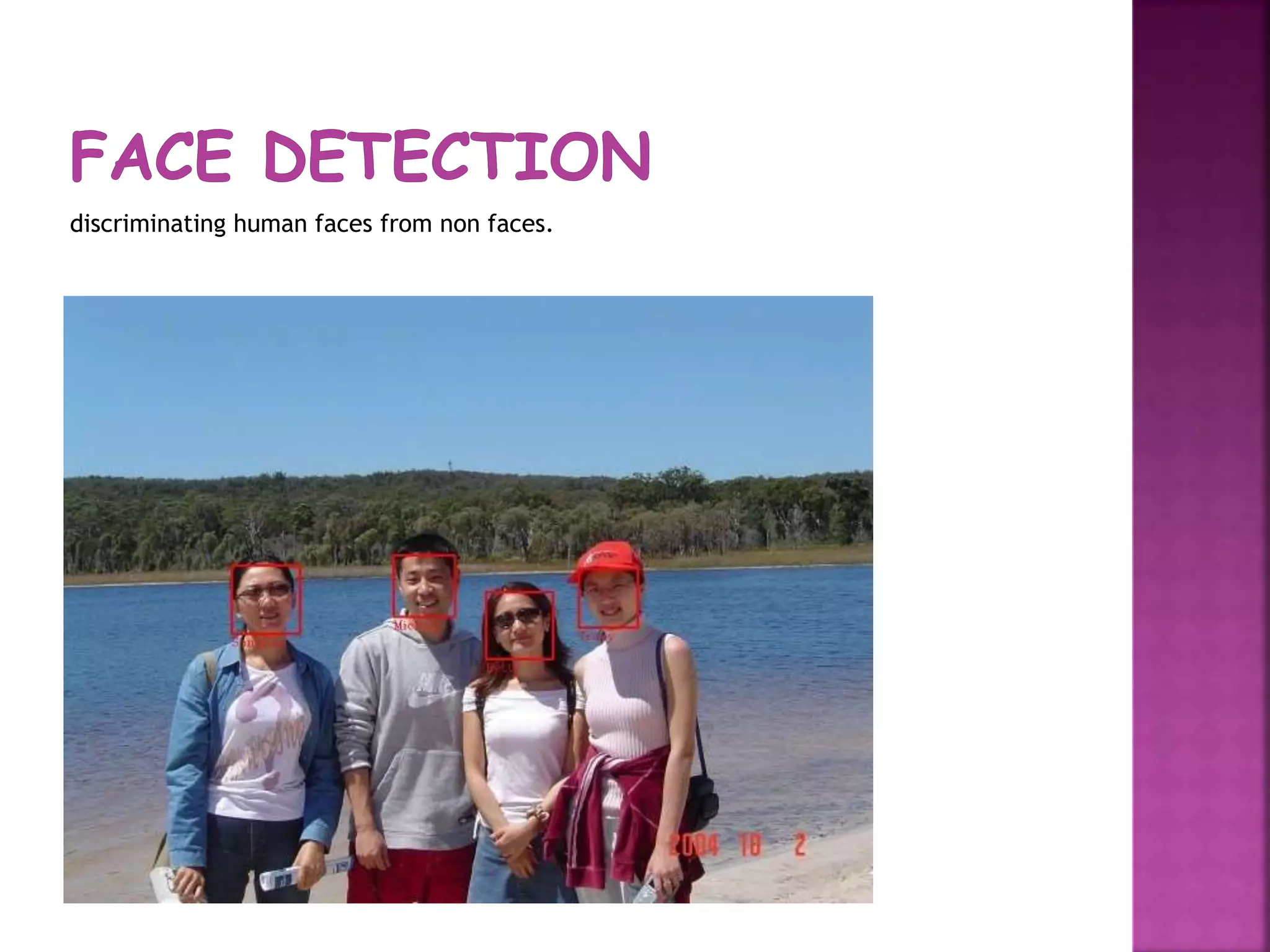
discriminating human faces from non faces.
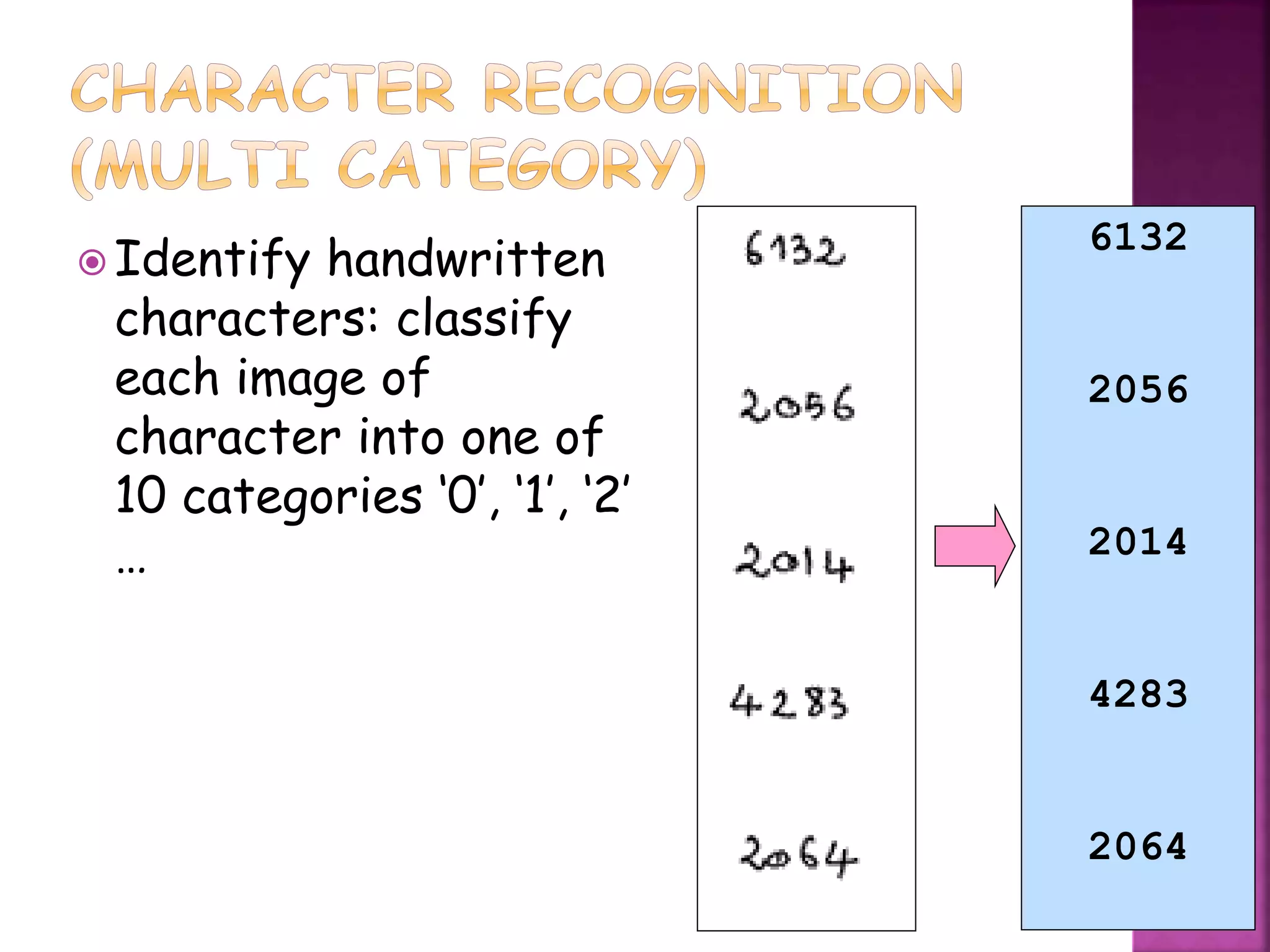
 Identify handwritten
characters: classify
each image of
character into one of
10 categories ‘0’, ‘1’, ‘2’
…
6132
2056
2014
4283
2064
 Youtube.com
 Wikipedia.com
 Mathswork.com
 Slideshare.com
supervised learning

supervised learning

  • 1.
    Compiled by: Amar NarayanTripathi Roll no:1205213007 IT Final Year IET Lucknow
  • 2.
     Machine learningis a subfield of computer science that explores the study and construction of algorithms that can learn from and make predictions on data.  Such algorithms operate by building a model from example inputs in order to make data- driven predictions or decisions, rather than following strictly static program instructions.
  • 3.
     Supervised learning: Learn by examples as to what a face is in terms of structure, color, etc so that after several iterations it learns to define a face.  Unsupervised learning : since there is no desired output in this case that is provided therefore categorization is done so that the algorithm differentiates correctly between the face of a horse, cat or human.
  • 4.
     REINFORCEMENT LEARNING: Learnhow to behave successfully to achieve a goal while interacting with an external environment .(Learn via Experiences!)
  • 5.
     Supervised learningis the machine learning task of inferring a function from labeled training data. The training data consist of a set of training examples. In supervised learning, each example is a pair consisting of an input object and a desired output value. A supervised learning algorithm analyzes the training data and produces an inferred function, which can be used for mapping new examples.
  • 7.
     Learning (training):Learn a model using the training data  Testing: Test the model using unseen test data to assess the model accuracy  Accuracy= No. of correct classifications Total no of test cases
  • 8.
     In orderto solve a given problem of supervised learning, one has to perform the following steps: 1. Determine the type of training examples. Before doing anything else, the user should decide what kind of data is to be used as a training set. 2. Gather a training set. Thus, a set of input objects is gathered and corresponding outputs are also gathered, either from human experts or from measurements. 3. Determine the structure of the learned function and corresponding learning algorithm.
  • 9.
    4. Complete thedesign. Run the learning algorithm on the gathered training set. 5. Evaluate the accuracy of the learned function. After parameter adjustment and learning, the performance of the resulting function should be measured on a test set that is separate from the training set.
  • 10.
     Regression meansto predict the output value using training data.  Classification means to group the output into a class.  e.g. we use regression to predict the house price from training data and use classification to predict the Gender.
  • 11.
    Learning of binaryclassification  Given: a set of m examples (xi,yi) i = 1,2…m sampled from some distribution D, where xiRn and yi{-1,+1}  Find: a function f f: Rn -> {-1,+1} which classifies ‘well’ examples xj sampled from D. comments  The function f is usually a statistical model, whose parameters are learnt from the set of examples.  The set of examples are called – ‘training set’.  Y is called – ‘target variable’, or ‘target’.  Examples with yi=+1 are called ‘positive examples’.  Examples with yi=-1 are called ‘negative examples’.
  • 12.
  • 16.
     Customer discovery: predictwhether a customer is likely to purchase certain goods according to a database of customer profiles and their history of shopping activities.
  • 17.
  • 18.
     Identify handwritten characters:classify each image of character into one of 10 categories ‘0’, ‘1’, ‘2’ … 6132 2056 2014 4283 2064
  • 19.
     Youtube.com  Wikipedia.com Mathswork.com  Slideshare.com