Amity School of Engineering & Technology
PATTERN RECOGNITION
1
ABHIJITH MENON
BALINI MANOJ KUMAR
SUDHANVI VELLALA
MAAZ HASAN
PRIYANKA YADAV
Amity School of Engineering & Technology
CONTENTS
INTRODUCTION
PATTERN
PATTERN RECOGNITION
PATTERN RECOGNITION SYSTEM
PATTERN RECOGNITION MODEL
APPLICATION OF PATTERN RECOGNITION
CONCLUSION
2
Amity School of Engineering & Technology
3
INTRODUCTION
Pattern Recognition is a branch of Artificial
Intelligence.
Humans can recognize the faces without worrying
about the varying illuminations. When implementing
such recognition artificially ,it becomes a very complex
task.
The field of Artificial Intelligence has made this
complex task possible.
Amity School of Engineering & Technology
4
PATTERN
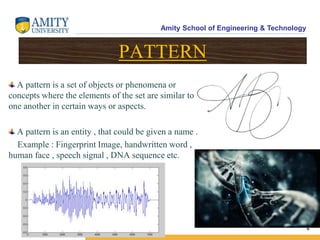
A pattern is a set of objects or phenomena or
concepts where the elements of the set are similar to
one another in certain ways or aspects.
A pattern is an entity , that could be given a name .
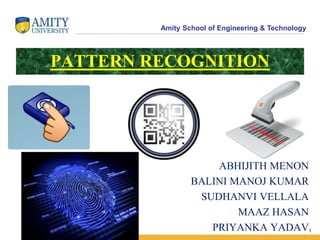
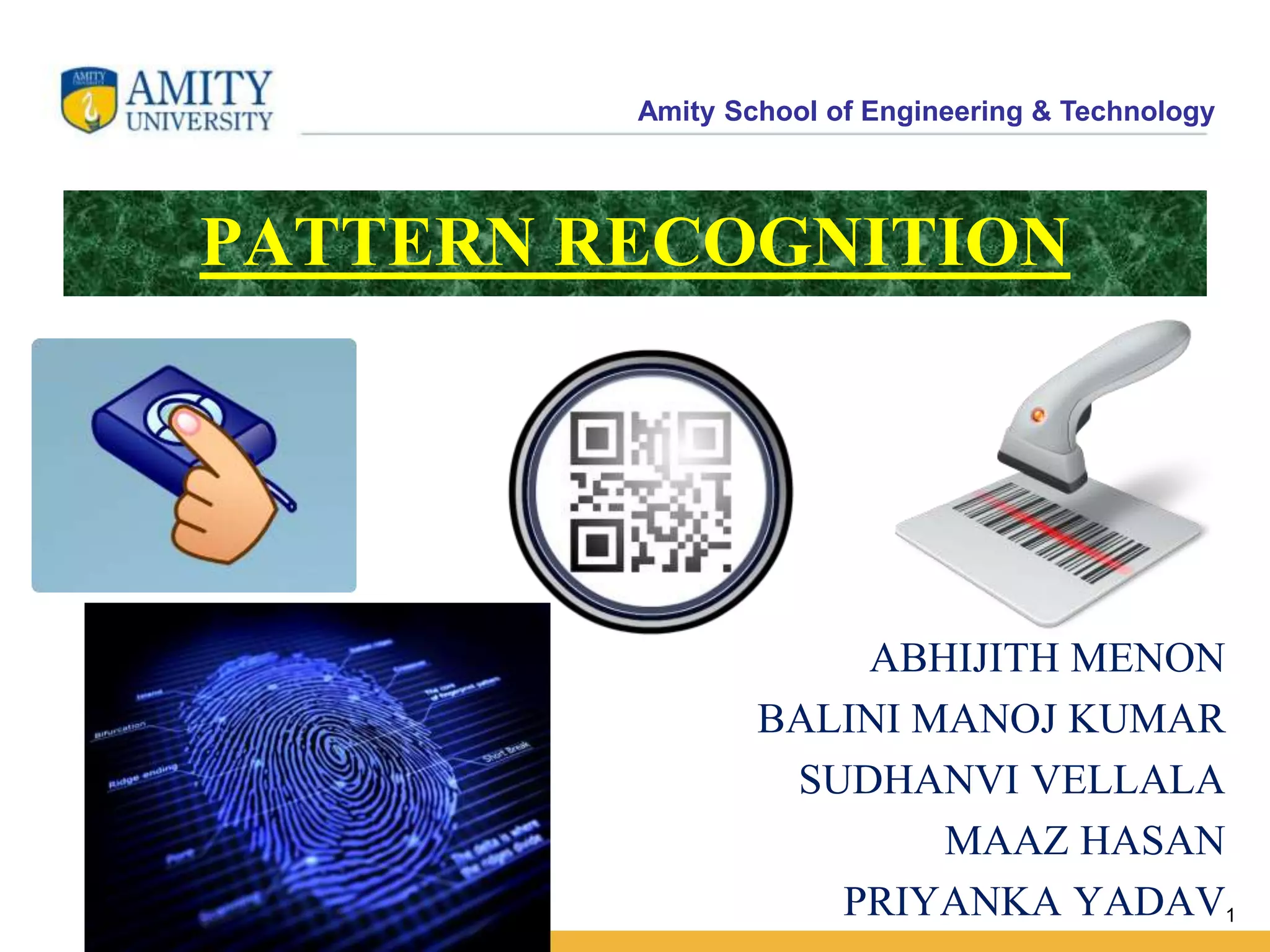
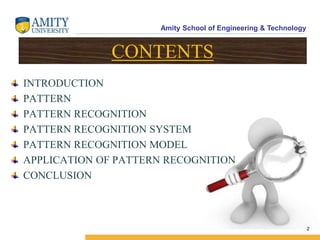
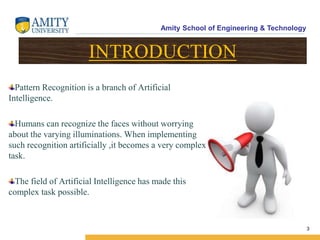
Example : Fingerprint Image, handwritten word ,
human face , speech signal , DNA sequence etc.
Amity School of Engineering & Technology
5
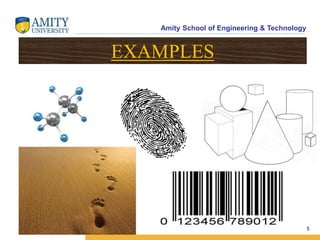
EXAMPLES
Amity School of Engineering & Technology
6
PATTERN RECOGNITION
Pattern recognition is the procedure of processing and analizing diverse
infornation ( numerical , literal, logical ) characterizing the objects or phenomenon ,
so as to provide descriptions ,identifications , classifications and interpretations for
them .
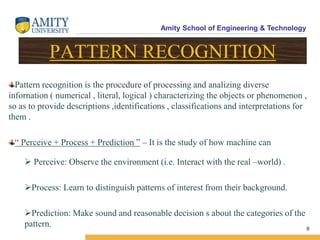
“ Perceive + Process + Prediction ” – It is the study of how machine can
 Perceive: Observe the environment (i.e. Interact with the real –world) .
Process: Learn to distinguish patterns of interest from their background.
Prediction: Make sound and reasonable decision s about the categories of the
pattern.
Amity School of Engineering & Technology
7
PATTERN RECOGNITION SYSTEM
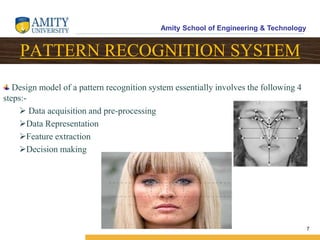
Design model of a pattern recognition system essentially involves the following 4
steps:-
 Data acquisition and pre-processing
Data Representation
Feature extraction
Decision making
Amity School of Engineering & Technology
8
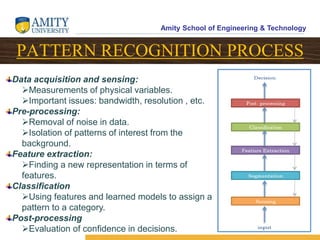
PATTERN RECOGNITION PROCESS
Data acquisition and sensing:
Measurements of physical variables.
Important issues: bandwidth, resolution , etc.
Pre-processing:
Removal of noise in data.
Isolation of patterns of interest from the
background.
Feature extraction:
Finding a new representation in terms of
features.
Classification
Using features and learned models to assign a
pattern to a category.
Post-processing
Evaluation of confidence in decisions.
Amity School of Engineering & Technology
9
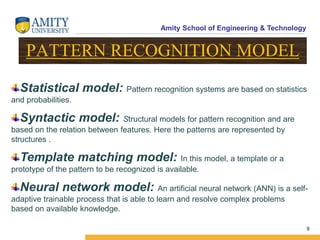
PATTERN RECOGNITION MODEL
Statistical model: Pattern recognition systems are based on statistics
and probabilities.
Syntactic model: Structural models for pattern recognition and are
based on the relation between features. Here the patterns are represented by
structures .
Template matching model: In this model, a template or a
prototype of the pattern to be recognized is available.
Neural network model: An artificial neural network (ANN) is a self-
adaptive trainable process that is able to learn and resolve complex problems
based on available knowledge.
Amity School of Engineering & Technology
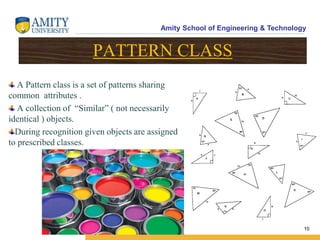
PATTERN CLASS
10
A Pattern class is a set of patterns sharing
common attributes .
A collection of “Similar” ( not necessarily
identical ) objects.
During recognition given objects are assigned
to prescribed classes.
Amity School of Engineering & Technology
11
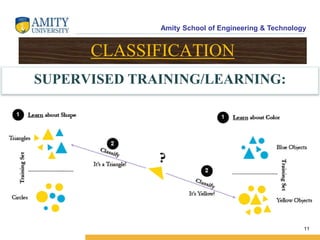
CLASSIFICATION
SUPERVISED TRAINING/LEARNING:
Amity School of Engineering & Technology
12
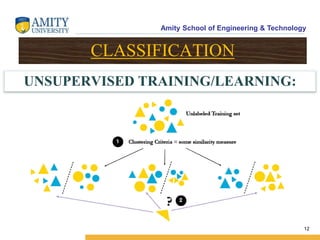
CLASSIFICATION
UNSUPERVISED TRAINING/LEARNING:
Amity School of Engineering & Technology
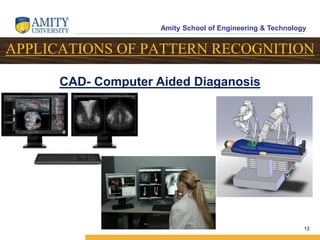
13
CAD- Computer Aided Diaganosis
APPLICATIONS OF PATTERN RECOGNITION
Amity School of Engineering & Technology
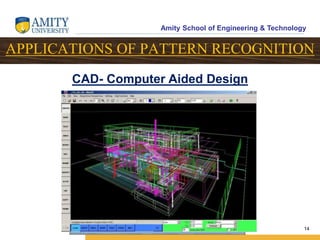
14
CAD- Computer Aided Design
APPLICATIONS OF PATTERN RECOGNITION
Amity School of Engineering & Technology
15
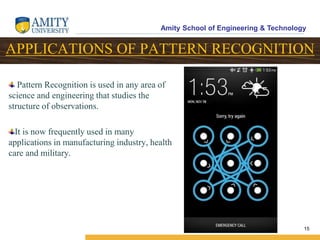
APPLICATIONS OF PATTERN RECOGNITION
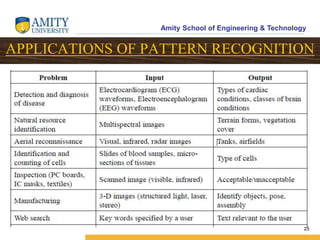
Pattern Recognition is used in any area of
science and engineering that studies the
structure of observations.
It is now frequently used in many
applications in manufacturing industry, health
care and military.
Amity School of Engineering & Technology
16
APPLICATIONS OF PATTERN RECOGNITION
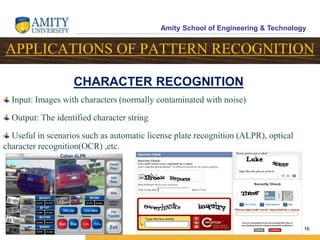
Input: Images with characters (normally contaminated with noise)
Output: The identified character string
Useful in scenarios such as automatic license plate recognition (ALPR), optical
character recognition(OCR) ,etc.
CHARACTER RECOGNITION
Amity School of Engineering & Technology
17
APPLICATIONS OF PATTERN RECOGNITION
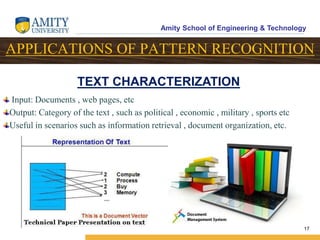
Input: Documents , web pages, etc
Output: Category of the text , such as political , economic , military , sports etc
Useful in scenarios such as information retrieval , document organization, etc.
TEXT CHARACTERIZATION
Amity School of Engineering & Technology
18
APPLICATIONS OF PATTERN RECOGNITION
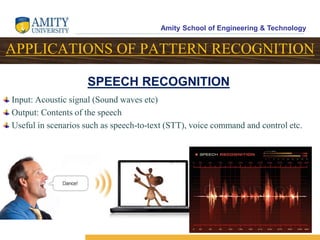
Input: Acoustic signal (Sound waves etc)
Output: Contents of the speech
Useful in scenarios such as speech-to-text (STT), voice command and control etc.
SPEECH RECOGNITION
Amity School of Engineering & Technology
19
APPLICATIONS OF PATTERN RECOGNITION
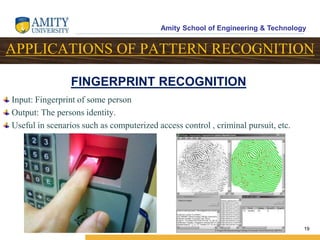
FINGERPRINT RECOGNITION
Input: Fingerprint of some person
Output: The persons identity.
Useful in scenarios such as computerized access control , criminal pursuit, etc.
Amity School of Engineering & Technology
20
APPLICATIONS OF PATTERN RECOGNITION
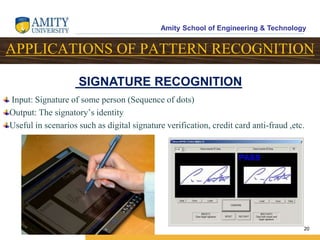
Input: Signature of some person (Sequence of dots)
Output: The signatory’s identity
Useful in scenarios such as digital signature verification, credit card anti-fraud ,etc.
SIGNATURE RECOGNITION
Amity School of Engineering & Technology
21
APPLICATIONS OF PATTERN RECOGNITION
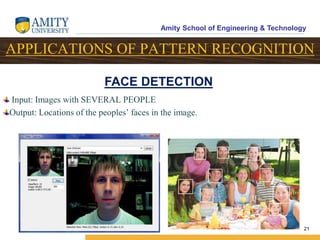
Input: Images with SEVERAL PEOPLE
Output: Locations of the peoples’ faces in the image.
FACE DETECTION
Amity School of Engineering & Technology
22
APPLICATIONS OF PATTERN
RECOGNITION
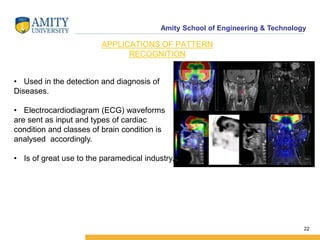
• Used in the detection and diagnosis of
Diseases.
• Electrocardiodiagram (ECG) waveforms
are sent as input and types of cardiac
condition and classes of brain condition is
analysed accordingly.
• Is of great use to the paramedical industry.
Amity School of Engineering & Technology
23
APPLICATIONS OF PATTERN
RECOGNITION
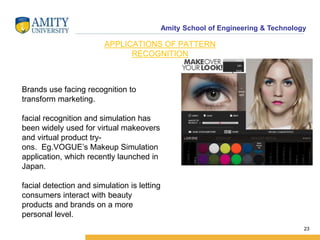
Brands use facing recognition to
transform marketing.
facial recognition and simulation has
been widely used for virtual makeovers
and virtual product try-
ons. Eg.VOGUE’s Makeup Simulation
application, which recently launched in
Japan.
facial detection and simulation is letting
consumers interact with beauty
products and brands on a more
personal level.
Amity School of Engineering & Technology
24
APPLICATIONS OF PATTERN
RECOGNITION
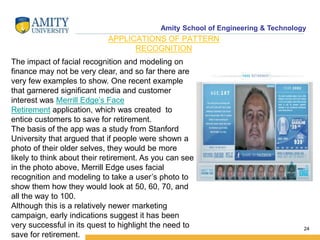
The impact of facial recognition and modeling on
finance may not be very clear, and so far there are
very few examples to show. One recent example
that garnered significant media and customer
interest was Merrill Edge’s Face
Retirement application, which was created to
entice customers to save for retirement.
The basis of the app was a study from Stanford
University that argued that if people were shown a
photo of their older selves, they would be more
likely to think about their retirement. As you can see
in the photo above, Merrill Edge uses facial
recognition and modeling to take a user’s photo to
show them how they would look at 50, 60, 70, and
all the way to 100.
Although this is a relatively newer marketing
campaign, early indications suggest it has been
very successful in its quest to highlight the need to
save for retirement.
Amity School of Engineering & Technology
25
APPLICATIONS OF PATTERN RECOGNITION
Amity School of Engineering & Technology
26
Template matching is simple to implement but the
template size must be small to decrease
computational delay.
Statistical methods highly depends on the
assumption of distribution.
Neural networks can adaptively refine the
classifier and the decision surface in principle can
be arbitrarily implemented .
Syntactic methods concerned structural sense to
encode but additional process to define primitives
are required.
CONCLUSION
Amity School of Engineering & Technology
27
FUTURE WORKS
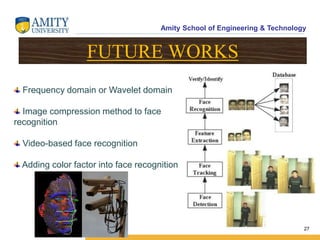
Frequency domain or Wavelet domain
Image compression method to face
recognition
Video-based face recognition
Adding color factor into face recognition
Amity School of Engineering & Technology
28

Pattern Recognition

  • 1.
    Amity School ofEngineering & Technology PATTERN RECOGNITION 1 ABHIJITH MENON BALINI MANOJ KUMAR SUDHANVI VELLALA MAAZ HASAN PRIYANKA YADAV
  • 2.
    Amity School ofEngineering & Technology CONTENTS INTRODUCTION PATTERN PATTERN RECOGNITION PATTERN RECOGNITION SYSTEM PATTERN RECOGNITION MODEL APPLICATION OF PATTERN RECOGNITION CONCLUSION 2
  • 3.
    Amity School ofEngineering & Technology 3 INTRODUCTION Pattern Recognition is a branch of Artificial Intelligence. Humans can recognize the faces without worrying about the varying illuminations. When implementing such recognition artificially ,it becomes a very complex task. The field of Artificial Intelligence has made this complex task possible.
  • 4.
    Amity School ofEngineering & Technology 4 PATTERN A pattern is a set of objects or phenomena or concepts where the elements of the set are similar to one another in certain ways or aspects. A pattern is an entity , that could be given a name . Example : Fingerprint Image, handwritten word , human face , speech signal , DNA sequence etc.
  • 5.
    Amity School ofEngineering & Technology 5 EXAMPLES
  • 6.
    Amity School ofEngineering & Technology 6 PATTERN RECOGNITION Pattern recognition is the procedure of processing and analizing diverse infornation ( numerical , literal, logical ) characterizing the objects or phenomenon , so as to provide descriptions ,identifications , classifications and interpretations for them . “ Perceive + Process + Prediction ” – It is the study of how machine can  Perceive: Observe the environment (i.e. Interact with the real –world) . Process: Learn to distinguish patterns of interest from their background. Prediction: Make sound and reasonable decision s about the categories of the pattern.
  • 7.
    Amity School ofEngineering & Technology 7 PATTERN RECOGNITION SYSTEM Design model of a pattern recognition system essentially involves the following 4 steps:-  Data acquisition and pre-processing Data Representation Feature extraction Decision making
  • 8.
    Amity School ofEngineering & Technology 8 PATTERN RECOGNITION PROCESS Data acquisition and sensing: Measurements of physical variables. Important issues: bandwidth, resolution , etc. Pre-processing: Removal of noise in data. Isolation of patterns of interest from the background. Feature extraction: Finding a new representation in terms of features. Classification Using features and learned models to assign a pattern to a category. Post-processing Evaluation of confidence in decisions.
  • 9.
    Amity School ofEngineering & Technology 9 PATTERN RECOGNITION MODEL Statistical model: Pattern recognition systems are based on statistics and probabilities. Syntactic model: Structural models for pattern recognition and are based on the relation between features. Here the patterns are represented by structures . Template matching model: In this model, a template or a prototype of the pattern to be recognized is available. Neural network model: An artificial neural network (ANN) is a self- adaptive trainable process that is able to learn and resolve complex problems based on available knowledge.
  • 10.
    Amity School ofEngineering & Technology PATTERN CLASS 10 A Pattern class is a set of patterns sharing common attributes . A collection of “Similar” ( not necessarily identical ) objects. During recognition given objects are assigned to prescribed classes.
  • 11.
    Amity School ofEngineering & Technology 11 CLASSIFICATION SUPERVISED TRAINING/LEARNING:
  • 12.
    Amity School ofEngineering & Technology 12 CLASSIFICATION UNSUPERVISED TRAINING/LEARNING:
  • 13.
    Amity School ofEngineering & Technology 13 CAD- Computer Aided Diaganosis APPLICATIONS OF PATTERN RECOGNITION
  • 14.
    Amity School ofEngineering & Technology 14 CAD- Computer Aided Design APPLICATIONS OF PATTERN RECOGNITION
  • 15.
    Amity School ofEngineering & Technology 15 APPLICATIONS OF PATTERN RECOGNITION Pattern Recognition is used in any area of science and engineering that studies the structure of observations. It is now frequently used in many applications in manufacturing industry, health care and military.
  • 16.
    Amity School ofEngineering & Technology 16 APPLICATIONS OF PATTERN RECOGNITION Input: Images with characters (normally contaminated with noise) Output: The identified character string Useful in scenarios such as automatic license plate recognition (ALPR), optical character recognition(OCR) ,etc. CHARACTER RECOGNITION
  • 17.
    Amity School ofEngineering & Technology 17 APPLICATIONS OF PATTERN RECOGNITION Input: Documents , web pages, etc Output: Category of the text , such as political , economic , military , sports etc Useful in scenarios such as information retrieval , document organization, etc. TEXT CHARACTERIZATION
  • 18.
    Amity School ofEngineering & Technology 18 APPLICATIONS OF PATTERN RECOGNITION Input: Acoustic signal (Sound waves etc) Output: Contents of the speech Useful in scenarios such as speech-to-text (STT), voice command and control etc. SPEECH RECOGNITION
  • 19.
    Amity School ofEngineering & Technology 19 APPLICATIONS OF PATTERN RECOGNITION FINGERPRINT RECOGNITION Input: Fingerprint of some person Output: The persons identity. Useful in scenarios such as computerized access control , criminal pursuit, etc.
  • 20.
    Amity School ofEngineering & Technology 20 APPLICATIONS OF PATTERN RECOGNITION Input: Signature of some person (Sequence of dots) Output: The signatory’s identity Useful in scenarios such as digital signature verification, credit card anti-fraud ,etc. SIGNATURE RECOGNITION
  • 21.
    Amity School ofEngineering & Technology 21 APPLICATIONS OF PATTERN RECOGNITION Input: Images with SEVERAL PEOPLE Output: Locations of the peoples’ faces in the image. FACE DETECTION
  • 22.
    Amity School ofEngineering & Technology 22 APPLICATIONS OF PATTERN RECOGNITION • Used in the detection and diagnosis of Diseases. • Electrocardiodiagram (ECG) waveforms are sent as input and types of cardiac condition and classes of brain condition is analysed accordingly. • Is of great use to the paramedical industry.
  • 23.
    Amity School ofEngineering & Technology 23 APPLICATIONS OF PATTERN RECOGNITION Brands use facing recognition to transform marketing. facial recognition and simulation has been widely used for virtual makeovers and virtual product try- ons. Eg.VOGUE’s Makeup Simulation application, which recently launched in Japan. facial detection and simulation is letting consumers interact with beauty products and brands on a more personal level.
  • 24.
    Amity School ofEngineering & Technology 24 APPLICATIONS OF PATTERN RECOGNITION The impact of facial recognition and modeling on finance may not be very clear, and so far there are very few examples to show. One recent example that garnered significant media and customer interest was Merrill Edge’s Face Retirement application, which was created to entice customers to save for retirement. The basis of the app was a study from Stanford University that argued that if people were shown a photo of their older selves, they would be more likely to think about their retirement. As you can see in the photo above, Merrill Edge uses facial recognition and modeling to take a user’s photo to show them how they would look at 50, 60, 70, and all the way to 100. Although this is a relatively newer marketing campaign, early indications suggest it has been very successful in its quest to highlight the need to save for retirement.
  • 25.
    Amity School ofEngineering & Technology 25 APPLICATIONS OF PATTERN RECOGNITION
  • 26.
    Amity School ofEngineering & Technology 26 Template matching is simple to implement but the template size must be small to decrease computational delay. Statistical methods highly depends on the assumption of distribution. Neural networks can adaptively refine the classifier and the decision surface in principle can be arbitrarily implemented . Syntactic methods concerned structural sense to encode but additional process to define primitives are required. CONCLUSION
  • 27.
    Amity School ofEngineering & Technology 27 FUTURE WORKS Frequency domain or Wavelet domain Image compression method to face recognition Video-based face recognition Adding color factor into face recognition
  • 28.
    Amity School ofEngineering & Technology 28