•   What is pattern?
•   What is pattern recognition system?
•   Pattern recognition procedure
•   Pattern recognition approaches
•   Pattern recognition system components
•   The design cycle
• A set of instances that
•         share some regularities and similarities
•         is repeatable
•          is observable, some time partially, using sensors
•          May have noise and distortion
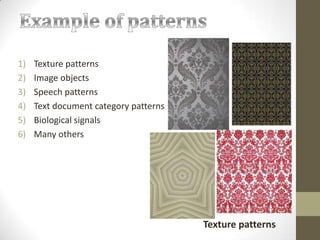
1)   Texture patterns
2)   Image objects
3)   Speech patterns
4)   Text document category patterns
5)   Biological signals
6)   Many others


                                       Texture patterns
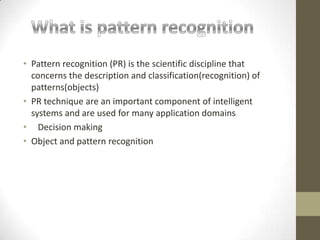
• Pattern recognition (PR) is the scientific discipline that
  concerns the description and classification(recognition) of
  patterns(objects)
• PR technique are an important component of intelligent
  systems and are used for many application domains
• Decision making
• Object and pattern recognition
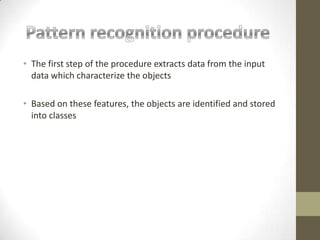
• The first step of the procedure extracts data from the input
  data which characterize the objects

• Based on these features, the objects are identified and stored
  into classes
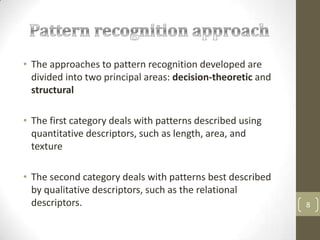
• The approaches to pattern recognition developed are
  divided into two principal areas: decision-theoretic and
  structural

• The first category deals with patterns described using
  quantitative descriptors, such as length, area, and
  texture

• The second category deals with patterns best described
  by qualitative descriptors, such as the relational
  descriptors.                                               8
The approaches are:

Statistical approach
Syntactic and structural approach
Neural network approach
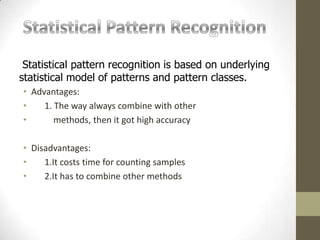
Statistical pattern recognition is based on underlying
statistical model of patterns and pattern classes.
• Advantages:
•    1. The way always combine with other
•       methods, then it got high accuracy

• Disadvantages:
•    1.It costs time for counting samples
•    2.It has to combine other methods
• Structural or syntactic PR: pattern classes represented by
  means of formal structures as
  grammars, automata, strings, etc.
• The aim of structural recognition procedure should not be
  merely to arrive at a “yes”, “no”, “don’t know” decision but to
  produce a structural description of the input picture.
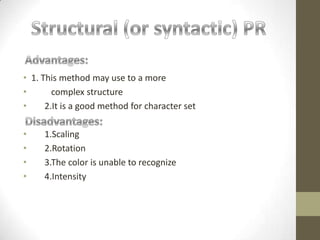
• 1. This method may use to a more
•       complex structure
•     2.It is a good method for character set

•    1.Scaling
•    2.Rotation
•    3.The color is unable to recognize
•    4.Intensity
• classifier is represented as a network of cells modeling
  neurons of the human brain (connectionist approach).

• Pattern recognition can be implemented by using a feed-
  forward neural network that has been trained accordingly

• During training, the network is trained to associate outputs
  with input patterns
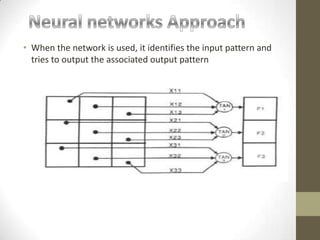
• When the network is used, it identifies the input pattern and
  tries to output the associated output pattern
•   Sensing
•   Segmentation and grouping
•   Feature extraction
•   Classification
•   Post processing
• Sensing
•      use of transducer (camera / microphone)
•      PR system depends on the bandwidth , the resolution
  sensitivity distortion of the transducer ,

• Segmentation and grouping
• Patterns should be well separated and should not overlap

• Feature extraction
• aims to create discriminative features goods for
  classification

•
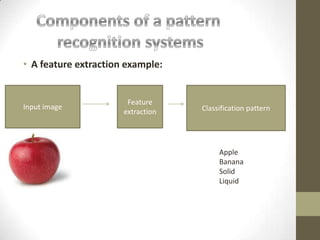
• A feature extraction example:


                       Feature
Input image                        Classification pattern
                      extraction


                                        Apple
                                        Banana
                                        Solid
                                        Liquid
• Classification
• Use a feature vector provided by a feature extractor to assign
  the object to a category

• Post processing
• Exploit the context dependent information other than from a
  target pattern itself to improve performance
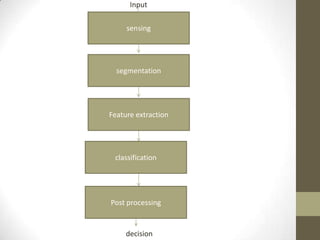
Input

     sensing


  segmentation


Feature extraction


 classification


Post processing


     decision
•   Data collection
•   Feature choice
•   Model choice
•   Training
•   Evaluation
•   Computational complexity
• Data collection
• How do we know when we have collected an adequately
  large and representative set of examples for training and
  testing the system?

• Feature choice
• Depends on the characteristics of the problem domain .
  simple to extract , invariant to irrelevant transformation
  , insensitive to noise

• Model choice
• Unsatisfied with the performance of one classifier and wants
  to jump to another class of model
• Training
• Use data to determine the classifier . Many different procedure for
  training classifiers and choosing models

• Evaluation
• Measure the error rate
•     Different feature set
•     Different training methods
•     Different training and test data sets

• Computational complexity
•   What is the trade-off between computational ease and
  performance ?

• (How a algorithm scales as a function of the number of
  features, patterns /categories)
• http://www.doc.ic.ac.uk/~nd/surprise_96/journal/vol4/cs11/r
  eport.html#Pattern%20Recognition%20-%20an%20example

• http://www.doc.ic.ac.uk/~nd/surprise_96/journal/vol4/cs11/r
  eport.html#Pattern%20Recognition%20-%20an%20example

Artificial intelligence Pattern recognition system

  • 2.
    What is pattern? • What is pattern recognition system? • Pattern recognition procedure • Pattern recognition approaches • Pattern recognition system components • The design cycle
  • 3.
    • A setof instances that • share some regularities and similarities • is repeatable • is observable, some time partially, using sensors • May have noise and distortion
  • 4.
    1) Texture patterns 2) Image objects 3) Speech patterns 4) Text document category patterns 5) Biological signals 6) Many others Texture patterns
  • 6.
    • Pattern recognition(PR) is the scientific discipline that concerns the description and classification(recognition) of patterns(objects) • PR technique are an important component of intelligent systems and are used for many application domains • Decision making • Object and pattern recognition
  • 7.
    • The firststep of the procedure extracts data from the input data which characterize the objects • Based on these features, the objects are identified and stored into classes
  • 8.
    • The approachesto pattern recognition developed are divided into two principal areas: decision-theoretic and structural • The first category deals with patterns described using quantitative descriptors, such as length, area, and texture • The second category deals with patterns best described by qualitative descriptors, such as the relational descriptors. 8
  • 9.
    The approaches are: Statisticalapproach Syntactic and structural approach Neural network approach
  • 10.
    Statistical pattern recognitionis based on underlying statistical model of patterns and pattern classes. • Advantages: • 1. The way always combine with other • methods, then it got high accuracy • Disadvantages: • 1.It costs time for counting samples • 2.It has to combine other methods
  • 11.
    • Structural orsyntactic PR: pattern classes represented by means of formal structures as grammars, automata, strings, etc. • The aim of structural recognition procedure should not be merely to arrive at a “yes”, “no”, “don’t know” decision but to produce a structural description of the input picture.
  • 12.
    • 1. Thismethod may use to a more • complex structure • 2.It is a good method for character set • 1.Scaling • 2.Rotation • 3.The color is unable to recognize • 4.Intensity
  • 13.
    • classifier isrepresented as a network of cells modeling neurons of the human brain (connectionist approach). • Pattern recognition can be implemented by using a feed- forward neural network that has been trained accordingly • During training, the network is trained to associate outputs with input patterns
  • 14.
    • When thenetwork is used, it identifies the input pattern and tries to output the associated output pattern
  • 15.
    Sensing • Segmentation and grouping • Feature extraction • Classification • Post processing
  • 16.
    • Sensing • use of transducer (camera / microphone) • PR system depends on the bandwidth , the resolution sensitivity distortion of the transducer , • Segmentation and grouping • Patterns should be well separated and should not overlap • Feature extraction • aims to create discriminative features goods for classification •
  • 17.
    • A featureextraction example: Feature Input image Classification pattern extraction Apple Banana Solid Liquid
  • 18.
    • Classification • Usea feature vector provided by a feature extractor to assign the object to a category • Post processing • Exploit the context dependent information other than from a target pattern itself to improve performance
  • 19.
    Input sensing segmentation Feature extraction classification Post processing decision
  • 20.
    Data collection • Feature choice • Model choice • Training • Evaluation • Computational complexity
  • 21.
    • Data collection •How do we know when we have collected an adequately large and representative set of examples for training and testing the system? • Feature choice • Depends on the characteristics of the problem domain . simple to extract , invariant to irrelevant transformation , insensitive to noise • Model choice • Unsatisfied with the performance of one classifier and wants to jump to another class of model
  • 22.
    • Training • Usedata to determine the classifier . Many different procedure for training classifiers and choosing models • Evaluation • Measure the error rate • Different feature set • Different training methods • Different training and test data sets • Computational complexity • What is the trade-off between computational ease and performance ? • (How a algorithm scales as a function of the number of features, patterns /categories)
  • 23.
    • http://www.doc.ic.ac.uk/~nd/surprise_96/journal/vol4/cs11/r eport.html#Pattern%20Recognition%20-%20an%20example • http://www.doc.ic.ac.uk/~nd/surprise_96/journal/vol4/cs11/r eport.html#Pattern%20Recognition%20-%20an%20example