ID3 Algorithm
Rehouma Cherif
Master AI and SD
02/13/2020
History
 Invented by Ross Quinlan in 1975.
 Quinlan was a computer science
researcher in data mining, and decision
theory.
 Received doctorate in computer science at
the University of Washington in 1968.
Want big impact?
Use big image.
What is the ID3 algorithm?
 ID3 (Iterative Dichotomiser 3).
 A mathematical algorithm for building the
decision tree.
 Algorithm used to generate a decision tree.
 The resulting tree is used to classify future
samples.
 ID3 is a precursor to the C4.5 Algorithm.
 Uses Information Theory invented by Shannon in
1948.
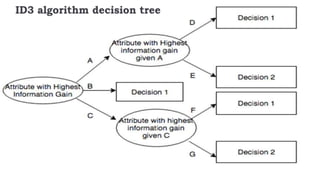
Decision Tree
 Rules for classifying data using attributes.
 Tree consists of decision nodes and decision
leafs.
 Nodes can have two or more branches which
represents the value for the attribute tested.
 Leafs nodes produces a homogeneous result.
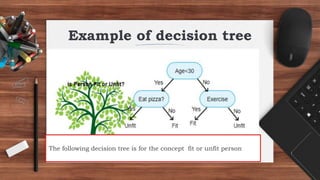
Example of decision tree
The following decision tree is for the concept fit or unfit person
The Process
 Take the attributes and calculates their
entropies.
 Chooses attribute that has the lowest
entropy is minimum or when information
gain is maximum
 Makes a node containing that attribute
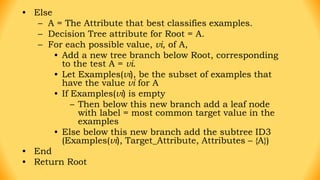
The Algorithm
 Create a root node for the tree.
 If all examples are positive, Return the
single-node tree Root, with label = +.
 If all examples are negative, Return the
single-node tree Root, with label = -.
• Else
– A = The Attribute that best classifies examples.
– Decision Tree attribute for Root = A.
– For each possible value, vi, of A,
• Add a new tree branch below Root, corresponding
to the test A = vi.
• Let Examples(vi), be the subset of examples that
have the value vi for A
• If Examples(vi) is empty
– Then below this new branch add a leaf node
with label = most common target value in the
examples
• Else below this new branch add the subtree ID3
(Examples(vi), Target_Attribute, Attributes – {A})
• End
• Return Root
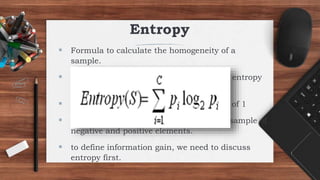
Entropy
 Formula to calculate the homogeneity of a
sample.
 A complete homogeneous sample has an entropy
of 0
 An equally divided sample as an entropy of 1
 Entropy = - p+log2 (p+) -p-log2 (p-) for a sample of
negative and positive elements.
 to define information gain, we need to discuss
entropy first.
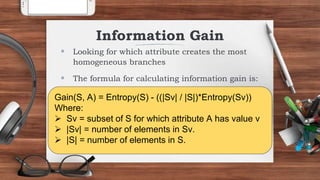
Information Gain
 Looking for which attribute creates the most
homogeneous branches
 The formula for calculating information gain is:
Gain(S, A) = Entropy(S) - ((|Sv| / |S|)*Entropy(Sv))
Where:
 Sv = subset of S for which attribute A has value v
 |Sv| = number of elements in Sv.
 |S| = number of elements in S.
12
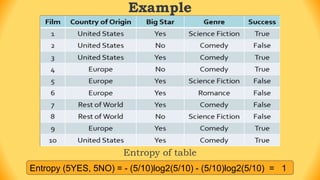
Entropy of table
Entropy (5YES, 5NO) = - (5/10)log2(5/10) - (5/10)log2(5/10) = 1
Example
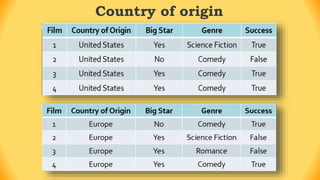
Country of origin
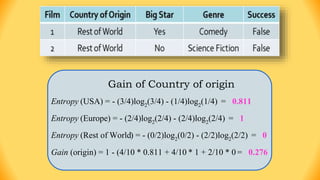
Gain of Country of origin
Entropy (USA) = - (3/4)log2
(3/4) - (1/4)log2
(1/4) = 0.811
Entropy (Europe) = - (2/4)log2
(2/4) - (2/4)log2
(2/4) = 1
Entropy (Rest of World) = - (0/2)log2
(0/2) - (2/2)log2
(2/2) = 0
Gain (origin) = 1 - (4/10 * 0.811 + 4/10 * 1 + 2/10 * 0 = 0.276
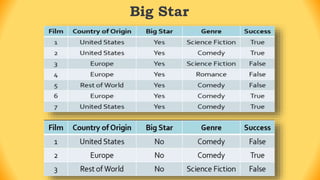
Big Star
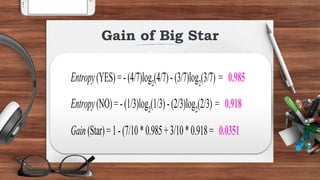
Gain of Big Star
Entropy(YES)=-(4/7)log2
(4/7)-(3/7)log2
(3/7) = 0.985
Entropy(NO)=-(1/3)log2
(1/3)-(2/3)log2
(2/3) = 0.918
Gain(Star)=1-(7/10*0.985+3/10*0.918= 0.0351
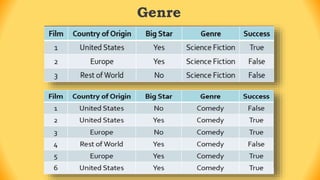
Genre
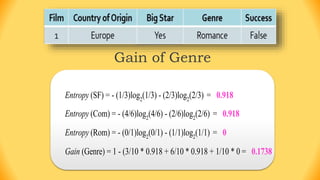
Entropy (SF) = - (1/3)log2
(1/3) - (2/3)log2
(2/3) = 0.918
Entropy (Com) = - (4/6)log2
(4/6) - (2/6)log2
(2/6) = 0.918
Entropy (Rom) = - (0/1)log2
(0/1) - (1/1)log2
(1/1) = 0
Gain (Genre) = 1 - (3/10 * 0.918 + 6/10 * 0.918 + 1/10 * 0 = 0.1738
Gain of Genre
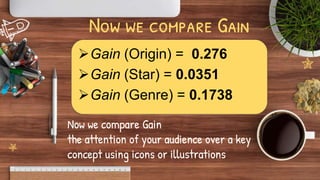
Now we compare Gain
Now we compare Gain
the attention of your audience over a key
concept using icons or illustrations
Gain (Origin) = 0.276
Gain (Star) = 0.0351
Gain (Genre) = 0.1738
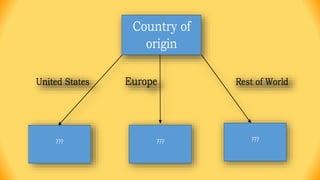
United States Europe Rest of World
Country of
origin
??? ???
???
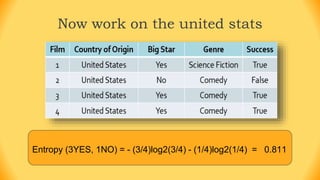
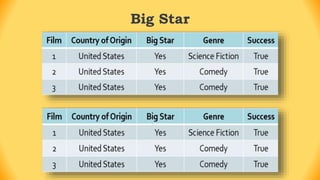
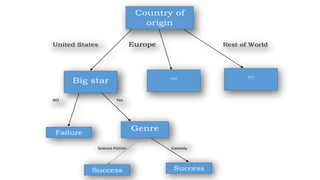
Now work on the united stats
Entropy (3YES, 1NO) = - (3/4)log2(3/4) - (1/4)log2(1/4) = 0.811
Big Star
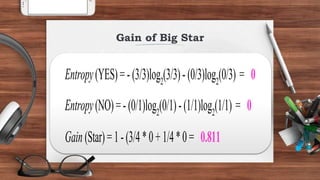
Gain of Big Star
Entropy(YES)=-(3/3)log2
(3/3)-(0/3)log2
(0/3) = 0
Entropy(NO)=-(0/1)log2
(0/1)-(1/1)log2
(1/1) = 0
Gain(Star)=1-(3/4*0+1/4*0= 0.811
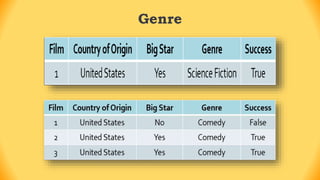
Genre
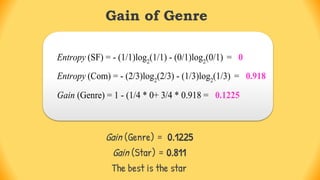
Gain of Genre
Gain (Genre) = 0.1225
Gain (Star) = 0.811
The best is the star
Entropy (SF) = - (1/1)log2
(1/1) - (0/1)log2
(0/1) = 0
Entropy (Com) = - (2/3)log2
(2/3) - (1/3)log2
(1/3) = 0.918
Gain (Genre) = 1 - (1/4 * 0+ 3/4 * 0.918 = 0.1225
United States Europe Rest of World
NO Yes
Science Fiction Comedy
Country of
origin
Big star
???
???
Failure
Genre
Success Success
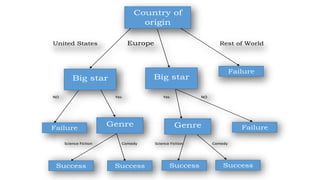
United States Europe Rest of World
NO Yes Yes NO
Science Fiction Comedy Science Fiction Comedy
Country of
origin
Big star Big star
Failure
Genre
Success Success
Genre
Success Success
Failure
Failure
Advantage of ID3
 Builds the fastest tree.
 Builds a short tree.
 Only need to test enough
attributes until all data is
classified.
Disadvantage of ID3
 Only one attribute at a time is
tested for making a decision.
 The modification of expert after
result.
Conclusion
 There exist another algorithms were
invented just after id3 has the same role
like algorithm 4.5 and algorithm cart,
ect.
 Scientific research in this domain are
search to makes a system can give a
decision tree very exact without
modification of the expert
Thanks!

ID3 Algorithm

  • 1.
  • 2.
    History  Invented byRoss Quinlan in 1975.  Quinlan was a computer science researcher in data mining, and decision theory.  Received doctorate in computer science at the University of Washington in 1968.
  • 3.
  • 4.
    What is theID3 algorithm?  ID3 (Iterative Dichotomiser 3).  A mathematical algorithm for building the decision tree.  Algorithm used to generate a decision tree.  The resulting tree is used to classify future samples.  ID3 is a precursor to the C4.5 Algorithm.  Uses Information Theory invented by Shannon in 1948.
  • 5.
    Decision Tree  Rulesfor classifying data using attributes.  Tree consists of decision nodes and decision leafs.  Nodes can have two or more branches which represents the value for the attribute tested.  Leafs nodes produces a homogeneous result.
  • 6.
    Example of decisiontree The following decision tree is for the concept fit or unfit person
  • 7.
    The Process  Takethe attributes and calculates their entropies.  Chooses attribute that has the lowest entropy is minimum or when information gain is maximum  Makes a node containing that attribute
  • 8.
    The Algorithm  Createa root node for the tree.  If all examples are positive, Return the single-node tree Root, with label = +.  If all examples are negative, Return the single-node tree Root, with label = -.
  • 9.
    • Else – A= The Attribute that best classifies examples. – Decision Tree attribute for Root = A. – For each possible value, vi, of A, • Add a new tree branch below Root, corresponding to the test A = vi. • Let Examples(vi), be the subset of examples that have the value vi for A • If Examples(vi) is empty – Then below this new branch add a leaf node with label = most common target value in the examples • Else below this new branch add the subtree ID3 (Examples(vi), Target_Attribute, Attributes – {A}) • End • Return Root
  • 10.
    Entropy  Formula tocalculate the homogeneity of a sample.  A complete homogeneous sample has an entropy of 0  An equally divided sample as an entropy of 1  Entropy = - p+log2 (p+) -p-log2 (p-) for a sample of negative and positive elements.  to define information gain, we need to discuss entropy first.
  • 11.
    Information Gain  Lookingfor which attribute creates the most homogeneous branches  The formula for calculating information gain is: Gain(S, A) = Entropy(S) - ((|Sv| / |S|)*Entropy(Sv)) Where:  Sv = subset of S for which attribute A has value v  |Sv| = number of elements in Sv.  |S| = number of elements in S.
  • 12.
  • 13.
    Entropy of table Entropy(5YES, 5NO) = - (5/10)log2(5/10) - (5/10)log2(5/10) = 1 Example
  • 14.
  • 15.
    Gain of Countryof origin Entropy (USA) = - (3/4)log2 (3/4) - (1/4)log2 (1/4) = 0.811 Entropy (Europe) = - (2/4)log2 (2/4) - (2/4)log2 (2/4) = 1 Entropy (Rest of World) = - (0/2)log2 (0/2) - (2/2)log2 (2/2) = 0 Gain (origin) = 1 - (4/10 * 0.811 + 4/10 * 1 + 2/10 * 0 = 0.276
  • 16.
  • 17.
    Gain of BigStar Entropy(YES)=-(4/7)log2 (4/7)-(3/7)log2 (3/7) = 0.985 Entropy(NO)=-(1/3)log2 (1/3)-(2/3)log2 (2/3) = 0.918 Gain(Star)=1-(7/10*0.985+3/10*0.918= 0.0351
  • 18.
  • 19.
    Entropy (SF) =- (1/3)log2 (1/3) - (2/3)log2 (2/3) = 0.918 Entropy (Com) = - (4/6)log2 (4/6) - (2/6)log2 (2/6) = 0.918 Entropy (Rom) = - (0/1)log2 (0/1) - (1/1)log2 (1/1) = 0 Gain (Genre) = 1 - (3/10 * 0.918 + 6/10 * 0.918 + 1/10 * 0 = 0.1738 Gain of Genre
  • 20.
    Now we compareGain Now we compare Gain the attention of your audience over a key concept using icons or illustrations Gain (Origin) = 0.276 Gain (Star) = 0.0351 Gain (Genre) = 0.1738
  • 21.
    United States EuropeRest of World Country of origin ??? ??? ???
  • 22.
    Now work onthe united stats Entropy (3YES, 1NO) = - (3/4)log2(3/4) - (1/4)log2(1/4) = 0.811
  • 23.
  • 24.
    Gain of BigStar Entropy(YES)=-(3/3)log2 (3/3)-(0/3)log2 (0/3) = 0 Entropy(NO)=-(0/1)log2 (0/1)-(1/1)log2 (1/1) = 0 Gain(Star)=1-(3/4*0+1/4*0= 0.811
  • 25.
  • 26.
    Gain of Genre Gain(Genre) = 0.1225 Gain (Star) = 0.811 The best is the star Entropy (SF) = - (1/1)log2 (1/1) - (0/1)log2 (0/1) = 0 Entropy (Com) = - (2/3)log2 (2/3) - (1/3)log2 (1/3) = 0.918 Gain (Genre) = 1 - (1/4 * 0+ 3/4 * 0.918 = 0.1225
  • 27.
    United States EuropeRest of World NO Yes Science Fiction Comedy Country of origin Big star ??? ??? Failure Genre Success Success
  • 28.
    United States EuropeRest of World NO Yes Yes NO Science Fiction Comedy Science Fiction Comedy Country of origin Big star Big star Failure Genre Success Success Genre Success Success Failure Failure
  • 29.
    Advantage of ID3 Builds the fastest tree.  Builds a short tree.  Only need to test enough attributes until all data is classified.
  • 30.
    Disadvantage of ID3 Only one attribute at a time is tested for making a decision.  The modification of expert after result.
  • 31.
    Conclusion  There existanother algorithms were invented just after id3 has the same role like algorithm 4.5 and algorithm cart, ect.  Scientific research in this domain are search to makes a system can give a decision tree very exact without modification of the expert
  • 32.