Ethnographic Research
Adopting a Cultural Lens
to Interpret Observed Behaviour
Dr. J D Chandrapal
MBA – marketing , PGDHRM, Ph D, CII (Award) – London
Development Officer - LIC of India – Ahmedabad - 9825070933
Ethnography – What?
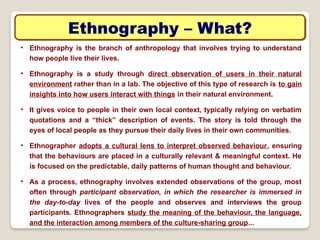
• Ethnography is the branch of anthropology that involves trying to understand
how people live their lives.
• Ethnography is a study through direct observation of users in their natural
environment rather than in a lab. The objective of this type of research is to gain
insights into how users interact with things in their natural environment.
• It gives voice to people in their own local context, typically relying on verbatim
quotations and a “thick” description of events. The story is told through the
eyes of local people as they pursue their daily lives in their own communities.
• Ethnographer adopts a cultural lens to interpret observed behaviour, ensuring
that the behaviours are placed in a culturally relevant & meaningful context. He
is focused on the predictable, daily patterns of human thought and behaviour.
• As a process, ethnography involves extended observations of the group, most
often through participant observation, in which the researcher is immersed in
the day-to-day lives of the people and observes and interviews the group
participants. Ethnographers study the meaning of the behaviour, the language,
and the interaction among members of the culture-sharing group...
Ethnography – Key Elements
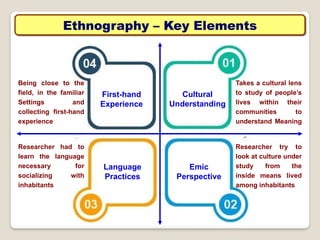
Emic
Perspective
Cultural
Understanding
Language
Practices
First-hand
Experience
Takes a cultural lens
to study of people’s
lives within their
communities to
understand Meaning
Researcher try to
look at culture under
study from the
inside means lived
among inhabitants
Being close to the
field, in the familiar
Settings and
collecting first-hand
experience
Researcher had to
learn the language
necessary for
socializing with
inhabitants
Features of Ethnography
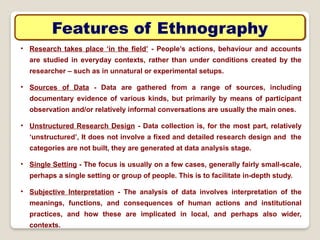
• Research takes place ‘in the field’ - People’s actions, behaviour and accounts
are studied in everyday contexts, rather than under conditions created by the
researcher – such as in unnatural or experimental setups.
• Sources of Data - Data are gathered from a range of sources, including
documentary evidence of various kinds, but primarily by means of participant
observation and/or relatively informal conversations are usually the main ones.
• Unstructured Research Design - Data collection is, for the most part, relatively
‘unstructured’, It does not involve a fixed and detailed research design and the
categories are not built, they are generated at data analysis stage.
• Single Setting - The focus is usually on a few cases, generally fairly small-scale,
perhaps a single setting or group of people. This is to facilitate in-depth study.
• Subjective Interpretation - The analysis of data involves interpretation of the
meanings, functions, and consequences of human actions and institutional
practices, and how these are implicated in local, and perhaps also wider,
contexts.
Emic Perspectives
• Emic perspective or the ‘native’s point of view’ can be understood as the
perspective in which the researcher gains the insider’s point of view of a culture
under study through the meanings that the members of that culture live with.
• For example. In a particular society, there are special rituals conducted by the
people. If the researcher is approaching the field with an emic perspective, he
attempts to comprehend the subjective meanings that people give to these
practices. He refrains from engaging in an objective study but tries to make
sense of the rituals through the eyes of the research participants.
• A key feature in emic perspective is that the researcher gives prominence to the
data themselves rather than to the theoretical understanding of
the conceptual frameworks.
• This, however, can be very difficult to attempt as all researchers have
preconceived ideas and biases. Now, let us move on to the etic perspective.
Etic Perspectives
• In the Etic perspective, the researcher looks at the research field objectively
from a distance.
• This does not denote that he physically maintains a distance, but highlights that
the researcher gives prominence to the theoretical frameworks and concepts
and allows these to guide him, rather than be guided by the subjective meanings
of the research participants.
• Let us comprehend this through an example. A researcher who attempts to
apply theories and concepts that already exist in a discipline to comprehend a
particular research field is using an etic perspective, as he fails to capture the
subjective meaning.
• The etic perspective presents an objective outlook of the research field. The
researcher does not immerse within the context to a point where he lives the
experience of the research participant..
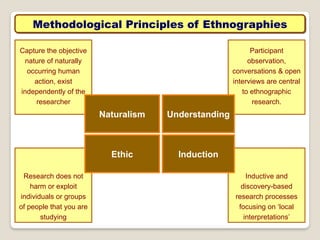
Methodological Principles of Ethnographies
Capture the objective
nature of naturally
occurring human
action, exist
independently of the
researcher
Research does not
harm or exploit
individuals or groups
of people that you are
studying
Participant
observation,
conversations & open
interviews are central
to ethnographic
research.
Inductive and
discovery-based
research processes
focusing on ‘local
interpretations’
Naturalism Understanding
Ethic Induction
Realist Ethnography
• It reflects a particular stance taken by the researcher toward the individuals
being studied.
• Realist ethnography is an objective account of the situation and reporting
objectively on the information learned from participants at a site.
• The realist ethnographer narrates the study in a third-person dispassionate
voice and reports on what is observed or heard from participants.
• The ethnographer remains in the background as an omniscient reporter of
the “facts.” The realist also reports objective data in a measured style
uncontaminated by personal bias, political goals, and judgment.
• Researcher may provide mundane details of everyday life among the
people studied & also uses the standard categories for cultural description.
• Ethnographer produces the participants’ views through closely edited
quotations and has the final word on how the culture is to be interpreted
and presented.
Critical Ethnography
• A “critical” approach by including in the research an advocacy perspective.
• The critical ethnography is a type of ethnographic research in which the authors
advocate for the emancipation of groups marginalized in society.
• Critical researchers typically are politically minded individuals who seek,
through their research, to speak out against inequality and domination.
• For example, critical ethnographers might study schools that provide privileges
to certain types of students, or counseling practices that serve to overlook the
needs of underrepresented counseling practices that serve to overlook the
needs of underrepresented groups.
• The major components of a critical ethnography include a value-laden
orientation, empowering people by giving them more authority, challenging the
status quo, and addressing concerns about power and control.
• A critical ethnographer will study issues of power, empowerment, inequality,
inequity, dominance, repression, hegemony, and victimization.
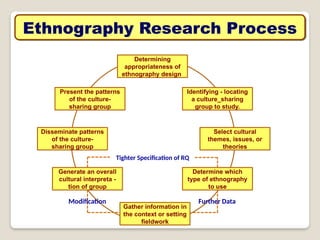
Ethnography Research Process
Determining
appropriateness of
ethnography design
Identifying - locating
a culture_sharing
group to study.
Select cultural
themes, issues, or
theories
Determine which
type of ethnography
to use
Gather information in
the context or setting
fieldwork
Present the patterns
of the culture-
sharing group
Disseminate patterns
of the culture-
sharing group
Generate an overall
cultural interpreta -
tion of group
Tighter Specification of RQ
Further Data
Modification
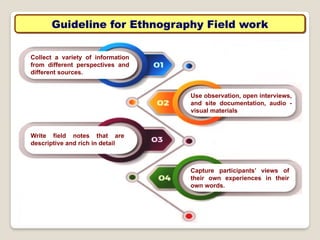
Guideline for Ethnography Field work
Collect a variety of information
from different perspectives and
different sources.
Use observation, open interviews,
and site documentation, audio -
visual materials
Write field notes that are
descriptive and rich in detail
Capture participants’ views of
their own experiences in their
own words.
Two types of Observation Method
Passive observation
• Passive observation which can also be known as ‘shadowing’ is where a
user or users are shadowed while they go about their everyday tasks
observed by a researcher.
• Using a number of methods such as taking notes, photographs, sketches
or videos. The research may be conducted as part of a team so that a
larger number of users can be observed and therefore gaining a greater
insight quickly.
Contextual interviews
• Contextual interviews are where the researcher will interact with users
while observing them.
• The interviews will be held in a natural environment, so as not to feel too
formal.
Analysis of Ethnographic Data
• In ethnographic research, analysis takes place throughout the project and is
tightly connected with interpretation. Means that, during your research process,
you will continuously analyze, interpret and learn from your empirical data.
• Start with reading through your field notes and other data. Do this several times
to becoming familiar with the empirical data that helps you to understand them.
• Start to make notes on the texts you are reading and pay attention to traces of
patterns, connections, similarities, or contrastive points. Then write analytical
memos of these.
• Reduction of data that are closely connected to your research question
• Formalize the analysis further through coding if necessary or looking for
specific and local meanings in your data.
• Explain preliminary conclusions to your participants for the validation purpose
• Once you have findings and conclusions in mind, you may need to elaborate the
preliminary research question of your study.
Thank You

00 Ethnographic Research-Qualitative data Analysis.pptx

  • 1.
    Ethnographic Research Adopting aCultural Lens to Interpret Observed Behaviour Dr. J D Chandrapal MBA – marketing , PGDHRM, Ph D, CII (Award) – London Development Officer - LIC of India – Ahmedabad - 9825070933
  • 2.
    Ethnography – What? •Ethnography is the branch of anthropology that involves trying to understand how people live their lives. • Ethnography is a study through direct observation of users in their natural environment rather than in a lab. The objective of this type of research is to gain insights into how users interact with things in their natural environment. • It gives voice to people in their own local context, typically relying on verbatim quotations and a “thick” description of events. The story is told through the eyes of local people as they pursue their daily lives in their own communities. • Ethnographer adopts a cultural lens to interpret observed behaviour, ensuring that the behaviours are placed in a culturally relevant & meaningful context. He is focused on the predictable, daily patterns of human thought and behaviour. • As a process, ethnography involves extended observations of the group, most often through participant observation, in which the researcher is immersed in the day-to-day lives of the people and observes and interviews the group participants. Ethnographers study the meaning of the behaviour, the language, and the interaction among members of the culture-sharing group...
  • 3.
    Ethnography – KeyElements Emic Perspective Cultural Understanding Language Practices First-hand Experience Takes a cultural lens to study of people’s lives within their communities to understand Meaning Researcher try to look at culture under study from the inside means lived among inhabitants Being close to the field, in the familiar Settings and collecting first-hand experience Researcher had to learn the language necessary for socializing with inhabitants
  • 4.
    Features of Ethnography •Research takes place ‘in the field’ - People’s actions, behaviour and accounts are studied in everyday contexts, rather than under conditions created by the researcher – such as in unnatural or experimental setups. • Sources of Data - Data are gathered from a range of sources, including documentary evidence of various kinds, but primarily by means of participant observation and/or relatively informal conversations are usually the main ones. • Unstructured Research Design - Data collection is, for the most part, relatively ‘unstructured’, It does not involve a fixed and detailed research design and the categories are not built, they are generated at data analysis stage. • Single Setting - The focus is usually on a few cases, generally fairly small-scale, perhaps a single setting or group of people. This is to facilitate in-depth study. • Subjective Interpretation - The analysis of data involves interpretation of the meanings, functions, and consequences of human actions and institutional practices, and how these are implicated in local, and perhaps also wider, contexts.
  • 5.
    Emic Perspectives • Emicperspective or the ‘native’s point of view’ can be understood as the perspective in which the researcher gains the insider’s point of view of a culture under study through the meanings that the members of that culture live with. • For example. In a particular society, there are special rituals conducted by the people. If the researcher is approaching the field with an emic perspective, he attempts to comprehend the subjective meanings that people give to these practices. He refrains from engaging in an objective study but tries to make sense of the rituals through the eyes of the research participants. • A key feature in emic perspective is that the researcher gives prominence to the data themselves rather than to the theoretical understanding of the conceptual frameworks. • This, however, can be very difficult to attempt as all researchers have preconceived ideas and biases. Now, let us move on to the etic perspective.
  • 6.
    Etic Perspectives • Inthe Etic perspective, the researcher looks at the research field objectively from a distance. • This does not denote that he physically maintains a distance, but highlights that the researcher gives prominence to the theoretical frameworks and concepts and allows these to guide him, rather than be guided by the subjective meanings of the research participants. • Let us comprehend this through an example. A researcher who attempts to apply theories and concepts that already exist in a discipline to comprehend a particular research field is using an etic perspective, as he fails to capture the subjective meaning. • The etic perspective presents an objective outlook of the research field. The researcher does not immerse within the context to a point where he lives the experience of the research participant..
  • 7.
    Methodological Principles ofEthnographies Capture the objective nature of naturally occurring human action, exist independently of the researcher Research does not harm or exploit individuals or groups of people that you are studying Participant observation, conversations & open interviews are central to ethnographic research. Inductive and discovery-based research processes focusing on ‘local interpretations’ Naturalism Understanding Ethic Induction
  • 8.
    Realist Ethnography • Itreflects a particular stance taken by the researcher toward the individuals being studied. • Realist ethnography is an objective account of the situation and reporting objectively on the information learned from participants at a site. • The realist ethnographer narrates the study in a third-person dispassionate voice and reports on what is observed or heard from participants. • The ethnographer remains in the background as an omniscient reporter of the “facts.” The realist also reports objective data in a measured style uncontaminated by personal bias, political goals, and judgment. • Researcher may provide mundane details of everyday life among the people studied & also uses the standard categories for cultural description. • Ethnographer produces the participants’ views through closely edited quotations and has the final word on how the culture is to be interpreted and presented.
  • 9.
    Critical Ethnography • A“critical” approach by including in the research an advocacy perspective. • The critical ethnography is a type of ethnographic research in which the authors advocate for the emancipation of groups marginalized in society. • Critical researchers typically are politically minded individuals who seek, through their research, to speak out against inequality and domination. • For example, critical ethnographers might study schools that provide privileges to certain types of students, or counseling practices that serve to overlook the needs of underrepresented counseling practices that serve to overlook the needs of underrepresented groups. • The major components of a critical ethnography include a value-laden orientation, empowering people by giving them more authority, challenging the status quo, and addressing concerns about power and control. • A critical ethnographer will study issues of power, empowerment, inequality, inequity, dominance, repression, hegemony, and victimization.
  • 10.
    Ethnography Research Process Determining appropriatenessof ethnography design Identifying - locating a culture_sharing group to study. Select cultural themes, issues, or theories Determine which type of ethnography to use Gather information in the context or setting fieldwork Present the patterns of the culture- sharing group Disseminate patterns of the culture- sharing group Generate an overall cultural interpreta - tion of group Tighter Specification of RQ Further Data Modification
  • 11.
    Guideline for EthnographyField work Collect a variety of information from different perspectives and different sources. Use observation, open interviews, and site documentation, audio - visual materials Write field notes that are descriptive and rich in detail Capture participants’ views of their own experiences in their own words.
  • 12.
    Two types ofObservation Method Passive observation • Passive observation which can also be known as ‘shadowing’ is where a user or users are shadowed while they go about their everyday tasks observed by a researcher. • Using a number of methods such as taking notes, photographs, sketches or videos. The research may be conducted as part of a team so that a larger number of users can be observed and therefore gaining a greater insight quickly. Contextual interviews • Contextual interviews are where the researcher will interact with users while observing them. • The interviews will be held in a natural environment, so as not to feel too formal.
  • 13.
    Analysis of EthnographicData • In ethnographic research, analysis takes place throughout the project and is tightly connected with interpretation. Means that, during your research process, you will continuously analyze, interpret and learn from your empirical data. • Start with reading through your field notes and other data. Do this several times to becoming familiar with the empirical data that helps you to understand them. • Start to make notes on the texts you are reading and pay attention to traces of patterns, connections, similarities, or contrastive points. Then write analytical memos of these. • Reduction of data that are closely connected to your research question • Formalize the analysis further through coding if necessary or looking for specific and local meanings in your data. • Explain preliminary conclusions to your participants for the validation purpose • Once you have findings and conclusions in mind, you may need to elaborate the preliminary research question of your study.
  • 14.

Editor's Notes

  • #4 What are produced, for the most part, are verbal descriptions, explanations, and theories; quantification and statistical analysis play a subordinate role at most.