Presentation on
the topic
“guidance”
B.Ed notes 4
sem.
- PRESENTED BY :- MS. PRAGATI KACHHI
( UGC NET ,
CTET, AWES EXAM QUALIFIED )
YOUTUBE CHANNEL NAME :- PRAGATI
KACHHI
WHAT IS GUIDANCE ?
“People born with skills , they have potential to conquer the
world but sometimes they divert from right path ,so they need guidance”.
• Meaning :- help or advice
• सहायता या परामर्श
Guidance means “to direct”, “to point out”, “to show the path”. But guidance is not exactly
the process of directing while directing one imposes his opinion on others. Rather
guidance means providing some help or assistance to somebody by somebody.
Guidance is interpreted as a specialized service to help the individual to
solve certain major problems—personal, educational, vocational and the
like.
In fact, the term guidance interpreted so far is not properly defined and
accepted. The reason is that for some it is a concept, a point of view, for
others it is a process and for others it is a group of services and for some it
is a field of study.
So guidance is accepted as both a concept and a process and must be
interpreted accordingly in the educational process.
“Guidance is assistance made available by professionally qualified and adequately trained
men and women to an individual of any age to help him manage his own life activities,
develop his own decisions and carry his own burdons”. —Crow and crow
“Guidance is the process of helping a person to develop and accept an integrated and
adequate picture of himself and of his role in the world of work, to test this concept against
reality and to convert it into reality with satisfaction to himself and benefit to the society”.
—National vocational guidance association (USA)
Scope of guidance:
the dictionary meaning of the term scope implies area, jurisdiction, outlook, range of view,
field or opportunity of activities, breadth, operation, application and subject matter.
• Hence the scope of guidance covers:-
• (I) types of guidance, viz. Personal guidance, educational guidance and vocational guidance.
• (Ii) guidance for adjustment of individual through socialized, curricular, co-curricular activities, community resources,
vocational opportunities, group life, group contacts etc.
• (Iii) individual guidance service
• (Iv) group guidance service.
• (V) devices for collection of data through testing and non-testing devices like achievement test, aptitude test,
personality test, creativity test, intelligence test, attitude scale, interest inventory, interview schedule. Cumulative
record card, observation, check list, rating scale and socio-metric techniques etc.
• (Vi) organisation of guidance services.
• (Vii) counselling services or techniques
• (Viii) role of different personnel involved in guidance and counselling service.
• (Ix) follow-up service in guidance.
Hence the scope of guidance covers:-
(i) Types of guidance, viz. Personal guidance, educational guidance and vocational guidance.
(Ii) guidance for adjustment of individual through socialized, curricular, co-curricular activities, community
resources, vocational opportunities, group life, group contacts etc.
(Iii) individual guidance service.
(Iv) group guidance service.
(V) devices for collection of data through testing and non-testing devices like achievement test, aptitude test,
personality test, creativity test, intelligence test, attitude scale, interest inventory, interview schedule.
Cumulative record card, observation, check list, rating scale and socio-metric techniques etc.
(Vi) organization of guidance services.
(Vii) counselling services or techniques.
(Viii) role of different personnel involved in guidance and counselling service.
(Ix) follow-up service in guidance.
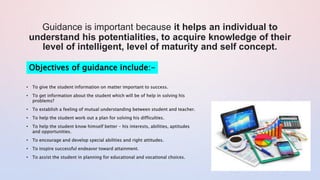
Guidance is important because it helps an individual to
understand his potentialities, to acquire knowledge of their
level of intelligent, level of maturity and self concept.
Objectives of guidance include:-
• To give the student information on matter important to success.
• To get information about the student which will be of help in solving his
problems?
• To establish a feeling of mutual understanding between student and teacher.
• To help the student work out a plan for solving his difficulties.
• To help the student know himself better – his interests, abilities, aptitudes
and opportunities.
• To encourage and develop special abilities and right attitudes.
• To inspire successful endeavor toward attainment.
• To assist the student in planning for educational and vocational choices.
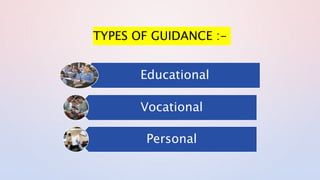
TYPES OF GUIDANCE :-
Educational
Vocational
Personal
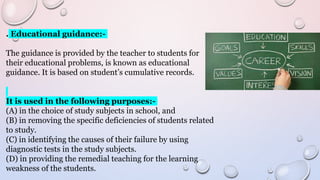
. Educational guidance:-
The guidance is provided by the teacher to students for
their educational problems, is known as educational
guidance. It is based on student’s cumulative records.
It is used in the following purposes:-
(A) in the choice of study subjects in school, and
(B) in removing the specific deficiencies of students related
to study.
(C) in identifying the causes of their failure by using
diagnostic tests in the study subjects.
(D) in providing the remedial teaching for the learning
weakness of the students.
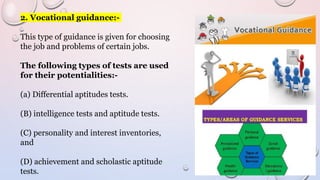
2. Vocational guidance:-
This type of guidance is given for choosing
the job and problems of certain jobs.
The following types of tests are used
for their potentialities:-
(a) Differential aptitudes tests.
(B) intelligence tests and aptitude tests.
(C) personality and interest inventories,
and
(D) achievement and scholastic aptitude
tests.
3. Personal guidance:-
This type of guidance is provided for the personal problems of an
individual or other than educational and vocational problems.
These are:-
(a) Family and home problems.
(B) financial or economic problems.
(C) physical-disabilities of the individual.
(D) emotional adjustment and anxiety or curiosities.
(E) social relationship of the individual and husband wife relations
problems.
(F) school and peers relation or classmates relation, may be
isolated in the class.
Types of tools used in guidance:
Various types of tools are employed in
guidance services which have been
mentioned as follows:-
(1) anecdotal records
(2) achievement and diagnostic test
(3) psychological tests personality, adjustment,
interest inventories
(4) case-study
(5) autobiography
(6) rating
(7) sociometry or sociogram
(8) questionnaire
(9) observation
(10) interview techniques
(11) school cumulative records
(12) check list
(13) clinical test, eye sight, hearing or audio-test
(14) adjustment inventories, and
(15) conferences with the pupils.
CHARACTERISTICS OF GUIDANCE :-
• 1. It is a help given by one person to another in solving problem.
• 2. It is not giving directions and imposition of one person’s point of view upon another
person.
• 3. It is not making decisions for an individual which he should make for himself.
• 4. It is formal as well as informal process of guidance.
• 5. Guidance is usually given by qualified and trained person to develop own point view of one
self.
• 6. It is a continuous and life long process for all sphere or walk of life.
• 7. It is a purposive process in making choices for his adjustment and solving problems.
• 8. It enables the individual to take decision to grow independently and he is responsible for
himself.
• 9. It stimulates and helps the students to set-up worthwhile. It is a process of development.
• 10. There are people who need help and there are people who can help them.
Characteristics
• . 11guidance and teaching are inseparable to one another.
• 12. It converts the reality into satisfaction to himself and benefit to society.
• 13. It provides richer experiences for making his-own contribution to our democratic
society.
• 14. It is mentally effort to conserve the priceless native capacities of youth and costly
training provided for youth in school.
• 15. It is related to the life goals and makes desirable member of the social order.
• 16. The intelligent guidance makes the teaching-learning process most effective.
Teaching is incomplete without proper guidance.
Principles of guidance:-
Guidance is based on some psychological and sociological principles.
Some of the principles have been listed as follows:-
1. It involves of principles of individual differences, every individual has own
abilities, potentialities and needs.
2. It studies the individual as whole, means physical, emotional, social and
mental structure.
3. It is based on democratic principles. Guidance is for all, for all stages not
for few individuals.
4. Guidance employs to co-operative efforts in solving the problems of an
individual (parents, teachers and experts).
5. It is not prescriptive but progressive procedure for self-guidance. In
guidance awareness is given and decision is taken by the individual.
6. It is a continuous or life long process for all.
7. Guidance is an integral part of an educational programme. Teaching
involves guidance.
8. It is a personalistic approach for human development.
Objectives of guidance:-
guidance is purposeful process. It is assistance to the person which
contributes for his development and brings excellence at the jobs
performances.
• It has the following objectives:-
• 1. To develop competency to solve the problems related to individual adjustment and
social process.
• 2. To assist individual to adjust adequately with the environment.
• 3. To provide information about educational and vocational opportunities or
occupational information.
• 4. To provide the awareness of his potentialities and abilities.
• 5. To help him for developing potentialities and abilities.
• 6. To organize the follow-up programs for the job placement and evaluation of its
effectiveness.
Need for guidance:-
guidance is used for dealing with problems of adjustment and other
problem of life-educational and vocational problems.
• 1. Psychological factors:-
Psychological factors refer to the individual differences and intra- individual differences among his
students. Rate of growth and development—physical, social, emotional and mental information’s are
essential for a teacher. He should know their aptitudes and interests in the school subjects and jobs.
2. Social factors:-
Education is a social process of development. There is increase of enrolment in school and colleges. The
large number of students are admitted in a class, so the personal contact of teacher and taught is not
possible.
3. Philosophical factors:-
There is a rapid change in social philosophy and values of the society. An elective approach
is used to formulate the objectives of education. There is a cultural and social difference in
the classroom it amounts to adjustment problems in the class. It requires guidance for their
adjustment
4. Scientific and technological factor:-
The present era is of scientific and technological advancement in the developing countries.
It also causes the adjustment problems in the society. The computer science has greatly
influenced our daily life activities. It requires the proper guidance for new type problems.
Some specific areas require guidance services:-
(A) mass education needs group and individual guidance.
(B) improving the quality of man and man power.
(C) democratic set up requires talents and excellence in various fields to provide leadership.
(D) guidance is a new process of creative thinking and creative teaching and
(E) guidance is an art of high level of helping boys and girls to plan their own action wisely
For video notes & Explanation subscribe my channel
……………thank you..
guidance notes.pptx

guidance notes.pptx

  • 1.
    Presentation on the topic “guidance” B.Ednotes 4 sem. - PRESENTED BY :- MS. PRAGATI KACHHI ( UGC NET , CTET, AWES EXAM QUALIFIED ) YOUTUBE CHANNEL NAME :- PRAGATI KACHHI
  • 2.
    WHAT IS GUIDANCE? “People born with skills , they have potential to conquer the world but sometimes they divert from right path ,so they need guidance”. • Meaning :- help or advice • सहायता या परामर्श Guidance means “to direct”, “to point out”, “to show the path”. But guidance is not exactly the process of directing while directing one imposes his opinion on others. Rather guidance means providing some help or assistance to somebody by somebody.
  • 3.
    Guidance is interpretedas a specialized service to help the individual to solve certain major problems—personal, educational, vocational and the like. In fact, the term guidance interpreted so far is not properly defined and accepted. The reason is that for some it is a concept, a point of view, for others it is a process and for others it is a group of services and for some it is a field of study. So guidance is accepted as both a concept and a process and must be interpreted accordingly in the educational process.
  • 4.
    “Guidance is assistancemade available by professionally qualified and adequately trained men and women to an individual of any age to help him manage his own life activities, develop his own decisions and carry his own burdons”. —Crow and crow “Guidance is the process of helping a person to develop and accept an integrated and adequate picture of himself and of his role in the world of work, to test this concept against reality and to convert it into reality with satisfaction to himself and benefit to the society”. —National vocational guidance association (USA)
  • 5.
    Scope of guidance: thedictionary meaning of the term scope implies area, jurisdiction, outlook, range of view, field or opportunity of activities, breadth, operation, application and subject matter. • Hence the scope of guidance covers:- • (I) types of guidance, viz. Personal guidance, educational guidance and vocational guidance. • (Ii) guidance for adjustment of individual through socialized, curricular, co-curricular activities, community resources, vocational opportunities, group life, group contacts etc. • (Iii) individual guidance service • (Iv) group guidance service. • (V) devices for collection of data through testing and non-testing devices like achievement test, aptitude test, personality test, creativity test, intelligence test, attitude scale, interest inventory, interview schedule. Cumulative record card, observation, check list, rating scale and socio-metric techniques etc. • (Vi) organisation of guidance services. • (Vii) counselling services or techniques • (Viii) role of different personnel involved in guidance and counselling service. • (Ix) follow-up service in guidance.
  • 6.
    Hence the scopeof guidance covers:- (i) Types of guidance, viz. Personal guidance, educational guidance and vocational guidance. (Ii) guidance for adjustment of individual through socialized, curricular, co-curricular activities, community resources, vocational opportunities, group life, group contacts etc. (Iii) individual guidance service. (Iv) group guidance service. (V) devices for collection of data through testing and non-testing devices like achievement test, aptitude test, personality test, creativity test, intelligence test, attitude scale, interest inventory, interview schedule. Cumulative record card, observation, check list, rating scale and socio-metric techniques etc. (Vi) organization of guidance services. (Vii) counselling services or techniques. (Viii) role of different personnel involved in guidance and counselling service. (Ix) follow-up service in guidance.
  • 7.
    Guidance is importantbecause it helps an individual to understand his potentialities, to acquire knowledge of their level of intelligent, level of maturity and self concept. Objectives of guidance include:- • To give the student information on matter important to success. • To get information about the student which will be of help in solving his problems? • To establish a feeling of mutual understanding between student and teacher. • To help the student work out a plan for solving his difficulties. • To help the student know himself better – his interests, abilities, aptitudes and opportunities. • To encourage and develop special abilities and right attitudes. • To inspire successful endeavor toward attainment. • To assist the student in planning for educational and vocational choices.
  • 8.
    TYPES OF GUIDANCE:- Educational Vocational Personal
  • 9.
    . Educational guidance:- Theguidance is provided by the teacher to students for their educational problems, is known as educational guidance. It is based on student’s cumulative records. It is used in the following purposes:- (A) in the choice of study subjects in school, and (B) in removing the specific deficiencies of students related to study. (C) in identifying the causes of their failure by using diagnostic tests in the study subjects. (D) in providing the remedial teaching for the learning weakness of the students.
  • 10.
    2. Vocational guidance:- Thistype of guidance is given for choosing the job and problems of certain jobs. The following types of tests are used for their potentialities:- (a) Differential aptitudes tests. (B) intelligence tests and aptitude tests. (C) personality and interest inventories, and (D) achievement and scholastic aptitude tests.
  • 11.
    3. Personal guidance:- Thistype of guidance is provided for the personal problems of an individual or other than educational and vocational problems. These are:- (a) Family and home problems. (B) financial or economic problems. (C) physical-disabilities of the individual. (D) emotional adjustment and anxiety or curiosities. (E) social relationship of the individual and husband wife relations problems. (F) school and peers relation or classmates relation, may be isolated in the class.
  • 12.
    Types of toolsused in guidance: Various types of tools are employed in guidance services which have been mentioned as follows:- (1) anecdotal records (2) achievement and diagnostic test (3) psychological tests personality, adjustment, interest inventories (4) case-study (5) autobiography (6) rating (7) sociometry or sociogram (8) questionnaire (9) observation (10) interview techniques (11) school cumulative records (12) check list (13) clinical test, eye sight, hearing or audio-test (14) adjustment inventories, and (15) conferences with the pupils.
  • 13.
    CHARACTERISTICS OF GUIDANCE:- • 1. It is a help given by one person to another in solving problem. • 2. It is not giving directions and imposition of one person’s point of view upon another person. • 3. It is not making decisions for an individual which he should make for himself. • 4. It is formal as well as informal process of guidance. • 5. Guidance is usually given by qualified and trained person to develop own point view of one self. • 6. It is a continuous and life long process for all sphere or walk of life. • 7. It is a purposive process in making choices for his adjustment and solving problems. • 8. It enables the individual to take decision to grow independently and he is responsible for himself. • 9. It stimulates and helps the students to set-up worthwhile. It is a process of development. • 10. There are people who need help and there are people who can help them.
  • 14.
    Characteristics • . 11guidanceand teaching are inseparable to one another. • 12. It converts the reality into satisfaction to himself and benefit to society. • 13. It provides richer experiences for making his-own contribution to our democratic society. • 14. It is mentally effort to conserve the priceless native capacities of youth and costly training provided for youth in school. • 15. It is related to the life goals and makes desirable member of the social order. • 16. The intelligent guidance makes the teaching-learning process most effective. Teaching is incomplete without proper guidance.
  • 15.
    Principles of guidance:- Guidanceis based on some psychological and sociological principles. Some of the principles have been listed as follows:- 1. It involves of principles of individual differences, every individual has own abilities, potentialities and needs. 2. It studies the individual as whole, means physical, emotional, social and mental structure. 3. It is based on democratic principles. Guidance is for all, for all stages not for few individuals. 4. Guidance employs to co-operative efforts in solving the problems of an individual (parents, teachers and experts). 5. It is not prescriptive but progressive procedure for self-guidance. In guidance awareness is given and decision is taken by the individual. 6. It is a continuous or life long process for all. 7. Guidance is an integral part of an educational programme. Teaching involves guidance. 8. It is a personalistic approach for human development.
  • 16.
    Objectives of guidance:- guidanceis purposeful process. It is assistance to the person which contributes for his development and brings excellence at the jobs performances. • It has the following objectives:- • 1. To develop competency to solve the problems related to individual adjustment and social process. • 2. To assist individual to adjust adequately with the environment. • 3. To provide information about educational and vocational opportunities or occupational information. • 4. To provide the awareness of his potentialities and abilities. • 5. To help him for developing potentialities and abilities. • 6. To organize the follow-up programs for the job placement and evaluation of its effectiveness.
  • 17.
    Need for guidance:- guidanceis used for dealing with problems of adjustment and other problem of life-educational and vocational problems. • 1. Psychological factors:- Psychological factors refer to the individual differences and intra- individual differences among his students. Rate of growth and development—physical, social, emotional and mental information’s are essential for a teacher. He should know their aptitudes and interests in the school subjects and jobs. 2. Social factors:- Education is a social process of development. There is increase of enrolment in school and colleges. The large number of students are admitted in a class, so the personal contact of teacher and taught is not possible.
  • 18.
    3. Philosophical factors:- Thereis a rapid change in social philosophy and values of the society. An elective approach is used to formulate the objectives of education. There is a cultural and social difference in the classroom it amounts to adjustment problems in the class. It requires guidance for their adjustment 4. Scientific and technological factor:- The present era is of scientific and technological advancement in the developing countries. It also causes the adjustment problems in the society. The computer science has greatly influenced our daily life activities. It requires the proper guidance for new type problems. Some specific areas require guidance services:- (A) mass education needs group and individual guidance. (B) improving the quality of man and man power. (C) democratic set up requires talents and excellence in various fields to provide leadership. (D) guidance is a new process of creative thinking and creative teaching and (E) guidance is an art of high level of helping boys and girls to plan their own action wisely
  • 19.
    For video notes& Explanation subscribe my channel ……………thank you..