ETHNOGRAPHY
FAUZI ATUNNISA
NADIA MAYANG SARI
RIZKA ISNATA
SHERLY DWI PUTRI FERDI
SUCI
Focus
area
• Meaning and Definition
• Purpose of Ethnographic Research
• Characteristic of Ethnographic
Research
• Use of Ethnography
• Methodology of Ethnographic
Research
• Steps involve in Ethnographic
Research Method
• Skills required for Ethnography
studies
Presentation title 2
Meaning and Definition
• Ethnography is a Social science research method. It is primary data
collection method. It is mainly combined with social background. A
qualitative approach that studies the cultural patterns and perspectives of
participants in their natural setting.
• Ethnography came from the Greek, it identifies its roots in sociology and
anthropology.
*Ethnos = People
*Graphing = Writing
• "Ethnography literally means 'a portrait of a people'. Ethnography is a
written description of a particular culture, the custom, belief and
behaviour based on information collected through field work." (Harris and
Johnson 2000).
Presentation title 3
• Ethnography is the study of social interactions, behaviour and
perceptions that occur within organizations team communities and
Groups.
• Hammersley (1985) the task is to document the culture the perspective
of practices of the people in the settings the aim is to get inside the
way each group of people sees the world.
• Creswell (1998) explained that the ethnography study looks at people
in interaction in ordinary settings and attempts to discern pervasive
patterns such as life cycle, events and cultural themes
Presentation title 4
Purpose of Ethnographic Research
• The main purpose of ethnography is to obtain a deep understanding of people and their culture.
• One distinguishing feature is fieldwork.
• In ethnographic research, the context is what defines the situation and makes it what it is
Characteristic of Ethnographic Research
Presentation title 6
According to Hammersley and Sanders, ethnography is characterized by the following
features:
• People's behaviour is studied in everyday contexts.
• It is conducted in a natural setting.
• Its goal is more likely to be exploratory rather than evaluative.
• It is aimed at discovering the local person's or "native's" point of view, wherein, the native
may be a consumer or an end-user.
• Data are gathered from a wide range of sources, but observation and/or relatively
informal conversations are usually the principal ones.
• The approach to data collection is unstructured in that it does not involve following
through a predetermined detailed plan set up at the beginning of the study nor does it
determine the categories that will be used for analyzing and interpreting the soft data
obtained. This does not mean that the research is unsystematic. It simply means that
initially the data are collected as raw form and a wide amount as feasible
Use of
Ethnography
Presentation title 7
Ethnography is primarily used in the following instances:
• While searching for the meanings of cultural norms and views.
• In trying to understand the reasons for the use of certain behavior or practices.
• For examining social trends and instances like divorce, illness, migration.
• For examining social interactions and encounters.
• To understand the roles of families and organizations and their behavior.
• To identify new patterns and gain new insights into social phenomenon
• To understand the hygiene and sanitation practices of communities.
• To observe the types of punishment given to children at school.
• To study the behaviour of workers in an organization.
Methodology of Ethnographic
Research
Presentation title 8
1. Objectivity:
➤ In ethnographic study, being objective is important. Here objectivity means that one
must look at the culture in its own terms and not push once on actuality or judgements
upon it.
2. Interviews:
➤To learn from people what has been believed, how they think and how that affect the
life interviewing is an efficient method
3. Participant Observation:
➤In participant observation, the researcher is connected to the basics of human
experiences, participates in their activities, to know how and why of human behaviour
in a particular context and gains a deep knowledge about the intricacies and inner
workings through immersion.
4. Survey:
➤ The demographic information is obtained through survey. Surveys are used to get
beliefs and views without providing specific direction to the person being surveyed.
Own sentiments should not be introduced into a survey.
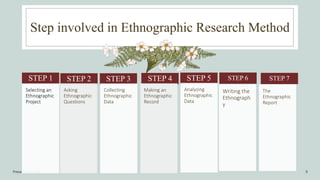
Step involved in Ethnographic Research Method
Presentation title 9
STEP 1
Selecting an
Ethnographic
Project
STEP 2
Asking
Ethnographic
Questions
STEP 3
Collecting
Ethnographic
Data
STEP 4
Making an
Ethnographic
Record
STEP 5
Analyzing
Ethnographic
Data
STEP 6
Writing the
Ethnograph
y
STEP 7
The
Ethnographic
Report
1. Selecting an Ethnographic Project:
• The scope of project can vary greatly, from studying a whole complex society to a single
social situation.
• So, that it can be completed in reasonable time. A social institution always has three
components a place, actors, and activities.
2. Asking Ethnographic Questions:
• The ethnographer needs to have questions in mind that will guide what the researchers sees
and hears and the collection of data.
3. Collecting Ethnographic Data:
• The researcher does field work to find out the activities of the people, the physical
characteristics of the situation and what it feels like to be part of the situation
• The step generally begins with an overview comprising broad descriptive observations.
• Then after looking at the data, one can move on to more focused observations. Here, the
researcher can use participant observation, in-depth interviews and so on to gather data
Presentation title 10
4. Making an Ethnographic Record:
• This step includes taking field notes, photographs, making maps and, using any other
appropriate means to record the observations.
5. Analyzing Ethnographic Data:
• The field work is always followed by data analysis, which leads to new questions and new
hypothesis more data collection and field notes and more analysis.
• The cycle continues until the project is completed.
6. Writing the Ethnography:
• The ethnographic report should be written so that the culture or group is brought to life,
making readers feel they understand that people and the way of life.
Presentation title 11
7. Ethnographic Report:
• The ethnographic report can range in length from several pages to a volume or two.
• One can greatly simplify this task by beginning the writing early as data accumulated
instead waiting until the end.
• The writing task will also be easier if, before writing one read other well-written
ethnographies.
Presentation title 12
Skills required for Ethnographic Studies
Ethnographic studies require wide range of skills. These can be briefly listed as follows:
• High degree of interpretative agility is required to understand the wide range of issues and facts
involved in the study.
• The researcher needs to be unbiased and unprejudiced in order for the study to draw valid and
reliable conclusions.
• The researcher needs to be familiar with the social settings and needs to have a high degree of
intellectuality and diplomacy.
• The researcher needs to be familiar with the social settings and needs to have a high degree of
intellectuality and diplomacy.
• The researcher needs to be sensitive towards the culture, values and norms of the social setting in
which the study is being conducted
Presentation title 13
Do’s and Don’ts Do’s : Do’s
• Have an open mind, free of any kinds of prejudice or biasness.
• Participate as much as you can in the interactions.
• Keep a simple stature so that the people feel comfortable and act naturally.
• An ethnographer needs to be able to differentiate between interesting and actionable findings
• A prior study and understanding of the group and the environment is vital for a good ethnographic
study.
• Good understanding of social science theory, research methods and research design is important for
conducting ethnographic studies.
• Think about what you are going to ask beforehand and get familiar with the questions.
• During an interview try to put your respondents at ease and choose a setting where your interviewee
will feel safe and comfortable.
• Do figure beforehand how the observations are to be recorded.
• Conduct the study in a relaxed and stress free mood.
• Always keep in mind to respect the ethics and norms of the group under the study.
Presentation title 14
Don’ts Do’s:
• Do not interrupt and simply observe.
• Never put pressure on the study subjects.
• Do not offend the culture, values and norms of the group under study.
• Do not over dress and keep your actions limited.
• Never distort the facts to meet the research aim.
• Never go unprepared and without prior understanding of the group.
• Never cross the ethical boundaries to conduct the research
Presentation title 15
Advantages:
• It provides extensive and in-deptn findings about numan behaviour.
• It can evolve and explore new enquiry.
• It provides opportunities to study in-depth a variety of cultural aspects of present-
day human population and their ways of life.
• It allows to utilize the range of unique methods like focus groups, participant
observation, interviews, and direct field observations.
• It offers researcher rich and through commentary on human behaviour, culture and
society as whole.
• Participant observation gives opportunities to collect observed insights into social
practices which are usually concealed.
Presentation title 16
Shortcomings:
• In ethnography, there is a chance of researcher bias.
• It deals most solely with qualitative data.
• Statistics and numbers are replaced with recorded statements of individuals and the
observations of the researcher.
• To provide an accurate and legitimate conclusion the researcher must visit the
place several times.
• The unpredictable occurrences are common sense it occurs in uncontrolled environment.
• It is nonreplicable as the human behaviour can be influenced by numerous variables at any
given moment.
• The results can't be generalized to other time periods or to other cultures due to its
specificity
Presentation title 17
THANK YOU
“
”

ETHNOGRAPHY. presentation for advanced classroom action research

  • 1.
    ETHNOGRAPHY FAUZI ATUNNISA NADIA MAYANGSARI RIZKA ISNATA SHERLY DWI PUTRI FERDI SUCI
  • 2.
    Focus area • Meaning andDefinition • Purpose of Ethnographic Research • Characteristic of Ethnographic Research • Use of Ethnography • Methodology of Ethnographic Research • Steps involve in Ethnographic Research Method • Skills required for Ethnography studies Presentation title 2
  • 3.
    Meaning and Definition •Ethnography is a Social science research method. It is primary data collection method. It is mainly combined with social background. A qualitative approach that studies the cultural patterns and perspectives of participants in their natural setting. • Ethnography came from the Greek, it identifies its roots in sociology and anthropology. *Ethnos = People *Graphing = Writing • "Ethnography literally means 'a portrait of a people'. Ethnography is a written description of a particular culture, the custom, belief and behaviour based on information collected through field work." (Harris and Johnson 2000). Presentation title 3
  • 4.
    • Ethnography isthe study of social interactions, behaviour and perceptions that occur within organizations team communities and Groups. • Hammersley (1985) the task is to document the culture the perspective of practices of the people in the settings the aim is to get inside the way each group of people sees the world. • Creswell (1998) explained that the ethnography study looks at people in interaction in ordinary settings and attempts to discern pervasive patterns such as life cycle, events and cultural themes Presentation title 4
  • 5.
    Purpose of EthnographicResearch • The main purpose of ethnography is to obtain a deep understanding of people and their culture. • One distinguishing feature is fieldwork. • In ethnographic research, the context is what defines the situation and makes it what it is
  • 6.
    Characteristic of EthnographicResearch Presentation title 6 According to Hammersley and Sanders, ethnography is characterized by the following features: • People's behaviour is studied in everyday contexts. • It is conducted in a natural setting. • Its goal is more likely to be exploratory rather than evaluative. • It is aimed at discovering the local person's or "native's" point of view, wherein, the native may be a consumer or an end-user. • Data are gathered from a wide range of sources, but observation and/or relatively informal conversations are usually the principal ones. • The approach to data collection is unstructured in that it does not involve following through a predetermined detailed plan set up at the beginning of the study nor does it determine the categories that will be used for analyzing and interpreting the soft data obtained. This does not mean that the research is unsystematic. It simply means that initially the data are collected as raw form and a wide amount as feasible
  • 7.
    Use of Ethnography Presentation title7 Ethnography is primarily used in the following instances: • While searching for the meanings of cultural norms and views. • In trying to understand the reasons for the use of certain behavior or practices. • For examining social trends and instances like divorce, illness, migration. • For examining social interactions and encounters. • To understand the roles of families and organizations and their behavior. • To identify new patterns and gain new insights into social phenomenon • To understand the hygiene and sanitation practices of communities. • To observe the types of punishment given to children at school. • To study the behaviour of workers in an organization.
  • 8.
    Methodology of Ethnographic Research Presentationtitle 8 1. Objectivity: ➤ In ethnographic study, being objective is important. Here objectivity means that one must look at the culture in its own terms and not push once on actuality or judgements upon it. 2. Interviews: ➤To learn from people what has been believed, how they think and how that affect the life interviewing is an efficient method 3. Participant Observation: ➤In participant observation, the researcher is connected to the basics of human experiences, participates in their activities, to know how and why of human behaviour in a particular context and gains a deep knowledge about the intricacies and inner workings through immersion. 4. Survey: ➤ The demographic information is obtained through survey. Surveys are used to get beliefs and views without providing specific direction to the person being surveyed. Own sentiments should not be introduced into a survey.
  • 9.
    Step involved inEthnographic Research Method Presentation title 9 STEP 1 Selecting an Ethnographic Project STEP 2 Asking Ethnographic Questions STEP 3 Collecting Ethnographic Data STEP 4 Making an Ethnographic Record STEP 5 Analyzing Ethnographic Data STEP 6 Writing the Ethnograph y STEP 7 The Ethnographic Report
  • 10.
    1. Selecting anEthnographic Project: • The scope of project can vary greatly, from studying a whole complex society to a single social situation. • So, that it can be completed in reasonable time. A social institution always has three components a place, actors, and activities. 2. Asking Ethnographic Questions: • The ethnographer needs to have questions in mind that will guide what the researchers sees and hears and the collection of data. 3. Collecting Ethnographic Data: • The researcher does field work to find out the activities of the people, the physical characteristics of the situation and what it feels like to be part of the situation • The step generally begins with an overview comprising broad descriptive observations. • Then after looking at the data, one can move on to more focused observations. Here, the researcher can use participant observation, in-depth interviews and so on to gather data Presentation title 10
  • 11.
    4. Making anEthnographic Record: • This step includes taking field notes, photographs, making maps and, using any other appropriate means to record the observations. 5. Analyzing Ethnographic Data: • The field work is always followed by data analysis, which leads to new questions and new hypothesis more data collection and field notes and more analysis. • The cycle continues until the project is completed. 6. Writing the Ethnography: • The ethnographic report should be written so that the culture or group is brought to life, making readers feel they understand that people and the way of life. Presentation title 11
  • 12.
    7. Ethnographic Report: •The ethnographic report can range in length from several pages to a volume or two. • One can greatly simplify this task by beginning the writing early as data accumulated instead waiting until the end. • The writing task will also be easier if, before writing one read other well-written ethnographies. Presentation title 12
  • 13.
    Skills required forEthnographic Studies Ethnographic studies require wide range of skills. These can be briefly listed as follows: • High degree of interpretative agility is required to understand the wide range of issues and facts involved in the study. • The researcher needs to be unbiased and unprejudiced in order for the study to draw valid and reliable conclusions. • The researcher needs to be familiar with the social settings and needs to have a high degree of intellectuality and diplomacy. • The researcher needs to be familiar with the social settings and needs to have a high degree of intellectuality and diplomacy. • The researcher needs to be sensitive towards the culture, values and norms of the social setting in which the study is being conducted Presentation title 13
  • 14.
    Do’s and Don’tsDo’s : Do’s • Have an open mind, free of any kinds of prejudice or biasness. • Participate as much as you can in the interactions. • Keep a simple stature so that the people feel comfortable and act naturally. • An ethnographer needs to be able to differentiate between interesting and actionable findings • A prior study and understanding of the group and the environment is vital for a good ethnographic study. • Good understanding of social science theory, research methods and research design is important for conducting ethnographic studies. • Think about what you are going to ask beforehand and get familiar with the questions. • During an interview try to put your respondents at ease and choose a setting where your interviewee will feel safe and comfortable. • Do figure beforehand how the observations are to be recorded. • Conduct the study in a relaxed and stress free mood. • Always keep in mind to respect the ethics and norms of the group under the study. Presentation title 14
  • 15.
    Don’ts Do’s: • Donot interrupt and simply observe. • Never put pressure on the study subjects. • Do not offend the culture, values and norms of the group under study. • Do not over dress and keep your actions limited. • Never distort the facts to meet the research aim. • Never go unprepared and without prior understanding of the group. • Never cross the ethical boundaries to conduct the research Presentation title 15
  • 16.
    Advantages: • It providesextensive and in-deptn findings about numan behaviour. • It can evolve and explore new enquiry. • It provides opportunities to study in-depth a variety of cultural aspects of present- day human population and their ways of life. • It allows to utilize the range of unique methods like focus groups, participant observation, interviews, and direct field observations. • It offers researcher rich and through commentary on human behaviour, culture and society as whole. • Participant observation gives opportunities to collect observed insights into social practices which are usually concealed. Presentation title 16
  • 17.
    Shortcomings: • In ethnography,there is a chance of researcher bias. • It deals most solely with qualitative data. • Statistics and numbers are replaced with recorded statements of individuals and the observations of the researcher. • To provide an accurate and legitimate conclusion the researcher must visit the place several times. • The unpredictable occurrences are common sense it occurs in uncontrolled environment. • It is nonreplicable as the human behaviour can be influenced by numerous variables at any given moment. • The results can't be generalized to other time periods or to other cultures due to its specificity Presentation title 17
  • 18.