Curriculum and Methods of Instruction:
Teaching English as a Foreign Language
How to Design and Evaluation Research in Education
Ethnographic Research
By:
Hadeel Al mawaly
Supervised by :
Prof. Dina Al Jamal
what is the Ethnographic
research?
Ethnographic research is a qualitative method
where researchers observe and interact with a
study’s participants in their real-life situation.
Ethnographic research is particularly appropriate
for behaviors that are best understood by observing
them within their natural settings.
The Unique Value of Ethnographic
research
 A key strength of ethnographic research is that it
provides the researcher with a much more
comprehensive perspective than do other forms of
educational research.
Ethnographic concepts
• The concept of culture is typically
defined in one of two ways. Those who
focus on behavior define it as the sum of
a social group’s observable patterns of
behavior, customs, and ways of life.
Those who concentrate on ideas say that
it comprises the ideas, beliefs, and
knowledge that characterize a particular
group of people. nevertheless one
defines it, culture is the most important
of all ethnographic concepts.
Culture
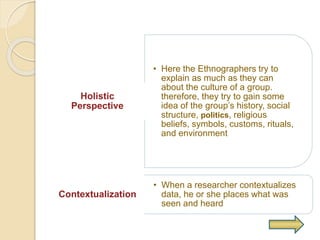
• Here the Ethnographers try to
explain as much as they can
about the culture of a group.
therefore, they try to gain some
idea of the group’s history, social
structure, politics, religious
beliefs, symbols, customs, rituals,
and environment
Holistic
Perspective
• When a researcher contextualizes
data, he or she places what was
seen and heard
Contextualization
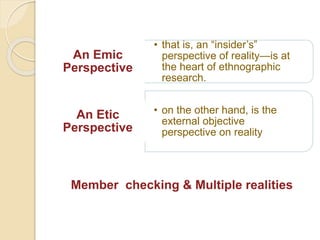
• that is, an “insider’s”
perspective of reality—is at
the heart of ethnographic
research.
An Emic
Perspective
• on the other hand, is the
external objective
perspective on reality
An Etic
Perspective
Member checking & Multiple realities
Do Ethnographic Researches use
Hypothesis?
Ethnographic researchers seldom
formulate precise hypotheses ahead
of time. Rather, they develop them as
their study emerges.
Sampling in Ethnographic Research
The sample in ethnographic studies is
almost always purposive.
 The data obtained from ethnographic
research samples rarely, if ever,
permit generalization to a population.
Data Collection and Analysis in
Ethnographic Research
 The two major means of data collection in
ethnographic research are participant observation
and detailed interviewing.
 • Researchers use a variety of instruments in
ethnographic studies to collect data and to check
validity. This is frequently referred to as triangulation.
 • Analysis consists of continual reworking of data with
emphasis on patterns, key events, and use of visual
representations in addition to interviews and
observations.
Data Collection in Ethnographic
Research
Interviewing
participant observation
Field notes
Field jottings
field diary
field log
Advantages & Disadvantages
Advantages Disadvantages
• It provides the researcher with a
much more comprehensive
•Perspective than do other forms of
educational research.
• It is highly dependent on the
• Particular researcher’s
observations and interpretations.
• It lends itself well to research
topics that are not easily quantified.
• Usually there is no way to check
the validity of the researcher’s
• Conclusions.
• It is particularly
• appropriate to behaviors that are
best understood by observing them
within their natural settings.
• Observer bias is almost
impossible to eliminate.
• It is especially
• Suited to studying group behavior
over time.
• Preplanning and review by others
are
• Much less useful than in
quantitative studies.
FIELDWORK
• Field notes are the notes a researcher in an ethnographic
study takes in the field. They include both descriptive field
notes (what he or she sees and hears) and reflective field
notes (what he or she thinks about what has been observed).
• Field jottings refer to quick notes about something the
researcher wants to write more about later.
• A field diary is a personal statement of the researcher’s
feelings and opinions about the people and situations he or
she is observing.
• A field log is a sort of running account of how the researcher
plans to spend his or her time compared to how he or she
actually spends it.
Ethnographic research

Ethnographic research

  • 1.
    Curriculum and Methodsof Instruction: Teaching English as a Foreign Language How to Design and Evaluation Research in Education Ethnographic Research By: Hadeel Al mawaly Supervised by : Prof. Dina Al Jamal
  • 3.
    what is theEthnographic research? Ethnographic research is a qualitative method where researchers observe and interact with a study’s participants in their real-life situation. Ethnographic research is particularly appropriate for behaviors that are best understood by observing them within their natural settings.
  • 4.
    The Unique Valueof Ethnographic research  A key strength of ethnographic research is that it provides the researcher with a much more comprehensive perspective than do other forms of educational research.
  • 5.
    Ethnographic concepts • Theconcept of culture is typically defined in one of two ways. Those who focus on behavior define it as the sum of a social group’s observable patterns of behavior, customs, and ways of life. Those who concentrate on ideas say that it comprises the ideas, beliefs, and knowledge that characterize a particular group of people. nevertheless one defines it, culture is the most important of all ethnographic concepts. Culture
  • 6.
    • Here theEthnographers try to explain as much as they can about the culture of a group. therefore, they try to gain some idea of the group’s history, social structure, politics, religious beliefs, symbols, customs, rituals, and environment Holistic Perspective • When a researcher contextualizes data, he or she places what was seen and heard Contextualization
  • 7.
    • that is,an “insider’s” perspective of reality—is at the heart of ethnographic research. An Emic Perspective • on the other hand, is the external objective perspective on reality An Etic Perspective Member checking & Multiple realities
  • 8.
    Do Ethnographic Researchesuse Hypothesis? Ethnographic researchers seldom formulate precise hypotheses ahead of time. Rather, they develop them as their study emerges.
  • 10.
    Sampling in EthnographicResearch The sample in ethnographic studies is almost always purposive.  The data obtained from ethnographic research samples rarely, if ever, permit generalization to a population.
  • 11.
    Data Collection andAnalysis in Ethnographic Research  The two major means of data collection in ethnographic research are participant observation and detailed interviewing.  • Researchers use a variety of instruments in ethnographic studies to collect data and to check validity. This is frequently referred to as triangulation.  • Analysis consists of continual reworking of data with emphasis on patterns, key events, and use of visual representations in addition to interviews and observations.
  • 12.
    Data Collection inEthnographic Research Interviewing participant observation Field notes Field jottings field diary field log
  • 14.
    Advantages & Disadvantages AdvantagesDisadvantages • It provides the researcher with a much more comprehensive •Perspective than do other forms of educational research. • It is highly dependent on the • Particular researcher’s observations and interpretations. • It lends itself well to research topics that are not easily quantified. • Usually there is no way to check the validity of the researcher’s • Conclusions. • It is particularly • appropriate to behaviors that are best understood by observing them within their natural settings. • Observer bias is almost impossible to eliminate. • It is especially • Suited to studying group behavior over time. • Preplanning and review by others are • Much less useful than in quantitative studies.
  • 15.
    FIELDWORK • Field notesare the notes a researcher in an ethnographic study takes in the field. They include both descriptive field notes (what he or she sees and hears) and reflective field notes (what he or she thinks about what has been observed). • Field jottings refer to quick notes about something the researcher wants to write more about later. • A field diary is a personal statement of the researcher’s feelings and opinions about the people and situations he or she is observing. • A field log is a sort of running account of how the researcher plans to spend his or her time compared to how he or she actually spends it.