An Introduction
An Introduction
Dr. J D Chandrapal
MBA marketing PGDHRM Ph D CII (Award) London
MBA – marketing , PGDHRM, Ph D, CII (Award) – London
Development Officer - LIC of India – Ahmedabad - 9825070933
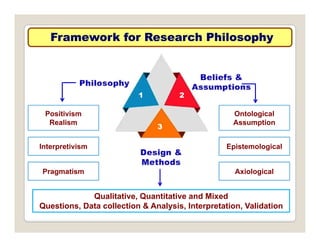
Framework for Research Philosophy
1 2
Ontological
Assumption
Positivism
Realism
3
Epistemological
A iological
Interpretivism
Pragmatism
Qualitative, Quantitative and Mixed
Axiological
Pragmatism
Questions, Data collection & Analysis, Interpretation, Validation
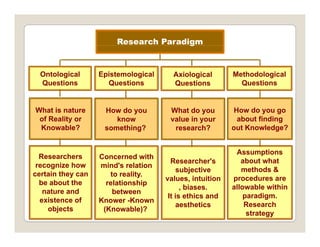
Research Paradigm
Ontological Epistemological Axiological Methodological
g
O to og ca
Questions
p ste o og ca
Questions
Axiological
Questions
et odo og ca
Questions
Wh t i t H d Wh t d H d
What is nature
of Reality or
Knowable?
How do you
know
something?
What do you
value in your
research?
How do you go
about finding
out Knowledge?
Researchers
recognize how
Concerned with
mind's relation
Researcher's
subjective
Assumptions
about what
methods &
certain they can
be about the
nature and
existence of
to reality.
relationship
between
Knower -Known
subjective
values, intuition
, biases.
It is ethics and
methods &
procedures are
allowable within
paradigm.
existence of
objects
Knower -Known
(Knowable)?
aesthetics Research
strategy
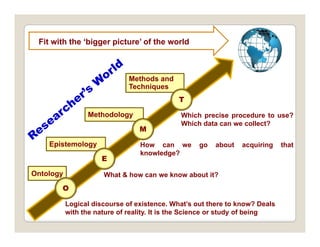
Fit with the ‘bigger picture’ of the world
M th d d
gg p
Methods and
Techniques
T
Methodology Which precise procedure to use?
Which data can we collect?
M
Epistemology How can we go about acquiring that
knowledge?
E
Ontology
i l di f i Wh ’ h k ? D l
What & how can we know about it?
O
Logical discourse of existence. What’s out there to know? Deals
with the nature of reality. It is the Science or study of being
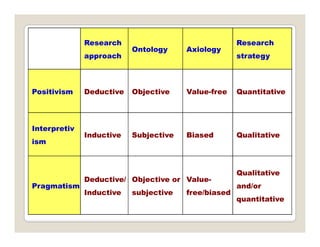
Research Research
approach
Ontology Axiology
strategy
Positivism Deductive Objective Value-free Quantitative
Interpretiv
i
Inductive Subjective Biased Qualitative
ism
j
Q lit ti
Pragmatism
Deductive/
Inductive
Objective or
subjective
Value-
free/biased
Qualitative
and/or
quantitative
quantitative
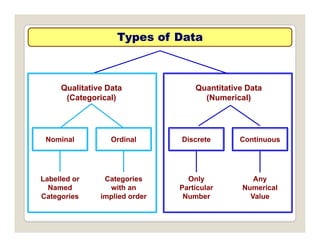
Types of Data
Types of Data
Qualitative Data
(Categorical)
Quantitative Data
(Numerical)
Nominal Ordinal Discrete Continuous
Labelled or
Named
Categories
Categories
with an
implied order
Only
Particular
Number
Any
Numerical
Value
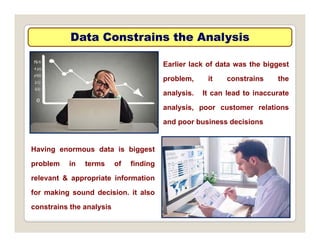
Data Constrains the Analysis
Earlier lack of data was the biggest
bl it t i th
problem, it constrains the
analysis. It can lead to inaccurate
analysis poor customer relations
analysis, poor customer relations
and poor business decisions
Having enormous data is biggest
problem in terms of finding
relevant & appropriate information
for making sound decision. it also
constrains the analysis
Data Analysis
Data Analysis –
– What?
What?
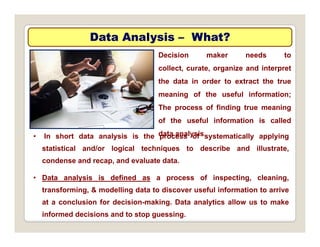
Decision maker needs to
collect, curate, organize and interpret
the data in order to extract the true
meaning of the useful information;
The process of finding true meaning
• In short data analysis is the process of systematically applying
The process of finding true meaning
of the useful information is called
data analysis.
y p y y pp y g
statistical and/or logical techniques to describe and illustrate,
condense and recap, and evaluate data.
• Data analysis is defined as a process of inspecting, cleaning,
transforming, & modelling data to discover useful information to arrive
at a conclusion for decision making Data analytics allow us to make
at a conclusion for decision-making. Data analytics allow us to make
informed decisions and to stop guessing.
Potential of Data analysis
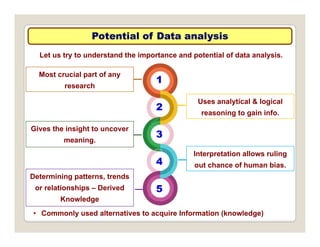
Let us try to understand the importance and potential of data analysis.
Most crucial part of any
1
Most crucial part of any
research
Uses analytical & logical
1
2
reasoning to gain info.
Gives the insight to uncover
meaning
2
3
meaning.
Interpretation allows ruling
out chance of human bias.
4
Determining patterns, trends
or relationships – Derived
Knowledge
5
• Commonly used alternatives to acquire Information (knowledge)
Knowledge
Data Analysis
Data Analysis –
– Why?
Why?
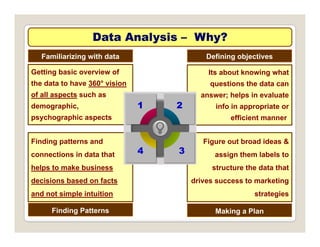
Familiarizing with data Defining objectives
Getting basic overview of Its about knowing what
the data to have 360° vision
of all aspects such as
demographic,
questions the data can
answer; helps in evaluate
info in appropriate or
1 2
demographic,
psychographic aspects
info in appropriate or
efficient manner
Fi di tt d Fi t b d id &
1 2
Finding patterns and
connections in data that
helps to make business
Figure out broad ideas &
assign them labels to
structure the data that
3
4
p
decisions based on facts
and not simple intuition
st uctu e t e data t at
drives success to marketing
strategies
Finding Patterns Making a Plan
Data Analysis Categories
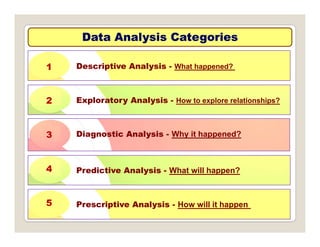
1 Descriptive Analysis - What happened?
2 Exploratory Analysis - How to explore relationships?
3 Diagnostic Analysis - Why it happened?
4 Predictive Analysis What will happen?
4
5
Predictive Analysis - What will happen?
5 Prescriptive Analysis - How will it happen
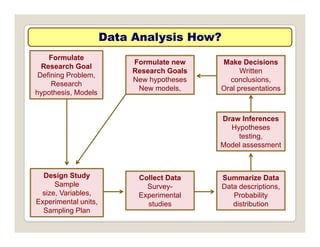
Data Analysis How?
Data Analysis How?
Formulate
Research Goal
Defining Problem
Make Decisions
Written
Formulate new
Research Goals
Defining Problem,
Research
hypothesis, Models
conclusions,
Oral presentations
New hypotheses
New models,
Draw Inferences
Hypotheses
testing,
g,
Model assessment
Collect Data
Survey-
Experimental
t di
Design Study
Sample
size, Variables,
Experimental units
Summarize Data
Data descriptions,
Probability
di t ib ti
studies
Experimental units,
Sampling Plan
distribution
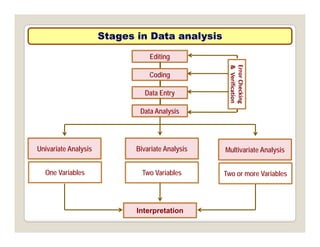
Stages in Data analysis
Editing
Coding
Error
&
Ve
Coding
Data Entry
r
Checking
erification
Data Analysis
Univariate Analysis Bivariate Analysis Multivariate Analysis
O V i bl T V i bl
One Variables Two Variables Two or more Variables
Interpretation

00 - Lecture - 01_MVA - Quantitative Data Analysis - An Introduction.pdf

  • 1.
    An Introduction An Introduction Dr.J D Chandrapal MBA marketing PGDHRM Ph D CII (Award) London MBA – marketing , PGDHRM, Ph D, CII (Award) – London Development Officer - LIC of India – Ahmedabad - 9825070933
  • 2.
    Framework for ResearchPhilosophy Framework for Research Philosophy 1 2 Ontological Assumption Positivism Realism 3 Epistemological A iological Interpretivism Pragmatism Qualitative, Quantitative and Mixed Axiological Pragmatism Questions, Data collection & Analysis, Interpretation, Validation
  • 3.
    Research Paradigm Ontological EpistemologicalAxiological Methodological g O to og ca Questions p ste o og ca Questions Axiological Questions et odo og ca Questions Wh t i t H d Wh t d H d What is nature of Reality or Knowable? How do you know something? What do you value in your research? How do you go about finding out Knowledge? Researchers recognize how Concerned with mind's relation Researcher's subjective Assumptions about what methods & certain they can be about the nature and existence of to reality. relationship between Knower -Known subjective values, intuition , biases. It is ethics and methods & procedures are allowable within paradigm. existence of objects Knower -Known (Knowable)? aesthetics Research strategy
  • 4.
    Fit with the‘bigger picture’ of the world M th d d gg p Methods and Techniques T Methodology Which precise procedure to use? Which data can we collect? M Epistemology How can we go about acquiring that knowledge? E Ontology i l di f i Wh ’ h k ? D l What & how can we know about it? O Logical discourse of existence. What’s out there to know? Deals with the nature of reality. It is the Science or study of being
  • 5.
    Research Research approach Ontology Axiology strategy PositivismDeductive Objective Value-free Quantitative Interpretiv i Inductive Subjective Biased Qualitative ism j Q lit ti Pragmatism Deductive/ Inductive Objective or subjective Value- free/biased Qualitative and/or quantitative quantitative
  • 7.
    Types of Data Typesof Data Qualitative Data (Categorical) Quantitative Data (Numerical) Nominal Ordinal Discrete Continuous Nominal Ordinal Discrete Continuous Labelled or Named Categories Categories with an implied order Only Particular Number Any Numerical Value
  • 8.
    Data Constrains theAnalysis Data Constrains the Analysis Earlier lack of data was the biggest bl it t i th problem, it constrains the analysis. It can lead to inaccurate analysis poor customer relations analysis, poor customer relations and poor business decisions Having enormous data is biggest problem in terms of finding relevant & appropriate information for making sound decision. it also constrains the analysis
  • 9.
    Data Analysis Data Analysis– – What? What? Decision maker needs to collect, curate, organize and interpret the data in order to extract the true meaning of the useful information; The process of finding true meaning • In short data analysis is the process of systematically applying The process of finding true meaning of the useful information is called data analysis. y p y y pp y g statistical and/or logical techniques to describe and illustrate, condense and recap, and evaluate data. • Data analysis is defined as a process of inspecting, cleaning, transforming, & modelling data to discover useful information to arrive at a conclusion for decision making Data analytics allow us to make at a conclusion for decision-making. Data analytics allow us to make informed decisions and to stop guessing.
  • 10.
    Potential of Dataanalysis Potential of Data analysis Let us try to understand the importance and potential of data analysis. Most crucial part of any 1 Most crucial part of any research Uses analytical & logical 1 2 reasoning to gain info. Gives the insight to uncover meaning 2 3 meaning. Interpretation allows ruling out chance of human bias. 4 Determining patterns, trends or relationships – Derived Knowledge 5 • Commonly used alternatives to acquire Information (knowledge) Knowledge
  • 11.
    Data Analysis Data Analysis– – Why? Why? Familiarizing with data Defining objectives Getting basic overview of Its about knowing what the data to have 360° vision of all aspects such as demographic, questions the data can answer; helps in evaluate info in appropriate or 1 2 demographic, psychographic aspects info in appropriate or efficient manner Fi di tt d Fi t b d id & 1 2 Finding patterns and connections in data that helps to make business Figure out broad ideas & assign them labels to structure the data that 3 4 p decisions based on facts and not simple intuition st uctu e t e data t at drives success to marketing strategies Finding Patterns Making a Plan
  • 12.
    Data Analysis Categories DataAnalysis Categories 1 Descriptive Analysis - What happened? 2 Exploratory Analysis - How to explore relationships? 3 Diagnostic Analysis - Why it happened? 4 Predictive Analysis What will happen? 4 5 Predictive Analysis - What will happen? 5 Prescriptive Analysis - How will it happen
  • 13.
    Data Analysis How? DataAnalysis How? Formulate Research Goal Defining Problem Make Decisions Written Formulate new Research Goals Defining Problem, Research hypothesis, Models conclusions, Oral presentations New hypotheses New models, Draw Inferences Hypotheses testing, g, Model assessment Collect Data Survey- Experimental t di Design Study Sample size, Variables, Experimental units Summarize Data Data descriptions, Probability di t ib ti studies Experimental units, Sampling Plan distribution
  • 14.
    Stages in Dataanalysis Stages in Data analysis Editing Coding Error & Ve Coding Data Entry r Checking erification Data Analysis Univariate Analysis Bivariate Analysis Multivariate Analysis O V i bl T V i bl One Variables Two Variables Two or more Variables Interpretation