MCQ – Participant Observation
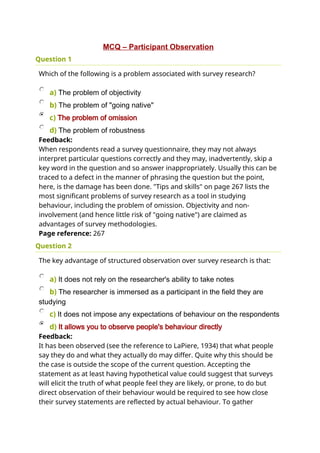
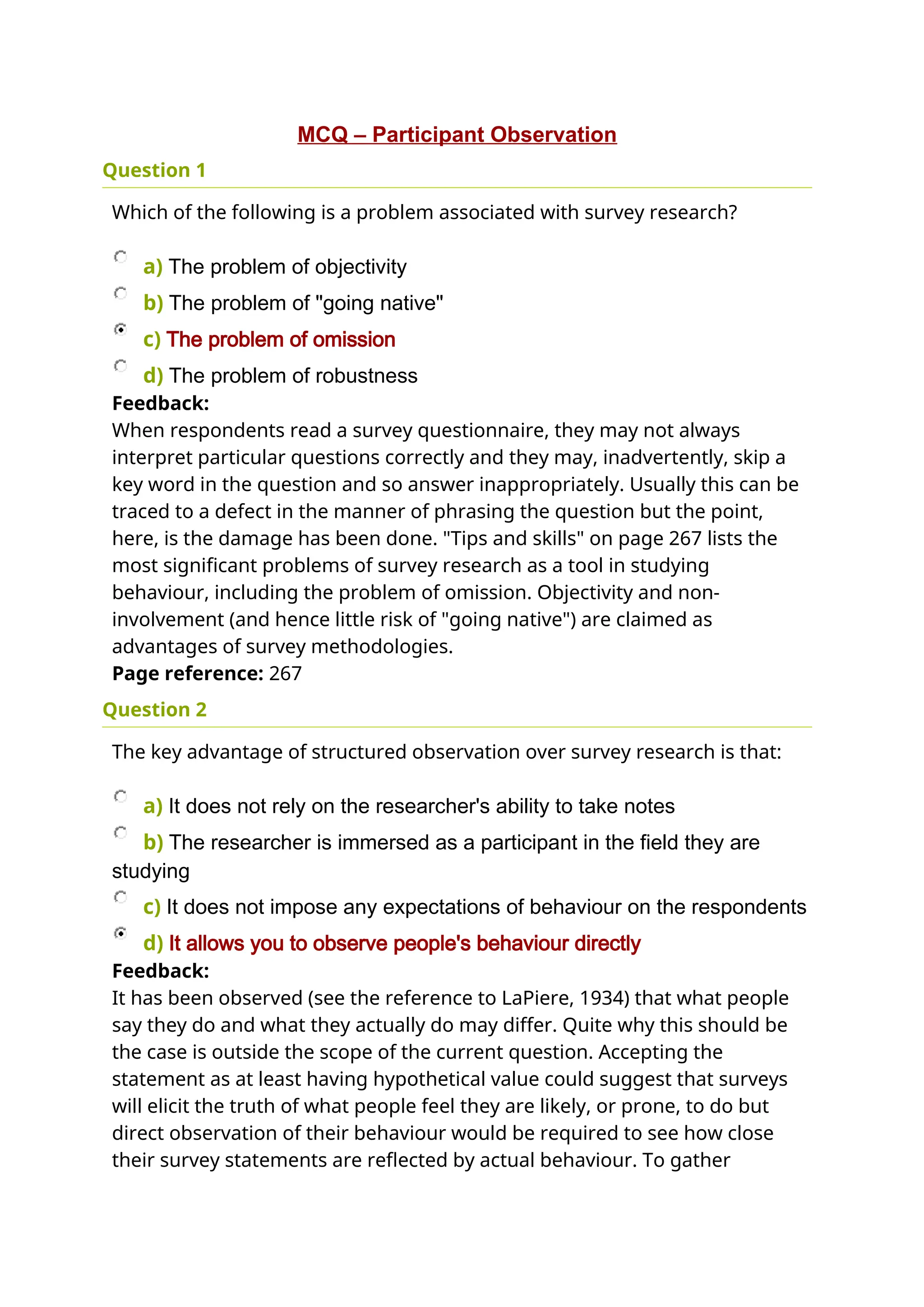
Question 1
Which of the following is a problem associated with survey research?
a) The problem of objectivity
b) The problem of "going native"
c) The problem of omission
d) The problem of robustness
Feedback:
When respondents read a survey questionnaire, they may not always
interpret particular questions correctly and they may, inadvertently, skip a
key word in the question and so answer inappropriately. Usually this can be
traced to a defect in the manner of phrasing the question but the point,
here, is the damage has been done. "Tips and skills" on page 267 lists the
most significant problems of survey research as a tool in studying
behaviour, including the problem of omission. Objectivity and non-
involvement (and hence little risk of "going native") are claimed as
advantages of survey methodologies.
Page reference: 267
Question 2
The key advantage of structured observation over survey research is that:
a) It does not rely on the researcher's ability to take notes
b) The researcher is immersed as a participant in the field they are
studying
c) It does not impose any expectations of behaviour on the respondents
d) It allows you to observe people's behaviour directly
Feedback:
It has been observed (see the reference to LaPiere, 1934) that what people
say they do and what they actually do may differ. Quite why this should be
the case is outside the scope of the current question. Accepting the
statement as at least having hypothetical value could suggest that surveys
will elicit the truth of what people feel they are likely, or prone, to do but
direct observation of their behaviour would be required to see how close
their survey statements are reflected by actual behaviour. To gather
quantitative data, observation needs to be structured into a standardized
format in order to have measurement validity.
Page reference: 268
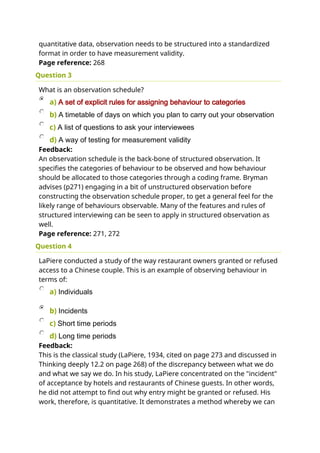
Question 3
What is an observation schedule?
a) A set of explicit rules for assigning behaviour to categories
b) A timetable of days on which you plan to carry out your observation
c) A list of questions to ask your interviewees
d) A way of testing for measurement validity
Feedback:
An observation schedule is the back-bone of structured observation. It
specifies the categories of behaviour to be observed and how behaviour
should be allocated to those categories through a coding frame. Bryman
advises (p271) engaging in a bit of unstructured observation before
constructing the observation schedule proper, to get a general feel for the
likely range of behaviours observable. Many of the features and rules of
structured interviewing can be seen to apply in structured observation as
well.
Page reference: 271, 272
Question 4
LaPiere conducted a study of the way restaurant owners granted or refused
access to a Chinese couple. This is an example of observing behaviour in
terms of:
a) Individuals
b) Incidents
c) Short time periods
d) Long time periods
Feedback:
This is the classical study (LaPiere, 1934, cited on page 273 and discussed in
Thinking deeply 12.2 on page 268) of the discrepancy between what we do
and what we say we do. In his study, LaPiere concentrated on the "incident"
of acceptance by hotels and restaurants of Chinese guests. In other words,
he did not attempt to find out why entry might be granted or refused. His
work, therefore, is quantitative. It demonstrates a method whereby we can
record the way people respond to particular events or incidents in a social
setting. This may only refer to one point in time but will still allow for
comparisons to be made because of high degrees of reliability. It should be
pointed out that LaPiere conducted a survey as the counterpoint for his
argument.
Page reference: 273
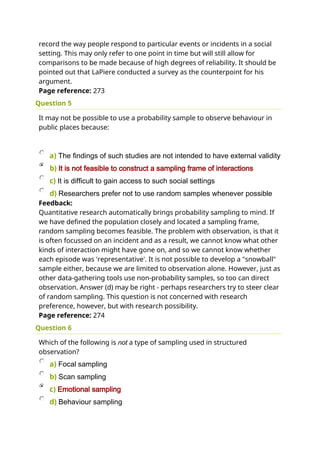
Question 5
It may not be possible to use a probability sample to observe behaviour in
public places because:
a) The findings of such studies are not intended to have external validity
b) It is not feasible to construct a sampling frame of interactions
c) It is difficult to gain access to such social settings
d) Researchers prefer not to use random samples whenever possible
Feedback:
Quantitative research automatically brings probability sampling to mind. If
we have defined the population closely and located a sampling frame,
random sampling becomes feasible. The problem with observation, is that it
is often focussed on an incident and as a result, we cannot know what other
kinds of interaction might have gone on, and so we cannot know whether
each episode was 'representative'. It is not possible to develop a "snowball"
sample either, because we are limited to observation alone. However, just as
other data-gathering tools use non-probability samples, so too can direct
observation. Answer (d) may be right - perhaps researchers try to steer clear
of random sampling. This question is not concerned with research
preference, however, but with research possibility.
Page reference: 274
Question 6
Which of the following is not a type of sampling used in structured
observation?
a) Focal sampling
b) Scan sampling
c) Emotional sampling
d) Behaviour sampling
Feedback:
Martin & Bateson (2007, cited on page 274) identify four main types of
sampling that apply to structured observation. It is important to bear in
mind that the behaviour itself is the focus of study, rather than the person
exhibiting the behaviour, so samples are drawn up according to occurrences
in time. "Ad libitum sampling", records all behaviours observed in a
particular time period whereas, "focal sampling" concentrates on one
individual only, in a set time period. "Scan sampling" observes behaviours
within a group at set intervals. Finally, "behaviour sampling", somewhat
confusingly, occurs by the researcher observing which individuals engage in
which sort of behaviours. We can observe behaviour but there seems no way
we can observe impulses to behaviour, like emotions.
Page reference: 274
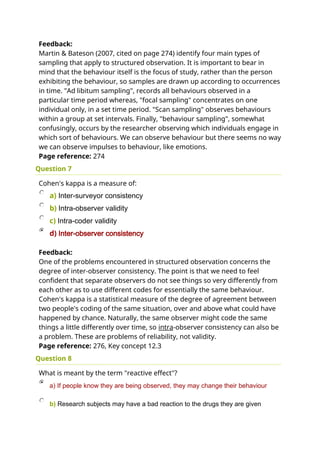
Question 7
Cohen's kappa is a measure of:
a) Inter-surveyor consistency
b) Intra-observer validity
c) Intra-coder validity
d) Inter-observer consistency
Feedback:
One of the problems encountered in structured observation concerns the
degree of inter-observer consistency. The point is that we need to feel
confident that separate observers do not see things so very differently from
each other as to use different codes for essentially the same behaviour.
Cohen's kappa is a statistical measure of the degree of agreement between
two people's coding of the same situation, over and above what could have
happened by chance. Naturally, the same observer might code the same
things a little differently over time, so intra-observer consistency can also be
a problem. These are problems of reliability, not validity.
Page reference: 276, Key concept 12.3
Question 8
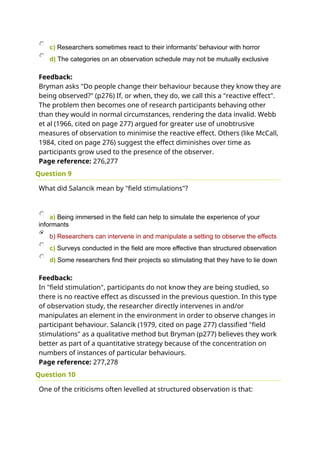
What is meant by the term "reactive effect"?
a) If people know they are being observed, they may change their behaviour
b) Research subjects may have a bad reaction to the drugs they are given
c) Researchers sometimes react to their informants' behaviour with horror
d) The categories on an observation schedule may not be mutually exclusive
Feedback:
Bryman asks "Do people change their behaviour because they know they are
being observed?" (p276) If, or when, they do, we call this a "reactive effect".
The problem then becomes one of research participants behaving other
than they would in normal circumstances, rendering the data invalid. Webb
et al (1966, cited on page 277) argued for greater use of unobtrusive
measures of observation to minimise the reactive effect. Others (like McCall,
1984, cited on page 276) suggest the effect diminishes over time as
participants grow used to the presence of the observer.
Page reference: 276,277
Question 9
What did Salancik mean by "field stimulations"?
a) Being immersed in the field can help to simulate the experience of your
informants
b) Researchers can intervene in and manipulate a setting to observe the effects
c) Surveys conducted in the field are more effective than structured observation
d) Some researchers find their projects so stimulating that they have to lie down
Feedback:
In "field stimulation", participants do not know they are being studied, so
there is no reactive effect as discussed in the previous question. In this type
of observation study, the researcher directly intervenes in and/or
manipulates an element in the environment in order to observe changes in
participant behaviour. Salancik (1979, cited on page 277) classified "field
stimulations" as a qualitative method but Bryman (p277) believes they work
better as part of a quantitative strategy because of the concentration on
numbers of instances of particular behaviours.
Page reference: 277,278
Question 10
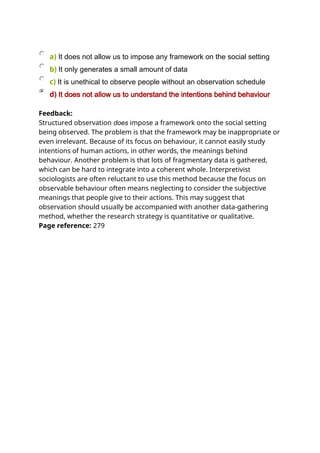
One of the criticisms often levelled at structured observation is that:
a) It does not allow us to impose any framework on the social setting
b) It only generates a small amount of data
c) It is unethical to observe people without an observation schedule
d) It does not allow us to understand the intentions behind behaviour
Feedback:
Structured observation does impose a framework onto the social setting
being observed. The problem is that the framework may be inappropriate or
even irrelevant. Because of its focus on behaviour, it cannot easily study
intentions of human actions, in other words, the meanings behind
behaviour. Another problem is that lots of fragmentary data is gathered,
which can be hard to integrate into a coherent whole. Interpretivist
sociologists are often reluctant to use this method because the focus on
observable behaviour often means neglecting to consider the subjective
meanings that people give to their actions. This may suggest that
observation should usually be accompanied with another data-gathering
method, whether the research strategy is quantitative or qualitative.
Page reference: 279

MCQ – Participant Observation-Qualitaive data analysis.docx

  • 1.
    MCQ – ParticipantObservation Question 1 Which of the following is a problem associated with survey research? a) The problem of objectivity b) The problem of "going native" c) The problem of omission d) The problem of robustness Feedback: When respondents read a survey questionnaire, they may not always interpret particular questions correctly and they may, inadvertently, skip a key word in the question and so answer inappropriately. Usually this can be traced to a defect in the manner of phrasing the question but the point, here, is the damage has been done. "Tips and skills" on page 267 lists the most significant problems of survey research as a tool in studying behaviour, including the problem of omission. Objectivity and non- involvement (and hence little risk of "going native") are claimed as advantages of survey methodologies. Page reference: 267 Question 2 The key advantage of structured observation over survey research is that: a) It does not rely on the researcher's ability to take notes b) The researcher is immersed as a participant in the field they are studying c) It does not impose any expectations of behaviour on the respondents d) It allows you to observe people's behaviour directly Feedback: It has been observed (see the reference to LaPiere, 1934) that what people say they do and what they actually do may differ. Quite why this should be the case is outside the scope of the current question. Accepting the statement as at least having hypothetical value could suggest that surveys will elicit the truth of what people feel they are likely, or prone, to do but direct observation of their behaviour would be required to see how close their survey statements are reflected by actual behaviour. To gather
  • 2.
    quantitative data, observationneeds to be structured into a standardized format in order to have measurement validity. Page reference: 268 Question 3 What is an observation schedule? a) A set of explicit rules for assigning behaviour to categories b) A timetable of days on which you plan to carry out your observation c) A list of questions to ask your interviewees d) A way of testing for measurement validity Feedback: An observation schedule is the back-bone of structured observation. It specifies the categories of behaviour to be observed and how behaviour should be allocated to those categories through a coding frame. Bryman advises (p271) engaging in a bit of unstructured observation before constructing the observation schedule proper, to get a general feel for the likely range of behaviours observable. Many of the features and rules of structured interviewing can be seen to apply in structured observation as well. Page reference: 271, 272 Question 4 LaPiere conducted a study of the way restaurant owners granted or refused access to a Chinese couple. This is an example of observing behaviour in terms of: a) Individuals b) Incidents c) Short time periods d) Long time periods Feedback: This is the classical study (LaPiere, 1934, cited on page 273 and discussed in Thinking deeply 12.2 on page 268) of the discrepancy between what we do and what we say we do. In his study, LaPiere concentrated on the "incident" of acceptance by hotels and restaurants of Chinese guests. In other words, he did not attempt to find out why entry might be granted or refused. His work, therefore, is quantitative. It demonstrates a method whereby we can
  • 3.
    record the waypeople respond to particular events or incidents in a social setting. This may only refer to one point in time but will still allow for comparisons to be made because of high degrees of reliability. It should be pointed out that LaPiere conducted a survey as the counterpoint for his argument. Page reference: 273 Question 5 It may not be possible to use a probability sample to observe behaviour in public places because: a) The findings of such studies are not intended to have external validity b) It is not feasible to construct a sampling frame of interactions c) It is difficult to gain access to such social settings d) Researchers prefer not to use random samples whenever possible Feedback: Quantitative research automatically brings probability sampling to mind. If we have defined the population closely and located a sampling frame, random sampling becomes feasible. The problem with observation, is that it is often focussed on an incident and as a result, we cannot know what other kinds of interaction might have gone on, and so we cannot know whether each episode was 'representative'. It is not possible to develop a "snowball" sample either, because we are limited to observation alone. However, just as other data-gathering tools use non-probability samples, so too can direct observation. Answer (d) may be right - perhaps researchers try to steer clear of random sampling. This question is not concerned with research preference, however, but with research possibility. Page reference: 274 Question 6 Which of the following is not a type of sampling used in structured observation? a) Focal sampling b) Scan sampling c) Emotional sampling d) Behaviour sampling
  • 4.
    Feedback: Martin & Bateson(2007, cited on page 274) identify four main types of sampling that apply to structured observation. It is important to bear in mind that the behaviour itself is the focus of study, rather than the person exhibiting the behaviour, so samples are drawn up according to occurrences in time. "Ad libitum sampling", records all behaviours observed in a particular time period whereas, "focal sampling" concentrates on one individual only, in a set time period. "Scan sampling" observes behaviours within a group at set intervals. Finally, "behaviour sampling", somewhat confusingly, occurs by the researcher observing which individuals engage in which sort of behaviours. We can observe behaviour but there seems no way we can observe impulses to behaviour, like emotions. Page reference: 274 Question 7 Cohen's kappa is a measure of: a) Inter-surveyor consistency b) Intra-observer validity c) Intra-coder validity d) Inter-observer consistency Feedback: One of the problems encountered in structured observation concerns the degree of inter-observer consistency. The point is that we need to feel confident that separate observers do not see things so very differently from each other as to use different codes for essentially the same behaviour. Cohen's kappa is a statistical measure of the degree of agreement between two people's coding of the same situation, over and above what could have happened by chance. Naturally, the same observer might code the same things a little differently over time, so intra-observer consistency can also be a problem. These are problems of reliability, not validity. Page reference: 276, Key concept 12.3 Question 8 What is meant by the term "reactive effect"? a) If people know they are being observed, they may change their behaviour b) Research subjects may have a bad reaction to the drugs they are given
  • 5.
    c) Researchers sometimesreact to their informants' behaviour with horror d) The categories on an observation schedule may not be mutually exclusive Feedback: Bryman asks "Do people change their behaviour because they know they are being observed?" (p276) If, or when, they do, we call this a "reactive effect". The problem then becomes one of research participants behaving other than they would in normal circumstances, rendering the data invalid. Webb et al (1966, cited on page 277) argued for greater use of unobtrusive measures of observation to minimise the reactive effect. Others (like McCall, 1984, cited on page 276) suggest the effect diminishes over time as participants grow used to the presence of the observer. Page reference: 276,277 Question 9 What did Salancik mean by "field stimulations"? a) Being immersed in the field can help to simulate the experience of your informants b) Researchers can intervene in and manipulate a setting to observe the effects c) Surveys conducted in the field are more effective than structured observation d) Some researchers find their projects so stimulating that they have to lie down Feedback: In "field stimulation", participants do not know they are being studied, so there is no reactive effect as discussed in the previous question. In this type of observation study, the researcher directly intervenes in and/or manipulates an element in the environment in order to observe changes in participant behaviour. Salancik (1979, cited on page 277) classified "field stimulations" as a qualitative method but Bryman (p277) believes they work better as part of a quantitative strategy because of the concentration on numbers of instances of particular behaviours. Page reference: 277,278 Question 10 One of the criticisms often levelled at structured observation is that:
  • 6.
    a) It doesnot allow us to impose any framework on the social setting b) It only generates a small amount of data c) It is unethical to observe people without an observation schedule d) It does not allow us to understand the intentions behind behaviour Feedback: Structured observation does impose a framework onto the social setting being observed. The problem is that the framework may be inappropriate or even irrelevant. Because of its focus on behaviour, it cannot easily study intentions of human actions, in other words, the meanings behind behaviour. Another problem is that lots of fragmentary data is gathered, which can be hard to integrate into a coherent whole. Interpretivist sociologists are often reluctant to use this method because the focus on observable behaviour often means neglecting to consider the subjective meanings that people give to their actions. This may suggest that observation should usually be accompanied with another data-gathering method, whether the research strategy is quantitative or qualitative. Page reference: 279