Boiling Point Elevation
Chapter #10
XI FDC Chemistry
Ms. Sidra Javed
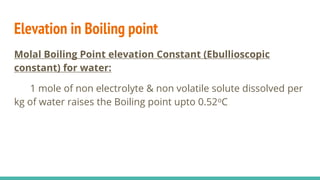
Elevation in Boiling point
Molal Boiling Point elevation Constant (Ebullioscopic
constant) for water:
1 mole of non electrolyte & non volatile solute dissolved per
kg of water raises the Boiling point upto 0.52oC
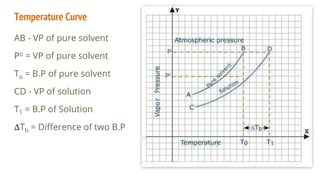
Temperature Curve
AB - VP of pure solvent
Po = VP of pure solvent
To = B.P of pure solvent
CD - VP of solution
T1 = B.P of Solution
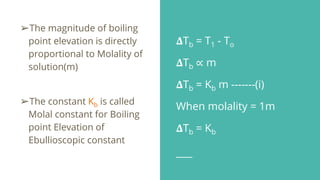
𝚫Tb = Difference of two B.P
𝚫Tb = T1 - To
𝚫Tb ∝ m
𝚫Tb = Kb m -------(i)
When molality = 1m
𝚫Tb = Kb
➢The magnitude of boiling
point elevation is directly
proportional to Molality of
solution(m)
➢The constant Kb is called
Molal constant for Boiling
point Elevation of
Ebullioscopic constant
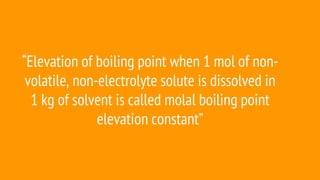
“Elevation of boiling point when 1 mol of non-
volatile, non-electrolyte solute is dissolved in
1 kg of solvent is called molal boiling point
elevation constant”
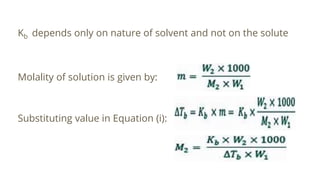
Kb depends only on nature of solvent and not on the solute
Molality of solution is given by:
Substituting value in Equation (i):
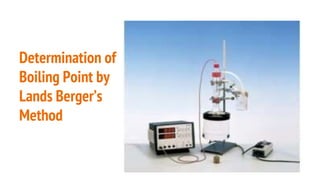
Determination of
Boiling Point by
Lands Berger’s
Method
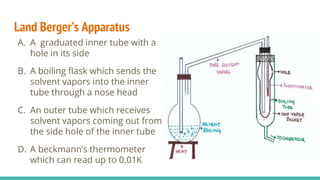
Land Berger’s Apparatus
A. A graduated inner tube with a
hole in its side
B. A boiling flask which sends the
solvent vapors into the inner
tube through a nose head
C. An outer tube which receives
solvent vapors coming out from
the side hole of the inner tube
D. A beckmann’s thermometer
which can read up to 0.01K
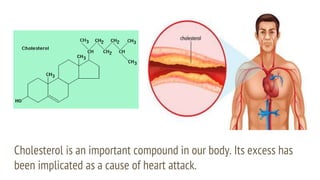
Cholesterol is an important compound in our body. Its excess has
been implicated as a cause of heart attack.
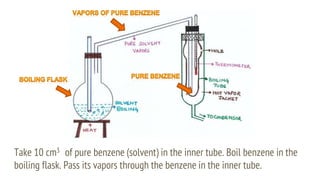
Take 10 cm3 of pure benzene (solvent) in the inner tube. Boil benzene in the
boiling flask. Pass its vapors through the benzene in the inner tube.
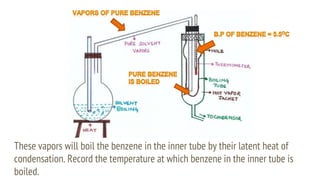
These vapors will boil the benzene in the inner tube by their latent heat of
condensation. Record the temperature at which benzene in the inner tube is
boiled.
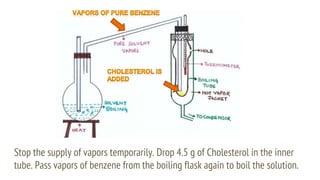
Stop the supply of vapors temporarily. Drop 4.5 g of Cholesterol in the inner
tube. Pass vapors of benzene from the boiling flask again to boil the solution.
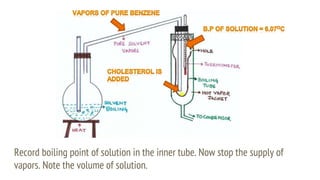
Record boiling point of solution in the inner tube. Now stop the supply of
vapors. Note the volume of solution.
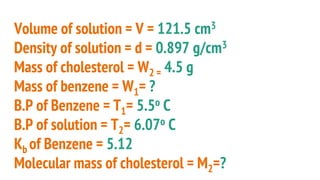
Volume of solution = V = 121.5 cm3
Density of solution = d = 0.897 g/cm3
Mass of cholesterol = W2 = 4.5 g
Mass of benzene = W1= ?
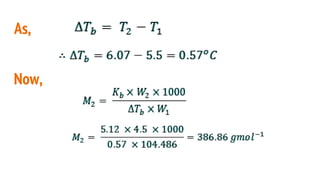
B.P of Benzene = T1= 5.5o C
B.P of solution = T2= 6.07o C
Kb of Benzene = 5.12
Molecular mass of cholesterol = M2=?
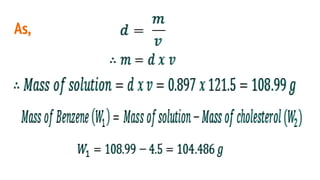
As,
As,
Now,
End of Lesson

Boiling point elevation

  • 1.
    Boiling Point Elevation Chapter#10 XI FDC Chemistry Ms. Sidra Javed
  • 2.
    Elevation in Boilingpoint Molal Boiling Point elevation Constant (Ebullioscopic constant) for water: 1 mole of non electrolyte & non volatile solute dissolved per kg of water raises the Boiling point upto 0.52oC
  • 3.
    Temperature Curve AB -VP of pure solvent Po = VP of pure solvent To = B.P of pure solvent CD - VP of solution T1 = B.P of Solution 𝚫Tb = Difference of two B.P
  • 4.
    𝚫Tb = T1- To 𝚫Tb ∝ m 𝚫Tb = Kb m -------(i) When molality = 1m 𝚫Tb = Kb ➢The magnitude of boiling point elevation is directly proportional to Molality of solution(m) ➢The constant Kb is called Molal constant for Boiling point Elevation of Ebullioscopic constant
  • 5.
    “Elevation of boilingpoint when 1 mol of non- volatile, non-electrolyte solute is dissolved in 1 kg of solvent is called molal boiling point elevation constant”
  • 6.
    Kb depends onlyon nature of solvent and not on the solute Molality of solution is given by: Substituting value in Equation (i):
  • 7.
    Determination of Boiling Pointby Lands Berger’s Method
  • 8.
    Land Berger’s Apparatus A.A graduated inner tube with a hole in its side B. A boiling flask which sends the solvent vapors into the inner tube through a nose head C. An outer tube which receives solvent vapors coming out from the side hole of the inner tube D. A beckmann’s thermometer which can read up to 0.01K
  • 9.
    Cholesterol is animportant compound in our body. Its excess has been implicated as a cause of heart attack.
  • 10.
    Take 10 cm3of pure benzene (solvent) in the inner tube. Boil benzene in the boiling flask. Pass its vapors through the benzene in the inner tube.
  • 11.
    These vapors willboil the benzene in the inner tube by their latent heat of condensation. Record the temperature at which benzene in the inner tube is boiled.
  • 12.
    Stop the supplyof vapors temporarily. Drop 4.5 g of Cholesterol in the inner tube. Pass vapors of benzene from the boiling flask again to boil the solution.
  • 13.
    Record boiling pointof solution in the inner tube. Now stop the supply of vapors. Note the volume of solution.
  • 14.
    Volume of solution= V = 121.5 cm3 Density of solution = d = 0.897 g/cm3 Mass of cholesterol = W2 = 4.5 g Mass of benzene = W1= ? B.P of Benzene = T1= 5.5o C B.P of solution = T2= 6.07o C Kb of Benzene = 5.12 Molecular mass of cholesterol = M2=?
  • 15.
  • 16.
  • 17.