Solutions
Definitions A  solution  is a homogeneous mixture A  solute  is dissolved in a  solvent . solute is the substance being dissolved solvent is the liquid in which the solute is dissolved an  aqueous  solution has water as solvent A  saturated  solution is one where the concentration is at a maximum - no more solute is able to dissolve. A saturated solution represents an equilibrium: the rate of dissolving is equal to the rate of crystallization.  The salt continues to dissolve, but crystallizes at the same rate so that there “appears” to be nothing happening.
Dissolution of Solid Solute What are the driving forces which cause solutes to dissolve to form solutions? 1.  Covalent  solutes dissolve by  H-bonding to water  or by  LDF   2.  Ionic  solutes dissolve by dissociation into their ions .
 
 
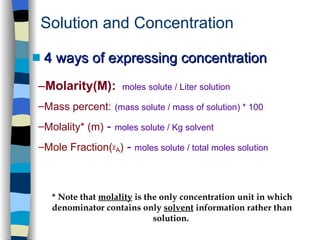
Solution and Concentration 4 ways of expressing concentration Molarity(M):   moles solute / Liter solution Mass percent:   (mass solute / mass of solution) * 100 Molality* (m)   -  moles solute / Kg solvent Mole Fraction(  A )  -  moles solute / total moles solution * Note that  molality  is the only concentration unit in which denominator contains only  solvent  information rather than solution.
% (w/w) =  % (w/v) =  % (v/v) =  % Concentration
% Concentration: % Mass Example 3.5 g of CoCl 2  is dissolved in 100mL solution.  Assuming the  density  of the solution is 1.0 g/mL, what is concentration of the solution in % mass? %m =  3.5 g CoCl 2 100g H 2 O = 3.5% (m/m)
Concentration: Molarity Example If 0.435 g of KMnO 4  is dissolved in enough water to give 250. mL of solution, what is the molarity of KMnO 4 ?   Now that the number of moles of substance is known, this can be combined with the volume of solution — which must be in liters — to give the molarity. Because 250. mL is equivalent to 0.250 L . As is almost always the case, the first step is to convert the mass of material to moles. 0.435 g KMnO 4  •  1 mol KMnO 4   =  0.00275 mol KMnO 4   158.0 g KMnO 4 Molarity KMnO 4  =  0.00275 mol KMnO 4   =  0.0110 M   0.250 L solution
When a solution is diluted, solvent is added to lower its concentration. The amount of solute remains constant before and after the dilution: moles BEFORE = moles AFTER C 1 V 1  = C 2 V 2 Dilution A bottle of 0.500 M standard sucrose stock solution is in the lab.  Give precise instructions to your assistant on how to use the stock solution to prepare 250.0 mL of a 0.348 M sucrose solution. Suppose you have 0.500 M sucrose stock solution.  How do you prepare 250 mL of 0.348 M sucrose solution ? Concentration 0.500 M Sucrose 250 mL of 0.348 M sucrose
3 Stages of Solution Process Separation of Solute must overcome IMF or ion-ion attractions in solute requires energy,  ENDOTHERMIC  ( +   H) Separation of Solvent must overcome IMF of solvent particles requires energy, ENDOTHERMIC (+   H) Interaction of Solute & Solvent attractive bonds form between solute particles and solvent particles “ Solvation” or “Hydration” (where water = solvent) releases energy, EXOTHERMIC ( -    H)
Dissolution at the molecular level? Consider the dissolution of NaOH in H 2 O
Factors Affecting Solubility 1. Nature of Solute / Solvent . -  Like dissolves like  (IMF) 2. Temperature - i) Solids/Liquids- Solubility increases with Temperature Increase K.E. increases motion and collision between solute / solvent. ii) gas - Solubility decreases with Temperature Increase K.E. result in gas escaping to atmosphere. 3. Pressure Factor - i) Solids/Liquids - Very little effect Solids and Liquids are already close together, extra pressure will not  increase solubility. ii) gas - Solubility increases with Pressure. Increase pressure squeezes gas solute into solvent.
Solubilities of Solids vs Temperature Solubilities of several ionic solid as a function of temperature. MOST salts have greater solubility in hot water. A  few  salts have negative heat of solution, (exothermic process) and they become less soluble with increasing temperature.
Temperature & the Solubility of Gases The solubility of gases DECREASES at higher temperatures
Henry’s Law The effect of partial pressure on solubility of gases At pressure of few atmosphere or less, solubility of gas solute follows Henry Law which states that the amount of solute gas dissolved in solution is directly proportional to the amount of pressure above the solution. c = k P c = solubility of the gas (M) k = Henry’s Law Constant P = partial pressure of gas  Henry’s Law Constants (25°C), k N 2 8.42 •10 -7   M/mmHg O 2 1.66 •10 - 6   M/mmHg CO 2   4.48•10 -5   M/mmHg
Henry’s Law & Soft Drinks Soft drinks contain “carbonated water” – water with dissolved carbon dioxide gas. The drinks are bottled with a CO 2  pressure greater than 1 atm.  When the bottle is opened, the pressure of CO 2  decreases and the solubility of CO 2  also decreases, according to Henry’s Law. Therefore, bubbles of CO 2  escape from solution.
Henry’s Law Application The solubility of pure N 2  (g) at 25 o C and 1.00 atm pressure is 6.8 x 10 -4  mol/L.  What is the solubility of N 2  under atmospheric conditions if the partial pressure of N 2  is 0.78 atm? Step 1:  Use the first set of data to find “k” for N 2  at 25 °C Step 2: Use this constant to find the solubility (concentration) when P is 0.78 atm:
Colligative Properties Dissolving solute in pure liquid will change all physical properties of liquid, Density, Vapor Pressure, Boiling Point, Freezing Point, Osmotic Pressure Colligative Properties  are properties of a liquid that change when a solute is added.  The magnitude of the change depends on the  number  of solute particles in the solution, NOT on the  identity  of the solute particles.
Vapor Pressure Lowering for a Solution The diagram below shows how a phase diagram is affected by dissolving a solute in a solvent.  The black curve represents the pure liquid and the blue curve represents the solution. Notice the changes in the  freezing  &  boiling  points.
Vapor Pressure Lowering The presence of a non-volatile solute means that fewer solvent particles are at the solution’s surface, so less solvent evaporates!
Application of Vapor Pressure Lowering Describe what is happening in the pictures below. Use the concept of vapor pressure lowering to explain this phenomenon.
Raoult’s Law Describes vapor pressure lowering mathematically. The lowering of the vapour pressure when a  non-volatile solute  is dissolved in a volatile solvent (A) can be described by Raoult’s Law: P A  =   A P° A P A  = vapour pressure of solvent A above the  solution c A  = mole fraction of the solvent A in the solution P° A  = vapour pressure of  pure  solvent A only the solvent (A) contributes to  the vapour pressure of the solution
What is the vapor pressure of water above a sucrose (MW=342.3 g/mol) solution prepared by dissolving 158.0 g of sucrose in 641.6 g of water at 25 ºC? The vapor pressure of pure water at 25 ºC is 23.76 mmHg . mol sucrose = (158.0 g)/(342.3 g/mol) = 0.462 mol mol water = (641.6 g)/(18 g/mol) = 35.6 mol P sol’n  =  X water   P  water  = (0.987)(23.76 mm Hg)    =  23.5 mm Hg
Mixtures of Volatile Liquids Both liquids evaporate & contribute to the vapor pressure
Raoult’s Law: Mixing Two Volatile Liquids Since BOTH liquids are volatile and contribute to the vapour, the total vapor pressure can be represented using Dalton’s Law: P T  = P A  + P B The vapor pressure from each component follows Raoult’s Law: P T  =   A P° A  +   B P° B Also,   A  +   B  = 1  (since there are 2 components)
Benzene and Toluene Consider a two solvent (volatile) system The vapor pressure from each component follows Raoult's Law. Benzene - Toluene mixture: Recall that with only two components,   Bz  +   Tol  = 1 Benzene:  when   Bz  = 1,  P Bz  =  P° Bz  = 384 torr &  when   Bz  = 0 , P Bz  = 0 Toluene:  when   Tol  = 1,  P Tol  = P° Tol  = 133 torr &  when   Tol  = 0, P Bz  = 0
 
Normal Boiling Process Extension of vapor pressure concept: Normal Boiling Point:  BP of Substance @ 1atm When solute is added, BP > Normal BP Boiling point is elevated when solute inhibits solvent from escaping . Elevation of B. pt . Express by Boiling point Elevation  equation
Boiling Point Elevation  T b  = (T b  -T b °) = i ·m ·k b Where,   T b  = BP. Elevation T b   = BP of solvent in solution   T b °  = BP of pure solvent   m   = molality  ,  k b  = BP Constant Some Boiling Point Elevation and Freezing Point Depression Constants Normal bp (°C)  K b   Normal fp (°C)    K f Solvent  pure solvent  (°C/m)  pure solvent  (°C/m) Water  100.00  +0.5121  0.0 1.86 Benzene 80.10  +2.53 5.50  4.90 Camphor  207  +5.611  179.75  39.7 Chloroform  61.70  +3.63  - 63.5  4.70 (CH 3 Cl)
Freezing Point Depression Normal  Freezing Point:  FP of Substance @ 1atm When solute is added, FP < Normal  FP FP is depressed when solute inhibits solvent from crystallizing. When solution freezes the solid form is almost always pure. Solute particles does not fit into the crystal lattice of the solvent because of the differences in size.  The solute essentially remains in solution and blocks other solvent from fitting into the crystal lattice during the freezing process.
Freezing Point Depression Phase Diagram and the lowering of the freezing point.  T f  = i ·m ·k f   Where,   T f  =  FP depression i = van’t Hoff Factor m   = molality  ,  k f  = FP Constant Generally freezing point depression is  used to determine the molar mass of an unknown substance . Derive an equation to find molar mass from the equation above.
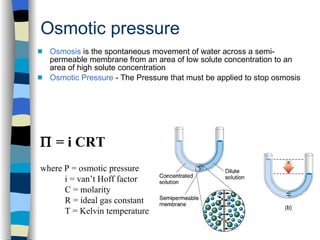
Osmotic pressure Osmosis  is the spontaneous movement of water across a semi-permeable membrane from an area of low solute concentration to an area of high solute concentration Osmotic Pressure  - The Pressure that must be applied to stop osmosis    = i CRT where P = osmotic pressure i = van’t Hoff factor C = molarity R = ideal gas constant T = Kelvin temperature
Osmosis and Blood Cells (a) A cell placed in an  isotonic  solution. The net movement of water in and out of the cell is zero because the concentration of solutes inside and outside the cell is the same.  (b) In a  hypertonic  solution, the concentration of solutes outside the cell is greater than that inside. There is a net flow of water out of the cell, causing the cell to dehydrate, shrink, and perhaps die. (c) In a  hypotonic  solution, the concentration of solutes outside of the cell is less than that inside. There is a net flow of water into the cell, causing the cell to swell and perhaps to burst.

Solutions Powerpoint

  • 1.
  • 2.
    Definitions A solution is a homogeneous mixture A solute is dissolved in a solvent . solute is the substance being dissolved solvent is the liquid in which the solute is dissolved an aqueous solution has water as solvent A saturated solution is one where the concentration is at a maximum - no more solute is able to dissolve. A saturated solution represents an equilibrium: the rate of dissolving is equal to the rate of crystallization. The salt continues to dissolve, but crystallizes at the same rate so that there “appears” to be nothing happening.
  • 3.
    Dissolution of SolidSolute What are the driving forces which cause solutes to dissolve to form solutions? 1. Covalent solutes dissolve by H-bonding to water or by LDF 2. Ionic solutes dissolve by dissociation into their ions .
  • 4.
  • 5.
  • 6.
    Solution and Concentration4 ways of expressing concentration Molarity(M): moles solute / Liter solution Mass percent: (mass solute / mass of solution) * 100 Molality* (m) - moles solute / Kg solvent Mole Fraction(  A ) - moles solute / total moles solution * Note that molality is the only concentration unit in which denominator contains only solvent information rather than solution.
  • 7.
    % (w/w) = % (w/v) = % (v/v) = % Concentration
  • 8.
    % Concentration: %Mass Example 3.5 g of CoCl 2 is dissolved in 100mL solution. Assuming the density of the solution is 1.0 g/mL, what is concentration of the solution in % mass? %m = 3.5 g CoCl 2 100g H 2 O = 3.5% (m/m)
  • 9.
    Concentration: Molarity ExampleIf 0.435 g of KMnO 4 is dissolved in enough water to give 250. mL of solution, what is the molarity of KMnO 4 ? Now that the number of moles of substance is known, this can be combined with the volume of solution — which must be in liters — to give the molarity. Because 250. mL is equivalent to 0.250 L . As is almost always the case, the first step is to convert the mass of material to moles. 0.435 g KMnO 4 • 1 mol KMnO 4 = 0.00275 mol KMnO 4 158.0 g KMnO 4 Molarity KMnO 4 = 0.00275 mol KMnO 4 = 0.0110 M 0.250 L solution
  • 10.
    When a solutionis diluted, solvent is added to lower its concentration. The amount of solute remains constant before and after the dilution: moles BEFORE = moles AFTER C 1 V 1 = C 2 V 2 Dilution A bottle of 0.500 M standard sucrose stock solution is in the lab. Give precise instructions to your assistant on how to use the stock solution to prepare 250.0 mL of a 0.348 M sucrose solution. Suppose you have 0.500 M sucrose stock solution. How do you prepare 250 mL of 0.348 M sucrose solution ? Concentration 0.500 M Sucrose 250 mL of 0.348 M sucrose
  • 11.
    3 Stages ofSolution Process Separation of Solute must overcome IMF or ion-ion attractions in solute requires energy, ENDOTHERMIC ( +  H) Separation of Solvent must overcome IMF of solvent particles requires energy, ENDOTHERMIC (+  H) Interaction of Solute & Solvent attractive bonds form between solute particles and solvent particles “ Solvation” or “Hydration” (where water = solvent) releases energy, EXOTHERMIC ( -  H)
  • 12.
    Dissolution at themolecular level? Consider the dissolution of NaOH in H 2 O
  • 13.
    Factors Affecting Solubility1. Nature of Solute / Solvent . - Like dissolves like (IMF) 2. Temperature - i) Solids/Liquids- Solubility increases with Temperature Increase K.E. increases motion and collision between solute / solvent. ii) gas - Solubility decreases with Temperature Increase K.E. result in gas escaping to atmosphere. 3. Pressure Factor - i) Solids/Liquids - Very little effect Solids and Liquids are already close together, extra pressure will not increase solubility. ii) gas - Solubility increases with Pressure. Increase pressure squeezes gas solute into solvent.
  • 14.
    Solubilities of Solidsvs Temperature Solubilities of several ionic solid as a function of temperature. MOST salts have greater solubility in hot water. A few salts have negative heat of solution, (exothermic process) and they become less soluble with increasing temperature.
  • 15.
    Temperature & theSolubility of Gases The solubility of gases DECREASES at higher temperatures
  • 16.
    Henry’s Law Theeffect of partial pressure on solubility of gases At pressure of few atmosphere or less, solubility of gas solute follows Henry Law which states that the amount of solute gas dissolved in solution is directly proportional to the amount of pressure above the solution. c = k P c = solubility of the gas (M) k = Henry’s Law Constant P = partial pressure of gas Henry’s Law Constants (25°C), k N 2 8.42 •10 -7 M/mmHg O 2 1.66 •10 - 6 M/mmHg CO 2 4.48•10 -5 M/mmHg
  • 17.
    Henry’s Law &Soft Drinks Soft drinks contain “carbonated water” – water with dissolved carbon dioxide gas. The drinks are bottled with a CO 2 pressure greater than 1 atm. When the bottle is opened, the pressure of CO 2 decreases and the solubility of CO 2 also decreases, according to Henry’s Law. Therefore, bubbles of CO 2 escape from solution.
  • 18.
    Henry’s Law ApplicationThe solubility of pure N 2 (g) at 25 o C and 1.00 atm pressure is 6.8 x 10 -4 mol/L. What is the solubility of N 2 under atmospheric conditions if the partial pressure of N 2 is 0.78 atm? Step 1: Use the first set of data to find “k” for N 2 at 25 °C Step 2: Use this constant to find the solubility (concentration) when P is 0.78 atm:
  • 19.
    Colligative Properties Dissolvingsolute in pure liquid will change all physical properties of liquid, Density, Vapor Pressure, Boiling Point, Freezing Point, Osmotic Pressure Colligative Properties are properties of a liquid that change when a solute is added. The magnitude of the change depends on the number of solute particles in the solution, NOT on the identity of the solute particles.
  • 20.
    Vapor Pressure Loweringfor a Solution The diagram below shows how a phase diagram is affected by dissolving a solute in a solvent. The black curve represents the pure liquid and the blue curve represents the solution. Notice the changes in the freezing & boiling points.
  • 21.
    Vapor Pressure LoweringThe presence of a non-volatile solute means that fewer solvent particles are at the solution’s surface, so less solvent evaporates!
  • 22.
    Application of VaporPressure Lowering Describe what is happening in the pictures below. Use the concept of vapor pressure lowering to explain this phenomenon.
  • 23.
    Raoult’s Law Describesvapor pressure lowering mathematically. The lowering of the vapour pressure when a non-volatile solute is dissolved in a volatile solvent (A) can be described by Raoult’s Law: P A =  A P° A P A = vapour pressure of solvent A above the solution c A = mole fraction of the solvent A in the solution P° A = vapour pressure of pure solvent A only the solvent (A) contributes to the vapour pressure of the solution
  • 24.
    What is thevapor pressure of water above a sucrose (MW=342.3 g/mol) solution prepared by dissolving 158.0 g of sucrose in 641.6 g of water at 25 ºC? The vapor pressure of pure water at 25 ºC is 23.76 mmHg . mol sucrose = (158.0 g)/(342.3 g/mol) = 0.462 mol mol water = (641.6 g)/(18 g/mol) = 35.6 mol P sol’n = X water P  water = (0.987)(23.76 mm Hg) = 23.5 mm Hg
  • 25.
    Mixtures of VolatileLiquids Both liquids evaporate & contribute to the vapor pressure
  • 26.
    Raoult’s Law: MixingTwo Volatile Liquids Since BOTH liquids are volatile and contribute to the vapour, the total vapor pressure can be represented using Dalton’s Law: P T = P A + P B The vapor pressure from each component follows Raoult’s Law: P T =  A P° A +  B P° B Also,  A +  B = 1 (since there are 2 components)
  • 27.
    Benzene and TolueneConsider a two solvent (volatile) system The vapor pressure from each component follows Raoult's Law. Benzene - Toluene mixture: Recall that with only two components,  Bz +  Tol = 1 Benzene: when  Bz = 1, P Bz = P° Bz = 384 torr & when  Bz = 0 , P Bz = 0 Toluene: when  Tol = 1, P Tol = P° Tol = 133 torr & when  Tol = 0, P Bz = 0
  • 28.
  • 29.
    Normal Boiling ProcessExtension of vapor pressure concept: Normal Boiling Point: BP of Substance @ 1atm When solute is added, BP > Normal BP Boiling point is elevated when solute inhibits solvent from escaping . Elevation of B. pt . Express by Boiling point Elevation equation
  • 30.
    Boiling Point Elevation T b = (T b -T b °) = i ·m ·k b Where,  T b = BP. Elevation T b = BP of solvent in solution T b ° = BP of pure solvent m = molality , k b = BP Constant Some Boiling Point Elevation and Freezing Point Depression Constants Normal bp (°C) K b Normal fp (°C) K f Solvent pure solvent (°C/m) pure solvent (°C/m) Water 100.00 +0.5121 0.0 1.86 Benzene 80.10 +2.53 5.50 4.90 Camphor 207 +5.611 179.75 39.7 Chloroform 61.70 +3.63 - 63.5 4.70 (CH 3 Cl)
  • 31.
    Freezing Point DepressionNormal Freezing Point: FP of Substance @ 1atm When solute is added, FP < Normal FP FP is depressed when solute inhibits solvent from crystallizing. When solution freezes the solid form is almost always pure. Solute particles does not fit into the crystal lattice of the solvent because of the differences in size. The solute essentially remains in solution and blocks other solvent from fitting into the crystal lattice during the freezing process.
  • 32.
    Freezing Point DepressionPhase Diagram and the lowering of the freezing point.  T f = i ·m ·k f Where,  T f = FP depression i = van’t Hoff Factor m = molality , k f = FP Constant Generally freezing point depression is used to determine the molar mass of an unknown substance . Derive an equation to find molar mass from the equation above.
  • 33.
    Osmotic pressure Osmosis is the spontaneous movement of water across a semi-permeable membrane from an area of low solute concentration to an area of high solute concentration Osmotic Pressure - The Pressure that must be applied to stop osmosis  = i CRT where P = osmotic pressure i = van’t Hoff factor C = molarity R = ideal gas constant T = Kelvin temperature
  • 34.
    Osmosis and BloodCells (a) A cell placed in an isotonic solution. The net movement of water in and out of the cell is zero because the concentration of solutes inside and outside the cell is the same. (b) In a hypertonic solution, the concentration of solutes outside the cell is greater than that inside. There is a net flow of water out of the cell, causing the cell to dehydrate, shrink, and perhaps die. (c) In a hypotonic solution, the concentration of solutes outside of the cell is less than that inside. There is a net flow of water into the cell, causing the cell to swell and perhaps to burst.

Editor's Notes

  • #11 1 Recognize the problem and state it clearly Making the observation i.e., there is a ball of fire in the sky