ELEVATION IN BOILING
POINT
By Abhay Pandey
In the accomplishment of this project successfully, many people have best owned upon me
their blessings and the heart pledged support, this time I am utilizing to thank all the people
who have been concerned with this project.
Primarily I would thank god for being able to complete this project with success. Then I would
like to thank my Chemistry Teacher Mrs. and our school Principal
Mr. , whose valuable guidance has been the ones that helped me patch this
project and make it full proof success. His suggestions and his instructions have served as
the major contributor towards the completion of the project.
Then I would like to thank my parents and friends who have helped me with their valuable
suggestions and guidance has been very helpful in various phases of the completion of the
project.
Last but not the least I would like to thank my classmates who have helped me a lot.
ACKNOWLEDGEMENT-
This is to certify that "Abhay Pandey"
student of class - 12th 'A'
has successfully completed
their Chemistry Project on "Elevation in Boiling Point"
under the guidance of "Mrs. "
Teacher Signature
CERTIFICATE
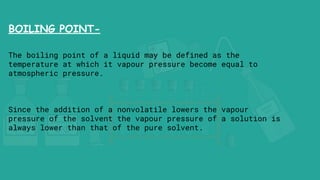
BOILING POINT-
The boiling point of a liquid may be defined as the
temperature at which it vapour pressure become equal to
atmospheric pressure.
Since the addition of a nonvolatile lowers the vapour
pressure of the solvent the vapour pressure of a solution is
always lower than that of the pure solvent.
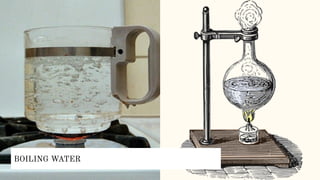
BOILING WATER
Elevation of Boiling Point-
(2nd Colligative property)
➔ As we know boiling point of a liquid is a temperature at which its
vapour pressure become equal to the atmospheric pressure.
➔ The boiling point of a solution is always higher than the boiling
point of pure solvent in which the solution is prepared. This is
because vapour pressure of solution at a given temperature is found
to be lower than vapour pressure of pure solvent at the same
temperature.
➔ In a pure liquid the entire surface is occupied by the molecule of
liquid. If a non volatile solution is added to pure liquid to give a
solution. Then surface has both solvent and solute molecules, So the
fraction of surface covered by solving molecule get reduced. So the
number of solvent molecule escaping from surface is reduced. does the
vapour pressure is also reduced.
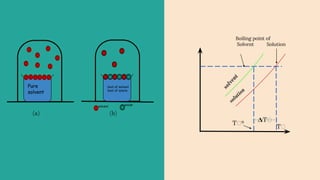
Pure
solvent
1mol of solvent
1mol of solute
(b)
solution
solvent
Boiling point of
Solvent Solution
T ⁰
𝚫T
T
(a)
solvent solute
➔ For dilute Solution 𝚫Tₕ∝m
𝚫Tₕ=kₕ
mₕ
➔ If T ⁰ is Boiling point of pure solvent and T
is the boiling point of solution,then elevation
in Boiling Point.
𝚫Tₕ=Tₕ-Tₕ⁰
[Here m is molality or molar concentration of solute in a solution]
[ kₕ: Boiling Point elevation constant / Molal elevation Constant ]
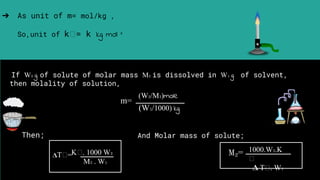
➔ As unit of m= mol/kg ,
So,unit of k = k kg mol ¹
If W₂ g of solute of molar mass M₂ is dissolved in W₁ g of solvent,
then molality of solution,
(W₂/M₂)mole
(W₁/1000) kg
m=
Then;
K . 1000 W₂
M₂ . W₁
𝚫T =
1000.W₂.K
𝚫 T . W₁
M₂=
And Molar mass of solute;
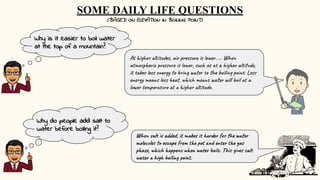
Why is it easier to boil water
at the top of a mountain?
Why do people add salt to
water before boiling it?
At higher altitudes, air pressure is lower. ... When
atmospheric pressure is lower, such as at a higher altitude,
it takes less energy to bring water to the boiling point. Less
energy means less heat, which means water will boil at a
lower temperature at a higher altitude.
When salt is added, it makes it harder for the water
molecules to escape from the pot and enter the gas
phase, which happens when water boils. This gives salt
water a high boiling point.
SOME DAILY LIFE QUESTIONS
(BASED ON ELEVATION IN BOILING POINT)
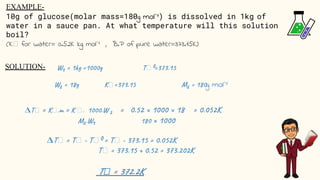
EXAMPLE-
10g of glucose(molar mass=180g mol⁻¹) is dissolved in 1kg of
water in a sauce pan. At what temperature will this solution
boil?
(K for water= 0.52K kg mol⁻¹ , B.P of pure water=373.15K)
g mol⁻¹
SOLUTION-
𝚫
T = 372.2K
𝚫
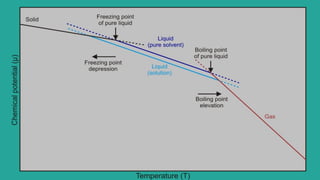
Graph between
Chemical potential & Temperature
elevation in boiling point

elevation in boiling point

  • 1.
  • 2.
    In the accomplishmentof this project successfully, many people have best owned upon me their blessings and the heart pledged support, this time I am utilizing to thank all the people who have been concerned with this project. Primarily I would thank god for being able to complete this project with success. Then I would like to thank my Chemistry Teacher Mrs. and our school Principal Mr. , whose valuable guidance has been the ones that helped me patch this project and make it full proof success. His suggestions and his instructions have served as the major contributor towards the completion of the project. Then I would like to thank my parents and friends who have helped me with their valuable suggestions and guidance has been very helpful in various phases of the completion of the project. Last but not the least I would like to thank my classmates who have helped me a lot. ACKNOWLEDGEMENT-
  • 3.
    This is tocertify that "Abhay Pandey" student of class - 12th 'A' has successfully completed their Chemistry Project on "Elevation in Boiling Point" under the guidance of "Mrs. " Teacher Signature CERTIFICATE
  • 4.
    BOILING POINT- The boilingpoint of a liquid may be defined as the temperature at which it vapour pressure become equal to atmospheric pressure. Since the addition of a nonvolatile lowers the vapour pressure of the solvent the vapour pressure of a solution is always lower than that of the pure solvent.
  • 5.
  • 6.
    Elevation of BoilingPoint- (2nd Colligative property) ➔ As we know boiling point of a liquid is a temperature at which its vapour pressure become equal to the atmospheric pressure. ➔ The boiling point of a solution is always higher than the boiling point of pure solvent in which the solution is prepared. This is because vapour pressure of solution at a given temperature is found to be lower than vapour pressure of pure solvent at the same temperature. ➔ In a pure liquid the entire surface is occupied by the molecule of liquid. If a non volatile solution is added to pure liquid to give a solution. Then surface has both solvent and solute molecules, So the fraction of surface covered by solving molecule get reduced. So the number of solvent molecule escaping from surface is reduced. does the vapour pressure is also reduced.
  • 7.
    Pure solvent 1mol of solvent 1molof solute (b) solution solvent Boiling point of Solvent Solution T ⁰ 𝚫T T (a) solvent solute
  • 8.
    ➔ For diluteSolution 𝚫Tₕ∝m 𝚫Tₕ=kₕ mₕ ➔ If T ⁰ is Boiling point of pure solvent and T is the boiling point of solution,then elevation in Boiling Point. 𝚫Tₕ=Tₕ-Tₕ⁰ [Here m is molality or molar concentration of solute in a solution] [ kₕ: Boiling Point elevation constant / Molal elevation Constant ]
  • 9.
    ➔ As unitof m= mol/kg , So,unit of k = k kg mol ¹ If W₂ g of solute of molar mass M₂ is dissolved in W₁ g of solvent, then molality of solution, (W₂/M₂)mole (W₁/1000) kg m= Then; K . 1000 W₂ M₂ . W₁ 𝚫T = 1000.W₂.K 𝚫 T . W₁ M₂= And Molar mass of solute;
  • 10.
    Why is iteasier to boil water at the top of a mountain? Why do people add salt to water before boiling it? At higher altitudes, air pressure is lower. ... When atmospheric pressure is lower, such as at a higher altitude, it takes less energy to bring water to the boiling point. Less energy means less heat, which means water will boil at a lower temperature at a higher altitude. When salt is added, it makes it harder for the water molecules to escape from the pot and enter the gas phase, which happens when water boils. This gives salt water a high boiling point. SOME DAILY LIFE QUESTIONS (BASED ON ELEVATION IN BOILING POINT)
  • 11.
    EXAMPLE- 10g of glucose(molarmass=180g mol⁻¹) is dissolved in 1kg of water in a sauce pan. At what temperature will this solution boil? (K for water= 0.52K kg mol⁻¹ , B.P of pure water=373.15K) g mol⁻¹ SOLUTION- 𝚫 T = 372.2K 𝚫
  • 12.