Diode
 Invented in 1904 by John Ambrose Fleming.
 Was constructed with 2 electrodes in the form of a
vacuum tube.
 In 1906, Lee Dee Forest added a 3rd electrode called a
control grid and the triode, which is used as amplifier,
switch..
 The application of triode created a new era in
broadcasting with the invention of the crystal radio sensor
by Pickard, 1912.
 Commonly used in DC power supply units as a rectifiers
and voltage regulators, clipper, clamper circuit.
 Comes in different shape and sizes
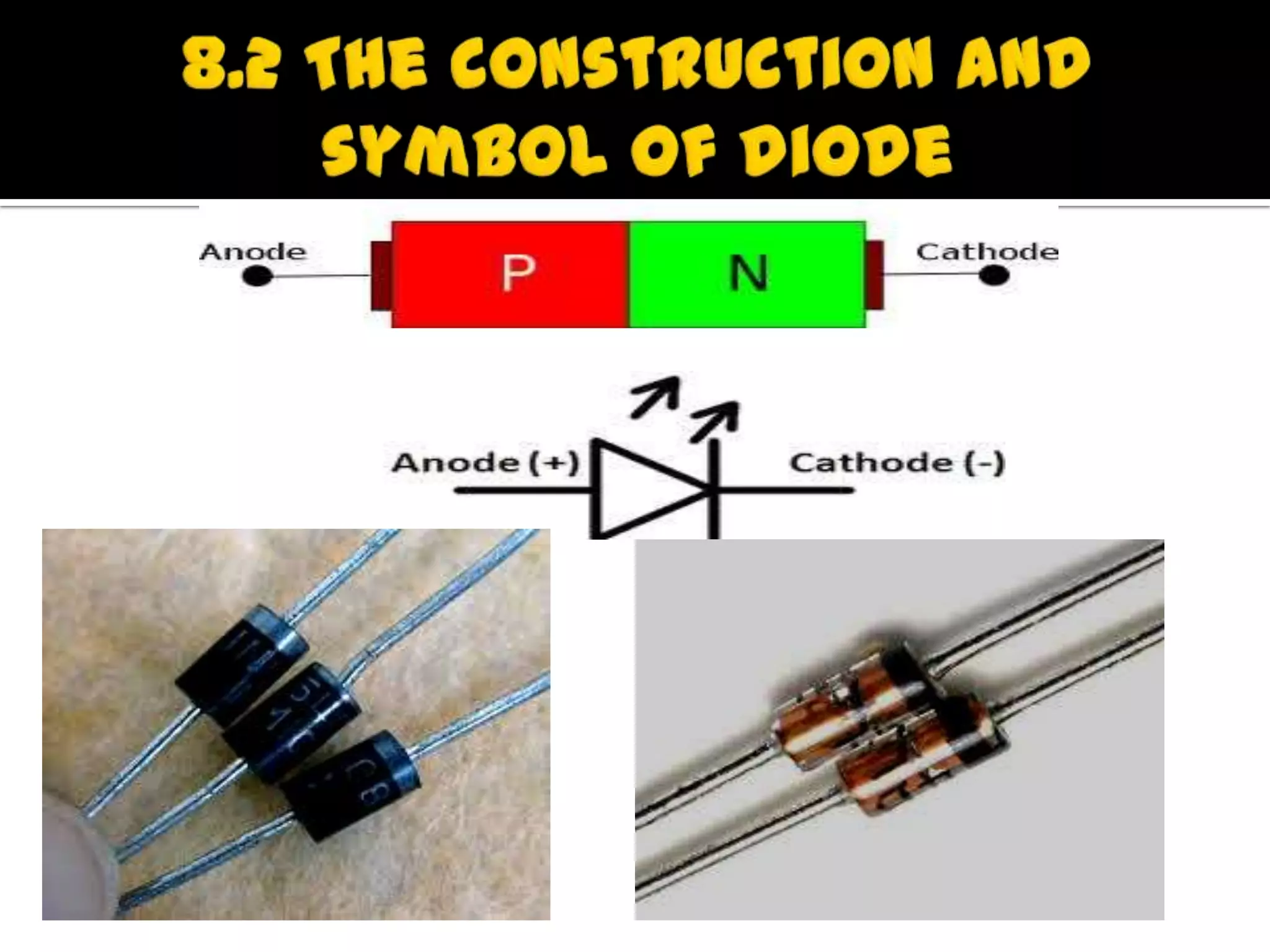
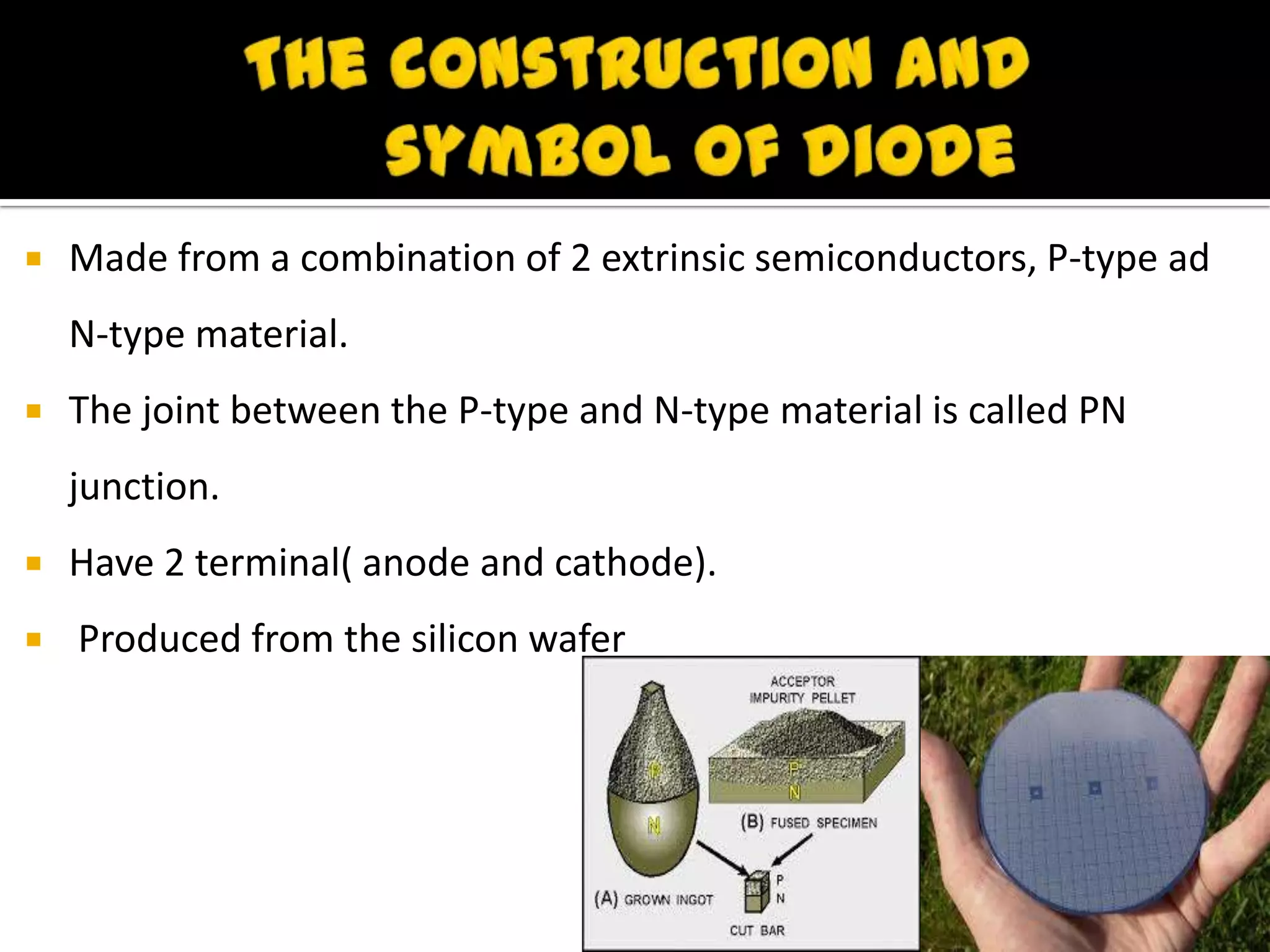
 Made from a combination of 2 extrinsic semiconductors, P-type ad
N-type material.
 The joint between the P-type and N-type material is called PN
junction.
 Have 2 terminal( anode and cathode).
 Produced from the silicon wafer
DEPLETION REGION
AND
JUNCTIONVOLTAGE
Near the PN junction the electrons diffuse into the vacant holes in the P material causing a
depletion zone.This depletion zone acts like an insulator preventing other free electrons in the
N-type silicon and holes in the P-type silicon from combining.
In addition this leaves a small electrical imbalance inside the crystal. Since the N region is
missing some electrons it has obtained a positive charge. And the extra electrons that filled the
holes in the P region, have given it a negative charge. Unfortunately one cannot generate
power from this electrical imbalance. However the stage is set to see how the PN junction
functions as a diode.
.
 At the p-n junction, electrons from the n-type
semiconductor will be attracted to the holes in the p-type
semiconductor.
 As a result, the holes and the electrons at the p-n
junction disappear, forming a layer called “depletion
layer”.
 At the same time, the p-type semiconductor becomes
more negative whereas the n-type semiconductor
becomes more positive.
 This will result a potential difference across the p-n
junction. This potential difference is called the junction
voltage (or the barrier voltage).
 The junction voltage will prevent the charge carrier from
flowing across the depletion layer.
REVERSE BIAS
&
FORWARD BIAS
 The polarity of applied voltage which causes
charge to flow through the diode is
called Forward Bias. (all current, almost no
volts)
 The polarity of applied voltage which can't
produce any current is called Reverse Bias.(all
volts, almost no current)
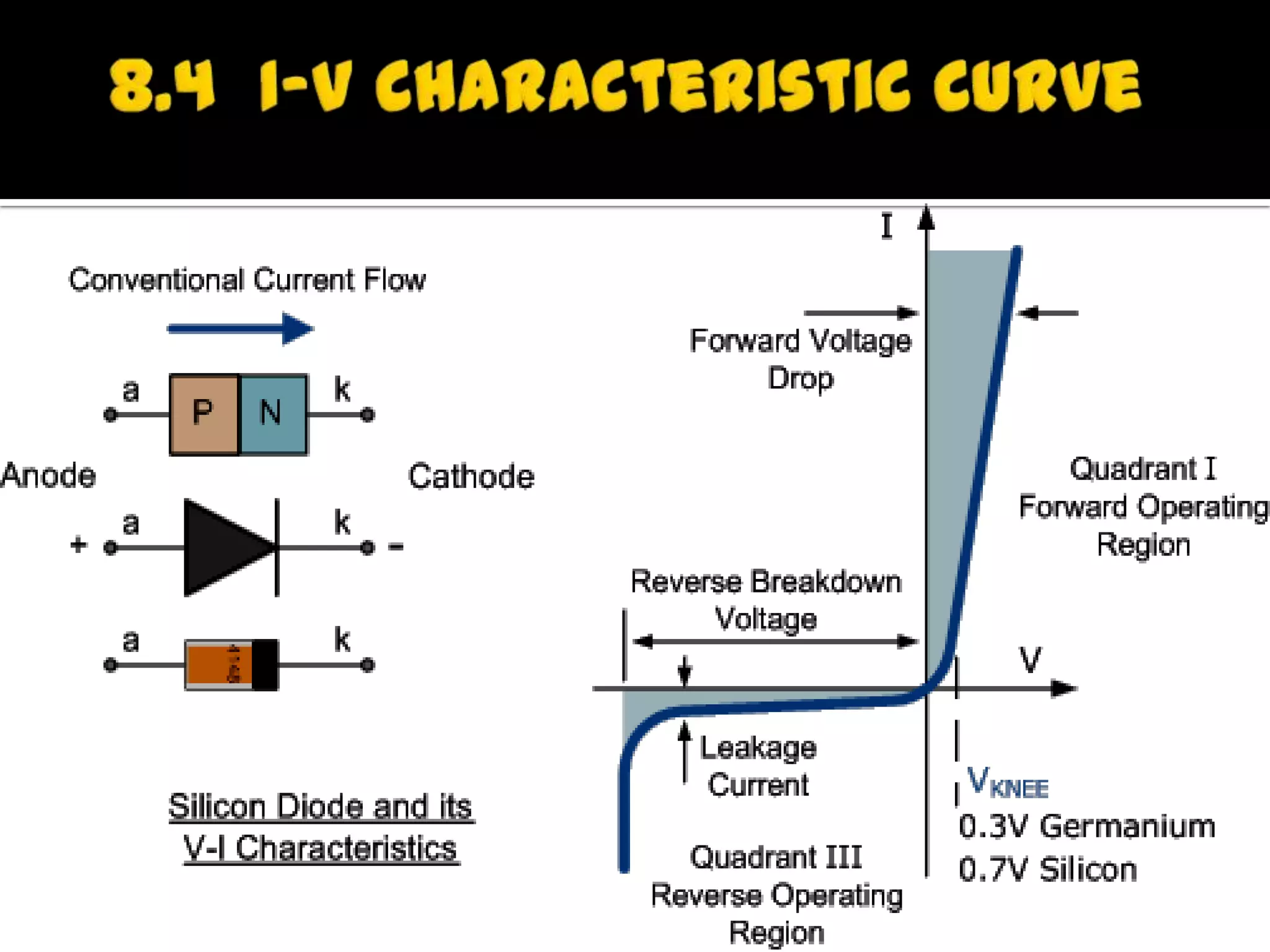
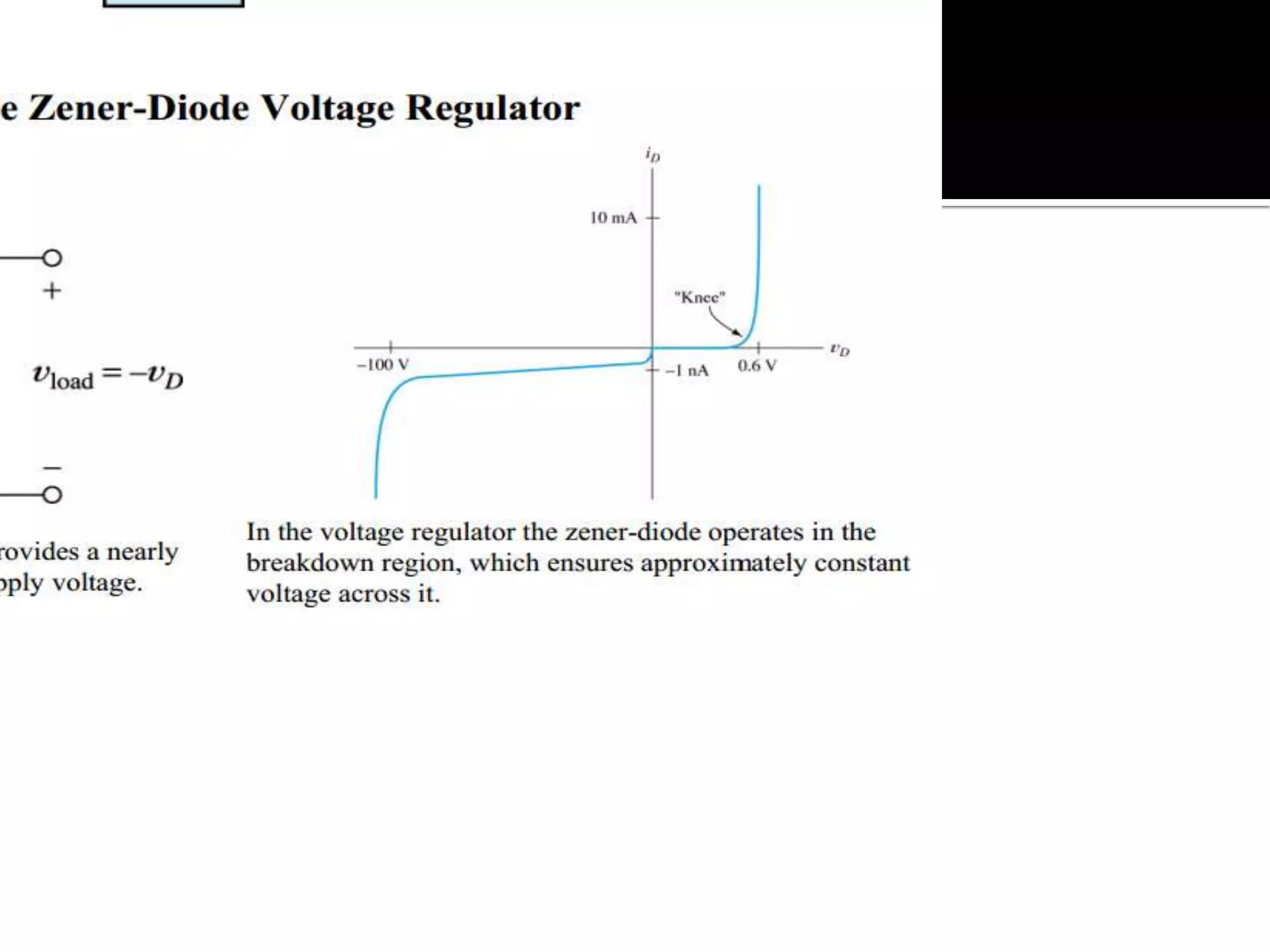
I-V Characteristic Curve
 Forward region: It is the operation region at which the
potential applied to anode is more positive than that
applied to the cathode.
 Reverse Region: It is the operation region at which anode
potential is more negative than cathode potential.
 Saturation Region: Part of the reverse region where the
diode impedance is very high, and causes very small drift
current.
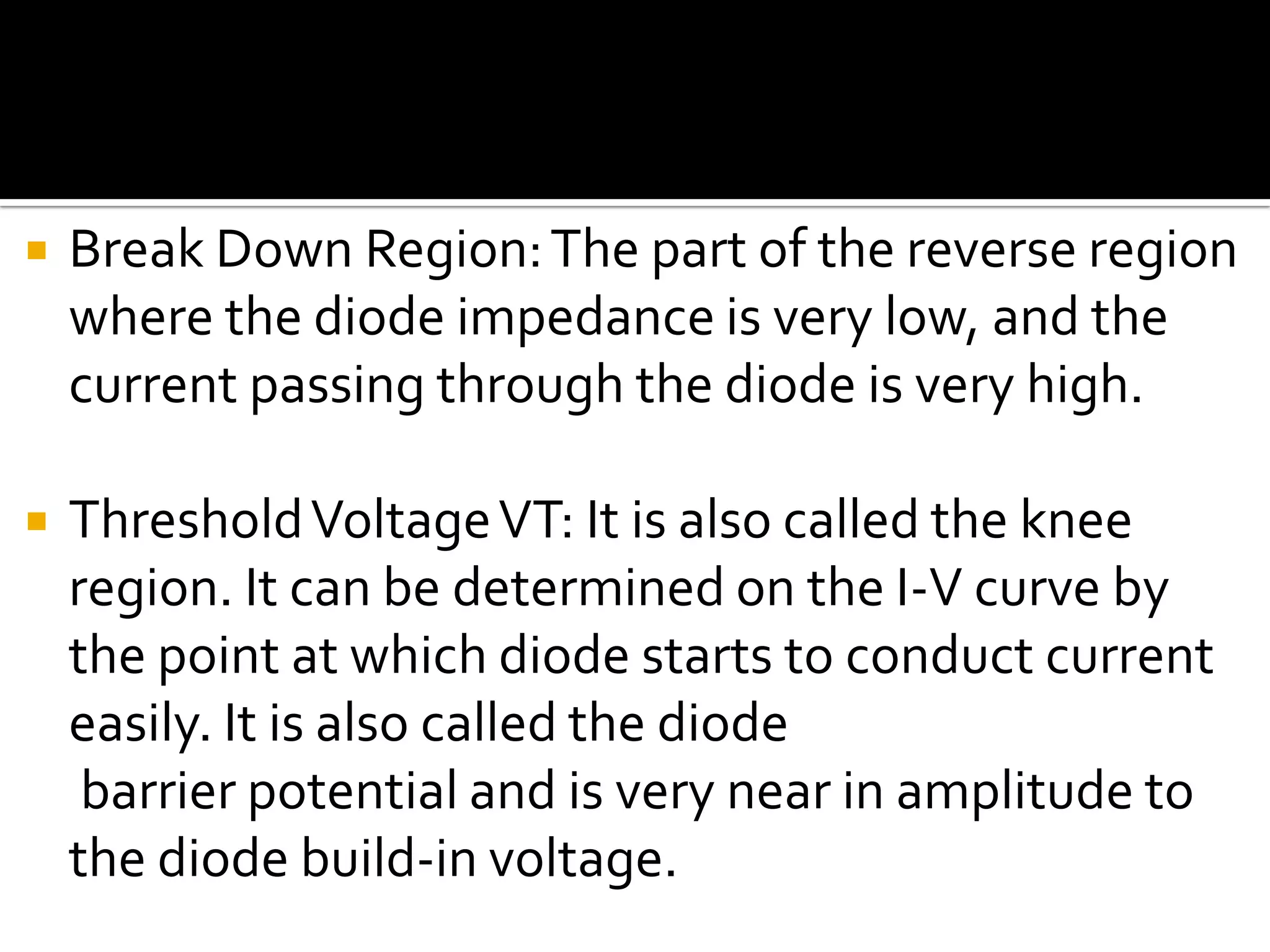
 Break Down Region:The part of the reverse region
where the diode impedance is very low, and the
current passing through the diode is very high.
 ThresholdVoltageVT: It is also called the knee
region. It can be determined on the I-V curve by
the point at which diode starts to conduct current
easily. It is also called the diode
barrier potential and is very near in amplitude to
the diode build-in voltage.
 Saturation Current: it is a very small current due to
drift current in the diode in the reverse bias region.
This current is very low (in the nano-amperes range)
due to the high impedance of the depletion region.
 Break DownVoltage: It is the maximum allowable
voltage in the reverse bias region, at which diode
resistance changed abruptly from very high
impedance to very low impedance. If the reverse
voltage applied on the diode exceeds this limit, a very
high current in the reverse direction passes through
the diode causing in burning it.
DIODES APPLICATION
 Rectifying power supply circuit
(Rectifier = penerus)
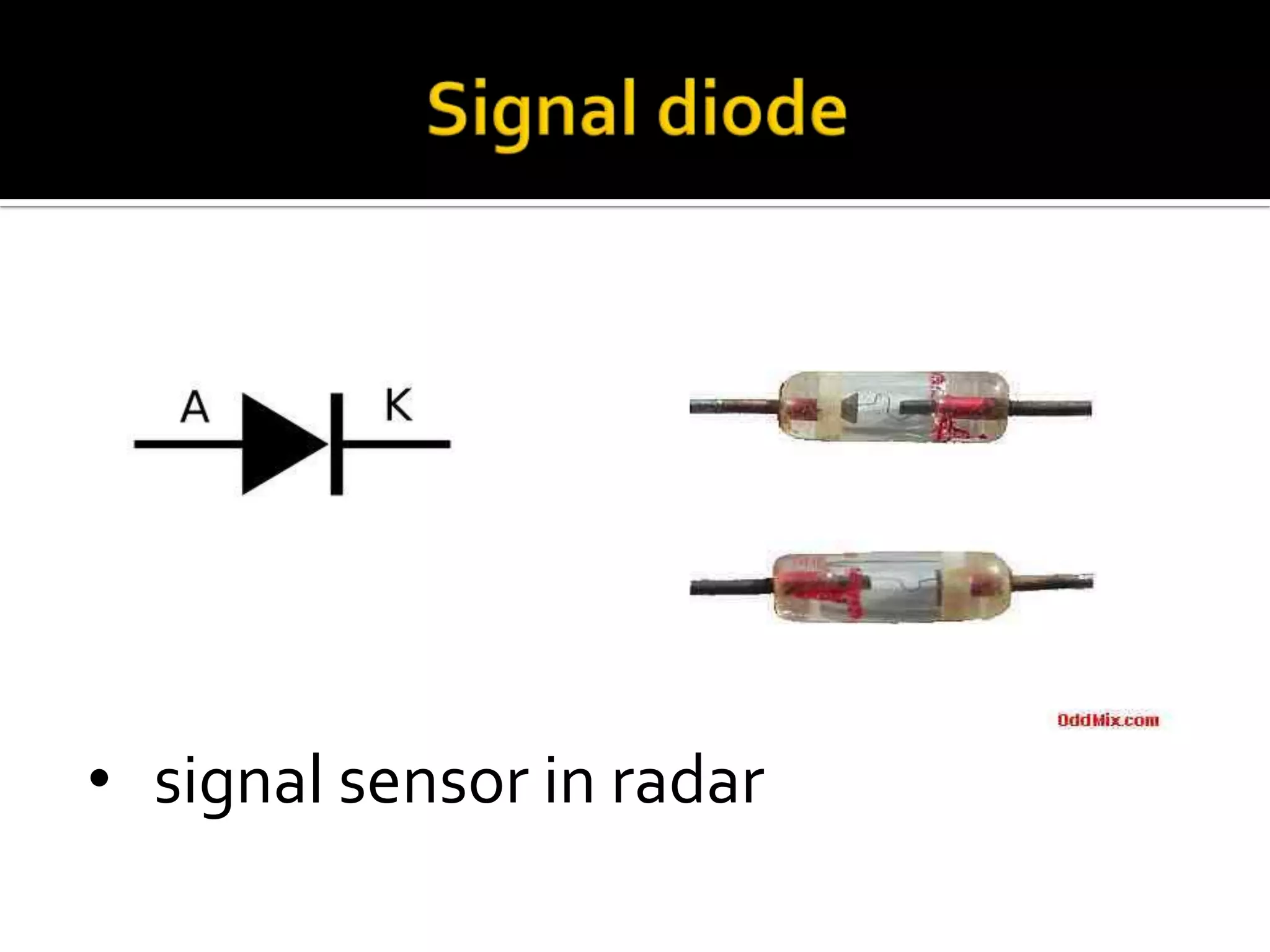
• signal sensor in radar
• Voltage regulator in power supply circuit.
• Voltage clipper in power supply circuit
 Indicator light in electronic circuit
• Oscillator circuit in an oscilloscope
• Variable capacitor in a tune circuit
• Light sensor in a remote control unit
• Focused single colour light source
in compact disc player
DIODEAPPLICATION
i. DC Power Supply
ii. Rectifier
iii. Filter
iv. Voltage regulator
DC POWER SUPPLY
RECTIFIER
2 types of rectifier
Half wave rectifier Full wave rectifier
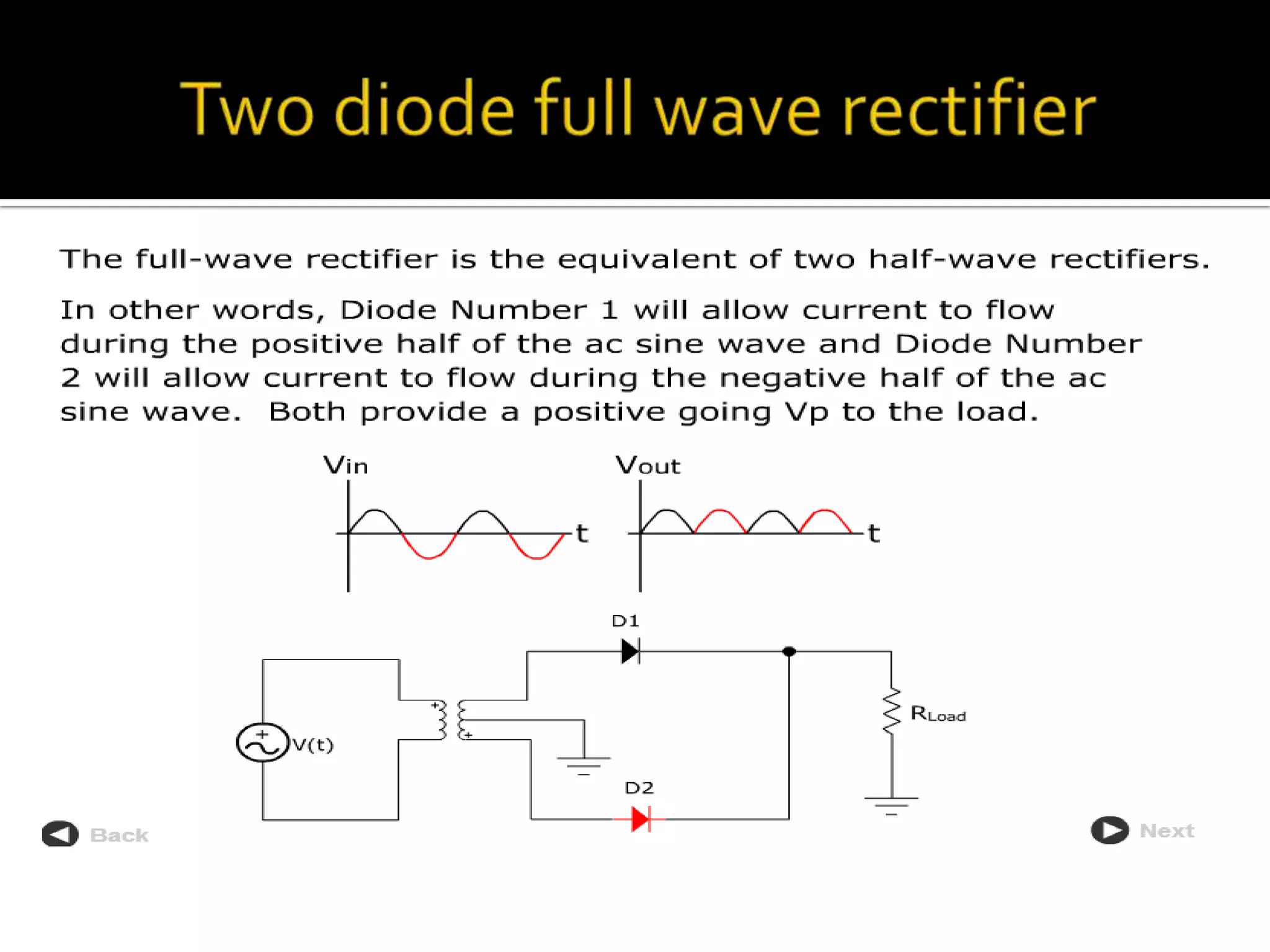
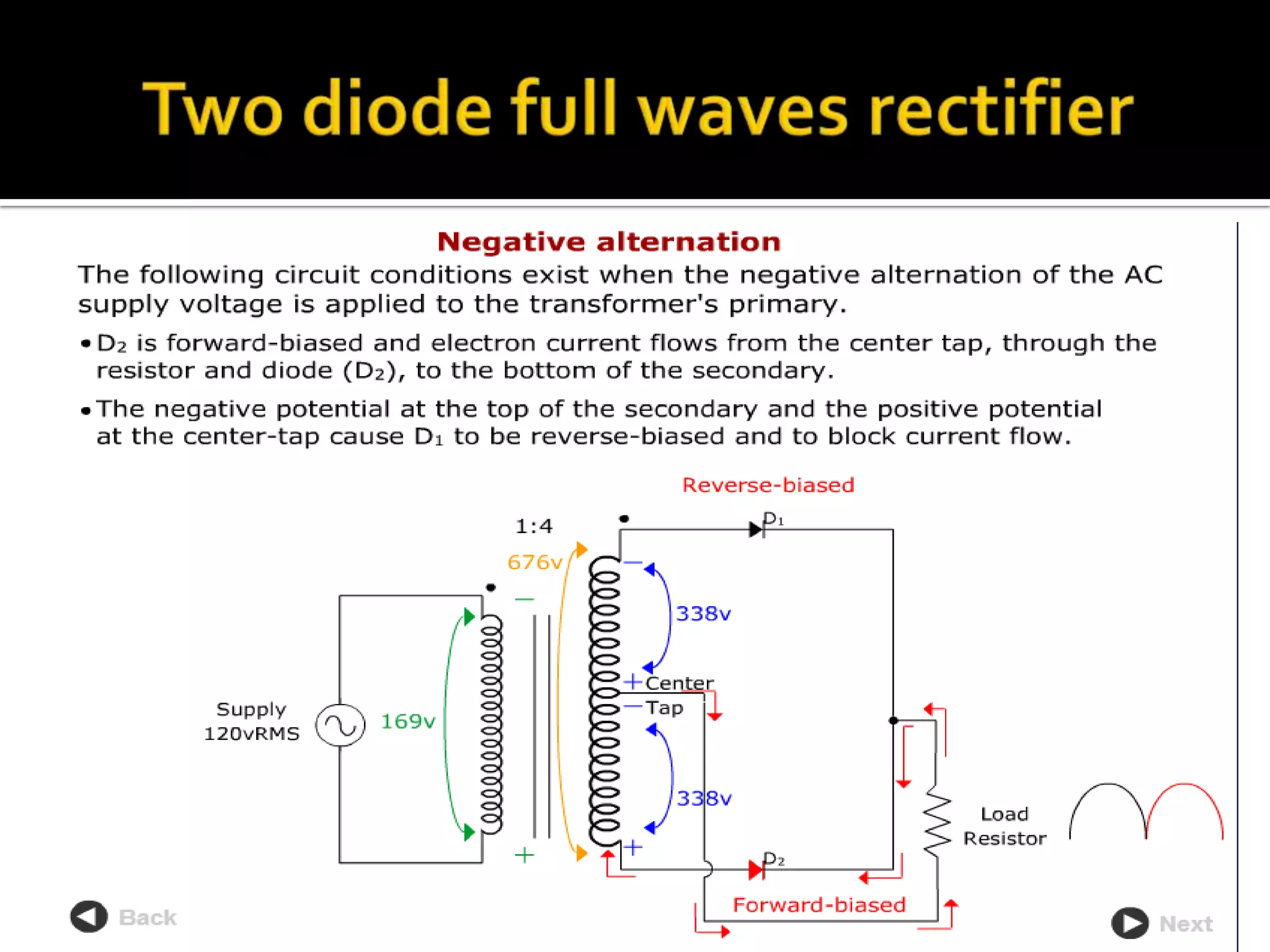
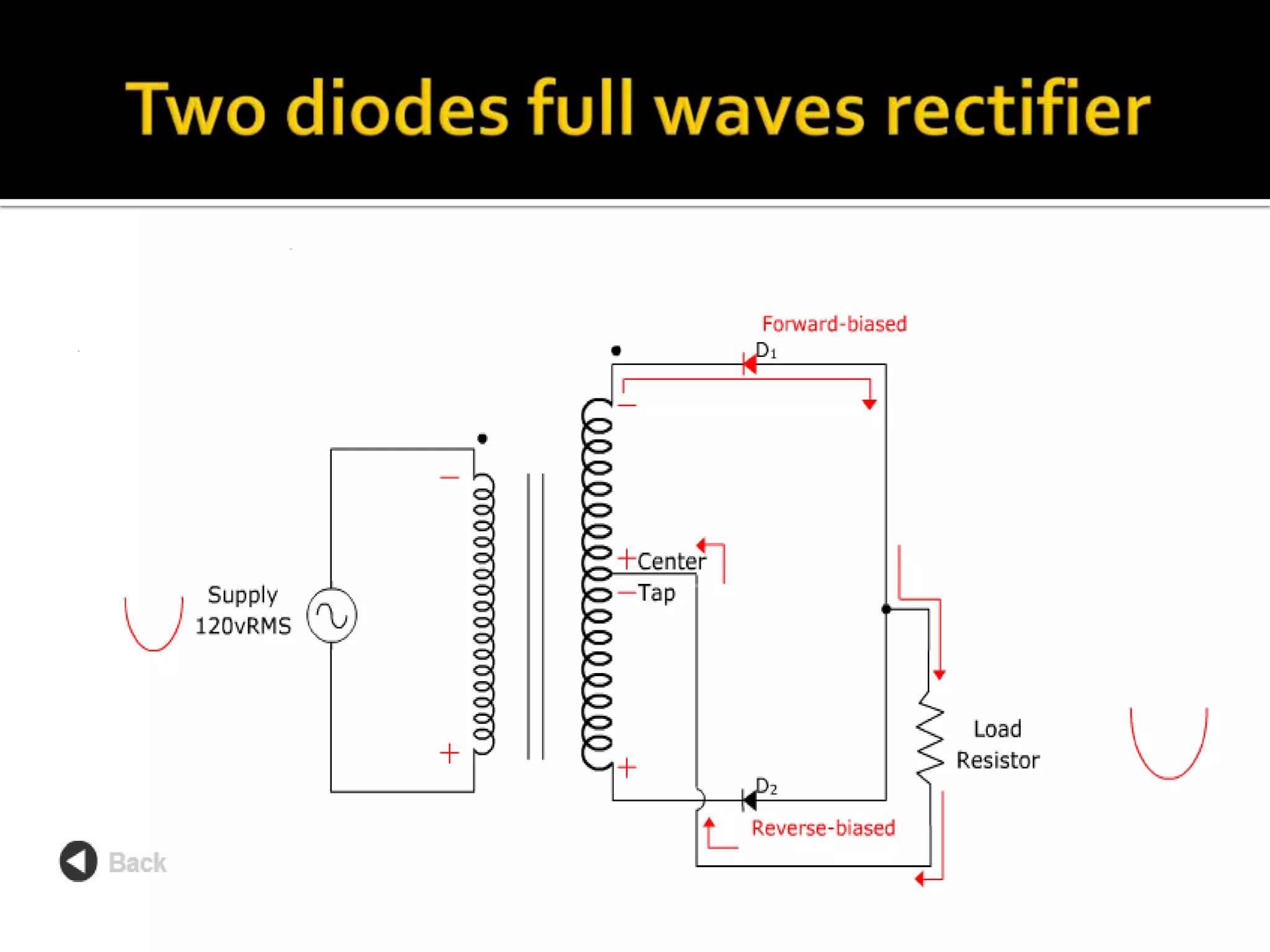
Two diode full wave
rectifier
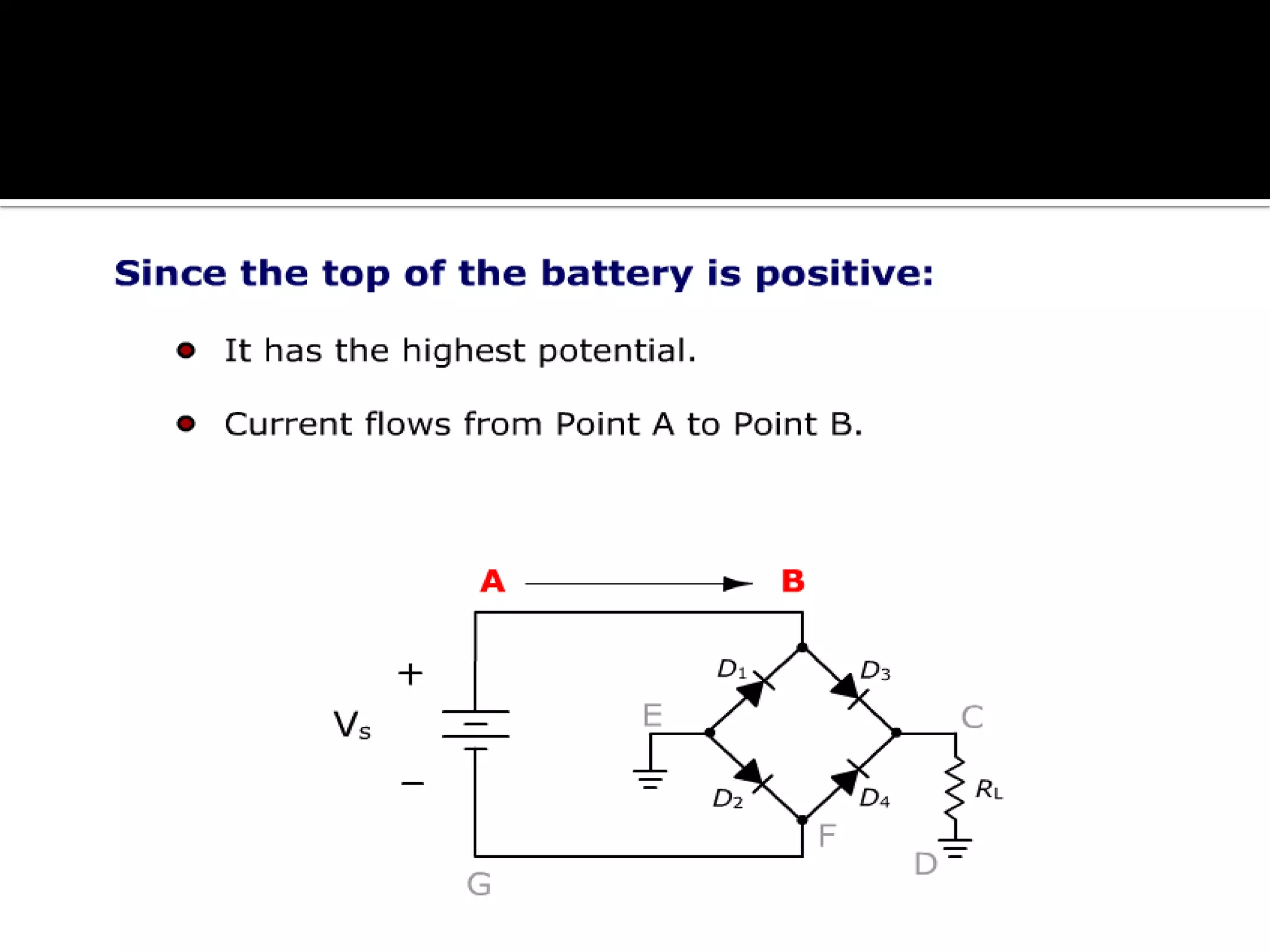
Bridge diode full wave
rectifier
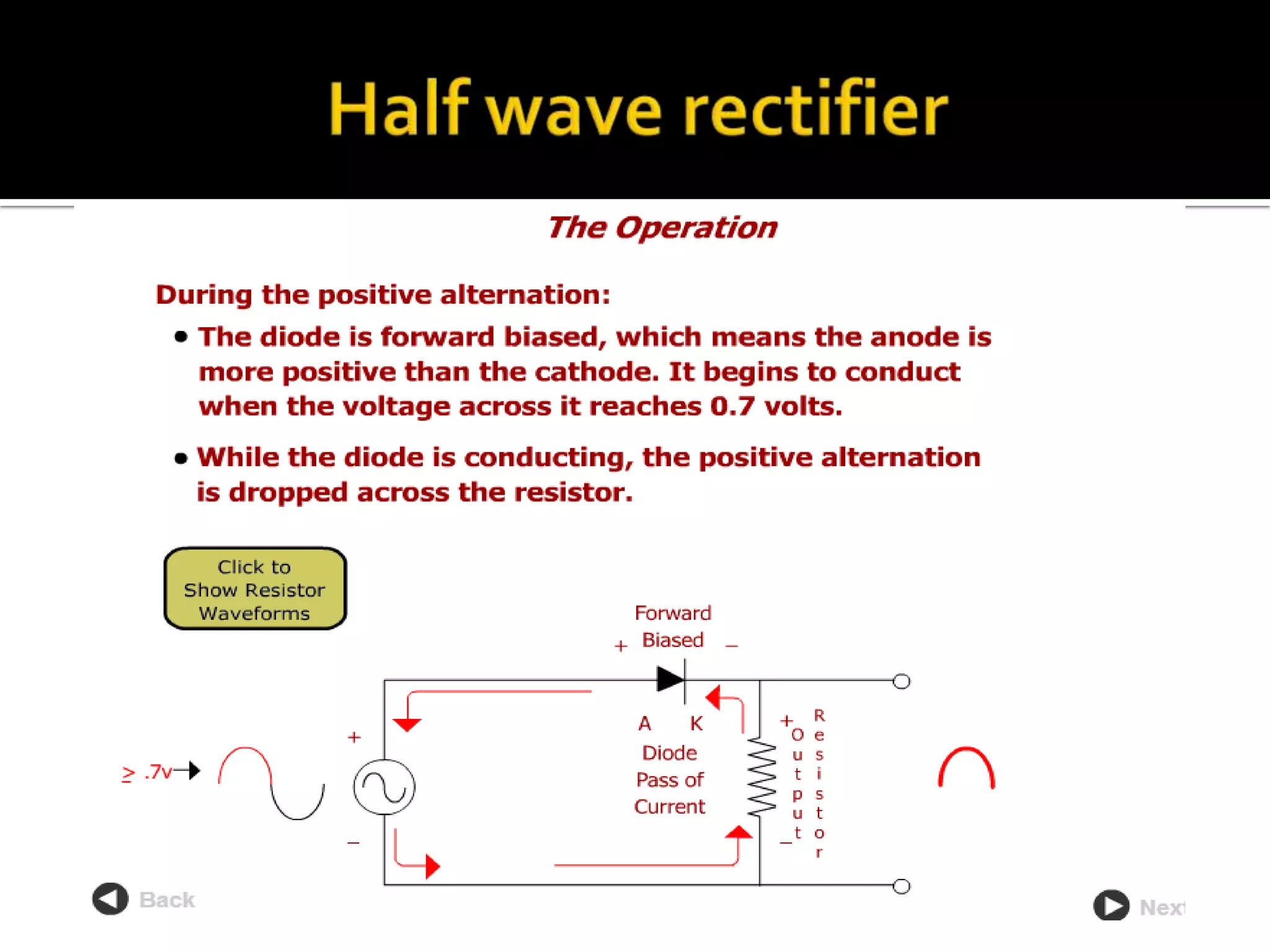
HALF WAVE RECTIFIER
 Can produce ripple voltage during both positive
and negative input cycle.
 There are 2 types of full wave rectifier:
I. Two diodes full wave rectifier
II. Bridge rectifier
TWO DIODES
FULLWAVE RECTIFIER
FULLWAVE
BRIDGE RECTIFIER
FILTER
 Circuit that converts the pulsating AC voltage to
a DC voltage.
 The main function of filter is to reduce the ripple
in the input waveform.
 Capacitor filter is very popular because of its low
cost, small size, light weight and good
characteristics
▪RC Filter
 LC (T) Filter
 LC (𝝿) Filter
 RLC Filter
VOLTAGE
REGULATOR
 Stabilize the output voltage.
 Reduce the ripple at the output voltage of the
filter circuit.
IC
VOLTAGE
REGULATOR
 Commonly use 78xx series.
 Provides a constant positive output
voltage.
 The two final xx digits designate the
value of the output voltage.
Diode

Diode

  • 1.
  • 2.
     Invented in1904 by John Ambrose Fleming.  Was constructed with 2 electrodes in the form of a vacuum tube.  In 1906, Lee Dee Forest added a 3rd electrode called a control grid and the triode, which is used as amplifier, switch..  The application of triode created a new era in broadcasting with the invention of the crystal radio sensor by Pickard, 1912.  Commonly used in DC power supply units as a rectifiers and voltage regulators, clipper, clamper circuit.  Comes in different shape and sizes
  • 4.
     Made froma combination of 2 extrinsic semiconductors, P-type ad N-type material.  The joint between the P-type and N-type material is called PN junction.  Have 2 terminal( anode and cathode).  Produced from the silicon wafer
  • 5.
  • 6.
    Near the PNjunction the electrons diffuse into the vacant holes in the P material causing a depletion zone.This depletion zone acts like an insulator preventing other free electrons in the N-type silicon and holes in the P-type silicon from combining. In addition this leaves a small electrical imbalance inside the crystal. Since the N region is missing some electrons it has obtained a positive charge. And the extra electrons that filled the holes in the P region, have given it a negative charge. Unfortunately one cannot generate power from this electrical imbalance. However the stage is set to see how the PN junction functions as a diode.
  • 7.
    .  At thep-n junction, electrons from the n-type semiconductor will be attracted to the holes in the p-type semiconductor.  As a result, the holes and the electrons at the p-n junction disappear, forming a layer called “depletion layer”.  At the same time, the p-type semiconductor becomes more negative whereas the n-type semiconductor becomes more positive.  This will result a potential difference across the p-n junction. This potential difference is called the junction voltage (or the barrier voltage).  The junction voltage will prevent the charge carrier from flowing across the depletion layer.
  • 8.
  • 10.
     The polarityof applied voltage which causes charge to flow through the diode is called Forward Bias. (all current, almost no volts)  The polarity of applied voltage which can't produce any current is called Reverse Bias.(all volts, almost no current)
  • 11.
  • 13.
     Forward region:It is the operation region at which the potential applied to anode is more positive than that applied to the cathode.  Reverse Region: It is the operation region at which anode potential is more negative than cathode potential.  Saturation Region: Part of the reverse region where the diode impedance is very high, and causes very small drift current.
  • 14.
     Break DownRegion:The part of the reverse region where the diode impedance is very low, and the current passing through the diode is very high.  ThresholdVoltageVT: It is also called the knee region. It can be determined on the I-V curve by the point at which diode starts to conduct current easily. It is also called the diode barrier potential and is very near in amplitude to the diode build-in voltage.
  • 15.
     Saturation Current:it is a very small current due to drift current in the diode in the reverse bias region. This current is very low (in the nano-amperes range) due to the high impedance of the depletion region.  Break DownVoltage: It is the maximum allowable voltage in the reverse bias region, at which diode resistance changed abruptly from very high impedance to very low impedance. If the reverse voltage applied on the diode exceeds this limit, a very high current in the reverse direction passes through the diode causing in burning it.
  • 16.
  • 17.
     Rectifying powersupply circuit (Rectifier = penerus)
  • 18.
  • 19.
    • Voltage regulatorin power supply circuit. • Voltage clipper in power supply circuit
  • 20.
     Indicator lightin electronic circuit
  • 21.
    • Oscillator circuitin an oscilloscope
  • 22.
    • Variable capacitorin a tune circuit
  • 23.
    • Light sensorin a remote control unit
  • 24.
    • Focused singlecolour light source in compact disc player
  • 25.
    DIODEAPPLICATION i. DC PowerSupply ii. Rectifier iii. Filter iv. Voltage regulator
  • 26.
  • 31.
  • 32.
    2 types ofrectifier Half wave rectifier Full wave rectifier Two diode full wave rectifier Bridge diode full wave rectifier
  • 33.
  • 38.
     Can produceripple voltage during both positive and negative input cycle.  There are 2 types of full wave rectifier: I. Two diodes full wave rectifier II. Bridge rectifier
  • 39.
  • 47.
  • 59.
  • 60.
     Circuit thatconverts the pulsating AC voltage to a DC voltage.  The main function of filter is to reduce the ripple in the input waveform.  Capacitor filter is very popular because of its low cost, small size, light weight and good characteristics
  • 64.
    ▪RC Filter  LC(T) Filter  LC (𝝿) Filter  RLC Filter
  • 65.
  • 66.
     Stabilize theoutput voltage.  Reduce the ripple at the output voltage of the filter circuit.
  • 71.
  • 73.
     Commonly use78xx series.  Provides a constant positive output voltage.  The two final xx digits designate the value of the output voltage.