Presentation on: Rectifier
Course Title: Analog Electronics
Course Coed: EEE 223
Presented to: Prof. Dr. Quazi Deen Mohammed khousru
ID:125-33-2656
ID:152-33-2634
ID:152-33-2710
Introduction
Rectifier
Type of rectifier
Half wave rectifier
Full wave rectifier
Bridge rectifier
introduction
 A rectifier is an electrical device that converts alternating
current (AC), which periodically reverses direction, to direct
current (DC), which is in only one direction, a process known
as rectification.
Types of Rectifiers
Half wave Rectifier
Full wave Rectifier
Bridge Rectifier
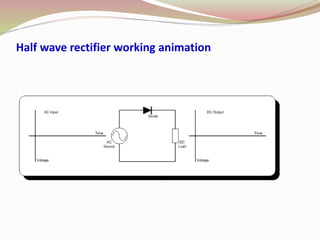
 In half wave rectification, either the positive or negative half of
the AC wave is passed, while the other half is blocked.
 Because only one half of the input waveform reaches the
output, it is very inefficient if used for power transfer.
Half wave rectifier
Half wave rectifier working animation
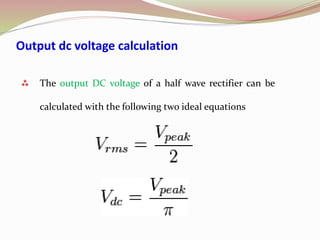
Output dc voltage calculation
 The output DC voltage of a half wave rectifier can be
calculated with the following two ideal equations
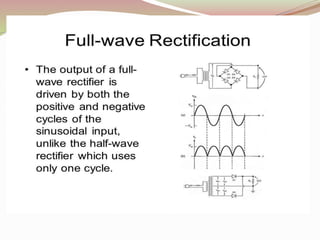
Full wave rectification
 In a circuit with a non - center tapped transformer, four
diodes are required instead of the one needed for half-
wave rectification.
 For single-phase AC, if the transformer is center-tapped,
then two diodes back-to-back (i.e. anodes-to-anode or
cathode-to-cathode) can form a full-wave rectifier.
formula
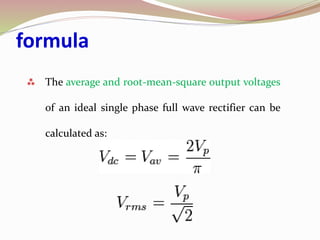
 The average and root-mean-square output voltages
of an ideal single phase full wave rectifier can be
calculated as:
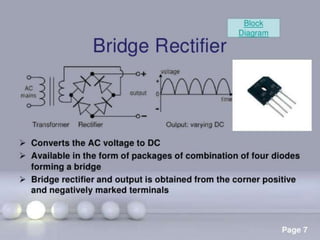
Bridge rectifier
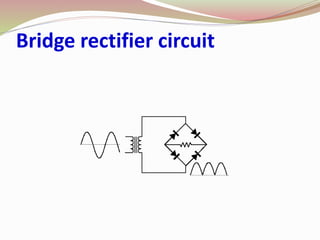
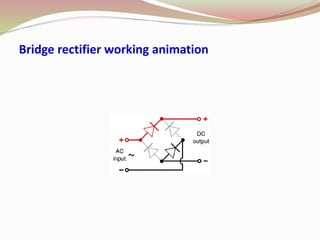
 A bridge rectifier makes use of four diodes in a
bridge arrangement to achieve full-wave
rectification.
Bridge rectifier circuit
Bridge rectifier working animation
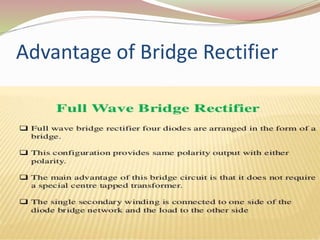
Advantage of Bridge Rectifier
rectifiers and all about rectifier

rectifiers and all about rectifier