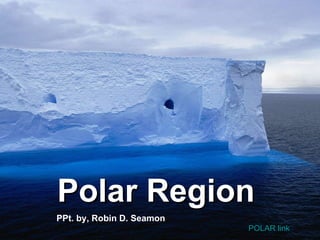
Polar Region POLAR link PPt. by, Robin D. Seamon
Arctic:  (N Pole) Antarctica:  (South Pole) COLDER than N. Pole; ground is always frozen, covered in snow & ice At the poles (N. Pole is magnetic!) Months of daylight in summer; months of night in the winter due to the earth’s tilt
Polar ice caps  high frozen, latitude region Glaciers:  rivers of frozen water Icebergs:  frozen chunks of fresh water in the ocean; much deeper under the water Permafrost:  permanently frozen ground Global warming is melting the ice!
 
http://express.howstuffworks.com/gif/wq-iceberg-underwater.jpg
Where are the POLAR REGIONS?
NO PLANTS IN THE POLAR REGIONS
ANIMALS in the Polar Regions: Polar bears, walrus, seal:  Arctic Penguins, seal:  Antarctica
Polar Region TESTING THE SNOW video (Man vs. Wild) Building an IGLOO (Man vs. Wild)
TUNDRA
Tundra:   vast, treeless land in the Arctic Region at North Pole;  A COLD desert! average temperature is -70 °F; very windy  Ground is frozen 10 inches to 3 feet Months of night time in the Winter, months of daylight in the summer
WHERE are TUNDRAS? N. American Tundra, Scandinavian Tundra, Russian Tundra (Siberia)
PLANTS in the TUNDRA:  the growing season is only 50-60 days long! Shrubs Sedges Mosses Lichens Grasses
ANIMALS in the TUNDRA: Caribou, musk oxen, wolverines, polar bears, snowshoe rabbits,  Migratory birds: pipers, plovers, harlequin ducks FACT: tundra mosquitos replace water in bodies with glycerol so as not to freeze!
http://images.nationalgeographic.com/wpf/media-live/photos/000/006/cache/musk-ox_640_600x450.jpg http://www.stapelknives.com/reveurl_story.html http://www.hauserbears.com/uploads/news/id86/polar-bear-family.jpg
ENVIRONMENTAL NOTES:   FRAGILE ECOSYSTEM!!! Biomass sinks :  takes in more carbon dioxide than it puts out Plants freeze & can’t decompose, therefore millions of years old plant material is frozen in the  permafrost. PROBLEM:  Global Warming  is melting the permafrost, releasing the carbon dioxide! …  greenhouse gas !
People are going there to mine & drill for oil Alaskan pipeline runs across a caribou migration route Roads/ towns built for miners & drillers Animals’ feeding patterns are disrupted; many polar bears (top of food chain predator) starve
Pesticides are sprayed for insects but also harm the migratory birds Pollution from the mines is harming the air, land & water in the fragile tundra environment Man… erosion SURVIVAL in the Snow
TAIGA http://www.alaska-in-pictures.com/denali-fall-foliage-taiga-1393-pictures.htm http://www.cas.vanderbilt.edu/bioimages/ecoregions/50607.htm
TAIGA :  Russian word for “forest” needle-leaf forest in the North ( boreal forest ) -65 °  F (winter) to 70 °  F (summer) Coldness & food shortages Cold, snowy winters Warm, humid summers
Where is the TAIGA? N. America, Europe, Asia
ANIMALS in the Taiga: Many hibernate during the winter Some migrate south in winter Millions of insects in the summer Birds migrate there for insects in the summer  Lynx, wolverine, bobcat, snowshoe rabbit, squirrel, red deer, moose, elk
Surviving the Rapids: Man vs. Wild
PLANTS in the TAIGA: Evergreen trees (conifers) Wildfires: thick tree bark
POLAR REGION
TUNDRA: Vegetation:   lichens , mosses,  sedges ,  perennial forbs , and  dwarfed shrubs , (often  heaths , but also birches and willows). Herbivores:   musk oxen, pikas, arctic hares, caribou, lemming,  Primary carnivore:   arctic fox, bear Secondary carnivore:   arctic wolves, snowy owls,
Polar Region
Polar Region

Polar region Notes on various Polar ecosystems including Arctic, Antarctic, Tundra, & Taiga, mentioning global warming & climate change with video links