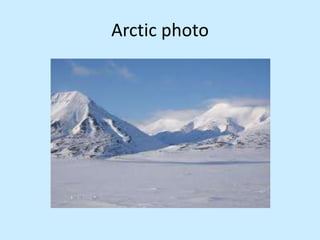
The Arctic is located in the northernmost part of the Earth and consists of the Arctic Ocean surrounded by parts of several countries. It is a unique ecosystem that includes organisms living in ice, marine life, birds, land animals, and human societies that have adapted to the cold conditions. Recent years have seen a decline in sea ice extent.

![Arctic
• The Arctic is a region located at the northern-most part of theEarth. The
Arctic consists of the Arctic Ocean and parts of Canada, Russia,Greenland,
the United States, Norway, Sweden, Finland, and Iceland. The Arctic region
consists of a vast, ice-covered ocean, surrounded by treeless permafrost.
The area can be defined as north of the Arctic Circle (66° 33'N), the
approximate limit of the midnight sun and the polar night. Alternatively, it
can be defined as the region where the average temperature for the
warmest month (July) is below 10 °C (50 °F); the northernmost tree
line roughly follows the isotherm at the boundary of this region.[1][2]
• Socially and politically, the Arctic region includes the northern territories
of the eight Arctic states, although by natural science definitions much of
this territory is considered subarctic. The Arctic region is a unique area
among Earth's ecosystems. The cultures in the region and the
Arctic indigenous peoples have adapted to its cold and extreme
conditions. In recent years the extent of the sea ice has declined.[3][4]Life in
the Arctic includes organisms living in the
ice,[5] zooplankton and phytoplankton, fish and marine mammals, birds,
land animals, plants and human societies.](https://image.slidesharecdn.com/arcticantartica-120108051052-phpapp02/85/Arctic-antartica-2-320.jpg)

![Antarctica
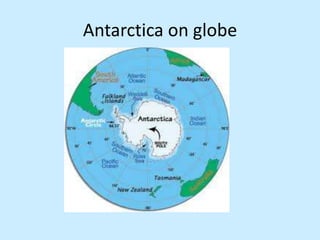
• Antarctica is Earth's southernmost continent, encapsulating the South Pole. It is situated in the Antarcticregion of
the Southern Hemisphere, almost entirely south of theAntarctic Circle, and is surrounded by the Southern Ocean. At
14.0 million km2 (5.4 million sq mi), it is the fifth-largest continent in area after Asia, Africa, North
America, and South America. For comparison, Antarctica is nearly twice the size of Australia. About 98% of
Antarctica is covered by ice that averages at least 1 mile (1.6 km) in thickness.
• Antarctica, on average, is the coldest, driest, and windiest continent, and has the highest average elevation of all the
continents.[6] Antarctica is considered a desert, with annualprecipitation of only 200 mm (8 inches) along the coast
and far less inland.[7] The temperature in Antarctica has reached −89 °C (−129 °F). There are no permanent human
residents, but anywhere from 1,000 to 5,000 people reside throughout the year at the research stations scattered
across the continent. Only cold-adapted organisms survive there, including many types of algae, animals (for
example mites, nematodes,penguins, seals and tardigrades), bacteria, fungi, plants, andprotista. Vegetation where
it occurs is tundra.
• Although myths and speculation about a Terra Australis("Southern Land") date back to antiquity, the first confirmed
sighting of the continent is commonly accepted to have occurred in 1820 by the Russian expedition of Fabian
Gottlieb von Bellingshausen and Mikhail Lazarev. The continent, however, remained largely neglected for the rest of
the 19th century because of its hostile environment, lack of resources, and isolation. The Antarctic Treaty was
signed in 1959 by 12 countries; to date, 47 countries have signed the treaty. The treaty prohibits military activities
and mineral mining, prohibits nuclear explosions and nuclear power, supports scientific research, and protects the
continent's ecozone. Ongoing experiments are conducted by more than 4,000 scientists of multiple nationalities.](https://image.slidesharecdn.com/arcticantartica-120108051052-phpapp02/85/Arctic-antartica-6-320.jpg)