ENVIROMENT
Tundra is the coldest of all the biomes. It is noted for its frost-molded
landscapes, extremely low temperatures, little precipitation, poor
nutrients, and short growing seasons. Dead organic material functions
as a nutrient pool. The two major nutrients are nitrogen and
phosphorus. Winter temperatures don't reach above 20° F and
average -20° to -30°F. The tundra is an unusually cold and dry
climate. Precipitation totals 6-10 inches of rain a year, which includes
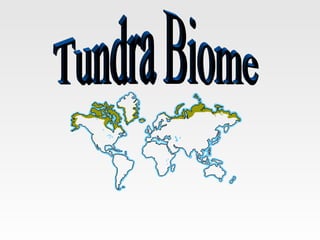
melted snow. The tundra climate spans from most of Greenland to
parts of Alaska, northern Canada, and northern Russia. The latitudinal
range is 75° N to 60° N. Tundra climates can be found on the coastal
areas of the arctic. The ocean water keeps the climate from falling to
the extreme temperatures found in the interior of the continents.
FLORA
All of the plants found in the tundra biome grow very slowly due to the
cool temperatures. There are more than 2,000 types of plants that can
grow there. Most of them are types of moss. However, you will also find
shrubs, grass, and some willow out there as well. Approximately 400
different species of flowers have been identified in the tundra biome.
Because of the short growing season, most tundra plants are
perennials-they spend several years gathering and storing nutrients
between each episode of seed production. Many can reproduce by
sending runners through the soil, sprouting new plants at the nodes.
This is less costly than blooming and producing seeds and fruits.

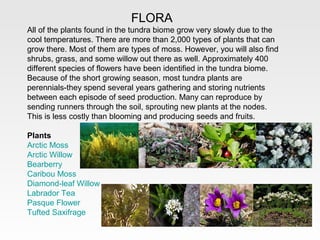
Plants
Arctic Moss
Arctic Willow
Bearberry
Caribou Moss
Diamond-leaf Willow
Labrador Tea
Pasque Flower
Tufted Saxifrage
FAUNA
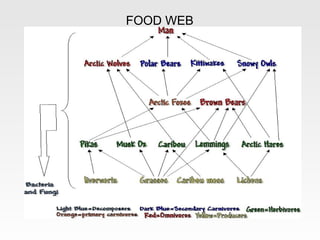
    The fauna in the arctic is also diverse. Herbivorous mammals include
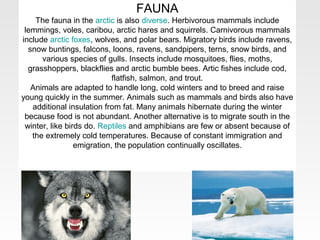
 lemmings, voles, caribou, arctic hares and squirrels. Carnivorous mammals
include arctic foxes, wolves, and polar bears. Migratory birds include ravens,
  snow buntings, falcons, loons, ravens, sandpipers, terns, snow birds, and
      various species of gulls. Insects include mosquitoes, flies, moths,
  grasshoppers, blackflies and arctic bumble bees. Artic fishes include cod,
                            flatfish, salmon, and trout.
   Animals are adapted to handle long, cold winters and to breed and raise
young quickly in the summer. Animals such as mammals and birds also have
   additional insulation from fat. Many animals hibernate during the winter
 because food is not abundant. Another alternative is to migrate south in the
 winter, like birds do. Reptiles and amphibians are few or absent because of
   the extremely cold temperatures. Because of constant immigration and
                 emigration, the population continually oscillates.
FOOD WEB
THREATS
•   Threats                                          •   Solutions
•   The melting of the permafrost as a result of     •   Switch to alternative energy uses to
    global warming could radically change the            minimize human-made global warming.
    landscape and what species are able to live      •   Establish protected areas and park reserves
    there.                                               to restrict human influence.
•   Ozone depletion at the North and South           •   Limit road construction, mining activities,
    Poles means stronger ultraviolet rays that           and the building of pipelines
    will harm the tundra.                                intundra habitat.
•   Air pollution can cause smog clouds that         •   Limit tourism and respect local cultures
    contaminate lichen, a significant food
    source for many animals.
•   Exploration of oil, gas, and minerals and
    construction of pipelines and roads can
    cause physical disturbances and habitat
    fragmentation.
•   Oil spills can kill wildlife and significantly
    damage tundra ecosystems.
•   Buildings and roads put heat and pressure
    on the permafrost, causing it to melt.
•   Invasive species push aside native
    vegetation and reduce diversity of plant
    cover.
IMPORTANCE

 The Tundra plays a large role in the temperature regulation of the planet. As
warm air rises from the tropical zone it is cooled in theTundra causing it to sink
back down to the equator. This causes weather and air currents. Without this
system climate as we know it would change drastically around the world. Areas
that once could support life may not anymore. It is also a winter home for many
species of birds. If they were to disappear from the food chain it would cause
devastating changes to other species dependent on the. the tundra is a key
factor in global biodiversity.
VOCABULARY
Phosphorus: a solid, nonmetallic element existing in at leastthree allotropic forms, on
e that is yellow, poisonous,flammable, and luminous in the dark, one that is red, less
poisonous, and less flammable, and another that is black,insoluble in most solvents,
and the least flammable


Biodiversity: diversity among and within plant and animal species in anenvironment.
Bibliography
http://www.blueplanetbiomes.org/tundra.htm
http://www.ucmp.berkeley.edu/glossary/gloss5/biome/tundra.html
CREDITS

Ian Diaz
Luis Medina
Job Gutierrez

Projecto biologia

  • 2.
    ENVIROMENT Tundra is thecoldest of all the biomes. It is noted for its frost-molded landscapes, extremely low temperatures, little precipitation, poor nutrients, and short growing seasons. Dead organic material functions as a nutrient pool. The two major nutrients are nitrogen and phosphorus. Winter temperatures don't reach above 20° F and average -20° to -30°F. The tundra is an unusually cold and dry climate. Precipitation totals 6-10 inches of rain a year, which includes melted snow. The tundra climate spans from most of Greenland to parts of Alaska, northern Canada, and northern Russia. The latitudinal range is 75° N to 60° N. Tundra climates can be found on the coastal areas of the arctic. The ocean water keeps the climate from falling to the extreme temperatures found in the interior of the continents.
  • 3.
    FLORA All of theplants found in the tundra biome grow very slowly due to the cool temperatures. There are more than 2,000 types of plants that can grow there. Most of them are types of moss. However, you will also find shrubs, grass, and some willow out there as well. Approximately 400 different species of flowers have been identified in the tundra biome. Because of the short growing season, most tundra plants are perennials-they spend several years gathering and storing nutrients between each episode of seed production. Many can reproduce by sending runners through the soil, sprouting new plants at the nodes. This is less costly than blooming and producing seeds and fruits. Plants Arctic Moss Arctic Willow Bearberry Caribou Moss Diamond-leaf Willow Labrador Tea Pasque Flower Tufted Saxifrage
  • 4.
    FAUNA The fauna in the arctic is also diverse. Herbivorous mammals include lemmings, voles, caribou, arctic hares and squirrels. Carnivorous mammals include arctic foxes, wolves, and polar bears. Migratory birds include ravens, snow buntings, falcons, loons, ravens, sandpipers, terns, snow birds, and various species of gulls. Insects include mosquitoes, flies, moths, grasshoppers, blackflies and arctic bumble bees. Artic fishes include cod, flatfish, salmon, and trout. Animals are adapted to handle long, cold winters and to breed and raise young quickly in the summer. Animals such as mammals and birds also have additional insulation from fat. Many animals hibernate during the winter because food is not abundant. Another alternative is to migrate south in the winter, like birds do. Reptiles and amphibians are few or absent because of the extremely cold temperatures. Because of constant immigration and emigration, the population continually oscillates.
  • 5.
  • 6.
    THREATS • Threats • Solutions • The melting of the permafrost as a result of • Switch to alternative energy uses to global warming could radically change the minimize human-made global warming. landscape and what species are able to live • Establish protected areas and park reserves there. to restrict human influence. • Ozone depletion at the North and South • Limit road construction, mining activities, Poles means stronger ultraviolet rays that and the building of pipelines will harm the tundra. intundra habitat. • Air pollution can cause smog clouds that • Limit tourism and respect local cultures contaminate lichen, a significant food source for many animals. • Exploration of oil, gas, and minerals and construction of pipelines and roads can cause physical disturbances and habitat fragmentation. • Oil spills can kill wildlife and significantly damage tundra ecosystems. • Buildings and roads put heat and pressure on the permafrost, causing it to melt. • Invasive species push aside native vegetation and reduce diversity of plant cover.
  • 7.
    IMPORTANCE The Tundraplays a large role in the temperature regulation of the planet. As warm air rises from the tropical zone it is cooled in theTundra causing it to sink back down to the equator. This causes weather and air currents. Without this system climate as we know it would change drastically around the world. Areas that once could support life may not anymore. It is also a winter home for many species of birds. If they were to disappear from the food chain it would cause devastating changes to other species dependent on the. the tundra is a key factor in global biodiversity.
  • 8.
    VOCABULARY Phosphorus: a solid,nonmetallic element existing in at leastthree allotropic forms, on e that is yellow, poisonous,flammable, and luminous in the dark, one that is red, less poisonous, and less flammable, and another that is black,insoluble in most solvents, and the least flammable Biodiversity: diversity among and within plant and animal species in anenvironment.
  • 9.
  • 10.