TECHNICAL SEMINAR REPORT 
National Institute of Science & Technology 1 
FLASH MEMORY 
Presented by 
RRaajjnniikkaanntt BBaall 
Roll no:IT200118159 
Under the Guidance 
of 
MMrr.. PPrraaddeeeepp KKuummaarr JJeennaa..
FLASH MEMORY 
INTRODUCTION 
National Institute of Science & Technology 2 Presented By: Rajnikant Bal, IT200118159 
• Flash memory provides exciting opportunities to 
increase the flexibility of an embedded product. 
• Flash Memory is solid state non-volatile memory. 
• It stores electrical charges rather than magnetic 
media. 
• Flash memory is light, compact, energy efficient and 
less expensive. 
• It is a ideal storage medium for digital camera, smart 
card etc.
FLASH MEMORY 
WHAT IS FLASH MEMORY? 
• Flash memory is electronically erasable, electronically 
National Institute of Science & Technology 3 
programmable, (generally) read-only memory. 
• From an embedded system designer’s perspective, the key 
difference between flash memory and EEPROM is that 
flash devices are block structured; that is, while flash 
memory locations are individually programmable, they are 
not individually erasable the way they are with EEPROM. 
Presented By: Rajnikant Bal, IT200118159 
Cont..
FLASH MEMORY 
National Institute of Science & Technology 4 
• Flash memory is erased in sections whose sizes and 
locations in the chip are defined by the part’s 
manufacturer. 
• As a result, once a flash memory location is programmed, 
the entire section containing the location must be erased 
before that location can be programmed again. 
Presented By: Rajnikant Bal, IT200118159
National Institute of Science & Technology 5 
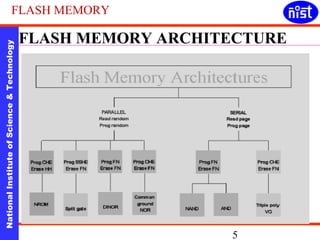
FLASH MEMORY ARCHITECTURE 
FLASH MEMORY
FLASH MEMORY 
HOW FLASH MEMORY WORKS 
National Institute of Science & Technology 6 
• Flash memory is a type of EEPROM chip. 
• Flash memory cell consists of two transistors and 
these transistors are separated by a thin oxide 
layer. 
• One transistor is called floating and other one is 
control gate. 
• A cell censor monitor the level of charge passing 
through floating gate. if the flow through the gate is 
greater than 50%of charge its value is ‘1’. If charge 
passing drops below 50% threshold it’s value is ‘0’. 
Presented By: Rajnikant Bal, IT200118159
FLASH MEMORY 
HOW TO ERASE & WRITE TO FLASH? 
National Institute of Science & Technology 7 Presented By: Rajnikant Bal, IT200118159 
• Flash memory is a type of EEPROM chip. It has a 
grid of columns and rows with a cell that has two 
transistors at each intersection . The two transistors 
are separated from each other by a thin oxide layer. 
• Programming algorithms specified to Flash controller 
is used to control Flash memory.
FLASH MEMORY 
FLASH APPLICATIONS 
National Institute of Science & Technology 8 Presented By: Rajnikant Bal, IT200118159 
• FLASH Memory for Data Storage 
The flash can also be used for configuration data and mass 
storage. Since flash is non-volatile these systems can restore 
configuration parameters after a power failure or reset.
FLASH MEMORY 
FLASH APPLICATIONS 
• Various Types of Flash Memories Products 
National Institute of Science & Technology 9 
1. Data flash memories are used as flexible data storage 
devices in mobile telephones, PDA’s, digital cameras, 
MP3 players . 
2. Program flash memories (or Code Flash) are used as 
memories for software in personal computers, mobile 
telephones and other electronic devices. 
3. Embedded flash memories are used to equip chip 
cards,which are increasingly utilized as cash cards and ID 
cards. Flash memory is often used in MP3 players and 
digital cameras, magazines.
FLASH MEMORY 
FLASH APPLICATIONS 
National Institute of Science & Technology 10 Presented By: Rajnikant Bal, IT200118159 
• Products needing reduced service costs 
• A product with in-circuit programmable flash memory is 
easier to service than an otherwise identical product built 
with UV-erase EPROM, since no disassembly is required 
to update the firmware or insert test functions.
FLASH MEMORY 
FLASH APPLICATIONS 
National Institute of Science & Technology 11 Presented By: Rajnikant Bal, IT200118159 
• Nonvolatile storage needed but battery not desirable 
In an application where long-term data storage is required 
but a battery is not desirable, flash provides an ideal 
alternative to battery-backed static RAM.
ADVANTAGES 
FLASH MEMORY 
National Institute of Science & Technology 12 
• Flash memory is noise less. 
• It allows faster access. 
• It is smaller size and lighter. 
• It has no moving parts. 
• Embedded applications can take advantage of Flash 
memory by both storing application data in it and by 
allowing modifications of the application code itself . 
Presented By: Rajnikant Bal, IT200118159
LIMITATIONS 
FLASH MEMORY 
National Institute of Science & Technology 13 
• Flash memory costs five to ten times more 
than standard DRAM. 
• Another downside is the overabundance of 
formats. 
• Huge premium to pay power saving of flash 
memory. 
Presented By: Rajnikant Bal, IT200118159
FLASH MEMORY 
CONCLUSION 
National Institute of Science & Technology 14 
• Flash memory thus can provide an alternative 
to conventional DRAM memory. But it’s cost 
has to be decreased drastically to ensure that 
it replays the DRAM quickly. 
• It is a ideal storage medium for digital 
camera,smart card etc. 
Presented By: Rajnikant Bal, IT200118159
FLASH MEMORY 
National Institute of Science & Technology 15 
TTHHAANNKKYYOOUU !!!!!!!!!!!!!!!! 
Presented By: Rajnikant Bal, IT200118159

Flash memory

  • 1.
    TECHNICAL SEMINAR REPORT National Institute of Science & Technology 1 FLASH MEMORY Presented by RRaajjnniikkaanntt BBaall Roll no:IT200118159 Under the Guidance of MMrr.. PPrraaddeeeepp KKuummaarr JJeennaa..
  • 2.
    FLASH MEMORY INTRODUCTION National Institute of Science & Technology 2 Presented By: Rajnikant Bal, IT200118159 • Flash memory provides exciting opportunities to increase the flexibility of an embedded product. • Flash Memory is solid state non-volatile memory. • It stores electrical charges rather than magnetic media. • Flash memory is light, compact, energy efficient and less expensive. • It is a ideal storage medium for digital camera, smart card etc.
  • 3.
    FLASH MEMORY WHATIS FLASH MEMORY? • Flash memory is electronically erasable, electronically National Institute of Science & Technology 3 programmable, (generally) read-only memory. • From an embedded system designer’s perspective, the key difference between flash memory and EEPROM is that flash devices are block structured; that is, while flash memory locations are individually programmable, they are not individually erasable the way they are with EEPROM. Presented By: Rajnikant Bal, IT200118159 Cont..
  • 4.
    FLASH MEMORY NationalInstitute of Science & Technology 4 • Flash memory is erased in sections whose sizes and locations in the chip are defined by the part’s manufacturer. • As a result, once a flash memory location is programmed, the entire section containing the location must be erased before that location can be programmed again. Presented By: Rajnikant Bal, IT200118159
  • 5.
    National Institute ofScience & Technology 5 FLASH MEMORY ARCHITECTURE FLASH MEMORY
  • 6.
    FLASH MEMORY HOWFLASH MEMORY WORKS National Institute of Science & Technology 6 • Flash memory is a type of EEPROM chip. • Flash memory cell consists of two transistors and these transistors are separated by a thin oxide layer. • One transistor is called floating and other one is control gate. • A cell censor monitor the level of charge passing through floating gate. if the flow through the gate is greater than 50%of charge its value is ‘1’. If charge passing drops below 50% threshold it’s value is ‘0’. Presented By: Rajnikant Bal, IT200118159
  • 7.
    FLASH MEMORY HOWTO ERASE & WRITE TO FLASH? National Institute of Science & Technology 7 Presented By: Rajnikant Bal, IT200118159 • Flash memory is a type of EEPROM chip. It has a grid of columns and rows with a cell that has two transistors at each intersection . The two transistors are separated from each other by a thin oxide layer. • Programming algorithms specified to Flash controller is used to control Flash memory.
  • 8.
    FLASH MEMORY FLASHAPPLICATIONS National Institute of Science & Technology 8 Presented By: Rajnikant Bal, IT200118159 • FLASH Memory for Data Storage The flash can also be used for configuration data and mass storage. Since flash is non-volatile these systems can restore configuration parameters after a power failure or reset.
  • 9.
    FLASH MEMORY FLASHAPPLICATIONS • Various Types of Flash Memories Products National Institute of Science & Technology 9 1. Data flash memories are used as flexible data storage devices in mobile telephones, PDA’s, digital cameras, MP3 players . 2. Program flash memories (or Code Flash) are used as memories for software in personal computers, mobile telephones and other electronic devices. 3. Embedded flash memories are used to equip chip cards,which are increasingly utilized as cash cards and ID cards. Flash memory is often used in MP3 players and digital cameras, magazines.
  • 10.
    FLASH MEMORY FLASHAPPLICATIONS National Institute of Science & Technology 10 Presented By: Rajnikant Bal, IT200118159 • Products needing reduced service costs • A product with in-circuit programmable flash memory is easier to service than an otherwise identical product built with UV-erase EPROM, since no disassembly is required to update the firmware or insert test functions.
  • 11.
    FLASH MEMORY FLASHAPPLICATIONS National Institute of Science & Technology 11 Presented By: Rajnikant Bal, IT200118159 • Nonvolatile storage needed but battery not desirable In an application where long-term data storage is required but a battery is not desirable, flash provides an ideal alternative to battery-backed static RAM.
  • 12.
    ADVANTAGES FLASH MEMORY National Institute of Science & Technology 12 • Flash memory is noise less. • It allows faster access. • It is smaller size and lighter. • It has no moving parts. • Embedded applications can take advantage of Flash memory by both storing application data in it and by allowing modifications of the application code itself . Presented By: Rajnikant Bal, IT200118159
  • 13.
    LIMITATIONS FLASH MEMORY National Institute of Science & Technology 13 • Flash memory costs five to ten times more than standard DRAM. • Another downside is the overabundance of formats. • Huge premium to pay power saving of flash memory. Presented By: Rajnikant Bal, IT200118159
  • 14.
    FLASH MEMORY CONCLUSION National Institute of Science & Technology 14 • Flash memory thus can provide an alternative to conventional DRAM memory. But it’s cost has to be decreased drastically to ensure that it replays the DRAM quickly. • It is a ideal storage medium for digital camera,smart card etc. Presented By: Rajnikant Bal, IT200118159
  • 15.
    FLASH MEMORY NationalInstitute of Science & Technology 15 TTHHAANNKKYYOOUU !!!!!!!!!!!!!!!! Presented By: Rajnikant Bal, IT200118159