1 Flash Memory
2 History of Flash Memory
3 Types of Flash Memory
4 Uses of Flash Memory
5 Examples of Flash Memory
6 Advantages & Disadvantages of Flash Memory
7 Future of Flash Memory
FLASH MEMORY
 Flash memory is a non-volatile memory .That can be
electrically erased and reprogrammed
 It was developed from EEPROM (electrically erasable
programmable read-only memory)
 Flash memory is a new memory technology that
allowed stores data to be saved when the memory
device was disconnected from its power sources.
1
HIstory
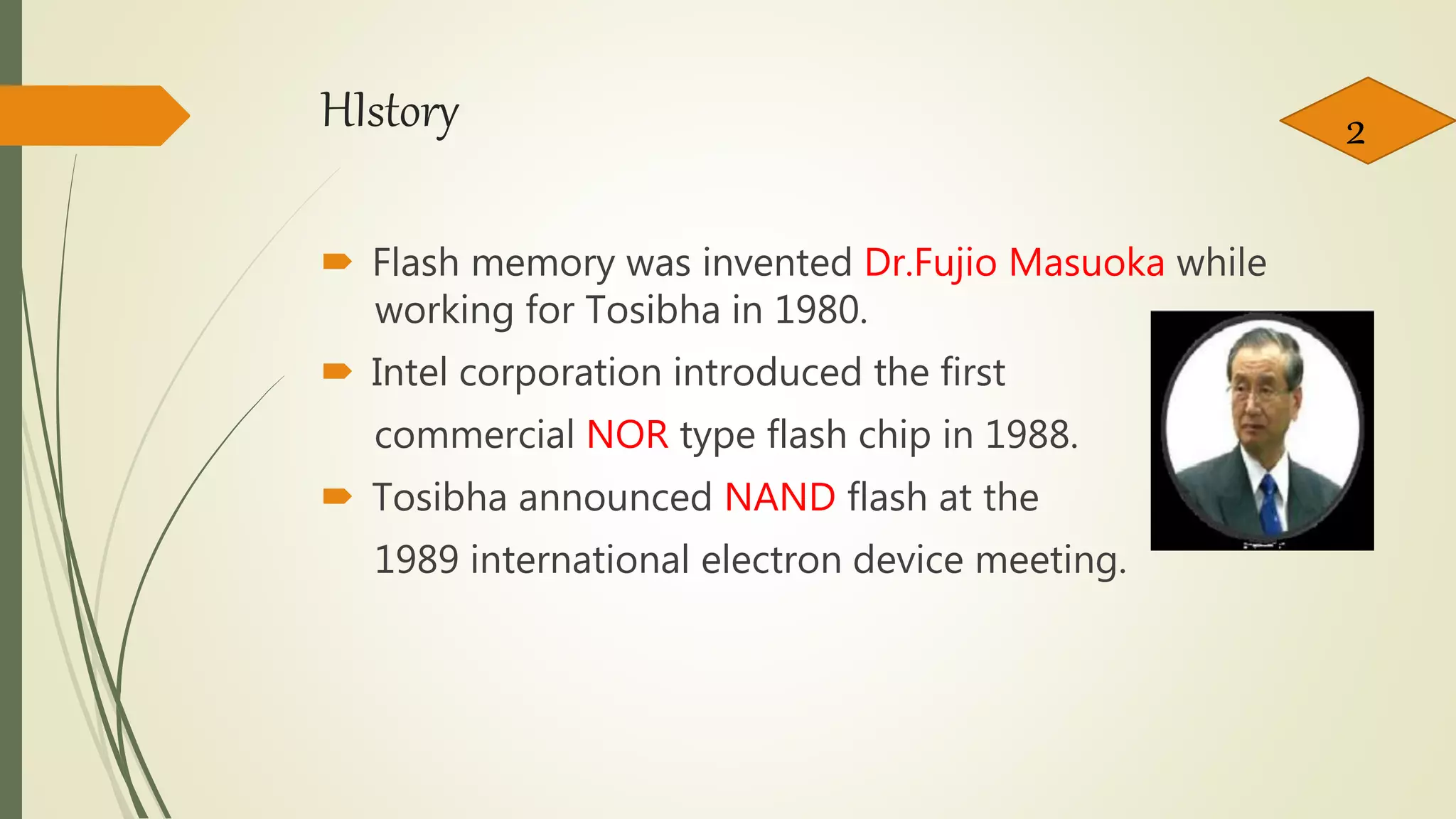
 Flash memory was invented Dr.Fujio Masuoka while
working for Tosibha in 1980.
 Intel corporation introduced the first
commercial NOR type flash chip in 1988.
 Tosibha announced NAND flash at the
1989 international electron device meeting.
2
internal structure of flash memory 3
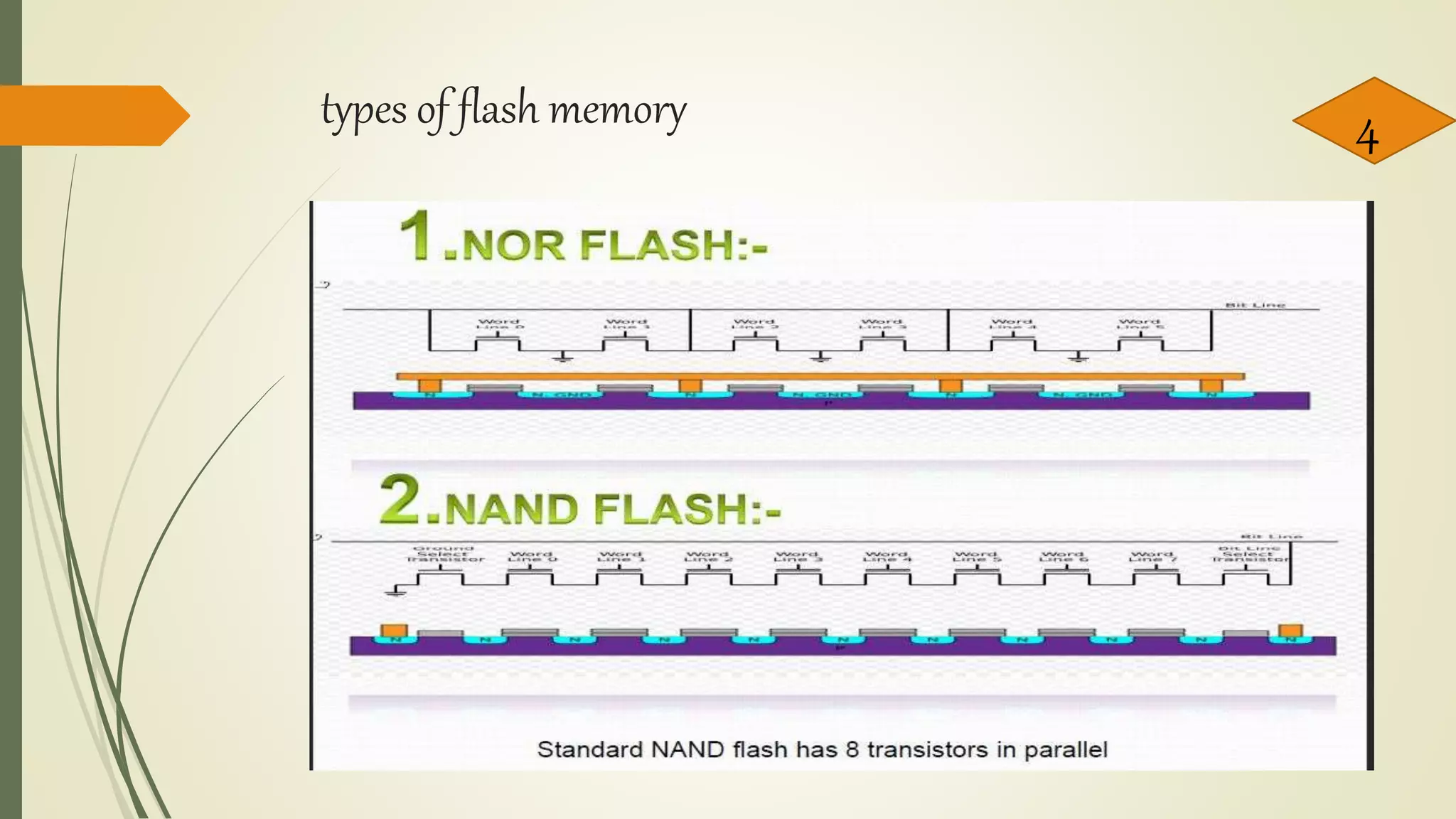
types of flash memory 4
nor flash memory
 NOR flash memory was first introduced by Intel
in1988.
 Developed to replace read only memory (ROM).
 NOR flash is more expensive and takes longer to erase
and write new data.
 NOR is most often used in mobile phones.
♦ Can access any memory cell
♦ Slow sequential access
5
nand flash memory
 NAND flash was introduced by Toshiba in 1989.
 Developed to replace hard disks
 NAND has significantly higher storage capacity than
NOR.
 It has found a market in devices to which large files are
frequently uploaded and replaced.
 MP3 players, digital cameras and USB drives use NAND
flash
♦ Can only access pages
♦ Faster sequential access
6
Manufacturers of flash 7
uses of flash memory
 Flash memory generally used in computers, television,
set-up box, cell phone, digital cameras, mp3 players,
global position system.
 We used the flash memory to store our data
reprogrammed data.
 Flash memory is also used in much industrial
applications.
8
Example of flash memory 9
Advantages of flash memory
 Flash memory is very durable and portable devices
which we use every where easily.
We can store much and more data in flash memory.
 We can read and erase our data easily.
10
Disadvantages of flash memory
 Both NAND/NOR memory has limited number of
programming/erasure cycles.
 Virus can easily transfer in flash memory.
 When flash memory is crash then data is lost.
11
Future of flash memory
 Continues to be among the most aggressively scaled
electronic technologies Memory cell size minimum of 20
nm expected to be met in 2010 May be replaced by
Phase-Change RAM or other emerging technologies.
 In the future size of flash memory cell is decrease and
the capacity is increase.
12
conclusion
 Flash memory is a widely used reliable and fixable non-
volatile memory to store software code and data in a
micro controller. However as with any programmable
and erasable memory . Physical parameters must be
understood and the application for a long time data
retention time. And cumulative program must be
handled according to the DATA sheet.
13
14
15

Flash memory

  • 1.
    1 Flash Memory 2History of Flash Memory 3 Types of Flash Memory 4 Uses of Flash Memory 5 Examples of Flash Memory 6 Advantages & Disadvantages of Flash Memory 7 Future of Flash Memory
  • 2.
    FLASH MEMORY  Flashmemory is a non-volatile memory .That can be electrically erased and reprogrammed  It was developed from EEPROM (electrically erasable programmable read-only memory)  Flash memory is a new memory technology that allowed stores data to be saved when the memory device was disconnected from its power sources. 1
  • 3.
    HIstory  Flash memorywas invented Dr.Fujio Masuoka while working for Tosibha in 1980.  Intel corporation introduced the first commercial NOR type flash chip in 1988.  Tosibha announced NAND flash at the 1989 international electron device meeting. 2
  • 4.
    internal structure offlash memory 3
  • 5.
  • 6.
    nor flash memory NOR flash memory was first introduced by Intel in1988.  Developed to replace read only memory (ROM).  NOR flash is more expensive and takes longer to erase and write new data.  NOR is most often used in mobile phones. ♦ Can access any memory cell ♦ Slow sequential access 5
  • 7.
    nand flash memory NAND flash was introduced by Toshiba in 1989.  Developed to replace hard disks  NAND has significantly higher storage capacity than NOR.  It has found a market in devices to which large files are frequently uploaded and replaced.  MP3 players, digital cameras and USB drives use NAND flash ♦ Can only access pages ♦ Faster sequential access 6
  • 8.
  • 9.
    uses of flashmemory  Flash memory generally used in computers, television, set-up box, cell phone, digital cameras, mp3 players, global position system.  We used the flash memory to store our data reprogrammed data.  Flash memory is also used in much industrial applications. 8
  • 10.
  • 11.
    Advantages of flashmemory  Flash memory is very durable and portable devices which we use every where easily. We can store much and more data in flash memory.  We can read and erase our data easily. 10
  • 12.
    Disadvantages of flashmemory  Both NAND/NOR memory has limited number of programming/erasure cycles.  Virus can easily transfer in flash memory.  When flash memory is crash then data is lost. 11
  • 13.
    Future of flashmemory  Continues to be among the most aggressively scaled electronic technologies Memory cell size minimum of 20 nm expected to be met in 2010 May be replaced by Phase-Change RAM or other emerging technologies.  In the future size of flash memory cell is decrease and the capacity is increase. 12
  • 14.
    conclusion  Flash memoryis a widely used reliable and fixable non- volatile memory to store software code and data in a micro controller. However as with any programmable and erasable memory . Physical parameters must be understood and the application for a long time data retention time. And cumulative program must be handled according to the DATA sheet. 13
  • 15.
  • 16.