ANALYTICAL METHOD,CLEANING
VALIDATION
BY :
SAI VIVEK KOSARAJU, I M.PHARM, PHARMACEUTICS
JSS COLLEGE OF PHARMACY,OOTY.
ANALYTICAL METHOD VALIDATION
VALIDATION
 Validation is defined as the “FINDING OR TESTING
THE TRUTH OF SOME THING.”
 Validation is an essential procedure that
demonstrates that a manufacturing process
operating under defined standard conditions is
capable of consistently producing a product that
meets the established product specifications
 The proof of validation is obtained through the
collection and evaluation of data, preferably,
beginning from the process development phase and
continuing through the production phase.
Validation necessarily
includes process
qualification (the
qualification of materials,
equipment, systems,
buildings, personnel), but
it also includes the control
on the entire process for
repeated batches or runs
Objectives of validation
It reduces risk of regulatory non-compliance.
Reduction of time to the market for the new
products.
Eliminates the scrap & reduces the defect cost.
Reduces the chances of product re-call from
market.
It requires less in-process control & end
process testing.
Parametric release of batch can be achieved
in validation.
PARAMETERS ASSESED DURING
ANALYTICAL METHOD VALIDATION
8
1. Linearity and Range
2. Specificity
3. Precision
4. Accuracy
5. Limit of Detection
6. Limit of Quantitation
7. Robustness
8. System Suitability
Linearity and Range
 The range of an analytical procedure is the interval
between the upper and lower levels of analyte
(including these levels) that have been
demonstrated to be determined with a suitable
level of precision, accuracy, and linearity,
 For establishment of linearity, minimum 5
concentrations are recommended.
 Linearity results should be established by
appropriate statistical methods.
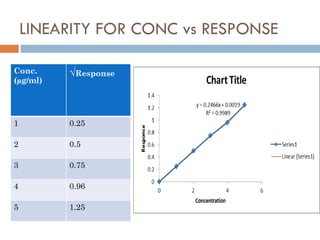
LINEARITY FOR CONC vs RESPONSE
Conc.
(µg/ml)
√Response
1 0.25
2 0.5
3 0.75
4 0.96
5 1.25
 If linearity is not attainable, a nonlinear
model may be used. The goal is to have a
model (whether linear or nonlinear) that
describes closely the concentration-response
relationship
 The following parameters should be determined:
 correlation coefficient
 y-intercept
 slope of the regression line
 The range of the procedure is validated by
verifying that the analytical procedure provides
acceptable precision, accuracy, and linearity when
applied to samples containing analyte at the
extremes of the range as well as within the range.
Precision
 The precision of an analytical procedure expresses
the closeness of agreement (degree of scatter)
between a series of measurements obtained from
multiple sampling of the same homogeneous sample
under the prescribed conditions
concentration Absorbance
10µg/ml
mean
0.21
0.32
0.39
0.53
0.36
Less Variation More Variation
High Precision Low Precision
 Precision may be considered at three levels:
Precision
Repeatability
Intermediate
Precision
Reproducibility
1. Repeatability
 Repeatability expresses the precision under the same
operating conditions over a short interval of time.
 Repeatability should be assessed using a minimum of 9
determinations covering the specified range.
2. Intermediate Precision
 Intermediate precision expresses variations within
laboratories, such as different days, different analysts,
different equipment, and so forth
Reproducibility
 Reproducibility expresses the precision between
laboratories. It is assessed by means of an inter-
laboratory trial. (Defined as ruggedness in USP,
ISO 17025)
Accuracy
 Closeness of agreement between the conventional
true value / an accepted reference value and the
value found
High Accuracy Less Accuracy
(Less Precision) (High Precision)
ASSESMENT OF ACCURACY
 Accuracy should be assessed using a minimum of 9
determinations over a minimum of 3 concentration
levels covering the specified range (e.g., 3
concentrations/3 replicates each of the total
analytical procedure).
 Accuracy should be reported as percent recovery
by the assay of known added amount of analyte in
the sample or as the difference between the mean
and the accepted true value.
LIMIT OF DETECTION & LIMIT OF
QUANTITATION
 Limit of Detection:
• It is the lowest amount of analyte in a sample which
can be detected but not necessarily quantitated.
 Limit of Quantitation:
• It is the lowest amount of analyte in a sample which
can be quantitatively determined with suitable
precision and accuracy.
23
Determination of LOD & LOQ
 Method
 Based on visual evaluation
 Based on standard deviation
of response and slope
LOD = 3.3 σ / Slope
 Signal to noise ratio 2:1 or 3:1
 Method
 Based on visual evaluation
 Based on standard deviation
of response and slope
LOD = 10 σ / Slope
 Signal to noise ratio 10:1
• Limit of Detection • Limit of
Quantitation
SPECIFICITY
 The ability to detect the analyte in the presence of
interfering substances (typically impurities,
degradants, matrix)is called as specificity.
1)Identification
 Suitable identification tests should be able to
discriminate between compounds of closely related
structures which are likely to be present.
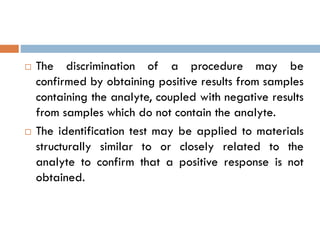
 The discrimination of a procedure may be
confirmed by obtaining positive results from samples
containing the analyte, coupled with negative results
from samples which do not contain the analyte.
 The identification test may be applied to materials
structurally similar to or closely related to the
analyte to confirm that a positive response is not
obtained.
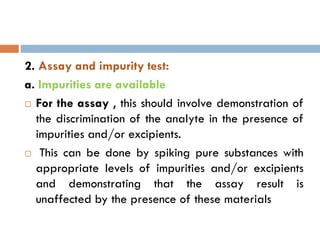
2. Assay and impurity test:
a. Impurities are available
 For the assay , this should involve demonstration of
the discrimination of the analyte in the presence of
impurities and/or excipients.
 This can be done by spiking pure substances with
appropriate levels of impurities and/or excipients
and demonstrating that the assay result is
unaffected by the presence of these materials
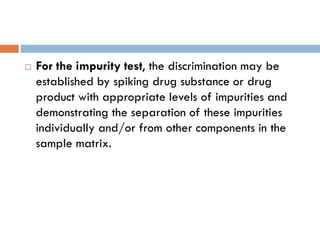
 For the impurity test, the discrimination may be
established by spiking drug substance or drug
product with appropriate levels of impurities and
demonstrating the separation of these impurities
individually and/or from other components in the
sample matrix.
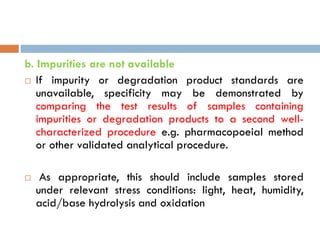
b. Impurities are not available
 If impurity or degradation product standards are
unavailable, specificity may be demonstrated by
comparing the test results of samples containing
impurities or degradation products to a second well-
characterized procedure e.g. pharmacopoeial method
or other validated analytical procedure.
 As appropriate, this should include samples stored
under relevant stress conditions: light, heat, humidity,
acid/base hydrolysis and oxidation
Robustness
 The robustness of an analytical procedure is a measure
of its capacity to remain unaffected by small, but
deliberate variations in method parameters and
provides an indication of its reliability during normal
usage.
 If measurements are susceptible to variations in
analytical conditions, the analytical conditions should be
suitably controlled or a precautionary statement should
be included in the procedure, such as:
• Use solution within 24 hours
• Maintain temperature below 25 degrees
 In the case of liquid chromatography, examples of typical variations
are:
 influence of variations of pH in a mobile phase
 influence of variations in mobile phase composition
 different columns (different lots and/or suppliers)
 temperature
 flow rate
 In the case of gas-chromatography, examples of typical variations
are:
 different columns (different lots and/or suppliers)
 temperature
 flow rate
System Suitability
 System suitability testing is an integral part of many
analytical procedures. The tests are based on the
concept that the equipment, electronics, analytical
operations and samples to be analyzed constitute
an integral system that can be evaluated as such.
CLEANING VALIDATION
WHY CLEANING VALIDATION IS SO
IMPORTANT:
 Pharmaceuticals can be contaminated by potentially
dangerous substances.
 Particular attention should be accorded to the
validation of cleaning procedures.
 Cleaning validation should be performed in order
to confirm the effectiveness of a cleaning
procedure.
Possible contaminants:
 Product residues
 Cleaning agent residues and breakdown
 Airborne matter
 Lubricants, ancillary material
 Decomposition residues
 Bacteria, mould and pyrogens
LEVELS OFCLEANING :
 There are 4 levels of cleaning, they are:
a) Level 1
b) Level 2
c) Level 3
d) Level 4
Level 1 cleaning: It is used only between steps in the
same manufacturing process
 Level 2 cleaning: It is used when cleaning between steps
in the same manufacturing process. Level 2 cleaning
would be used if step B was to be performed
immediately after step A for the same product line.
 Level 3 cleaning: It would be performed when cleaning
after an intermediate or final product step or one
product in preparation of an intermediate step of
another product.
 Level 4 cleaning: It would be used after final product is
ready.
 Level 1 & Level 2 cleaning :
a) lowest risk
b) higher limits
c) less extensive cleaning
d) visual verification of clean
 Level 3 & Level 4 cleaning:
a) Highest risk
b) Lower limits
c) More extensive cleaning
d) Analytical method
THE CLEANING PROCESS VALIDATION TAKES THE
FOLLOWING INTO ACCOUNT:
 Validation of Cleaning Processes,
 Equipment and Personnel,
 Microbiological Considerations,
 Documentation,
 Sampling, Rinsing, Rinse Samples and Detergents,
 Establishment of Limits.
VALIDATION OF CLEANING PROCESSES
 It is usually not considered acceptable to test-until-
clean. This concept involves cleaning, sampling, and
testing with repetition of this sequence until an
acceptable residue limit is attained
Raw materials sourced from different suppliers may
have different physical properties and impurity
profiles. When applicable such differences should be
considered when designing cleaning procedures, as
the materials may behave differently.
 If automated procedures are utilized (Clean-In-Place:
CIP), consideration should be given to monitoring the
critical control points and the parameters with
appropriate sensors and alarm points to ensure the
process is highly controlled.
 During a campaign (production of several batches of
the same product), cleaning between batches may be
reduced. The number of lots of the same product which
could be manufactured before a complete/ full
cleaning is done should be determined
EQUIPMENT AND PERSONNEL
 EQUIPMENT:
 All processing equipment should be specifically
designed to facilitate cleanability and permit visual
inspection and whenever possible, the equipment
should be made of smooth surfaces of non-reactive
materials
 Personnel:
 It is difficult to validate a manual cleaning
procedure (i.e. an inherently variable/cleaning
procedure). Therefore, operators carrying out
manual cleaning procedures should be adequately
trained, monitored, and periodically assessed.
MICROBIOLOGICAL CONSIDERATIONS
 The existence of conditions favorable to
reproduction of micro-organisms (e.g. moisture,
temperature, crevices and rough surfaces) and the
time of storage should be considered. The aim
should be to prevent excessive microbial
contamination.
 Equipment should be dried before storage, and
under no circumstances should stagnant water be
allowed to remain in equipment subsequent to
cleaning operations.
 The period and when appropriate, conditions of
storage of equipment before cleaning and the time
between cleaning and equipment reuse, should form
part of the validation of cleaning procedures. This is
to provide confidence that routine cleaning and
storage of equipment does not allow microbial
proliferation.
DOCUMENTATION:
 Detailed cleaning procedure(s) are to be
documented in SOPs
 A CLEANING VALIDATION PROTOCOL
SHOULD INCLUDE THE FOLLOWING:
 The objective of the validation process;
 Responsibilities for performing and approving
the validation study;
 Description of the equipment to be used;
 The interval between the end of production
and the beginning of the cleaning procedure;
The number of lots of the same product, which
could be manufactured during a campaign before
a full cleaning is done
 Detailed cleaning procedures to be used for each
product, each manufacturing system or each piece
of equipment;
 The number of cleaning cycles to be performed
consecutively;
 Sampling procedures, including the rationale for why
a certain sampling method is used;
 Clearly defined sampling locations;
 A Final Validation Report should be prepared. The
conclusions of this report should state that cleaning
process has been validated successfully.
 The report should be approved by the Plant
Management.
SAMPLING, RINSING, RINSE SAMPLES AND
DETERGENTS
 Sampling:
 There are two general types of sampling that are
considered to be acceptable, direct surface
sampling (swab method) and indirect sampling (use
of rinse solutions). A combination of the two methods
is generally the most desirable.
 Detergents:
 Detergents should be easily removable, being used
to facilitate the cleaning during the cleaning
process.
 When detergents are used in the cleaning process,
their composition should be known to the user and
their removal should be demonstrated.
 Acceptable limits should be defined for detergent
residues after cleaning
 Last Rinse:
 Water for injection should be used as the last rinse
for product-contact equipment to be utilized in the
fabrication of sterile products.
 Purified water is considered acceptable as the last
rinse for product-contact equipment used in the
fabrication of non-sterile products or sterile
products for ophthalmic use.
ESTABLISHMENT OF LIMITS:
 The pharmaceutical company's rationale for
selecting limits for product residues should be
logically based on a consideration of the materials
involved and their therapeutic dose. The limits
should be practical, achievable and verifiable

Analytical methods,cleaning validation

  • 1.
    ANALYTICAL METHOD,CLEANING VALIDATION BY : SAIVIVEK KOSARAJU, I M.PHARM, PHARMACEUTICS JSS COLLEGE OF PHARMACY,OOTY.
  • 2.
  • 3.
    VALIDATION  Validation isdefined as the “FINDING OR TESTING THE TRUTH OF SOME THING.”  Validation is an essential procedure that demonstrates that a manufacturing process operating under defined standard conditions is capable of consistently producing a product that meets the established product specifications
  • 4.
     The proofof validation is obtained through the collection and evaluation of data, preferably, beginning from the process development phase and continuing through the production phase.
  • 5.
    Validation necessarily includes process qualification(the qualification of materials, equipment, systems, buildings, personnel), but it also includes the control on the entire process for repeated batches or runs
  • 6.
    Objectives of validation Itreduces risk of regulatory non-compliance. Reduction of time to the market for the new products. Eliminates the scrap & reduces the defect cost. Reduces the chances of product re-call from market.
  • 7.
    It requires lessin-process control & end process testing. Parametric release of batch can be achieved in validation.
  • 8.
    PARAMETERS ASSESED DURING ANALYTICALMETHOD VALIDATION 8 1. Linearity and Range 2. Specificity 3. Precision 4. Accuracy 5. Limit of Detection 6. Limit of Quantitation 7. Robustness 8. System Suitability
  • 9.
    Linearity and Range The range of an analytical procedure is the interval between the upper and lower levels of analyte (including these levels) that have been demonstrated to be determined with a suitable level of precision, accuracy, and linearity,
  • 10.
     For establishmentof linearity, minimum 5 concentrations are recommended.  Linearity results should be established by appropriate statistical methods.
  • 11.
    LINEARITY FOR CONCvs RESPONSE Conc. (µg/ml) √Response 1 0.25 2 0.5 3 0.75 4 0.96 5 1.25
  • 12.
     If linearityis not attainable, a nonlinear model may be used. The goal is to have a model (whether linear or nonlinear) that describes closely the concentration-response relationship  The following parameters should be determined:  correlation coefficient  y-intercept  slope of the regression line
  • 13.
     The rangeof the procedure is validated by verifying that the analytical procedure provides acceptable precision, accuracy, and linearity when applied to samples containing analyte at the extremes of the range as well as within the range.
  • 14.
    Precision  The precisionof an analytical procedure expresses the closeness of agreement (degree of scatter) between a series of measurements obtained from multiple sampling of the same homogeneous sample under the prescribed conditions
  • 15.
  • 16.
     Precision maybe considered at three levels: Precision Repeatability Intermediate Precision Reproducibility
  • 17.
    1. Repeatability  Repeatabilityexpresses the precision under the same operating conditions over a short interval of time.  Repeatability should be assessed using a minimum of 9 determinations covering the specified range. 2. Intermediate Precision  Intermediate precision expresses variations within laboratories, such as different days, different analysts, different equipment, and so forth
  • 18.
    Reproducibility  Reproducibility expressesthe precision between laboratories. It is assessed by means of an inter- laboratory trial. (Defined as ruggedness in USP, ISO 17025)
  • 19.
    Accuracy  Closeness ofagreement between the conventional true value / an accepted reference value and the value found
  • 20.
    High Accuracy LessAccuracy (Less Precision) (High Precision)
  • 21.
    ASSESMENT OF ACCURACY Accuracy should be assessed using a minimum of 9 determinations over a minimum of 3 concentration levels covering the specified range (e.g., 3 concentrations/3 replicates each of the total analytical procedure).  Accuracy should be reported as percent recovery by the assay of known added amount of analyte in the sample or as the difference between the mean and the accepted true value.
  • 22.
    LIMIT OF DETECTION& LIMIT OF QUANTITATION  Limit of Detection: • It is the lowest amount of analyte in a sample which can be detected but not necessarily quantitated.  Limit of Quantitation: • It is the lowest amount of analyte in a sample which can be quantitatively determined with suitable precision and accuracy.
  • 23.
    23 Determination of LOD& LOQ  Method  Based on visual evaluation  Based on standard deviation of response and slope LOD = 3.3 σ / Slope  Signal to noise ratio 2:1 or 3:1  Method  Based on visual evaluation  Based on standard deviation of response and slope LOD = 10 σ / Slope  Signal to noise ratio 10:1 • Limit of Detection • Limit of Quantitation
  • 24.
    SPECIFICITY  The abilityto detect the analyte in the presence of interfering substances (typically impurities, degradants, matrix)is called as specificity. 1)Identification  Suitable identification tests should be able to discriminate between compounds of closely related structures which are likely to be present.
  • 25.
     The discriminationof a procedure may be confirmed by obtaining positive results from samples containing the analyte, coupled with negative results from samples which do not contain the analyte.  The identification test may be applied to materials structurally similar to or closely related to the analyte to confirm that a positive response is not obtained.
  • 26.
    2. Assay andimpurity test: a. Impurities are available  For the assay , this should involve demonstration of the discrimination of the analyte in the presence of impurities and/or excipients.  This can be done by spiking pure substances with appropriate levels of impurities and/or excipients and demonstrating that the assay result is unaffected by the presence of these materials
  • 27.
     For theimpurity test, the discrimination may be established by spiking drug substance or drug product with appropriate levels of impurities and demonstrating the separation of these impurities individually and/or from other components in the sample matrix.
  • 28.
    b. Impurities arenot available  If impurity or degradation product standards are unavailable, specificity may be demonstrated by comparing the test results of samples containing impurities or degradation products to a second well- characterized procedure e.g. pharmacopoeial method or other validated analytical procedure.  As appropriate, this should include samples stored under relevant stress conditions: light, heat, humidity, acid/base hydrolysis and oxidation
  • 29.
    Robustness  The robustnessof an analytical procedure is a measure of its capacity to remain unaffected by small, but deliberate variations in method parameters and provides an indication of its reliability during normal usage.  If measurements are susceptible to variations in analytical conditions, the analytical conditions should be suitably controlled or a precautionary statement should be included in the procedure, such as: • Use solution within 24 hours • Maintain temperature below 25 degrees
  • 30.
     In thecase of liquid chromatography, examples of typical variations are:  influence of variations of pH in a mobile phase  influence of variations in mobile phase composition  different columns (different lots and/or suppliers)  temperature  flow rate  In the case of gas-chromatography, examples of typical variations are:  different columns (different lots and/or suppliers)  temperature  flow rate
  • 31.
    System Suitability  Systemsuitability testing is an integral part of many analytical procedures. The tests are based on the concept that the equipment, electronics, analytical operations and samples to be analyzed constitute an integral system that can be evaluated as such.
  • 32.
  • 33.
    WHY CLEANING VALIDATIONIS SO IMPORTANT:  Pharmaceuticals can be contaminated by potentially dangerous substances.  Particular attention should be accorded to the validation of cleaning procedures.  Cleaning validation should be performed in order to confirm the effectiveness of a cleaning procedure.
  • 34.
    Possible contaminants:  Productresidues  Cleaning agent residues and breakdown  Airborne matter  Lubricants, ancillary material  Decomposition residues  Bacteria, mould and pyrogens
  • 35.
    LEVELS OFCLEANING : There are 4 levels of cleaning, they are: a) Level 1 b) Level 2 c) Level 3 d) Level 4 Level 1 cleaning: It is used only between steps in the same manufacturing process
  • 36.
     Level 2cleaning: It is used when cleaning between steps in the same manufacturing process. Level 2 cleaning would be used if step B was to be performed immediately after step A for the same product line.  Level 3 cleaning: It would be performed when cleaning after an intermediate or final product step or one product in preparation of an intermediate step of another product.  Level 4 cleaning: It would be used after final product is ready.
  • 37.
     Level 1& Level 2 cleaning : a) lowest risk b) higher limits c) less extensive cleaning d) visual verification of clean  Level 3 & Level 4 cleaning: a) Highest risk b) Lower limits c) More extensive cleaning d) Analytical method
  • 38.
    THE CLEANING PROCESSVALIDATION TAKES THE FOLLOWING INTO ACCOUNT:  Validation of Cleaning Processes,  Equipment and Personnel,  Microbiological Considerations,  Documentation,  Sampling, Rinsing, Rinse Samples and Detergents,  Establishment of Limits.
  • 39.
    VALIDATION OF CLEANINGPROCESSES  It is usually not considered acceptable to test-until- clean. This concept involves cleaning, sampling, and testing with repetition of this sequence until an acceptable residue limit is attained Raw materials sourced from different suppliers may have different physical properties and impurity profiles. When applicable such differences should be considered when designing cleaning procedures, as the materials may behave differently.
  • 40.
     If automatedprocedures are utilized (Clean-In-Place: CIP), consideration should be given to monitoring the critical control points and the parameters with appropriate sensors and alarm points to ensure the process is highly controlled.  During a campaign (production of several batches of the same product), cleaning between batches may be reduced. The number of lots of the same product which could be manufactured before a complete/ full cleaning is done should be determined
  • 41.
    EQUIPMENT AND PERSONNEL EQUIPMENT:  All processing equipment should be specifically designed to facilitate cleanability and permit visual inspection and whenever possible, the equipment should be made of smooth surfaces of non-reactive materials
  • 42.
     Personnel:  Itis difficult to validate a manual cleaning procedure (i.e. an inherently variable/cleaning procedure). Therefore, operators carrying out manual cleaning procedures should be adequately trained, monitored, and periodically assessed.
  • 43.
    MICROBIOLOGICAL CONSIDERATIONS  Theexistence of conditions favorable to reproduction of micro-organisms (e.g. moisture, temperature, crevices and rough surfaces) and the time of storage should be considered. The aim should be to prevent excessive microbial contamination.  Equipment should be dried before storage, and under no circumstances should stagnant water be allowed to remain in equipment subsequent to cleaning operations.
  • 44.
     The periodand when appropriate, conditions of storage of equipment before cleaning and the time between cleaning and equipment reuse, should form part of the validation of cleaning procedures. This is to provide confidence that routine cleaning and storage of equipment does not allow microbial proliferation.
  • 45.
    DOCUMENTATION:  Detailed cleaningprocedure(s) are to be documented in SOPs  A CLEANING VALIDATION PROTOCOL SHOULD INCLUDE THE FOLLOWING:  The objective of the validation process;  Responsibilities for performing and approving the validation study;  Description of the equipment to be used;
  • 46.
     The intervalbetween the end of production and the beginning of the cleaning procedure; The number of lots of the same product, which could be manufactured during a campaign before a full cleaning is done  Detailed cleaning procedures to be used for each product, each manufacturing system or each piece of equipment;  The number of cleaning cycles to be performed consecutively;
  • 47.
     Sampling procedures,including the rationale for why a certain sampling method is used;  Clearly defined sampling locations;  A Final Validation Report should be prepared. The conclusions of this report should state that cleaning process has been validated successfully.  The report should be approved by the Plant Management.
  • 48.
    SAMPLING, RINSING, RINSESAMPLES AND DETERGENTS  Sampling:  There are two general types of sampling that are considered to be acceptable, direct surface sampling (swab method) and indirect sampling (use of rinse solutions). A combination of the two methods is generally the most desirable.
  • 49.
     Detergents:  Detergentsshould be easily removable, being used to facilitate the cleaning during the cleaning process.  When detergents are used in the cleaning process, their composition should be known to the user and their removal should be demonstrated.  Acceptable limits should be defined for detergent residues after cleaning
  • 50.
     Last Rinse: Water for injection should be used as the last rinse for product-contact equipment to be utilized in the fabrication of sterile products.  Purified water is considered acceptable as the last rinse for product-contact equipment used in the fabrication of non-sterile products or sterile products for ophthalmic use.
  • 51.
    ESTABLISHMENT OF LIMITS: The pharmaceutical company's rationale for selecting limits for product residues should be logically based on a consideration of the materials involved and their therapeutic dose. The limits should be practical, achievable and verifiable