1
-: Presented By :- -:Guided By:-
Abhishek Pandey Dr. Bhavna Patel
1st Year M.Pharm (QA) Ms. Shraddha Parmar
Roll No. Q1
Dept. of Pharmaceutical Science
INTRODUCTION
2
Cleaning validation is documented evidence with a high degree of assurance that
one can consistently clean a system or a piece of equipment to predetermined and
acceptable limits.
The objectives of good manufacturing practices (GMP) include the prevention of
possible contamination and cross-contamination of pharmaceutical starting
materials and products.
Pharmaceutical products can be contaminated by a variety of substances such as
contaminants associated with microbes, previous products (both active
pharmaceutical ingredients (API) and excipient residues), residues of cleaning
agents, airborne materials, such as dust and particulate matter, lubricants.
Adequate cleaning procedures play an important role in preventing
contamination and cross-contamination. Validation of cleaning methods provides
documented evidence that an approved cleaning procedure will provide clean
equipment, suitable for its intended use.
Analytical Methods for Cleaning
Validation
DETECTION LIMITS;
 The Food and Drug Administration (FDA) cleaning validation
guidelines call for companies to "determine the specificity and
sensitivity of the analytical method used" .
 time was a useful word for analytical methods (referring to the
slope of the working curve);
 however, in popular usage, it has been loosely used and has
become synonymous with either "limit of detection" (MD) or
"limit of quantization" (LOQ). The FDA is referring to
LOD/LOQ:
 The LOD/LOQ of the analytical method should be at or
(preferably) below the acceptance criterion in the analyzed
sample 3
SPECIFICITY
•In terms of method specificity, there is a natural preference for
specific methods.
•After all, if one has a target residue, the best way to measure that
residue is to have an analytical procedure that measures only that
species and excludes all potentially interfering species.
• Specific methods are those methods that target a specific molecule
or species and are designed so that possible interferences are
eliminated.
•Specific methods include HPLC, ion chromatography (K),
SDSPAGE (sodium dodecyl sulfate-polyacrylamide gel
electrophoresis), and atomic absorption (AA).
4
NONSPECIFIC METHODS
•Nonspecific methods are usually methods that measure a gross property
that results from contributions from a variety of chemical species.
• Examples of nonspecific methods include conductivity and total
organic carbon (TOC).
•Each provides a measure of an overall property but provides no
information as to the chemical nature of the source of conductance or
organic carbon.
•When a nonspecific method is used for a target residue, it is necessary
to make some assumptions about what that nonspecific property
represents.
•This generally involves expressing the property as if all the measured
property is due to the target species.
5
Range:-
Range is a series of values of the measured species or property over
which the analytical
procedure was evaluated.
It is only necessary to assure that the procedure is valid over a range of
expected values.
For example, if the calculated acceptance limit for the analytical sample
is X
ppm, then one might want to evaluate a range from approximately 0.2X
to 1 .OX.
On the other hand, if expected results (perhaps based on prequalification
studies) are to be in the 0.1X to 0.3X range, then validation of a range of
0.05X to 0.5X may be justified. 6
7
LOD / LOQ
 LOD is the assay value at which it is still possible to say that the
material is present, but it may be not possible to quantify with a
specific value. LOD is typically estimated by several techniques.
 For example, for chromatographic techniques, LOD is estimated at
three times the standard deviation of a baseline response. Values
that are below the LOD are generally reported as < LOD. LOQ is
the lowest assay value for which a reasonable confidence exists
that the value is precise.
 There are also rules of thumb for estimating LOQs.
 For chromatographic procedures, the LOQ can be estimated as 10
times the standard deviation of the baseline noise.
Linearity Linearity refers to the characteristic of the relationship of the
measured property to the level of analyte present.
 Linearity is an indication that the measured signal is directly
proportional to the concentration of the analyte over the range.
 As a general rule for cleaning validation studies, the expectations
are that assays will be linear over the range.
 Estimates of linearity can be made by such techniques as
determination ~ (0.99 or better).
8
Accuracy
 Accuracy refers to the trueness of the measurements to
known values.
 This is determined by analyzing known standards. There is
no "magic number" for acceptable accuracy.
 However, more accurate methods are preferred over less
accurate methods.
 For example, if the acceptance criterion was 20 ppm, a
method with a accuracy of 2- 10 percent, giving a result of
18 ppm, could be considered an acceptable result.
 On the other hand, a method with an accuracy of 2- 20
percent, giving a result of 18 ppm, will be suspect in terms
of meeting the acceptance criterion. 9
Precision Precision refers to the reproducibility of the method and is often
measured by standard deviation.
 Simple precision is the reproducibility of the results in the same
lab over a series of replicate assays using the same operator, the
same equipment, and usually on the same day.
 Intermediate precision is the reproducibility of results in the
same lab using different operators, different
 pieces of equipment, and generally done on different days.
 Ruggedness is interlab reproducibility, involving reproducibility
in different labs.
10
CLEANING OF EQUIPMENT STAGE 1:
 DETERMINE THE MOST APPROPRIATE CLEANING
PROCEDURE FOR THE EQUIPMENT: –
 1. Generate acceptance criteria data for the contaminant.
 2. The cleaning method will be determined by the process,
the equipment the cleaning agents and the cleaning
techniques available.
 3. All aspects of the cleaning procedure should be clearly
defined in SOPs be they manual / CIP or COP
11
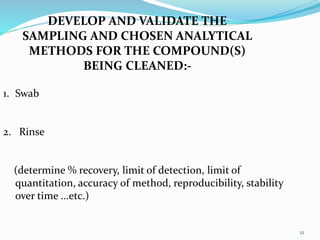
DEVELOP AND VALIDATE THE
SAMPLING AND CHOSEN ANALYTICAL
METHODS FOR THE COMPOUND(S)
BEING CLEANED:-
1. Swab
2. Rinse
(determine % recovery, limit of detection, limit of
quantitation, accuracy of method, reproducibility, stability
over time ...etc.)
12
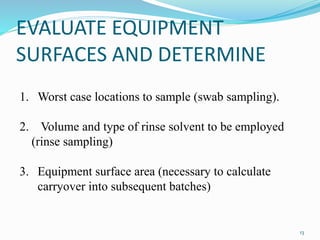
EVALUATE EQUIPMENT
SURFACES AND DETERMINE
13
1. Worst case locations to sample (swab sampling).
2. Volume and type of rinse solvent to be employed
(rinse sampling)
3. Equipment surface area (necessary to calculate
carryover into subsequent batches)
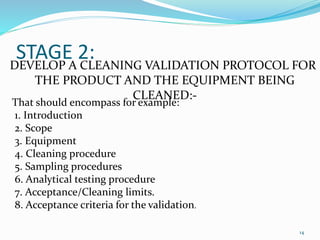
STAGE 2:DEVELOP A CLEANING VALIDATION PROTOCOL FOR
THE PRODUCT AND THE EQUIPMENT BEING
CLEANED:-
14
That should encompass for example:
1. Introduction
2. Scope
3. Equipment
4. Cleaning procedure
5. Sampling procedures
6. Analytical testing procedure
7. Acceptance/Cleaning limits.
8. Acceptance criteria for the validation.
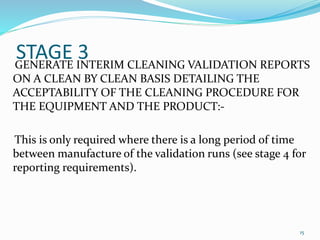
STAGE 3GENERATE INTERIM CLEANING VALIDATION REPORTS
ON A CLEAN BY CLEAN BASIS DETAILING THE
ACCEPTABILITY OF THE CLEANING PROCEDURE FOR
THE EQUIPMENT AND THE PRODUCT:-
This is only required where there is a long period of time
between manufacture of the validation runs (see stage 4 for
reporting requirements).
15
STAGE 4:GENERATE A CLEANING VALIDATION REPORT
DETAILING THE ACCEPTABILITY OF THE CLEANING
PROCEDURE FOR THE EQUIPMENT AND THE
PRODUCT:-
The report should give a full detailed background and
introduction to the cleaning Validation study and should
evaluate all data generated with respect to the acceptance
criteria employed for the study. The report should also
indicate the requirement if any for revalidation (period of
time /change control etc.)
16
FACILITIES
17
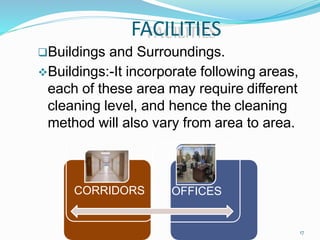
Buildings and Surroundings.
Buildings:-It incorporate following areas,
each of these area may require different
cleaning level, and hence the cleaning
method will also vary from area to area.
CORRIDORS OFFICES
FACILITIES
18
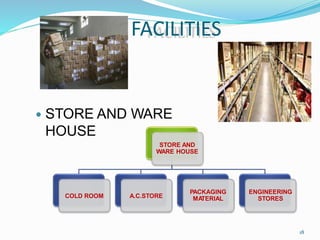
 STORE AND WARE
HOUSE
STORE AND
WARE HOUSE
COLD ROOM A.C.STORE
PACKAGING
MATERIAL
ENGINEERING
STORES
FACILITIES
19
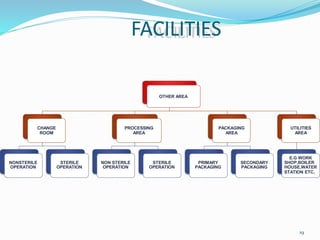
OTHER AREA
CHANGE
ROOM
NONSTERILE
OPERATION
STERILE
OPERATION
PROCESSING
AREA
NON STERILE
OPERATION
STERILE
OPERATION
PACKAGING
AREA
PRIMARY
PACKAGING
SECONDARY
PACKAGING
UTILITIES
AREA
E.G WORK
SHOP,BOILER
HOUSE,WATER
STATION ETC.
FACILITIES
20
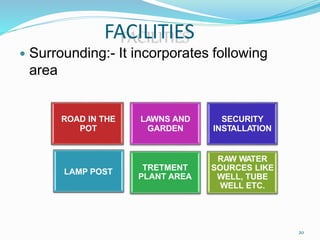
 Surrounding:- It incorporates following
area
ROAD IN THE
POT
LAWNS AND
GARDEN
SECURITY
INSTALLATION
LAMP POST TRETMENT
PLANT AREA
RAW WATER
SOURCES LIKE
WELL, TUBE
WELL ETC.
FACILITIES
21
 For each of above areas the QA person should
design cleaning method and write cleaning SOP
covering following points.
Cleaning equipment used.
Cleaning agent with their concentration.
Frequency of cleaning.
Procedure.
Responsibility for supervising.
Records.
Acceptance criteria.
Clean-In-Place (CIP) Method Cleaning of the equipment is performed in place without
disassembling.
 Cleaning process may be controlled manually or by an
automated program.
 Very consistent and reproducible cleaning method.
 Can be validated readily.
 Being a closed system visual inspection of all components
is difficult.
22
Factors affecting the effectiveness
of the CIP cleaning agents
 Temperature of the cleaning solution. Elevating the
temperature of a cleaning solution increases its dirt removal
efficiency. Molecules with high kinetic energy dislodge dirt faster
than slow moving molecules of a cold solution.
 Concentration of the cleaning agent. A concentrated cleaning
solution will clean a dirty surface much better than a dilute one
due to the increased surface binding capacity.
 Contact time of the cleaning solution. The longer the
detergent contact period, the higher the cleaning efficiency.
After some time, the detergent eventually dissolves the hard
stains/soil from the dirty surface.
 Pressure exerted by the cleaning solution (or turbulence).
The turbulence creates an abrasive force that dislodges stubborn
soil from the dirty surface.
23
REFERENCE
 http://www.ispeboston.org/files/fda_csv_training_-
_boston_ispe_presentation_-
_feb_20_2014_ispe_format_mbyrd.pdf
 http://www.biopharminternational.com/equipment-
cleaning-validation-within-multi-product-manufacturing-
facility?id=&sk=&date=&pageID=2
 http://www.pharmtech.com/best-practices-cleaning-
validation-swab-recovery-studies
 http://pharmaguidances.com/cleaning-validation-
protocol/
24

CLEANING VALIDATION for M.pharm and industry person

  • 1.
    1 -: Presented By:- -:Guided By:- Abhishek Pandey Dr. Bhavna Patel 1st Year M.Pharm (QA) Ms. Shraddha Parmar Roll No. Q1 Dept. of Pharmaceutical Science
  • 2.
    INTRODUCTION 2 Cleaning validation isdocumented evidence with a high degree of assurance that one can consistently clean a system or a piece of equipment to predetermined and acceptable limits. The objectives of good manufacturing practices (GMP) include the prevention of possible contamination and cross-contamination of pharmaceutical starting materials and products. Pharmaceutical products can be contaminated by a variety of substances such as contaminants associated with microbes, previous products (both active pharmaceutical ingredients (API) and excipient residues), residues of cleaning agents, airborne materials, such as dust and particulate matter, lubricants. Adequate cleaning procedures play an important role in preventing contamination and cross-contamination. Validation of cleaning methods provides documented evidence that an approved cleaning procedure will provide clean equipment, suitable for its intended use.
  • 3.
    Analytical Methods forCleaning Validation DETECTION LIMITS;  The Food and Drug Administration (FDA) cleaning validation guidelines call for companies to "determine the specificity and sensitivity of the analytical method used" .  time was a useful word for analytical methods (referring to the slope of the working curve);  however, in popular usage, it has been loosely used and has become synonymous with either "limit of detection" (MD) or "limit of quantization" (LOQ). The FDA is referring to LOD/LOQ:  The LOD/LOQ of the analytical method should be at or (preferably) below the acceptance criterion in the analyzed sample 3
  • 4.
    SPECIFICITY •In terms ofmethod specificity, there is a natural preference for specific methods. •After all, if one has a target residue, the best way to measure that residue is to have an analytical procedure that measures only that species and excludes all potentially interfering species. • Specific methods are those methods that target a specific molecule or species and are designed so that possible interferences are eliminated. •Specific methods include HPLC, ion chromatography (K), SDSPAGE (sodium dodecyl sulfate-polyacrylamide gel electrophoresis), and atomic absorption (AA). 4
  • 5.
    NONSPECIFIC METHODS •Nonspecific methodsare usually methods that measure a gross property that results from contributions from a variety of chemical species. • Examples of nonspecific methods include conductivity and total organic carbon (TOC). •Each provides a measure of an overall property but provides no information as to the chemical nature of the source of conductance or organic carbon. •When a nonspecific method is used for a target residue, it is necessary to make some assumptions about what that nonspecific property represents. •This generally involves expressing the property as if all the measured property is due to the target species. 5
  • 6.
    Range:- Range is aseries of values of the measured species or property over which the analytical procedure was evaluated. It is only necessary to assure that the procedure is valid over a range of expected values. For example, if the calculated acceptance limit for the analytical sample is X ppm, then one might want to evaluate a range from approximately 0.2X to 1 .OX. On the other hand, if expected results (perhaps based on prequalification studies) are to be in the 0.1X to 0.3X range, then validation of a range of 0.05X to 0.5X may be justified. 6
  • 7.
    7 LOD / LOQ LOD is the assay value at which it is still possible to say that the material is present, but it may be not possible to quantify with a specific value. LOD is typically estimated by several techniques.  For example, for chromatographic techniques, LOD is estimated at three times the standard deviation of a baseline response. Values that are below the LOD are generally reported as < LOD. LOQ is the lowest assay value for which a reasonable confidence exists that the value is precise.  There are also rules of thumb for estimating LOQs.  For chromatographic procedures, the LOQ can be estimated as 10 times the standard deviation of the baseline noise.
  • 8.
    Linearity Linearity refersto the characteristic of the relationship of the measured property to the level of analyte present.  Linearity is an indication that the measured signal is directly proportional to the concentration of the analyte over the range.  As a general rule for cleaning validation studies, the expectations are that assays will be linear over the range.  Estimates of linearity can be made by such techniques as determination ~ (0.99 or better). 8
  • 9.
    Accuracy  Accuracy refersto the trueness of the measurements to known values.  This is determined by analyzing known standards. There is no "magic number" for acceptable accuracy.  However, more accurate methods are preferred over less accurate methods.  For example, if the acceptance criterion was 20 ppm, a method with a accuracy of 2- 10 percent, giving a result of 18 ppm, could be considered an acceptable result.  On the other hand, a method with an accuracy of 2- 20 percent, giving a result of 18 ppm, will be suspect in terms of meeting the acceptance criterion. 9
  • 10.
    Precision Precision refersto the reproducibility of the method and is often measured by standard deviation.  Simple precision is the reproducibility of the results in the same lab over a series of replicate assays using the same operator, the same equipment, and usually on the same day.  Intermediate precision is the reproducibility of results in the same lab using different operators, different  pieces of equipment, and generally done on different days.  Ruggedness is interlab reproducibility, involving reproducibility in different labs. 10
  • 11.
    CLEANING OF EQUIPMENTSTAGE 1:  DETERMINE THE MOST APPROPRIATE CLEANING PROCEDURE FOR THE EQUIPMENT: –  1. Generate acceptance criteria data for the contaminant.  2. The cleaning method will be determined by the process, the equipment the cleaning agents and the cleaning techniques available.  3. All aspects of the cleaning procedure should be clearly defined in SOPs be they manual / CIP or COP 11
  • 12.
    DEVELOP AND VALIDATETHE SAMPLING AND CHOSEN ANALYTICAL METHODS FOR THE COMPOUND(S) BEING CLEANED:- 1. Swab 2. Rinse (determine % recovery, limit of detection, limit of quantitation, accuracy of method, reproducibility, stability over time ...etc.) 12
  • 13.
    EVALUATE EQUIPMENT SURFACES ANDDETERMINE 13 1. Worst case locations to sample (swab sampling). 2. Volume and type of rinse solvent to be employed (rinse sampling) 3. Equipment surface area (necessary to calculate carryover into subsequent batches)
  • 14.
    STAGE 2:DEVELOP ACLEANING VALIDATION PROTOCOL FOR THE PRODUCT AND THE EQUIPMENT BEING CLEANED:- 14 That should encompass for example: 1. Introduction 2. Scope 3. Equipment 4. Cleaning procedure 5. Sampling procedures 6. Analytical testing procedure 7. Acceptance/Cleaning limits. 8. Acceptance criteria for the validation.
  • 15.
    STAGE 3GENERATE INTERIMCLEANING VALIDATION REPORTS ON A CLEAN BY CLEAN BASIS DETAILING THE ACCEPTABILITY OF THE CLEANING PROCEDURE FOR THE EQUIPMENT AND THE PRODUCT:- This is only required where there is a long period of time between manufacture of the validation runs (see stage 4 for reporting requirements). 15
  • 16.
    STAGE 4:GENERATE ACLEANING VALIDATION REPORT DETAILING THE ACCEPTABILITY OF THE CLEANING PROCEDURE FOR THE EQUIPMENT AND THE PRODUCT:- The report should give a full detailed background and introduction to the cleaning Validation study and should evaluate all data generated with respect to the acceptance criteria employed for the study. The report should also indicate the requirement if any for revalidation (period of time /change control etc.) 16
  • 17.
    FACILITIES 17 Buildings and Surroundings. Buildings:-Itincorporate following areas, each of these area may require different cleaning level, and hence the cleaning method will also vary from area to area. CORRIDORS OFFICES
  • 18.
    FACILITIES 18  STORE ANDWARE HOUSE STORE AND WARE HOUSE COLD ROOM A.C.STORE PACKAGING MATERIAL ENGINEERING STORES
  • 19.
  • 20.
    FACILITIES 20  Surrounding:- Itincorporates following area ROAD IN THE POT LAWNS AND GARDEN SECURITY INSTALLATION LAMP POST TRETMENT PLANT AREA RAW WATER SOURCES LIKE WELL, TUBE WELL ETC.
  • 21.
    FACILITIES 21  For eachof above areas the QA person should design cleaning method and write cleaning SOP covering following points. Cleaning equipment used. Cleaning agent with their concentration. Frequency of cleaning. Procedure. Responsibility for supervising. Records. Acceptance criteria.
  • 22.
    Clean-In-Place (CIP) MethodCleaning of the equipment is performed in place without disassembling.  Cleaning process may be controlled manually or by an automated program.  Very consistent and reproducible cleaning method.  Can be validated readily.  Being a closed system visual inspection of all components is difficult. 22
  • 23.
    Factors affecting theeffectiveness of the CIP cleaning agents  Temperature of the cleaning solution. Elevating the temperature of a cleaning solution increases its dirt removal efficiency. Molecules with high kinetic energy dislodge dirt faster than slow moving molecules of a cold solution.  Concentration of the cleaning agent. A concentrated cleaning solution will clean a dirty surface much better than a dilute one due to the increased surface binding capacity.  Contact time of the cleaning solution. The longer the detergent contact period, the higher the cleaning efficiency. After some time, the detergent eventually dissolves the hard stains/soil from the dirty surface.  Pressure exerted by the cleaning solution (or turbulence). The turbulence creates an abrasive force that dislodges stubborn soil from the dirty surface. 23
  • 24.