

PRESENTED BY : YASH R.MENGHANI
M.PHARM 1st YEAR (SEMISTER II)
SMT.KISHORITAI BHOYAR COLLEGE OF
PHARMACY,KAMPTEE
1
INTRODUCTION :
 VALIDATION : Action of proving and documenting that
any process, procedure or method actually and
consistently leads to the expected results.
&
 QUALIFICATION : Action of proving and documenting
that any premises, systems and equipment are properly
installed, and/or work correctly and lead to the expected
results. The term qualification is normally used for
equipment, utilities and systems, and validation for
processes
 In this sense, qualification is part of validation.
2
TABLET COMPRESSION MACHINE:
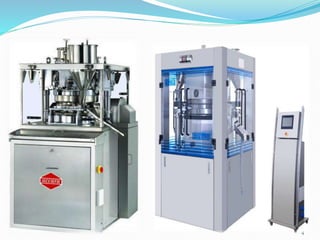
 A tablet press is a mechanical device that compresses
powder into tablets of uniform size and weight.
 Tablet Compression Machine is also known as Tablet
Press in Pharmaceutical Industry which is used to make
the tablets according to a pre-determined design.
 Compression is a critical step in the production of a
tablet dosage form. The materials being compressed will
need to have adequate flow and compression properties.
 Factors to be considered during compression are,
 Tooling
 Compression speed
3
4
TOOLING :
 Tablet compression machines are made in keeping the
view of the type of dies and punches will be used on them,
 The dies and punches and their setup on compression
machine is called tooling.
 The shape ,size and as well as certain identification
markings are determined by compression machine
tooling.
 Each tooling set consist of dies , upper and lower punches.
 Production efficiency, dosage uniformity and appearance
depend upon tooling set.
5
 Punches :
Length:
Upper punch - 5.25 inches
Lower punch - 3 inches.
Barrel diameter- 0.75 inches.
Head diameter- 1 inch
 D tooling : Is popular for large tablets
Punch:
Length- 5.25 inch
Head diameter- 1.25 inch
Barrel diameter- 1 inch
Dies :
out side diameter – 0.945 inch are used
6
VALIDATION :
 DESIGN QUALIFICATION
 INSTALLATION QUALIFICATION
 OPERATIONAL QUALIFICATION
 PERFORMANCE QUALIFICATION
7
INSTALLATION QUALIFICATION (IQ):
 Verify approved purchase order.
 Check manufacturer and supplier .
 Verify Model number and serial number.
 Check any physical damage.
 Confirm location and installation requirements as per
recommendation of manufacturer .
 Verify that the required utilities are available.
 Installation shall be conducted per instructions provide in
the manual.
OBJECTIVE OF IQ
 To check all the critical contacts parts which directly affect
quality of the product.
 To review proper installation as per checklist.
8
IQ CHECK LIST:
Compare all specification and write the observation
 Machine height – measure with measuring tape.
 Overall dimension- measure with measuring tape
 Rpm of turret – check by tachometer.
 Hopper :
i)Conventional hopper- by visual check
ii)MOC(master of construction )-using Molybdenum
iii)Height- Measure with measuring tape
 No. of station- visually count no.of holes on turret.
 Type of tooling- using venire caliper check the die hole
diameter .
 Feeder- by visual check.
9
Continue…
 Required utilities-electricity.
 Thickness controller cam
 Weight of controller cam
 Main drive :
i) ON indicator
ii) Potentiometer
iii) Selector Switch
iv) Emergency switch
 Dust extraction and exhaust system
 Lubrication
i) Oil pressure gauge
ii) Select switch for auto/manual
10
By Visual
check
OPERATIONAL QUALIFICATION (OQ ):
 Verify alarm control.
 Perform calibration requirements, identify in the
manual or established by the validation team.
 Operate the equipment at low medium and high speed
as per operation manual to verify the operation
control.
 Verify that all switches and push buttons are
functioning properly
 Establish procedures for operation, maintenance and
calibration
 Establish training program for relevant staff Run one
pilot batch for each product
11
 Objective of OQ :
 To operate machine as per proposed procedure given in
manual and record.
 To challenge the operating parameter of machine and
record.
 To challenge the safety operation and record.
12
OQ CHECK LIST:
1) Main switch- check visually by operating the main
switch of the machine.
2) Start push button- illuminated green switch By
pressing start button the green switch glows and the main
drive motor should start.
3) stop push button- illuminated red switch By pressing
stop button the red switch glows and the main drive
motor should stop
4) Turret RPM challenge test- set in the digital table
counter by rotating knob check by tachometer Rotation
direction (clockwise ) by visual check
13
Continue…
OQ CHECK LIST:
5) Emergency switch by visual check .
6)Tablet thickness & Hardness controls : By turning the swing
lever to right/left thickness increased hardness/decrease vise
versa
7) Machine speed adjustment : Release the locking knob and
rotate the hand wheel anticlockwise /clock wise- increased
speed/decreased speed
8) Main upper punch entry: Remove the bolt and rotate the
perforated segment to right/ left-upper punch penetration
increases/ decreases.
14
PERFORMANCE QUALIFICATION (PQ):
 Its an Evaluation of compression capabilities and tablet
characteristics.
 The compression capabilities and tablet characteristics are:
1) Content uniformity
2) Thickness
3) Hardness
4) Friability
5) weight variation
6) Disintegration test.
should be investigated.
15
OBJECTIVE OF PQ :
 First three batches of biliary and single layer product to
be compressed on given compression machine.
 All the critical physical parameters of product will be
checked during performance qualification.
 Measure the thickness, hardness, friability and weight
for each triplicate tablet run, as shown below
16
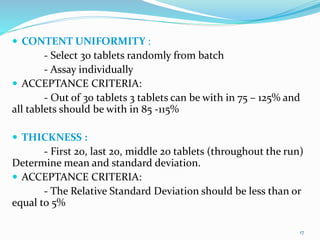
 CONTENT UNIFORMITY :
- Select 30 tablets randomly from batch
- Assay individually
 ACCEPTANCE CRITERIA:
- Out of 30 tablets 3 tablets can be with in 75 – 125% and
all tablets should be with in 85 -115%
 THICKNESS :
- First 20, last 20, middle 20 tablets (throughout the run)
Determine mean and standard deviation.
 ACCEPTANCE CRITERIA:
- The Relative Standard Deviation should be less than or
equal to 5%
17
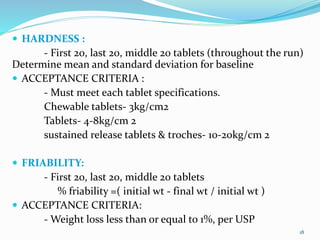
 HARDNESS :
- First 20, last 20, middle 20 tablets (throughout the run)
Determine mean and standard deviation for baseline
 ACCEPTANCE CRITERIA :
- Must meet each tablet specifications.
Chewable tablets- 3kg/cm2
Tablets- 4-8kg/cm 2
sustained release tablets & troches- 10-20kg/cm 2
 FRIABILITY:
- First 20, last 20, middle 20 tablets
% friability =( initial wt - final wt / initial wt )
 ACCEPTANCE CRITERIA:
- Weight loss less than or equal to 1%, per USP
18
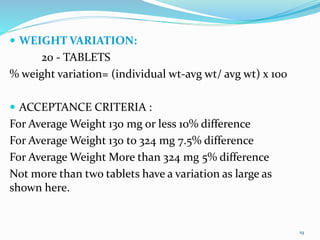
 WEIGHT VARIATION:
20 - TABLETS
% weight variation= (individual wt-avg wt/ avg wt) x 100
 ACCEPTANCE CRITERIA :
For Average Weight 130 mg or less 10% difference
For Average Weight 130 to 324 mg 7.5% difference
For Average Weight More than 324 mg 5% difference
Not more than two tablets have a variation as large as
shown here.
19
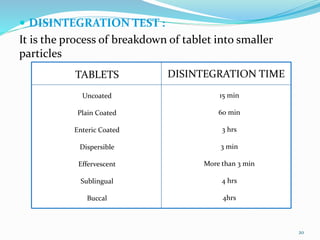
 DISINTEGRATION TEST :
It is the process of breakdown of tablet into smaller
particles
20
TABLETS DISINTEGRATION TIME
Uncoated
Plain Coated
Enteric Coated
Dispersible
Effervescent
Sublingual
Buccal
15 min
60 min
3 hrs
3 min
More than 3 min
4 hrs
4hrs
ACCEPTANCE CRITERIA:
 All tablets have disintegrated completely.
 If 1 or 2 tablets fails to disintegrate completely repeat
the test for 12 additional tablets.
21
VALIDATION/QUALIFICATION OF CAPSULE
FILLING MACHINE
Installation Qualification(IQ)
The Installation Qualification will confirm
details from
 the engineering specifications,
 equipment purchase order
 cGMP guidelines and requirements,
verify that the equipment has been installed
as specified by the vendor
22
Purchase Details :
 The purchase order no. date shall be checked
 The accessories their spare parts if any shall
be checked as per purchase order
 The delivery period shall be as per purchase
order
 Supplier or manufacturer name address shall be
checked
 Any deviation observed should be informed to the
supplier or manufacturer
23
 Details of the Equipment :
 Equipment name, make model no. shall be
recorded
 In-house identification no. shall be recorded
 Location for installation shall be checked
 Utilities required shall be listed down
 A detailed specification must be written which highlight
those parts of machine that are in
product contact
 Where stirring devices or augers are used to ensure
homogeneity and improve flow then specification of
these parts must be checked
24
 Acceptance Criteria For IQ :
 Fulfill the selection criteria its purpose of
Application
 The equipment shall be as per purchase order
 Accessories received shall be as per purchase
order
 Should meet pre-selected design parameters
 Manufacturer/supplier shall provide complete
equipment manual
 Material of construction shall be as per purchase order
25
Operational Qualification (OQ)
 Before initiating OQ ensure that SOP for operation and
Cleaning of Capsule Filling Machine is available.
 Purpose is to train the qualification team for
performing OQ
Procedure :
 Check all the dynamic attributes of the capsule filler
conform to the required specifications
 Initiate the actual operation of the equipment to ensure that
machine is operate within the desired rate of output.
 The operation of indicators, controls and alarms is verified
 Oil leaks that could contaminate the process are observed
26
Acceptance criteria For OQ :
 All operating inputs provided on the equipment
when tested shall-successfully comply
-meet tolerance limit
 The equipment should successfully perform when
operated as per SOP
 Critical alarm/indicators provided on the
equipment-
-calibrated
 The equipment when operated shall not
- produce abnormal sound
- show any discrepancy in its smooth
operation.
27
Performance Qualification(PQ)
 PQ activities demonstrates and documents that the
equipment is able to perform its intended functions
within the variable process limits for a specific product
 Acceptance criteria are developed according to the
regulatory requirements and production parameters
 To ensure that the quality and purity of the
product is maintained
 The PQ will also test the extremes of the operation, or the
peak load conditions, but it does not include testing to
failure.
28
 Procedure :
 Record the number of damaged capsules
 Capsules from throughout the lot/different batches
should be tested for weight uniformity
 Capsules from throughout the lot/different batches
should be tested for blend content uniformity
 Production speed i.e capsule per minute should be
evaluated
29
THANK
YOU !
30

Qualification of tablet compression (machine) & Capsule filling machine

  • 1.
    PRESENTED BY :YASH R.MENGHANI M.PHARM 1st YEAR (SEMISTER II) SMT.KISHORITAI BHOYAR COLLEGE OF PHARMACY,KAMPTEE 1
  • 2.
    INTRODUCTION :  VALIDATION: Action of proving and documenting that any process, procedure or method actually and consistently leads to the expected results. &  QUALIFICATION : Action of proving and documenting that any premises, systems and equipment are properly installed, and/or work correctly and lead to the expected results. The term qualification is normally used for equipment, utilities and systems, and validation for processes  In this sense, qualification is part of validation. 2
  • 3.
    TABLET COMPRESSION MACHINE: A tablet press is a mechanical device that compresses powder into tablets of uniform size and weight.  Tablet Compression Machine is also known as Tablet Press in Pharmaceutical Industry which is used to make the tablets according to a pre-determined design.  Compression is a critical step in the production of a tablet dosage form. The materials being compressed will need to have adequate flow and compression properties.  Factors to be considered during compression are,  Tooling  Compression speed 3
  • 4.
  • 5.
    TOOLING :  Tabletcompression machines are made in keeping the view of the type of dies and punches will be used on them,  The dies and punches and their setup on compression machine is called tooling.  The shape ,size and as well as certain identification markings are determined by compression machine tooling.  Each tooling set consist of dies , upper and lower punches.  Production efficiency, dosage uniformity and appearance depend upon tooling set. 5
  • 6.
     Punches : Length: Upperpunch - 5.25 inches Lower punch - 3 inches. Barrel diameter- 0.75 inches. Head diameter- 1 inch  D tooling : Is popular for large tablets Punch: Length- 5.25 inch Head diameter- 1.25 inch Barrel diameter- 1 inch Dies : out side diameter – 0.945 inch are used 6
  • 7.
    VALIDATION :  DESIGNQUALIFICATION  INSTALLATION QUALIFICATION  OPERATIONAL QUALIFICATION  PERFORMANCE QUALIFICATION 7
  • 8.
    INSTALLATION QUALIFICATION (IQ): Verify approved purchase order.  Check manufacturer and supplier .  Verify Model number and serial number.  Check any physical damage.  Confirm location and installation requirements as per recommendation of manufacturer .  Verify that the required utilities are available.  Installation shall be conducted per instructions provide in the manual. OBJECTIVE OF IQ  To check all the critical contacts parts which directly affect quality of the product.  To review proper installation as per checklist. 8
  • 9.
    IQ CHECK LIST: Compareall specification and write the observation  Machine height – measure with measuring tape.  Overall dimension- measure with measuring tape  Rpm of turret – check by tachometer.  Hopper : i)Conventional hopper- by visual check ii)MOC(master of construction )-using Molybdenum iii)Height- Measure with measuring tape  No. of station- visually count no.of holes on turret.  Type of tooling- using venire caliper check the die hole diameter .  Feeder- by visual check. 9 Continue…
  • 10.
     Required utilities-electricity. Thickness controller cam  Weight of controller cam  Main drive : i) ON indicator ii) Potentiometer iii) Selector Switch iv) Emergency switch  Dust extraction and exhaust system  Lubrication i) Oil pressure gauge ii) Select switch for auto/manual 10 By Visual check
  • 11.
    OPERATIONAL QUALIFICATION (OQ):  Verify alarm control.  Perform calibration requirements, identify in the manual or established by the validation team.  Operate the equipment at low medium and high speed as per operation manual to verify the operation control.  Verify that all switches and push buttons are functioning properly  Establish procedures for operation, maintenance and calibration  Establish training program for relevant staff Run one pilot batch for each product 11
  • 12.
     Objective ofOQ :  To operate machine as per proposed procedure given in manual and record.  To challenge the operating parameter of machine and record.  To challenge the safety operation and record. 12
  • 13.
    OQ CHECK LIST: 1)Main switch- check visually by operating the main switch of the machine. 2) Start push button- illuminated green switch By pressing start button the green switch glows and the main drive motor should start. 3) stop push button- illuminated red switch By pressing stop button the red switch glows and the main drive motor should stop 4) Turret RPM challenge test- set in the digital table counter by rotating knob check by tachometer Rotation direction (clockwise ) by visual check 13 Continue…
  • 14.
    OQ CHECK LIST: 5)Emergency switch by visual check . 6)Tablet thickness & Hardness controls : By turning the swing lever to right/left thickness increased hardness/decrease vise versa 7) Machine speed adjustment : Release the locking knob and rotate the hand wheel anticlockwise /clock wise- increased speed/decreased speed 8) Main upper punch entry: Remove the bolt and rotate the perforated segment to right/ left-upper punch penetration increases/ decreases. 14
  • 15.
    PERFORMANCE QUALIFICATION (PQ): Its an Evaluation of compression capabilities and tablet characteristics.  The compression capabilities and tablet characteristics are: 1) Content uniformity 2) Thickness 3) Hardness 4) Friability 5) weight variation 6) Disintegration test. should be investigated. 15
  • 16.
    OBJECTIVE OF PQ:  First three batches of biliary and single layer product to be compressed on given compression machine.  All the critical physical parameters of product will be checked during performance qualification.  Measure the thickness, hardness, friability and weight for each triplicate tablet run, as shown below 16
  • 17.
     CONTENT UNIFORMITY: - Select 30 tablets randomly from batch - Assay individually  ACCEPTANCE CRITERIA: - Out of 30 tablets 3 tablets can be with in 75 – 125% and all tablets should be with in 85 -115%  THICKNESS : - First 20, last 20, middle 20 tablets (throughout the run) Determine mean and standard deviation.  ACCEPTANCE CRITERIA: - The Relative Standard Deviation should be less than or equal to 5% 17
  • 18.
     HARDNESS : -First 20, last 20, middle 20 tablets (throughout the run) Determine mean and standard deviation for baseline  ACCEPTANCE CRITERIA : - Must meet each tablet specifications. Chewable tablets- 3kg/cm2 Tablets- 4-8kg/cm 2 sustained release tablets & troches- 10-20kg/cm 2  FRIABILITY: - First 20, last 20, middle 20 tablets % friability =( initial wt - final wt / initial wt )  ACCEPTANCE CRITERIA: - Weight loss less than or equal to 1%, per USP 18
  • 19.
     WEIGHT VARIATION: 20- TABLETS % weight variation= (individual wt-avg wt/ avg wt) x 100  ACCEPTANCE CRITERIA : For Average Weight 130 mg or less 10% difference For Average Weight 130 to 324 mg 7.5% difference For Average Weight More than 324 mg 5% difference Not more than two tablets have a variation as large as shown here. 19
  • 20.
     DISINTEGRATION TEST: It is the process of breakdown of tablet into smaller particles 20 TABLETS DISINTEGRATION TIME Uncoated Plain Coated Enteric Coated Dispersible Effervescent Sublingual Buccal 15 min 60 min 3 hrs 3 min More than 3 min 4 hrs 4hrs
  • 21.
    ACCEPTANCE CRITERIA:  Alltablets have disintegrated completely.  If 1 or 2 tablets fails to disintegrate completely repeat the test for 12 additional tablets. 21
  • 22.
    VALIDATION/QUALIFICATION OF CAPSULE FILLINGMACHINE Installation Qualification(IQ) The Installation Qualification will confirm details from  the engineering specifications,  equipment purchase order  cGMP guidelines and requirements, verify that the equipment has been installed as specified by the vendor 22
  • 23.
    Purchase Details : The purchase order no. date shall be checked  The accessories their spare parts if any shall be checked as per purchase order  The delivery period shall be as per purchase order  Supplier or manufacturer name address shall be checked  Any deviation observed should be informed to the supplier or manufacturer 23
  • 24.
     Details ofthe Equipment :  Equipment name, make model no. shall be recorded  In-house identification no. shall be recorded  Location for installation shall be checked  Utilities required shall be listed down  A detailed specification must be written which highlight those parts of machine that are in product contact  Where stirring devices or augers are used to ensure homogeneity and improve flow then specification of these parts must be checked 24
  • 25.
     Acceptance CriteriaFor IQ :  Fulfill the selection criteria its purpose of Application  The equipment shall be as per purchase order  Accessories received shall be as per purchase order  Should meet pre-selected design parameters  Manufacturer/supplier shall provide complete equipment manual  Material of construction shall be as per purchase order 25
  • 26.
    Operational Qualification (OQ) Before initiating OQ ensure that SOP for operation and Cleaning of Capsule Filling Machine is available.  Purpose is to train the qualification team for performing OQ Procedure :  Check all the dynamic attributes of the capsule filler conform to the required specifications  Initiate the actual operation of the equipment to ensure that machine is operate within the desired rate of output.  The operation of indicators, controls and alarms is verified  Oil leaks that could contaminate the process are observed 26
  • 27.
    Acceptance criteria ForOQ :  All operating inputs provided on the equipment when tested shall-successfully comply -meet tolerance limit  The equipment should successfully perform when operated as per SOP  Critical alarm/indicators provided on the equipment- -calibrated  The equipment when operated shall not - produce abnormal sound - show any discrepancy in its smooth operation. 27
  • 28.
    Performance Qualification(PQ)  PQactivities demonstrates and documents that the equipment is able to perform its intended functions within the variable process limits for a specific product  Acceptance criteria are developed according to the regulatory requirements and production parameters  To ensure that the quality and purity of the product is maintained  The PQ will also test the extremes of the operation, or the peak load conditions, but it does not include testing to failure. 28
  • 29.
     Procedure : Record the number of damaged capsules  Capsules from throughout the lot/different batches should be tested for weight uniformity  Capsules from throughout the lot/different batches should be tested for blend content uniformity  Production speed i.e capsule per minute should be evaluated 29
  • 30.