Pediatric Intubation
Rob Parker, DO
Pediatric Critical Care Fellow
March 11, 2016
Outline
 Indications
 How are kids different
 What to know before you intubate
 The set up
 What drugs
 How to perform
 Scenarios
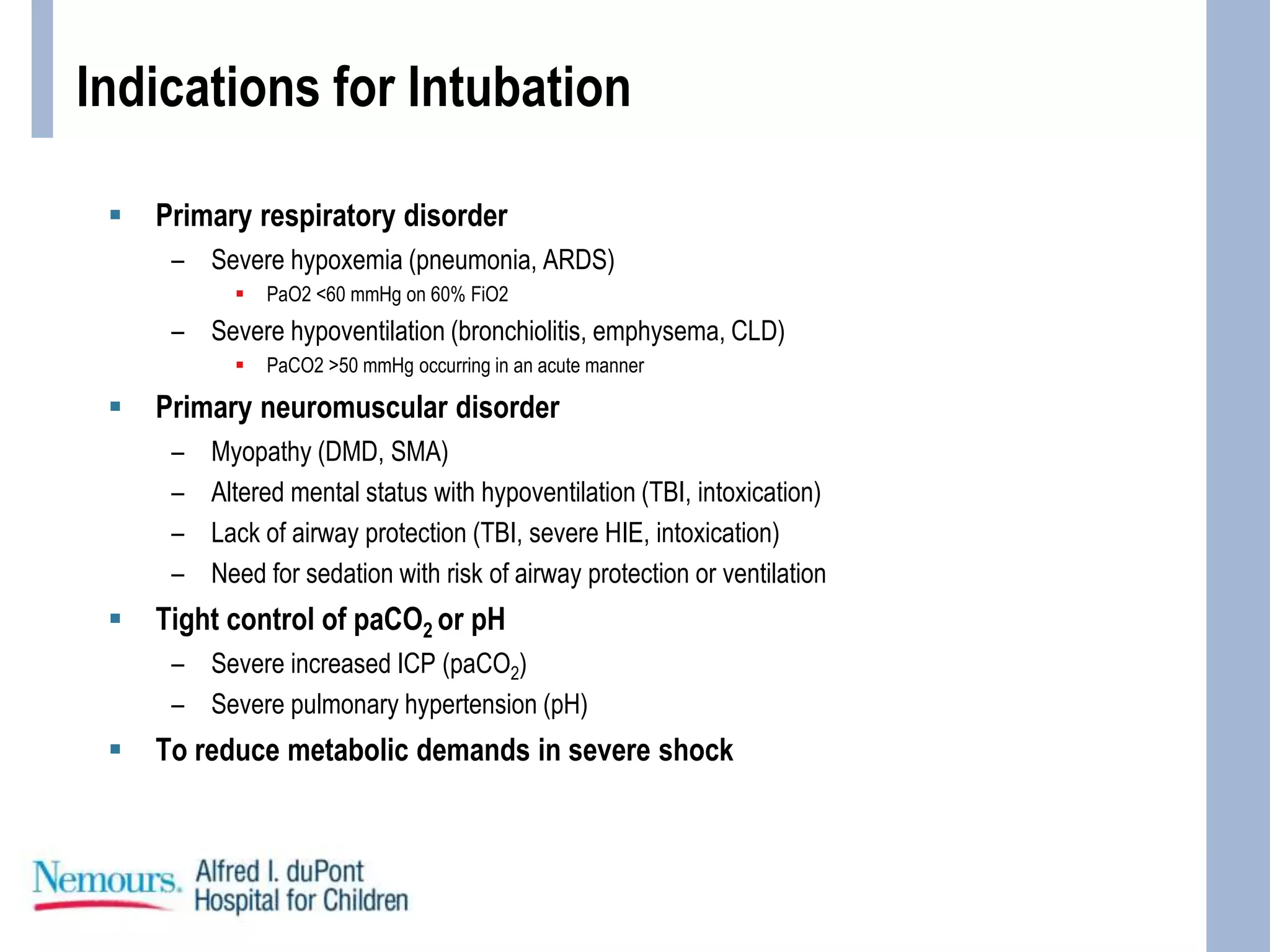
Indications for Intubation
 Primary respiratory disorder
– Severe hypoxemia (pneumonia, ARDS)
 PaO2 <60 mmHg on 60% FiO2
– Severe hypoventilation (bronchiolitis, emphysema, CLD)
 PaCO2 >50 mmHg occurring in an acute manner
 Primary neuromuscular disorder
– Myopathy (DMD, SMA)
– Altered mental status with hypoventilation (TBI, intoxication)
– Lack of airway protection (TBI, severe HIE, intoxication)
– Need for sedation with risk of airway protection or ventilation
 Tight control of paCO2 or pH
– Severe increased ICP (paCO2)
– Severe pulmonary hypertension (pH)
 To reduce metabolic demands in severe shock
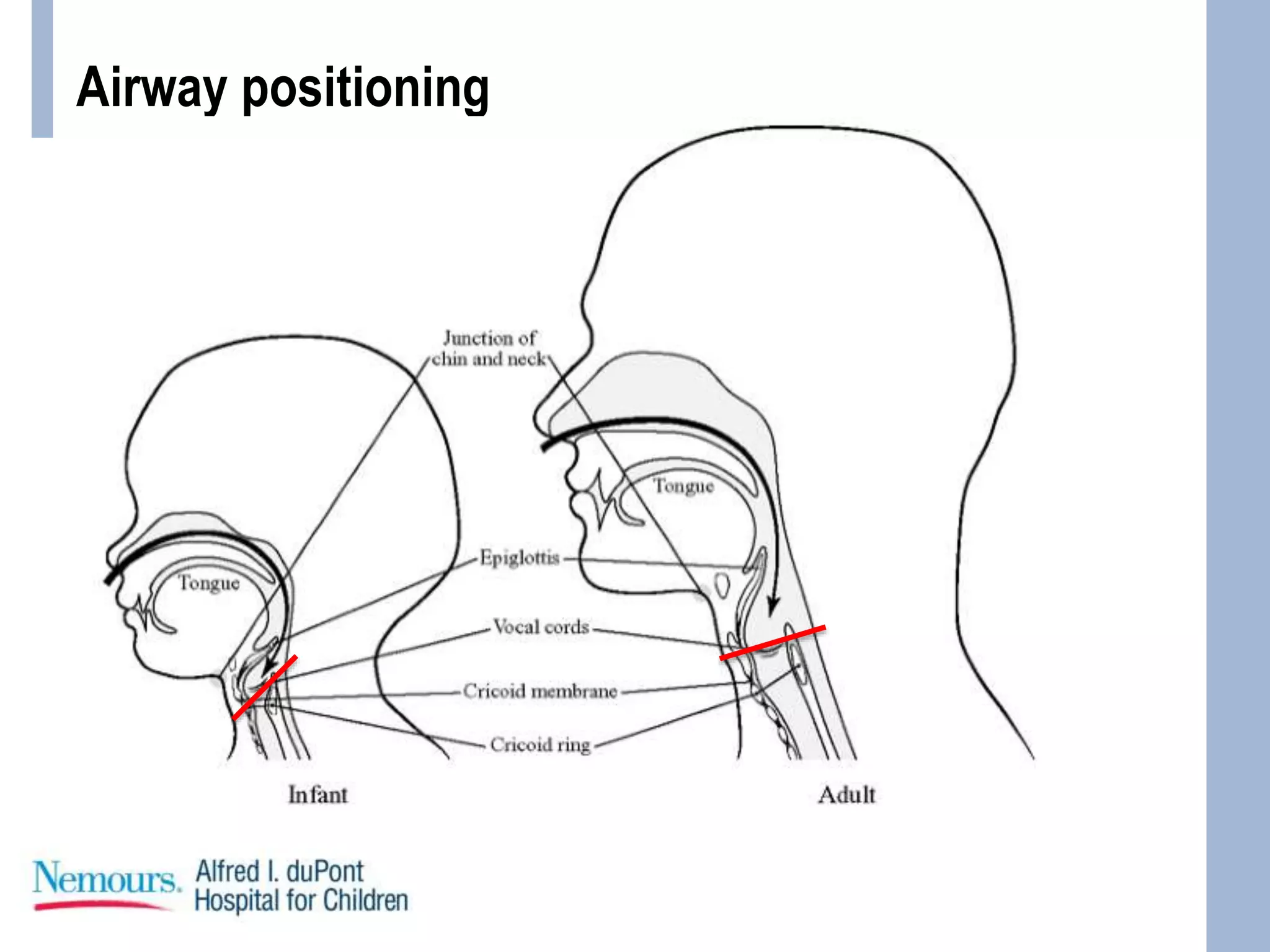
How Are Kids Different
 Airway positioning
 Larger tongue
 Angled vocal cords
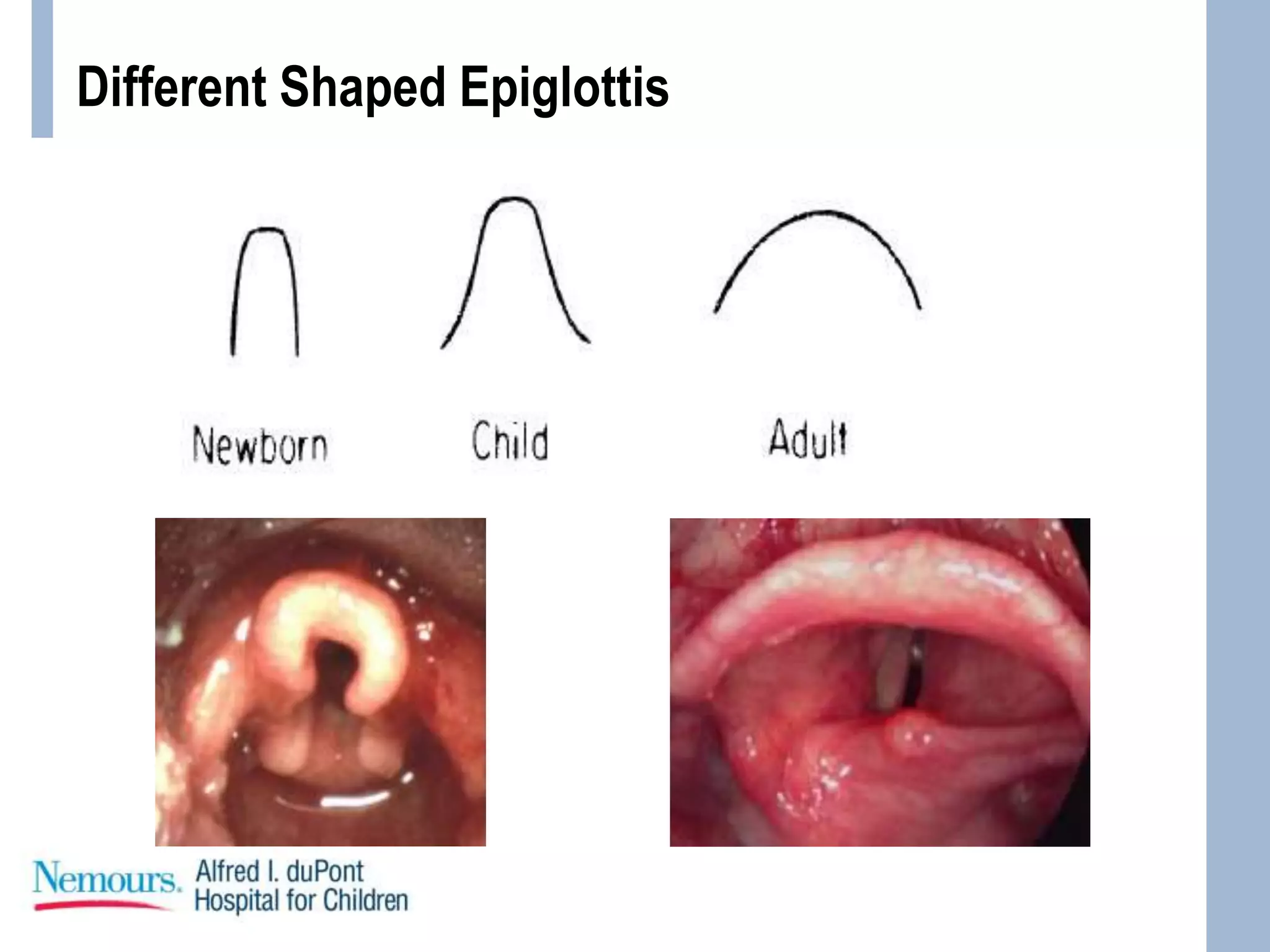
 Differently shaped epiglottis
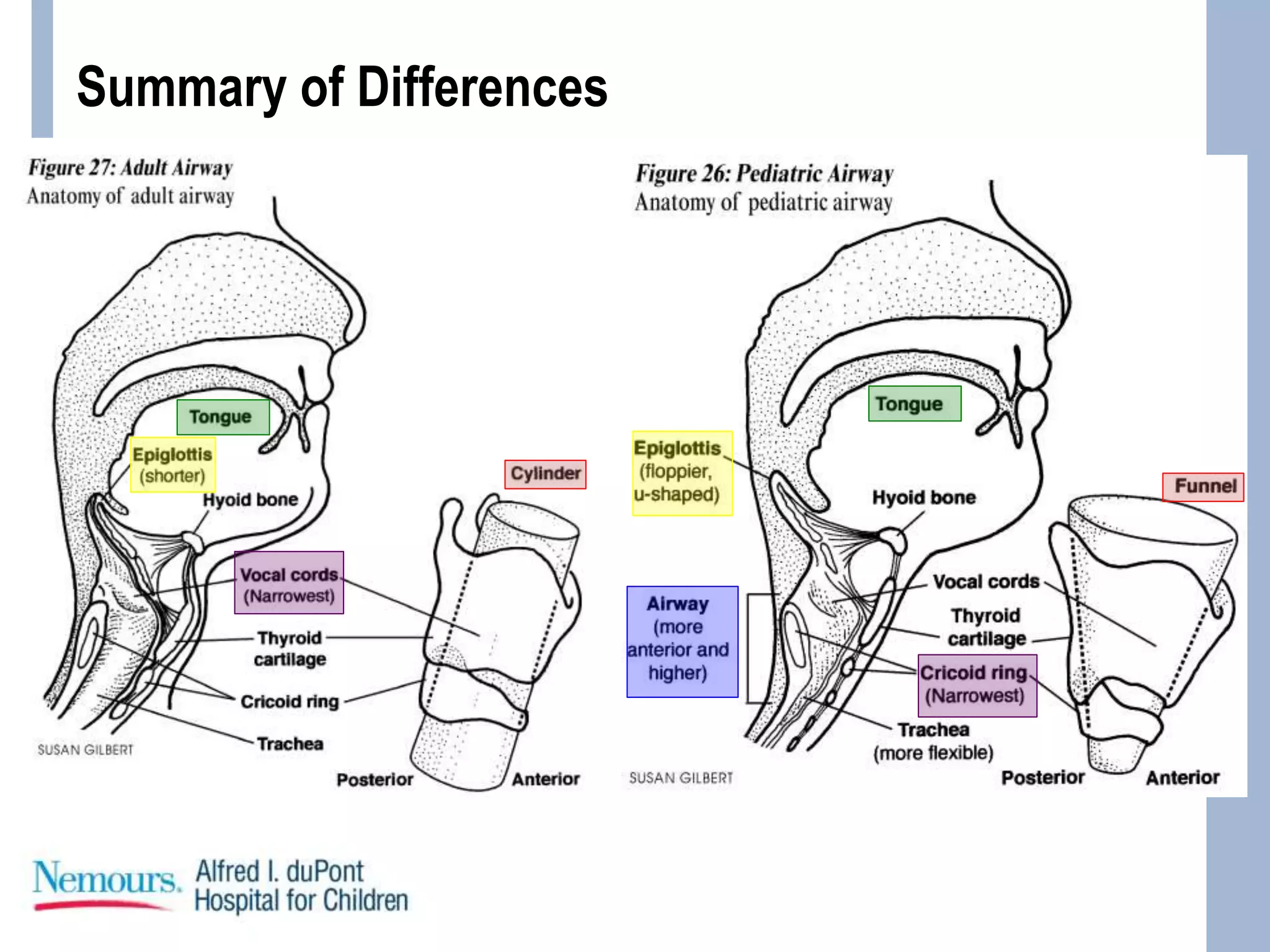
 Funneled shaped larynx with differing narrowmost
point
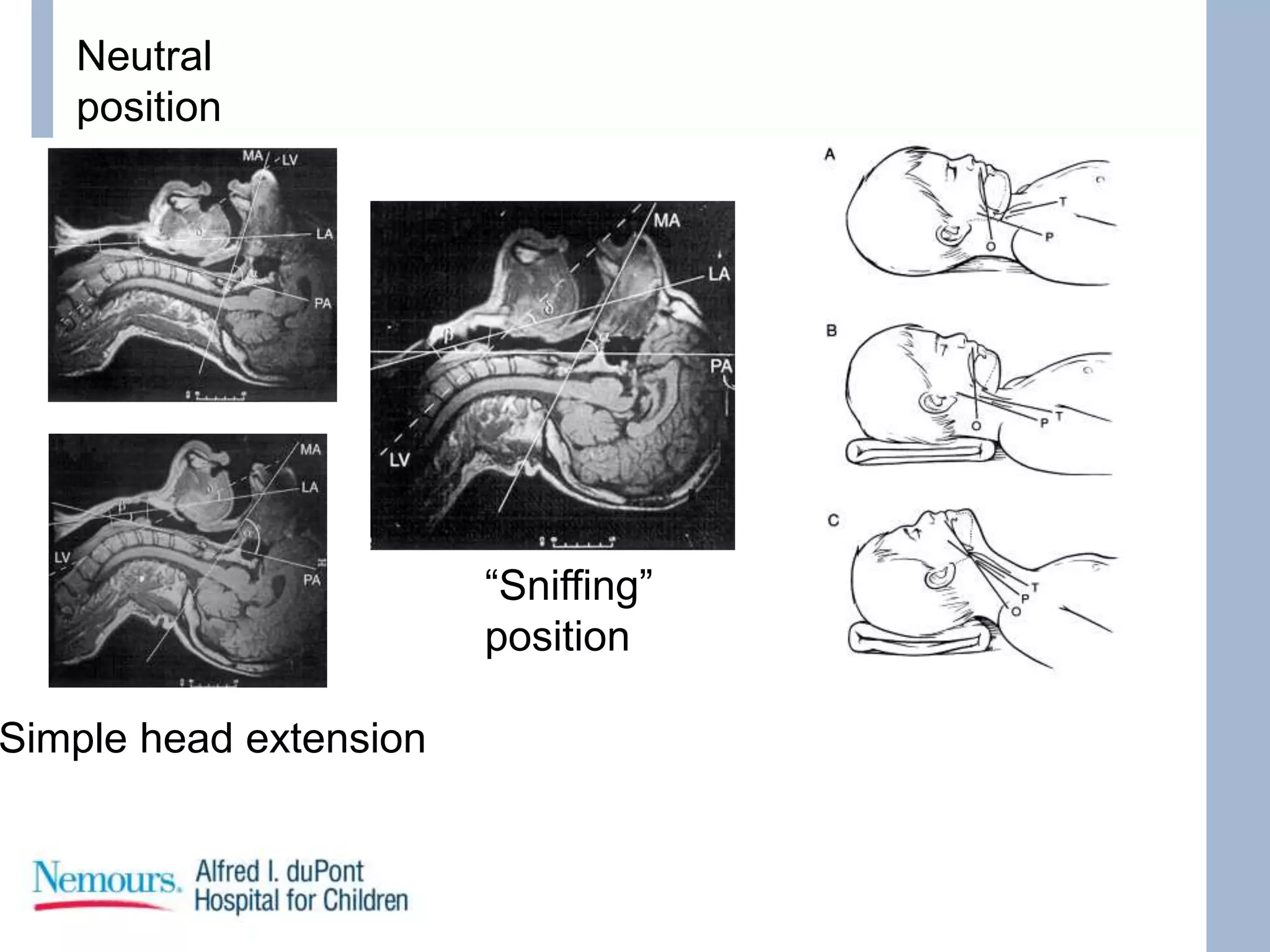
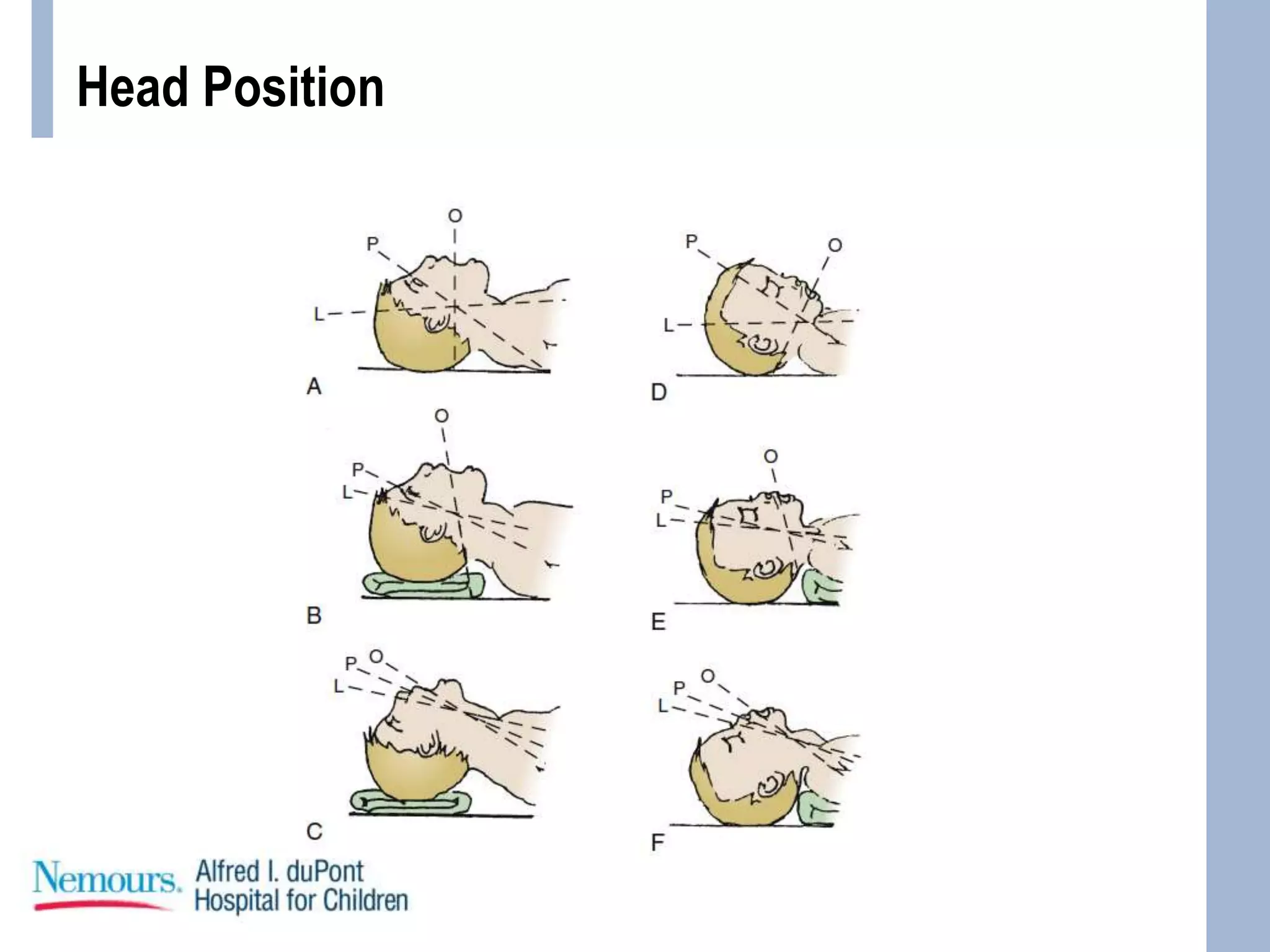
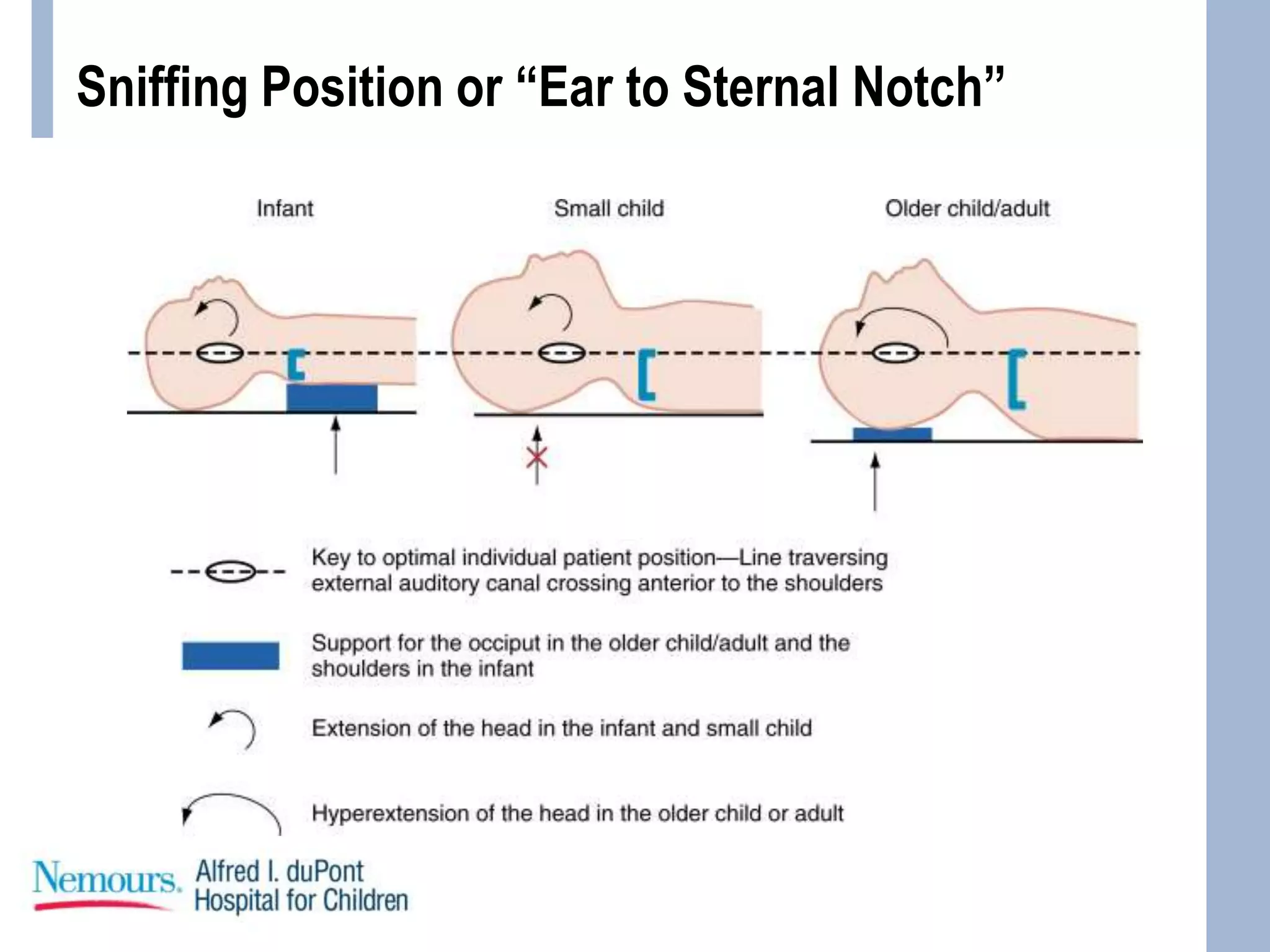
Airway positioning
Neutral
position
Simple head extension
“Sniffing”
position
Head Position
Sniffing Position or “Ear to Sternal Notch”
Larger Tongue and Angled Vocal Cords
Different Shaped Epiglottis
Funnel Shaped Larynx
Summary of Differences
Things You Should Know BEFORE You Intubate
Look
 Look for normal
face and anatomy
– Pierre Robin,
Treacher Collins,
Achondroplasia,
Cleft lip/palate,
Down Syndrome,
Crouzon,
Goldenhar, Apert,
Mucopolysaccari
dosis
– Tumors, trauma
– “Buck teeth,”
missing teeth,
obesity, cervical
immobility
Pierre Robin S.
Down S.
Achondroplasia
Crouzon S.
Treacher Collins S.
Goldenhar S.
Apert S.
Mucopolysaccaridosis
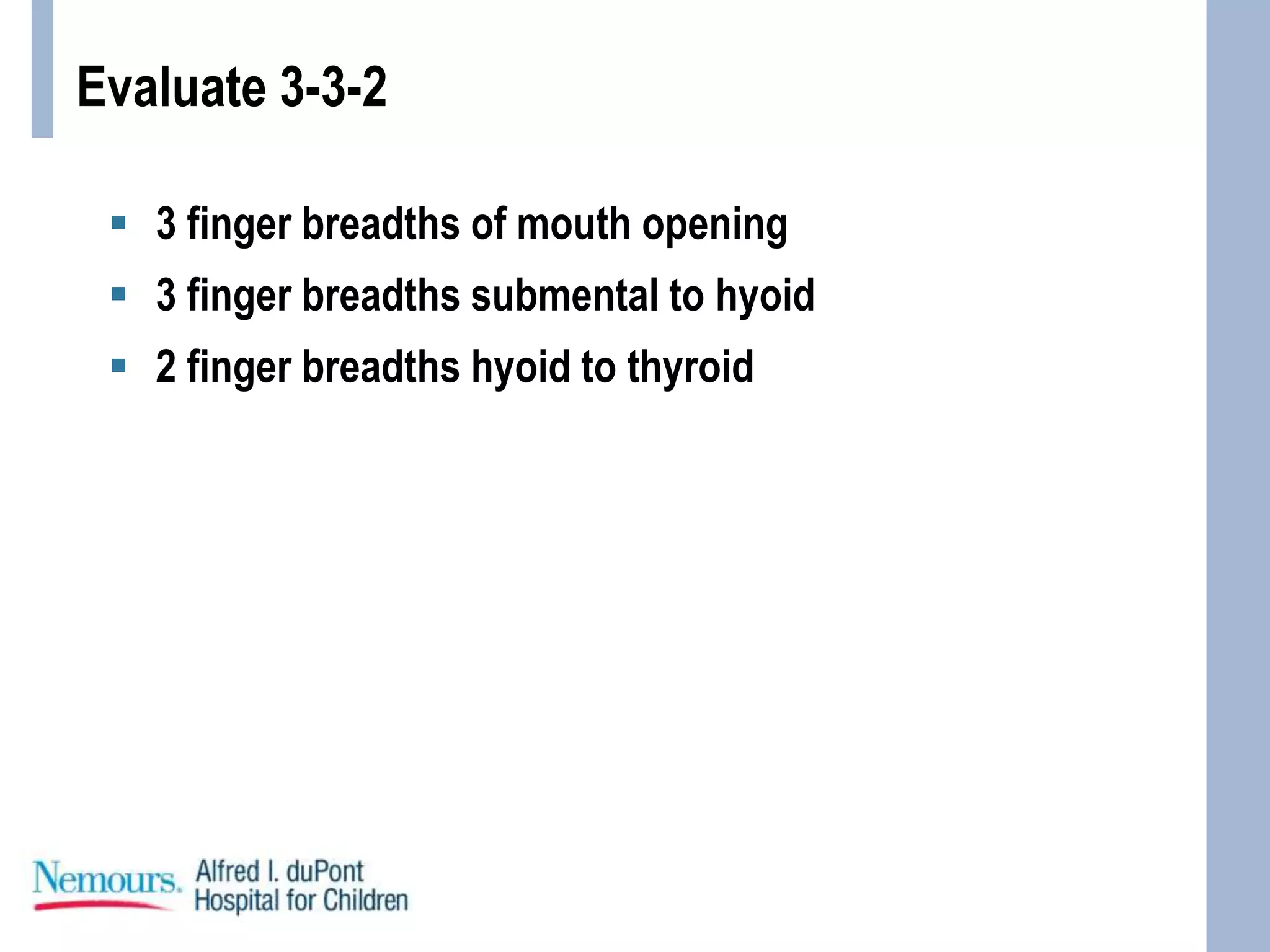
Evaluate 3-3-2
 3 finger breadths of mouth opening
 3 finger breadths submental to hyoid
 2 finger breadths hyoid to thyroid
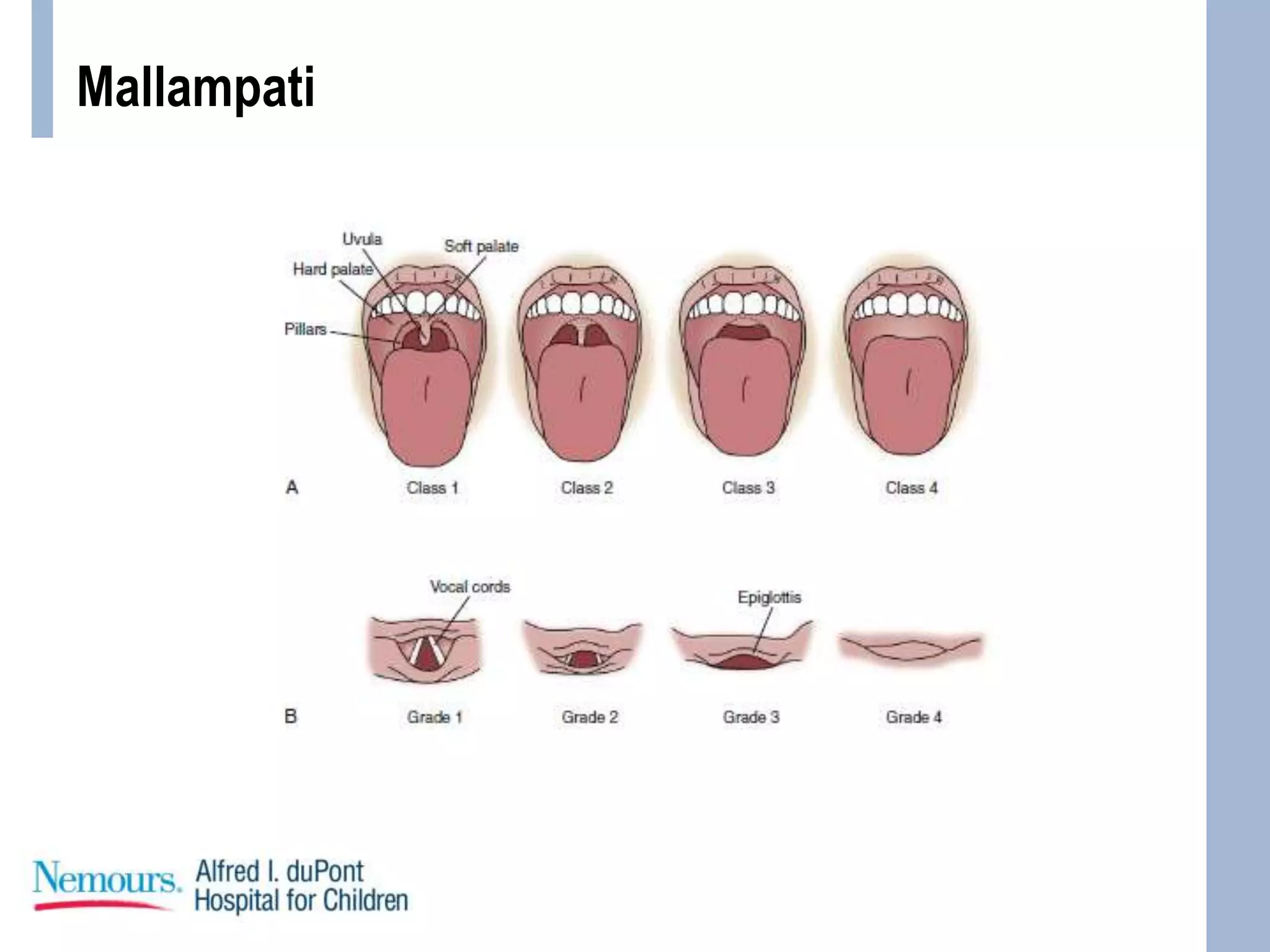
Mallampati
Obstruction
Neck Mobility
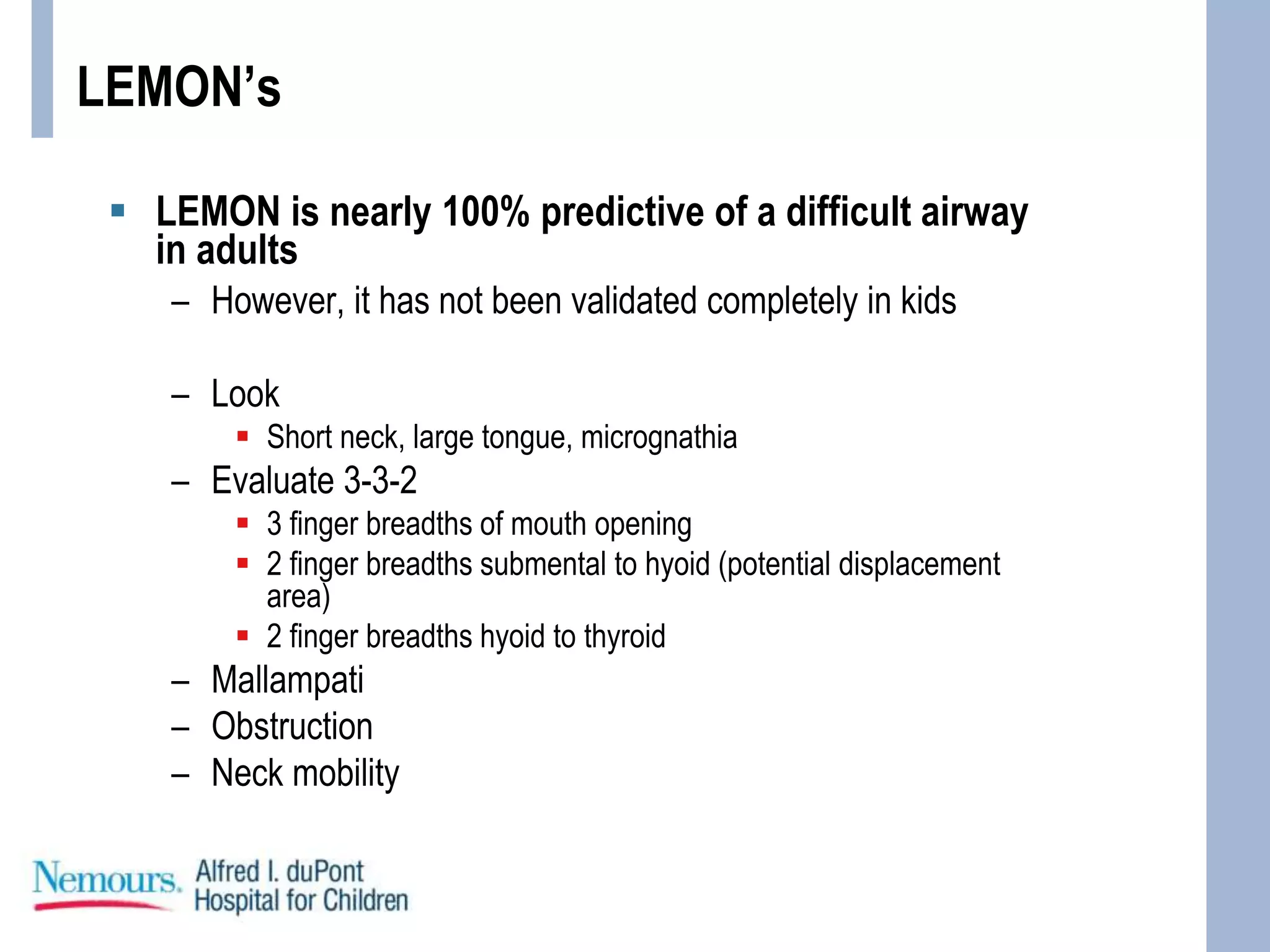
LEMON’s
 LEMON is nearly 100% predictive of a difficult airway
in adults
– However, it has not been validated completely in kids
– Look
 Short neck, large tongue, micrognathia
– Evaluate 3-3-2
 3 finger breadths of mouth opening
 2 finger breadths submental to hyoid (potential displacement
area)
 2 finger breadths hyoid to thyroid
– Mallampati
– Obstruction
– Neck mobility
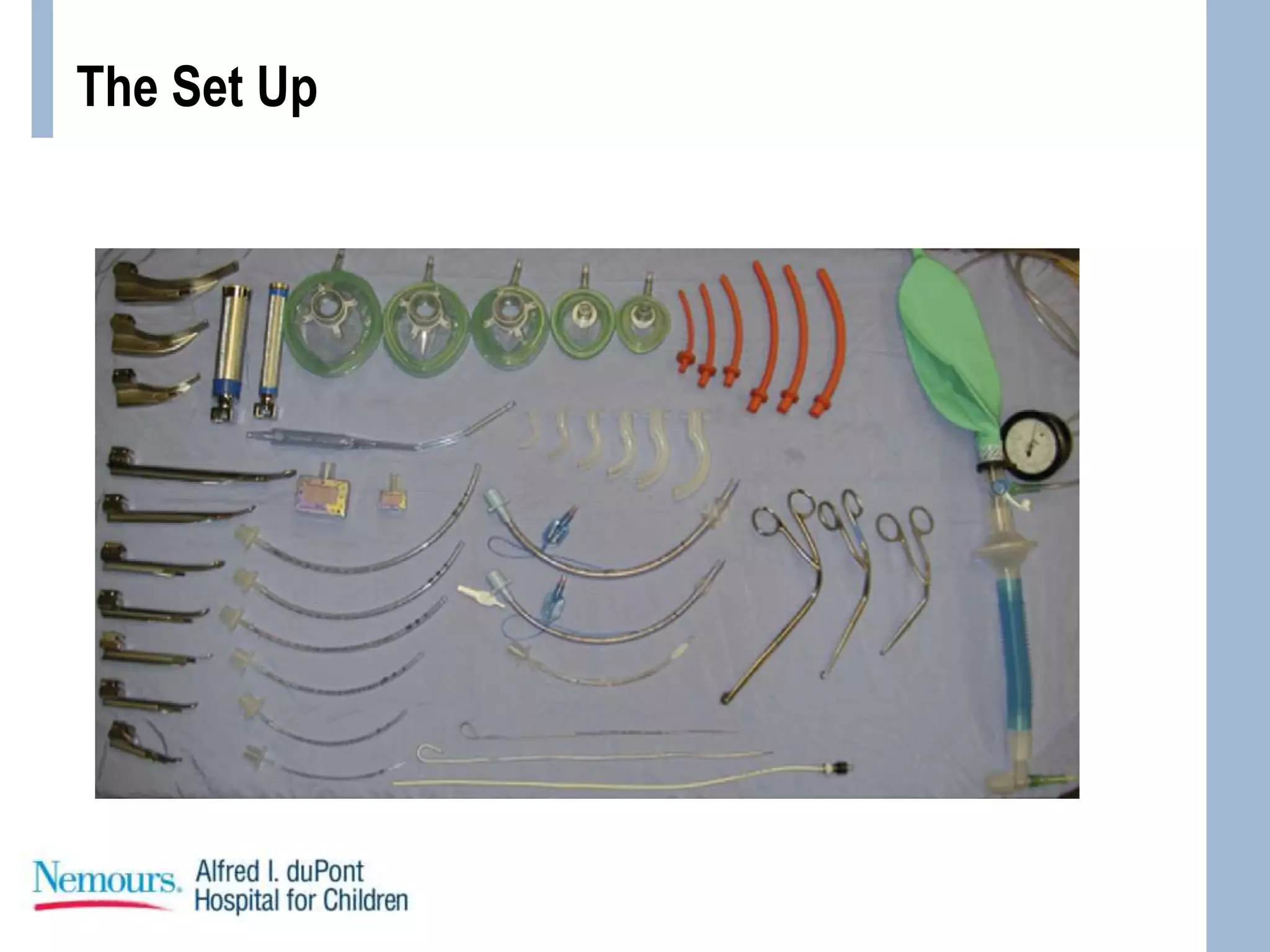
The Set Up
SOAP - ME
 Suction
– Large Bore (Yankauer)
– Small Bore (Oxygen suction or
flexible)
 Oxygen
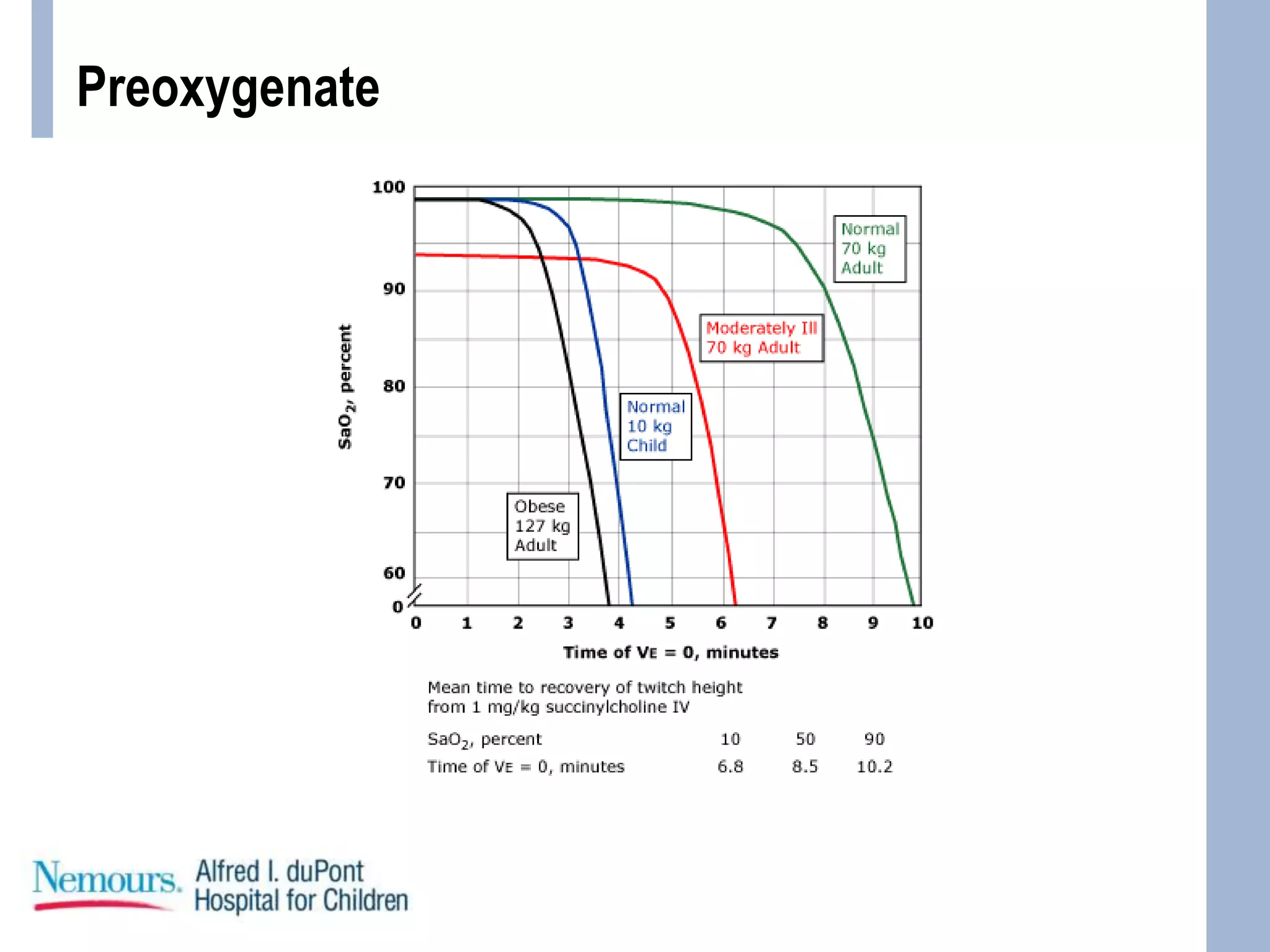
– Pre-oxygenate with 100% FiO2
for 5 min
– May be able to do 5-8 large
volume breaths
 Airway
– Appropriately sized tubes
– Appropriately sized blades
– Oral and nasal airways
 Personnel
– RT, nursing, fellow/attending,
sedation provider
 Medications
– Premedication
– Induction
– Paralytic
– Rescue medications (epi, fluids)
 Equipment
– Vent
– BVM
– ETT, stylet, syringe
– Ways to secure ETT
– End tidal CO2, Capnography
– Working IV
– CXR
Miller Vs Mac
The Blade
Miller
 Thinner, straight blade
 Miller blade is preferred for
infants and younger children
 Facilitates lifting of the
epiglottis and exposing the
glottic opening
 Placed on top of epiglottis
lifting away
 Possibly better control of
tongue
Mac
 Wider, curved blade
 Mac tends to be used for
older children and adults
 Curves around tongue
 Placed into vallecula and lift
away
 Possibly wider glottic
opening
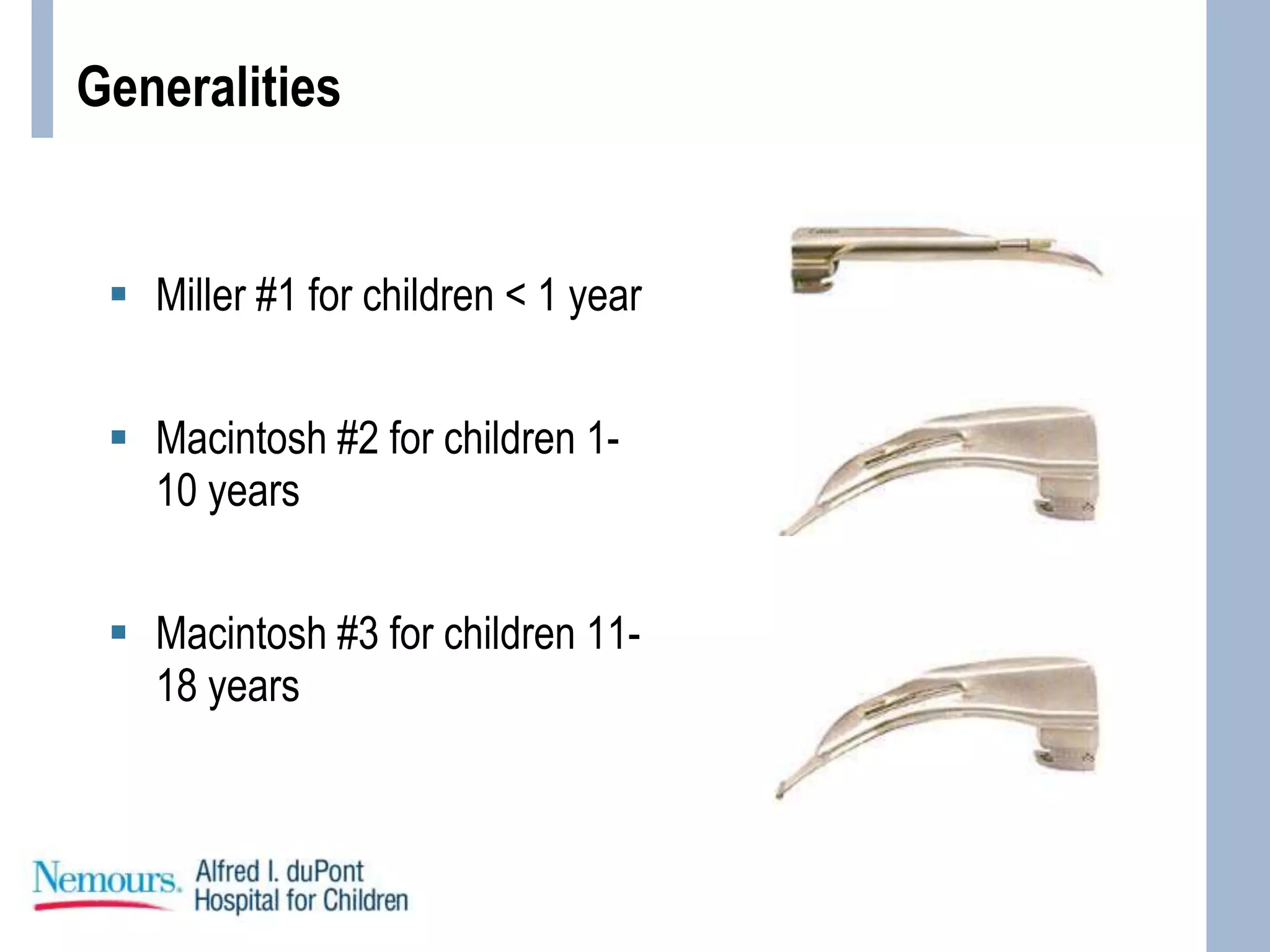
Generalities
 Miller #1 for children < 1 year
 Macintosh #2 for children 1-
10 years
 Macintosh #3 for children 11-
18 years
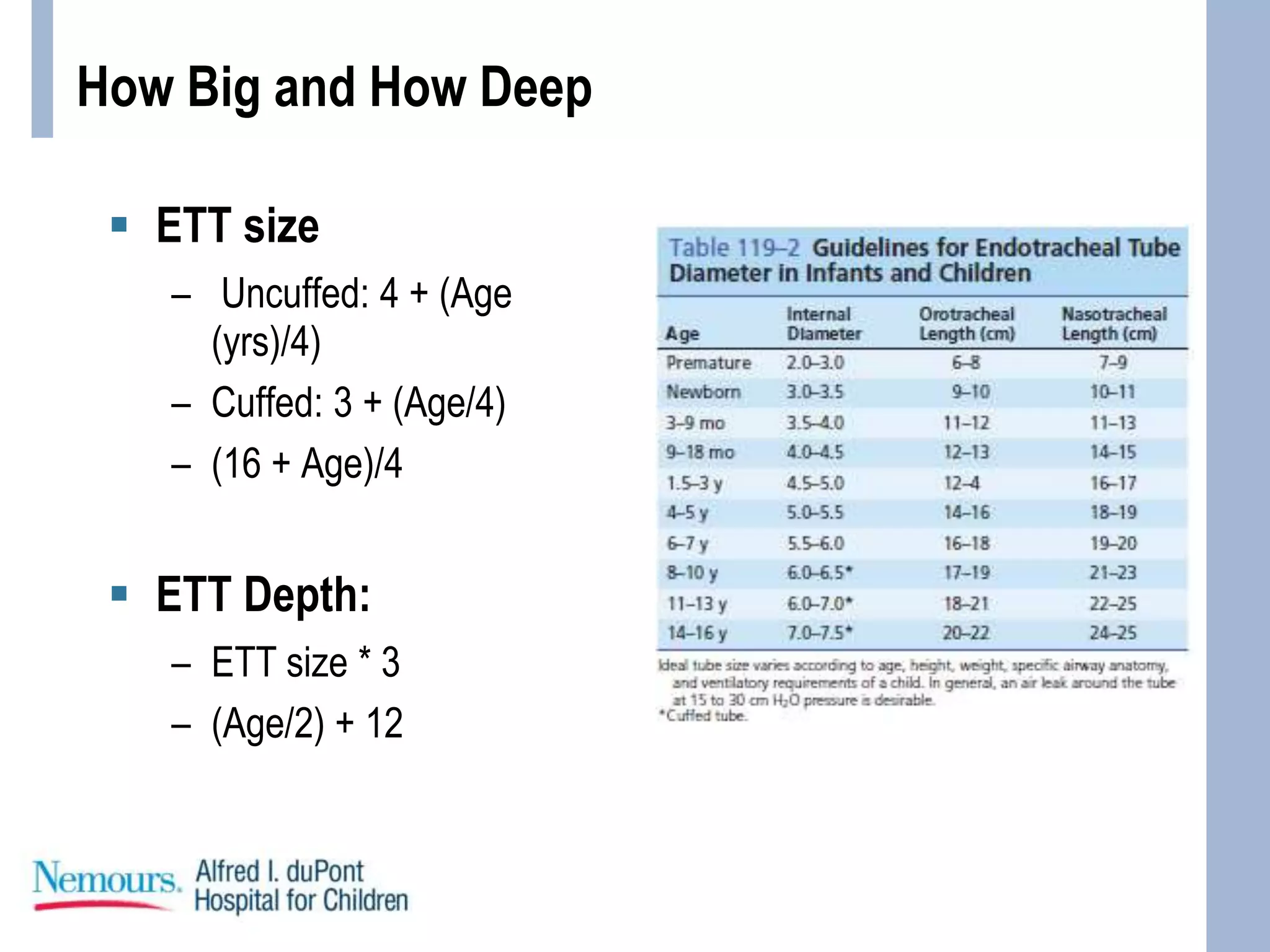
How Big and How Deep
 ETT size
– Uncuffed: 4 + (Age
(yrs)/4)
– Cuffed: 3 + (Age/4)
– (16 + Age)/4
 ETT Depth:
– ETT size * 3
– (Age/2) + 12
Cuff Vs Uncuff
 Old School:
– Uncuff for under 8yo to help prevent subglottic stenosis
and avoid post-extubation stridor
– Deakers et al. J Peds1994 study of 188 kids (95 uncuff,
93 cuff) showed no difference in post-extubation stridor
– Newth et al. J Peds 2004 study of 387 kids showed no
difference in use of racemic post extubation
 Current teaching:
– Cuffed tubes universally preferred
– Enables better oxygenation/ventilation
– Better for severe lung disease
RSI – The 7 P’s
 Preparation
– Correct indication, equipment, personnel
 Preoxygenation
– 100% FiO2, assisted breaths if clinically indicated
 Pretreatment
– Atropine, lidocaine, robinol
 Put to Sleep
– Etomidate, propofol, ketamine, fentanyl/versed
 Paralyze
– Sux, vec, roc, cis
 Pass tube
– Direct laryngoscopy, video laryngoscopy, fiberoptic
 Placement Verification
– Capnography, EtCO2, auscultation, mist, chest rise, CXR
Preoxygenate
Pretreatment
 Lidocaine:
– Blunts rise in ICP with laryngoscopy
– No good data on validity of claim
– Rx: 1-2mg/kg
 Atropine:
– Thought to blunt vagal response and prevent bradycardia;
also helps with secretions
– No good data
– Not necessarily recommended but often used in very young
children
– Rx: 0.02mg/kg with no min dose any more
 Glycopyrrolate:
– Can dry secretions some and give a slight increase to HR
– Rx: 5mcg/kg
Put to Sleep
 Etomidate
 Propofol
 Ketamine
 Fentanyl/versed
Etomidate
 Non narcotic, non barbiturate sedative
 Fast, reliable, hemodynamically stable
 Decreases cerebral blood flow and metabolic oxygen
demand lowering ICP
 Can cause adrenal suppression with a single dose
 Can cause myoclonic jerks/hiccups
 Rx:
– 0.3mg/kg
– Works in 15-30 seconds
 Who:
– Hemodynamically unstable pts without sepsis (heart pts, ICP
pts)
Propofol
 Alkphenol sedative hypnotic
 Fast acting and easily titratable
 Decreases cerebral metabolic oxygen demand and
lowers ICP
 Antiepileptic and antiemetic properties
 Can lower BP
 Rx:
– 1-4 mg/kg
– Works in 30-60 seconds
 Who:
– Pts with ICP issues, many respiratory pts, elective
intubations for AMS
Ketamine
 PCP derivative that provides analgesia, anesthesia and
amnesia
 Minimal respiratory depression and hemodynamically
stable
 Bronchodilation
 Can increase cerebral metabolic oxygen demand and ICP
 Causes increased secretions and emergence phenomenon
 Can cause laryngospasm
 Rx:
– 1-2mg/kg
– Works in 1-2 min
 Who:
– Asthma, potentially hemodynamically unstable pts
Fentanyl/Versed
 Opioid and benzo combination
 Analgesia, amnesia and anesthesia
 Dose dependent respiratory depression
 Minimal hemodynamic instability
 Nearly universally applicable
 Wider therapeutic window with less consistent sedation
 Rx
– Fentanyl 2-4 mcg/kg over 2 min to avoid rigid chest
– Versed 0.1 mg/kg
 Who:
– Most anyone
Succinylcholine
 Depolarizing muscle relaxant
 Potent, reliable and fast acting with quick offset
 Good for rapid sequence intubation
 Contraindicated in hyperkalemia, burns, trauma, increased
IOP, likely ICP, mitochondrial and neuromuscular kids
 Rx:
– 1-2 mg/kg
– Onset 60 seconds and lasts 5‐10 minutes
 Who:
– Most people unless contraindicated
Vecuronium
 Nondepolarizing muscle relaxant
 No contraindications
 Works rapidly
 Rx:
– 0.1mg/kg
– Onset in 90-120 seconds and lasts 15-60 min
 Who:
– Most anyone
– Can stay around in renal failure patients
Rocuronium
 Nondepolarizing muscle relaxant
 No contraindications
 Works rapidly
 Rx:
– 0.6-1.2mg/kg (1mg/kg for ease)
– Onset is 60 seconds and lasts 20-40 min
 Who:
– Most anyone
Cisatracurium
 Nondepolarizing muscle relaxant
 Safe in hepatic and renal failure
 Hoffman degredation
 Fast onset and offset
 May cause hypotension and histamine release with
prolonged use
 Rx:
– 0.2mg/kg
– Onset of 2 min and lasts 20 min
 Who:
– Renal and liver failure patients
Full view of larynx in child
Child laryngoscopy Miller blade
Infant laryngoscopy Miller blade
Child Miller large tonsils
Wisconsin blade, difficult infant laryngoscopy
Cases
 12yo asthmatic with impending respiratory failure
secondary to a viral illness
 Tube Size:
– 6.5-7.0
 Depth:
– 19.5-21
 Induction:
– Ketamine, maybe propofol
 Paralytic:
– Any
Cases
 4yo with AMS and large posterior fossa mass with
midline shift
 Tube size:
– 4.5-5.0
 Depth:
– 13.5-15
 Induction:
– Propofol, etomidate (lidocaine)
 Paralytic:
– Roc (not sux)
Cases
 8mo with bronchiolitis and respiratory failure
 Tube size:
– 4.0
 Depth:
– 12
 Induction:
– Propofol, fentanyl/versed (? Atropine)
 Paralytic:
– Any
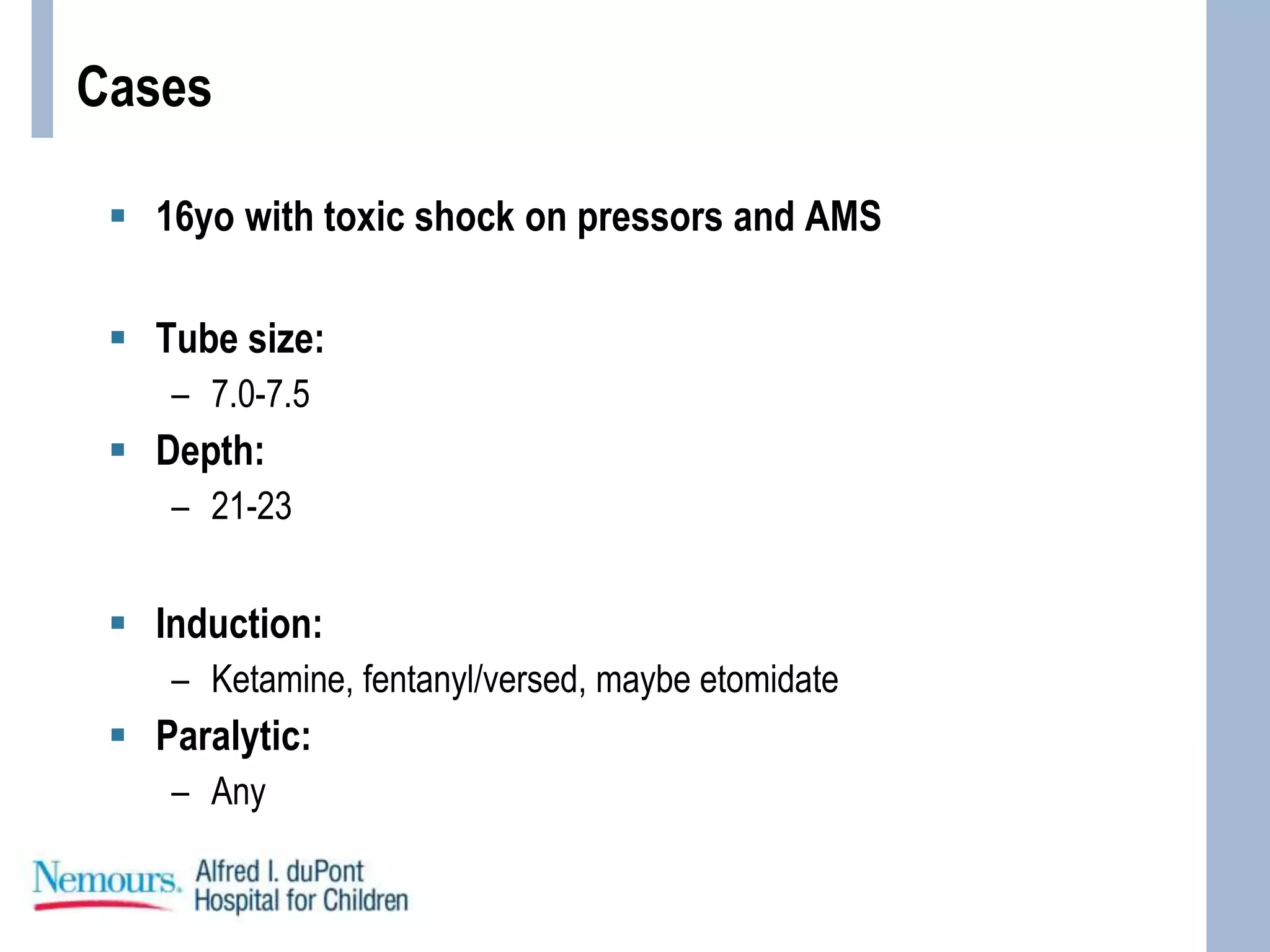
Cases
 16yo with toxic shock on pressors and AMS
 Tube size:
– 7.0-7.5
 Depth:
– 21-23
 Induction:
– Ketamine, fentanyl/versed, maybe etomidate
 Paralytic:
– Any
Thank You
Questions?
Intubation Drugs for Pediatric Patients
Braslow Tape

Pediatric intubation

  • 1.
    Pediatric Intubation Rob Parker,DO Pediatric Critical Care Fellow March 11, 2016
  • 3.
    Outline  Indications  Howare kids different  What to know before you intubate  The set up  What drugs  How to perform  Scenarios
  • 4.
    Indications for Intubation Primary respiratory disorder – Severe hypoxemia (pneumonia, ARDS)  PaO2 <60 mmHg on 60% FiO2 – Severe hypoventilation (bronchiolitis, emphysema, CLD)  PaCO2 >50 mmHg occurring in an acute manner  Primary neuromuscular disorder – Myopathy (DMD, SMA) – Altered mental status with hypoventilation (TBI, intoxication) – Lack of airway protection (TBI, severe HIE, intoxication) – Need for sedation with risk of airway protection or ventilation  Tight control of paCO2 or pH – Severe increased ICP (paCO2) – Severe pulmonary hypertension (pH)  To reduce metabolic demands in severe shock
  • 5.
    How Are KidsDifferent  Airway positioning  Larger tongue  Angled vocal cords  Differently shaped epiglottis  Funneled shaped larynx with differing narrowmost point
  • 6.
  • 7.
  • 8.
  • 9.
    Sniffing Position or“Ear to Sternal Notch”
  • 10.
    Larger Tongue andAngled Vocal Cords
  • 11.
  • 12.
  • 13.
  • 14.
    Things You ShouldKnow BEFORE You Intubate
  • 15.
    Look  Look fornormal face and anatomy – Pierre Robin, Treacher Collins, Achondroplasia, Cleft lip/palate, Down Syndrome, Crouzon, Goldenhar, Apert, Mucopolysaccari dosis – Tumors, trauma – “Buck teeth,” missing teeth, obesity, cervical immobility Pierre Robin S. Down S. Achondroplasia Crouzon S. Treacher Collins S. Goldenhar S. Apert S. Mucopolysaccaridosis
  • 16.
    Evaluate 3-3-2  3finger breadths of mouth opening  3 finger breadths submental to hyoid  2 finger breadths hyoid to thyroid
  • 17.
  • 18.
  • 19.
  • 20.
    LEMON’s  LEMON isnearly 100% predictive of a difficult airway in adults – However, it has not been validated completely in kids – Look  Short neck, large tongue, micrognathia – Evaluate 3-3-2  3 finger breadths of mouth opening  2 finger breadths submental to hyoid (potential displacement area)  2 finger breadths hyoid to thyroid – Mallampati – Obstruction – Neck mobility
  • 21.
  • 22.
    SOAP - ME Suction – Large Bore (Yankauer) – Small Bore (Oxygen suction or flexible)  Oxygen – Pre-oxygenate with 100% FiO2 for 5 min – May be able to do 5-8 large volume breaths  Airway – Appropriately sized tubes – Appropriately sized blades – Oral and nasal airways  Personnel – RT, nursing, fellow/attending, sedation provider  Medications – Premedication – Induction – Paralytic – Rescue medications (epi, fluids)  Equipment – Vent – BVM – ETT, stylet, syringe – Ways to secure ETT – End tidal CO2, Capnography – Working IV – CXR
  • 23.
  • 24.
    The Blade Miller  Thinner,straight blade  Miller blade is preferred for infants and younger children  Facilitates lifting of the epiglottis and exposing the glottic opening  Placed on top of epiglottis lifting away  Possibly better control of tongue Mac  Wider, curved blade  Mac tends to be used for older children and adults  Curves around tongue  Placed into vallecula and lift away  Possibly wider glottic opening
  • 25.
    Generalities  Miller #1for children < 1 year  Macintosh #2 for children 1- 10 years  Macintosh #3 for children 11- 18 years
  • 26.
    How Big andHow Deep  ETT size – Uncuffed: 4 + (Age (yrs)/4) – Cuffed: 3 + (Age/4) – (16 + Age)/4  ETT Depth: – ETT size * 3 – (Age/2) + 12
  • 27.
    Cuff Vs Uncuff Old School: – Uncuff for under 8yo to help prevent subglottic stenosis and avoid post-extubation stridor – Deakers et al. J Peds1994 study of 188 kids (95 uncuff, 93 cuff) showed no difference in post-extubation stridor – Newth et al. J Peds 2004 study of 387 kids showed no difference in use of racemic post extubation  Current teaching: – Cuffed tubes universally preferred – Enables better oxygenation/ventilation – Better for severe lung disease
  • 28.
    RSI – The7 P’s  Preparation – Correct indication, equipment, personnel  Preoxygenation – 100% FiO2, assisted breaths if clinically indicated  Pretreatment – Atropine, lidocaine, robinol  Put to Sleep – Etomidate, propofol, ketamine, fentanyl/versed  Paralyze – Sux, vec, roc, cis  Pass tube – Direct laryngoscopy, video laryngoscopy, fiberoptic  Placement Verification – Capnography, EtCO2, auscultation, mist, chest rise, CXR
  • 29.
  • 30.
    Pretreatment  Lidocaine: – Bluntsrise in ICP with laryngoscopy – No good data on validity of claim – Rx: 1-2mg/kg  Atropine: – Thought to blunt vagal response and prevent bradycardia; also helps with secretions – No good data – Not necessarily recommended but often used in very young children – Rx: 0.02mg/kg with no min dose any more  Glycopyrrolate: – Can dry secretions some and give a slight increase to HR – Rx: 5mcg/kg
  • 31.
    Put to Sleep Etomidate  Propofol  Ketamine  Fentanyl/versed
  • 32.
    Etomidate  Non narcotic,non barbiturate sedative  Fast, reliable, hemodynamically stable  Decreases cerebral blood flow and metabolic oxygen demand lowering ICP  Can cause adrenal suppression with a single dose  Can cause myoclonic jerks/hiccups  Rx: – 0.3mg/kg – Works in 15-30 seconds  Who: – Hemodynamically unstable pts without sepsis (heart pts, ICP pts)
  • 33.
    Propofol  Alkphenol sedativehypnotic  Fast acting and easily titratable  Decreases cerebral metabolic oxygen demand and lowers ICP  Antiepileptic and antiemetic properties  Can lower BP  Rx: – 1-4 mg/kg – Works in 30-60 seconds  Who: – Pts with ICP issues, many respiratory pts, elective intubations for AMS
  • 34.
    Ketamine  PCP derivativethat provides analgesia, anesthesia and amnesia  Minimal respiratory depression and hemodynamically stable  Bronchodilation  Can increase cerebral metabolic oxygen demand and ICP  Causes increased secretions and emergence phenomenon  Can cause laryngospasm  Rx: – 1-2mg/kg – Works in 1-2 min  Who: – Asthma, potentially hemodynamically unstable pts
  • 35.
    Fentanyl/Versed  Opioid andbenzo combination  Analgesia, amnesia and anesthesia  Dose dependent respiratory depression  Minimal hemodynamic instability  Nearly universally applicable  Wider therapeutic window with less consistent sedation  Rx – Fentanyl 2-4 mcg/kg over 2 min to avoid rigid chest – Versed 0.1 mg/kg  Who: – Most anyone
  • 36.
    Succinylcholine  Depolarizing musclerelaxant  Potent, reliable and fast acting with quick offset  Good for rapid sequence intubation  Contraindicated in hyperkalemia, burns, trauma, increased IOP, likely ICP, mitochondrial and neuromuscular kids  Rx: – 1-2 mg/kg – Onset 60 seconds and lasts 5‐10 minutes  Who: – Most people unless contraindicated
  • 37.
    Vecuronium  Nondepolarizing musclerelaxant  No contraindications  Works rapidly  Rx: – 0.1mg/kg – Onset in 90-120 seconds and lasts 15-60 min  Who: – Most anyone – Can stay around in renal failure patients
  • 38.
    Rocuronium  Nondepolarizing musclerelaxant  No contraindications  Works rapidly  Rx: – 0.6-1.2mg/kg (1mg/kg for ease) – Onset is 60 seconds and lasts 20-40 min  Who: – Most anyone
  • 39.
    Cisatracurium  Nondepolarizing musclerelaxant  Safe in hepatic and renal failure  Hoffman degredation  Fast onset and offset  May cause hypotension and histamine release with prolonged use  Rx: – 0.2mg/kg – Onset of 2 min and lasts 20 min  Who: – Renal and liver failure patients
  • 40.
    Full view oflarynx in child
  • 41.
  • 42.
  • 43.
  • 44.
    Wisconsin blade, difficultinfant laryngoscopy
  • 45.
    Cases  12yo asthmaticwith impending respiratory failure secondary to a viral illness  Tube Size: – 6.5-7.0  Depth: – 19.5-21  Induction: – Ketamine, maybe propofol  Paralytic: – Any
  • 46.
    Cases  4yo withAMS and large posterior fossa mass with midline shift  Tube size: – 4.5-5.0  Depth: – 13.5-15  Induction: – Propofol, etomidate (lidocaine)  Paralytic: – Roc (not sux)
  • 47.
    Cases  8mo withbronchiolitis and respiratory failure  Tube size: – 4.0  Depth: – 12  Induction: – Propofol, fentanyl/versed (? Atropine)  Paralytic: – Any
  • 48.
    Cases  16yo withtoxic shock on pressors and AMS  Tube size: – 7.0-7.5  Depth: – 21-23  Induction: – Ketamine, fentanyl/versed, maybe etomidate  Paralytic: – Any
  • 49.
  • 50.
    Intubation Drugs forPediatric Patients
  • 51.