Intravenous Fluids In Pediatrics
Dr. Adeel Ashiq
House Surgeon
PSW SHL
Objectives
• Physiology of Fluid Distribution
• Different types of IV fluids
• Distribution of IV Fluids in Body
Compartments
• Maintenance Fluid Calculation
• Calculation of Deficits
• Phases of Resuscitation
• Special circumstances
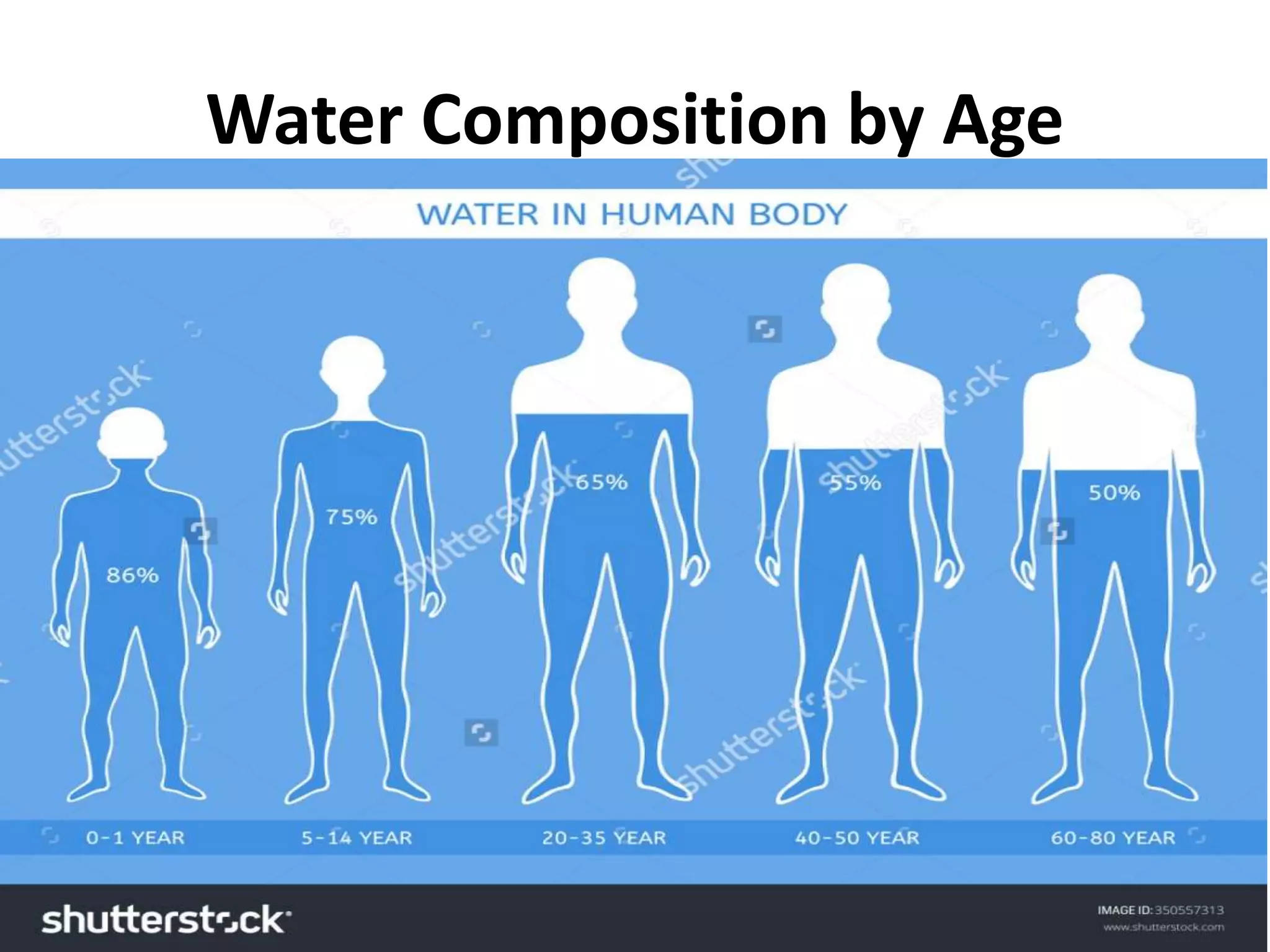
Water Composition by Age
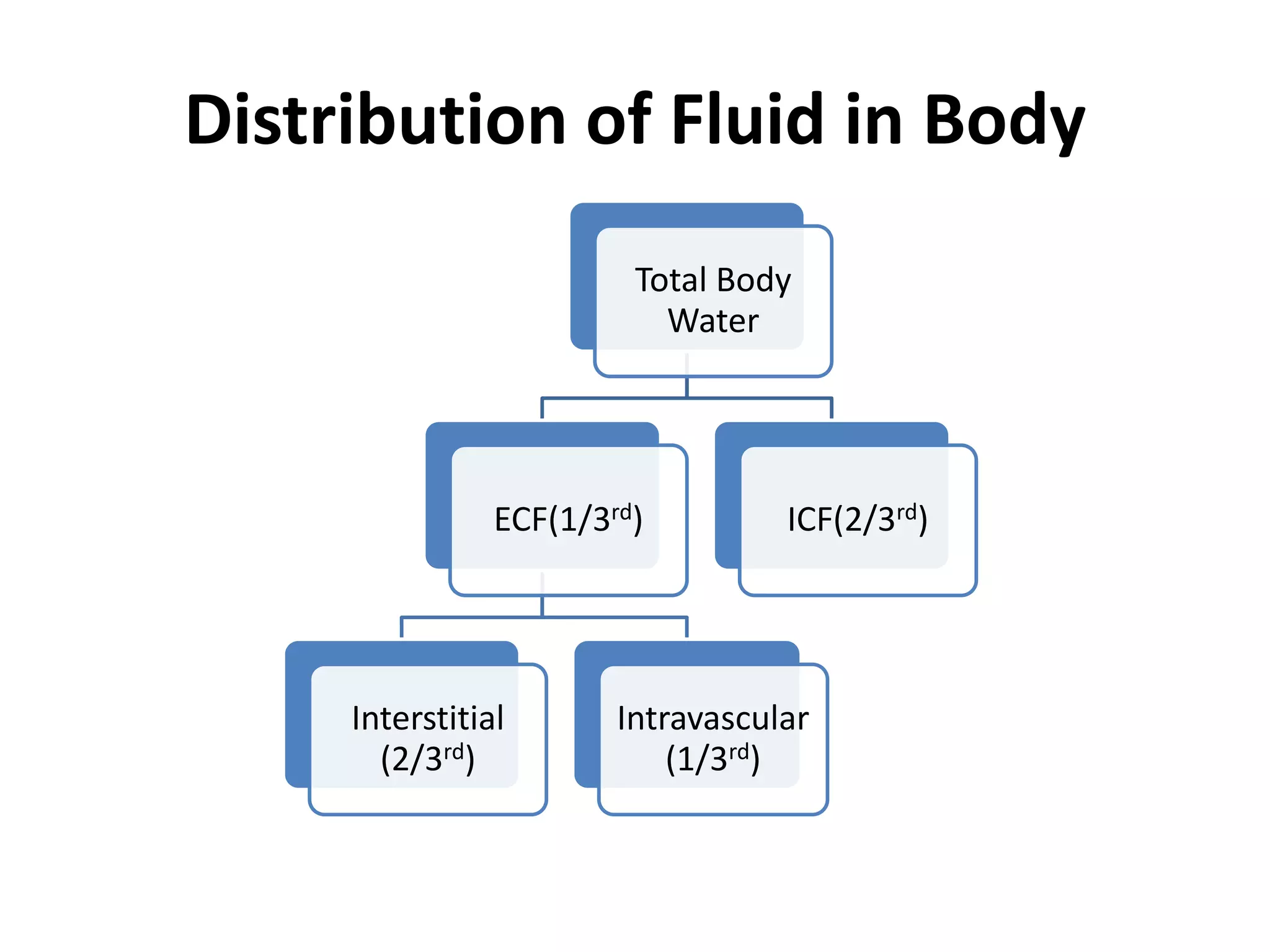
Distribution of Fluid in Body
Total Body
Water
ECF(1/3rd)
Interstitial
(2/3rd)
Intravascular
(1/3rd)
ICF(2/3rd)
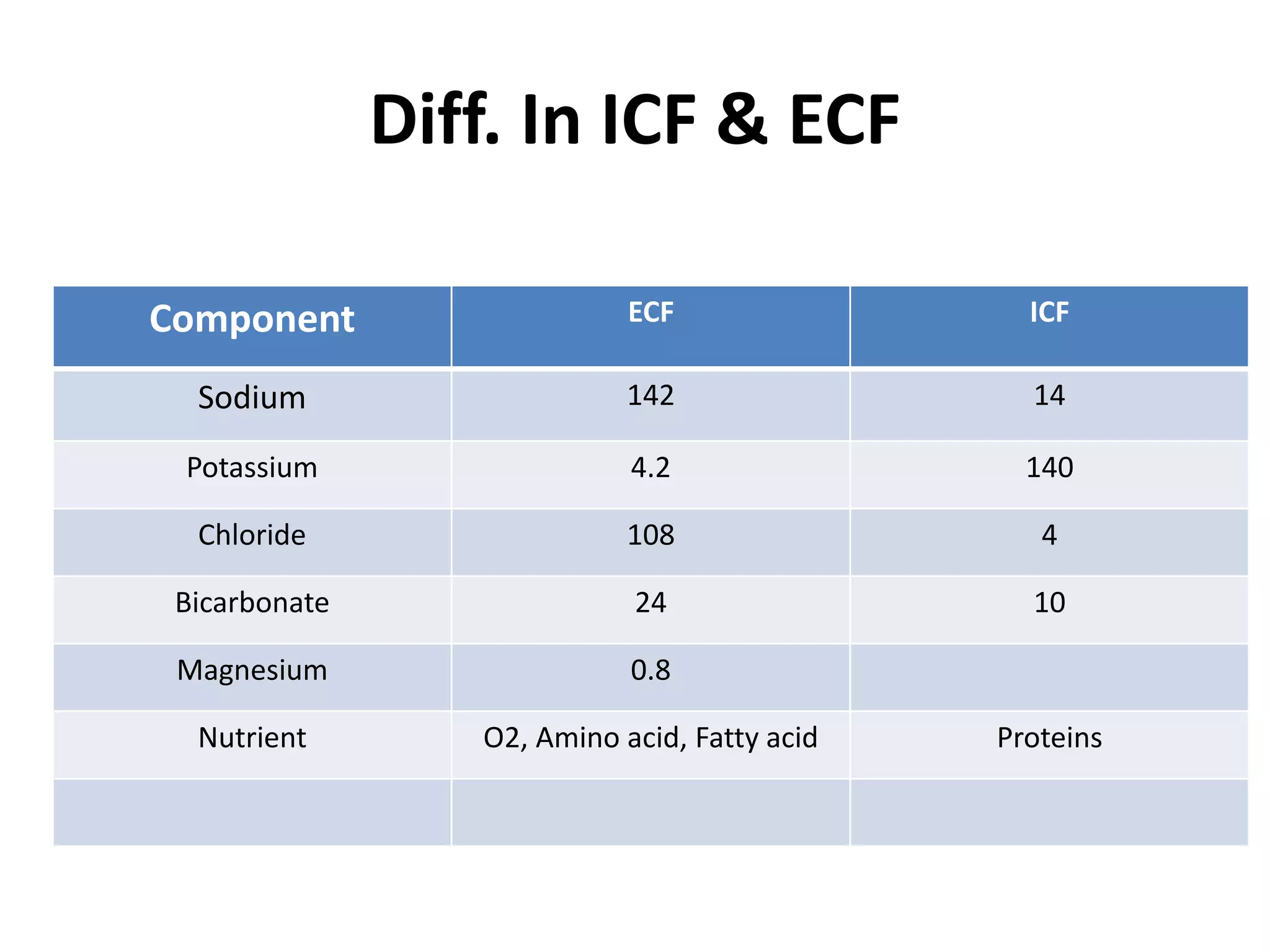
Diff. In ICF & ECF
Component ECF ICF
Sodium 142 14
Potassium 4.2 140
Chloride 108 4
Bicarbonate 24 10
Magnesium 0.8
Nutrient O2, Amino acid, Fatty acid Proteins
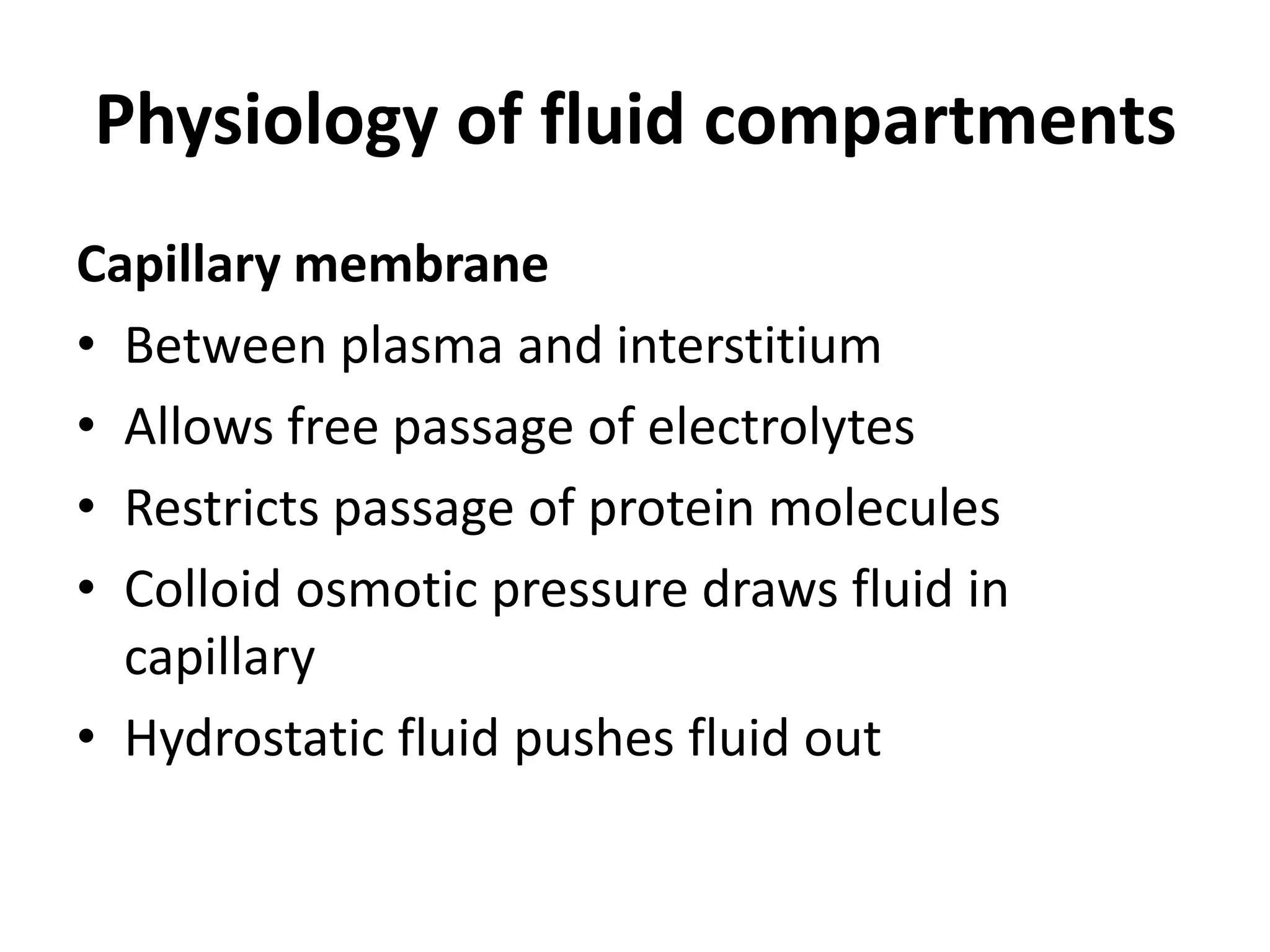
Physiology of fluid compartments
Capillary membrane
• Between plasma and interstitium
• Allows free passage of electrolytes
• Restricts passage of protein molecules
• Colloid osmotic pressure draws fluid in
capillary
• Hydrostatic fluid pushes fluid out
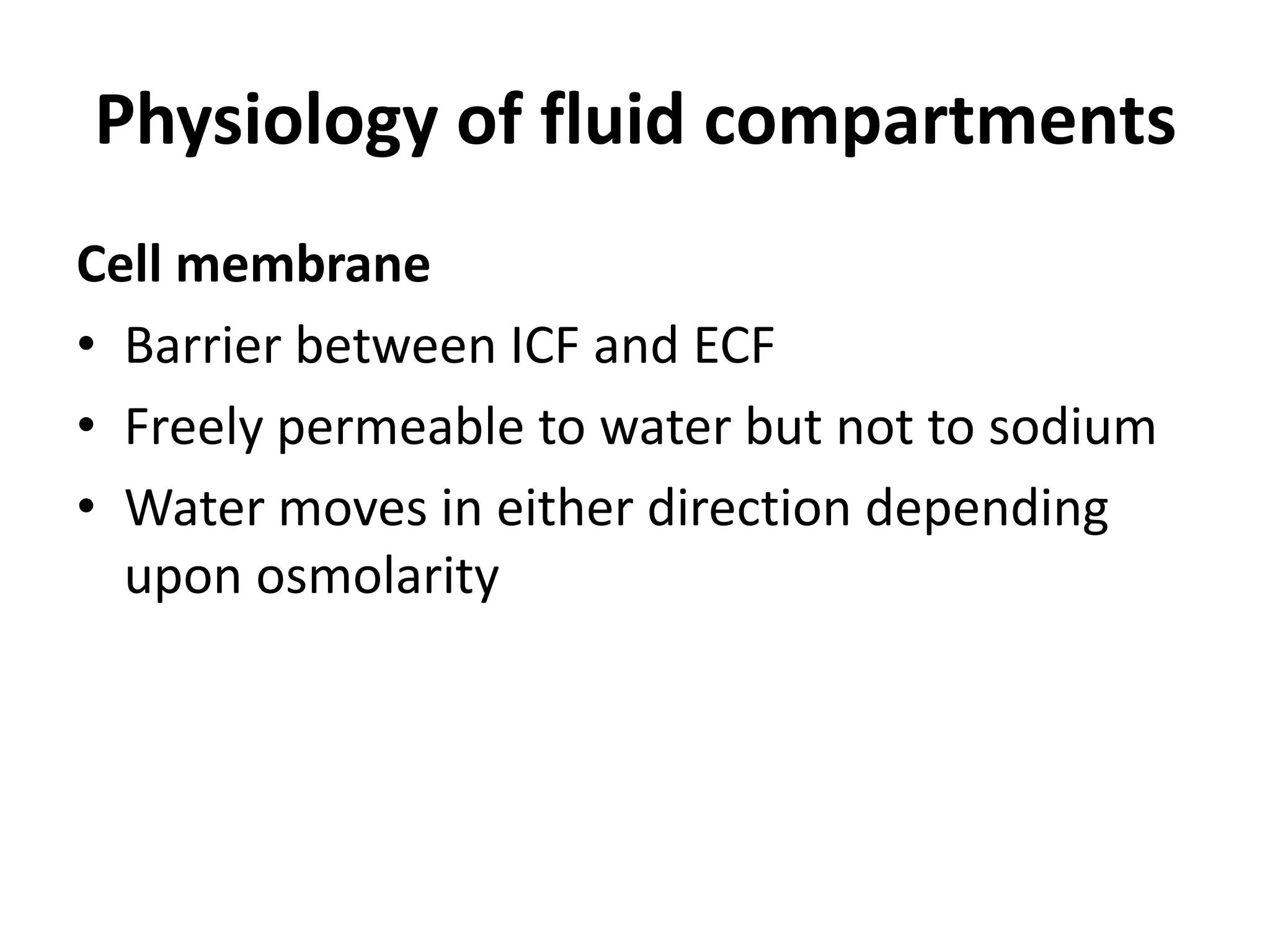
Physiology of fluid compartments
Cell membrane
• Barrier between ICF and ECF
• Freely permeable to water but not to sodium
• Water moves in either direction depending
upon osmolarity
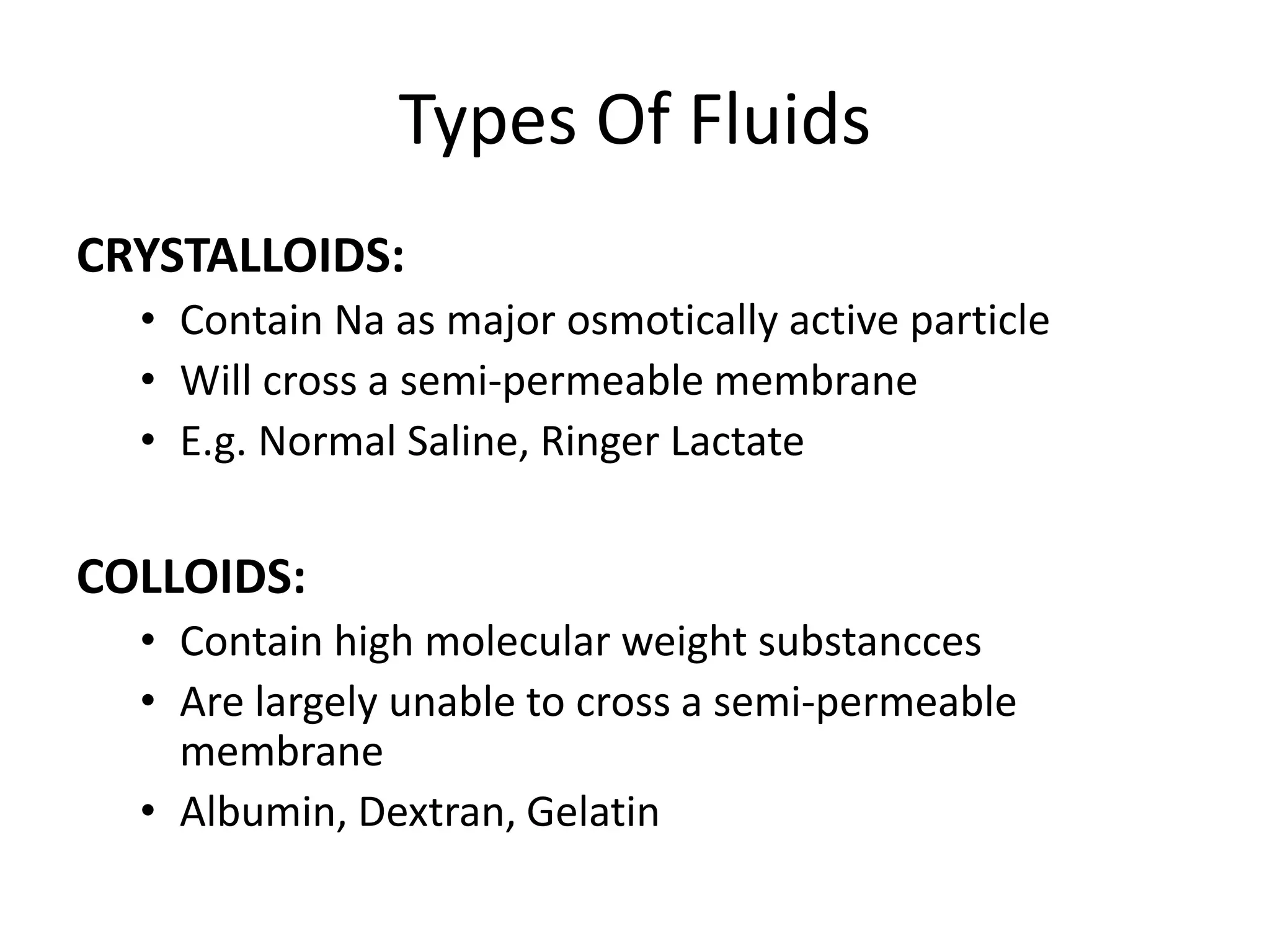
Types Of Fluids
CRYSTALLOIDS:
• Contain Na as major osmotically active particle
• Will cross a semi-permeable membrane
• E.g. Normal Saline, Ringer Lactate
COLLOIDS:
• Contain high molecular weight substancces
• Are largely unable to cross a semi-permeable
membrane
• Albumin, Dextran, Gelatin
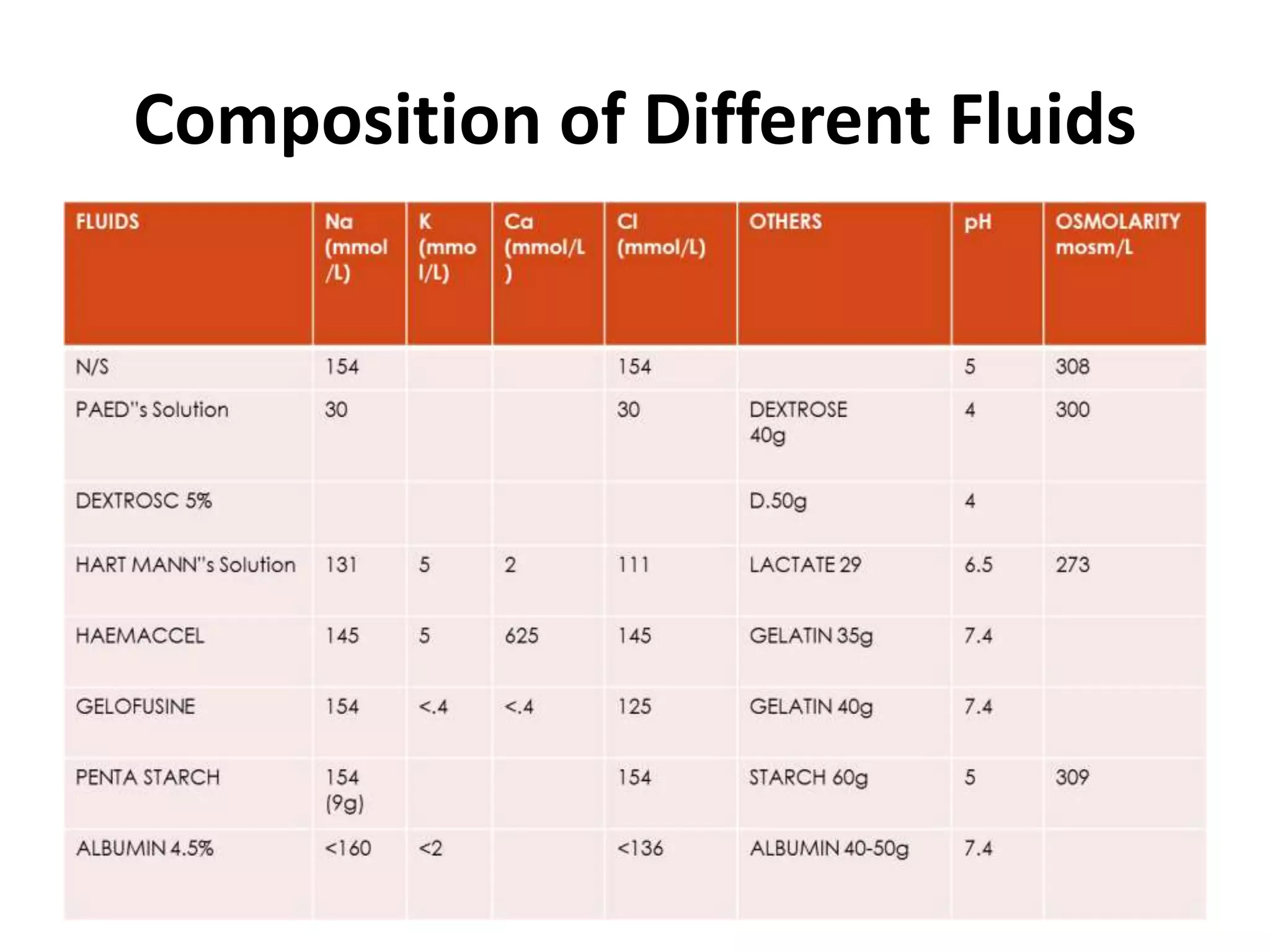
Composition of Different Fluids
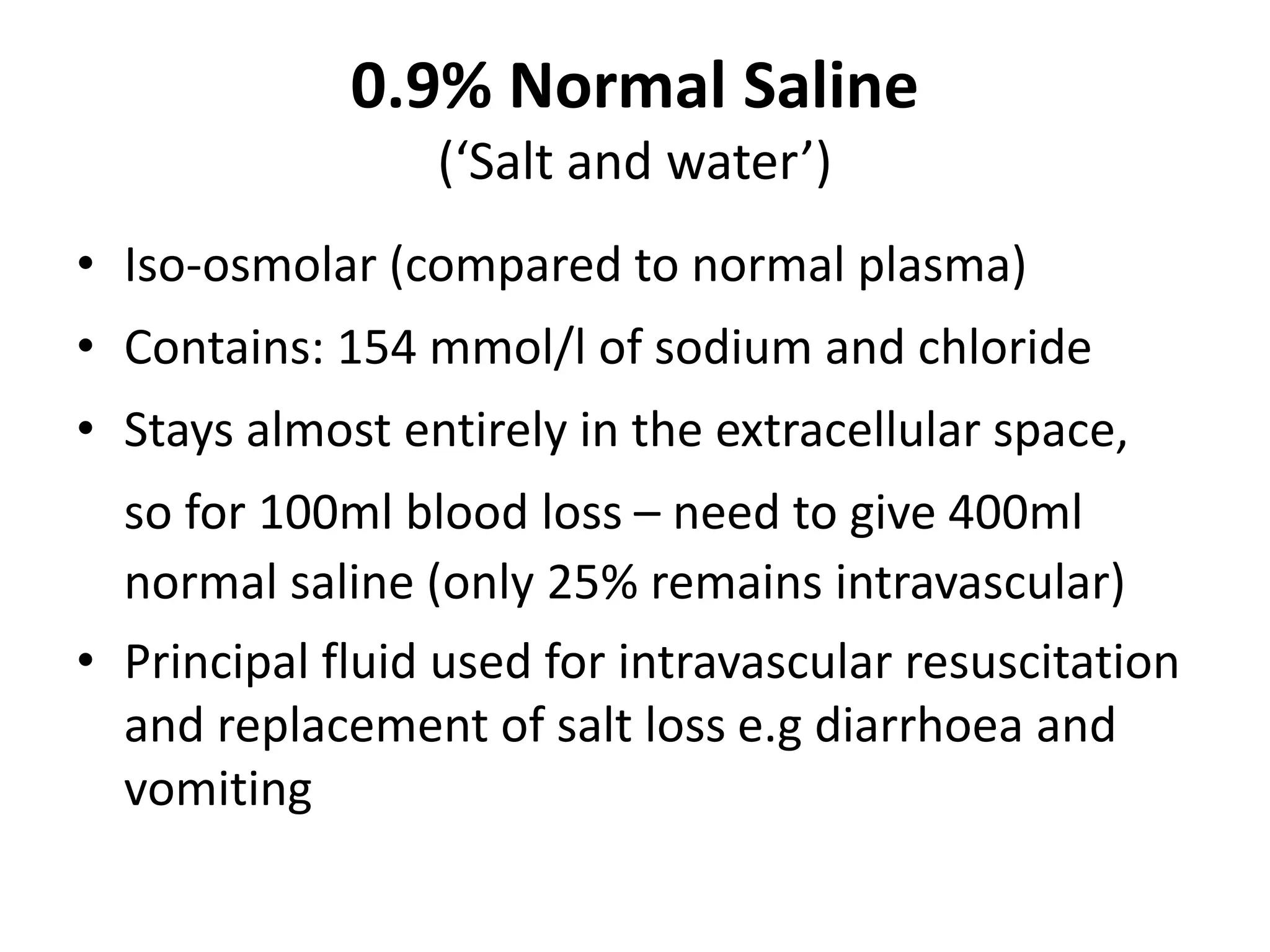
0.9% Normal Saline
(‘Salt and water’)
• Iso-osmolar (compared to normal plasma)
• Contains: 154 mmol/l of sodium and chloride
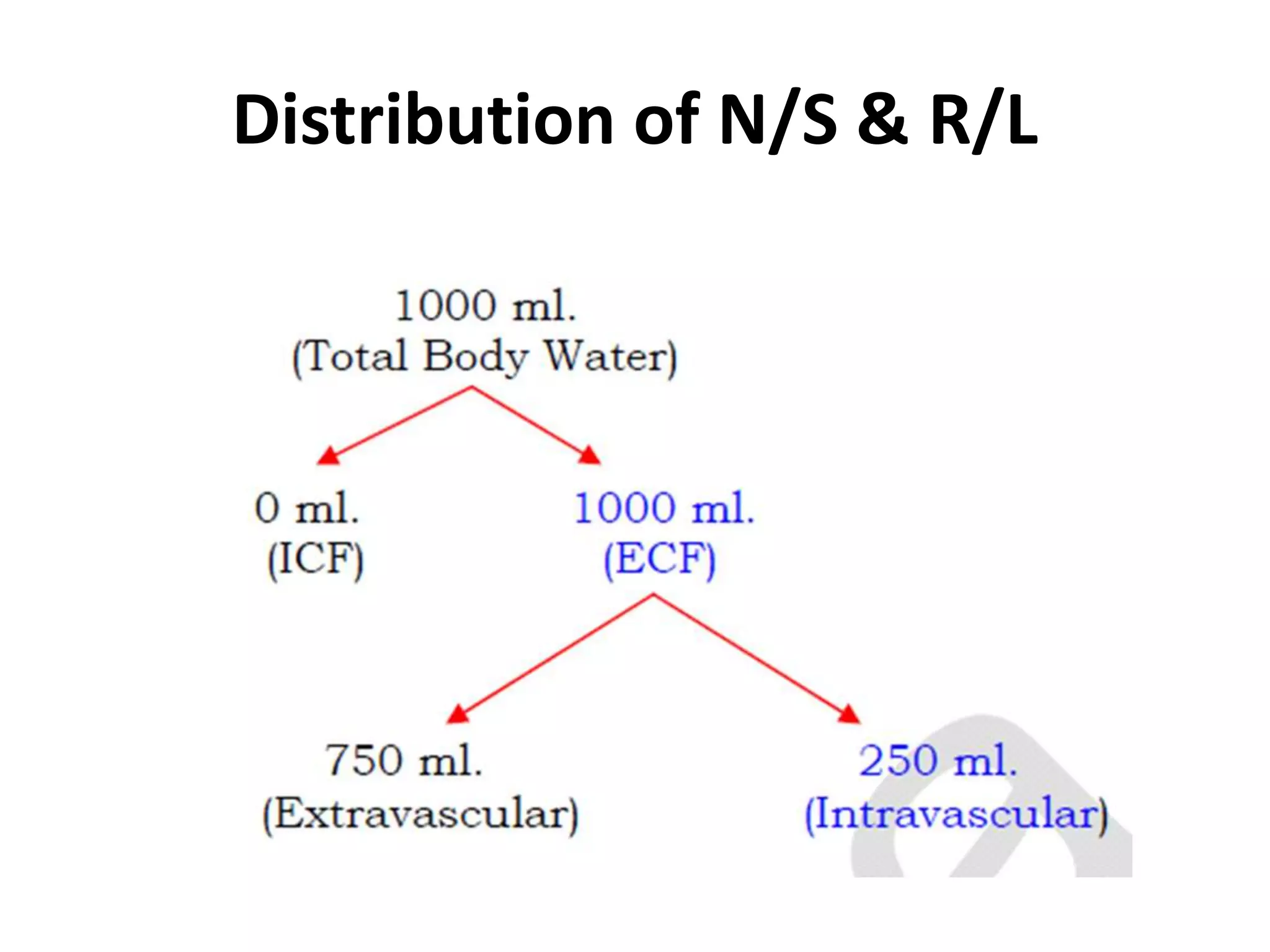
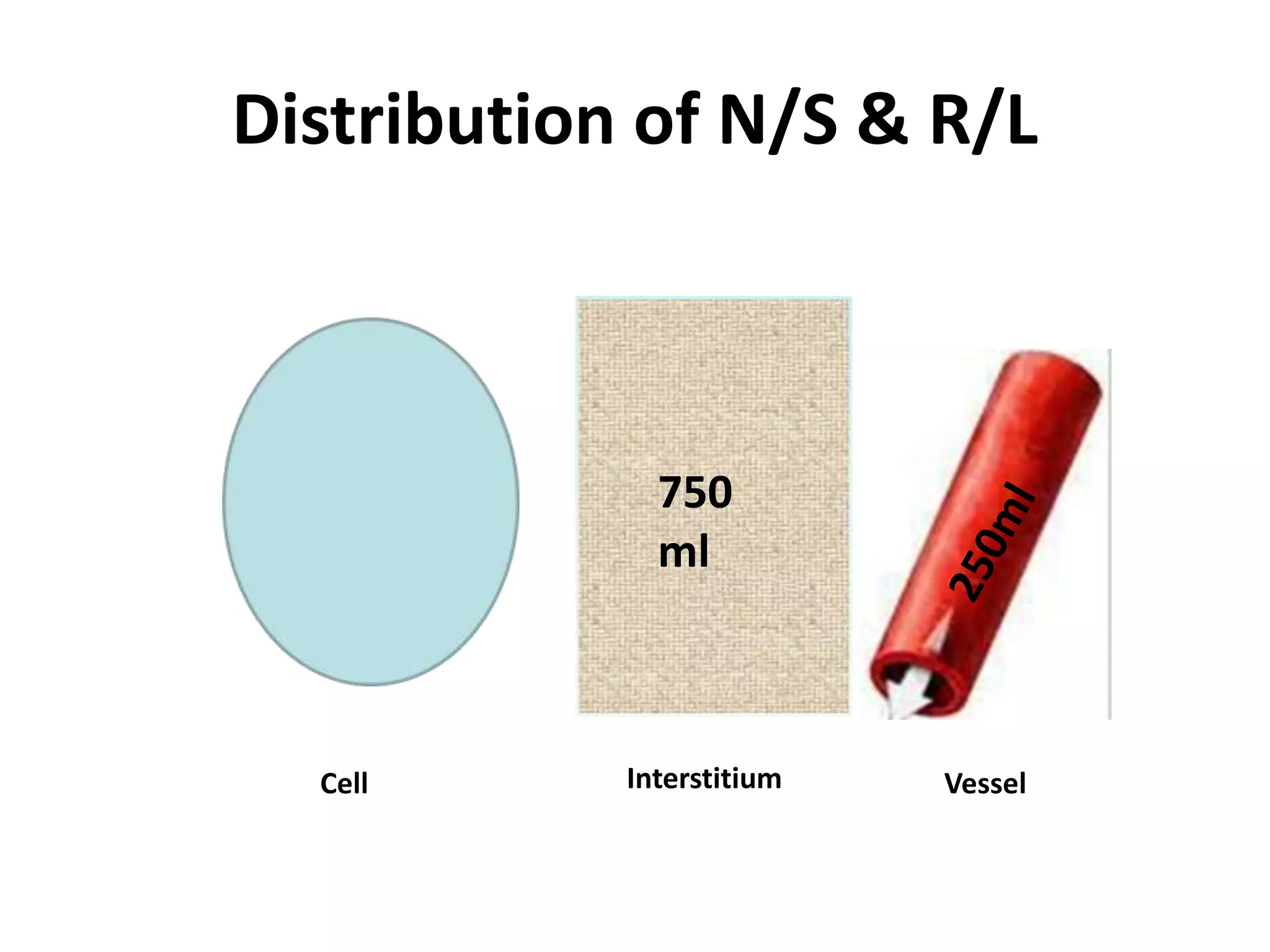
• Stays almost entirely in the extracellular space,
so for 100ml blood loss – need to give 400ml
normal saline (only 25% remains intravascular)
• Principal fluid used for intravascular resuscitation
and replacement of salt loss e.g diarrhoea and
vomiting
Distribution of N/S & R/L
Cell Interstitium Vessel
750
ml
5% Dextrose (D5W)
“Sugar and Water”
• Commonly used ‘maintenance’ fluid in conjuction with
normal saline
• Provides some calories (approximately 10% of daily
requirements)
• Regarded as ‘electrolyte free’
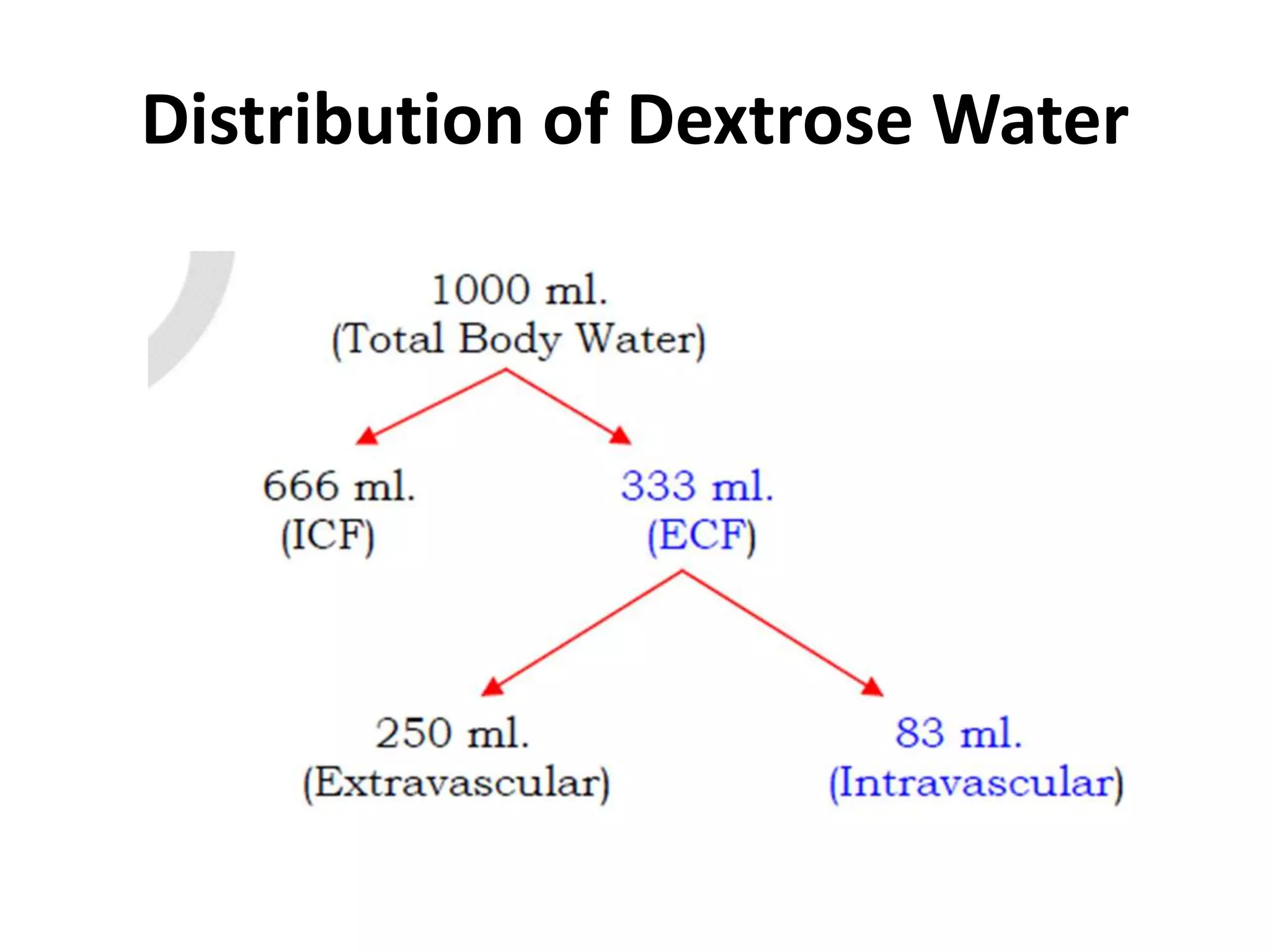
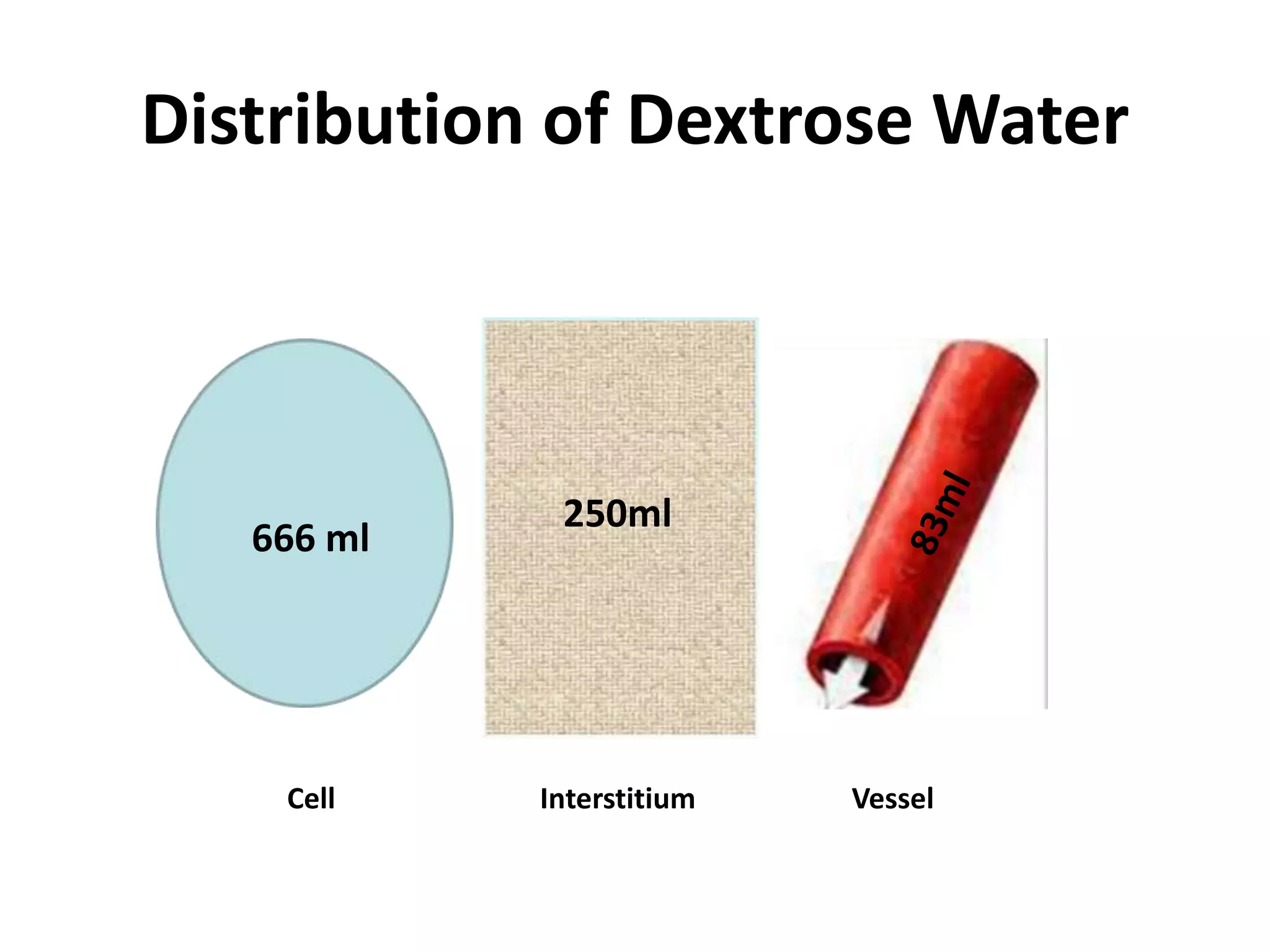
• Distribution: <10% Intravascular; > 66% intracellular
• When infused is rapidly redistributed into the intracellular
space; Less than 10% stays in the intravascular space
therefore it is of limited use in fluid resuscitation.
• For every 100ml blood loss – need 1000ml dextrose
replacement [10% retained in intravascular space
Distribution of Dextrose Water
666 ml
250ml
InterstitiumCell Vessel
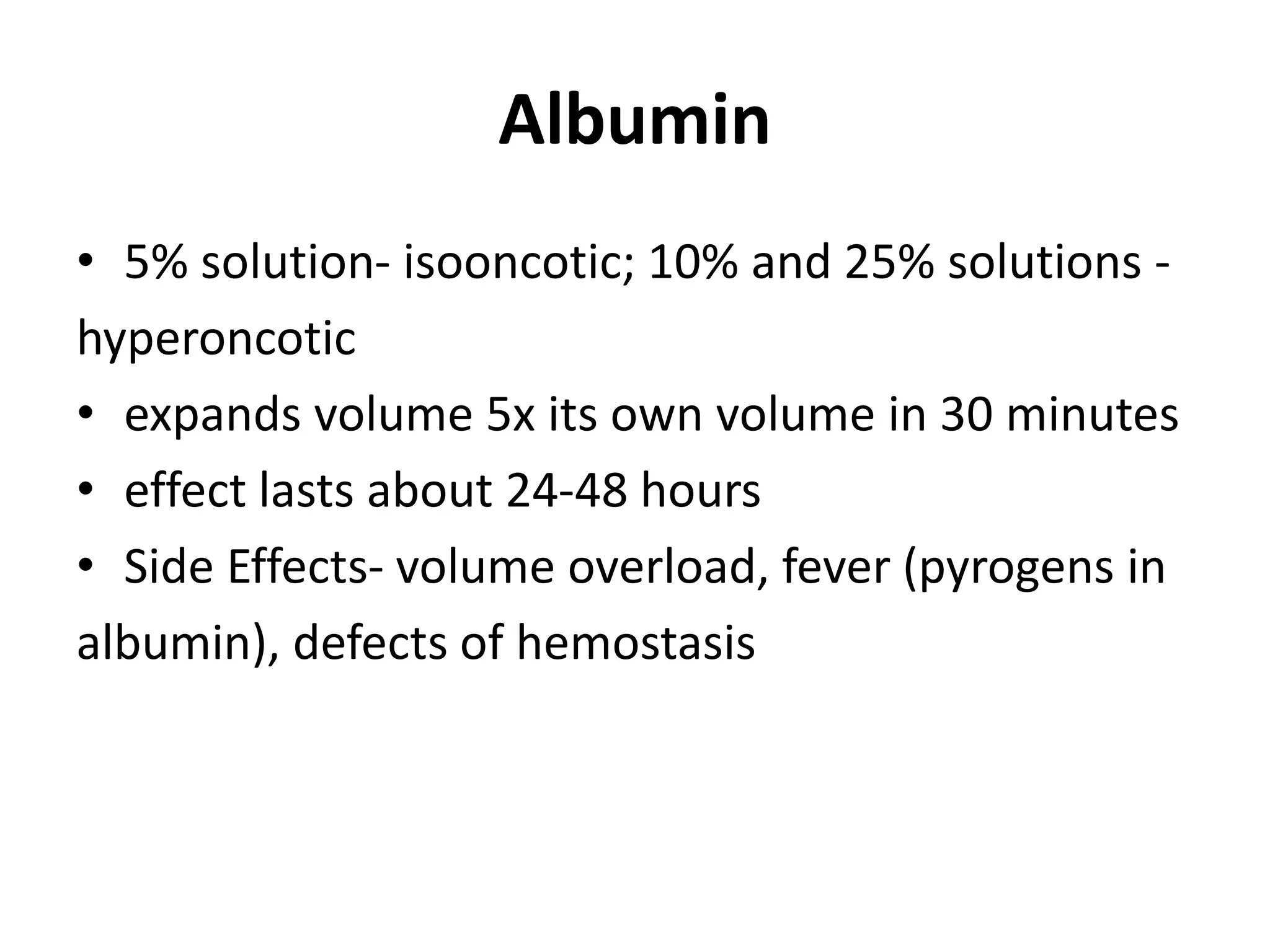
Albumin
• natural protein
• t1/2 = 20 days in the body but t1/2 = 1.6 hours in
plasma
• 10% leaves the vascular space within 2 hours,
95% within 2 days
• causes 80-90% of our natural oncotic pressure
• stays within the intravascular space unless the
capillary permeability is abnormal
Albumin
• 5% solution- isooncotic; 10% and 25% solutions -
hyperoncotic
• expands volume 5x its own volume in 30 minutes
• effect lasts about 24-48 hours
• Side Effects- volume overload, fever (pyrogens in
albumin), defects of hemostasis
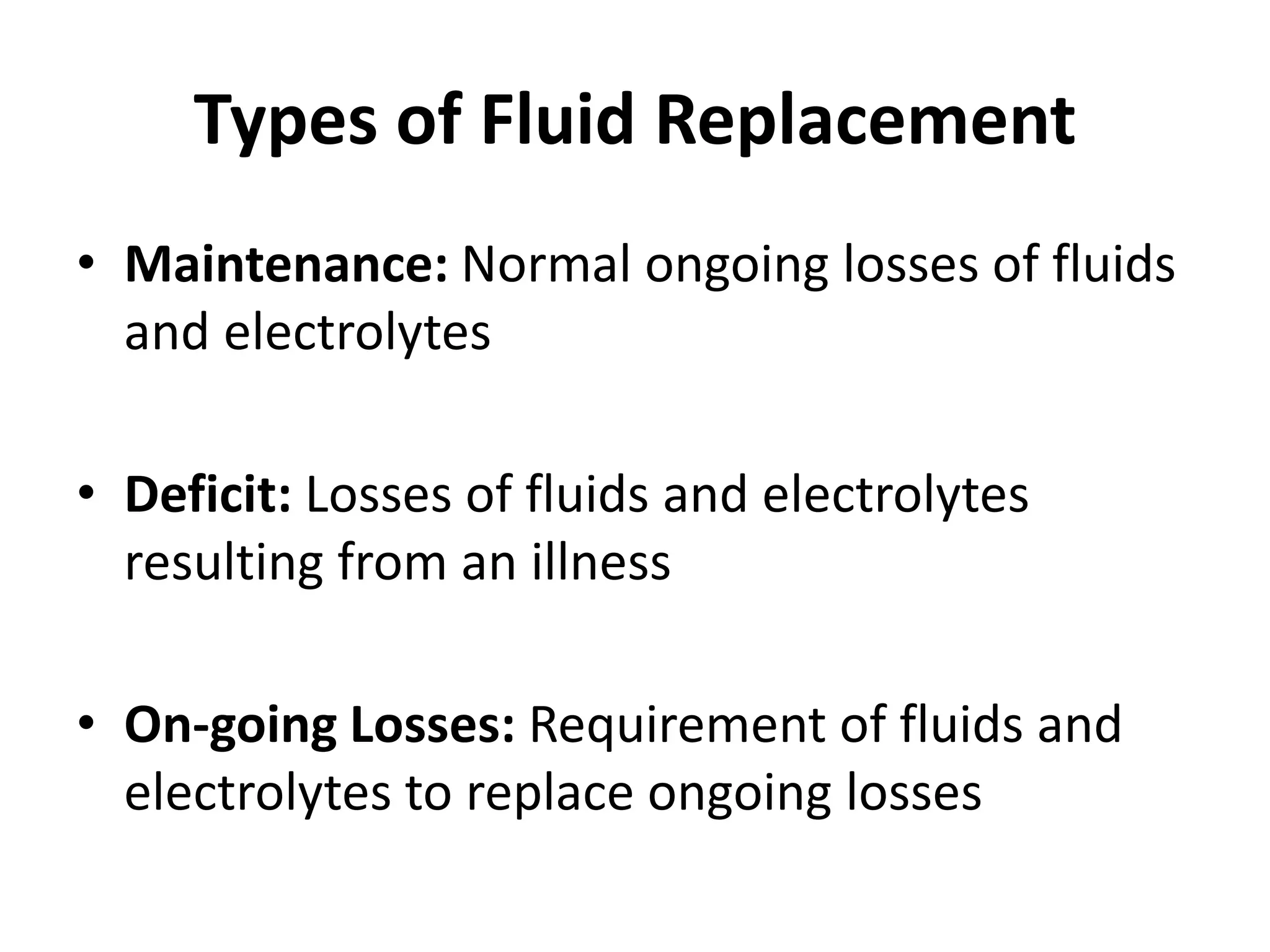
Types of Fluid Replacement
• Maintenance: Normal ongoing losses of fluids
and electrolytes
• Deficit: Losses of fluids and electrolytes
resulting from an illness
• On-going Losses: Requirement of fluids and
electrolytes to replace ongoing losses
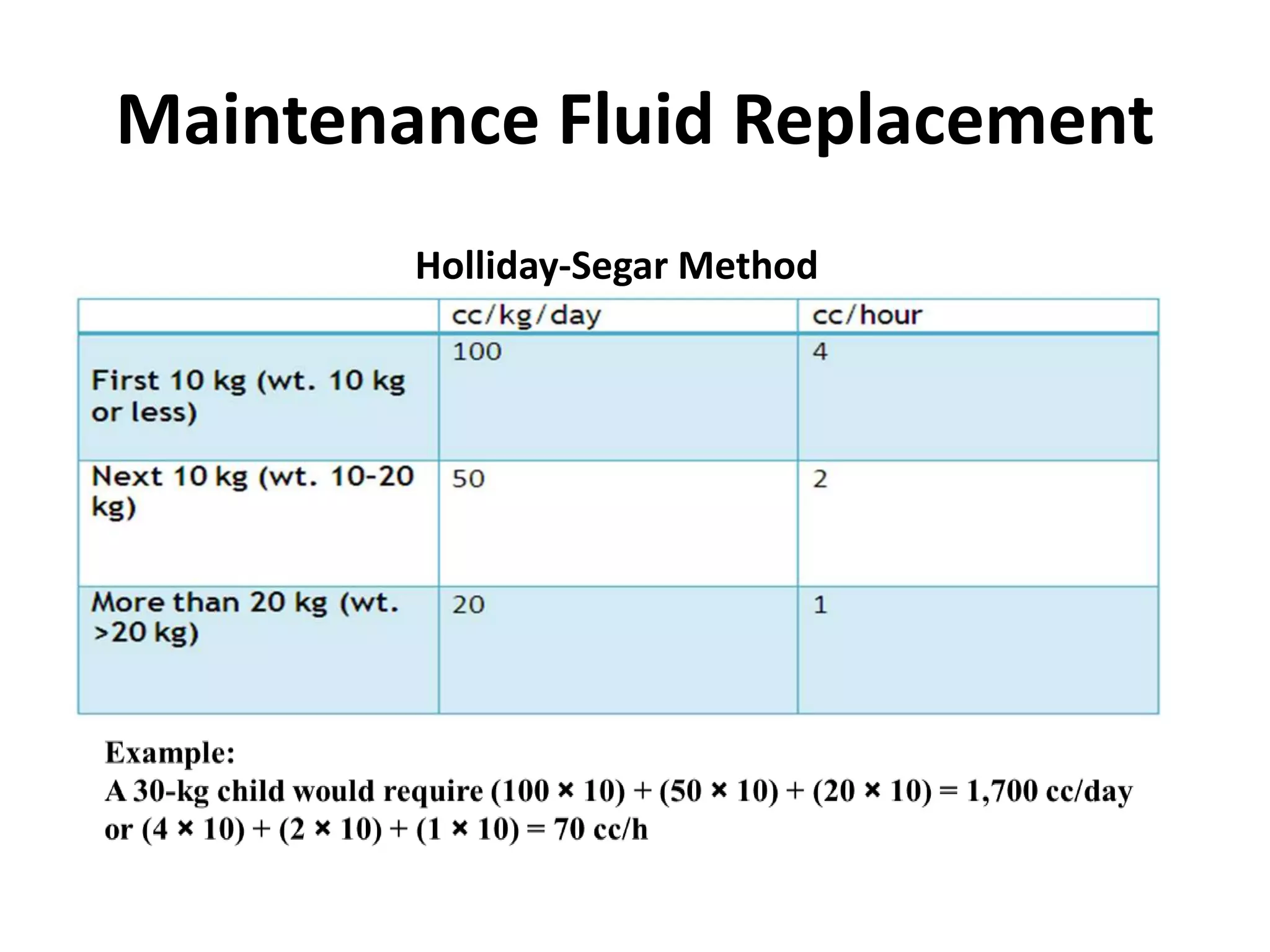
Maintenance Fluid Replacement
Holliday-Segar Method
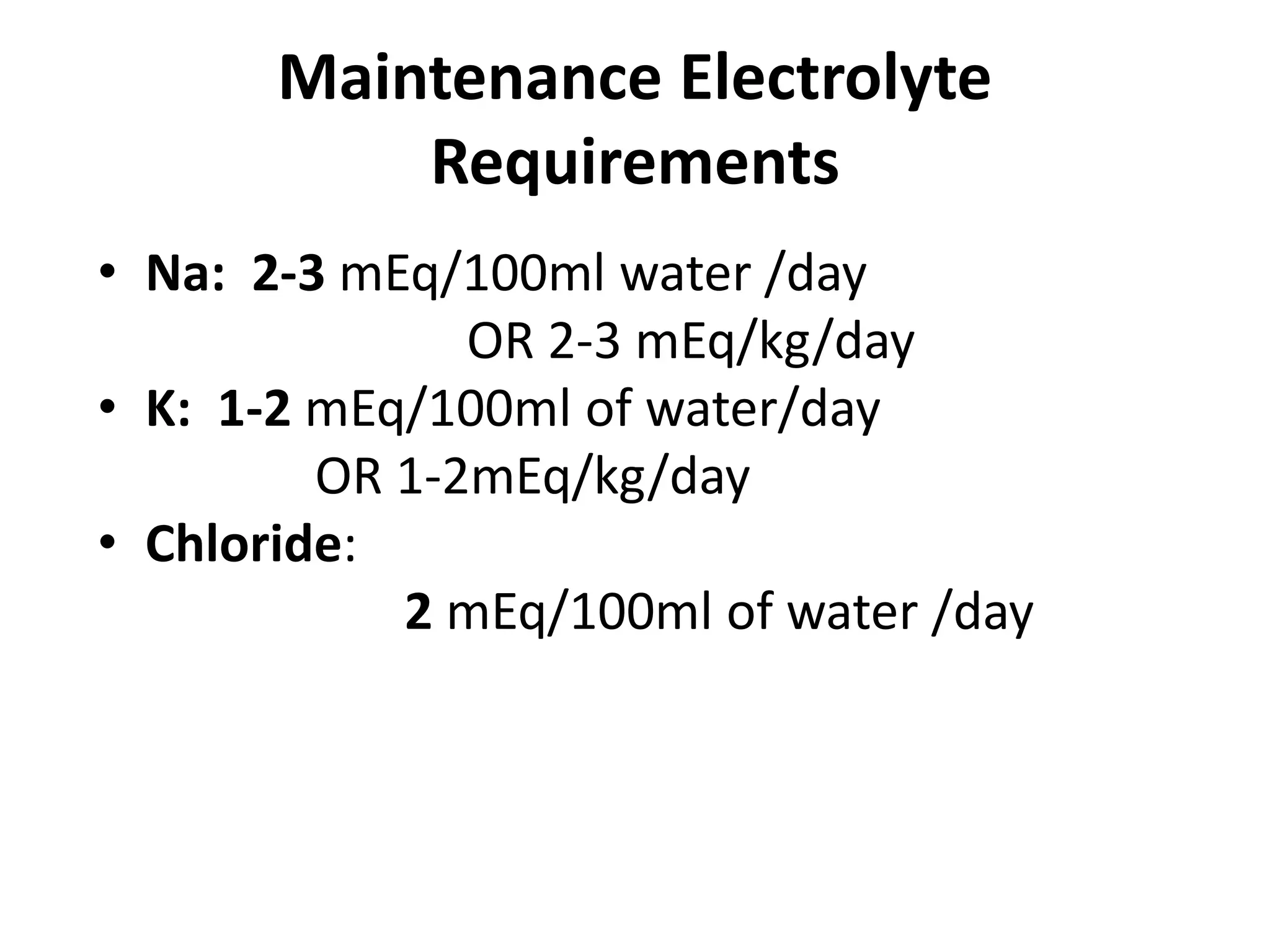
Maintenance Electrolyte
Requirements
• Na: 2-3 mEq/100ml water /day
OR 2-3 mEq/kg/day
• K: 1-2 mEq/100ml of water/day
OR 1-2mEq/kg/day
• Chloride:
2 mEq/100ml of water /day
Factors Increasing Maintenance Fluid
Requirements
• Fever-each 1 degree Celcius over 38 degrees
increases maintenance fluid requirements by
12%
• Hyperventilation
• Increased temperature of the environment
• Burns
• Ongoing losses-diarrhea, vomiting, NG tube
output
Factors Decreasing Maintenance Fluid
Requirements
• Skin: Mist tent, incubator (premature infants)
• Lungs: Humidified ventilator
• Mist tent
• Renal: Oliguria, anuria
• Misc: Hypothyroidism
Deficit Calculation
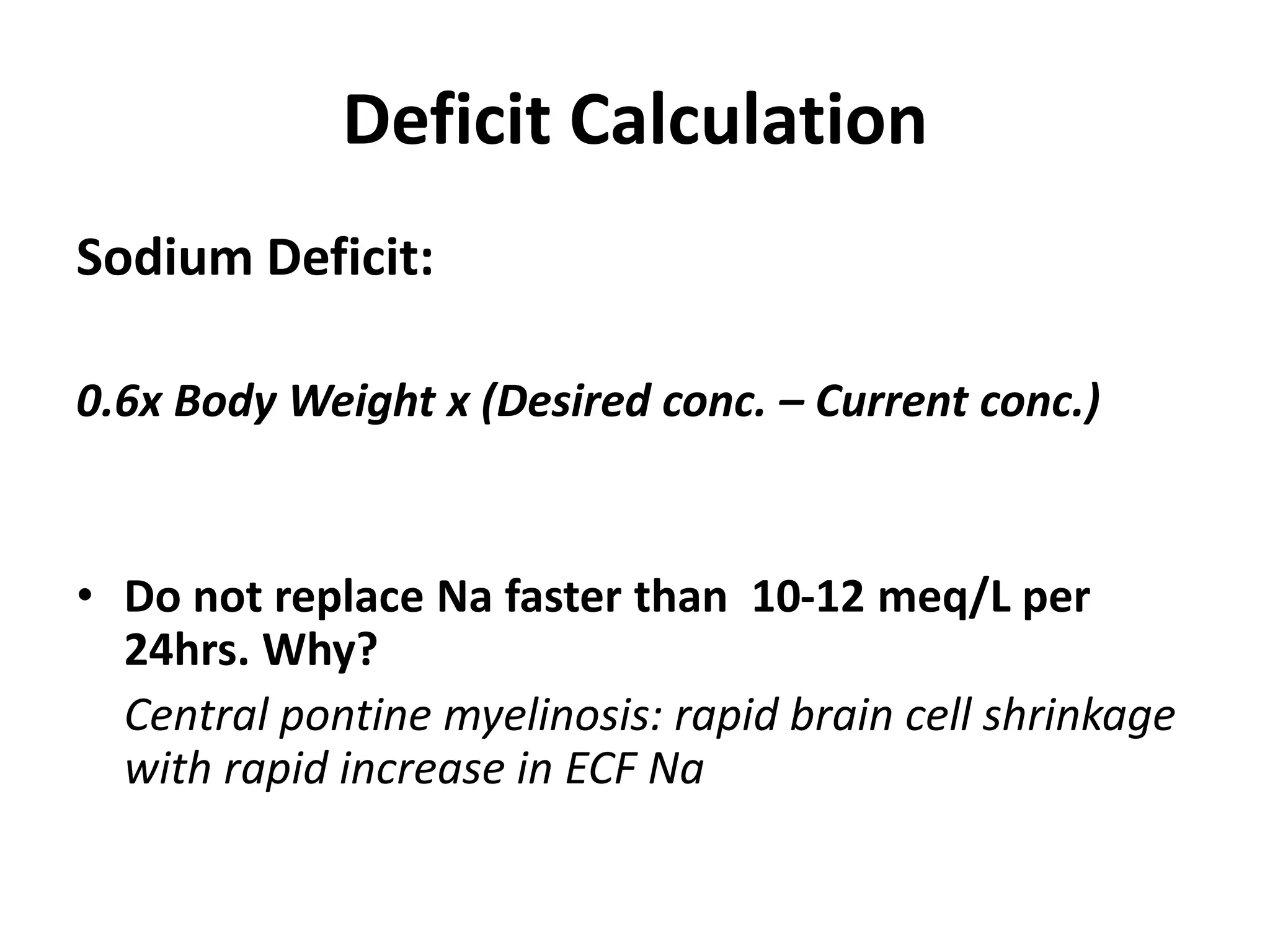
Sodium Deficit:
0.6x Body Weight x (Desired conc. – Current conc.)
• Do not replace Na faster than 10-12 meq/L per
24hrs. Why?
Central pontine myelinosis: rapid brain cell shrinkage
with rapid increase in ECF Na
Deficit Calculation
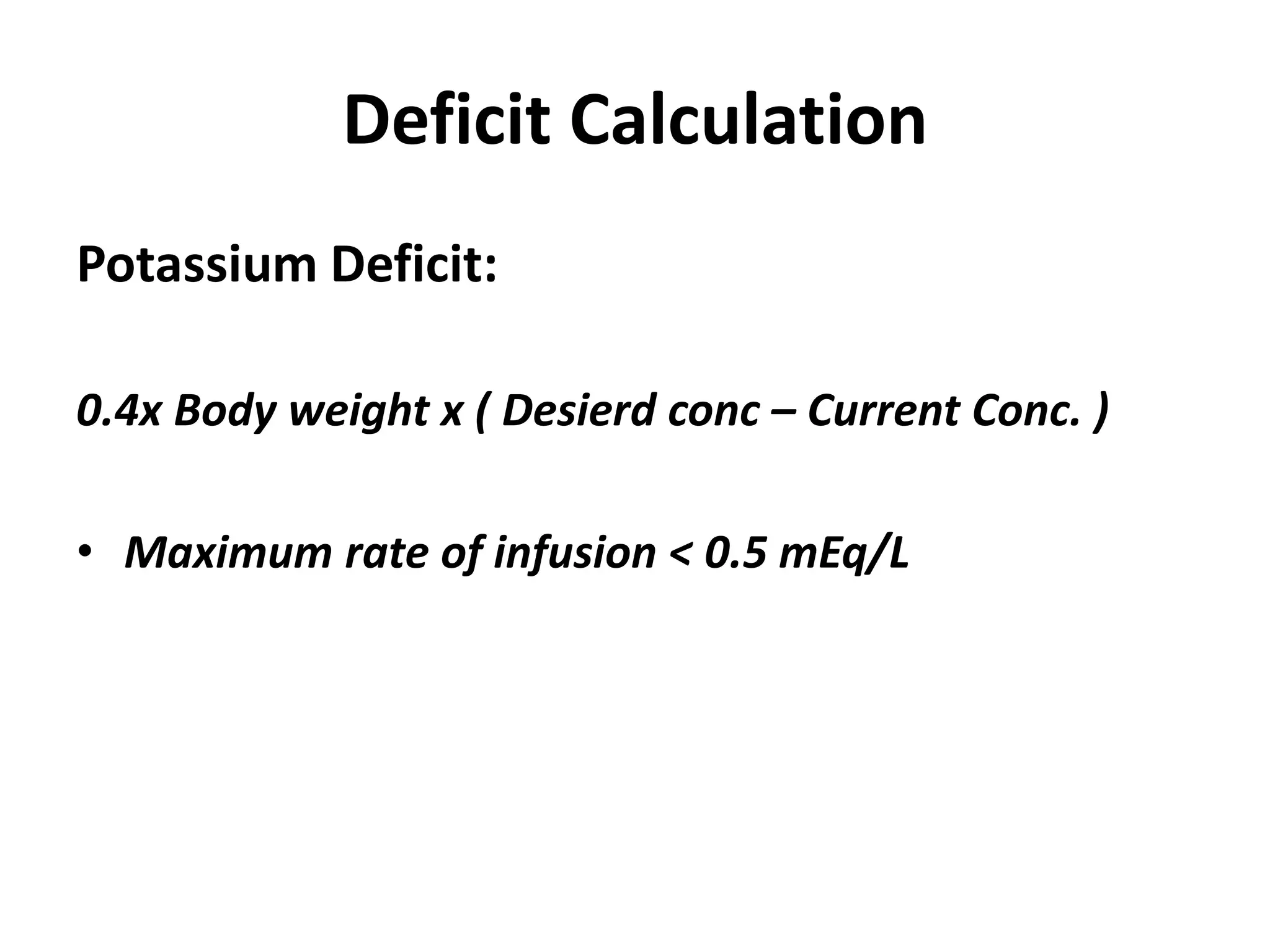
Potassium Deficit:
0.4x Body weight x ( Desierd conc – Current Conc. )
• Maximum rate of infusion < 0.5 mEq/L
Deficit Calculation
Bicarbonate Deficit :
mEq =Base deficit x 0.3 x weight in Kg
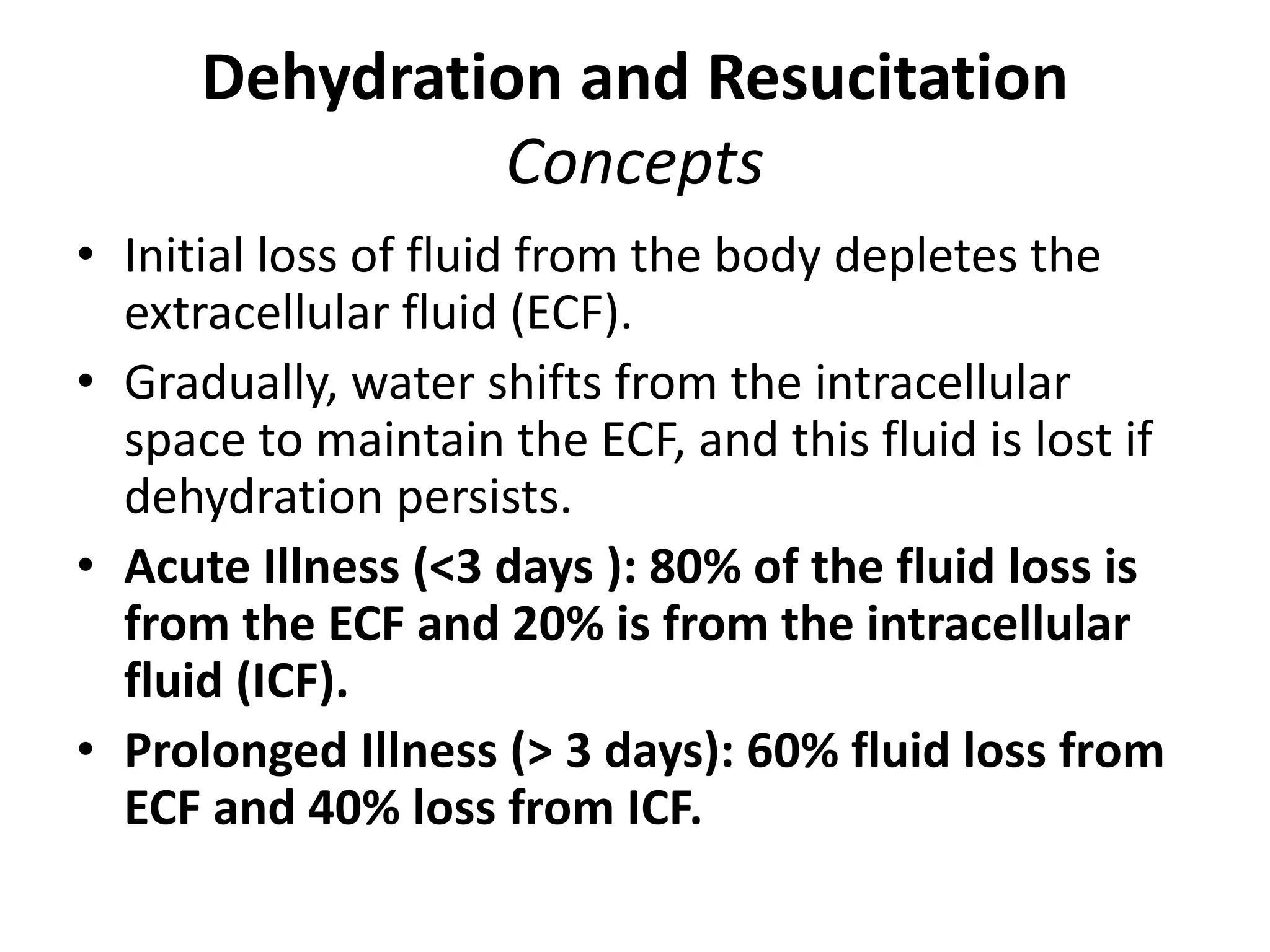
Dehydration and Resucitation
Concepts
• Initial loss of fluid from the body depletes the
extracellular fluid (ECF).
• Gradually, water shifts from the intracellular
space to maintain the ECF, and this fluid is lost if
dehydration persists.
• Acute Illness (<3 days ): 80% of the fluid loss is
from the ECF and 20% is from the intracellular
fluid (ICF).
• Prolonged Illness (> 3 days): 60% fluid loss from
ECF and 40% loss from ICF.
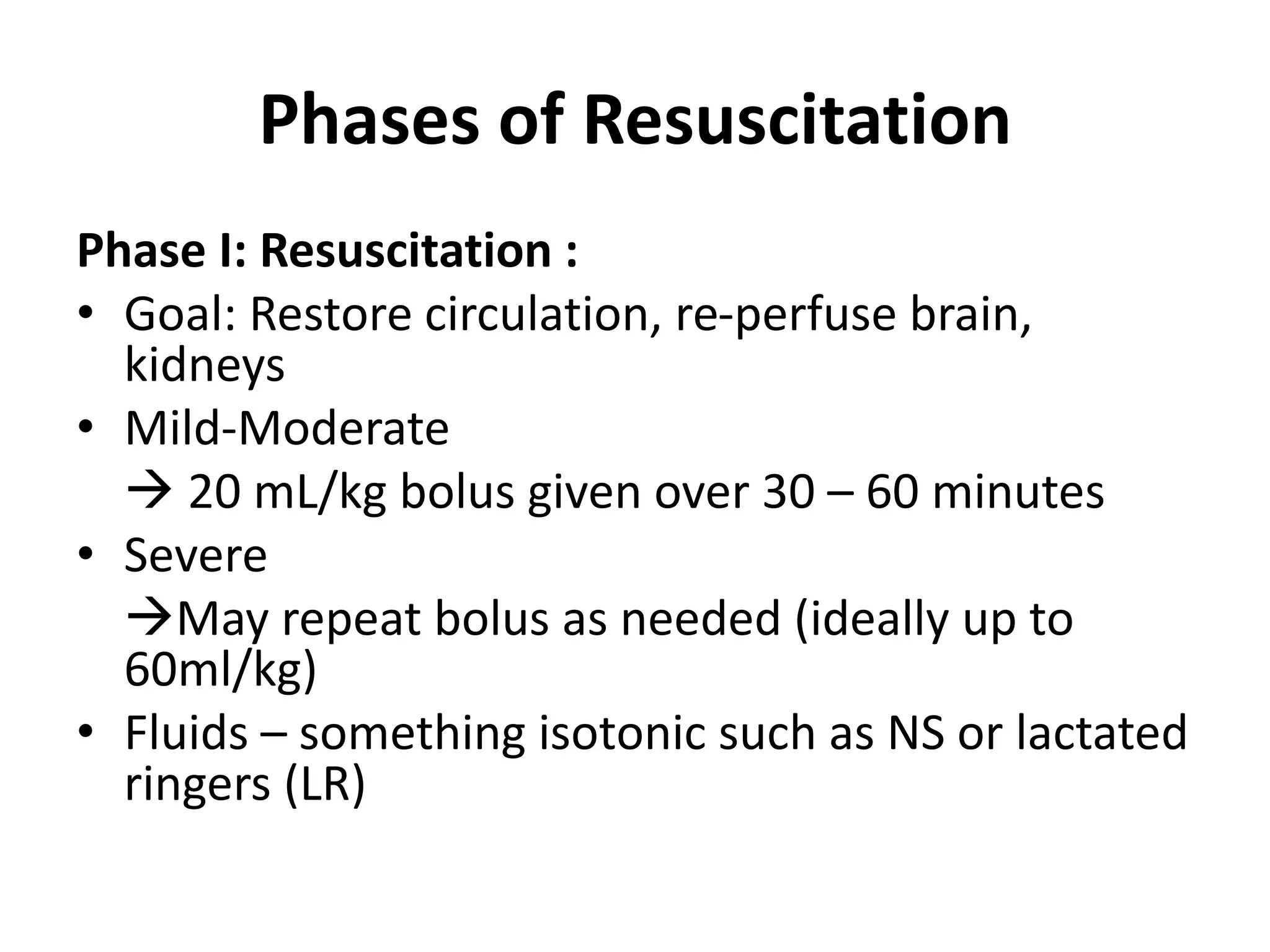
Phases of Resuscitation
Phase I: Resuscitation :
• Goal: Restore circulation, re-perfuse brain,
kidneys
• Mild-Moderate
 20 mL/kg bolus given over 30 – 60 minutes
• Severe
May repeat bolus as needed (ideally up to
60ml/kg)
• Fluids – something isotonic such as NS or lactated
ringers (LR)
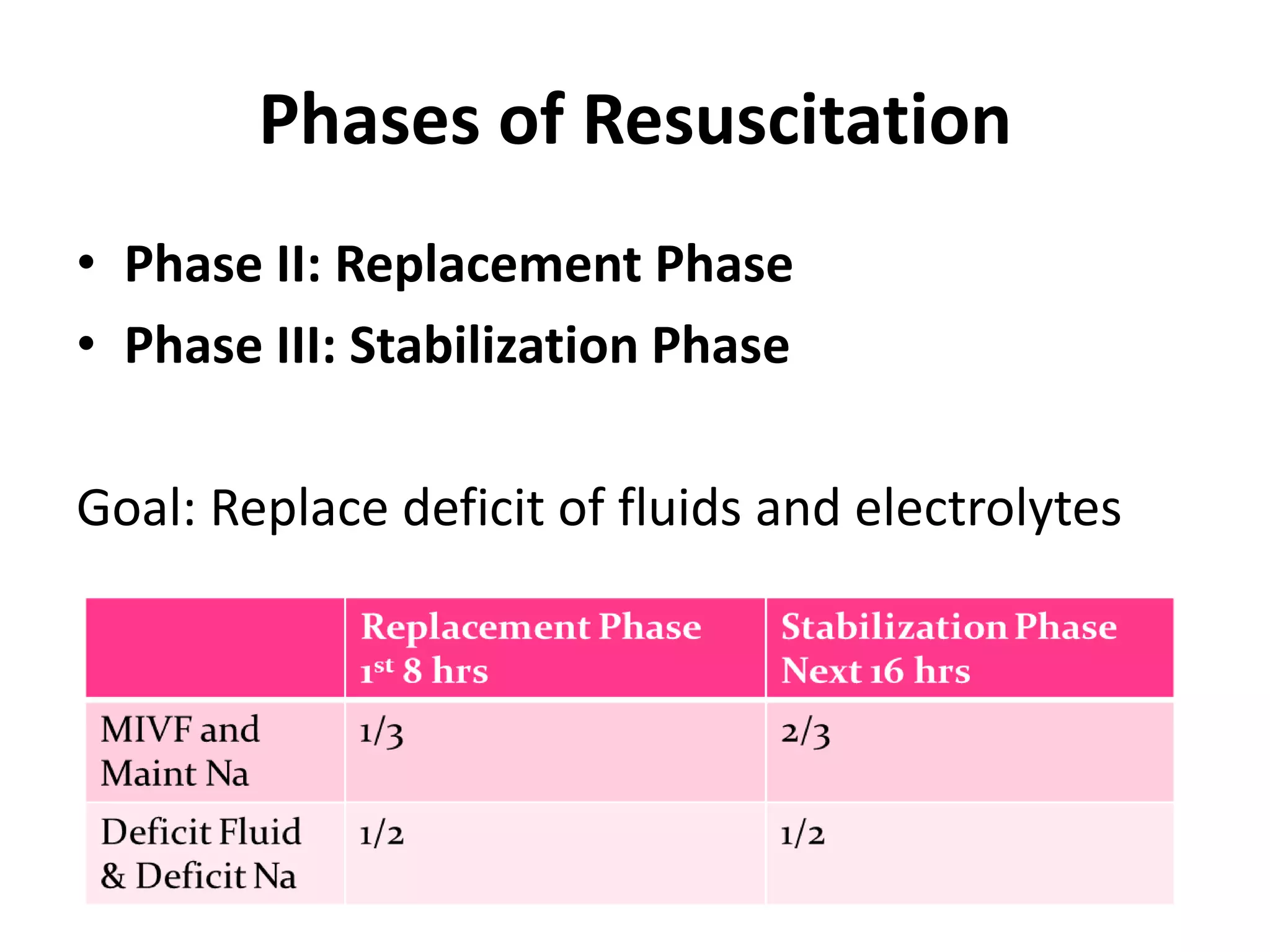
Phases of Resuscitation
• Phase II: Replacement Phase
• Phase III: Stabilization Phase
Goal: Replace deficit of fluids and electrolytes
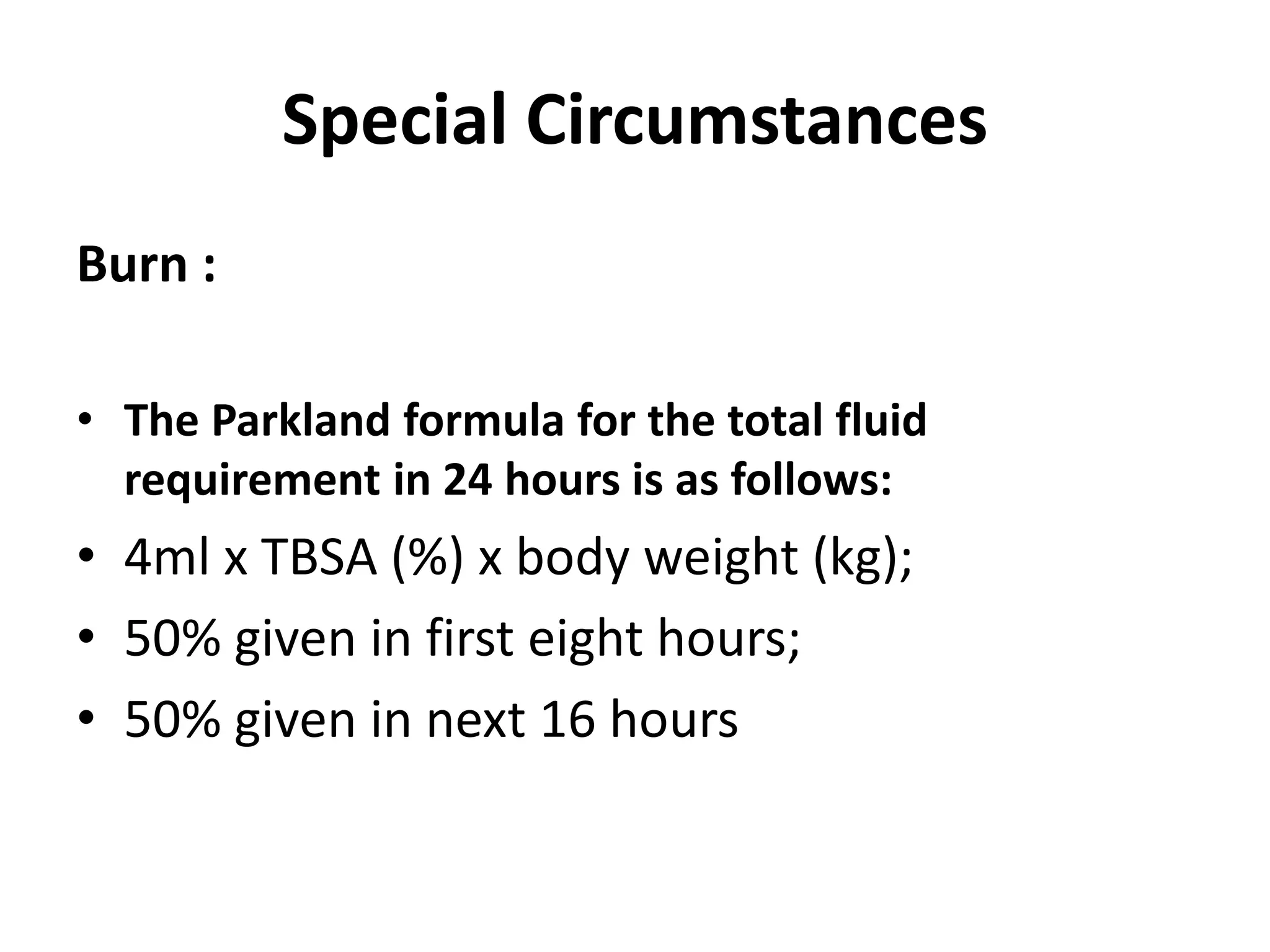
Special Circumstances
Burn :
• The Parkland formula for the total fluid
requirement in 24 hours is as follows:
• 4ml x TBSA (%) x body weight (kg);
• 50% given in first eight hours;
• 50% given in next 16 hours
Special Circumstances
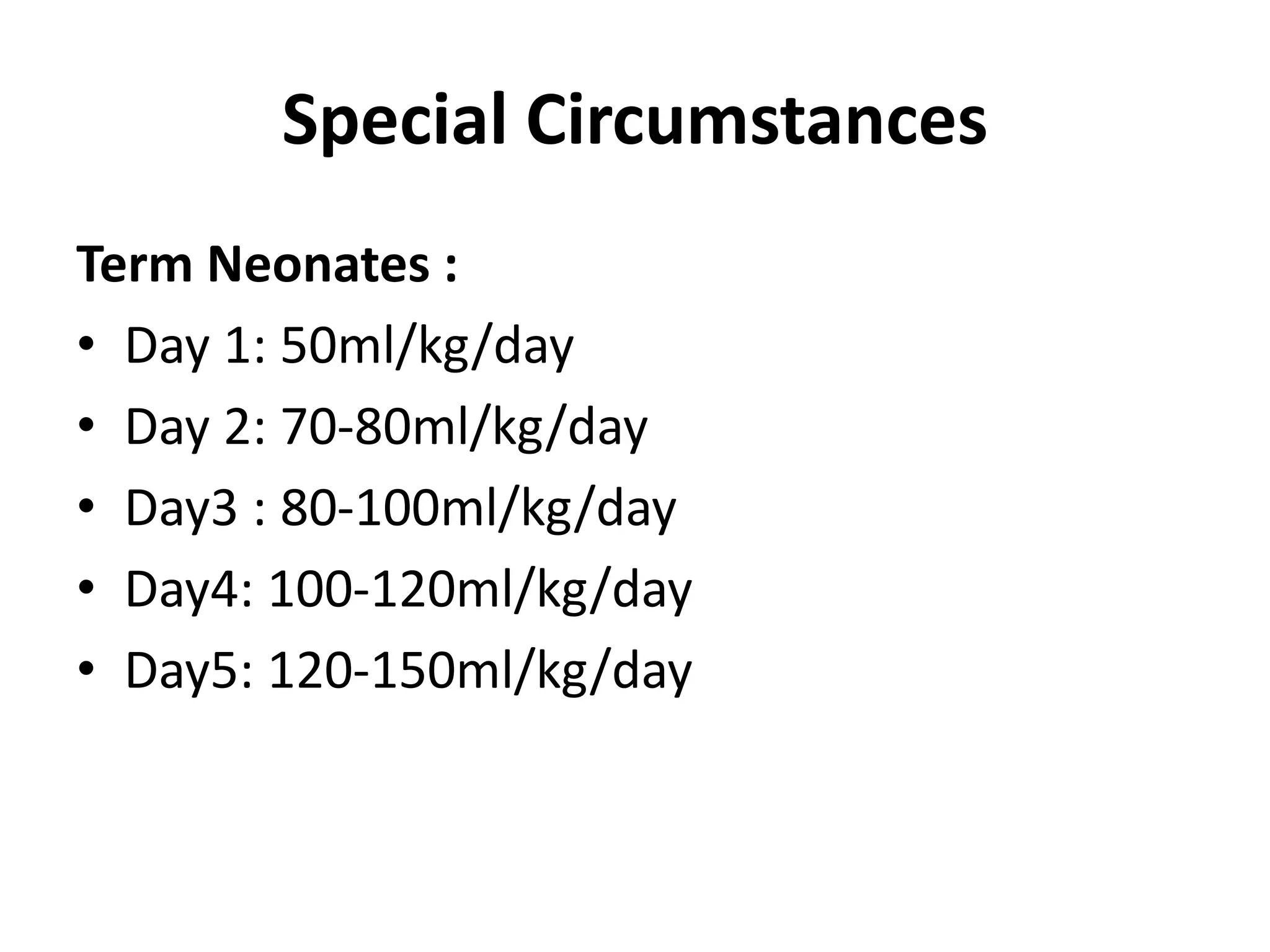
Term Neonates :
• Day 1: 50ml/kg/day
• Day 2: 70-80ml/kg/day
• Day3 : 80-100ml/kg/day
• Day4: 100-120ml/kg/day
• Day5: 120-150ml/kg/day
Important Guide Lines
• Measure serum electrolyte and blood glucose
when starting IV fluids and at least every 24
hours thereafter.
• If Term neonate need IV Fluid for routine
maintenance give isotonic crystalloid
containing sodium 131-154mmol/L with 5-
10% Glucose.
Intravenous fluids in pediatrics

Intravenous fluids in pediatrics

  • 1.
    Intravenous Fluids InPediatrics Dr. Adeel Ashiq House Surgeon PSW SHL
  • 2.
    Objectives • Physiology ofFluid Distribution • Different types of IV fluids • Distribution of IV Fluids in Body Compartments • Maintenance Fluid Calculation • Calculation of Deficits • Phases of Resuscitation • Special circumstances
  • 3.
  • 4.
    Distribution of Fluidin Body Total Body Water ECF(1/3rd) Interstitial (2/3rd) Intravascular (1/3rd) ICF(2/3rd)
  • 5.
    Diff. In ICF& ECF Component ECF ICF Sodium 142 14 Potassium 4.2 140 Chloride 108 4 Bicarbonate 24 10 Magnesium 0.8 Nutrient O2, Amino acid, Fatty acid Proteins
  • 6.
    Physiology of fluidcompartments Capillary membrane • Between plasma and interstitium • Allows free passage of electrolytes • Restricts passage of protein molecules • Colloid osmotic pressure draws fluid in capillary • Hydrostatic fluid pushes fluid out
  • 7.
    Physiology of fluidcompartments Cell membrane • Barrier between ICF and ECF • Freely permeable to water but not to sodium • Water moves in either direction depending upon osmolarity
  • 8.
    Types Of Fluids CRYSTALLOIDS: •Contain Na as major osmotically active particle • Will cross a semi-permeable membrane • E.g. Normal Saline, Ringer Lactate COLLOIDS: • Contain high molecular weight substancces • Are largely unable to cross a semi-permeable membrane • Albumin, Dextran, Gelatin
  • 9.
  • 10.
    0.9% Normal Saline (‘Saltand water’) • Iso-osmolar (compared to normal plasma) • Contains: 154 mmol/l of sodium and chloride • Stays almost entirely in the extracellular space, so for 100ml blood loss – need to give 400ml normal saline (only 25% remains intravascular) • Principal fluid used for intravascular resuscitation and replacement of salt loss e.g diarrhoea and vomiting
  • 11.
  • 12.
    Distribution of N/S& R/L Cell Interstitium Vessel 750 ml
  • 13.
    5% Dextrose (D5W) “Sugarand Water” • Commonly used ‘maintenance’ fluid in conjuction with normal saline • Provides some calories (approximately 10% of daily requirements) • Regarded as ‘electrolyte free’ • Distribution: <10% Intravascular; > 66% intracellular • When infused is rapidly redistributed into the intracellular space; Less than 10% stays in the intravascular space therefore it is of limited use in fluid resuscitation. • For every 100ml blood loss – need 1000ml dextrose replacement [10% retained in intravascular space
  • 14.
  • 15.
    Distribution of DextroseWater 666 ml 250ml InterstitiumCell Vessel
  • 16.
    Albumin • natural protein •t1/2 = 20 days in the body but t1/2 = 1.6 hours in plasma • 10% leaves the vascular space within 2 hours, 95% within 2 days • causes 80-90% of our natural oncotic pressure • stays within the intravascular space unless the capillary permeability is abnormal
  • 17.
    Albumin • 5% solution-isooncotic; 10% and 25% solutions - hyperoncotic • expands volume 5x its own volume in 30 minutes • effect lasts about 24-48 hours • Side Effects- volume overload, fever (pyrogens in albumin), defects of hemostasis
  • 18.
    Types of FluidReplacement • Maintenance: Normal ongoing losses of fluids and electrolytes • Deficit: Losses of fluids and electrolytes resulting from an illness • On-going Losses: Requirement of fluids and electrolytes to replace ongoing losses
  • 19.
  • 20.
    Maintenance Electrolyte Requirements • Na:2-3 mEq/100ml water /day OR 2-3 mEq/kg/day • K: 1-2 mEq/100ml of water/day OR 1-2mEq/kg/day • Chloride: 2 mEq/100ml of water /day
  • 21.
    Factors Increasing MaintenanceFluid Requirements • Fever-each 1 degree Celcius over 38 degrees increases maintenance fluid requirements by 12% • Hyperventilation • Increased temperature of the environment • Burns • Ongoing losses-diarrhea, vomiting, NG tube output
  • 22.
    Factors Decreasing MaintenanceFluid Requirements • Skin: Mist tent, incubator (premature infants) • Lungs: Humidified ventilator • Mist tent • Renal: Oliguria, anuria • Misc: Hypothyroidism
  • 23.
    Deficit Calculation Sodium Deficit: 0.6xBody Weight x (Desired conc. – Current conc.) • Do not replace Na faster than 10-12 meq/L per 24hrs. Why? Central pontine myelinosis: rapid brain cell shrinkage with rapid increase in ECF Na
  • 24.
    Deficit Calculation Potassium Deficit: 0.4xBody weight x ( Desierd conc – Current Conc. ) • Maximum rate of infusion < 0.5 mEq/L
  • 25.
    Deficit Calculation Bicarbonate Deficit: mEq =Base deficit x 0.3 x weight in Kg
  • 26.
    Dehydration and Resucitation Concepts •Initial loss of fluid from the body depletes the extracellular fluid (ECF). • Gradually, water shifts from the intracellular space to maintain the ECF, and this fluid is lost if dehydration persists. • Acute Illness (<3 days ): 80% of the fluid loss is from the ECF and 20% is from the intracellular fluid (ICF). • Prolonged Illness (> 3 days): 60% fluid loss from ECF and 40% loss from ICF.
  • 27.
    Phases of Resuscitation PhaseI: Resuscitation : • Goal: Restore circulation, re-perfuse brain, kidneys • Mild-Moderate  20 mL/kg bolus given over 30 – 60 minutes • Severe May repeat bolus as needed (ideally up to 60ml/kg) • Fluids – something isotonic such as NS or lactated ringers (LR)
  • 28.
    Phases of Resuscitation •Phase II: Replacement Phase • Phase III: Stabilization Phase Goal: Replace deficit of fluids and electrolytes
  • 29.
    Special Circumstances Burn : •The Parkland formula for the total fluid requirement in 24 hours is as follows: • 4ml x TBSA (%) x body weight (kg); • 50% given in first eight hours; • 50% given in next 16 hours
  • 30.
    Special Circumstances Term Neonates: • Day 1: 50ml/kg/day • Day 2: 70-80ml/kg/day • Day3 : 80-100ml/kg/day • Day4: 100-120ml/kg/day • Day5: 120-150ml/kg/day
  • 31.
    Important Guide Lines •Measure serum electrolyte and blood glucose when starting IV fluids and at least every 24 hours thereafter. • If Term neonate need IV Fluid for routine maintenance give isotonic crystalloid containing sodium 131-154mmol/L with 5- 10% Glucose.