Pediatric ResuscitationPediatric Resuscitation
PharmacologyPharmacology
ObjectivesObjectives
 Review the pharmacology, dosing, andReview the pharmacology, dosing, and
indications for RSI medicationsindications for RSI medications
 Discuss the side-effects and contraindicationsDiscuss the side-effects and contraindications
for RSI medicationsfor RSI medications
 Discuss medications for specific patientsDiscuss medications for specific patients
Pearls of Resuscitation MedicationPearls of Resuscitation Medication
 Determine diagnosis and verbalize to teamDetermine diagnosis and verbalize to team
 Verbalize medications that might be usedVerbalize medications that might be used
 Special circumstances in pediatric age groupsSpecial circumstances in pediatric age groups
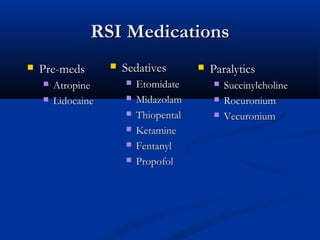
RSI MedicationsRSI Medications
 SedativesSedatives
 EtomidateEtomidate
 MidazolamMidazolam
 ThiopentalThiopental
 KetamineKetamine
 FentanylFentanyl
 PropofolPropofol
 ParalyticsParalytics
 SuccinylcholineSuccinylcholine
 RocuroniumRocuronium
 VecuroniumVecuronium
 Pre-medsPre-meds
 AtropineAtropine
 LidocaineLidocaine
Pre-medicationsPre-medications
 AtropineAtropine
 Inhibits acetylcholine receptors in parasympathetic system.Inhibits acetylcholine receptors in parasympathetic system.
Inhibits histamine and serotonin receptorsInhibits histamine and serotonin receptors
 Used to decrease airway secretionsUsed to decrease airway secretions
 Used to decrease reflex bradycardiaUsed to decrease reflex bradycardia
 Dose: 0.02mg/kg (min of 0.1mg; max of 1mg)Dose: 0.02mg/kg (min of 0.1mg; max of 1mg)
Pre-medicationsPre-medications
 LidocaineLidocaine
 Inhibits sodium channelsInhibits sodium channels
 Used to decrease ICPUsed to decrease ICP
 Dose: 1-1.5mg/kgDose: 1-1.5mg/kg
SedativesSedatives
 EtomidateEtomidate
 Ultra-short acting imidazole (non-barbiturate) hypnoticUltra-short acting imidazole (non-barbiturate) hypnotic
 Duration 10-15 minutesDuration 10-15 minutes
 Advantages:Advantages:
 Decreases ICP and cerebral metabolic rateDecreases ICP and cerebral metabolic rate
 Minimal hemodynamic effects (maintains blood pressure)Minimal hemodynamic effects (maintains blood pressure)
 Disadvantages:Disadvantages:
 Adrenal suppressionAdrenal suppression
 May cause myoclonus, cough, vomitingMay cause myoclonus, cough, vomiting
 Dose: 0.3mg/kg (max of 20mg)Dose: 0.3mg/kg (max of 20mg)
 What to remember:What to remember:
 Reduces ICP without systemic involvementReduces ICP without systemic involvement
 Can cause myoclonus-resembles seizuresCan cause myoclonus-resembles seizures
 Caution use in patients with adrenal insufficiencyCaution use in patients with adrenal insufficiency
SedativesSedatives
 MidazolamMidazolam
 Binds to and activates benzodiazipine receptor in GABABinds to and activates benzodiazipine receptor in GABA
 Causes less cardiovascular and respiratory depression thanCauses less cardiovascular and respiratory depression than
thiopentalthiopental
 Used less often in RSI due to need to titrate for sedationUsed less often in RSI due to need to titrate for sedation
effect and wide response rangeeffect and wide response range
 Advantages:Advantages:
 Can facilitate intubation without paralyticCan facilitate intubation without paralytic
 Rapid onsetRapid onset
 Disadvantages:Disadvantages:
 HypotensionHypotension
 Usually combined with opiate for RSIUsually combined with opiate for RSI
 Dose: 0.1mg/kg (max of 5mg for 1st dose)Dose: 0.1mg/kg (max of 5mg for 1st dose)
SedativesSedatives
 Thiopental SodiumThiopental Sodium
 Binds to and activates barbiturate receptor on GABABinds to and activates barbiturate receptor on GABA
 Ultra-shourt acting barbiturateUltra-shourt acting barbiturate
 Duration 5-10 minDuration 5-10 min
 Onset of action 10-20 secondsOnset of action 10-20 seconds
 Contraindicated in porphyria and status asthmaticusContraindicated in porphyria and status asthmaticus
 Advantages:Advantages:
 Decreases ICP and cerebral metabolismDecreases ICP and cerebral metabolism
 Reduces cerebral oxygen demandReduces cerebral oxygen demand
 AnticonvulsantAnticonvulsant
 Disavantages:Disavantages:
 Causses hypotensionCausses hypotension
 Myocardial depressionMyocardial depression
 Causes vasodilationCauses vasodilation
 Can cause bronchospasm (do not use in asthmatic patients)Can cause bronchospasm (do not use in asthmatic patients)
 Dose: 3-5 mg/kg (max of 500 mg)Dose: 3-5 mg/kg (max of 500 mg)
 What to remember:What to remember:
 Reduces ICP but also reduces systemic blood pressureReduces ICP but also reduces systemic blood pressure
 Is a barbiturate so will help to reduce seizure activityIs a barbiturate so will help to reduce seizure activity
 Ultra short actingUltra short acting
SedativesSedatives
 KetamineKetamine
 produces dissociative anesthesiaproduces dissociative anesthesia
 Rapid sedation, amnesia and analgesiaRapid sedation, amnesia and analgesia
 Advantages:Advantages:
 Analgesia and amnesiaAnalgesia and amnesia
 BronchodilationBronchodilation
 Maintains blood pressure and cardiac outputMaintains blood pressure and cardiac output
 Disadvantages:Disadvantages:
 Increases intraocular pressureIncreases intraocular pressure
 Increases secretionsIncreases secretions
 May cause laryngospasmMay cause laryngospasm
 Dose: 1-2mg/kg/doseDose: 1-2mg/kg/dose
 What to remember:What to remember:
 No longer contraindicated in head traumaNo longer contraindicated in head trauma
 Causes bronchodilation so good choice in asthmaticsCauses bronchodilation so good choice in asthmatics
 Maintains blood presure so good choice in shock patientsMaintains blood presure so good choice in shock patients
 Has an anxiolytic propertyHas an anxiolytic property
SedativesSedatives
 FentanylFentanyl
 Binds to opioid receptor in brainBinds to opioid receptor in brain
 Shortest acting opioidShortest acting opioid
 Useful adjuvant in induction agents lacking analgesic effect (etomidate,Useful adjuvant in induction agents lacking analgesic effect (etomidate,
thiopental, propofol)thiopental, propofol)
 Advantages:Advantages:
 Hemodynamic stabilityHemodynamic stability
 May blunt sympathetic response to laryngoscopyMay blunt sympathetic response to laryngoscopy
 Useful for post-intubation sedation/analgesiaUseful for post-intubation sedation/analgesia
 Disadvantages:Disadvantages:
 Lacks amnestic propertyLacks amnestic property
 Can cause rigid chestCan cause rigid chest
 Dose: 1-2mcg/kg/doseDose: 1-2mcg/kg/dose
SedativesSedatives
 PropofolPropofol
 Short-acting hypnotic agentShort-acting hypnotic agent
 Advantages:Advantages:
 Can facilitate intubation without paralysisCan facilitate intubation without paralysis
 Rapid onsetRapid onset
 Disadvantages:Disadvantages:
 Apnea in childrenApnea in children
 Cardiovascular depressionCardiovascular depression
 HypotensionHypotension
 No analgesia properties (must use opiate with propofol)No analgesia properties (must use opiate with propofol)
 Dose: 2.5-3.5mg/kgDose: 2.5-3.5mg/kg
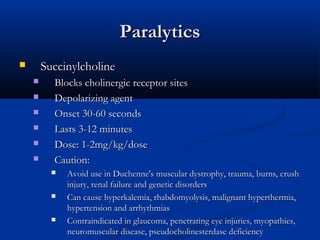
ParalyticsParalytics
 SuccinylcholineSuccinylcholine
 Blocks cholinergic receptor sitesBlocks cholinergic receptor sites
 Depolarizing agentDepolarizing agent
 Onset 30-60 secondsOnset 30-60 seconds
 Lasts 3-12 minutesLasts 3-12 minutes
 Dose: 1-2mg/kg/doseDose: 1-2mg/kg/dose
 Caution:Caution:
 Avoid use in Duchenne's muscular dystrophy, trauma, burns, crushAvoid use in Duchenne's muscular dystrophy, trauma, burns, crush
injury, renal failure and genetic disordersinjury, renal failure and genetic disorders
 Can cause hyperkalemia, rhabdomyolysis, malignant hyperthermia,Can cause hyperkalemia, rhabdomyolysis, malignant hyperthermia,
hypertension and arrhythmiashypertension and arrhythmias
 Contraindicated in glaucoma, penetrating eye injuries, myopathies,Contraindicated in glaucoma, penetrating eye injuries, myopathies,
neuromuscular disease, pseudocholinesterdase deficiencyneuromuscular disease, pseudocholinesterdase deficiency
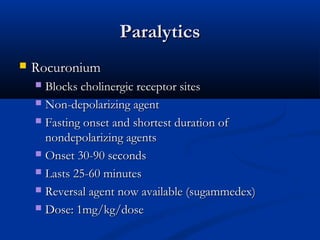
ParalyticsParalytics
 RocuroniumRocuronium
 Blocks cholinergic receptor sitesBlocks cholinergic receptor sites
 Non-depolarizing agentNon-depolarizing agent
 Fasting onset and shortest duration ofFasting onset and shortest duration of
nondepolarizing agentsnondepolarizing agents
 Onset 30-90 secondsOnset 30-90 seconds
 Lasts 25-60 minutesLasts 25-60 minutes
 Reversal agent now available (sugammedex)Reversal agent now available (sugammedex)
 Dose: 1mg/kg/doseDose: 1mg/kg/dose
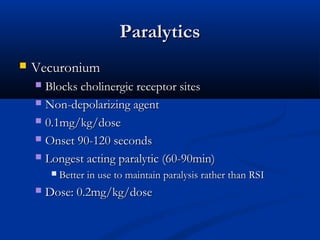
ParalyticsParalytics
 VecuroniumVecuronium
 Blocks cholinergic receptor sitesBlocks cholinergic receptor sites
 Non-depolarizing agentNon-depolarizing agent
 0.1mg/kg/dose0.1mg/kg/dose
 Onset 90-120 secondsOnset 90-120 seconds
 Longest acting paralytic (60-90min)Longest acting paralytic (60-90min)
 Better in use to maintain paralysis rather than RSIBetter in use to maintain paralysis rather than RSI
 Dose: 0.2mg/kg/doseDose: 0.2mg/kg/dose

Pediatric intubation pharmacology

  • 1.
  • 2.
    ObjectivesObjectives  Review thepharmacology, dosing, andReview the pharmacology, dosing, and indications for RSI medicationsindications for RSI medications  Discuss the side-effects and contraindicationsDiscuss the side-effects and contraindications for RSI medicationsfor RSI medications  Discuss medications for specific patientsDiscuss medications for specific patients
  • 3.
    Pearls of ResuscitationMedicationPearls of Resuscitation Medication  Determine diagnosis and verbalize to teamDetermine diagnosis and verbalize to team  Verbalize medications that might be usedVerbalize medications that might be used  Special circumstances in pediatric age groupsSpecial circumstances in pediatric age groups
  • 4.
    RSI MedicationsRSI Medications SedativesSedatives  EtomidateEtomidate  MidazolamMidazolam  ThiopentalThiopental  KetamineKetamine  FentanylFentanyl  PropofolPropofol  ParalyticsParalytics  SuccinylcholineSuccinylcholine  RocuroniumRocuronium  VecuroniumVecuronium  Pre-medsPre-meds  AtropineAtropine  LidocaineLidocaine
  • 5.
    Pre-medicationsPre-medications  AtropineAtropine  Inhibitsacetylcholine receptors in parasympathetic system.Inhibits acetylcholine receptors in parasympathetic system. Inhibits histamine and serotonin receptorsInhibits histamine and serotonin receptors  Used to decrease airway secretionsUsed to decrease airway secretions  Used to decrease reflex bradycardiaUsed to decrease reflex bradycardia  Dose: 0.02mg/kg (min of 0.1mg; max of 1mg)Dose: 0.02mg/kg (min of 0.1mg; max of 1mg)
  • 6.
    Pre-medicationsPre-medications  LidocaineLidocaine  Inhibitssodium channelsInhibits sodium channels  Used to decrease ICPUsed to decrease ICP  Dose: 1-1.5mg/kgDose: 1-1.5mg/kg
  • 7.
    SedativesSedatives  EtomidateEtomidate  Ultra-shortacting imidazole (non-barbiturate) hypnoticUltra-short acting imidazole (non-barbiturate) hypnotic  Duration 10-15 minutesDuration 10-15 minutes  Advantages:Advantages:  Decreases ICP and cerebral metabolic rateDecreases ICP and cerebral metabolic rate  Minimal hemodynamic effects (maintains blood pressure)Minimal hemodynamic effects (maintains blood pressure)  Disadvantages:Disadvantages:  Adrenal suppressionAdrenal suppression  May cause myoclonus, cough, vomitingMay cause myoclonus, cough, vomiting  Dose: 0.3mg/kg (max of 20mg)Dose: 0.3mg/kg (max of 20mg)  What to remember:What to remember:  Reduces ICP without systemic involvementReduces ICP without systemic involvement  Can cause myoclonus-resembles seizuresCan cause myoclonus-resembles seizures  Caution use in patients with adrenal insufficiencyCaution use in patients with adrenal insufficiency
  • 8.
    SedativesSedatives  MidazolamMidazolam  Bindsto and activates benzodiazipine receptor in GABABinds to and activates benzodiazipine receptor in GABA  Causes less cardiovascular and respiratory depression thanCauses less cardiovascular and respiratory depression than thiopentalthiopental  Used less often in RSI due to need to titrate for sedationUsed less often in RSI due to need to titrate for sedation effect and wide response rangeeffect and wide response range  Advantages:Advantages:  Can facilitate intubation without paralyticCan facilitate intubation without paralytic  Rapid onsetRapid onset  Disadvantages:Disadvantages:  HypotensionHypotension  Usually combined with opiate for RSIUsually combined with opiate for RSI  Dose: 0.1mg/kg (max of 5mg for 1st dose)Dose: 0.1mg/kg (max of 5mg for 1st dose)
  • 9.
    SedativesSedatives  Thiopental SodiumThiopentalSodium  Binds to and activates barbiturate receptor on GABABinds to and activates barbiturate receptor on GABA  Ultra-shourt acting barbiturateUltra-shourt acting barbiturate  Duration 5-10 minDuration 5-10 min  Onset of action 10-20 secondsOnset of action 10-20 seconds  Contraindicated in porphyria and status asthmaticusContraindicated in porphyria and status asthmaticus  Advantages:Advantages:  Decreases ICP and cerebral metabolismDecreases ICP and cerebral metabolism  Reduces cerebral oxygen demandReduces cerebral oxygen demand  AnticonvulsantAnticonvulsant  Disavantages:Disavantages:  Causses hypotensionCausses hypotension  Myocardial depressionMyocardial depression  Causes vasodilationCauses vasodilation  Can cause bronchospasm (do not use in asthmatic patients)Can cause bronchospasm (do not use in asthmatic patients)  Dose: 3-5 mg/kg (max of 500 mg)Dose: 3-5 mg/kg (max of 500 mg)  What to remember:What to remember:  Reduces ICP but also reduces systemic blood pressureReduces ICP but also reduces systemic blood pressure  Is a barbiturate so will help to reduce seizure activityIs a barbiturate so will help to reduce seizure activity  Ultra short actingUltra short acting
  • 10.
    SedativesSedatives  KetamineKetamine  producesdissociative anesthesiaproduces dissociative anesthesia  Rapid sedation, amnesia and analgesiaRapid sedation, amnesia and analgesia  Advantages:Advantages:  Analgesia and amnesiaAnalgesia and amnesia  BronchodilationBronchodilation  Maintains blood pressure and cardiac outputMaintains blood pressure and cardiac output  Disadvantages:Disadvantages:  Increases intraocular pressureIncreases intraocular pressure  Increases secretionsIncreases secretions  May cause laryngospasmMay cause laryngospasm  Dose: 1-2mg/kg/doseDose: 1-2mg/kg/dose  What to remember:What to remember:  No longer contraindicated in head traumaNo longer contraindicated in head trauma  Causes bronchodilation so good choice in asthmaticsCauses bronchodilation so good choice in asthmatics  Maintains blood presure so good choice in shock patientsMaintains blood presure so good choice in shock patients  Has an anxiolytic propertyHas an anxiolytic property
  • 11.
    SedativesSedatives  FentanylFentanyl  Bindsto opioid receptor in brainBinds to opioid receptor in brain  Shortest acting opioidShortest acting opioid  Useful adjuvant in induction agents lacking analgesic effect (etomidate,Useful adjuvant in induction agents lacking analgesic effect (etomidate, thiopental, propofol)thiopental, propofol)  Advantages:Advantages:  Hemodynamic stabilityHemodynamic stability  May blunt sympathetic response to laryngoscopyMay blunt sympathetic response to laryngoscopy  Useful for post-intubation sedation/analgesiaUseful for post-intubation sedation/analgesia  Disadvantages:Disadvantages:  Lacks amnestic propertyLacks amnestic property  Can cause rigid chestCan cause rigid chest  Dose: 1-2mcg/kg/doseDose: 1-2mcg/kg/dose
  • 12.
    SedativesSedatives  PropofolPropofol  Short-actinghypnotic agentShort-acting hypnotic agent  Advantages:Advantages:  Can facilitate intubation without paralysisCan facilitate intubation without paralysis  Rapid onsetRapid onset  Disadvantages:Disadvantages:  Apnea in childrenApnea in children  Cardiovascular depressionCardiovascular depression  HypotensionHypotension  No analgesia properties (must use opiate with propofol)No analgesia properties (must use opiate with propofol)  Dose: 2.5-3.5mg/kgDose: 2.5-3.5mg/kg
  • 13.
    ParalyticsParalytics  SuccinylcholineSuccinylcholine  Blockscholinergic receptor sitesBlocks cholinergic receptor sites  Depolarizing agentDepolarizing agent  Onset 30-60 secondsOnset 30-60 seconds  Lasts 3-12 minutesLasts 3-12 minutes  Dose: 1-2mg/kg/doseDose: 1-2mg/kg/dose  Caution:Caution:  Avoid use in Duchenne's muscular dystrophy, trauma, burns, crushAvoid use in Duchenne's muscular dystrophy, trauma, burns, crush injury, renal failure and genetic disordersinjury, renal failure and genetic disorders  Can cause hyperkalemia, rhabdomyolysis, malignant hyperthermia,Can cause hyperkalemia, rhabdomyolysis, malignant hyperthermia, hypertension and arrhythmiashypertension and arrhythmias  Contraindicated in glaucoma, penetrating eye injuries, myopathies,Contraindicated in glaucoma, penetrating eye injuries, myopathies, neuromuscular disease, pseudocholinesterdase deficiencyneuromuscular disease, pseudocholinesterdase deficiency
  • 14.
    ParalyticsParalytics  RocuroniumRocuronium  Blockscholinergic receptor sitesBlocks cholinergic receptor sites  Non-depolarizing agentNon-depolarizing agent  Fasting onset and shortest duration ofFasting onset and shortest duration of nondepolarizing agentsnondepolarizing agents  Onset 30-90 secondsOnset 30-90 seconds  Lasts 25-60 minutesLasts 25-60 minutes  Reversal agent now available (sugammedex)Reversal agent now available (sugammedex)  Dose: 1mg/kg/doseDose: 1mg/kg/dose
  • 15.
    ParalyticsParalytics  VecuroniumVecuronium  Blockscholinergic receptor sitesBlocks cholinergic receptor sites  Non-depolarizing agentNon-depolarizing agent  0.1mg/kg/dose0.1mg/kg/dose  Onset 90-120 secondsOnset 90-120 seconds  Longest acting paralytic (60-90min)Longest acting paralytic (60-90min)  Better in use to maintain paralysis rather than RSIBetter in use to maintain paralysis rather than RSI  Dose: 0.2mg/kg/doseDose: 0.2mg/kg/dose

Editor's Notes

  • #6 Atropine: accelerates sinus and atrial pacemakers and increases conduction through the AV node Future: MOA, uses/indications, onset of action, lit support, dose
  • #8 Etomidate: Ultra-short acting imidazole hypnotic (duration 10-15 min) Dose 0.3 mg/kg (max ~ 20 mg) Advantages Decreases ICP/IOP and cerebral metabolic rate Minimal hemodynamic effects—BP maintained Disadvantages Adrenal suppression (transient with single dose) Injection pain Myoclonus, cough, hiccups Vomiting Sympathetic stimulation/hypertension (fentanyl attenuates) ?Lowered seizure threshold Drug of choice for multiple trauma w/ head injury Avoid in adrenal insufficiency, ?sepsis/septic shock Midazolam () cause less cardiovascular and respiratory depression than thiopental Used less often in RSI due to need to titrate for sedation effect and wide response range Most pediatric intubation experience in OR setting Advantages Can facilitate intubation without paralysis Rapid onset, highly effective Disadvantages Hypotension Usually combined with opiate Fentanyl or remifentanil 3 mcg/kg + propofol 3 mg/kg Further study before routine ED use
  • #10 Thiopental: causes vasodilatation and myocardial depression-can cause hypotension Can cause bronchospasm Reduces ICP, cerebral metabolism and cerebral oxygen demand Avoid in hypotnensive or hypovolemic patients Ultra-short acting barbiturate (duration 5-10 min) Dose 3-5 mg/kg IV Advantages Decreases ICP Decreases cerebral metabolism Anticonvulsant Highly effective Disadvantages Myocardial depression, hypotension ?Bronchospasm, laryngospasm Good agent for normotensive patient with head injury, seizures Avoid in patients with hypotension, hypovolemia, shock (or give lower dose, e.g. 1-2 mg/kg) Ketamine: Increases blood pressure and intraocular pressure SE: hallucinations, secretions (consider atropine), laryngospasm NO longer contraindicated in head trauma Dissociative agent Dose 1-2 mg/kg Advantages Analgesia, amnesia Bronchodilation Preservation of CO, BP Disadvantages May increase ICP, IOP Increased secretions (reduced by atropine) Emergence reactions (adolescents/adults) Good agent for asthma, hypotension/shock Avoid in increased ICP/IOP, uncontrolled HTN
  • #12 Fentanyl: Rigid chest-reverse with naloxone or paralytic Useful adjunct to induction agents lacking analgesic effect (etomidate, thiopental, propofol) Dose 1-3 mcg/kg Advantages Hemodynamic stability (lacks histamine release) May blunt sympathetic response to laryngoscopy Disadvantages Chest wall rigidity (high doses) Opiates only mildly sedating Lacks amnestic effect Useful for post-intubation sedation/analgesia Propofol dose is different for RSI vs sedation (sedation is 1mg/kg) Most pediatric intubation experience in OR setting Advantages Can facilitate intubation without paralysis Rapid onset, highly effective Disadvantages Hypotension Usually combined with opiate Fentanyl or remifentanil 3 mcg/kg + propofol 3 mg/kg Further study before routine ED use
  • #14 Depolarizing agent Defasciculating dose not necessary in children less than 5yo (dose is 0.1mg/kg) Can cause malignant hyperthermia, hyperkalemia, hypertension and arrhythmias Depolarizing agent; not reversible Dose 1.5-2 mg/kg (higher dose for infants) Advantages Rapid onset—20-60 seconds Brief duration—5-10 minutes Disadvantages ?Increased ICP/IOP Bradycardia—uncommon in RSI setting Fasciculations (minimal in children) Raises potassium ~ 0.5 mEq/L; life-threatening hyperkalemia in patients with muscular dystrophy/myopathy, denervation, catabolic states, renal failure, s/p major burn/crush Contraindications: Malignant hyperthermia/associated conditions Muscular dystrophy Central core disease Chronic myopathy Denervating neuromuscular disease Pre-existing hyperkalemia Plasma cholinesterase deficiency (prolonged paralysis) >48-72 hours after burns, major trauma, crush injury, denervation
  • #15 Fewer adverse effects than succ but succ shorter duration Rocuronium now has a reversal agent-sugammedex Non-depolarizing agent Dose 0.9-1.2 mg/kg Onset 60-90 seconds (faster in infants/children) Duration 30-60 minutes Advantages Fastest onset in this class Minimal CV effects Disadvantages Long duration (even longer in infants) Best choice if succinylcholine contraindicated; many consider drug of choice for RSI
  • #16 Must be reconstituted-takes time to prepare Non-depolarizing agent Dose 0.2 mg/kg for RSI Dose 0.1 mg/kg for standard paralysis Onset 90-120 seconds Duration 30-120 minutes (dose-dependent) Not ideal for RSI, but useful for post-intubation paralysis Pancuronium-slow onset, more cardiovascular effects Atracurium-causes histamine release and cardiovascular side effects