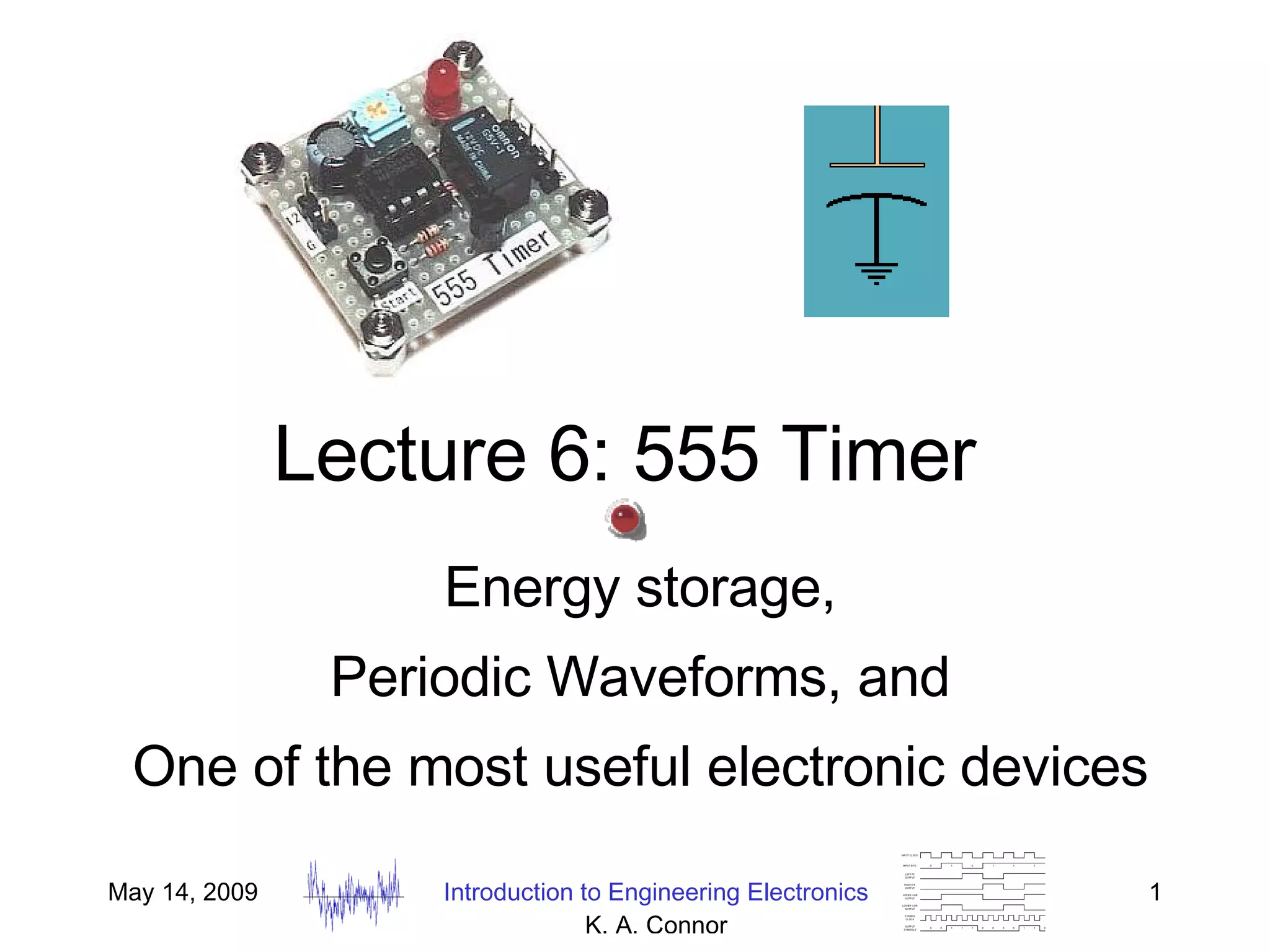
Lecture 6: 555 Timer Energy storage, Periodic Waveforms, and One of the most useful electronic devices
Examples of Physical Periodic Motion Pendulum Bouncing ball Vibrating string (stringed instrument) Circular motion (wheel) Cantilever beam (tuning fork)
Other Periodic Phenomena Daily cycle of solar energy Annual cycle of solar energy Daily temperature cycle Annual temperature cycle Monthly bank balance cycle Electronic clock pulse trains Line voltage and current
Daily Average Temperature Albany-Troy-Schenectady Data (blue) covers 1995-2002 Note the sinusoid (pink) fit to the data
Using Matlab to Produce Audio Signal from Daily Average Temps Data is normalized to mimic sound Data is filtered to find fundamental
Matlab Window
Periodic Pulse Train from a 555 Timer This circuit puts out a steady state train of pulses whose timing is determined by the values of R1, R2 and C1 The formula has a small error as we will see
Using Models Recall that you should use a model that you understand and/or know how to properly apply To use it properly Check for plausibility of predicted values (ballpark test). Are the values in a reasonable range? Check the rate of changes in the values (checking derivative or slope of plot). Are the most basic things satisfied? Conservation of energy, power, current, etc. Developing a qualitative understanding of phenomena now will help later and with simulations.
Charging a Capacitor Capacitor C1 is charged up by current flowing through R1 As the capacitor charges up, its voltage increases and the current charging it decreases, resulting in the charging rate shown
Charging a Capacitor Capacitor Current Capacitor Voltage Where the time constant
Charging a Capacitor Note that the voltage rises to a little above 6V in 1ms.
Charging a Capacitor There is a good description of capacitor charging and its use in 555 timer circuits at  http://www.uoguelph.ca/~antoon/gadgets/555/555.html
2 Minute Quiz Name___________  Section___ True or False? If C 1  < C 2 , for a fixed charging current, it will take longer to charge C 1  than C 2 If R 1  < R 2 , for a fixed charging voltage, it will take longer to charge a given capacitor C through R 1  than R 2 When a capacitor C is connected to a battery through a resistor R, the charging current will be a maximum at the moment the connection is made and decays after that.
555 Timer   At the beginning of the cycle, C1 is charged through resistors R1 and R2. The charging time constant is The voltage reaches (2/3)Vcc in a time
555 Timer When the voltage on the capacitor reaches (2/3)Vcc, a switch is closed at pin 7 and the capacitor is discharged to (1/3)Vcc, at which time the switch is opened and the cycle starts over
555 Timer The capacitor voltage cycles back and forth between (2/3)Vcc and (1/3)Vcc at times  and
555 Timer The frequency is then given by Note the error in the figure
Inside the 555 Note the voltage divider inside the 555 made up of 3 equal 5k resistors
555 Timer These figures are from the lab writeup Each pin has a name (function) Note the divider and other components inside
Astable and Monostable Multivibrators Astable puts out a continuous sequence of pulses Monostable puts out one pulse each time the switch is connected
Astable and Monostable Multivibrators What are they good for? Astable: clock, timing signal Monostable: a clean pulse of the correct height and duration for digital system
Optical Transmitter Circuit Astable is used to produce carrier pulses at a frequency we cannot hear (well above 20kHz)
Optical Receiver Circuit Receiver circuit for transmitter on previous slide
Clapper Circuit Signal is detected by microphone Clap is amplified by 741 op-amp Ugly clap pulse triggers monostable to produce clean digital pulse Counter counts clean pulses to 2 and triggers relay through the transistor
555 Timer Applications 40 LED bicycle light with 20 LEDs flashing alternately at 4.7Hz
555 Timer Applications 555 timer is used to produce an oscillating signal whose voltage output is increased by the transformer to a dangerous level, producing sparks.  DO NOT DO THIS WITHOUT SUPERVISION
Tank Circuit: A Classical Method Used  to Produce an Oscillating Signal A Tank Circuit is a combination of a capacitor and an inductor Each are energy storage devices
Tank Circuit: How Does It Work? Charge capacitor to 10V. At this point, all of the energy is in the capacitor. Disconnect voltage source and connect capacitor to inductor. Charge flows as current through inductor until capacitor voltage goes to zero. Current is then maximum through the inductor and all of the energy is in the inductor.
Tank Circuit The current in the inductor then recharges the capacitor until the cycle repeats. The energy oscillates between the capacitor and the inductor. Both the voltage and the current are sinusoidal.
Tank Circuit Voltage and Current
Tank Circuit There is a slight decay due to finite wire resistance. The frequency is given by  (period is about 10ms)
Tank Circuit Tank circuits are the basis of most oscillators. If such a combination is combined with an op-amp, an oscillator that produces a pure tone will result. This combination can also be used to power an electromagnet.  Charge a capacitor Connect the capacitor to an electromagnet (inductor). A sinusoidal magnetic field will result. The magnetic field can produce a magnetic force on magnetic materials and conductors.
Tank Circuit Application In lab 9 we will be using the circuit from a disposable camera. We can also use this type of camera as a power source for an electromagnet.
Disposable Camera Flash Capacitor Connected to a Small Electromagnet
Disposable Camera Flash Experiment/Project A piece of a paperclip is placed part way into the electromagnet. The camera capacitor is charged and then triggered to discharge through the electromagnet (coil). The large magnetic field of the coil attracts the paperclip to move inside of the coil. The clip passes through the coil, coasting out the other side at high speed when the current is gone.
Coin Flipper and Can Crusher The can crusher device (not presently in operation) crushes a soda can with a magnetic field.
Can Crusher and Coin Flipper This is an animation a student made as a graphics project a few years ago
Can Crusher and Coin Flipper For both the can crusher and coin flipper, the coil fed by the capacitor acts as the primary of a transformer. The can or the coin acts as the secondary.  A large current in the primary coil produces an even larger current in the can or coin (larger by the ratio of the turns in the primary coil) The current in the coin or can is such that an electromagnet of the opposite polarity is formed (Lenz’ Law) producing two magnets in close proximity with similar poles facing one another.  The similar poles dramatically repel one another
Magnetic Launchers Coilguns/Railguns
Coilguns & Railguns Two types of launchers are being developed for a variety of purposes.
Where Will You See This Material Again? Electromagnetic Fields and Forces: Fields and Waves I 555 Timers: Many courses including Analog Electronics and Digital Electronics Oscillators: Analog electronics Clocks, etc: Digital Electronics, Computer Components and Operations, and about half of the ECSE courses.
Appendix
Using Conservation Laws to Derive Fundamental Equations Energy stored in capacitor plus inductor Total energy must be constant, thus
Using Conservation Laws Simplifying This expression will hold if Noting that
Using Conservation Laws Note that for the tank circuit The same current I flows through both components The convention is that the current enters the higher voltage end of each component I + + V C V L
Using Conservation Laws Experimentally, it was also determined that the current-voltage relationship for a capacitor is Experimentally, it was also determined that the current-voltage relationship for an inductor is
Using Conservation Laws Applying the I-V relationship for a capacitor to the expressions we saw before for charging a capacitor through a resistor We see that
Using Conservation Laws Simplifying Which is satisfied if  The latter is the relationship for a resistor, so the results work.

Timer

  • 1.
    Lecture 6: 555Timer Energy storage, Periodic Waveforms, and One of the most useful electronic devices
  • 2.
    Examples of PhysicalPeriodic Motion Pendulum Bouncing ball Vibrating string (stringed instrument) Circular motion (wheel) Cantilever beam (tuning fork)
  • 3.
    Other Periodic PhenomenaDaily cycle of solar energy Annual cycle of solar energy Daily temperature cycle Annual temperature cycle Monthly bank balance cycle Electronic clock pulse trains Line voltage and current
  • 4.
    Daily Average TemperatureAlbany-Troy-Schenectady Data (blue) covers 1995-2002 Note the sinusoid (pink) fit to the data
  • 5.
    Using Matlab toProduce Audio Signal from Daily Average Temps Data is normalized to mimic sound Data is filtered to find fundamental
  • 6.
  • 7.
    Periodic Pulse Trainfrom a 555 Timer This circuit puts out a steady state train of pulses whose timing is determined by the values of R1, R2 and C1 The formula has a small error as we will see
  • 8.
    Using Models Recallthat you should use a model that you understand and/or know how to properly apply To use it properly Check for plausibility of predicted values (ballpark test). Are the values in a reasonable range? Check the rate of changes in the values (checking derivative or slope of plot). Are the most basic things satisfied? Conservation of energy, power, current, etc. Developing a qualitative understanding of phenomena now will help later and with simulations.
  • 9.
    Charging a CapacitorCapacitor C1 is charged up by current flowing through R1 As the capacitor charges up, its voltage increases and the current charging it decreases, resulting in the charging rate shown
  • 10.
    Charging a CapacitorCapacitor Current Capacitor Voltage Where the time constant
  • 11.
    Charging a CapacitorNote that the voltage rises to a little above 6V in 1ms.
  • 12.
    Charging a CapacitorThere is a good description of capacitor charging and its use in 555 timer circuits at http://www.uoguelph.ca/~antoon/gadgets/555/555.html
  • 13.
    2 Minute QuizName___________ Section___ True or False? If C 1 < C 2 , for a fixed charging current, it will take longer to charge C 1 than C 2 If R 1 < R 2 , for a fixed charging voltage, it will take longer to charge a given capacitor C through R 1 than R 2 When a capacitor C is connected to a battery through a resistor R, the charging current will be a maximum at the moment the connection is made and decays after that.
  • 14.
    555 Timer At the beginning of the cycle, C1 is charged through resistors R1 and R2. The charging time constant is The voltage reaches (2/3)Vcc in a time
  • 15.
    555 Timer Whenthe voltage on the capacitor reaches (2/3)Vcc, a switch is closed at pin 7 and the capacitor is discharged to (1/3)Vcc, at which time the switch is opened and the cycle starts over
  • 16.
    555 Timer Thecapacitor voltage cycles back and forth between (2/3)Vcc and (1/3)Vcc at times and
  • 17.
    555 Timer Thefrequency is then given by Note the error in the figure
  • 18.
    Inside the 555Note the voltage divider inside the 555 made up of 3 equal 5k resistors
  • 19.
    555 Timer Thesefigures are from the lab writeup Each pin has a name (function) Note the divider and other components inside
  • 20.
    Astable and MonostableMultivibrators Astable puts out a continuous sequence of pulses Monostable puts out one pulse each time the switch is connected
  • 21.
    Astable and MonostableMultivibrators What are they good for? Astable: clock, timing signal Monostable: a clean pulse of the correct height and duration for digital system
  • 22.
    Optical Transmitter CircuitAstable is used to produce carrier pulses at a frequency we cannot hear (well above 20kHz)
  • 23.
    Optical Receiver CircuitReceiver circuit for transmitter on previous slide
  • 24.
    Clapper Circuit Signalis detected by microphone Clap is amplified by 741 op-amp Ugly clap pulse triggers monostable to produce clean digital pulse Counter counts clean pulses to 2 and triggers relay through the transistor
  • 25.
    555 Timer Applications40 LED bicycle light with 20 LEDs flashing alternately at 4.7Hz
  • 26.
    555 Timer Applications555 timer is used to produce an oscillating signal whose voltage output is increased by the transformer to a dangerous level, producing sparks. DO NOT DO THIS WITHOUT SUPERVISION
  • 27.
    Tank Circuit: AClassical Method Used to Produce an Oscillating Signal A Tank Circuit is a combination of a capacitor and an inductor Each are energy storage devices
  • 28.
    Tank Circuit: HowDoes It Work? Charge capacitor to 10V. At this point, all of the energy is in the capacitor. Disconnect voltage source and connect capacitor to inductor. Charge flows as current through inductor until capacitor voltage goes to zero. Current is then maximum through the inductor and all of the energy is in the inductor.
  • 29.
    Tank Circuit Thecurrent in the inductor then recharges the capacitor until the cycle repeats. The energy oscillates between the capacitor and the inductor. Both the voltage and the current are sinusoidal.
  • 30.
  • 31.
    Tank Circuit Thereis a slight decay due to finite wire resistance. The frequency is given by (period is about 10ms)
  • 32.
    Tank Circuit Tankcircuits are the basis of most oscillators. If such a combination is combined with an op-amp, an oscillator that produces a pure tone will result. This combination can also be used to power an electromagnet. Charge a capacitor Connect the capacitor to an electromagnet (inductor). A sinusoidal magnetic field will result. The magnetic field can produce a magnetic force on magnetic materials and conductors.
  • 33.
    Tank Circuit ApplicationIn lab 9 we will be using the circuit from a disposable camera. We can also use this type of camera as a power source for an electromagnet.
  • 34.
    Disposable Camera FlashCapacitor Connected to a Small Electromagnet
  • 35.
    Disposable Camera FlashExperiment/Project A piece of a paperclip is placed part way into the electromagnet. The camera capacitor is charged and then triggered to discharge through the electromagnet (coil). The large magnetic field of the coil attracts the paperclip to move inside of the coil. The clip passes through the coil, coasting out the other side at high speed when the current is gone.
  • 36.
    Coin Flipper andCan Crusher The can crusher device (not presently in operation) crushes a soda can with a magnetic field.
  • 37.
    Can Crusher andCoin Flipper This is an animation a student made as a graphics project a few years ago
  • 38.
    Can Crusher andCoin Flipper For both the can crusher and coin flipper, the coil fed by the capacitor acts as the primary of a transformer. The can or the coin acts as the secondary. A large current in the primary coil produces an even larger current in the can or coin (larger by the ratio of the turns in the primary coil) The current in the coin or can is such that an electromagnet of the opposite polarity is formed (Lenz’ Law) producing two magnets in close proximity with similar poles facing one another. The similar poles dramatically repel one another
  • 39.
  • 40.
    Coilguns & RailgunsTwo types of launchers are being developed for a variety of purposes.
  • 41.
    Where Will YouSee This Material Again? Electromagnetic Fields and Forces: Fields and Waves I 555 Timers: Many courses including Analog Electronics and Digital Electronics Oscillators: Analog electronics Clocks, etc: Digital Electronics, Computer Components and Operations, and about half of the ECSE courses.
  • 42.
  • 43.
    Using Conservation Lawsto Derive Fundamental Equations Energy stored in capacitor plus inductor Total energy must be constant, thus
  • 44.
    Using Conservation LawsSimplifying This expression will hold if Noting that
  • 45.
    Using Conservation LawsNote that for the tank circuit The same current I flows through both components The convention is that the current enters the higher voltage end of each component I + + V C V L
  • 46.
    Using Conservation LawsExperimentally, it was also determined that the current-voltage relationship for a capacitor is Experimentally, it was also determined that the current-voltage relationship for an inductor is
  • 47.
    Using Conservation LawsApplying the I-V relationship for a capacitor to the expressions we saw before for charging a capacitor through a resistor We see that
  • 48.
    Using Conservation LawsSimplifying Which is satisfied if The latter is the relationship for a resistor, so the results work.