SEMINAR
ON
COLLECTIVE BARGAINING
PRESENTER:- PRAMOD KUMAR
INTRODUCTION:- Collective bargaining involves
discussion between two groups as to the terms and
condition of employment it is called collective because the
employer and the employee act as group rather than as
individuals .it is know as bargaining because the method
of teaching and agreement involves proposals , counter
proposals ,offer and counter offers and other negotiation.
DEFINITION :- Collective bargaining has been defined as
the process of discussion and negotiation between two
parties ,one or both of whom is a group of persons acting
in concert .More specifically , collective bargaining is the
procedure by which an employer and a group of
employees agree upon the conditions of work .
CHARACTERISTICS OF COLLECTIVE
BARGAINING:-
1. It is a collective process as both employer and
employee participate .
2. It is continuous process, which aims at establishing
stable relationship between two parties involved .
3. It involves not only bargaining but also
implementation .
4. It attempts n achieving discipline in industry.
5. It is a flexible approach ,as the parties involved have
to adopt a flexible attitude towards negotiations
OBJECTIVES OF COLLECTIVE BARGANING:-
•To maintain cordial relations between employer and employee.
•To promote democracy.
•To protect the interest of workers.
•To prevent unilateral actions to employees.
•To avoid the government intervention .
•To ensure the participation of trade unions.
•To save the time and money spent on legal battle.
•To promote participative management.
IMPOTRANCE OF COLLECTIVE BARGAINING :-
•Collective bargaining results better understanding
between both parties. Both employer and employee gain
better insight into the problems and aspirations of
workers.
•Collective bargaining is a democratic and pragmatic
method of regulating the terms and conditions of
employment .here parties are directly concerned with
problems related to issues of their industry .whether it is
health industry or any other enterprise.
•Collective bargaining provides flexible means of adjusting
wage structure and physical facilities provided by the
employer .both parties can meet any time to solve the
problems faced by the employers and employees of an
institution with democratic way.
•Collective bargaining helps the employees from the
exploitation of employer .rights of both parties are saved
with mutual understanding .
•Collective bargaining helps in implementation of decisions
because of direct involvement of both parties in any type of
issues.
•It helps in motivating the employers that leads to more
production and achieving the laid down objective of any
organization.
•PREREQUESTES OF COLLECTIVE BARGAINING :-
•Freedom of association and independence of unions.
•Stability of organizations of workers and employers .
•Favorable political climate –The government should not
only be sympathetic but also encourage collective
bargaining and agreements.
•Mutual trust and respect and also willingness on the part
of the parties concern to settle all matters by collective
bargaining or negotiation .
Bargaining power of each party depends on the :-
•Strength of its organization
•Knowledge and skill of negotiation of its
representatives.
•Trade recession or boom and shortages
•FACTORS FOR THE SUCCESS OF COLLECTIVE
BARGAINIG
•Economic environment factors .
•Psychological factors and structure of power relation .
•Nature and character of the product market .
•Nature of the labour market .
•Capital requirement and cost conditions .
•State of business conditions.
•Types of business conditions.
•Types of industrial relationship.
FOUR MAIN ACTIVITES OF COLLECTIVE BARGAINING
1. Distributive bargaining:- It involves bargain persistently
over the distribution of surplus. Under it bargain economic
issues like wages, salary , bonus are discussed by the employs
in periodic intervals . here ,one party gains something other
loses some .
2. Integrative bargaining:- In this type of bargaining both
parties gains something .example:- Training of employs for
particular work, and programe , special evaluation system for
performance appraisal .
3 Attitudinal structuring:- This bargaining
involves shaping and reshaping some attitude like
hostility between labour and management . when
there is a black log of bitterness between both
parties there must be attitudinal structuring
which is required to maintain smooth and cordial
relations between employer and employees .
4 Intra-organisational bargaining: - This type of
bargaining is to achieve general agreement with
employees and employers. Here, difference may
be seen in different groups on same issues. for
example – skilled worker may feel that there are
neglected by top managers or women may feel
that their interests being looked properly
•Principles for trade union
PRINCIPLES OF COLLECTIVE BARGANINIG :-
Principle for the management
•Principle for both union and management
Guide to collective bargaining :-
1. Electing the agent
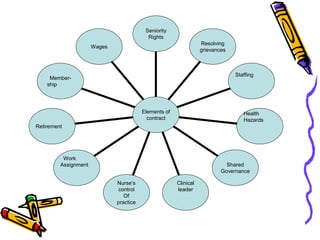
2. The elements of a contrast
Wages
Member-
ship
Retirement
Work
Assignment
Nurse’s
control
Of
practice
Clinical
leader
Shared
Governance
Health
Hazards
Staffing
Resolving
grievances
Seniority
Rights
Elements of
contract
NURSES PARTICIPATION IN COLLECTING
BARGAINING:-
Collective bargaining for nurses usually occurs in states
where there is significant trade union activity. At present,
there are few nurses involved in collective bargaining. All
nurses need to involve and understand the benefits of
unions.
Unions stimulate better hospital management by fostering
formal, central and consistent personnel policies with better
lines of communication.
Unions lead to improvement in the work place so that
recruitment and retentions become easier.
THANKS

Collective bargaining

  • 1.
  • 3.
    INTRODUCTION:- Collective bargaininginvolves discussion between two groups as to the terms and condition of employment it is called collective because the employer and the employee act as group rather than as individuals .it is know as bargaining because the method of teaching and agreement involves proposals , counter proposals ,offer and counter offers and other negotiation.
  • 4.
    DEFINITION :- Collectivebargaining has been defined as the process of discussion and negotiation between two parties ,one or both of whom is a group of persons acting in concert .More specifically , collective bargaining is the procedure by which an employer and a group of employees agree upon the conditions of work .
  • 5.
    CHARACTERISTICS OF COLLECTIVE BARGAINING:- 1.It is a collective process as both employer and employee participate . 2. It is continuous process, which aims at establishing stable relationship between two parties involved . 3. It involves not only bargaining but also implementation . 4. It attempts n achieving discipline in industry. 5. It is a flexible approach ,as the parties involved have to adopt a flexible attitude towards negotiations
  • 6.
    OBJECTIVES OF COLLECTIVEBARGANING:- •To maintain cordial relations between employer and employee. •To promote democracy. •To protect the interest of workers. •To prevent unilateral actions to employees. •To avoid the government intervention . •To ensure the participation of trade unions. •To save the time and money spent on legal battle. •To promote participative management.
  • 7.
    IMPOTRANCE OF COLLECTIVEBARGAINING :- •Collective bargaining results better understanding between both parties. Both employer and employee gain better insight into the problems and aspirations of workers. •Collective bargaining is a democratic and pragmatic method of regulating the terms and conditions of employment .here parties are directly concerned with problems related to issues of their industry .whether it is health industry or any other enterprise.
  • 8.
    •Collective bargaining providesflexible means of adjusting wage structure and physical facilities provided by the employer .both parties can meet any time to solve the problems faced by the employers and employees of an institution with democratic way. •Collective bargaining helps the employees from the exploitation of employer .rights of both parties are saved with mutual understanding . •Collective bargaining helps in implementation of decisions because of direct involvement of both parties in any type of issues. •It helps in motivating the employers that leads to more production and achieving the laid down objective of any organization.
  • 9.
    •PREREQUESTES OF COLLECTIVEBARGAINING :- •Freedom of association and independence of unions. •Stability of organizations of workers and employers . •Favorable political climate –The government should not only be sympathetic but also encourage collective bargaining and agreements. •Mutual trust and respect and also willingness on the part of the parties concern to settle all matters by collective bargaining or negotiation .
  • 10.
    Bargaining power ofeach party depends on the :- •Strength of its organization •Knowledge and skill of negotiation of its representatives. •Trade recession or boom and shortages
  • 11.
    •FACTORS FOR THESUCCESS OF COLLECTIVE BARGAINIG •Economic environment factors . •Psychological factors and structure of power relation . •Nature and character of the product market . •Nature of the labour market . •Capital requirement and cost conditions . •State of business conditions. •Types of business conditions. •Types of industrial relationship.
  • 12.
    FOUR MAIN ACTIVITESOF COLLECTIVE BARGAINING 1. Distributive bargaining:- It involves bargain persistently over the distribution of surplus. Under it bargain economic issues like wages, salary , bonus are discussed by the employs in periodic intervals . here ,one party gains something other loses some . 2. Integrative bargaining:- In this type of bargaining both parties gains something .example:- Training of employs for particular work, and programe , special evaluation system for performance appraisal .
  • 13.
    3 Attitudinal structuring:-This bargaining involves shaping and reshaping some attitude like hostility between labour and management . when there is a black log of bitterness between both parties there must be attitudinal structuring which is required to maintain smooth and cordial relations between employer and employees . 4 Intra-organisational bargaining: - This type of bargaining is to achieve general agreement with employees and employers. Here, difference may be seen in different groups on same issues. for example – skilled worker may feel that there are neglected by top managers or women may feel that their interests being looked properly
  • 14.
    •Principles for tradeunion PRINCIPLES OF COLLECTIVE BARGANINIG :- Principle for the management •Principle for both union and management
  • 15.
    Guide to collectivebargaining :- 1. Electing the agent 2. The elements of a contrast
  • 16.
  • 17.
    NURSES PARTICIPATION INCOLLECTING BARGAINING:- Collective bargaining for nurses usually occurs in states where there is significant trade union activity. At present, there are few nurses involved in collective bargaining. All nurses need to involve and understand the benefits of unions. Unions stimulate better hospital management by fostering formal, central and consistent personnel policies with better lines of communication. Unions lead to improvement in the work place so that recruitment and retentions become easier.
  • 18.