HOME VISITING & URINE
TESTING
PRAMOD KUMAR
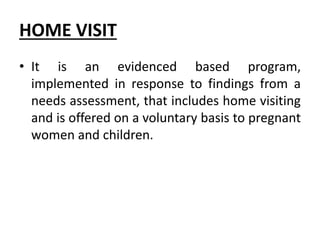
HOME VISIT
• It is an evidenced based program,
implemented in response to findings from a
needs assessment, that includes home visiting
and is offered on a voluntary basis to pregnant
women and children.
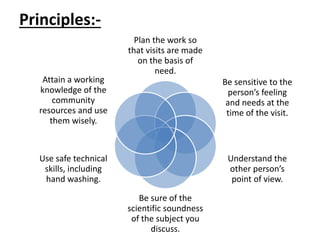
Principles:-
Plan the work so
that visits are made
on the basis of
need.
Be sensitive to the
person’s feeling
and needs at the
time of the visit.
Understand the
other person’s
point of view.
Be sure of the
scientific soundness
of the subject you
discuss.
Use safe technical
skills, including
hand washing.
Attain a working
knowledge of the
community
resources and use
them wisely.
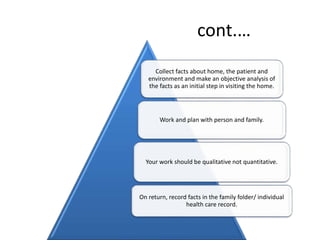
cont.…
Collect facts about home, the patient and
environment and make an objective analysis of
the facts as an initial step in visiting the home.
Work and plan with person and family.
Your work should be qualitative not quantitative.
On return, record facts in the family folder/ individual
health care record.
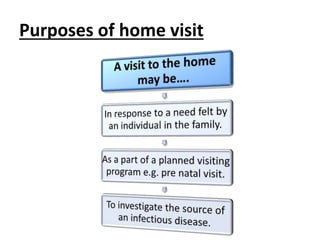
Purposes of home visit
cont.…..
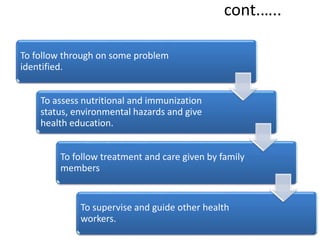
To follow through on some problem
identified.
To assess nutritional and immunization
status, environmental hazards and give
health education.
To follow treatment and care given by family
members
To supervise and guide other health
workers.
STEPS OF HOME VISIT:
A. Fact finding:-
– The first step during a home
visit is to study the clinical and
other records to get an
understanding of what has
been done. This should give a
lead to present needs and the
community health nurse will
be able to build on what has
been done.
cont.….
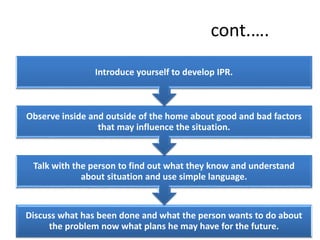
Discuss what has been done and what the person wants to do about
the problem now what plans he may have for the future.
Talk with the person to find out what they know and understand
about situation and use simple language.
Observe inside and outside of the home about good and bad factors
that may influence the situation.
Introduce yourself to develop IPR.
cont.….
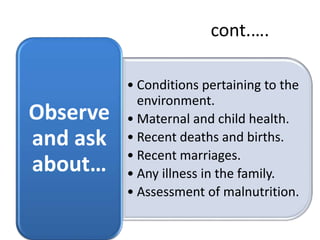
• Conditions pertaining to the
environment.
• Maternal and child health.
• Recent deaths and births.
• Recent marriages.
• Any illness in the family.
• Assessment of malnutrition.
Observe
and ask
about…
B. Examination and analysis:
• After the collection of facts, the process of examining and
analyzing begins. The personal, environmental and
economic factors, the emotional involvements and
spiritual aspects are taken together that constitute usual
health problem.
• The community health nurse should be able to combine
the facts about home condition, signs and symptoms,
attitudes and relationships to identify needs and problems
which will become the starting point of action.
• She should also assess the coping ability of the family.
C. Planning with the individual & the
family:
Planning action with the person and
gamily is one of the greatest importance.
Alternative plans and suggestions are
helpful.
Respect for individual rights is important.
D. Action:-
– Action depends upon the first three steps.
E. Follow-up:-
– Follow up is one of the most important steps in the
home visit.
– Always plan follow up according to need and time.
– It helps a community health nurse to evaluate the work.
– Follow up of persons undergoing treatment in chronic
illness is very important.
E. Evaluation of services:-
– Review each family records periodically and answer
the questions:
– What is the immediate problem?
– What is total problem?
– List the difficulties and unhelpful factors?
– List the coping abilities?
– What has been done about immediate problem?
– What plans are being made and what action is being
taken to deal with the underlying cause of the
problem?
– How can you make effective use of man and material
present?
Advantages:
• It permits the nurse to see the home and family situation.
• Develops feeling of trust and believe among community
members.
• It permits more realistic teaching in the actual situation.
• Family practices can observe by community health nurse.
• Other members of the family can be contacted who may
have greater influence and control on the members.
• It also provides opportunity to look for new health
problems.
Disadvantages:
• Visits are expensive in terms of time and transport facilities
are required
• Important point to be taken care is that such visits can only
be made at times convenient to the client
• The number of people who can be contacted within a given
period is limited
• Avoid bias: A tendency may develop to visit some families,
with whom good relations have been established, more
frequently, at the expense of trying to establish better
relations with others and, this situation may result in loss of
contact with the community as a whole and cause jealousy
and resentment amongst some members of it.
URINE ANALYSIS
Urine analysis : -
•Urine analysis is the
analysis of urine in order
to find out the presence
of sugar, albumin and
microorganism.
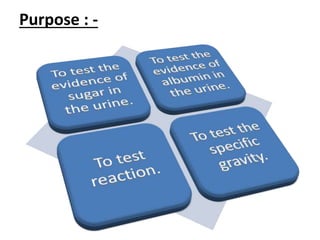
Purpose : -
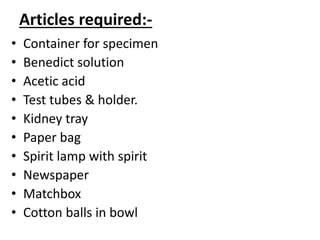
Articles required:-
• Container for specimen
• Benedict solution
• Acetic acid
• Test tubes & holder.
• Kidney tray
• Paper bag
• Spirit lamp with spirit
• Newspaper
• Matchbox
• Cotton balls in bowl
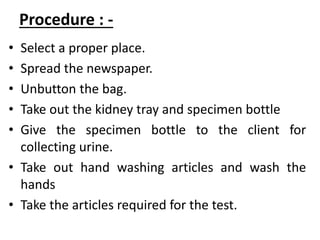
Procedure : -
• Select a proper place.
• Spread the newspaper.
• Unbutton the bag.
• Take out the kidney tray and specimen bottle
• Give the specimen bottle to the client for
collecting urine.
• Take out hand washing articles and wash the
hands
• Take the articles required for the test.
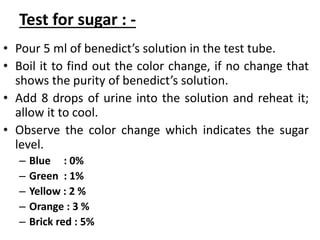
Test for sugar : -
• Pour 5 ml of benedict’s solution in the test tube.
• Boil it to find out the color change, if no change that
shows the purity of benedict’s solution.
• Add 8 drops of urine into the solution and reheat it;
allow it to cool.
• Observe the color change which indicates the sugar
level.
– Blue : 0%
– Green : 1%
– Yellow : 2 %
– Orange : 3 %
– Brick red : 5%
Test for albumin:-
• Fill the test tube 3/4th with urine, check the
reaction, if it is alkaline make it acidic.
• Boil the top portion.
• If there is cloudy appearance it indicates
albumin/phosphate.
• Add 5 drops of acetic acid & reheat.
• If cloud still presents it indicates albumin
presence and if it disappears it shoes phosphate
presence.
Termination of articles:-
• After the procedure it is essential to terminate
the articles in a proper manner.
• After the result, recording & reporting, dispose
the urine sample, as well as the liquid from the
used test tube.
• Take the articles to the hand washing area.
• Wash each article clearly.
• Put the articles on newspaper for drying up.
• Wash your hands.
Home visiting & urine testing

Home visiting & urine testing

  • 1.
    HOME VISITING &URINE TESTING PRAMOD KUMAR
  • 2.
    HOME VISIT • Itis an evidenced based program, implemented in response to findings from a needs assessment, that includes home visiting and is offered on a voluntary basis to pregnant women and children.
  • 3.
    Principles:- Plan the workso that visits are made on the basis of need. Be sensitive to the person’s feeling and needs at the time of the visit. Understand the other person’s point of view. Be sure of the scientific soundness of the subject you discuss. Use safe technical skills, including hand washing. Attain a working knowledge of the community resources and use them wisely.
  • 4.
    cont.… Collect facts abouthome, the patient and environment and make an objective analysis of the facts as an initial step in visiting the home. Work and plan with person and family. Your work should be qualitative not quantitative. On return, record facts in the family folder/ individual health care record.
  • 5.
  • 6.
    cont.….. To follow throughon some problem identified. To assess nutritional and immunization status, environmental hazards and give health education. To follow treatment and care given by family members To supervise and guide other health workers.
  • 7.
    STEPS OF HOMEVISIT: A. Fact finding:- – The first step during a home visit is to study the clinical and other records to get an understanding of what has been done. This should give a lead to present needs and the community health nurse will be able to build on what has been done.
  • 8.
    cont.…. Discuss what hasbeen done and what the person wants to do about the problem now what plans he may have for the future. Talk with the person to find out what they know and understand about situation and use simple language. Observe inside and outside of the home about good and bad factors that may influence the situation. Introduce yourself to develop IPR.
  • 9.
    cont.…. • Conditions pertainingto the environment. • Maternal and child health. • Recent deaths and births. • Recent marriages. • Any illness in the family. • Assessment of malnutrition. Observe and ask about…
  • 10.
    B. Examination andanalysis: • After the collection of facts, the process of examining and analyzing begins. The personal, environmental and economic factors, the emotional involvements and spiritual aspects are taken together that constitute usual health problem. • The community health nurse should be able to combine the facts about home condition, signs and symptoms, attitudes and relationships to identify needs and problems which will become the starting point of action. • She should also assess the coping ability of the family.
  • 11.
    C. Planning withthe individual & the family: Planning action with the person and gamily is one of the greatest importance. Alternative plans and suggestions are helpful. Respect for individual rights is important.
  • 12.
    D. Action:- – Actiondepends upon the first three steps. E. Follow-up:- – Follow up is one of the most important steps in the home visit. – Always plan follow up according to need and time. – It helps a community health nurse to evaluate the work. – Follow up of persons undergoing treatment in chronic illness is very important.
  • 13.
    E. Evaluation ofservices:- – Review each family records periodically and answer the questions: – What is the immediate problem? – What is total problem? – List the difficulties and unhelpful factors? – List the coping abilities? – What has been done about immediate problem? – What plans are being made and what action is being taken to deal with the underlying cause of the problem? – How can you make effective use of man and material present?
  • 14.
    Advantages: • It permitsthe nurse to see the home and family situation. • Develops feeling of trust and believe among community members. • It permits more realistic teaching in the actual situation. • Family practices can observe by community health nurse. • Other members of the family can be contacted who may have greater influence and control on the members. • It also provides opportunity to look for new health problems.
  • 15.
    Disadvantages: • Visits areexpensive in terms of time and transport facilities are required • Important point to be taken care is that such visits can only be made at times convenient to the client • The number of people who can be contacted within a given period is limited • Avoid bias: A tendency may develop to visit some families, with whom good relations have been established, more frequently, at the expense of trying to establish better relations with others and, this situation may result in loss of contact with the community as a whole and cause jealousy and resentment amongst some members of it.
  • 16.
  • 17.
    Urine analysis :- •Urine analysis is the analysis of urine in order to find out the presence of sugar, albumin and microorganism.
  • 18.
  • 19.
    Articles required:- • Containerfor specimen • Benedict solution • Acetic acid • Test tubes & holder. • Kidney tray • Paper bag • Spirit lamp with spirit • Newspaper • Matchbox • Cotton balls in bowl
  • 20.
    Procedure : - •Select a proper place. • Spread the newspaper. • Unbutton the bag. • Take out the kidney tray and specimen bottle • Give the specimen bottle to the client for collecting urine. • Take out hand washing articles and wash the hands • Take the articles required for the test.
  • 21.
    Test for sugar: - • Pour 5 ml of benedict’s solution in the test tube. • Boil it to find out the color change, if no change that shows the purity of benedict’s solution. • Add 8 drops of urine into the solution and reheat it; allow it to cool. • Observe the color change which indicates the sugar level. – Blue : 0% – Green : 1% – Yellow : 2 % – Orange : 3 % – Brick red : 5%
  • 22.
    Test for albumin:- •Fill the test tube 3/4th with urine, check the reaction, if it is alkaline make it acidic. • Boil the top portion. • If there is cloudy appearance it indicates albumin/phosphate. • Add 5 drops of acetic acid & reheat. • If cloud still presents it indicates albumin presence and if it disappears it shoes phosphate presence.
  • 23.
    Termination of articles:- •After the procedure it is essential to terminate the articles in a proper manner. • After the result, recording & reporting, dispose the urine sample, as well as the liquid from the used test tube. • Take the articles to the hand washing area. • Wash each article clearly. • Put the articles on newspaper for drying up. • Wash your hands.