COLLECTIVE
BARGAINING
PRESENTED BY : JISA ANNA
HISTORY
 In India trade unions have come to occupy the centre stage only
after 1900.
 In 1918, Gandhi, as the leader of the Ahmadabad Textile workers
advocated the resolution of conflict through collective bargaining
agreements.
 For another 10 years, this method of setting disputes did not gain
popularity. The legal steps taken by the government after the Second
World War revived interest in the subject once again
 After Independence, with the spread of trade unionism, collective
bargaining agreements have become popular.
 The agreements were found in industries such as chemicals,
petroleum, tea, coal, oil, aluminum, etc. In ports and docks, banking
and insurance, collective agreements at the national level were also
arrived at.
DEFINITION
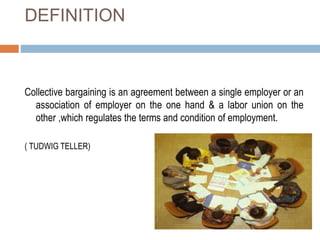
Collective bargaining is an agreement between a single employer or an
association of employer on the one hand & a labor union on the
other ,which regulates the terms and condition of employment.
( TUDWIG TELLER)
MEANING
Collective bargaining is a process between employers & employers to
reach an agreement regarding the rights and duties of people at
work .
It aims to reach a collective agreement which usually sets out issues
such an employees pay, working hours ,training ,health and safety
and rights to participate in work places or company affairs.
TYPES OF BARGAINING
 Conjunctive/distributive.
bargaining zero – sum game: win – lose. The principle “my gain is
your loss & your gain is my loss.
 Co-operative bargaining.
more open to coming down from their high horses:
win-win.
 Productivity bargaining
its for raising productivity & growth of organization.
 Composite bargaining
FEATURES
 A collective process
 A continuous process
 A flexible dynamic process
 Partnership of worker in management
 Maintain discipline in institution
 Promote individual jurisprudence.
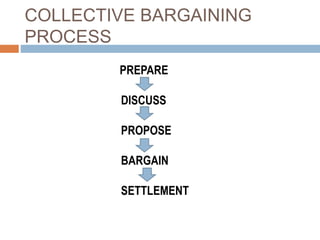
COLLECTIVE BARGAINING
PROCESS
PREPARE
DISCUSS
PROPOSE
BARGAIN
SETTLEMENT
POINTS ON CB
 1 ) It is a two-way process. It is a mutual give and take rather than takes it or
leave it method of arriving at the settlement of a dispute. Both parties are
involved
 2) It is a continuous process which provides a mechanism for continuing an
organized relationship between the management and trade unions. Collective
bargaining begins and ends with the writing of a contract. in it.
 (3) Collective bargaining is not a competitive process but it is essentially a
complementary process.
 4) Collective bargaining is a negotiation process and it is a device used by
wage earners to safeguard their interests. It is an instrument of an industrial
organization for discussion and negotiation between the two parties.
 Negotiations form an important aspect of the
process of collective bargaining i.e., there is
considerable scope for discussion,
compromise or mutual give and take in
collective bargaining.
IMPORTANCE OF CB
To employees:
 Self respect and responsibility
 Increase the strength of the workers
 Increase the morale & productivity
 Restricts managements arbitrary action
 Strengthen the trade union movement
To employer:
 Total productivity of the company increase
 Easier for management to resolve issue
 Reduce cost of labor turnover
 Open up channel of communication b/w top 7 bottom level
Continued
To society
 Industrial peace and harmony
 Build up a system of industrial jurisprudence
 Checks explosion of workers
ADVANTAGES &
DISADVANTAGES
ADVANTAGES
 Both parties can engage in discussions to solve problems.
 It establishes workable bilateral relationship between the
staff and the management.
 Collective bargaining allows for the protection of everyone’s
rights and welfare.
DISADVANTAGES
 While collective bargaining was developed to bridge the
communication gap between the employers and employees,
they can easily create further rifts instead of bridging the
gap.
 Collective bargaining is time consuming.
THANK YOU

Collective bargaining

  • 1.
  • 2.
    HISTORY  In Indiatrade unions have come to occupy the centre stage only after 1900.  In 1918, Gandhi, as the leader of the Ahmadabad Textile workers advocated the resolution of conflict through collective bargaining agreements.  For another 10 years, this method of setting disputes did not gain popularity. The legal steps taken by the government after the Second World War revived interest in the subject once again  After Independence, with the spread of trade unionism, collective bargaining agreements have become popular.  The agreements were found in industries such as chemicals, petroleum, tea, coal, oil, aluminum, etc. In ports and docks, banking and insurance, collective agreements at the national level were also arrived at.
  • 3.
    DEFINITION Collective bargaining isan agreement between a single employer or an association of employer on the one hand & a labor union on the other ,which regulates the terms and condition of employment. ( TUDWIG TELLER)
  • 4.
    MEANING Collective bargaining isa process between employers & employers to reach an agreement regarding the rights and duties of people at work . It aims to reach a collective agreement which usually sets out issues such an employees pay, working hours ,training ,health and safety and rights to participate in work places or company affairs.
  • 5.
    TYPES OF BARGAINING Conjunctive/distributive. bargaining zero – sum game: win – lose. The principle “my gain is your loss & your gain is my loss.  Co-operative bargaining. more open to coming down from their high horses: win-win.  Productivity bargaining its for raising productivity & growth of organization.  Composite bargaining
  • 6.
    FEATURES  A collectiveprocess  A continuous process  A flexible dynamic process  Partnership of worker in management  Maintain discipline in institution  Promote individual jurisprudence.
  • 7.
  • 8.
    POINTS ON CB 1 ) It is a two-way process. It is a mutual give and take rather than takes it or leave it method of arriving at the settlement of a dispute. Both parties are involved  2) It is a continuous process which provides a mechanism for continuing an organized relationship between the management and trade unions. Collective bargaining begins and ends with the writing of a contract. in it.  (3) Collective bargaining is not a competitive process but it is essentially a complementary process.  4) Collective bargaining is a negotiation process and it is a device used by wage earners to safeguard their interests. It is an instrument of an industrial organization for discussion and negotiation between the two parties.
  • 9.
     Negotiations forman important aspect of the process of collective bargaining i.e., there is considerable scope for discussion, compromise or mutual give and take in collective bargaining.
  • 10.
    IMPORTANCE OF CB Toemployees:  Self respect and responsibility  Increase the strength of the workers  Increase the morale & productivity  Restricts managements arbitrary action  Strengthen the trade union movement To employer:  Total productivity of the company increase  Easier for management to resolve issue  Reduce cost of labor turnover  Open up channel of communication b/w top 7 bottom level
  • 11.
    Continued To society  Industrialpeace and harmony  Build up a system of industrial jurisprudence  Checks explosion of workers
  • 12.
    ADVANTAGES & DISADVANTAGES ADVANTAGES  Bothparties can engage in discussions to solve problems.  It establishes workable bilateral relationship between the staff and the management.  Collective bargaining allows for the protection of everyone’s rights and welfare. DISADVANTAGES  While collective bargaining was developed to bridge the communication gap between the employers and employees, they can easily create further rifts instead of bridging the gap.  Collective bargaining is time consuming.
  • 13.