

PRESENTED BY:
PRAMOD KUMAR
India is the second most populous country of the
world. The current population is 1.27 billion (In
2014). It is also one of India’s biggest problems –
burdening and straining the nation’s resources.
India is poised to overtake China as the world’s
most populated nation in the next few decades.
 Population
A Population is a summation of all the organisms of
the same group or species, which live in the
same geographical area, and have the capability of
interbreeding.
 Human population control
Human population control is the practice of
artificially altering the rate of growth of a human
population.
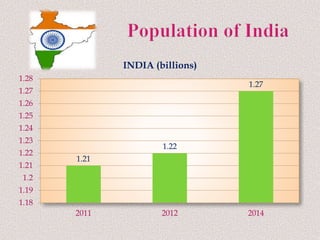
1.21
1.22
1.27
1.18
1.19
1.2
1.21
1.22
1.23
1.24
1.25
1.26
1.27
1.28
2011 2012 2014
INDIA (billions)
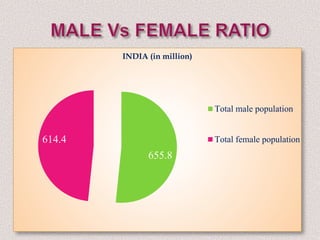
655.8
614.4
INDIA (in million)
Total male population
Total female population
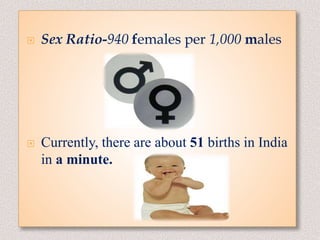
 Sex Ratio-940 females per 1,000 males
 Currently, there are about 51 births in India
in a minute.
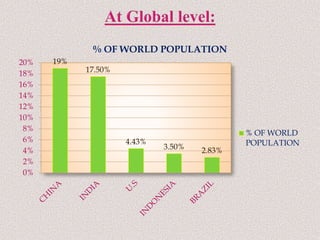
19%
17.50%
4.43%
3.50% 2.83%
0%
2%
4%
6%
8%
10%
12%
14%
16%
18%
20%
% OF WORLD POPULATION
% OF WORLD
POPULATION
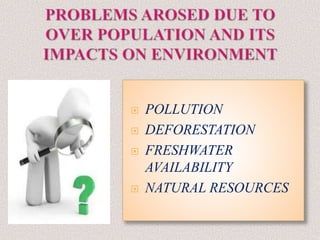
 POLLUTION
 DEFORESTATION
 FRESHWATER
AVAILABILITY
 NATURAL RESOURCES
 To obtain an accurate picture of the
factors which contribute to a rapid
increase of population;
 To gain a full understanding of
human fertility and the means of
regulating it;
 To device speedy ways of education
of the public.
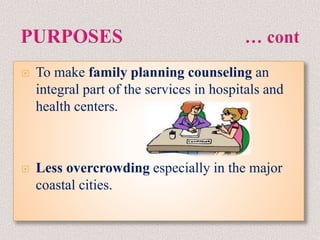
 To make family planning counseling an
integral part of the services in hospitals and
health centers.
 Less overcrowding especially in the major
coastal cities.
The factors which promote fertility
include :
 Age of marriage
 Duration of married life
 Socio-cultural aspects
 Place of woman in society
 The education
 Economic status
 Social policies pertain to age at marriage, education,
economic developments, and gender sensitivity for
woman status, participation of woman in labor
force.
Child marriage restraint Act of 1978: to increase the
legal age for marriage for girls from 15-18 years and
for boys 18-21 years .
Compulsory elementary education for all.
Temporary sterilization
 *Barrier methods
A) Physical methods
B) Chemical methods
C) Combined methods
 *Intra-uterine methods
 *Hormonal methods
 *Post-conception methods
 *Miscellaneous
 These methods are reversible
methods.
 *Male sterilization-male sterilization is also
called vasectomy.
The vasectomy-is customary to remove a piece
of vas deferens.
 *Female sterilization-female sterilization is
known as tubectomy .
In this procedure ligation of fallopian tube.
 The compulsory sterilization after two child norm
made by Indira Gandhi in early 1970s.She give a
slogan ”Hum Do Ham are Do”. Facilities offered
by government to its employees are limited to two
children only.
 Only those with two or fewer children are eligible
for election to a Gram panchayat, or local
government.
 India is first country which adopted an official
family planning in first five year plan 1950.
 Small family norms and the practices of family
planning.
 This was advocate in 1980 and targeted to be
achieved by the year 2000 AD.
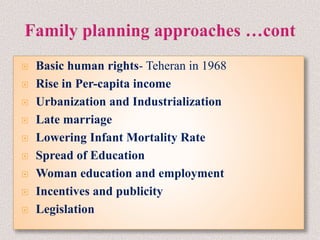
 Basic human rights- Teheran in 1968
 Rise in Per-capita income
 Urbanization and Industrialization
 Late marriage
 Lowering Infant Mortality Rate
 Spread of Education
 Woman education and employment
 Incentives and publicity
 Legislation
 National population Policy-
2000
 National Family welfare
programme- 1951
 Postpartum Programme-
1969
 National population
commission-2005
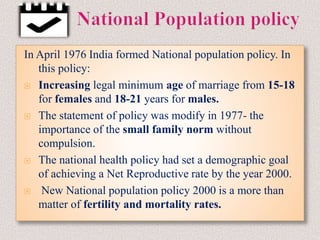
In April 1976 India formed National population policy. In
this policy:
 Increasing legal minimum age of marriage from 15-18
for females and 18-21 years for males.
 The statement of policy was modify in 1977- the
importance of the small family norm without
compulsion.
 The national health policy had set a demographic goal
of achieving a Net Reproductive rate by the year 2000.
 New National population policy 2000 is a more than
matter of fertility and mortality rates.
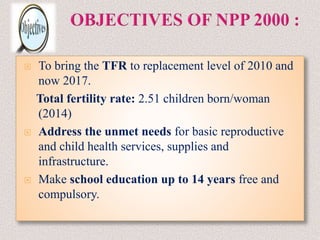
 To bring the TFR to replacement level of 2010 and
now 2017.
Total fertility rate: 2.51 children born/woman
(2014)
 Address the unmet needs for basic reproductive
and child health services, supplies and
infrastructure.
 Make school education up to 14 years free and
compulsory.
 Reduce the infant mortality rate to below 30 per
1000 live birth
Infant mortality rate:
Total: 43.19 deaths/1,000 live births
male: 41.9 deaths/1,000 live births
female: 44.63 deaths/1,000 live births (2014)
 Achieve universal immunization of children.
 Reduce maternal mortality rate to below 100/10000 live
birth.
In 2010- 220
In 2013- 190
 Promote delayed marriage age for girls, after 20.
 Achieve 80% institutional deliveries and 100%
deliveries by trained persons.
 Achieve 100% registration of births, deaths,
marriage and pregnancy.
 Prevent and control communicable diseases.
 Promote small family norms.
 India launched the National Family Welfare
Programme in 1951 with the objective of
"reducing the birth rate to the extent
necessary to stabilize the population at a level
consistent with the requirement of the
National economy.”
The approach under the programme during the
First and Second Five Year Plans was mainly
 "Clinical" under which facilities for provision of
services were created
 It was replaced by "Extension and Education
Approach" which envisaged expansion of
services
 Facilities along with spread of message of small
family norm.
 It was proposed to reduce birth rate from 35/1000 to
32/1000 by the end of plan.
 16.5 million Couples, constituting about 16.5% of
the couples in the reproductive age group, were
protected against conception by the end of IVth
Plan.
 To bring down the birth rate to 30/1000 by 1979.
 Increasing integration of family planning
services.
 Maternal and Child Health (MCH) and their
Nutrition.
 The years 1975-76 and 1976-77 recorded a
phenomenal increase in performance of
sterilization.
 The name of the programme also was changed
to “Family Welfare from Family Planning”.
 Certain long-term demographic goals of reaching
net reproduction rate of unity were envisaged.
VII five year plan (1985-90):
 Emphasis on promoting spacing methods,
 securing maximum community participation
 Promoting maternal and child health care.
 The approach adopted during the Seventh
Five Year Plan was continued during 1990-92
for effective community participation,
Mahila Swasthya Sangh (MSS) at village
level was constituted in 1990-91.
 Several new initiatives were introduced and ongoing
schemes were revamped in this plan.
 Realizing that Government efforts alone in
propagating and motivating the people for
adaptation of small family norm would not be
sufficient, greater stress has been laid on the
involvement of NGOs to supplement and
complement the Government efforts.
OBJECTIVES :
Reduction in the population growth rate
The strategies are:
 To assess the needs for reproductive and child high
quality.
 Integrated reproductive and child health care
reducing the infant and maternal morbidity and
mortality resulting in a reduction in the desired level
of fertility.
Director of Family Welfare is responsible
for planning, co-coordinating, monitoring,
supervising and evaluating activities with
other agencies of Delhi Govt. including NGO’s
in the primary health care activities.
 To facilitate provision of antenatal and natal
services to pregnant women.
 To facilitate implementation of Post partum
program.
 To facilitate provision of family planning services .
 Implementation of UIP (Universal Immunization
Program).
 Surveillance of VPD (Vaccine Preventable
Diseases) Services.
 Implementation of Pulse Polio Program.
 Implementation of PC & PNDT (Pre conception &
Pre Natal Diagnostic Techniques Act 1994
Prevention of Sex Selection) and MTP (Medical
Termination of Pregnancy) Act.
 Co-ordination and execution of IEC (Information
Education and Commission)activities through Mass
Education Media.
 Procurement of State Specific vaccines .
 To monitor performance and quality of family
welfare activities by NGO’s
 Facilitate provision of Adolescent Health
Services in the state of Delhi.
 RCH trainings by the H&FW Training Centre
to update knowledge & skills.
 Maternal Mortality Rate (MMR): Existing 104 per lakh
live births (CRS 2012, to be less than 100 by 2015 & less
than 75 by 2017).
 Total Fertility Rate (TFR): Existing 1.8 (CRS 2011,
TFR corresponding to replacement level of population
being 2.1).
 Sex Ratio at birth which was 809 (CRS 2001) and is 886
(CRS 2012) is planned to be brought up to 925 by 2015,
935 by 2017 and 954 by 2020.
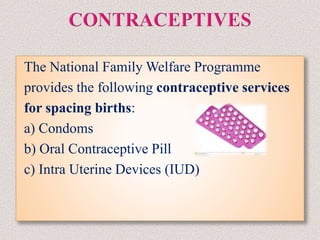
The National Family Welfare Programme
provides the following contraceptive services
for spacing births:
a) Condoms
b) Oral Contraceptive Pill
c) Intra Uterine Devices (IUD)
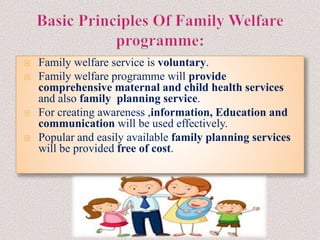
 Family welfare service is voluntary.
 Family welfare programme will provide
comprehensive maternal and child health services
and also family planning service.
 For creating awareness ,information, Education and
communication will be used effectively.
 Popular and easily available family planning services
will be provided free of cost.
 An All India hospital Postpartum
Programme was introduced in 1969.
 It is a hospital –based, maternity centered
approach to family planning.
 The postpartum period is commonly
understood as the first six weeks or 40 days
(depending on the culture) after the birth of
a child, when the woman’s uterus has largely
returned to its pre-pregnancy state.
 Benefits to women, children, and health systems.
 Women need information and services, including a
range of family planning methods,
throughout the maternal cycle, including the
postpartum period.
 Postpartum family planning can be integrated into
other programs, including programs to prevent
and manage HIV.
 To improve the mother and children through
MCH and family Welfare programme which
includes antenatal, neonatal and postnatal
services.
 Immunization services to children and
mothers and prophylaxis against anaemia
and blindness.
In 1952, India was the first country in
the world to launch a national programme,
emphasizing family planning to the extent
necessary for reducing birth rates
To establish co-ordination between centre and
states for population control.
 The commission will review the
implementation of national population policy
and will give directions in addition to establish
better co-ordination between different
programmes like demographic, educational
developmental and environmental protection.
 The commission will also help to form an
extensive population movement for population
control.
 Chief ministers of all the states /union
territories.
 Union ministers of concerned departments.
 Famous demographic specialists
 Public health workers
 Non-governmental organization.
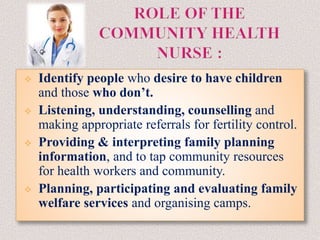
 Identify people who desire to have children
and those who don’t.
 Listening, understanding, counselling and
making appropriate referrals for fertility control.
 Providing & interpreting family planning
information, and to tap community resources
for health workers and community.
 Planning, participating and evaluating family
welfare services and organising camps.
 Supervising and guiding the other female
paramedical personnel such as H.V.,ANM’s
etc;
 Initiating and contributing towards research.
 Planning, conducting, evaluating with MO
in community health centre level training for
other paramedical staff including, Dias.
 Population is now a days crippling humanity and
India is leading second largest populated
country ,hence we all need to wake up and
implement the solution intend to halt crisis.
 Population control programme is a hope to
render comfortable space as per human density.
 To improve the country growth and make the
happy and wealthy country.
Population cntrol
Population cntrol

Population cntrol

  • 1.
  • 2.
    India is thesecond most populous country of the world. The current population is 1.27 billion (In 2014). It is also one of India’s biggest problems – burdening and straining the nation’s resources. India is poised to overtake China as the world’s most populated nation in the next few decades.
  • 3.
     Population A Populationis a summation of all the organisms of the same group or species, which live in the same geographical area, and have the capability of interbreeding.  Human population control Human population control is the practice of artificially altering the rate of growth of a human population.
  • 4.
  • 5.
    655.8 614.4 INDIA (in million) Totalmale population Total female population
  • 6.
     Sex Ratio-940females per 1,000 males  Currently, there are about 51 births in India in a minute.
  • 7.
  • 8.
     POLLUTION  DEFORESTATION FRESHWATER AVAILABILITY  NATURAL RESOURCES
  • 9.
     To obtainan accurate picture of the factors which contribute to a rapid increase of population;  To gain a full understanding of human fertility and the means of regulating it;  To device speedy ways of education of the public.
  • 10.
     To makefamily planning counseling an integral part of the services in hospitals and health centers.  Less overcrowding especially in the major coastal cities.
  • 11.
    The factors whichpromote fertility include :  Age of marriage  Duration of married life  Socio-cultural aspects  Place of woman in society  The education  Economic status
  • 12.
     Social policiespertain to age at marriage, education, economic developments, and gender sensitivity for woman status, participation of woman in labor force. Child marriage restraint Act of 1978: to increase the legal age for marriage for girls from 15-18 years and for boys 18-21 years . Compulsory elementary education for all.
  • 13.
    Temporary sterilization  *Barriermethods A) Physical methods B) Chemical methods C) Combined methods  *Intra-uterine methods  *Hormonal methods  *Post-conception methods  *Miscellaneous  These methods are reversible methods.
  • 14.
     *Male sterilization-malesterilization is also called vasectomy. The vasectomy-is customary to remove a piece of vas deferens.  *Female sterilization-female sterilization is known as tubectomy . In this procedure ligation of fallopian tube.
  • 15.
     The compulsorysterilization after two child norm made by Indira Gandhi in early 1970s.She give a slogan ”Hum Do Ham are Do”. Facilities offered by government to its employees are limited to two children only.  Only those with two or fewer children are eligible for election to a Gram panchayat, or local government.
  • 16.
     India isfirst country which adopted an official family planning in first five year plan 1950.  Small family norms and the practices of family planning.  This was advocate in 1980 and targeted to be achieved by the year 2000 AD.
  • 17.
     Basic humanrights- Teheran in 1968  Rise in Per-capita income  Urbanization and Industrialization  Late marriage  Lowering Infant Mortality Rate  Spread of Education  Woman education and employment  Incentives and publicity  Legislation
  • 18.
     National populationPolicy- 2000  National Family welfare programme- 1951  Postpartum Programme- 1969  National population commission-2005
  • 19.
    In April 1976India formed National population policy. In this policy:  Increasing legal minimum age of marriage from 15-18 for females and 18-21 years for males.  The statement of policy was modify in 1977- the importance of the small family norm without compulsion.  The national health policy had set a demographic goal of achieving a Net Reproductive rate by the year 2000.  New National population policy 2000 is a more than matter of fertility and mortality rates.
  • 20.
     To bringthe TFR to replacement level of 2010 and now 2017. Total fertility rate: 2.51 children born/woman (2014)  Address the unmet needs for basic reproductive and child health services, supplies and infrastructure.  Make school education up to 14 years free and compulsory.
  • 21.
     Reduce theinfant mortality rate to below 30 per 1000 live birth Infant mortality rate: Total: 43.19 deaths/1,000 live births male: 41.9 deaths/1,000 live births female: 44.63 deaths/1,000 live births (2014)  Achieve universal immunization of children.
  • 22.
     Reduce maternalmortality rate to below 100/10000 live birth. In 2010- 220 In 2013- 190  Promote delayed marriage age for girls, after 20.  Achieve 80% institutional deliveries and 100% deliveries by trained persons.  Achieve 100% registration of births, deaths, marriage and pregnancy.  Prevent and control communicable diseases.  Promote small family norms.
  • 23.
     India launchedthe National Family Welfare Programme in 1951 with the objective of "reducing the birth rate to the extent necessary to stabilize the population at a level consistent with the requirement of the National economy.”
  • 24.
    The approach underthe programme during the First and Second Five Year Plans was mainly  "Clinical" under which facilities for provision of services were created  It was replaced by "Extension and Education Approach" which envisaged expansion of services  Facilities along with spread of message of small family norm.
  • 25.
     It wasproposed to reduce birth rate from 35/1000 to 32/1000 by the end of plan.  16.5 million Couples, constituting about 16.5% of the couples in the reproductive age group, were protected against conception by the end of IVth Plan.
  • 26.
     To bringdown the birth rate to 30/1000 by 1979.  Increasing integration of family planning services.  Maternal and Child Health (MCH) and their Nutrition.  The years 1975-76 and 1976-77 recorded a phenomenal increase in performance of sterilization.  The name of the programme also was changed to “Family Welfare from Family Planning”.
  • 27.
     Certain long-termdemographic goals of reaching net reproduction rate of unity were envisaged. VII five year plan (1985-90):  Emphasis on promoting spacing methods,  securing maximum community participation  Promoting maternal and child health care.
  • 28.
     The approachadopted during the Seventh Five Year Plan was continued during 1990-92 for effective community participation, Mahila Swasthya Sangh (MSS) at village level was constituted in 1990-91.
  • 29.
     Several newinitiatives were introduced and ongoing schemes were revamped in this plan.  Realizing that Government efforts alone in propagating and motivating the people for adaptation of small family norm would not be sufficient, greater stress has been laid on the involvement of NGOs to supplement and complement the Government efforts.
  • 30.
    OBJECTIVES : Reduction inthe population growth rate The strategies are:  To assess the needs for reproductive and child high quality.  Integrated reproductive and child health care reducing the infant and maternal morbidity and mortality resulting in a reduction in the desired level of fertility.
  • 31.
    Director of FamilyWelfare is responsible for planning, co-coordinating, monitoring, supervising and evaluating activities with other agencies of Delhi Govt. including NGO’s in the primary health care activities.
  • 32.
     To facilitateprovision of antenatal and natal services to pregnant women.  To facilitate implementation of Post partum program.  To facilitate provision of family planning services .  Implementation of UIP (Universal Immunization Program).  Surveillance of VPD (Vaccine Preventable Diseases) Services.
  • 33.
     Implementation ofPulse Polio Program.  Implementation of PC & PNDT (Pre conception & Pre Natal Diagnostic Techniques Act 1994 Prevention of Sex Selection) and MTP (Medical Termination of Pregnancy) Act.  Co-ordination and execution of IEC (Information Education and Commission)activities through Mass Education Media.  Procurement of State Specific vaccines .
  • 34.
     To monitorperformance and quality of family welfare activities by NGO’s  Facilitate provision of Adolescent Health Services in the state of Delhi.  RCH trainings by the H&FW Training Centre to update knowledge & skills.
  • 35.
     Maternal MortalityRate (MMR): Existing 104 per lakh live births (CRS 2012, to be less than 100 by 2015 & less than 75 by 2017).  Total Fertility Rate (TFR): Existing 1.8 (CRS 2011, TFR corresponding to replacement level of population being 2.1).  Sex Ratio at birth which was 809 (CRS 2001) and is 886 (CRS 2012) is planned to be brought up to 925 by 2015, 935 by 2017 and 954 by 2020.
  • 36.
    The National FamilyWelfare Programme provides the following contraceptive services for spacing births: a) Condoms b) Oral Contraceptive Pill c) Intra Uterine Devices (IUD)
  • 37.
     Family welfareservice is voluntary.  Family welfare programme will provide comprehensive maternal and child health services and also family planning service.  For creating awareness ,information, Education and communication will be used effectively.  Popular and easily available family planning services will be provided free of cost.
  • 38.
     An AllIndia hospital Postpartum Programme was introduced in 1969.  It is a hospital –based, maternity centered approach to family planning.
  • 39.
     The postpartumperiod is commonly understood as the first six weeks or 40 days (depending on the culture) after the birth of a child, when the woman’s uterus has largely returned to its pre-pregnancy state.
  • 40.
     Benefits towomen, children, and health systems.  Women need information and services, including a range of family planning methods, throughout the maternal cycle, including the postpartum period.  Postpartum family planning can be integrated into other programs, including programs to prevent and manage HIV.
  • 41.
     To improvethe mother and children through MCH and family Welfare programme which includes antenatal, neonatal and postnatal services.  Immunization services to children and mothers and prophylaxis against anaemia and blindness.
  • 42.
    In 1952, Indiawas the first country in the world to launch a national programme, emphasizing family planning to the extent necessary for reducing birth rates To establish co-ordination between centre and states for population control.
  • 43.
     The commissionwill review the implementation of national population policy and will give directions in addition to establish better co-ordination between different programmes like demographic, educational developmental and environmental protection.  The commission will also help to form an extensive population movement for population control.
  • 44.
     Chief ministersof all the states /union territories.  Union ministers of concerned departments.  Famous demographic specialists  Public health workers  Non-governmental organization.
  • 45.
     Identify peoplewho desire to have children and those who don’t.  Listening, understanding, counselling and making appropriate referrals for fertility control.  Providing & interpreting family planning information, and to tap community resources for health workers and community.  Planning, participating and evaluating family welfare services and organising camps.
  • 46.
     Supervising andguiding the other female paramedical personnel such as H.V.,ANM’s etc;  Initiating and contributing towards research.  Planning, conducting, evaluating with MO in community health centre level training for other paramedical staff including, Dias.
  • 47.
     Population isnow a days crippling humanity and India is leading second largest populated country ,hence we all need to wake up and implement the solution intend to halt crisis.  Population control programme is a hope to render comfortable space as per human density.  To improve the country growth and make the happy and wealthy country.