BY-
PRAMOD KUMAR
Inter sectoral coordination for
achieving health goals has been accepted
as one of the guiding principles of the
health strategy that was adopted at the
international conference on primary
health care.
 INTER:
Inter means with in or it self.
 SECTOR:
Sector refers to the different – different areas or
they may be different organizations.
 COORDINATION:
Coordination is an administrative process which
seeks to bring about unity of purpose in order to
achieve common objectives.
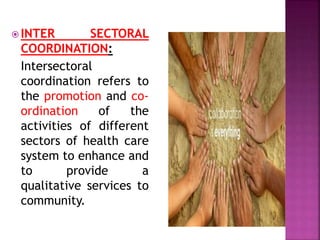
 INTER SECTORAL
COORDINATION:
Intersectoral
coordination refers to
the promotion and co-
ordination of the
activities of different
sectors of health care
system to enhance and
to provide a
qualitative services to
community.
 There are many governmental departments and
agencies working for people whose activities are
closely linked with health, as health itself is a
multi-sectoral subject that needs-
Clean water
Sanitation
Pollution free environment
Economic conditions
Food production etc.
 Earlier health care system focused more on
’curative’ rather than ‘preventive’ aspects.
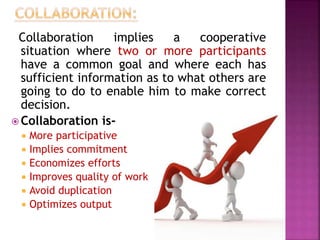
Collaboration implies a cooperative
situation where two or more participants
have a common goal and where each has
sufficient information as to what others are
going to do to enable him to make correct
decision.
 Collaboration is-
 More participative
 Implies commitment
 Economizes efforts
 Improves quality of work
 Avoid duplication
 Optimizes output
Collaboration is a process--- that facilitates
different functionaries and community to work
together for efficient service delivery.
COLLABORATION LEADS -THIRST
T = TIME SAVING
H =HELPS IN BUILDING RAPPORT WITH OTHERS
I =INCREASES EFFICIENCY
R =REDUCES WORKLOAD
S =SHARING OF IDEAS
T =TRUSTWORTHY
 To improve vertical
nature of programs.
 To maintain focus on
primary health care.
 To provide
directionality.
 To promote team
work.
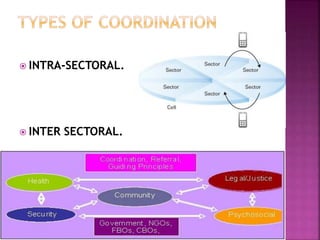
 INTRA-SECTORAL.
 INTER SECTORAL.
1. AT THE KNOWLEDGE LEVEL:-
 Lack of knowledge of other programmes and goals
of other sectors. Each programme is implemented
in an isolated manner.
For example Health Deptt. may not know the
goals of ICDS programme, which in turn may not
be aware of the goals of RCH programme etc. This
leads to misunderstanding, repetition and
sometimes even contradictions, which affect the
credibility.
2. AT THE ATTITUDINAL LEVEL:-
 The feeling of ‘why should I go, the other
person should come forward’.
 The attitudes are often based on
misconception—coordination means more
work and assuming responsibility for others
work.
3. AT THE PRACTICE LEVEL:-
Lack of knowledge about the mechanisms.
People do not know how to go about it and
how to formalize it. The formal mechanism
such as constitution of Advisory Committees,
Coordination Committees, Task-forces etc.
leadership style and willingness.
Health policies and priorities.
Sharing of a common vision and
perspective.
Defining role and responsibilities of
participatory agencies.
Participatory decision making.
 Developing informal contacts with involved
groups.
 Learning more about quality of services.
 Spelling out strategies and procedures.
 Conducting joint monitoring and evaluation.
 Taking immediate remedial measures in
solving problems related to
coordination/resource mobilization.
Promotion of
nutrition
Agriculture
Education
Social
Welfare/Wo
men and
Child
Development
Panchayats
Animal
Husbandry
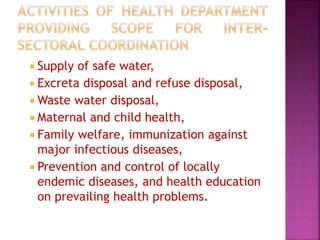
 Supply of safe water,
 Excreta disposal and refuse disposal,
 Waste water disposal,
 Maternal and child health,
 Family welfare, immunization against
major infectious diseases,
 Prevention and control of locally
endemic diseases, and health education
on prevailing health problems.
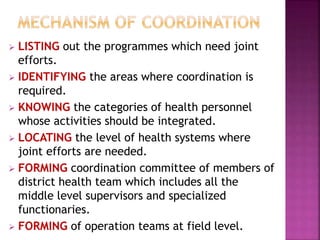
 LISTING out the programmes which need joint
efforts.
 IDENTIFYING the areas where coordination is
required.
 KNOWING the categories of health personnel
whose activities should be integrated.
 LOCATING the level of health systems where
joint efforts are needed.
 FORMING coordination committee of members of
district health team which includes all the
middle level supervisors and specialized
functionaries.
 FORMING of operation teams at field level.
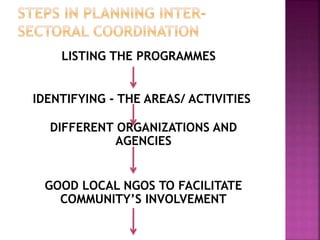
LISTING THE PROGRAMMES
IDENTIFYING - THE AREAS/ ACTIVITIES
DIFFERENT ORGANIZATIONS AND
AGENCIES
GOOD LOCAL NGOS TO FACILITATE
COMMUNITY’S INVOLVEMENT
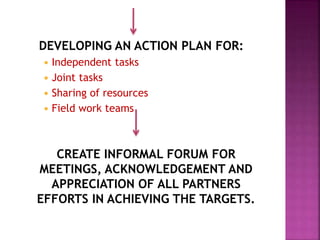
DEVELOPING AN ACTION PLAN FOR:
 Independent tasks
 Joint tasks
 Sharing of resources
 Field work teams
CREATE INFORMAL FORUM FOR
MEETINGS, ACKNOWLEDGEMENT AND
APPRECIATION OF ALL PARTNERS
EFFORTS IN ACHIEVING THE TARGETS.
 Community participation has been identified
as an important means of overcoming sectoral
barriers.
 It is the community and its involvement that
best motivates collaboration between sectors
through the community, health goals can be
linked to and reinforces other goals of well
being.
 It is a long arduous task but results are good
and lasting.
 The ranges of activities of community participation
therefore include the following:
 Helping community to analyze their problems and their
causes.
 To identify the needs and prioritize them in a logical
manner. Sometimes felt needs of the community may be
different from the perceived need of the health
professional.
 To plan activities to meet these needs/solve the
problems and to find resources for them.
 To monitor closely the implementation of programmes.
 Last but not the least to own the programme by
assuming full responsibility for its implementation.
 MORE achievement at lower cost.
 CATALYST for further development.
 DEVELOPS a sense of ownership and
subsequently responsibility in utilization
and maintenance of health care services.
 INCULCATES self-reliance by enhancing the
use of local indigenous expertise.
 Rangabela project, West Bengal
 Comprehensive Rural Development
Project, Jamkhed, Maharashtra
 RUSHA Integrated Health and Community
Development Project, Vallur, Tamil Nadu.
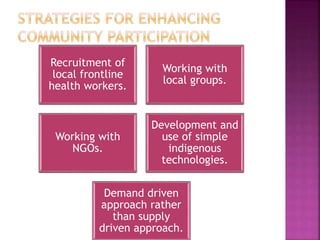
Recruitment of
local frontline
health workers.
Working with
local groups.
Working with
NGOs.
Development and
use of simple
indigenous
technologies.
Demand driven
approach rather
than supply
driven approach.
 TITLE OF THE STUDY:-
Intersectoral coordination, community
empowerment and dengue prevention: six years
of controlled interventions in Playa Municipality,
Havana, Cuba.
 OBJECTIVE:
To document the process, outcome and
effectiveness of a community-based
intervention for dengue control.
 METHODS:
The primary intervention, focused on strengthening
intersectoral coordination, was initiated by
researchers in January 2000 in a pilot area in Playa
municipality, Havana. In August 2002 health
authorities extended the intervention to
neighbouring areas, one of which was selected for
evaluation. In August 2003 a complementary
strategy, focused on community empowerment,
was initiated in half of the pilot area. Longitudinal
process assessment was carried out using document
analysis, interviews and group discussions. Random
population surveys in 1999, 2002 and 2005 assessed
levels of participation and behavioural changes.
Entomological surveillance data from 1999 to 2005
were used to determine effectiveness.
 RESULTS:
Mean scores for participation in the pilot area were
1.6, 3.4 and 4.4 at baseline, and 2 years after initiating
intersectoral coordination and intersectoral
coordination plus community empowerment
interventions, respectively. While in the control area
little behavioural change was observed over time,
changes were considerable in the pilot and extension
areas, with 80% of households involved in the
community empowerment intervention showed
adequate behavioural patterns. The pilot and extension
areas attained comparable entomological effectiveness
with significantly lower Breteau indices (BIs) than the
control area. The pilot (sub-) area with the community
empowerment intervention reached BIs below 0.1 that
continued to be significantly lower than the one in the
control area until the end of the study.
 CONCLUSION:
The study showed a trend in the levels and
quality of participation, behavioural change and
effectiveness of Aedes control from the routine
activities only over an intervention with
intersectoral coordination to one that combined
intersectoral coordination and community
empowerment approach.
Inter sectoral coordination

Inter sectoral coordination

  • 1.
  • 2.
    Inter sectoral coordinationfor achieving health goals has been accepted as one of the guiding principles of the health strategy that was adopted at the international conference on primary health care.
  • 3.
     INTER: Inter meanswith in or it self.  SECTOR: Sector refers to the different – different areas or they may be different organizations.  COORDINATION: Coordination is an administrative process which seeks to bring about unity of purpose in order to achieve common objectives.
  • 4.
     INTER SECTORAL COORDINATION: Intersectoral coordinationrefers to the promotion and co- ordination of the activities of different sectors of health care system to enhance and to provide a qualitative services to community.
  • 5.
     There aremany governmental departments and agencies working for people whose activities are closely linked with health, as health itself is a multi-sectoral subject that needs- Clean water Sanitation Pollution free environment Economic conditions Food production etc.  Earlier health care system focused more on ’curative’ rather than ‘preventive’ aspects.
  • 6.
    Collaboration implies acooperative situation where two or more participants have a common goal and where each has sufficient information as to what others are going to do to enable him to make correct decision.  Collaboration is-  More participative  Implies commitment  Economizes efforts  Improves quality of work  Avoid duplication  Optimizes output
  • 7.
    Collaboration is aprocess--- that facilitates different functionaries and community to work together for efficient service delivery. COLLABORATION LEADS -THIRST T = TIME SAVING H =HELPS IN BUILDING RAPPORT WITH OTHERS I =INCREASES EFFICIENCY R =REDUCES WORKLOAD S =SHARING OF IDEAS T =TRUSTWORTHY
  • 8.
     To improvevertical nature of programs.  To maintain focus on primary health care.  To provide directionality.  To promote team work.
  • 9.
  • 10.
    1. AT THEKNOWLEDGE LEVEL:-  Lack of knowledge of other programmes and goals of other sectors. Each programme is implemented in an isolated manner. For example Health Deptt. may not know the goals of ICDS programme, which in turn may not be aware of the goals of RCH programme etc. This leads to misunderstanding, repetition and sometimes even contradictions, which affect the credibility.
  • 11.
    2. AT THEATTITUDINAL LEVEL:-  The feeling of ‘why should I go, the other person should come forward’.  The attitudes are often based on misconception—coordination means more work and assuming responsibility for others work.
  • 12.
    3. AT THEPRACTICE LEVEL:- Lack of knowledge about the mechanisms. People do not know how to go about it and how to formalize it. The formal mechanism such as constitution of Advisory Committees, Coordination Committees, Task-forces etc.
  • 13.
    leadership style andwillingness. Health policies and priorities. Sharing of a common vision and perspective. Defining role and responsibilities of participatory agencies. Participatory decision making.
  • 14.
     Developing informalcontacts with involved groups.  Learning more about quality of services.  Spelling out strategies and procedures.  Conducting joint monitoring and evaluation.  Taking immediate remedial measures in solving problems related to coordination/resource mobilization.
  • 15.
  • 16.
     Supply ofsafe water,  Excreta disposal and refuse disposal,  Waste water disposal,  Maternal and child health,  Family welfare, immunization against major infectious diseases,  Prevention and control of locally endemic diseases, and health education on prevailing health problems.
  • 17.
     LISTING outthe programmes which need joint efforts.  IDENTIFYING the areas where coordination is required.  KNOWING the categories of health personnel whose activities should be integrated.  LOCATING the level of health systems where joint efforts are needed.  FORMING coordination committee of members of district health team which includes all the middle level supervisors and specialized functionaries.  FORMING of operation teams at field level.
  • 18.
    LISTING THE PROGRAMMES IDENTIFYING- THE AREAS/ ACTIVITIES DIFFERENT ORGANIZATIONS AND AGENCIES GOOD LOCAL NGOS TO FACILITATE COMMUNITY’S INVOLVEMENT
  • 19.
    DEVELOPING AN ACTIONPLAN FOR:  Independent tasks  Joint tasks  Sharing of resources  Field work teams CREATE INFORMAL FORUM FOR MEETINGS, ACKNOWLEDGEMENT AND APPRECIATION OF ALL PARTNERS EFFORTS IN ACHIEVING THE TARGETS.
  • 20.
     Community participationhas been identified as an important means of overcoming sectoral barriers.  It is the community and its involvement that best motivates collaboration between sectors through the community, health goals can be linked to and reinforces other goals of well being.  It is a long arduous task but results are good and lasting.
  • 21.
     The rangesof activities of community participation therefore include the following:  Helping community to analyze their problems and their causes.  To identify the needs and prioritize them in a logical manner. Sometimes felt needs of the community may be different from the perceived need of the health professional.  To plan activities to meet these needs/solve the problems and to find resources for them.  To monitor closely the implementation of programmes.  Last but not the least to own the programme by assuming full responsibility for its implementation.
  • 22.
     MORE achievementat lower cost.  CATALYST for further development.  DEVELOPS a sense of ownership and subsequently responsibility in utilization and maintenance of health care services.  INCULCATES self-reliance by enhancing the use of local indigenous expertise.
  • 23.
     Rangabela project,West Bengal  Comprehensive Rural Development Project, Jamkhed, Maharashtra  RUSHA Integrated Health and Community Development Project, Vallur, Tamil Nadu.
  • 24.
    Recruitment of local frontline healthworkers. Working with local groups. Working with NGOs. Development and use of simple indigenous technologies. Demand driven approach rather than supply driven approach.
  • 25.
     TITLE OFTHE STUDY:- Intersectoral coordination, community empowerment and dengue prevention: six years of controlled interventions in Playa Municipality, Havana, Cuba.  OBJECTIVE: To document the process, outcome and effectiveness of a community-based intervention for dengue control.
  • 26.
     METHODS: The primaryintervention, focused on strengthening intersectoral coordination, was initiated by researchers in January 2000 in a pilot area in Playa municipality, Havana. In August 2002 health authorities extended the intervention to neighbouring areas, one of which was selected for evaluation. In August 2003 a complementary strategy, focused on community empowerment, was initiated in half of the pilot area. Longitudinal process assessment was carried out using document analysis, interviews and group discussions. Random population surveys in 1999, 2002 and 2005 assessed levels of participation and behavioural changes. Entomological surveillance data from 1999 to 2005 were used to determine effectiveness.
  • 27.
     RESULTS: Mean scoresfor participation in the pilot area were 1.6, 3.4 and 4.4 at baseline, and 2 years after initiating intersectoral coordination and intersectoral coordination plus community empowerment interventions, respectively. While in the control area little behavioural change was observed over time, changes were considerable in the pilot and extension areas, with 80% of households involved in the community empowerment intervention showed adequate behavioural patterns. The pilot and extension areas attained comparable entomological effectiveness with significantly lower Breteau indices (BIs) than the control area. The pilot (sub-) area with the community empowerment intervention reached BIs below 0.1 that continued to be significantly lower than the one in the control area until the end of the study.
  • 28.
     CONCLUSION: The studyshowed a trend in the levels and quality of participation, behavioural change and effectiveness of Aedes control from the routine activities only over an intervention with intersectoral coordination to one that combined intersectoral coordination and community empowerment approach.