Explain the importance of human
resource management.
Describe how recruitment and
selection contribute to placing the
right person in a job.
Explain how training programs
and performance appraisals help
employees grow and develop.
Outline the methods employers
use to compensate employees.
Discuss employee separation and
the impact of downsizing and
outsourcing.
Explain how Maslow’s hierarchy-
of-needs theory, goal setting, job
design, and managers’ attitudes
relate to employee motivation.
1
2
3
4
5
6
AGENDA
1) Providing qualified, well-trained
employees for the organization.
2) Maximizing employee effectiveness in
the organization.
3) Satisfying individual employee needs
through monetary compensation,
benefits, opportunities to advance, and
job satisfaction.
Vital to All
Organizations
Human resource management - function of
attracting, developing, and retaining enough
qualified employees to perform the activities
necessary to accomplish organizational
objectives. Three main objectives:
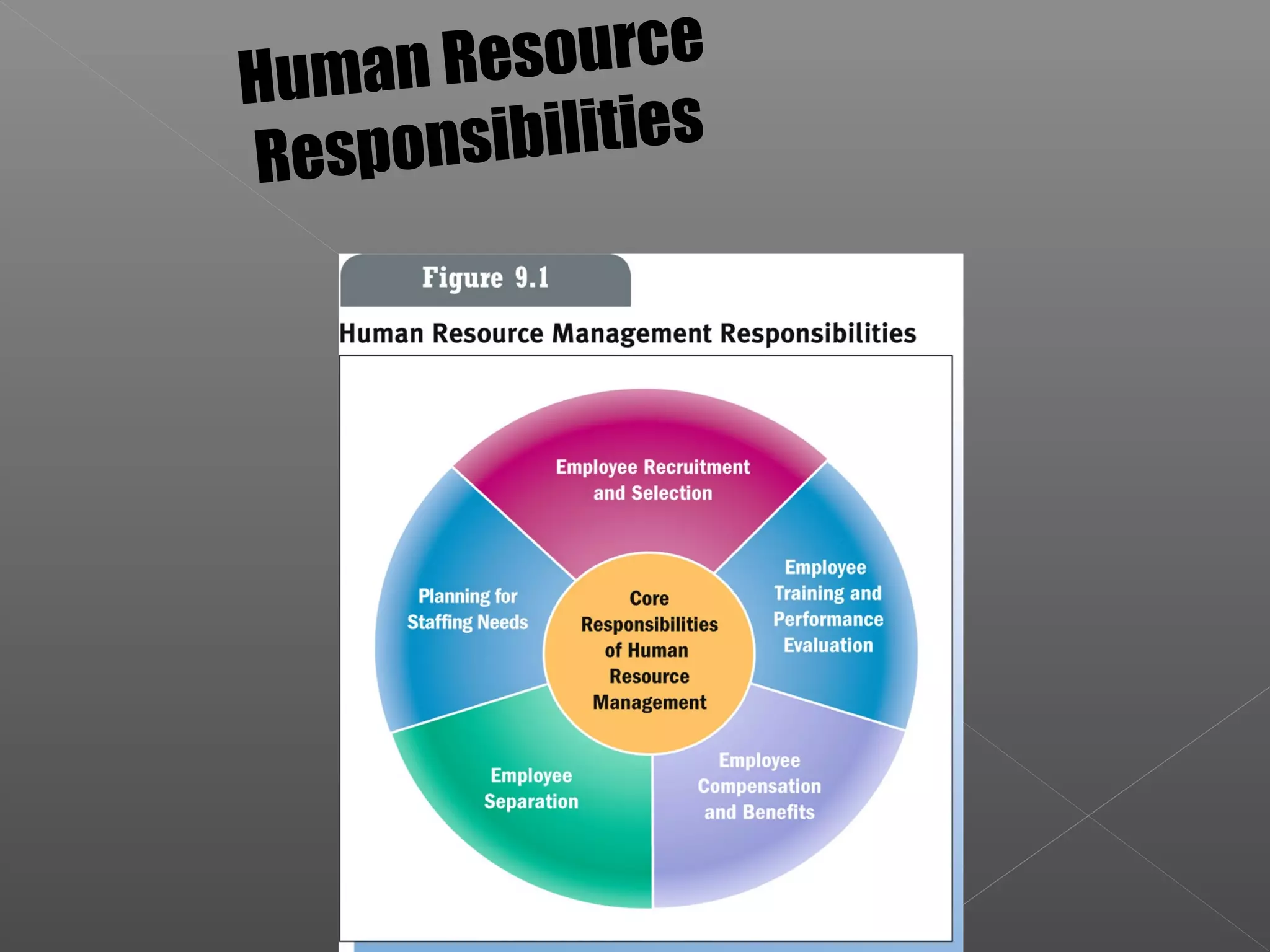
Human Resource
Responsibilities
• 35% of human resource professionals report a
shortage of job candidates with degrees related field.
• HR must be creative in searching for qualified
employees.
• Businesses look both internally and externally.
Recruitment &
Selection
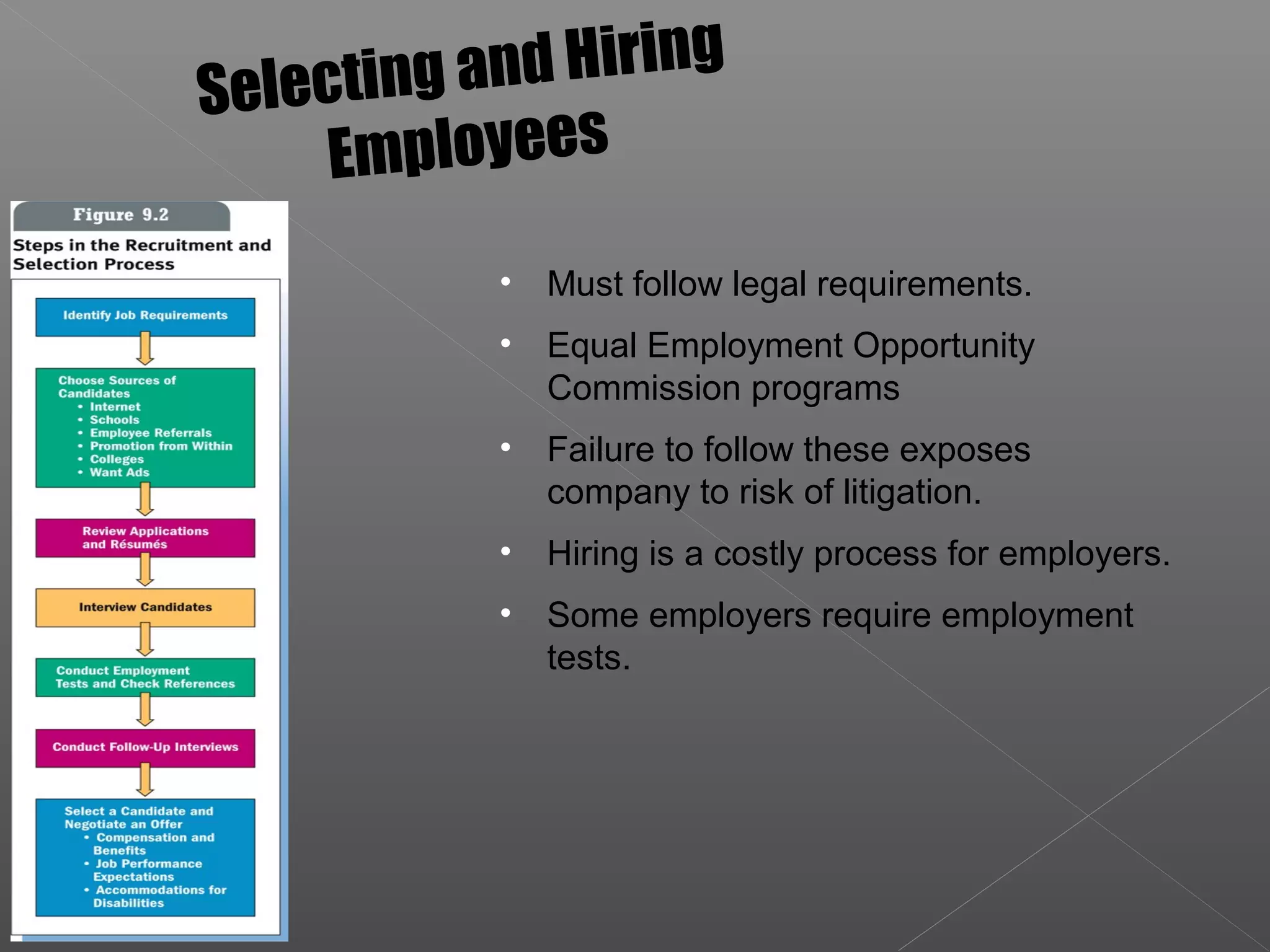
• Must follow legal requirements.
• Equal Employment Opportunity
Commission programs
• Failure to follow these exposes
company to risk of litigation.
• Hiring is a costly process for employers.
• Some employers require employment
tests.
Selecting and Hiring
Employees
Orientation and
Training
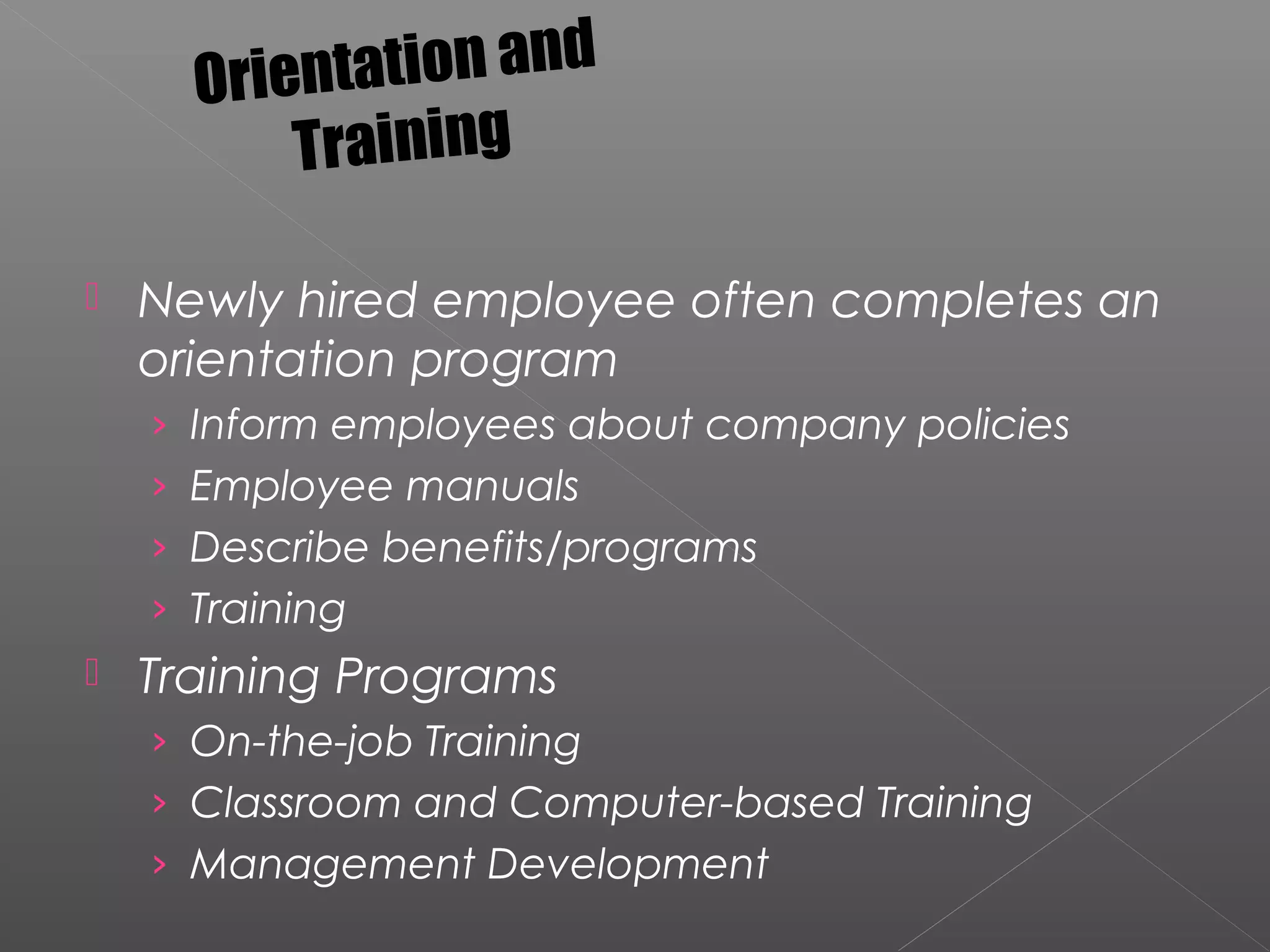
 Newly hired employee often completes an
orientation program
› Inform employees about company policies
› Employee manuals
› Describe benefits/programs
› Training
 Training Programs
› On-the-job Training
› Classroom and Computer-based Training
› Management Development
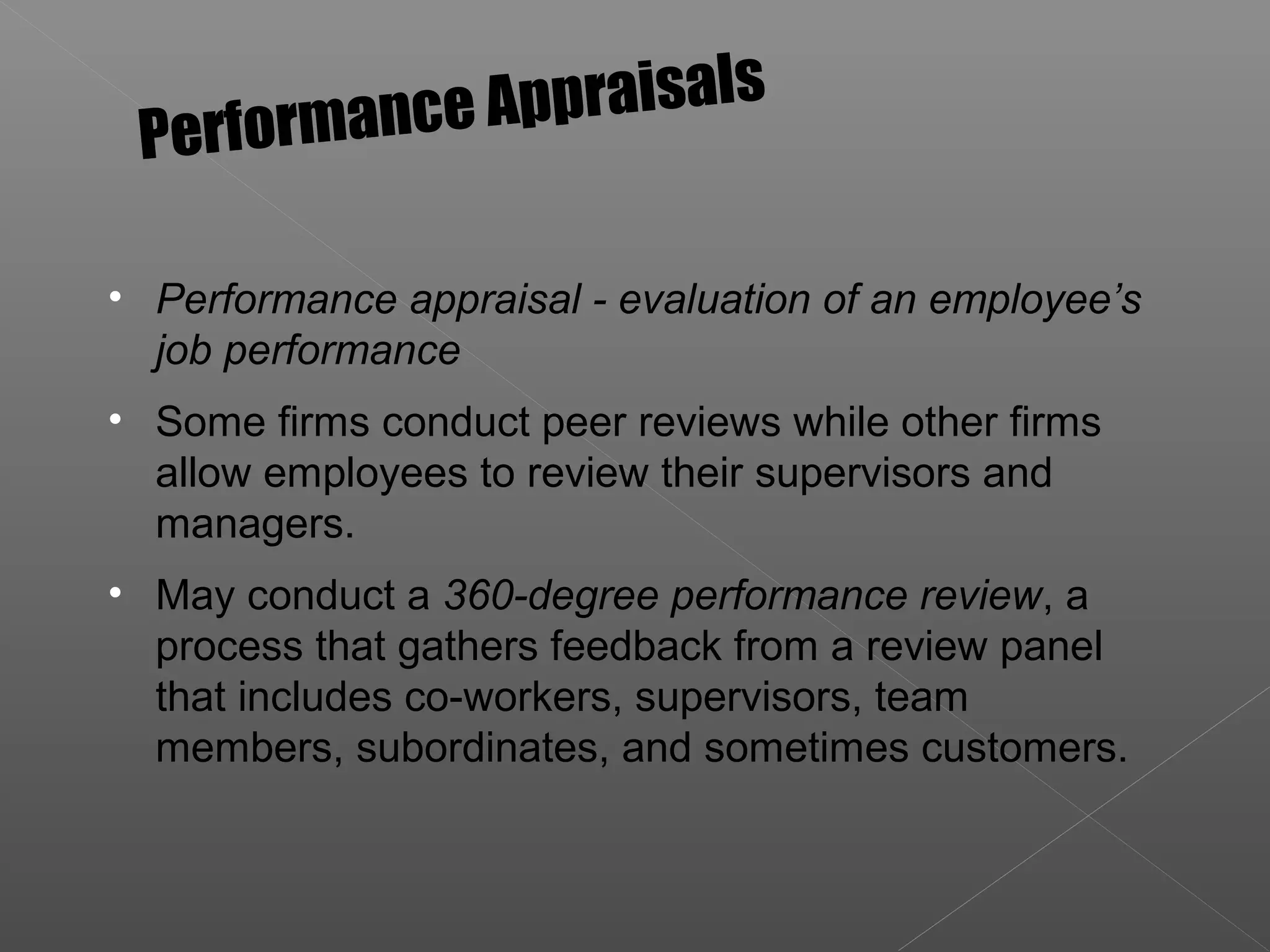
• Performance appraisal - evaluation of an employee’s
job performance
• Some firms conduct peer reviews while other firms
allow employees to review their supervisors and
managers.
• May conduct a 360-degree performance review, a
process that gathers feedback from a review panel
that includes co-workers, supervisors, team
members, subordinates, and sometimes customers.
Performance Appraisals
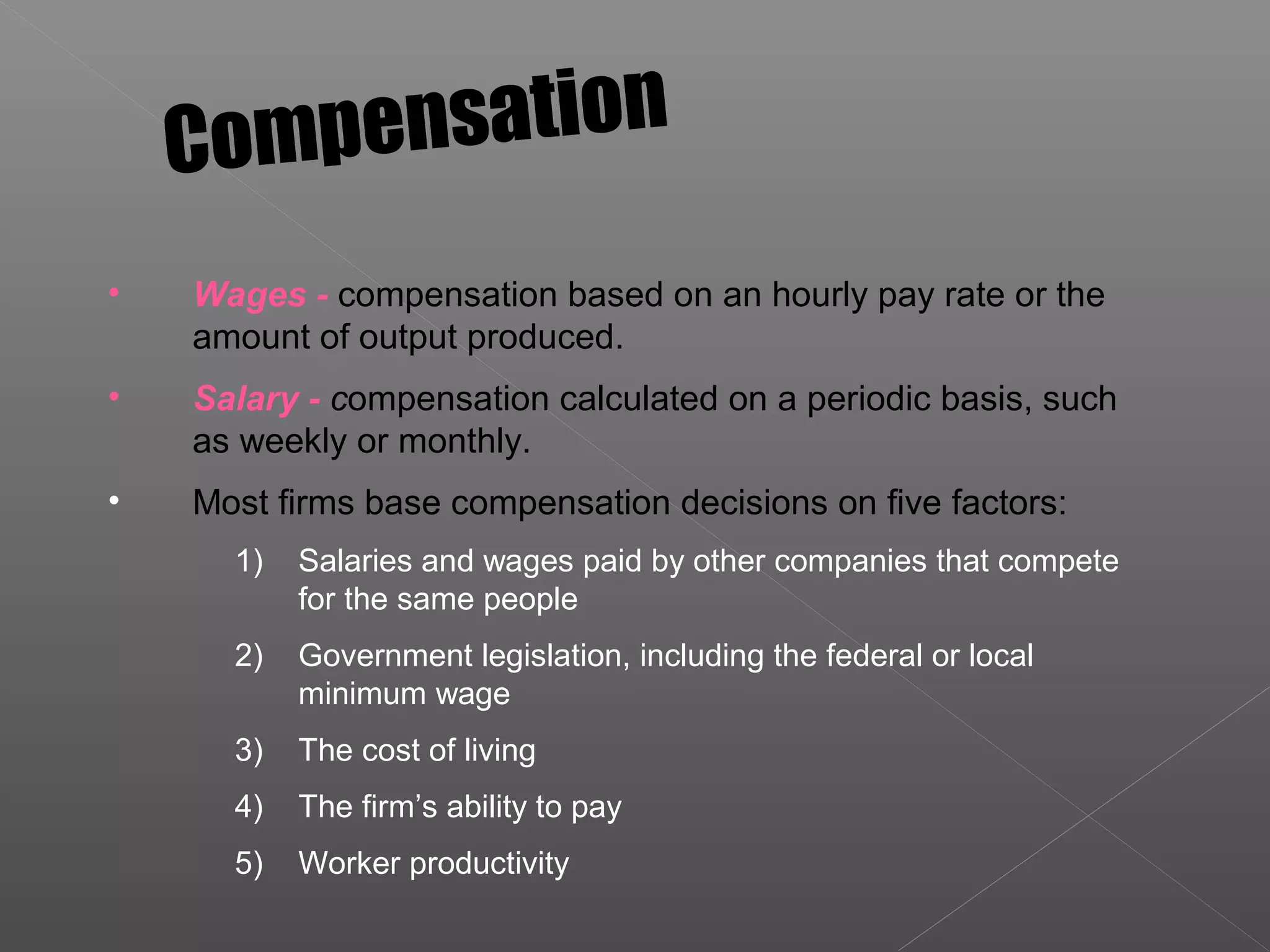
• Wages - compensation based on an hourly pay rate or the
amount of output produced.
• Salary - compensation calculated on a periodic basis, such
as weekly or monthly.
• Most firms base compensation decisions on five factors:
1) Salaries and wages paid by other companies that compete
for the same people
2) Government legislation, including the federal or local
minimum wage
3) The cost of living
4) The firm’s ability to pay
5) Worker productivity
Compensation
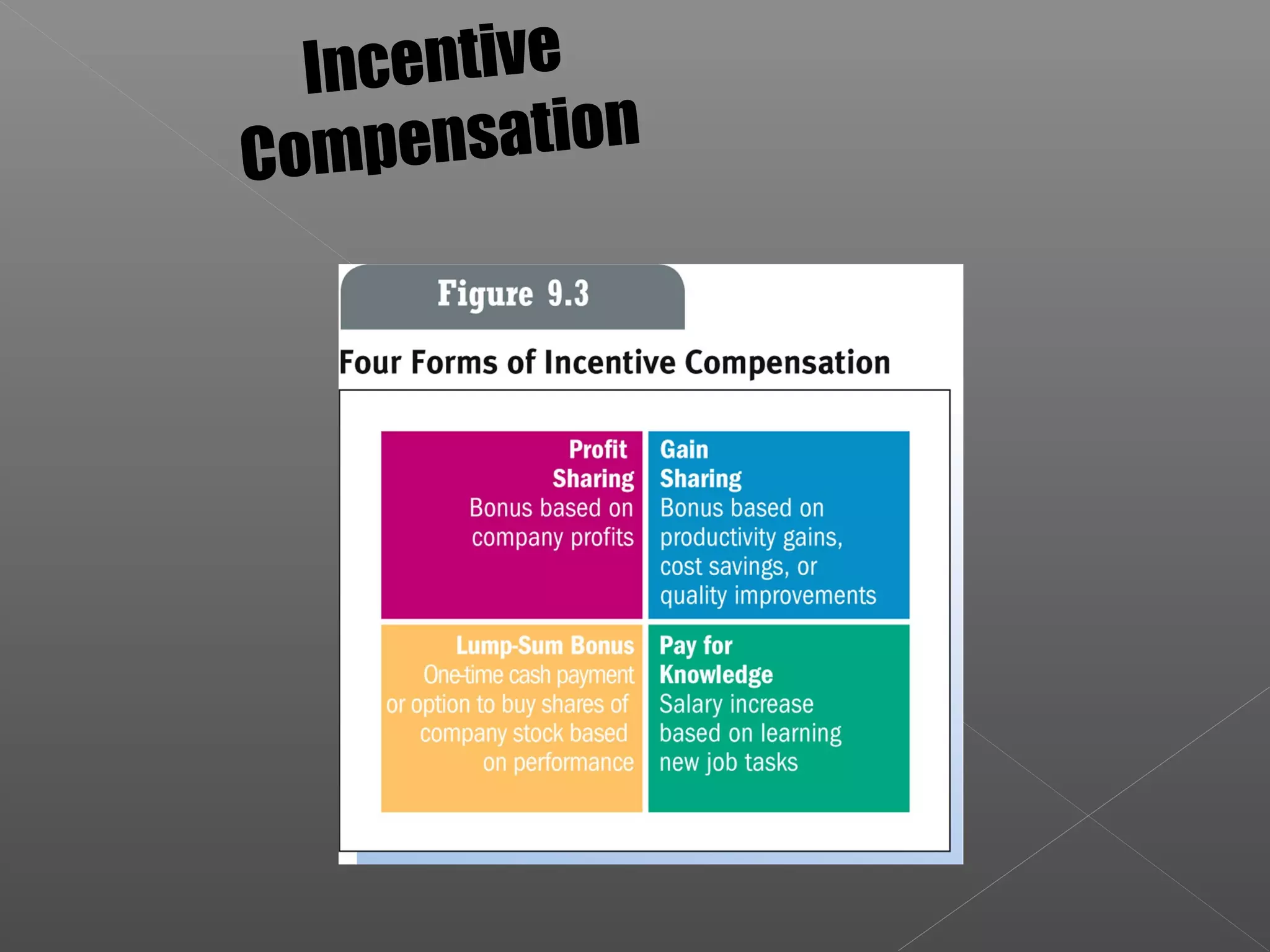
Incentive
Compensation
• Employee Benefits - Rewards such as retirement
plans,
health insurance, vacation, and tuition reimbursement
provided for employees either entirely or in part at the
company’s expense
• EOBI, medical leaves, increments, etc
• Costs of health care are increasingly being shifted to
workers.
• Retirement plans have become a big area of concern
for businesses.
Employee Benefits
• Employees are provided a range of options from
which they can choose.
– Medical, dental, vision, life and disability insurance
• Many companies also offer flexible time off policies
instead of establishing a set number of holidays,
vacations days and sick days.
• Companies sometimes provide paid time off (PTO)
programs.
Flexible Benefits
• Allow employees to adjust their working hours and places
of work to accommodate their personal needs.
• Flextime allows employees to set their own work hours
within constraints specified by the firm.
• A compressed workweek allows employees to work the
regular number of weekly hours in fewer than the typical
five days.
• A job sharing program allows two or more employees to
divide the tasks of one job.
• A home-based work program allows employees, or
telecommuters, to perform their jobs from home instead
of at the workplace
Flexible Work
• Voluntary turnover: employees leave firms to start their own
businesses, take jobs with other firms, move to another city, or retire.
– Some firms ask employees who leave voluntarily to participate in exit
interviews to find out why they decided to leave.
– Successful companies are clearly focused on retaining their best workers.
• Involuntary turnover: employers terminate employees because of poor
job performance, negative attitudes toward work and co-workers, or
misconduct such as dishonesty or sexual harassment.
– Necessary because poor performers lower productivity and
employee morale.
– Employers must carefully document reasons when terminating
employees.
Employee
Separation
• Downsizing - process of
reducing the number of
employees within a firm by
eliminating jobs
• Downsizing doesn’t guarantee
improvements or cost savings.
• Devastating impact on employee
morale
• Encourages employees to put
individual career success ahead
of company loyalty
Downsizing/Outsourcing
• Outsourcing - contracting with
another business to perform
tasks or functions previously
handled by internal staff
members
• Focus on business
competitiveness and flexibility
• Get best price among
competing bidders while
avoiding long-term costs of in-
house operations
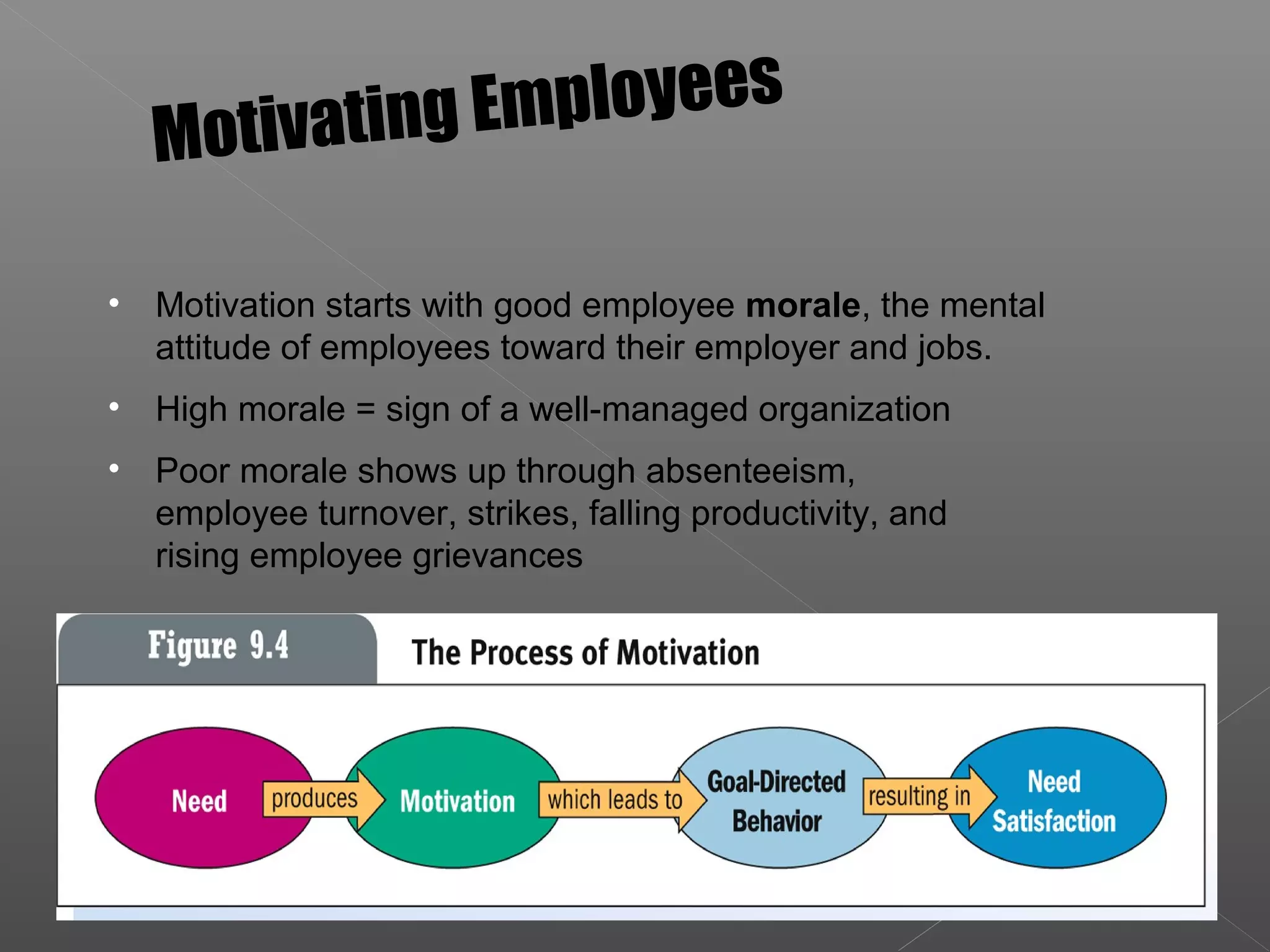
• Motivation starts with good employee morale, the mental
attitude of employees toward their employer and jobs.
• High morale = sign of a well-managed organization
• Poor morale shows up through absenteeism,
employee turnover, strikes, falling productivity, and
rising employee grievances
Motivating Employees
• Maslow’s hierarchy of needs: people have five levels of needs
that they seek to satisfy.
• A satisfied need is not a motivator; only needs that remain
unsatisfied can influence behavior.
• People’s needs are arranged in a hierarchy of importance; once
they satisfy one need, at least partially, another emerges and
demands satisfaction.
– Physiological needs
– Safety needs
– Social (belongingness) needs
– Esteem needs
– Self-actualization needs
Maslow’s Hierarchy of
Needs Theory
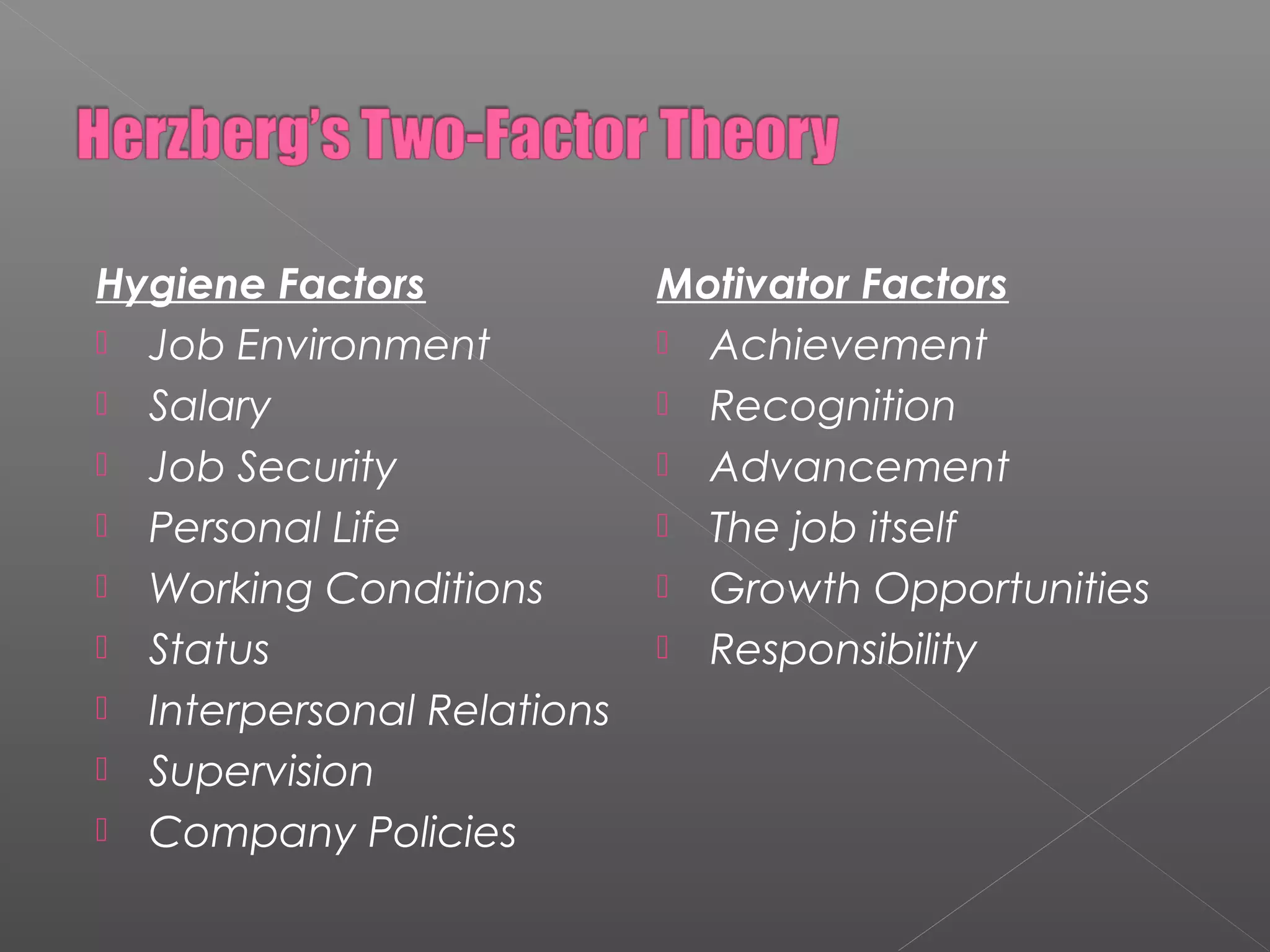
Hygiene Factors
 Job Environment
 Salary
 Job Security
 Personal Life
 Working Conditions
 Status
 Interpersonal Relations
 Supervision
 Company Policies
Motivator Factors
 Achievement
 Recognition
 Advancement
 The job itself
 Growth Opportunities
 Responsibility
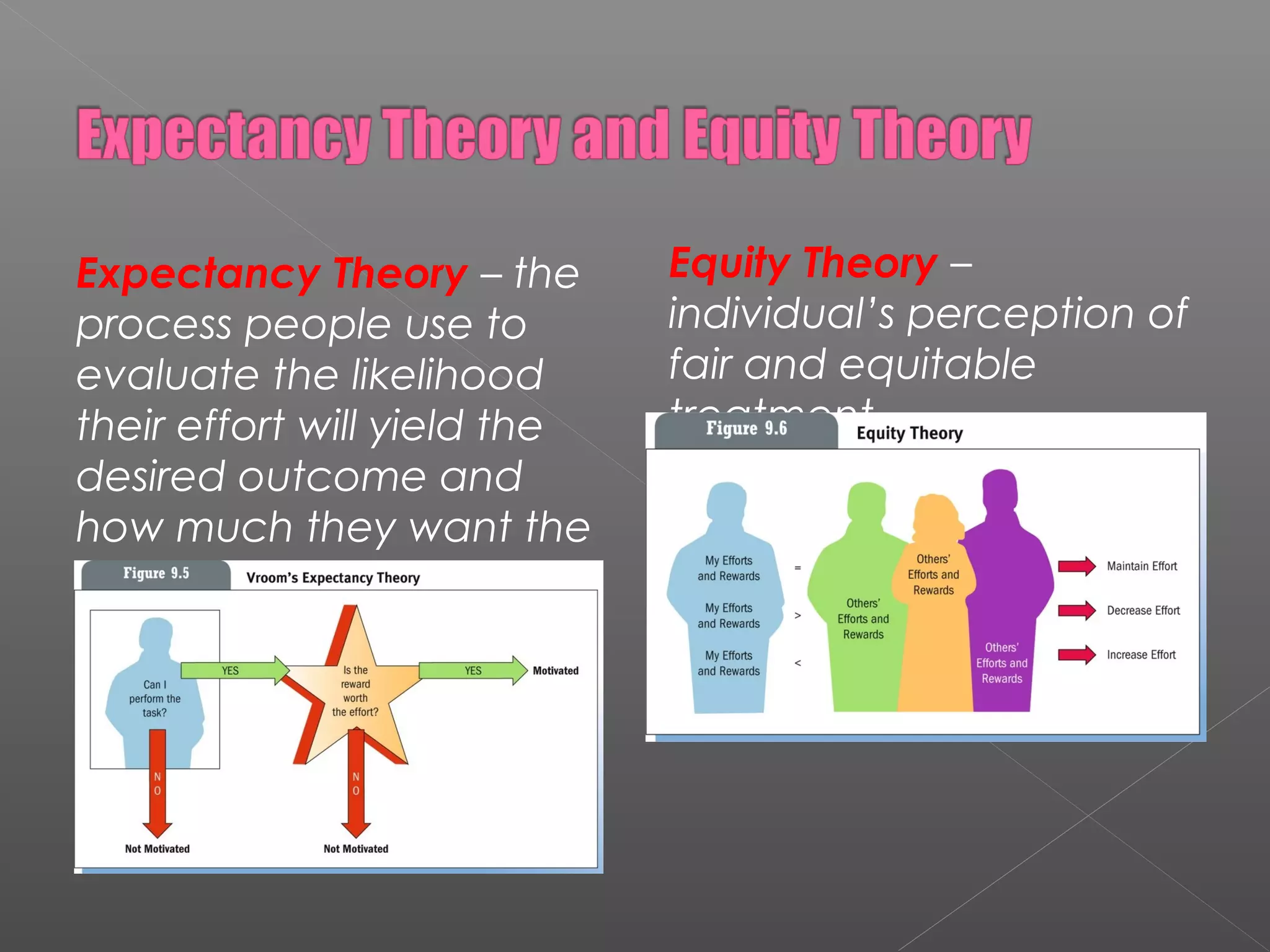
Expectancy Theory – the
process people use to
evaluate the likelihood
their effort will yield the
desired outcome and
how much they want the
outcome.
Equity Theory –
individual’s perception of
fair and equitable
treatment.
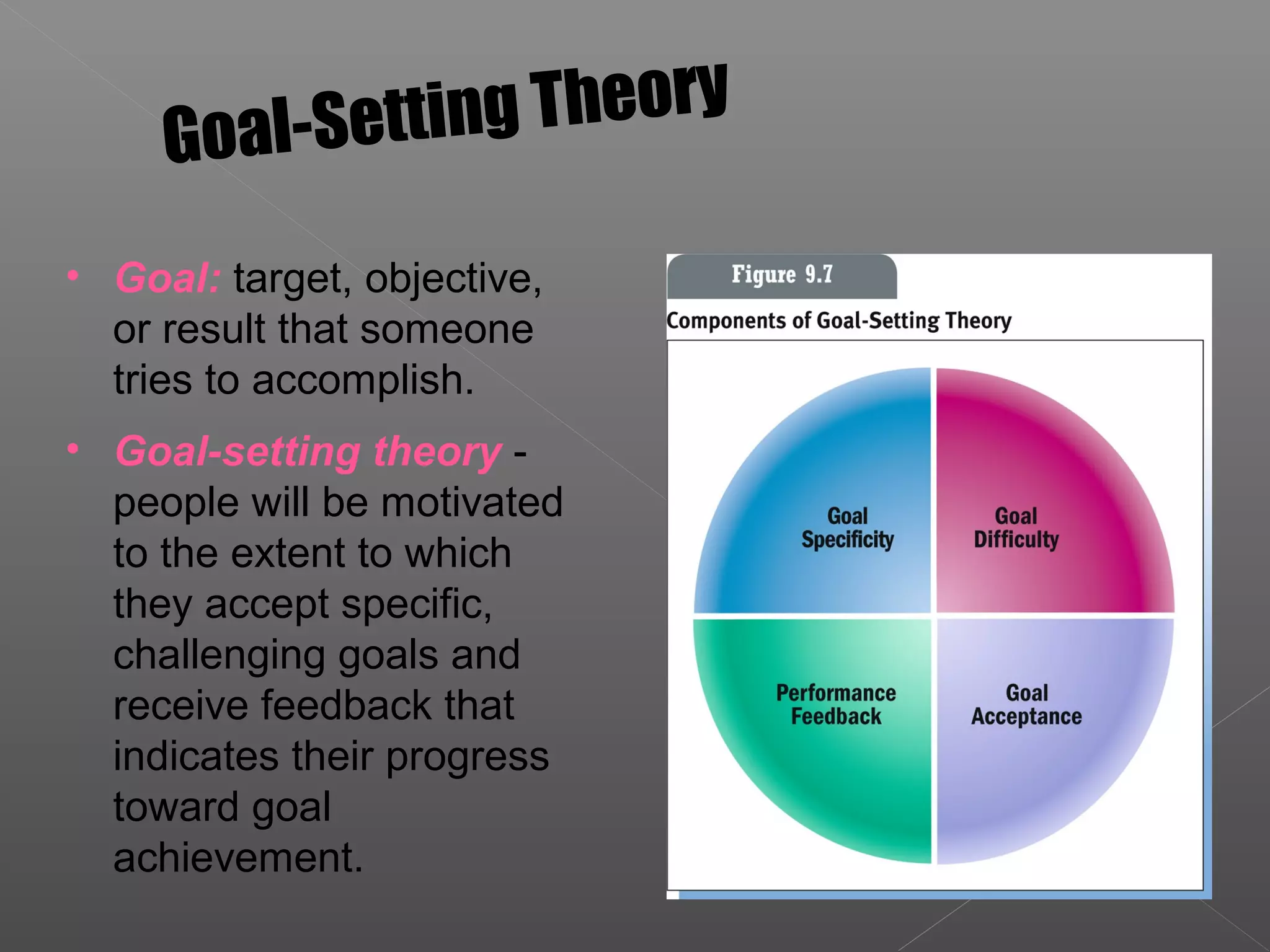
• Goal: target, objective,
or result that someone
tries to accomplish.
• Goal-setting theory -
people will be motivated
to the extent to which
they accept specific,
challenging goals and
receive feedback that
indicates their progress
toward goal
achievement.
Goal-Setting Theory
 Systematic and organized approach that allows
managers to focus on attainable goals and
achieve the best results.
 MBO helps motivate individuals by aligning their
objectives with the goals of the organization.
 MBO Principals:
› A series of related organizations, goals, and objectives
› Specific objectives for each individual
› Participative decision making
› Set time period to accomplish goals
› Performance evaluation and feedback
Management by
Objective
• Two assumptions manager make about employees,
according to psychologist Douglas McGregor:
• Theory X: employees dislike work and try to avoid it
whenever possible; managers must coerce or control them
or threaten punishment to achieve the organization’s goals.
• Theory Y: typical person likes work and learns to accept
and seek responsibilities; managers assume creative people
solve work-related problems.
• A third theory from management professor William Ouchi:
• Theory Z: worker involvement is key to increased productivity
for the company and improved quality of work life for
employees.
Managers’ Attitudes
and Motivation
THANK YOU

Human Resource Management and Motivation

  • 2.
    Explain the importanceof human resource management. Describe how recruitment and selection contribute to placing the right person in a job. Explain how training programs and performance appraisals help employees grow and develop. Outline the methods employers use to compensate employees. Discuss employee separation and the impact of downsizing and outsourcing. Explain how Maslow’s hierarchy- of-needs theory, goal setting, job design, and managers’ attitudes relate to employee motivation. 1 2 3 4 5 6 AGENDA
  • 3.
    1) Providing qualified,well-trained employees for the organization. 2) Maximizing employee effectiveness in the organization. 3) Satisfying individual employee needs through monetary compensation, benefits, opportunities to advance, and job satisfaction. Vital to All Organizations Human resource management - function of attracting, developing, and retaining enough qualified employees to perform the activities necessary to accomplish organizational objectives. Three main objectives:
  • 4.
  • 5.
    • 35% ofhuman resource professionals report a shortage of job candidates with degrees related field. • HR must be creative in searching for qualified employees. • Businesses look both internally and externally. Recruitment & Selection
  • 6.
    • Must followlegal requirements. • Equal Employment Opportunity Commission programs • Failure to follow these exposes company to risk of litigation. • Hiring is a costly process for employers. • Some employers require employment tests. Selecting and Hiring Employees
  • 7.
    Orientation and Training  Newlyhired employee often completes an orientation program › Inform employees about company policies › Employee manuals › Describe benefits/programs › Training  Training Programs › On-the-job Training › Classroom and Computer-based Training › Management Development
  • 8.
    • Performance appraisal- evaluation of an employee’s job performance • Some firms conduct peer reviews while other firms allow employees to review their supervisors and managers. • May conduct a 360-degree performance review, a process that gathers feedback from a review panel that includes co-workers, supervisors, team members, subordinates, and sometimes customers. Performance Appraisals
  • 9.
    • Wages -compensation based on an hourly pay rate or the amount of output produced. • Salary - compensation calculated on a periodic basis, such as weekly or monthly. • Most firms base compensation decisions on five factors: 1) Salaries and wages paid by other companies that compete for the same people 2) Government legislation, including the federal or local minimum wage 3) The cost of living 4) The firm’s ability to pay 5) Worker productivity Compensation
  • 10.
  • 11.
    • Employee Benefits- Rewards such as retirement plans, health insurance, vacation, and tuition reimbursement provided for employees either entirely or in part at the company’s expense • EOBI, medical leaves, increments, etc • Costs of health care are increasingly being shifted to workers. • Retirement plans have become a big area of concern for businesses. Employee Benefits
  • 12.
    • Employees areprovided a range of options from which they can choose. – Medical, dental, vision, life and disability insurance • Many companies also offer flexible time off policies instead of establishing a set number of holidays, vacations days and sick days. • Companies sometimes provide paid time off (PTO) programs. Flexible Benefits
  • 13.
    • Allow employeesto adjust their working hours and places of work to accommodate their personal needs. • Flextime allows employees to set their own work hours within constraints specified by the firm. • A compressed workweek allows employees to work the regular number of weekly hours in fewer than the typical five days. • A job sharing program allows two or more employees to divide the tasks of one job. • A home-based work program allows employees, or telecommuters, to perform their jobs from home instead of at the workplace Flexible Work
  • 14.
    • Voluntary turnover:employees leave firms to start their own businesses, take jobs with other firms, move to another city, or retire. – Some firms ask employees who leave voluntarily to participate in exit interviews to find out why they decided to leave. – Successful companies are clearly focused on retaining their best workers. • Involuntary turnover: employers terminate employees because of poor job performance, negative attitudes toward work and co-workers, or misconduct such as dishonesty or sexual harassment. – Necessary because poor performers lower productivity and employee morale. – Employers must carefully document reasons when terminating employees. Employee Separation
  • 15.
    • Downsizing -process of reducing the number of employees within a firm by eliminating jobs • Downsizing doesn’t guarantee improvements or cost savings. • Devastating impact on employee morale • Encourages employees to put individual career success ahead of company loyalty Downsizing/Outsourcing • Outsourcing - contracting with another business to perform tasks or functions previously handled by internal staff members • Focus on business competitiveness and flexibility • Get best price among competing bidders while avoiding long-term costs of in- house operations
  • 16.
    • Motivation startswith good employee morale, the mental attitude of employees toward their employer and jobs. • High morale = sign of a well-managed organization • Poor morale shows up through absenteeism, employee turnover, strikes, falling productivity, and rising employee grievances Motivating Employees
  • 17.
    • Maslow’s hierarchyof needs: people have five levels of needs that they seek to satisfy. • A satisfied need is not a motivator; only needs that remain unsatisfied can influence behavior. • People’s needs are arranged in a hierarchy of importance; once they satisfy one need, at least partially, another emerges and demands satisfaction. – Physiological needs – Safety needs – Social (belongingness) needs – Esteem needs – Self-actualization needs Maslow’s Hierarchy of Needs Theory
  • 18.
    Hygiene Factors  JobEnvironment  Salary  Job Security  Personal Life  Working Conditions  Status  Interpersonal Relations  Supervision  Company Policies Motivator Factors  Achievement  Recognition  Advancement  The job itself  Growth Opportunities  Responsibility
  • 19.
    Expectancy Theory –the process people use to evaluate the likelihood their effort will yield the desired outcome and how much they want the outcome. Equity Theory – individual’s perception of fair and equitable treatment.
  • 20.
    • Goal: target,objective, or result that someone tries to accomplish. • Goal-setting theory - people will be motivated to the extent to which they accept specific, challenging goals and receive feedback that indicates their progress toward goal achievement. Goal-Setting Theory
  • 21.
     Systematic andorganized approach that allows managers to focus on attainable goals and achieve the best results.  MBO helps motivate individuals by aligning their objectives with the goals of the organization.  MBO Principals: › A series of related organizations, goals, and objectives › Specific objectives for each individual › Participative decision making › Set time period to accomplish goals › Performance evaluation and feedback Management by Objective
  • 22.
    • Two assumptionsmanager make about employees, according to psychologist Douglas McGregor: • Theory X: employees dislike work and try to avoid it whenever possible; managers must coerce or control them or threaten punishment to achieve the organization’s goals. • Theory Y: typical person likes work and learns to accept and seek responsibilities; managers assume creative people solve work-related problems. • A third theory from management professor William Ouchi: • Theory Z: worker involvement is key to increased productivity for the company and improved quality of work life for employees. Managers’ Attitudes and Motivation
  • 23.