





PRESENTED BY:
PRAMOD KUMAR
 An infection is the entry and multiplication of
an infectious agent on the tissue of host.
 If the infection fails to cause injury to cell ore
tissue. Then infection is asymptomatic.
 If the pathogen multiply and cause clinical
signs and symptoms, then it is symptomatic.
 If the infectious disease can be transmitted
from one person to another then it is a
communicable disease.
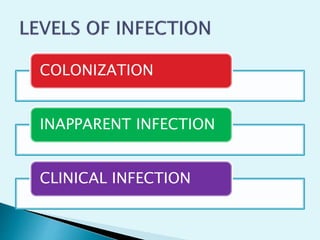
COLONIZATION
INAPPARENT INFECTION
CLINICAL INFECTION
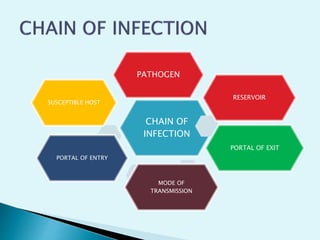
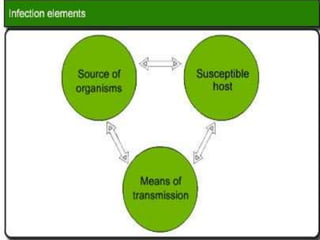
CHAIN OF
INFECTION
PATHOGEN
RESERVOIR
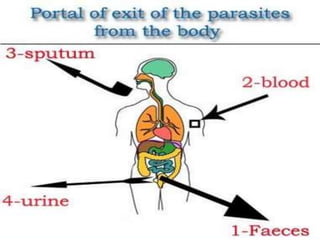
PORTAL OF EXIT
MODE OF
TRANSMISSION
PORTAL OF ENTRY
SUSCEPTIBLE HOST
1) CONTROL OR ELIMINATION OF RESERVOIR:
 Cleansing.
 Asepsis
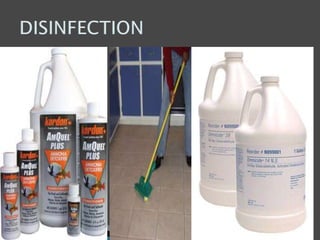
 Disinfection
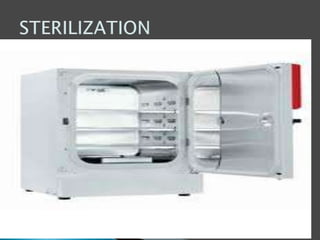
 Sterilization
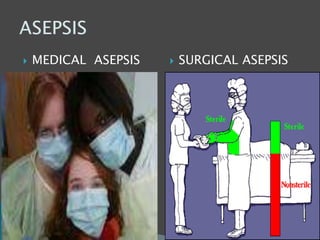
 MEDICAL ASEPSIS  SURGICAL ASEPSIS
 CONCENTRATION OF SOLUTION
 TYPE OF NUMBER OF PATHOGEN
 TEMPERATURE OF ENVIRONMENT
 SURFACE AREA TO TREAT
 PRESENCE OF SOAP
 PRESENCE OF ORGANIC MATERIAL
 PHYSICAL METHOD
 SUNLIGHT
 HEAT
 FILTERATION
 RADIATION
 CHEMICAL METHOD
 ALCOHOLS
 ALDEHYDES
 PHENOLS
 HALOGENS
 OXYDIZING AGENTS
 SURFACE ACTIVE AGENTS
 DYES
 GASES
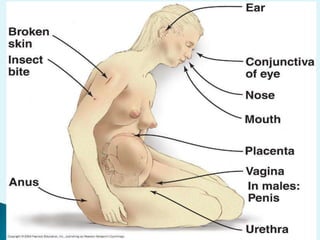
 The nurse follow prevention and
control practices to minimize or to
prevent organism from existing the
body.
 A nurse who has an upper respiratory
tract infection and continue to work
client should wear mask and
attention to hand washing.
 Nurse should educate client that Sharing bed
pans, urinals, basins, eating utensils can lead
to transmission if infection.
 Prevent infection through indirect contact,
soiled items and equipment must be kept
away from touching nurses clothing.
 Clarify the dirty linen in the arm against the
uniform
 Laundry hamper should be replaced before
they over flow.
 The most important technique in preventing
and controlling transmission of infection is
HAND HYGEINE
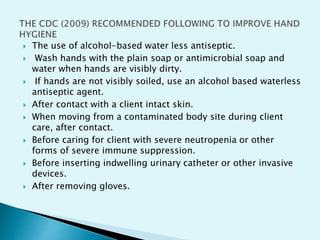
 The use of alcohol-based water less antiseptic.
 Wash hands with the plain soap or antimicrobial soap and
water when hands are visibly dirty.
 If hands are not visibly soiled, use an alcohol based waterless
antiseptic agent.
 After contact with a client intact skin.
 When moving from a contaminated body site during client
care, after contact.
 Before caring for client with severe neutropenia or other
forms of severe immune suppression.
 Before inserting indwelling urinary catheter or other invasive
devices.
 After removing gloves.
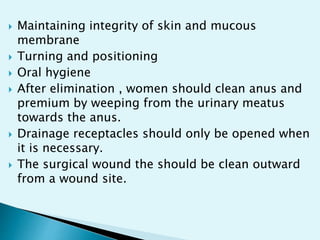
 Maintaining integrity of skin and mucous
membrane
 Turning and positioning
 Oral hygiene
 After elimination , women should clean anus and
premium by weeping from the urinary meatus
towards the anus.
 Drainage receptacles should only be opened when
it is necessary.
 The surgical wound the should be clean outward
from a wound site.
The nurses also protects himself or herself and
others through the use of isolation
precautions.
 Isolation precautions
 Protective environment.
 Specimen collection.
 Routine cleaning
 Surgical asepsis
 Performing sterile procedures
 Gloving.
 Research article 1:
 Assessment of infection control practices for
interventional techniques: a best evidence
synthesis of safe injection practices and use of
single-dose medication vials.
 Source:
Pain Management Center of Paducah, Paducah,
KY, and University of Louisville, Louisville, KY;
Mid Atlantic Spine & Pain Physicians of Newark,
Newark, DE, and Temple University Hospital,
Philadelphia, PA.
 Objectives:
To critically appraise and synthesize the literature on
infection control practices for interventional
techniques, including safe injection and medication
vial utilization.
 Result: A total of 60 reports met inclusion criteria,
There is good evidence that contamination of
multi-dose or single-dose vials can contribute to
infection. There was poor evidence that the use of
single-dose vials on multiple patients with
appropriate infection control practices cause
infection.
 Conclusion: There is good evidence that any
breach of sterile practice may result in
serious and life threatening infections.
 Safety of a patient is defined as a
state of health of health of patient
where he/ she is protected from
any kind of potential injury or
infection.
 To prevent the transmission of disease
from patient to patient, from patient
to nurses, health care workers and
vice-versa.
 To prevent injury to nurses while
handling the waste.
 To prevent general exposure to the
harmful toxic effects of the cytoxic,
genotoxic, chemical biomedical waste
as much as possible.
Meeting safety need is essential as it:
 Facilitates physical well being.
 Promotes physical and psychological comfort.
 Helps in adjustment and adaptation in a
hospital.
 Contributes to therapeutic effectiveness.
 Relieves anxiety.
 Protects the patient from potential risk of
injury.
 Enhances resistance to infection.
 Improves ability to carry out normal daily
activities.
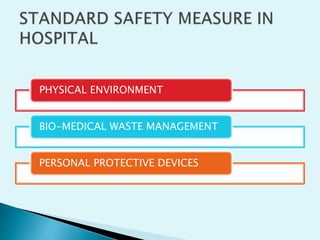
PHYSICAL ENVIRONMENT
BIO-MEDICAL WASTE MANAGEMENT
PERSONAL PROTECTIVE DEVICES
 Preventing mechanical injuries
 Preventing shocks and burns from
electrical fixtures.
 Prevention of fire.
 Protection from chemical injury.
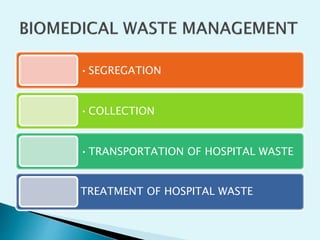
•SEGREGATION
•COLLECTION
•TRANSPORTATION OF HOSPITAL WASTE
TREATMENT OF HOSPITAL WASTE
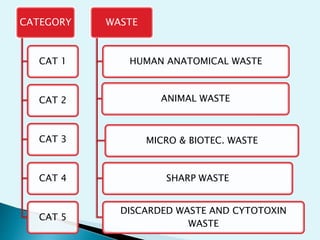
CATEGORY
CAT 1
CAT 2
CAT 3
CAT 4
CAT 5
WASTE
HUMAN ANATOMICAL WASTE
ANIMAL WASTE
MICRO & BIOTEC. WASTE
SHARP WASTE
DISCARDED WASTE AND CYTOTOXIN
WASTE
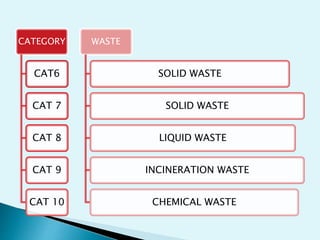
CATEGORY
CAT6
CAT 7
CAT 8
CAT 9
CAT 10
WASTE
SOLID WASTE
SOLID WASTE
LIQUID WASTE
INCINERATION WASTE
CHEMICAL WASTE
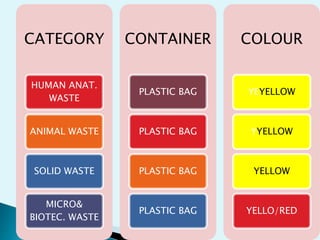
CATEGORY
HUMAN ANAT.
WASTE
ANIMAL WASTE
SOLID WASTE
MICRO&
BIOTEC. WASTE
CONTAINER
PLASTIC BAG
PLASTIC BAG
PLASTIC BAG
PLASTIC BAG
COLOUR
YEYELLOW
YYELLOW
YELLOW
YELLO/RED
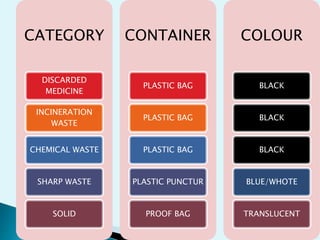
CATEGORY
DISCARDED
MEDICINE
INCINERATION
WASTE
CHEMICAL WASTE
SHARP WASTE
SOLID
CONTAINER
PLASTIC BAG
PLASTIC BAG
PLASTIC BAG
PLASTIC PUNCTUR
PROOF BAG
COLOUR
BLACK
BLACK
BLACK
BLUE/WHOTE
TRANSLUCENT
 Goggles
 Mask
 Gown
 Shoe covers
 Gloves
Special precaution are needed if the sharps are
infected with HIV or hepatitis B cases.
 Clean the wound immediately.
 An injection of TT is advisable.
 Dressing of wound may be required.
 Consult the physician .
 In case infectious solution is spilled on the
body:
 Remove the soiled and wash the part
thoroughly with plenty of water.
 Apply in non-irritant antiseptic cream.
 In case of spilling in eyes, was it with water.
 Consult the physician.
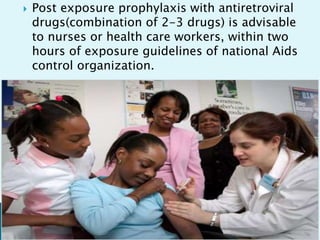
 Post exposure prophylaxis with antiretroviral
drugs(combination of 2-3 drugs) is advisable
to nurses or health care workers, within two
hours of exposure guidelines of national Aids
control organization.
 Use railing or guards on windows and beds.
 Keep floor dry and floor covering fixed firmly.
 Hold stretchers and wheel chairs securely
while assisting patient and lock the wheel an
the use co-workers.
 Ensure regular checking of equipment’s for
its safe and working condition.
 Maintain principals of body mechanism.
 Restrict smoking in the patient’s
unit/hospital.
 Drugs should be measured accurately before
administration to prevent toxicity and discard
the drugs for which the expiry date is over.
 Radiation equipment should be handled with
and operated by trained operators. Watch for
signs and symptoms of radiation injury and
report them promptly.
 Label the radiation exposure area as
hazardous. Restrict entry of patient and
visitors to the areas.
 Hand washing before and after care of each
patient is important
 Careful and regular monitoring of electrical
and gadgets is important to prevent
accidents. Repair and report electrical
equipment’s, safe guard inflammable liquids
and gases etc., or recharge fire extinguishers.
 Practice good house keeping and
maintenance in terms of regular care of
article.
 Keep chemicals in separate cupboard, well
labelled, under lock and key. keep the
hazardous chemical not in the medicine
cupboard. Use the chemicals at bed side with
caution.
 Infectious patient should be kept under
isolation.
 Use of effective techniques for disinfection
and sterilization. E.g. boiling, autoclaving etc.
 Identifies allergen for individual patients by
testing for their allergies and accordingly
their treatment and prevention may be
carried out.
 Ensure regular and frequent spray of
insecticide and pesticides and use mosquito
repellents. Eg. DDT, spray, etc.
Infection

Infection

  • 1.
  • 2.
     An infectionis the entry and multiplication of an infectious agent on the tissue of host.  If the infection fails to cause injury to cell ore tissue. Then infection is asymptomatic.  If the pathogen multiply and cause clinical signs and symptoms, then it is symptomatic.  If the infectious disease can be transmitted from one person to another then it is a communicable disease.
  • 3.
  • 4.
    CHAIN OF INFECTION PATHOGEN RESERVOIR PORTAL OFEXIT MODE OF TRANSMISSION PORTAL OF ENTRY SUSCEPTIBLE HOST
  • 5.
    1) CONTROL ORELIMINATION OF RESERVOIR:  Cleansing.  Asepsis  Disinfection  Sterilization
  • 7.
     MEDICAL ASEPSIS SURGICAL ASEPSIS
  • 9.
     CONCENTRATION OFSOLUTION  TYPE OF NUMBER OF PATHOGEN  TEMPERATURE OF ENVIRONMENT  SURFACE AREA TO TREAT  PRESENCE OF SOAP  PRESENCE OF ORGANIC MATERIAL
  • 11.
     PHYSICAL METHOD SUNLIGHT  HEAT  FILTERATION  RADIATION
  • 12.
     CHEMICAL METHOD ALCOHOLS  ALDEHYDES  PHENOLS  HALOGENS  OXYDIZING AGENTS  SURFACE ACTIVE AGENTS  DYES  GASES
  • 15.
     The nursefollow prevention and control practices to minimize or to prevent organism from existing the body.  A nurse who has an upper respiratory tract infection and continue to work client should wear mask and attention to hand washing.
  • 18.
     Nurse shouldeducate client that Sharing bed pans, urinals, basins, eating utensils can lead to transmission if infection.  Prevent infection through indirect contact, soiled items and equipment must be kept away from touching nurses clothing.  Clarify the dirty linen in the arm against the uniform  Laundry hamper should be replaced before they over flow.  The most important technique in preventing and controlling transmission of infection is HAND HYGEINE
  • 19.
     The useof alcohol-based water less antiseptic.  Wash hands with the plain soap or antimicrobial soap and water when hands are visibly dirty.  If hands are not visibly soiled, use an alcohol based waterless antiseptic agent.  After contact with a client intact skin.  When moving from a contaminated body site during client care, after contact.  Before caring for client with severe neutropenia or other forms of severe immune suppression.  Before inserting indwelling urinary catheter or other invasive devices.  After removing gloves.
  • 24.
     Maintaining integrityof skin and mucous membrane  Turning and positioning  Oral hygiene  After elimination , women should clean anus and premium by weeping from the urinary meatus towards the anus.  Drainage receptacles should only be opened when it is necessary.  The surgical wound the should be clean outward from a wound site.
  • 26.
    The nurses alsoprotects himself or herself and others through the use of isolation precautions.  Isolation precautions  Protective environment.  Specimen collection.  Routine cleaning  Surgical asepsis  Performing sterile procedures  Gloving.
  • 27.
     Research article1:  Assessment of infection control practices for interventional techniques: a best evidence synthesis of safe injection practices and use of single-dose medication vials.  Source: Pain Management Center of Paducah, Paducah, KY, and University of Louisville, Louisville, KY; Mid Atlantic Spine & Pain Physicians of Newark, Newark, DE, and Temple University Hospital, Philadelphia, PA.
  • 28.
     Objectives: To criticallyappraise and synthesize the literature on infection control practices for interventional techniques, including safe injection and medication vial utilization.  Result: A total of 60 reports met inclusion criteria, There is good evidence that contamination of multi-dose or single-dose vials can contribute to infection. There was poor evidence that the use of single-dose vials on multiple patients with appropriate infection control practices cause infection.
  • 29.
     Conclusion: Thereis good evidence that any breach of sterile practice may result in serious and life threatening infections.
  • 31.
     Safety ofa patient is defined as a state of health of health of patient where he/ she is protected from any kind of potential injury or infection.
  • 32.
     To preventthe transmission of disease from patient to patient, from patient to nurses, health care workers and vice-versa.  To prevent injury to nurses while handling the waste.  To prevent general exposure to the harmful toxic effects of the cytoxic, genotoxic, chemical biomedical waste as much as possible.
  • 33.
    Meeting safety needis essential as it:  Facilitates physical well being.  Promotes physical and psychological comfort.  Helps in adjustment and adaptation in a hospital.  Contributes to therapeutic effectiveness.  Relieves anxiety.  Protects the patient from potential risk of injury.  Enhances resistance to infection.  Improves ability to carry out normal daily activities.
  • 34.
    PHYSICAL ENVIRONMENT BIO-MEDICAL WASTEMANAGEMENT PERSONAL PROTECTIVE DEVICES
  • 35.
     Preventing mechanicalinjuries  Preventing shocks and burns from electrical fixtures.  Prevention of fire.  Protection from chemical injury.
  • 36.
  • 37.
    CATEGORY CAT 1 CAT 2 CAT3 CAT 4 CAT 5 WASTE HUMAN ANATOMICAL WASTE ANIMAL WASTE MICRO & BIOTEC. WASTE SHARP WASTE DISCARDED WASTE AND CYTOTOXIN WASTE
  • 38.
    CATEGORY CAT6 CAT 7 CAT 8 CAT9 CAT 10 WASTE SOLID WASTE SOLID WASTE LIQUID WASTE INCINERATION WASTE CHEMICAL WASTE
  • 39.
    CATEGORY HUMAN ANAT. WASTE ANIMAL WASTE SOLIDWASTE MICRO& BIOTEC. WASTE CONTAINER PLASTIC BAG PLASTIC BAG PLASTIC BAG PLASTIC BAG COLOUR YEYELLOW YYELLOW YELLOW YELLO/RED
  • 40.
    CATEGORY DISCARDED MEDICINE INCINERATION WASTE CHEMICAL WASTE SHARP WASTE SOLID CONTAINER PLASTICBAG PLASTIC BAG PLASTIC BAG PLASTIC PUNCTUR PROOF BAG COLOUR BLACK BLACK BLACK BLUE/WHOTE TRANSLUCENT
  • 42.
     Goggles  Mask Gown  Shoe covers  Gloves
  • 43.
    Special precaution areneeded if the sharps are infected with HIV or hepatitis B cases.  Clean the wound immediately.  An injection of TT is advisable.  Dressing of wound may be required.  Consult the physician .  In case infectious solution is spilled on the body:  Remove the soiled and wash the part thoroughly with plenty of water.  Apply in non-irritant antiseptic cream.  In case of spilling in eyes, was it with water.  Consult the physician.
  • 44.
     Post exposureprophylaxis with antiretroviral drugs(combination of 2-3 drugs) is advisable to nurses or health care workers, within two hours of exposure guidelines of national Aids control organization.
  • 45.
     Use railingor guards on windows and beds.  Keep floor dry and floor covering fixed firmly.  Hold stretchers and wheel chairs securely while assisting patient and lock the wheel an the use co-workers.  Ensure regular checking of equipment’s for its safe and working condition.  Maintain principals of body mechanism.  Restrict smoking in the patient’s unit/hospital.
  • 46.
     Drugs shouldbe measured accurately before administration to prevent toxicity and discard the drugs for which the expiry date is over.  Radiation equipment should be handled with and operated by trained operators. Watch for signs and symptoms of radiation injury and report them promptly.  Label the radiation exposure area as hazardous. Restrict entry of patient and visitors to the areas.  Hand washing before and after care of each patient is important
  • 47.
     Careful andregular monitoring of electrical and gadgets is important to prevent accidents. Repair and report electrical equipment’s, safe guard inflammable liquids and gases etc., or recharge fire extinguishers.  Practice good house keeping and maintenance in terms of regular care of article.  Keep chemicals in separate cupboard, well labelled, under lock and key. keep the hazardous chemical not in the medicine cupboard. Use the chemicals at bed side with caution.
  • 48.
     Infectious patientshould be kept under isolation.  Use of effective techniques for disinfection and sterilization. E.g. boiling, autoclaving etc.  Identifies allergen for individual patients by testing for their allergies and accordingly their treatment and prevention may be carried out.  Ensure regular and frequent spray of insecticide and pesticides and use mosquito repellents. Eg. DDT, spray, etc.