Download to read offline
![COLLECTIVE BARGAINING
[S H A R M A]1
INTRODUCTION:
The union may negotiate with a single employer (who is typically representing a company's
shareholders) or may negotiate with a group of businesses, depending on the country, to reach an
industry-wide agreement. A collective agreement functions as a labour contract between an
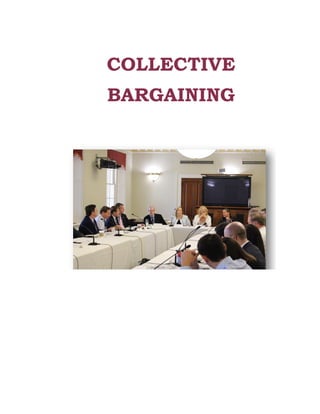
employer and one or more unions. Collective bargaining consists of the process of negotiation
between representatives of a union and employers.
DEFINITION:
Collective Bargaining Collective bargaining involves a set of procedures by which
employee representatives and employer representatives negotiate to obtain a signed
agreement that describes conditions of employment, especially wages, hours and
benefits.
Collective bargaining is a process of negotiations between employers and the
representatives of a unit of employees aimed at reaching agreements that regulate
working conditions. Collective agreement usually set out wage scales, working hours,
training, health and safety, overtime, grievance mechanisms and rights to participate in
workplace or company affairs.
OBJECTIVES OF COLLECTIVE BARGAINING
To arrive at an agreement on wages and other conditions of employment.
To maintain employee - employer relation bilaterally.
To protect the interests of nurse employees through collective action.
To negotiate voluntarily, yielding some concessions and sacrifices by both parties.
To bargain from a position of strength without exploiting the weaknesses.
To resolve the differences between nurse employees and management through
negotiation.
To have a peaceful co - existence for the mutual benefits and progress.](https://image.slidesharecdn.com/collectivebargaining-200715143223/85/Collective-bargaining-2-320.jpg)
![COLLECTIVE BARGAINING
[S H A R M A]2
CHARACTERISTICS OF COLLECTIVE BARGAINING:
Collective: In Collective bargaining, where the employers representative and employees
representatives sit together to negotiate terms of employment.
Strength: Both the parties in collective bargaining is strong and equal.
Voluntary: Both parties come to the negotiation table voluntarily in order to go in
particular negotiation. It is based on discussions, mutual trust, and understanding.
Formal: It is a formal process in which certain employment related issues are to be
regulated at national, organizational and workplace levels.
Flexible: It is flexible and continuous process and not fixed or static.
Improvement: It is method to improve the employer employee’s relation in the
organization and resolve management and employees conflicts.
Representation: The management does not directly deal with employees. It carries
negotiations with the representatives / executives of unions / associations.
Dynamic: Collective bargaining is dynamic, that go on changing over a period and
grows and expand the way of agreement, the way of implementation and way of
discussion.
Continuous: Collective bargaining is continuous and begins with agreement, the
implementation of agreement and further negotiations.
Bipartite process: Because the employee and employers representatives negotiate
directly face to face across the table.](https://image.slidesharecdn.com/collectivebargaining-200715143223/85/Collective-bargaining-3-320.jpg)
![COLLECTIVE BARGAINING
[S H A R M A]3
PROCESS OF COLLECTIVE BARGAINING
The process of collective bargain involves negotiation and discussion between the management
and union. It is a complex process involving a number of procedures, techniques and tools. This
process comprise of five main steps.
PREPARATORY PHASE
In this phase following activities are carried out:
Selection of negotiation team: It consists of representatives of both the parties.
They should have adequate knowledge and skills for negotiation.
Timing is important.
Identification of problem.
Examination of situation, and issues for negotiation.
Collection of data: Enough supporting data is kept ready.
Preparatory
Phase
Discussion
Phase
Proposal
Phase
Bargaining
Phase
Settlement
Phase
Formalizing
agreement
Enforcing
agreement](https://image.slidesharecdn.com/collectivebargaining-200715143223/85/Collective-bargaining-4-320.jpg)
![COLLECTIVE BARGAINING
[S H A R M A]4
Initially time is spent to gather relevant data related to issues.
DISCUSSION PHASE
The following activities are carried out during discussion phase:
Decide an appropriate time and set a proper climate for negotiation.
Decision on ground rules.
Maintenance of mutual trust and understanding.
Involve in active listening, asking questions, observation, and summarizing decisions.
POSSIBLE ALTERNATIVES OR PROPOSAL PHASE
During this phase, there is
Initial opening of statements.
Possible alternatives/opinions to resolve the issues by both parties
Brainstorming.
BARGAINING PHASE
During bargaining phase, both parties involves in the following activities:
Problem-solving
Proposals are set forth
SETTLEMENT PHASE
After the bargaining phase, settlement phase starts with:
Consensus agreement on common decision
Negotiated change
FORMALIZING THE AGREEMENT
Drafting of agreements: After good faith bargaining, a formal document must prepare.
It should be simple, clear and concise.
Signing the agreement: Both parties sign the agreement and abide by its terms and
conditions.](https://image.slidesharecdn.com/collectivebargaining-200715143223/85/Collective-bargaining-5-320.jpg)
![COLLECTIVE BARGAINING
[S H A R M A]5
ENFORCING THE AGREEMENT
To have the agreement effective and meaning, it should be enforced or implemented
immediately.
TYPES OF COLLECTIVE BARGAINING
According to Fosson JA, there are four types of collective bargaining:
Distributive bargaining (Fig. 1)
Integrative or cooperative bargaining (Fig. 2)
Productivity bargaining (Fig. 3)
Composite bargaining (Fig. 4)
DISTRIBUTIVE OR CONJUNCTIVE BARGAINING
Economic issues like wages, salaries and bonus are discussed.
One party's gain is another party's loss more competitive.
INTEGRATIVE OR COOPERATIVE BARGAINING
Both the parties may gain, or at least neither party loses
It tends to be more cooperative
Both the parties are trying to make more of something
PRODUCTIVITY BARGAINING
Substantial benefits based on productivity standards
Management control over workplace relations
COMPOSITE BARGAINING
Wages with equity](https://image.slidesharecdn.com/collectivebargaining-200715143223/85/Collective-bargaining-6-320.jpg)
![COLLECTIVE BARGAINING
[S H A R M A]6
MERITS
It provides nurses the opportunity to have a voice regarding professional issues of
staffing and working practice as well as wages, benefits and working conditions.
Promotes nurses' democracy and their participation in management.
Helps in establishing harmonious relationship between nurse employee and the
employer.
Emphasizes on the interests and benefits of both parties.
Eliminates unnecessary expenditure and avoids bitterness among nurses and their
employers.
Participation in decision making process.
All union members and management must confirm to terms of contract without
exception.
Nurses gain control of practice.
Ensure that nurses have fair pay, good benefits and safe working conditions.
DEMERITS
The collective bargaining process may not be fair at all times.
The decision is often influenced by power and politics.
The immediate consequence of collective bargaining if not fulfilled is strike or lock-out.
Reduced individuality.
Other union members may outvote one's decisions.
Disputes not handled with individual and management only; less room for professional
judgment. Must pay unions dues even if one does not support unionization.](https://image.slidesharecdn.com/collectivebargaining-200715143223/85/Collective-bargaining-7-320.jpg)

Collective bargaining is the negotiation process between employee representatives, such as unions, and employers to establish agreements on employment conditions like wages and benefits. It typically involves several phases including preparation, discussion, proposal, bargaining, settlement, and formalization of agreements, with the goal of maintaining strong, voluntary relations between both parties. While it provides advantages like a voice for employees and promotes harmonious relationships, it can also have drawbacks including potential unfairness and reduced individual autonomy.


