Presented by-
Prachi Dixit
1
Transgenesis .
Introduction.
Definition.
History .
Production of transgenic animals.
The methodology.
Examples of transgenics.
Importance.
Issue related to transgenic technology.
Conclusion.
2
Process of introducing foreign or exogenous DNA into an
animals genome is called transgenesis.
Transgenesis is the process of introducing
an exogenous gene called a transgene into a living
organism so that the organism will exhibit a new property and
transmit that property to its offspring.
Transgenesis can be facilitated by liposomes
by liposomes, enzymes, plasmid vectors, viral
vectors, pronuclear injection, protoplast fusion, and ballistic
DNA injection.
3
4
A transgenic animal is one that carries a foreign gene
that has been deliberately inserted into its genome.
Foreign genes are inserted into the germ line of the
animal , so it can be transmitted to the progeny.
 Transgenic technology has led to the development of
fishes, live stock and other animals with altered genetic
profiles which are useful to mankind.
5
6
Horse Donkey Mule
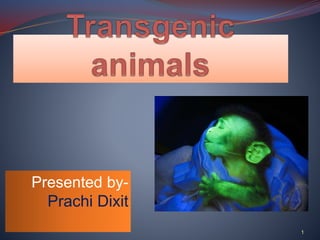
Transgenic animals are the genetically modified
organisms which have a foreign gene in their
genome due to which they show certain properties
which are different from non- genetically modified
organisms.
 Glow fish as pets.
Sheep with more wool.
 Cow producing more milk with lower cholesterol.
7
8
9
Example – “Dolly”
(sheep)
Dolly was a
female domestic sheep,
and the
first mammal cloned from
an adult somatic cell,
using the process
of nuclear transfer. Born5
July 1996
She was cloned by Sir
Ian Wilmut, Keith
Campbell and colleagues
at the Roslin Institute,
part of the University of
Edinburgh, Scotland.
10
Example –
“supermouse”
 First transgenic animal
was a “Supermouse”
created by ‘Ralph
Brinster’ and ‘Richard
Palmiter’ In 1982.
It was created by
inserting a human
growth hormone gene in
mouse genome.
The offspring was
much larger than the
parents.
11
Example- “Herman”
(Bull)
First transgenic
mammal “Herman”
,the bull was the first
genetically modified
or transgenic
mammal in the
world.
12
Transgenic technology has been developed and
perfected in the laboratory mouse.
Since the early1980’s hundreds of different
genes have been introduced into various mouse
strains.
These studies have contributed to understanding
of gene regulation
13
 Step 1- construction of a transgene.
 Transgene made of three parts-
• Promoter
• Gene to be expressed
• Termination sequence
14
 Step 2- Introduction of foreign gene into
the animal.
 Pronuclear microinjection method.
 Embryonic stem cell method.
 Retrovirus-mediated gene transfer method.
15
 Step 3 – Screening for transgenic positives.
 Transgenic progenies are screened by PCR to
examine the site of incorporation of the gene.
 Some transgenes may not be expressed if
integrated into a transcriptionally inactive site.
 Step 4 – Further animal breeding is done to obtain
maximal expression.
 Heterozygous offspring's homozygous strains are
mated to form.
16
Retroviruses can be used for the transfer of foreign genes
into animal genomes.
This can best be done at 4-16 cell stage embryos.
Completion of this process requires that the host cell
undergoes the S phase of the cell cycle. Therefore,
retroviruses effectively transduce only mitotically active
cells.
 Very high rates of gene transfer are achieved with the
use of retroviruses.
17
18
Limitations on the size of the foreign DNA insert (usually 9 to
15 kb) transferred.
The genome of the retroviral strain can be integrated into the
same nucleus as the transgene. This means that the virus
itself could be produced by the transgenic organism and
create a problem especially if the animal will be used for
production of food.
Low copy number integration.
Additional steps required to produce retroviruses.
19
A female animal is superovulated
and eggs are collected.
The eggs are fertilized in vitro.
The transgene containing solution is
Injected into the male pronucleus.
Eggs with the transgenes are kept overnight in an incubator
to develop.
The eggs are then implanted into the uterus of a pseudo
pregnant female.
20
Because of the disadvantages of the retroviral vectors,
microinjection of DNA is currently the preferred method for
producing transgenic mice.
The mouse was the first animal to undergo successful gene
transfer using DNA microinjection .
This method involves:- transfer of a desired gene
constructed from another member in the same or different
species into the pronucleus of a reproductive cell.
Then it will be cultured in vitro until reaches embryonic phase
then transferred to the recipient cell.
21
22
Transgenic animals can be created by manipulating embryonic
stem cell.
ES cells are obtained from the inner cell mass of the blastocyst.
Transgenic stem cells are grown in vitro.
Then they are inserted into a host uterus to grow normally.
Harvest the Inner Cell Mass (ICM) from 3 day old blastocysts.
Inject the transgenic ES cells into the blastocoele of a new 3-day old host
blastocyst.
23
24
25
Some example of
transgenic animals
Super fish
•Growth hormone gene inserted into fertilized egg.
•Increased growth and size.
•Transgenic fish grows about 10-11 time faster than
normal fish.
Glo fish
•Genetically modified zebra fish.
•Produced by integrating a fluorescent protein gene from
jelly fish into embryo of fish.
26
27
Super fish
Glo fish
Onco mouse
•Mouse model to study cancer.
•Made by inserting activated oncogenes.
Alzheimer’s mouse
•In the brain of Alzheimer’s patients, dead nerve cells are
entangled in a protein called amyloid.
•Mouse made by introducing amyloid precursor gene into
fertilized egg of mice.
28
29
Alzheimer’s
mouse
Onco mouse
Enviro pig
•Pigs have trouble fully digesting a compound known as
phytate in many cereal grains used to feed them.
•Transgenic pigs are created by introducing phytase gene
of Ecoli.
•Phytase enzyme is thus produced in the salivary gland
of pig.
•It degrades indigestible phytate with the release of
phosphate that is readily digested by pigs.
Pig for organ transplant
•Pigs with human genes, in order to decrease the chance
of organ rejection by human body.
30
31
For good quality wool.
32
“ANDI” was the first transgenic monkey, born in 2000.
ANDI proves that transgenic primates can be created
and can express a foreign gene delivered into their
genome.
33
“ROSIE” was the first transgenic cow , born in 1997.
Produced human protein enriched milk at 2.4g/lt contains
human gene Alpha lactalbumin.
34
Transgenic goats engineered to produce human
breast milk.
•University of California scientists created the transgenic
goats by transferring human genes for breast milk
enzymes and proteins into goat embryos.
•Produce 60% of the lysozyme and lactoferrin found in
human mother’s milk.
•For babies of mother’s who aren’t present or can’t nurse
them, milk from these transgenic goats could provide the
next best alternative.
35
36
Industrial importance –
•Toxicity sensitive transgenic animals to test chemicals.
•Spider silk in milk of goat.
Medical importance –
•Disease model.
•Xenotransplantation.
Agriculture importance –
•Disease resistant animals.
•For improving quality & quantity of milk, meat, eggs & wool
production.
37
Production of organs for transplant.
Surgical techniques.
Cancer models.
Antibody production.
Study of role of gene.
38
There may be health risks associated with
transgenics.
There may be long term effects on the environment
when transgenic animals are released into the field.
Abnormalities suffered are more.
Reduced fertility.
Respiratory and circulatory problems.
Weak immune system.
39
With proper research and careful use the
transgenic animals can go a long way in solving
several problems for which science doesn't have
a solution till now.
40
41
Thank you

Transgenic Animals

  • 1.
  • 2.
    Transgenesis . Introduction. Definition. History . Productionof transgenic animals. The methodology. Examples of transgenics. Importance. Issue related to transgenic technology. Conclusion. 2
  • 3.
    Process of introducingforeign or exogenous DNA into an animals genome is called transgenesis. Transgenesis is the process of introducing an exogenous gene called a transgene into a living organism so that the organism will exhibit a new property and transmit that property to its offspring. Transgenesis can be facilitated by liposomes by liposomes, enzymes, plasmid vectors, viral vectors, pronuclear injection, protoplast fusion, and ballistic DNA injection. 3
  • 4.
  • 5.
    A transgenic animalis one that carries a foreign gene that has been deliberately inserted into its genome. Foreign genes are inserted into the germ line of the animal , so it can be transmitted to the progeny.  Transgenic technology has led to the development of fishes, live stock and other animals with altered genetic profiles which are useful to mankind. 5
  • 6.
  • 7.
    Transgenic animals arethe genetically modified organisms which have a foreign gene in their genome due to which they show certain properties which are different from non- genetically modified organisms.  Glow fish as pets. Sheep with more wool.  Cow producing more milk with lower cholesterol. 7
  • 8.
  • 9.
  • 10.
    Example – “Dolly” (sheep) Dollywas a female domestic sheep, and the first mammal cloned from an adult somatic cell, using the process of nuclear transfer. Born5 July 1996 She was cloned by Sir Ian Wilmut, Keith Campbell and colleagues at the Roslin Institute, part of the University of Edinburgh, Scotland. 10
  • 11.
    Example – “supermouse”  Firsttransgenic animal was a “Supermouse” created by ‘Ralph Brinster’ and ‘Richard Palmiter’ In 1982. It was created by inserting a human growth hormone gene in mouse genome. The offspring was much larger than the parents. 11
  • 12.
    Example- “Herman” (Bull) First transgenic mammal“Herman” ,the bull was the first genetically modified or transgenic mammal in the world. 12
  • 13.
    Transgenic technology hasbeen developed and perfected in the laboratory mouse. Since the early1980’s hundreds of different genes have been introduced into various mouse strains. These studies have contributed to understanding of gene regulation 13
  • 14.
     Step 1-construction of a transgene.  Transgene made of three parts- • Promoter • Gene to be expressed • Termination sequence 14
  • 15.
     Step 2-Introduction of foreign gene into the animal.  Pronuclear microinjection method.  Embryonic stem cell method.  Retrovirus-mediated gene transfer method. 15
  • 16.
     Step 3– Screening for transgenic positives.  Transgenic progenies are screened by PCR to examine the site of incorporation of the gene.  Some transgenes may not be expressed if integrated into a transcriptionally inactive site.  Step 4 – Further animal breeding is done to obtain maximal expression.  Heterozygous offspring's homozygous strains are mated to form. 16
  • 17.
    Retroviruses can beused for the transfer of foreign genes into animal genomes. This can best be done at 4-16 cell stage embryos. Completion of this process requires that the host cell undergoes the S phase of the cell cycle. Therefore, retroviruses effectively transduce only mitotically active cells.  Very high rates of gene transfer are achieved with the use of retroviruses. 17
  • 18.
  • 19.
    Limitations on thesize of the foreign DNA insert (usually 9 to 15 kb) transferred. The genome of the retroviral strain can be integrated into the same nucleus as the transgene. This means that the virus itself could be produced by the transgenic organism and create a problem especially if the animal will be used for production of food. Low copy number integration. Additional steps required to produce retroviruses. 19
  • 20.
    A female animalis superovulated and eggs are collected. The eggs are fertilized in vitro. The transgene containing solution is Injected into the male pronucleus. Eggs with the transgenes are kept overnight in an incubator to develop. The eggs are then implanted into the uterus of a pseudo pregnant female. 20
  • 21.
    Because of thedisadvantages of the retroviral vectors, microinjection of DNA is currently the preferred method for producing transgenic mice. The mouse was the first animal to undergo successful gene transfer using DNA microinjection . This method involves:- transfer of a desired gene constructed from another member in the same or different species into the pronucleus of a reproductive cell. Then it will be cultured in vitro until reaches embryonic phase then transferred to the recipient cell. 21
  • 22.
  • 23.
    Transgenic animals canbe created by manipulating embryonic stem cell. ES cells are obtained from the inner cell mass of the blastocyst. Transgenic stem cells are grown in vitro. Then they are inserted into a host uterus to grow normally. Harvest the Inner Cell Mass (ICM) from 3 day old blastocysts. Inject the transgenic ES cells into the blastocoele of a new 3-day old host blastocyst. 23
  • 24.
  • 25.
  • 26.
    Super fish •Growth hormonegene inserted into fertilized egg. •Increased growth and size. •Transgenic fish grows about 10-11 time faster than normal fish. Glo fish •Genetically modified zebra fish. •Produced by integrating a fluorescent protein gene from jelly fish into embryo of fish. 26
  • 27.
  • 28.
    Onco mouse •Mouse modelto study cancer. •Made by inserting activated oncogenes. Alzheimer’s mouse •In the brain of Alzheimer’s patients, dead nerve cells are entangled in a protein called amyloid. •Mouse made by introducing amyloid precursor gene into fertilized egg of mice. 28
  • 29.
  • 30.
    Enviro pig •Pigs havetrouble fully digesting a compound known as phytate in many cereal grains used to feed them. •Transgenic pigs are created by introducing phytase gene of Ecoli. •Phytase enzyme is thus produced in the salivary gland of pig. •It degrades indigestible phytate with the release of phosphate that is readily digested by pigs. Pig for organ transplant •Pigs with human genes, in order to decrease the chance of organ rejection by human body. 30
  • 31.
  • 32.
  • 33.
    “ANDI” was thefirst transgenic monkey, born in 2000. ANDI proves that transgenic primates can be created and can express a foreign gene delivered into their genome. 33
  • 34.
    “ROSIE” was thefirst transgenic cow , born in 1997. Produced human protein enriched milk at 2.4g/lt contains human gene Alpha lactalbumin. 34
  • 35.
    Transgenic goats engineeredto produce human breast milk. •University of California scientists created the transgenic goats by transferring human genes for breast milk enzymes and proteins into goat embryos. •Produce 60% of the lysozyme and lactoferrin found in human mother’s milk. •For babies of mother’s who aren’t present or can’t nurse them, milk from these transgenic goats could provide the next best alternative. 35
  • 36.
  • 37.
    Industrial importance – •Toxicitysensitive transgenic animals to test chemicals. •Spider silk in milk of goat. Medical importance – •Disease model. •Xenotransplantation. Agriculture importance – •Disease resistant animals. •For improving quality & quantity of milk, meat, eggs & wool production. 37
  • 38.
    Production of organsfor transplant. Surgical techniques. Cancer models. Antibody production. Study of role of gene. 38
  • 39.
    There may behealth risks associated with transgenics. There may be long term effects on the environment when transgenic animals are released into the field. Abnormalities suffered are more. Reduced fertility. Respiratory and circulatory problems. Weak immune system. 39
  • 40.
    With proper researchand careful use the transgenic animals can go a long way in solving several problems for which science doesn't have a solution till now. 40
  • 41.