Arvind Deshpande
   Incompatibility among representations
   Complex CAD/CAM systems
   Shape, non-shape, design and manufacturing
    data
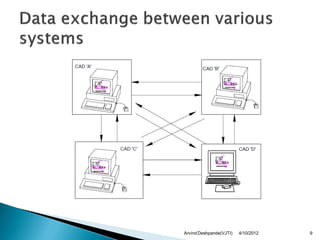
   Need to integrate and automate design and
    manufacturing processes to obtain maximum
    benefits from CAD/CAM systems
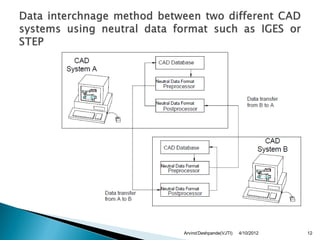
   Direct translators and neutral formats


                           Arvind Deshpande(VJTI)   4/10/2012   2
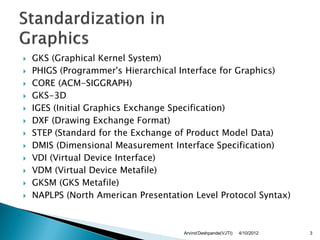
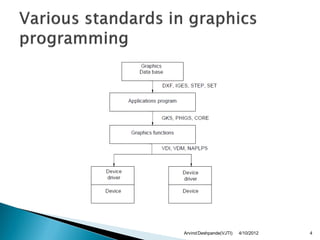
   GKS (Graphical Kernel System)
   PHIGS (Programmer's Hierarchical Interface for Graphics)
   CORE (ACM-SIGGRAPH)
   GKS-3D
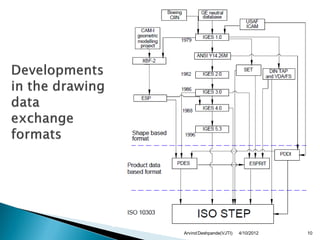
   IGES (Initial Graphics Exchange Specification)
   DXF (Drawing Exchange Format)
   STEP (Standard for the Exchange of Product Model Data)
   DMIS (Dimensional Measurement Interface Specification)
   VDI (Virtual Device Interface)
   VDM (Virtual Device Metafile)
   GKSM (GKS Metafile)
   NAPLPS (North American Presentation Level Protocol Syntax)


                                      Arvind Deshpande(VJTI)   4/10/2012   3
Arvind Deshpande(VJTI)   4/10/2012   4
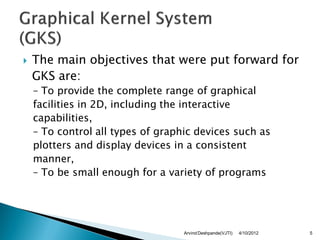
   The main objectives that were put forward for
    GKS are:
    – To provide the complete range of graphical
    facilities in 2D, including the interactive
    capabilities,
    – To control all types of graphic devices such as
    plotters and display devices in a consistent
    manner,
    – To be small enough for a variety of programs


                                   Arvind Deshpande(VJTI)   4/10/2012   5
Arvind Deshpande(VJTI)   4/10/2012   6
Arvind Deshpande(VJTI)   4/10/2012   7
   GKS 3D
   PHIGS
   NAPLPS


             Arvind Deshpande(VJTI)   4/10/2012   8
Arvind Deshpande(VJTI)   4/10/2012   9
Arvind Deshpande(VJTI)   4/10/2012   10
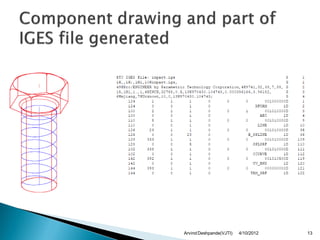
   IGES is the most comprehensive standard and
    is designed to transmit the entire product
    definition including that of manufacturing
    and any other associated information


                            Arvind Deshpande(VJTI)   4/10/2012   11
Arvind Deshpande(VJTI)   4/10/2012   12
Arvind Deshpande(VJTI)   4/10/2012   13
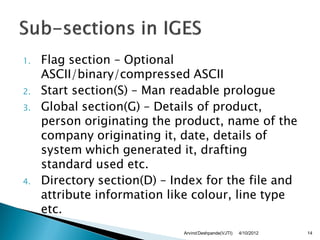
1.   Flag section – Optional
     ASCII/binary/compressed ASCII
2.   Start section(S) – Man readable prologue
3.   Global section(G) – Details of product,
     person originating the product, name of the
     company originating it, date, details of
     system which generated it, drafting
     standard used etc.
4.   Directory section(D) – Index for the file and
     attribute information like colour, line type
     etc.
                              Arvind Deshpande(VJTI)   4/10/2012   14
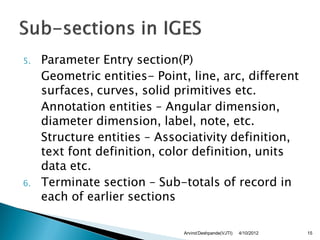
5.   Parameter Entry section(P)
     Geometric entities- Point, line, arc, different
     surfaces, curves, solid primitives etc.
     Annotation entities – Angular dimension,
     diameter dimension, label, note, etc.
     Structure entities – Associativity definition,
     text font definition, color definition, units
     data etc.
6.   Terminate section – Sub-totals of record in
     each of earlier sections

                               Arvind Deshpande(VJTI)   4/10/2012   15
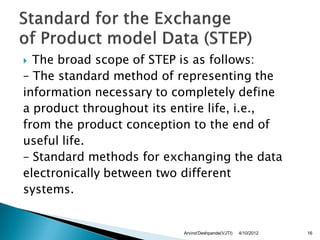
 The broad scope of STEP is as follows:
– The standard method of representing the
information necessary to completely define
a product throughout its entire life, i.e.,
from the product conception to the end of
useful life.
– Standard methods for exchanging the data
electronically between two different
systems.


                          Arvind Deshpande(VJTI)   4/10/2012   16
Arvind Deshpande(VJTI)   4/10/2012   17
Arvind Deshpande(VJTI)   4/10/2012   18
Arvind Deshpande(VJTI)   4/10/2012   19
 The DXF format has been developed
and supported by Autodesk for use with
the AutoCAD drawing files.


                          Arvind Deshpande(VJTI)   4/10/2012   20
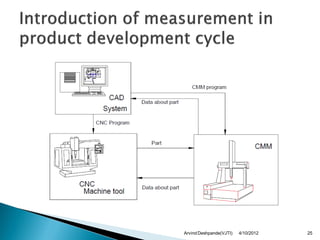
   A coordinate measuring machine is a dimensional
    measuring device, designed to move the measuring
    probe to determine the coordinates along the surface
    of the work piece. Apart from dimensional
    measurement, these machines are also used for
    profile measurement, angularity, digitizing or
    imaging.
   A CMM consists of four main components: the
    machine, measuring probe, control system and the
    measuring software. The control system in a CMM
    performs the function of a live interaction between
    various machine drives, displacement transducers,
    probing systems and the peripheral devices.


                                 Arvind Deshpande(VJTI)   4/10/2012   21
   Control systems can be classified according to
    the following groups of CMMs.
    1. Manually driven CMMs
    2. Motorized CMMs with automatic probing
    systems
    3. Direct computer controlled (DCC) CMMs
    4. CMMs linked with CAD, CAM and FMS etc.
   The first two methods are very common and self
    explanatory. In the case of DCC CMMs, the
    computer control is responsible for the
    movement of the slides, readout from
    displacement       transducers      and      data
    communication.


                               Arvind Deshpande(VJTI)   4/10/2012   22
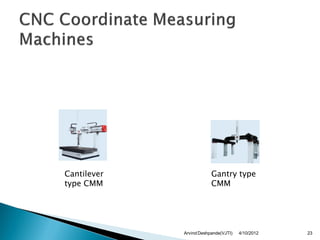
Cantilever               Gantry type
type CMM                 CMM


             Arvind Deshpande(VJTI)   4/10/2012   23
 Dimensional Measurement Interface
Specification (DMIS) is a new standard
in communication being established by
CAM-I for manufacturing.


                          Arvind Deshpande(VJTI)   4/10/2012   24
Arvind Deshpande(VJTI)   4/10/2012   25
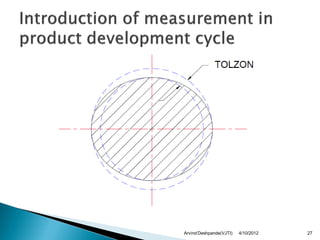
Function:Specifies a circularity tolerance for a
feature, and assigns to it a label.
• Format: T(label) = TOL/CIRLTY, tolzon,
var_1, F(label)
• var_1 can be: MMC or: LMC or: RFS
• label is an alphanumeric label assigned
to the tolerance, and is up to 10 characters
in length.


                             Arvind Deshpande(VJTI)   4/10/2012   26
Arvind Deshpande(VJTI)   4/10/2012   27

Graphics standards

  • 1.
  • 2.
    Incompatibility among representations  Complex CAD/CAM systems  Shape, non-shape, design and manufacturing data  Need to integrate and automate design and manufacturing processes to obtain maximum benefits from CAD/CAM systems  Direct translators and neutral formats Arvind Deshpande(VJTI) 4/10/2012 2
  • 3.
    GKS (Graphical Kernel System)  PHIGS (Programmer's Hierarchical Interface for Graphics)  CORE (ACM-SIGGRAPH)  GKS-3D  IGES (Initial Graphics Exchange Specification)  DXF (Drawing Exchange Format)  STEP (Standard for the Exchange of Product Model Data)  DMIS (Dimensional Measurement Interface Specification)  VDI (Virtual Device Interface)  VDM (Virtual Device Metafile)  GKSM (GKS Metafile)  NAPLPS (North American Presentation Level Protocol Syntax) Arvind Deshpande(VJTI) 4/10/2012 3
  • 4.
  • 5.
    The main objectives that were put forward for GKS are: – To provide the complete range of graphical facilities in 2D, including the interactive capabilities, – To control all types of graphic devices such as plotters and display devices in a consistent manner, – To be small enough for a variety of programs Arvind Deshpande(VJTI) 4/10/2012 5
  • 6.
  • 7.
  • 8.
    GKS 3D  PHIGS  NAPLPS Arvind Deshpande(VJTI) 4/10/2012 8
  • 9.
  • 10.
  • 11.
    IGES is the most comprehensive standard and is designed to transmit the entire product definition including that of manufacturing and any other associated information Arvind Deshpande(VJTI) 4/10/2012 11
  • 12.
  • 13.
  • 14.
    1. Flag section – Optional ASCII/binary/compressed ASCII 2. Start section(S) – Man readable prologue 3. Global section(G) – Details of product, person originating the product, name of the company originating it, date, details of system which generated it, drafting standard used etc. 4. Directory section(D) – Index for the file and attribute information like colour, line type etc. Arvind Deshpande(VJTI) 4/10/2012 14
  • 15.
    5. Parameter Entry section(P) Geometric entities- Point, line, arc, different surfaces, curves, solid primitives etc. Annotation entities – Angular dimension, diameter dimension, label, note, etc. Structure entities – Associativity definition, text font definition, color definition, units data etc. 6. Terminate section – Sub-totals of record in each of earlier sections Arvind Deshpande(VJTI) 4/10/2012 15
  • 16.
     The broadscope of STEP is as follows: – The standard method of representing the information necessary to completely define a product throughout its entire life, i.e., from the product conception to the end of useful life. – Standard methods for exchanging the data electronically between two different systems. Arvind Deshpande(VJTI) 4/10/2012 16
  • 17.
  • 18.
  • 19.
  • 20.
     The DXFformat has been developed and supported by Autodesk for use with the AutoCAD drawing files. Arvind Deshpande(VJTI) 4/10/2012 20
  • 21.
    A coordinate measuring machine is a dimensional measuring device, designed to move the measuring probe to determine the coordinates along the surface of the work piece. Apart from dimensional measurement, these machines are also used for profile measurement, angularity, digitizing or imaging.  A CMM consists of four main components: the machine, measuring probe, control system and the measuring software. The control system in a CMM performs the function of a live interaction between various machine drives, displacement transducers, probing systems and the peripheral devices. Arvind Deshpande(VJTI) 4/10/2012 21
  • 22.
    Control systems can be classified according to the following groups of CMMs. 1. Manually driven CMMs 2. Motorized CMMs with automatic probing systems 3. Direct computer controlled (DCC) CMMs 4. CMMs linked with CAD, CAM and FMS etc.  The first two methods are very common and self explanatory. In the case of DCC CMMs, the computer control is responsible for the movement of the slides, readout from displacement transducers and data communication. Arvind Deshpande(VJTI) 4/10/2012 22
  • 23.
    Cantilever Gantry type type CMM CMM Arvind Deshpande(VJTI) 4/10/2012 23
  • 24.
     Dimensional MeasurementInterface Specification (DMIS) is a new standard in communication being established by CAM-I for manufacturing. Arvind Deshpande(VJTI) 4/10/2012 24
  • 25.
  • 26.
    Function:Specifies a circularitytolerance for a feature, and assigns to it a label. • Format: T(label) = TOL/CIRLTY, tolzon, var_1, F(label) • var_1 can be: MMC or: LMC or: RFS • label is an alphanumeric label assigned to the tolerance, and is up to 10 characters in length. Arvind Deshpande(VJTI) 4/10/2012 26
  • 27.