VEERMATA JIJABAI TECHNOLOGICAL INSTITUTE
                                       Matunga, Mumbai – 400 019
                                             [Autonomous]
                                       End Semester Examination

Sem & Programme                   VIII Final Year B. Tech (Mechanical)           Duration       03 Hours
Course code & Course              ME0453 Computational Fluid Dynamics            Max.Marks      100
                                                                                 Date of Exam   3-5-2011
Instructions:    1.   Question 1 is compulsory. Solve any 4 out of the remaining.
                 2.   Figures to the right indicate full marks.
                 3.   Assume suitable data if necessary.
                 4.   Illustrate your answers with neat sketches wherever necessary.

1.       Answer in brief.                                                                                  2
                                                                                                           0
     a) Compare FDM, FVM and FEM.
     b) Compare direct methods with iterative methods for solving large number of
        equations.
     c) What is the difference between SIMPLE, SIMPLER and SIMPLEC?
     d) What are advantages and disadvantages of k-ε turbulence model?
     e) Explain the relevance of CFD theory in successful use of commercial software.

2. a) Derive energy equation and express it in conservation form.                                          1
                                                                                                           5
     b) Explain the finite difference method for any governing equation with suitable                      5
        boundary conditions.

3.       The governing differential equation for a thin fin with uniform cross-sectional
         area, where the heat loss to the surrounding is purely by convection, is given by
         d 2T hP
                −     ( T − T∞ ) = 0
          d 2 x kA
         a) Following the standard procedure of the Finite Volume discretization process,
              derive the discretization equation (DE) in usual form                                        6
               a P TP = ∑ a nb Tnb + b
         b) Use the following data: A = 2 x 10⁻⁵ m2, P = 0.015 m, k = 20 W/m-k,                            9
             h = 10 W/m2-K, T∞ = 250C, The temperature at the left end (”base”) is
             Tb = 1000C, while that at the right end (“tip”) is TL = 400C. The length of the
            fin is L = 20 mm. Use ∆x = 4 mm. Obtain the complete system of algebraic
            equations and solve for the temperature distribution within the fin.
         c) The analytical expression for the temperature distribution is given by                         2
                        T − T∞ 
                                sinh mx + sinh m( L − x )
              T − T∞  Tb − T∞ 
                               
                     =
             Tb − T∞                 sinh mL
                          hP
                where m =    . Compare your numerical solution with the analytical solution
                          kA
            at any one internal point in the fin.
         d) If right end (“tip”) is insulated or open to atmosphere, how the algebraic
            equation will change for the boundary point?                                                   3

4. a) A one-dimensional slab of 1 m width and a constant thermal diffusivity of 1 m2/hr                    1
      is initially at a uniform temperature of 1000C. The surface temperatures of the left                 0
      (x = 0) and right (x = L) faces are suddenly increased and maintained at 300 0C.
      There are no sources. Determine the temperature distribution within the wall at
0.1 hr and 0.2 hr. Use a grid size of 0.25 m and time step of 0.1 hr. Solve the
        problem with the fully implicit method.
     b) Write a general program to get temperature distribution for two dimensional                     1
        steady state conduction. The west boundary is at constant temperature, east                     0
        boundary receives steady heat flux, North boundary is exposed to atmosphere
        and South boundary is insulated. The program should take user input for
        dimensions, material properties, no. of nodes in 2 directions and boundary
        conditions.

5.        Consider Finite volume discretization of 1-D steady convection-diffusion equation
          for a variable φ , with no sources and a constant diffusion coefficient Γ . The
          diffusion term is evaluated using the usual central differencing scheme. For the
          convection term, a Second Order Upwind (SOU) scheme is used. In particular,
          the CV face value is evaluated by extrapolating values at two upstream points
          with respect to that face.
          a) For a uniform grid of size ∆x , considering flow in both the directions derive
              the generalized DE in the form                                                            8
               a P TP = ∑ a nbTnb
             and provide expressions for the coefficients a.
          b) Consider that left boundary condition is specified in terms of a known φ L ,               4
             obtain the appropriate DE for the CV adjacent to boundary using mirror node
             concept for the case of flow going from left to right.
          c) Write a general program to implement the SOU scheme using terms obtained                   8
             in a) and b).

6. a) Explain SIMPLE algorithm with a flowchart.                                                        1
                                                                                                        0
     b)                                                                                                 1
                                                                                                        0
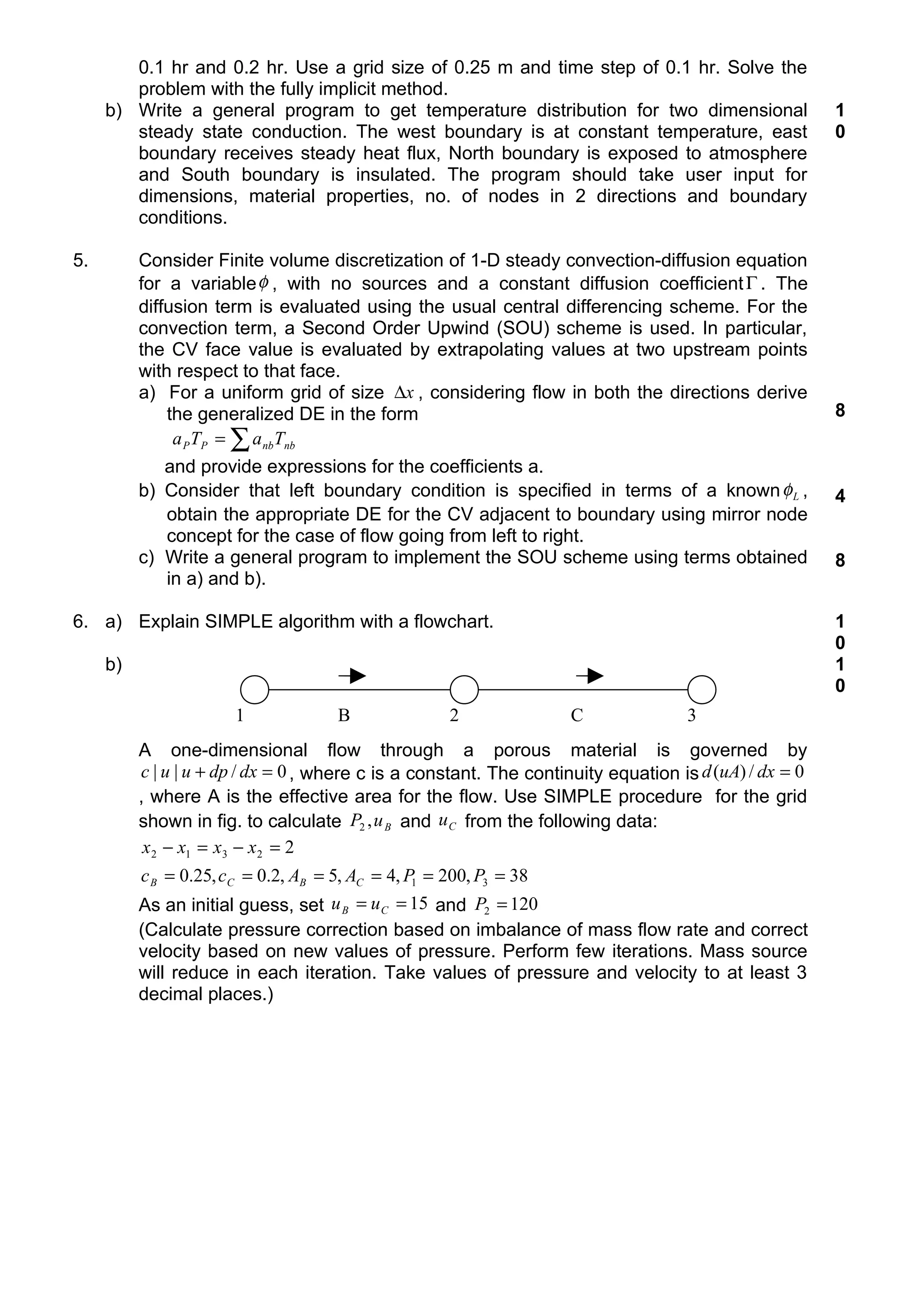
                       1             B              2               C               3
          A one-dimensional flow through a porous material is governed by
          c | u | u + dp / dx = 0 , where c is a constant. The continuity equation is d (uA) / dx = 0
          , where A is the effective area for the flow. Use SIMPLE procedure for the grid
          shown in fig. to calculate P2 , u B and u C from the following data:
           x 2 − x1 = x3 − x 2 = 2
          c B = 0.25, cC = 0.2, AB = 5, AC = 4, P1 = 200, P3 = 38
          As an initial guess, set u B = u C = 15 and P2 = 120
          (Calculate pressure correction based on imbalance of mass flow rate and correct
          velocity based on new values of pressure. Perform few iterations. Mass source
          will reduce in each iteration. Take values of pressure and velocity to at least 3
          decimal places.)

Cf dfinal1 (may11)

  • 1.
    VEERMATA JIJABAI TECHNOLOGICALINSTITUTE Matunga, Mumbai – 400 019 [Autonomous] End Semester Examination Sem & Programme VIII Final Year B. Tech (Mechanical) Duration 03 Hours Course code & Course ME0453 Computational Fluid Dynamics Max.Marks 100 Date of Exam 3-5-2011 Instructions: 1. Question 1 is compulsory. Solve any 4 out of the remaining. 2. Figures to the right indicate full marks. 3. Assume suitable data if necessary. 4. Illustrate your answers with neat sketches wherever necessary. 1. Answer in brief. 2 0 a) Compare FDM, FVM and FEM. b) Compare direct methods with iterative methods for solving large number of equations. c) What is the difference between SIMPLE, SIMPLER and SIMPLEC? d) What are advantages and disadvantages of k-ε turbulence model? e) Explain the relevance of CFD theory in successful use of commercial software. 2. a) Derive energy equation and express it in conservation form. 1 5 b) Explain the finite difference method for any governing equation with suitable 5 boundary conditions. 3. The governing differential equation for a thin fin with uniform cross-sectional area, where the heat loss to the surrounding is purely by convection, is given by d 2T hP − ( T − T∞ ) = 0 d 2 x kA a) Following the standard procedure of the Finite Volume discretization process, derive the discretization equation (DE) in usual form 6 a P TP = ∑ a nb Tnb + b b) Use the following data: A = 2 x 10⁻⁵ m2, P = 0.015 m, k = 20 W/m-k, 9 h = 10 W/m2-K, T∞ = 250C, The temperature at the left end (”base”) is Tb = 1000C, while that at the right end (“tip”) is TL = 400C. The length of the fin is L = 20 mm. Use ∆x = 4 mm. Obtain the complete system of algebraic equations and solve for the temperature distribution within the fin. c) The analytical expression for the temperature distribution is given by 2  T − T∞    sinh mx + sinh m( L − x ) T − T∞  Tb − T∞    = Tb − T∞ sinh mL hP where m = . Compare your numerical solution with the analytical solution kA at any one internal point in the fin. d) If right end (“tip”) is insulated or open to atmosphere, how the algebraic equation will change for the boundary point? 3 4. a) A one-dimensional slab of 1 m width and a constant thermal diffusivity of 1 m2/hr 1 is initially at a uniform temperature of 1000C. The surface temperatures of the left 0 (x = 0) and right (x = L) faces are suddenly increased and maintained at 300 0C. There are no sources. Determine the temperature distribution within the wall at
  • 2.
    0.1 hr and0.2 hr. Use a grid size of 0.25 m and time step of 0.1 hr. Solve the problem with the fully implicit method. b) Write a general program to get temperature distribution for two dimensional 1 steady state conduction. The west boundary is at constant temperature, east 0 boundary receives steady heat flux, North boundary is exposed to atmosphere and South boundary is insulated. The program should take user input for dimensions, material properties, no. of nodes in 2 directions and boundary conditions. 5. Consider Finite volume discretization of 1-D steady convection-diffusion equation for a variable φ , with no sources and a constant diffusion coefficient Γ . The diffusion term is evaluated using the usual central differencing scheme. For the convection term, a Second Order Upwind (SOU) scheme is used. In particular, the CV face value is evaluated by extrapolating values at two upstream points with respect to that face. a) For a uniform grid of size ∆x , considering flow in both the directions derive the generalized DE in the form 8 a P TP = ∑ a nbTnb and provide expressions for the coefficients a. b) Consider that left boundary condition is specified in terms of a known φ L , 4 obtain the appropriate DE for the CV adjacent to boundary using mirror node concept for the case of flow going from left to right. c) Write a general program to implement the SOU scheme using terms obtained 8 in a) and b). 6. a) Explain SIMPLE algorithm with a flowchart. 1 0 b) 1 0 1 B 2 C 3 A one-dimensional flow through a porous material is governed by c | u | u + dp / dx = 0 , where c is a constant. The continuity equation is d (uA) / dx = 0 , where A is the effective area for the flow. Use SIMPLE procedure for the grid shown in fig. to calculate P2 , u B and u C from the following data: x 2 − x1 = x3 − x 2 = 2 c B = 0.25, cC = 0.2, AB = 5, AC = 4, P1 = 200, P3 = 38 As an initial guess, set u B = u C = 15 and P2 = 120 (Calculate pressure correction based on imbalance of mass flow rate and correct velocity based on new values of pressure. Perform few iterations. Mass source will reduce in each iteration. Take values of pressure and velocity to at least 3 decimal places.)