A Machine Guarding  Case Study Shona Kelly Occupational Health Nurse Health and Safety Inspector HSNO Enforcement Officer GradDip OSH HR Management GradDip BS Dispute Resolution PostGradDip Arts Human Services OHSIG Conference 2011
Department of Labour  National Machine Guarding Project  2010-2013 The project targets fixed plant in workplaces. To ensure that AS4024.1 -2006 (series) and the Ergonomics of Machine Guarding are complied with for workers’ safety.  (All Practicable Steps)
Who has duties? Any  person who works with machinery, and who may have responsibilities for ensuring that machinery in their place of work complies with relevant machine guarding guidelines and standards.
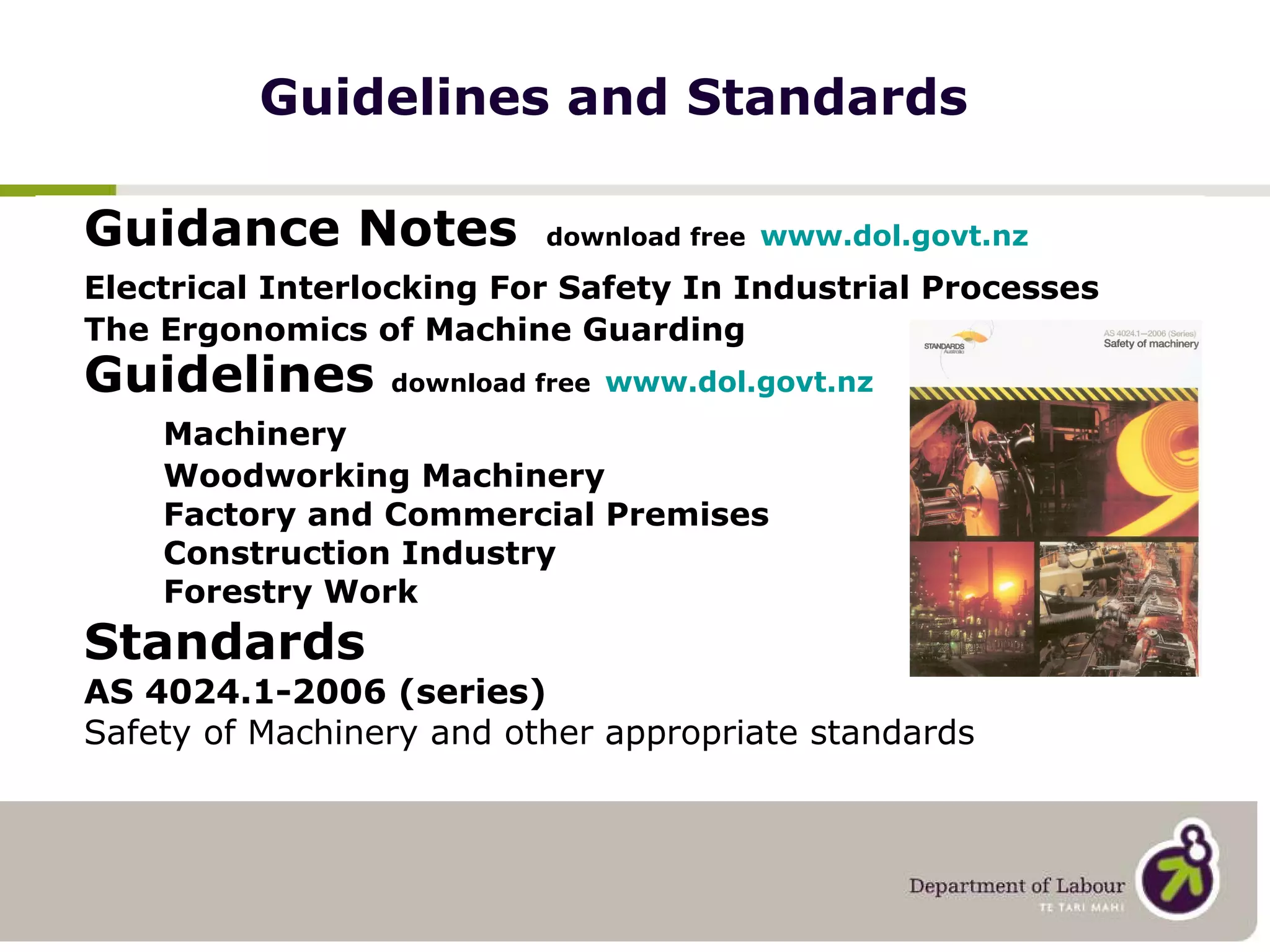
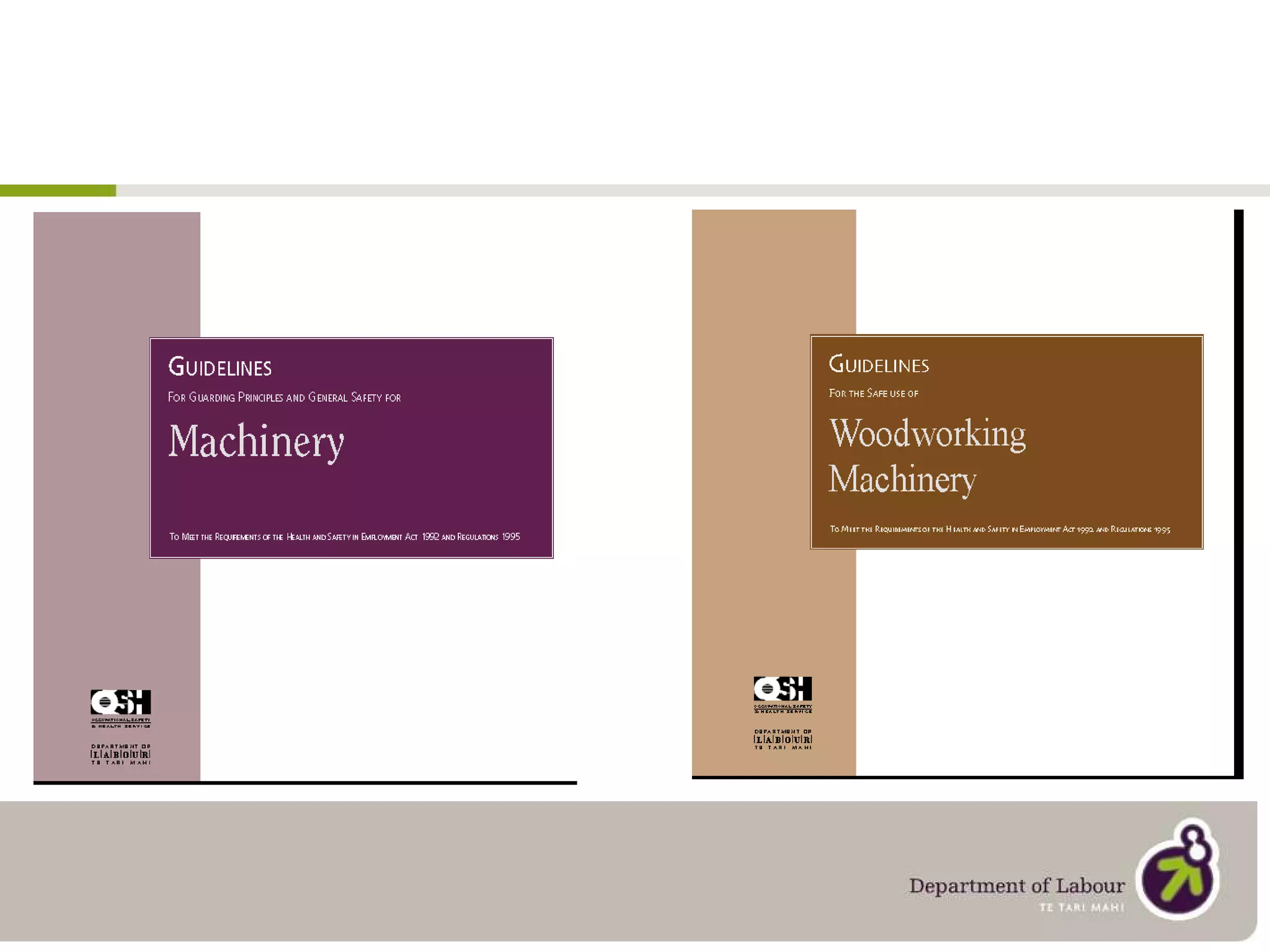
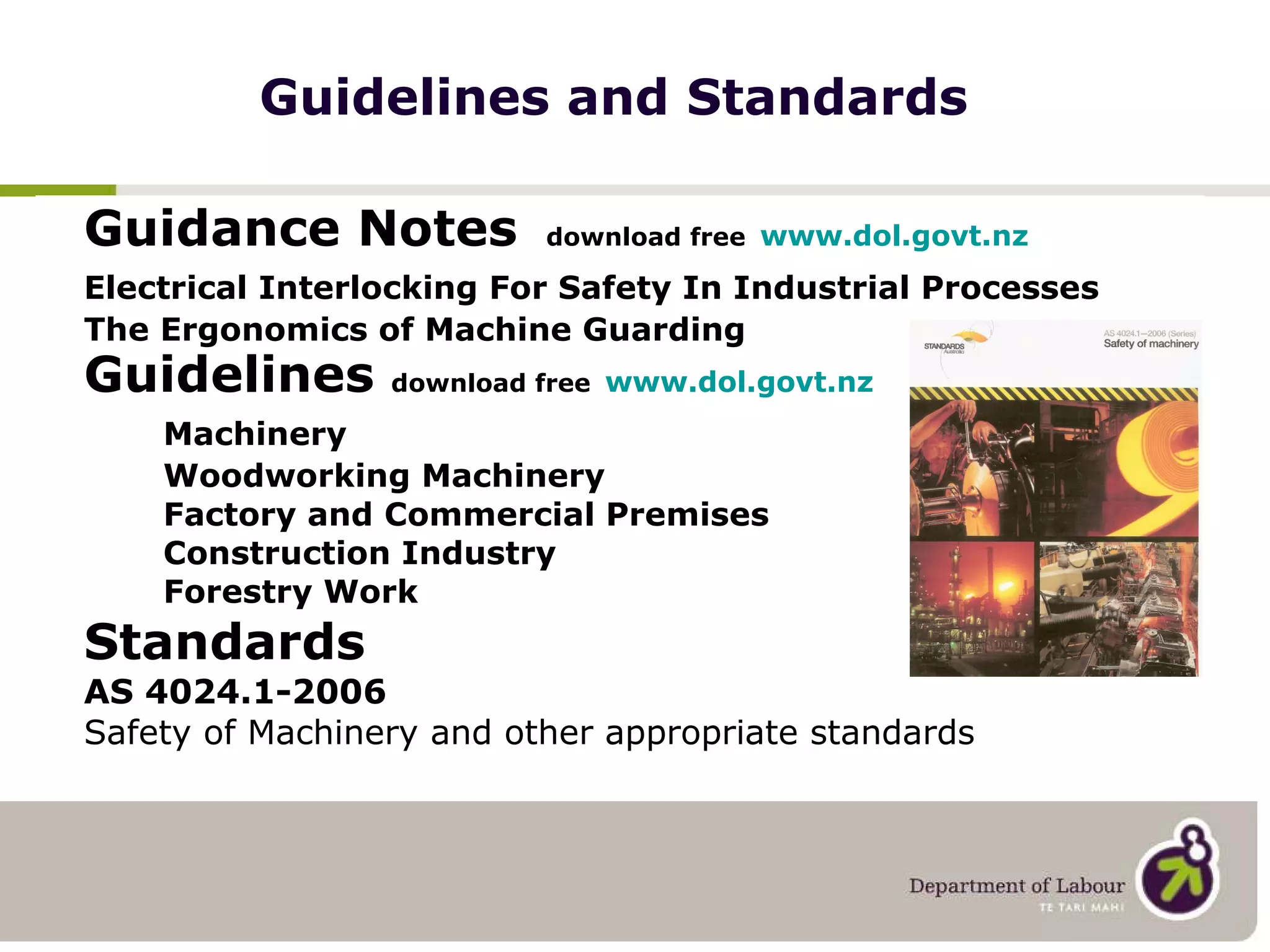
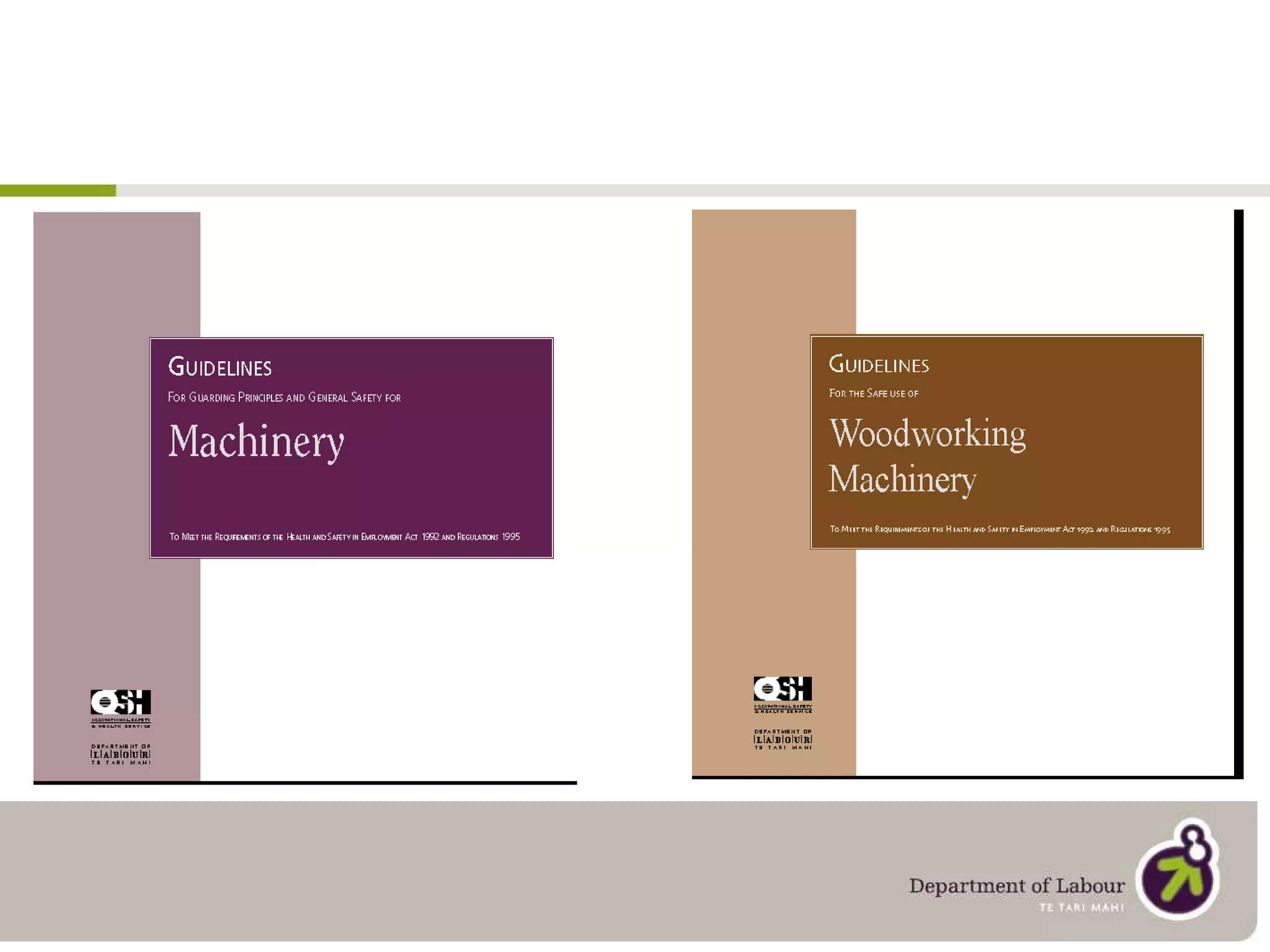
Guidelines and Standards Guidance Notes   download free   www.dol.govt.nz Electrical Interlocking For Safety In Industrial Processes The Ergonomics of Machine Guarding Guidelines  download free   www.dol.govt.nz Machinery Woodworking Machinery Factory and Commercial Premises Construction Industry Forestry Work Standards  AS 4024.1-2006 (series) Safety of Machinery and other appropriate standards
 
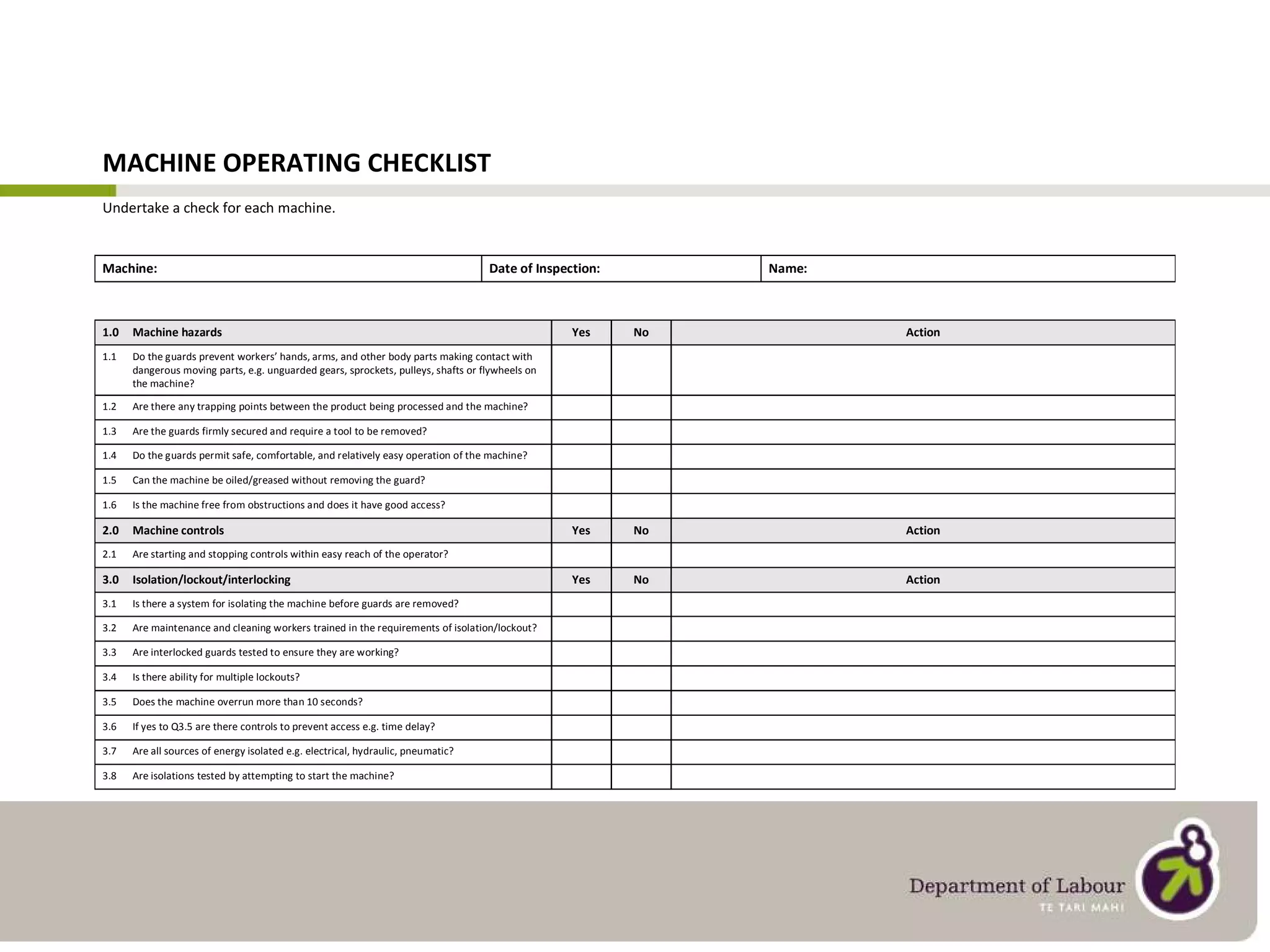
Proactive Assessment Process Information is provided to the employer Includes a checklist for review to be applied individually to all fixed plant on site Employer is responsible for identifying any deviation from the applicable standards Remedial action is undertaken immediately by employer Inspector returns to review employer’s assessments Identification of any matters not yet addressed Negotiated agreement for smaller upgrades Followed by employer’s written confirmation of actions taken For any significant non-compliance, a Written Warning, Prohibition Notice or Improvement Notice will be issued. Prosecution will be considered for all serious breaches of safety regulations.
Alternative Proactive Assessment Process Site visit by Inspector who provides information and checklists and completes an immediate assessment with the employer on the day. Any breach of safety regulations is addressed immediately by use of Written Warning, Prohibition Notice, Improvement Notice and Any significant breaches will be considered for Prosecution.
 
Reactive Site Assessment Section 6 of the Health and Safety in Employment Act requires that the employer provides a safe place of work, taking ‘all practicable steps’ to ensure the safety of employees while at work. This includes the installation and use of all appropriate guards for work tools.  In the event of any serious harm accident associated with machine guarding failure the Inspector will make an assessment for Prosecution.
Northland District Health Board  (NDHB) Laundry  Whangarei 2011
Proactive employer engagements NDHB is one of the Northland’s largest employers. The Occupational Health Manager liaises with the DoL Inspector/OHN at least quarterly to maintain a dialogue around occupational health issues and developments in the organisation. The NDHB was enthusiastic about participating in the MG Project to help ensure that the significant investment of new laundry plant was installed and operating at the highest safety standard.
NDHB Site visit assessment process Information was provided to the employer Included the checklist template for individual assessment of all fixed plant on site Employer was responsible for identifying any deviation from the applicable standards Remedial action was undertaken by employer Return visit by the Inspector to review assessments Identification of any minor matters not yet addressed Negotiated agreement Written confirmation of subsequent actions
observations Having suffered a variety of manual handling and other incidents over time, the laundry staff and the engineering/maintenance team were collectively engaged in the process of defining the pre-requisites and implementing each phase of the new installation. Their sense of ownership and pride was reflected in their willingness to share their experience in pictures and words to illustrate their journey in a collaborative workplace.
NDHB presentation See  slides
Outcomes The workplace has a team of workers who know that they have helped to shape their work life (and that of their employer) in a constructive and healthy way that benefits all. The DoL machine guarding project provided a useful means by which to evaluate and enhance the remedies the employer had initiated to address longstanding health and safety and wellbeing issues.
Acknowledgements Thanks to NDHB Laundry Manager Debbie Borovich and Occupational Health Manager Leona Murray for their generosity in sharing their in-house presentation of the laundry project.
National Compliance Project  Machine Guarding 18 th  May 2011
Why machine guarding? The Department of Labour has commenced a national compliance project designed to reduce the unacceptably high level of fatal and serious harm injuries associated with unsafe use of machinery.
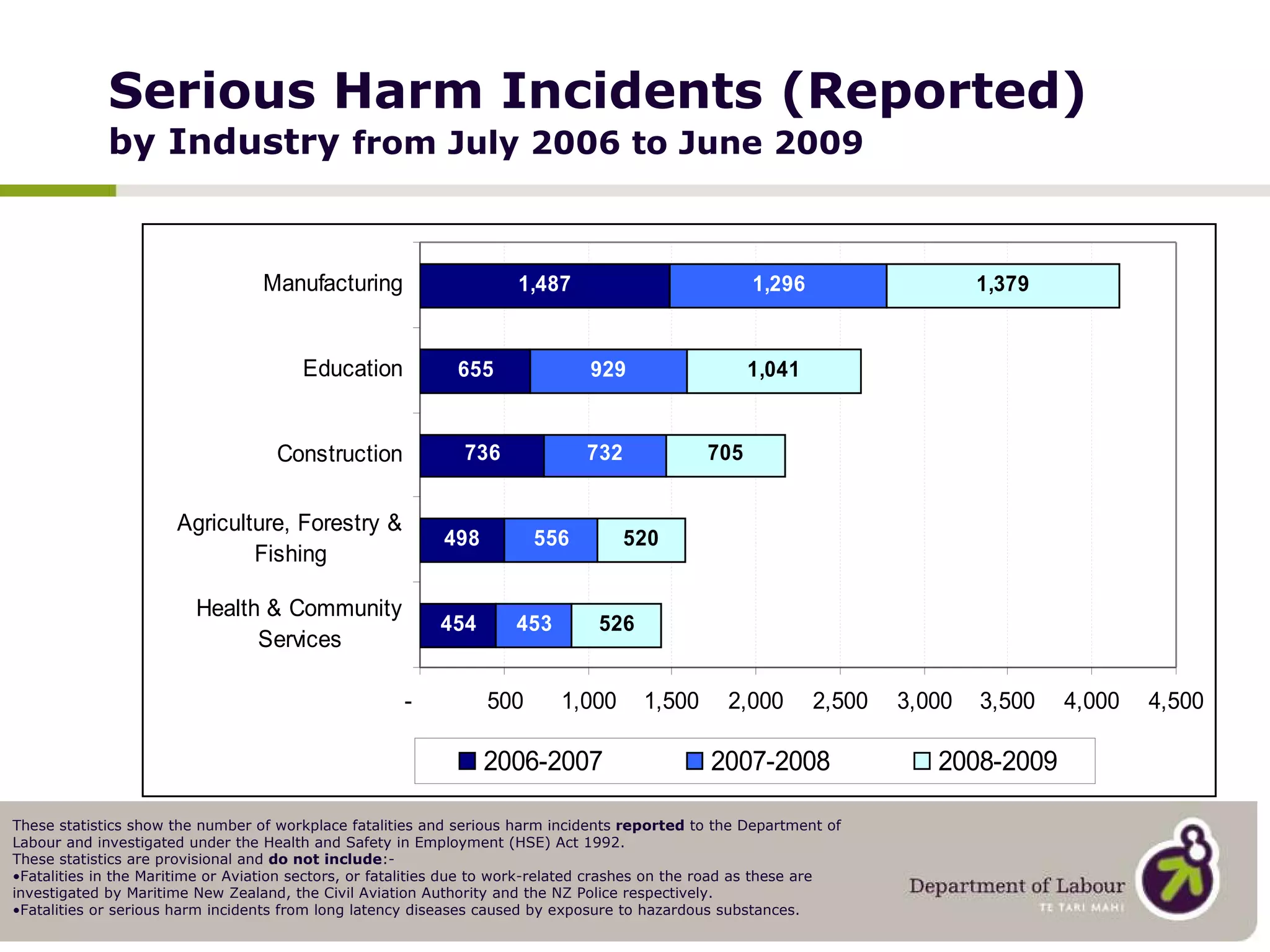
Serious Harm Incidents (Reported)  by Industry  from July 2006 to June 2009 These statistics show the number of workplace fatalities and serious harm incidents  reported  to the Department of Labour and investigated under the Health and Safety in Employment (HSE) Act 1992.  These statistics are provisional and  do not include :-  Fatalities in the Maritime or Aviation sectors, or fatalities due to work-related crashes on the road as these are investigated by Maritime New Zealand, the Civil Aviation Authority and the NZ Police respectively. Fatalities or serious harm incidents from long latency diseases caused by exposure to hazardous substances.
This will be a three-year nationwide project in which Heath and Safety Inspectors across New Zealand will have a clear and sustained focus on both the consistent application of current machine guarding standards and effective implementation of procedures and systems to ensure the safe use of machinery in the workplace.  Through an approach which will balance information, assistance and enforcement activity, the Department aims to reduce the severity of serious harm accidents resulting from the unsafe use of machinery. Three Year Nationwide Project
Focus area The initial focus areas for inspectors will be both the common mechanical hazards across all machinery and the common machinery types which are causing death and serious harm and for which there are well known and established standards for guarding.
Who has duties? Any person who works with machinery, and may have responsibilities for ensuring that machinery in their place of work, complies with relevant machine guarding guidelines and standards.
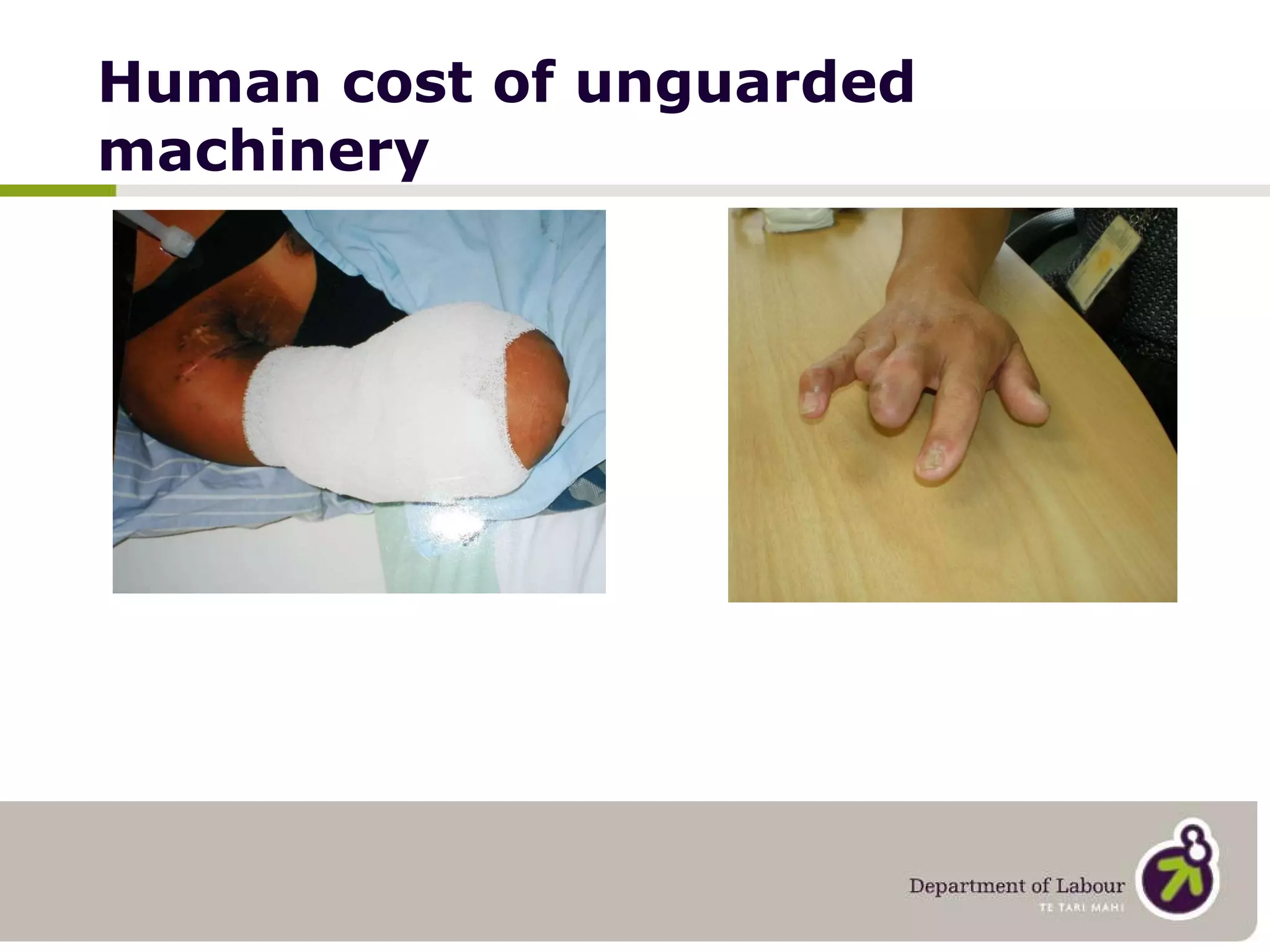
Human cost of unguarded machinery
Selecting safeguards Fixed guards & interlock guards Types of interlocks Common faults and  fail safe interlock Presence Sensing Devices Safety trip devices Interlock distance guards Two hand controls Guidelines & standards PRINCIPLES OF MACHINE GUARDING
Criteria for selecting Safeguard If hazards cannot be eliminated the question becomes How can we guard the machine? Consider which guard type best suits the need. Is it suitable for the intended use and environment? Is it designed and constructed to meet appropriate standards?  Can it be applied according to manufacturer’s instructions? Any material ejected by process? Are new hazards created? Ergonomics? Has motivation to defeat the guard been minimized ?
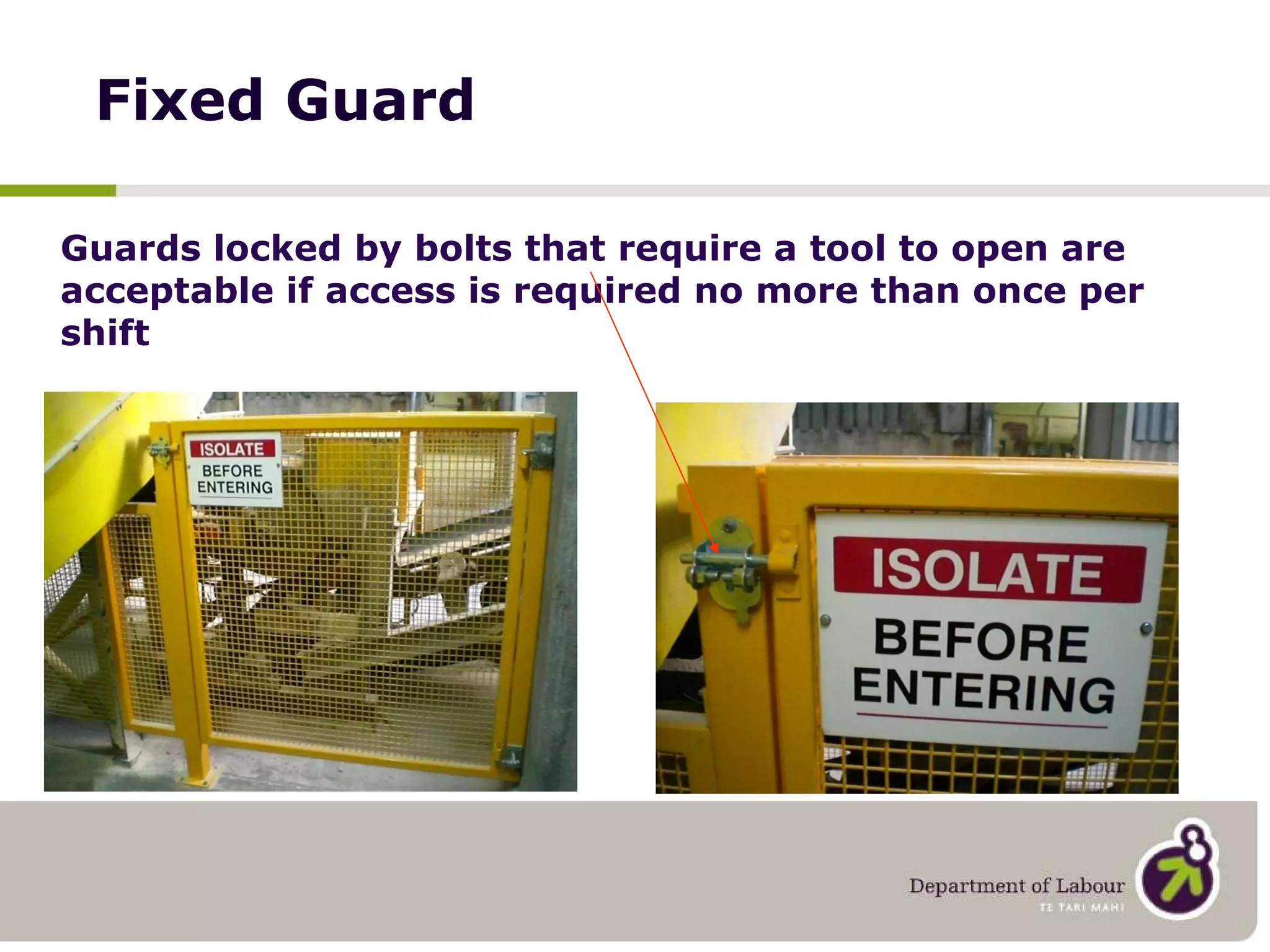
Fixed Guard Guards locked by bolts that require a tool to open are acceptable if access is required no more than once per shift
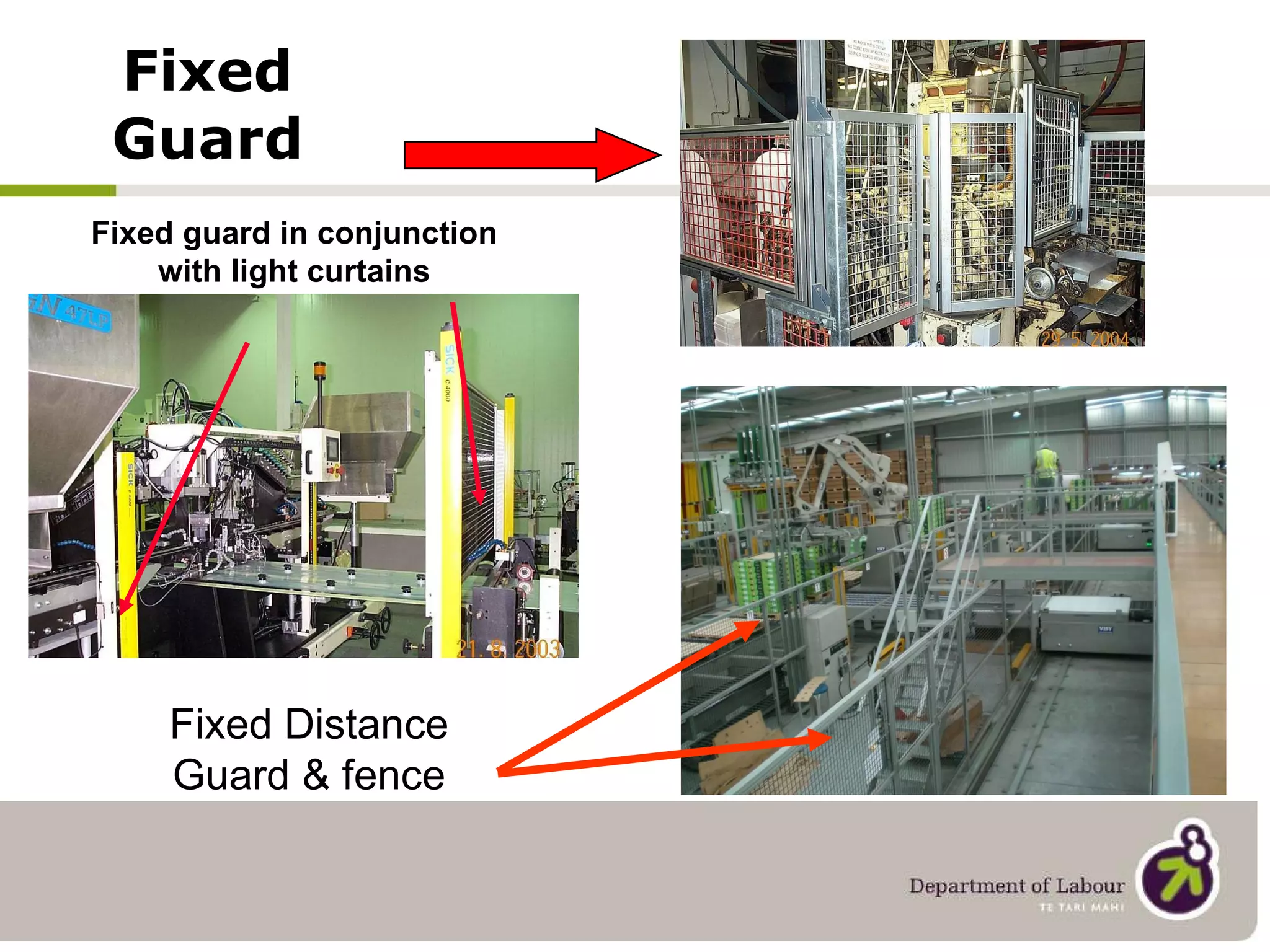
Fixed Guard Fixed Distance Guard & fence Fixed guard in conjunction with light curtains
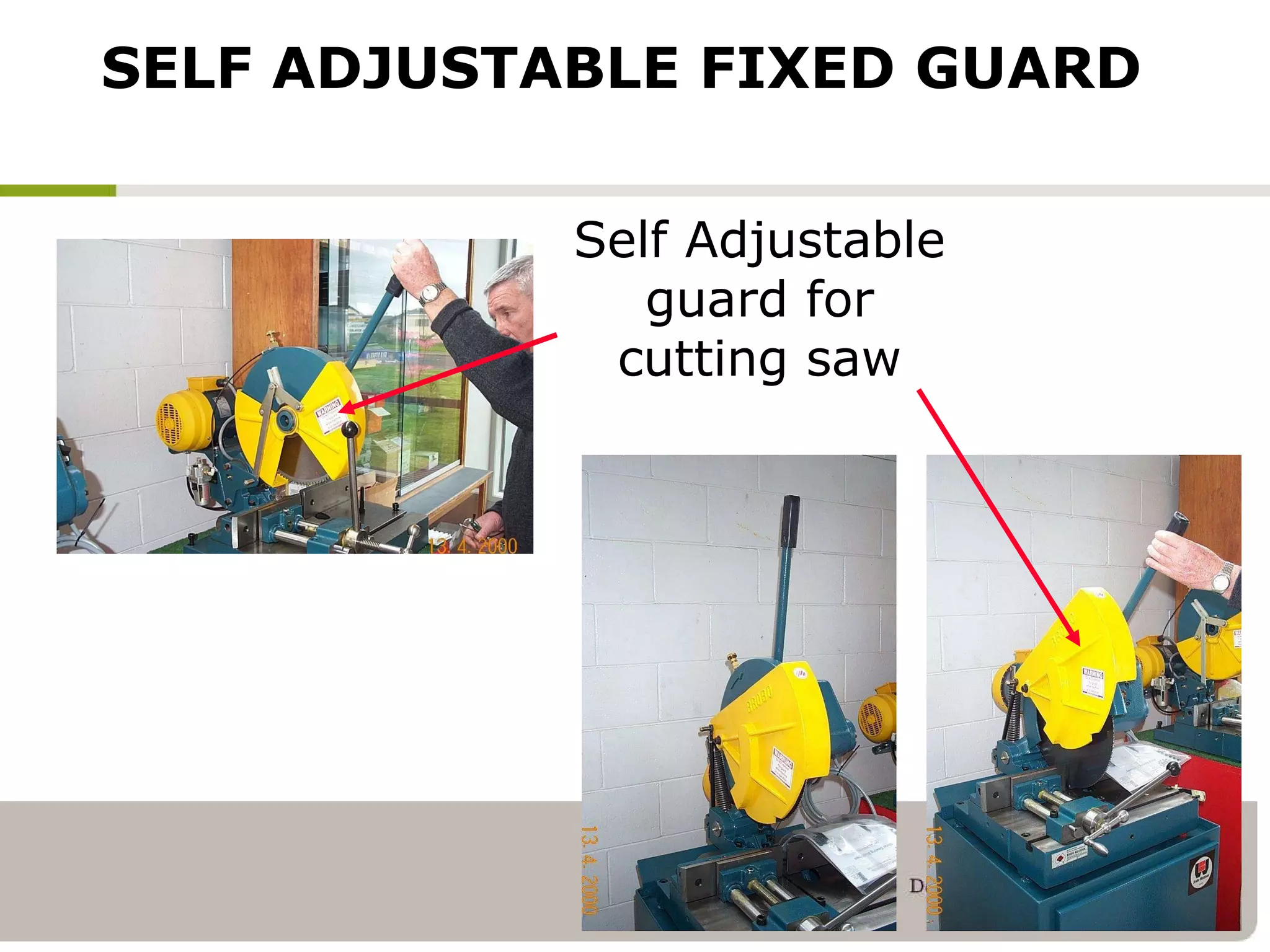
Self Adjustable guard for cutting saw SELF ADJUSTABLE FIXED GUARD
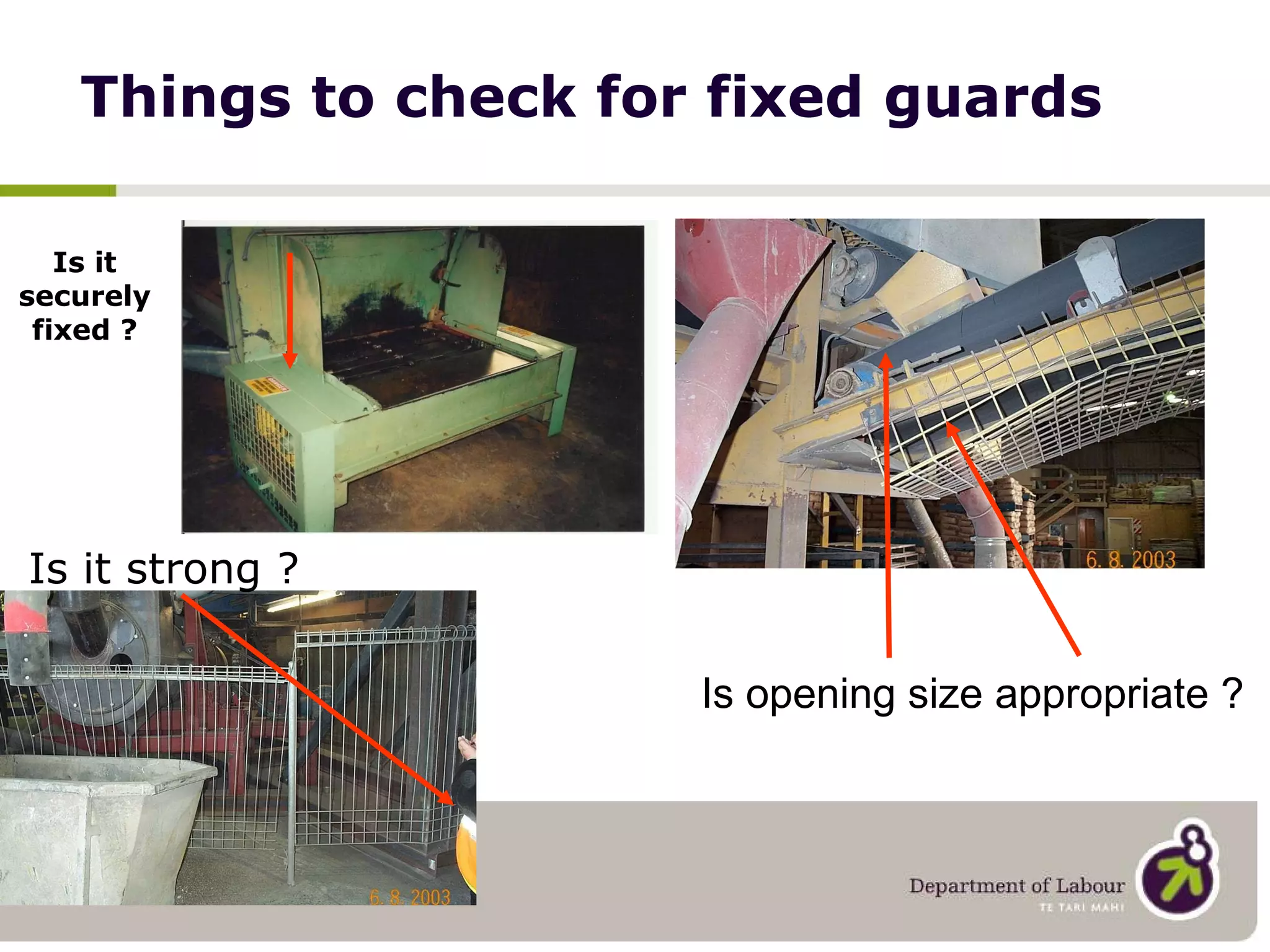
Things to check for fixed guards Is it securely fixed ? Is opening size appropriate ? Is it strong ?
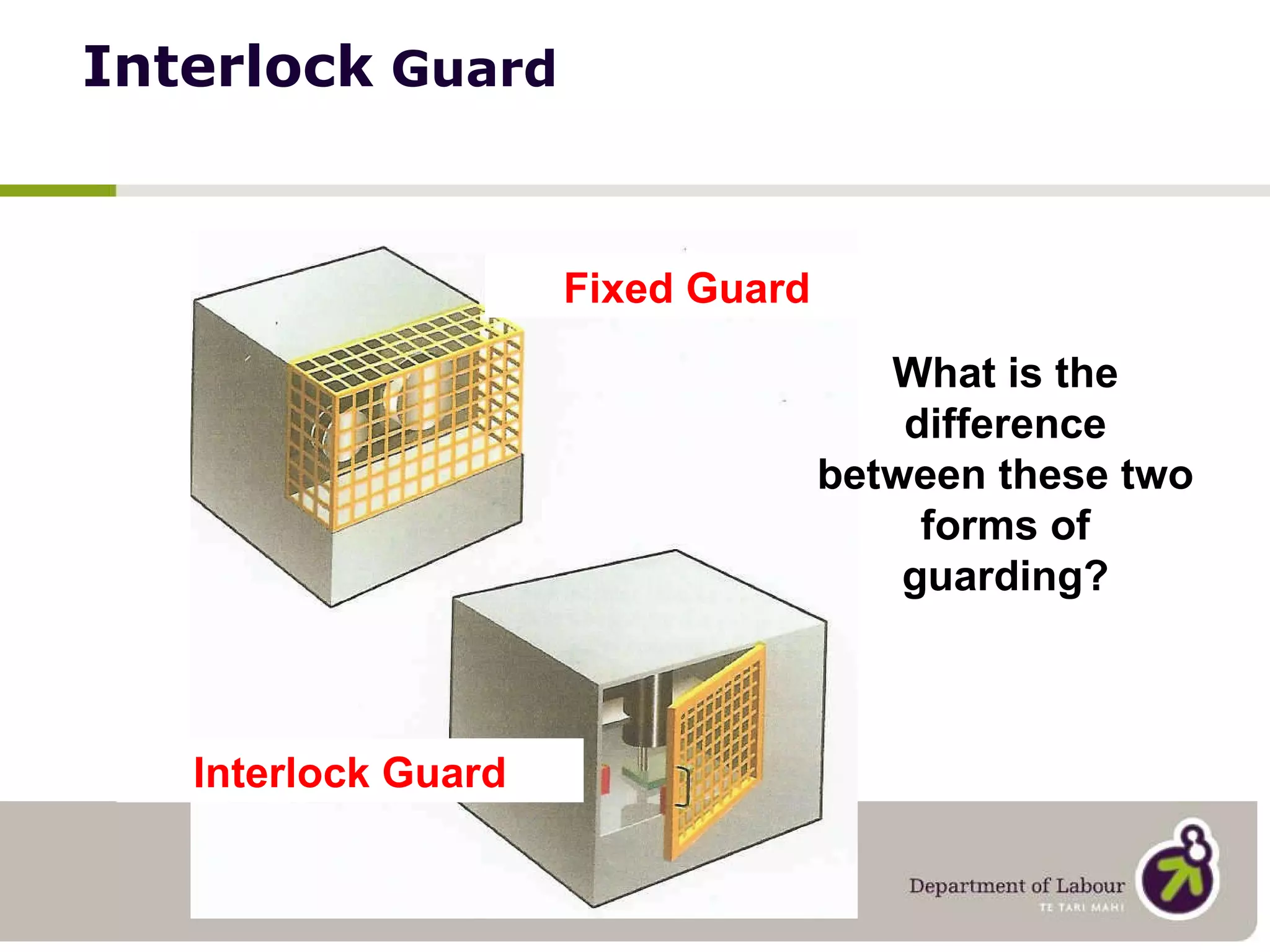
Interlock  Guard Fixed Guard Interlock Guard What is the difference between these two forms of guarding?
Interlock guard Used when a process requires an operator to open or remove a guard frequently Interfaced with control system to prevent inadvertent access Connect to power control
Interlock Guard Machine cannot be operated until guard is closed During operation guard cannot be opened Opening a guard will stop dangerous motion immediately Guard remains locked until dangerous motion has stopped Time delay or motion sensing release interlock can be fitted if there is overrun after power is cut off
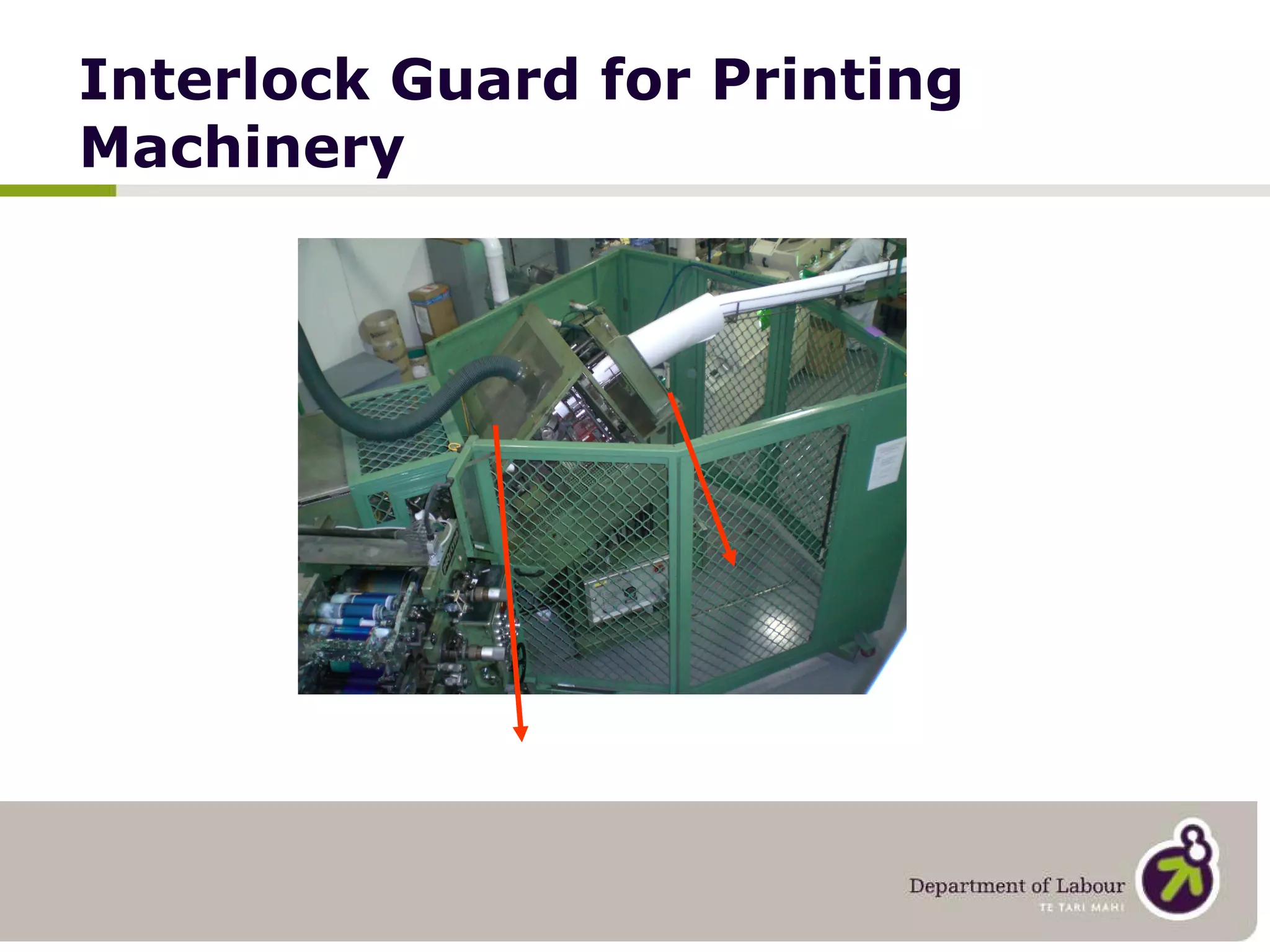
Interlock Guard for Printing Machinery
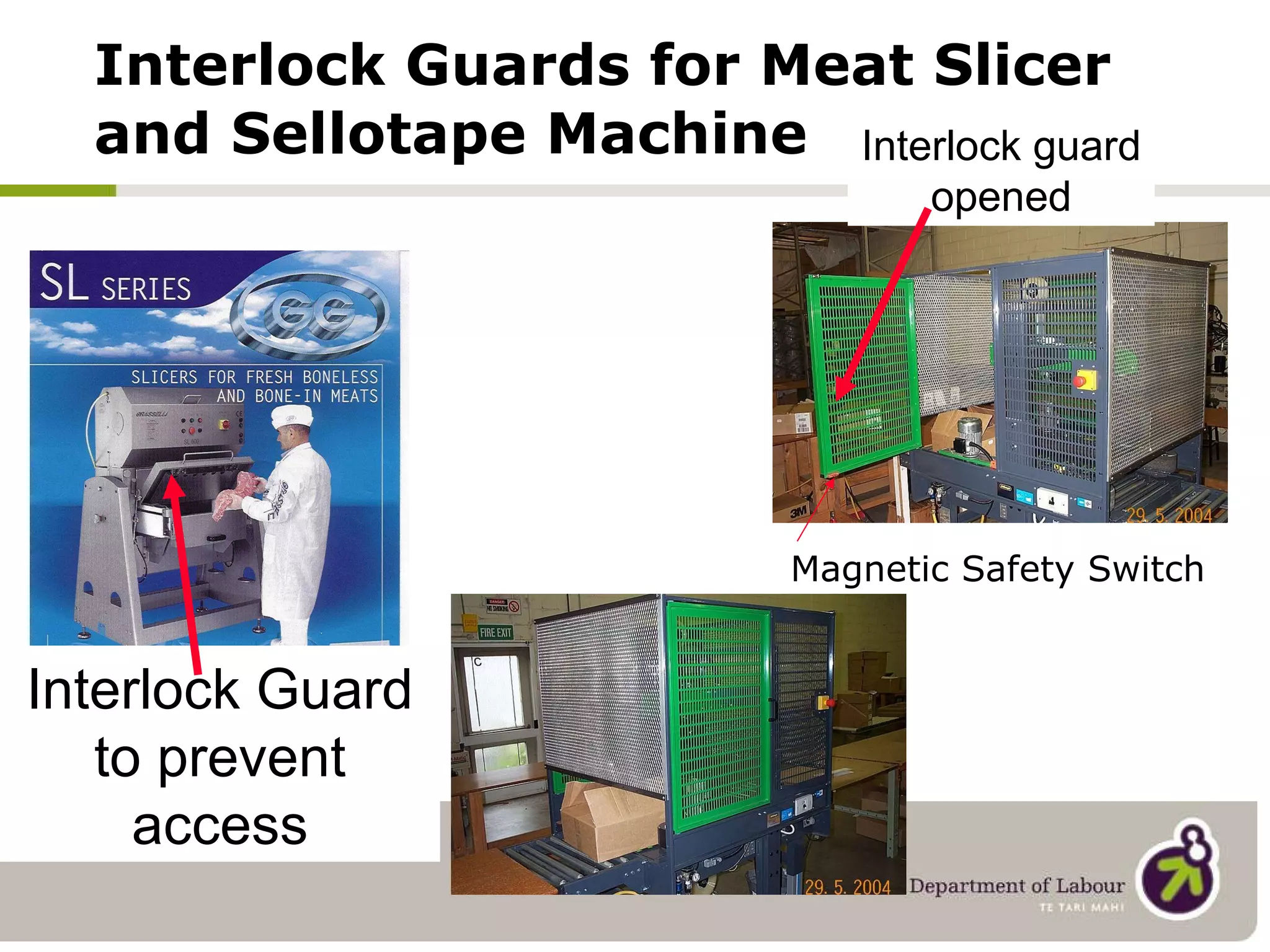
Interlock Guards for Meat Slicer and Sellotape Machine Interlock guard opened Magnetic Safety Switch Interlock Guard to prevent access
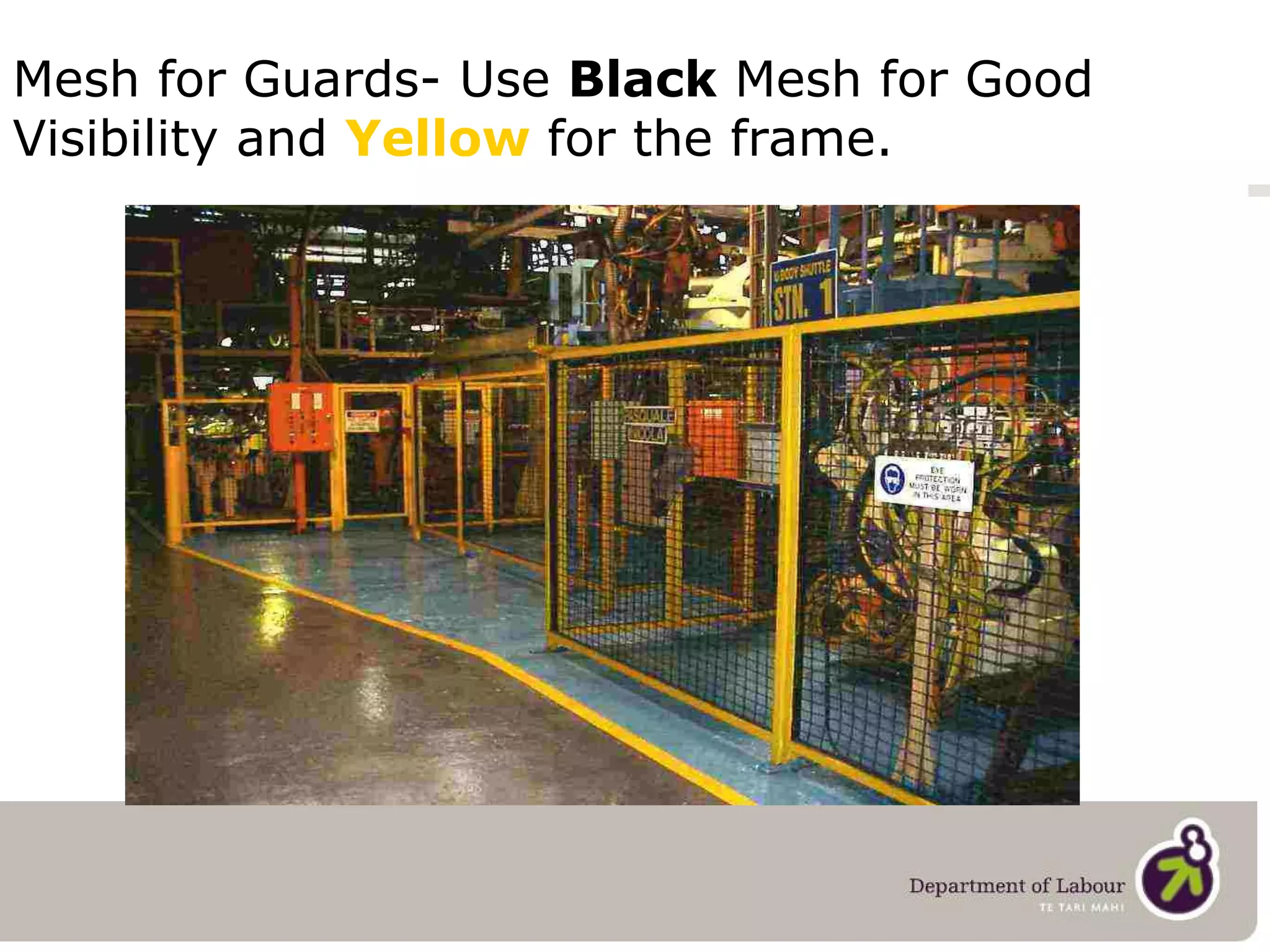
Mesh for Guards- Use  Black  Mesh for Good Visibility and  Yellow   for the frame.
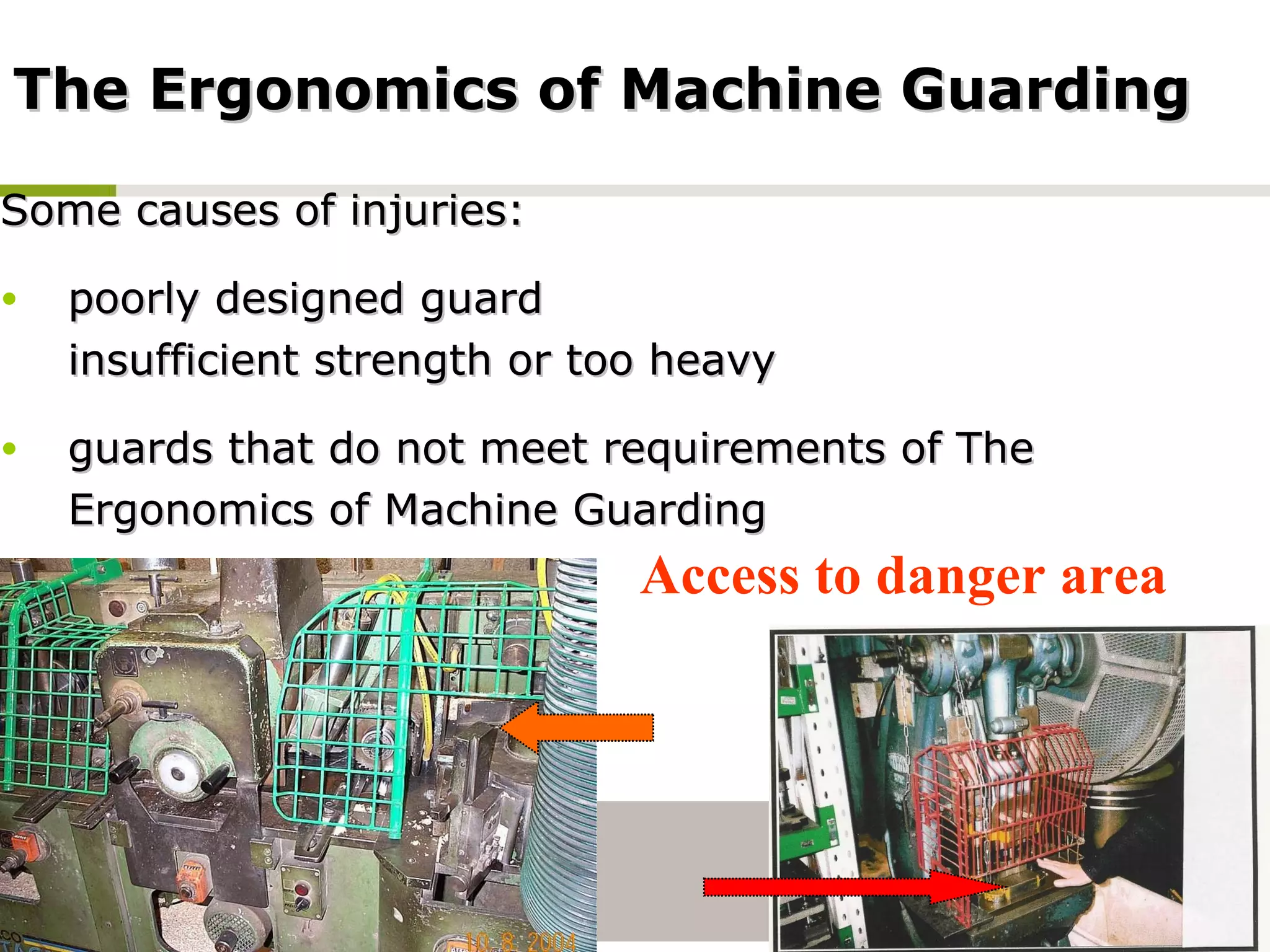
Some causes of injuries: poorly designed guard  insufficient strength or too heavy guards that do not meet requirements of The Ergonomics of Machine Guarding Access to danger area The Ergonomics of Machine Guarding
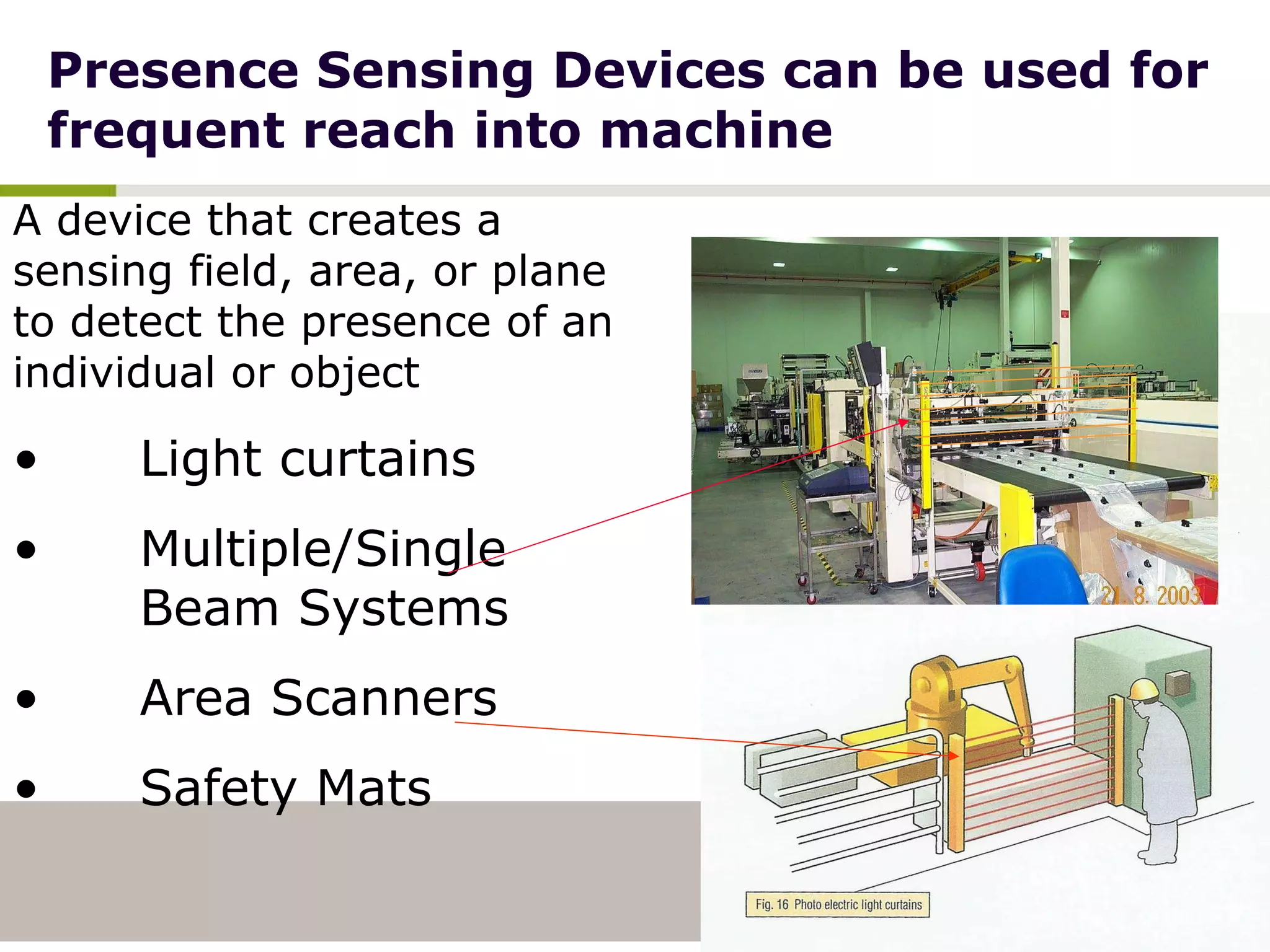
Presence Sensing Devices can be used for frequent reach into machine A device that creates a sensing field, area, or plane to detect the presence of an individual or object Light curtains Multiple/Single  Beam Systems Area Scanners Safety Mats
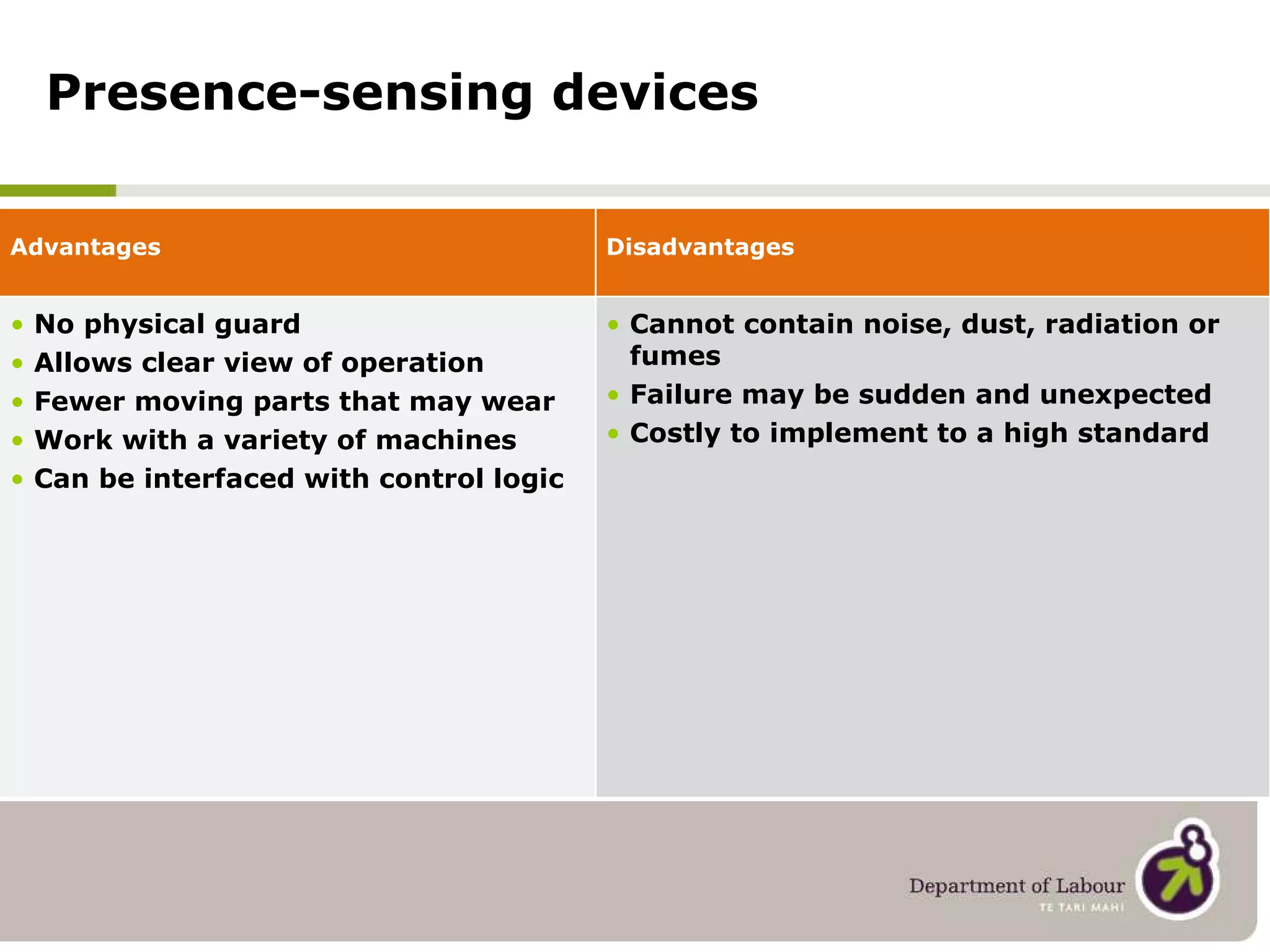
Presence-sensing devices   Advantages  Disadvantages  No physical guard Allows clear view of operation Fewer moving parts that may wear Work with a variety of machines Can be interfaced with control logic Cannot contain noise, dust, radiation or fumes Failure may be sudden and unexpected Costly to implement to a high standard
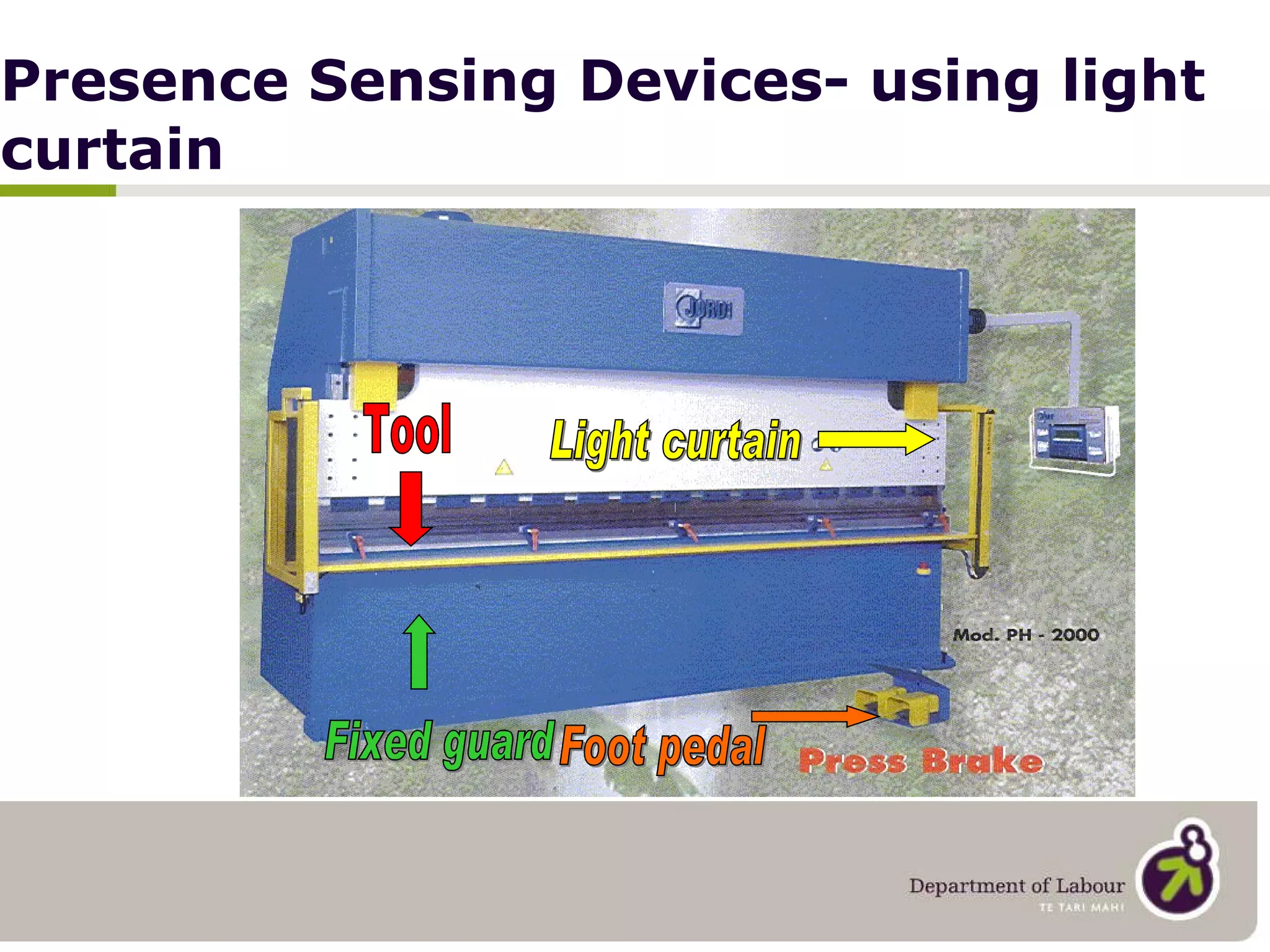
Presence Sensing Devices- using light curtain Light curtain Foot pedal Tool Fixed guard
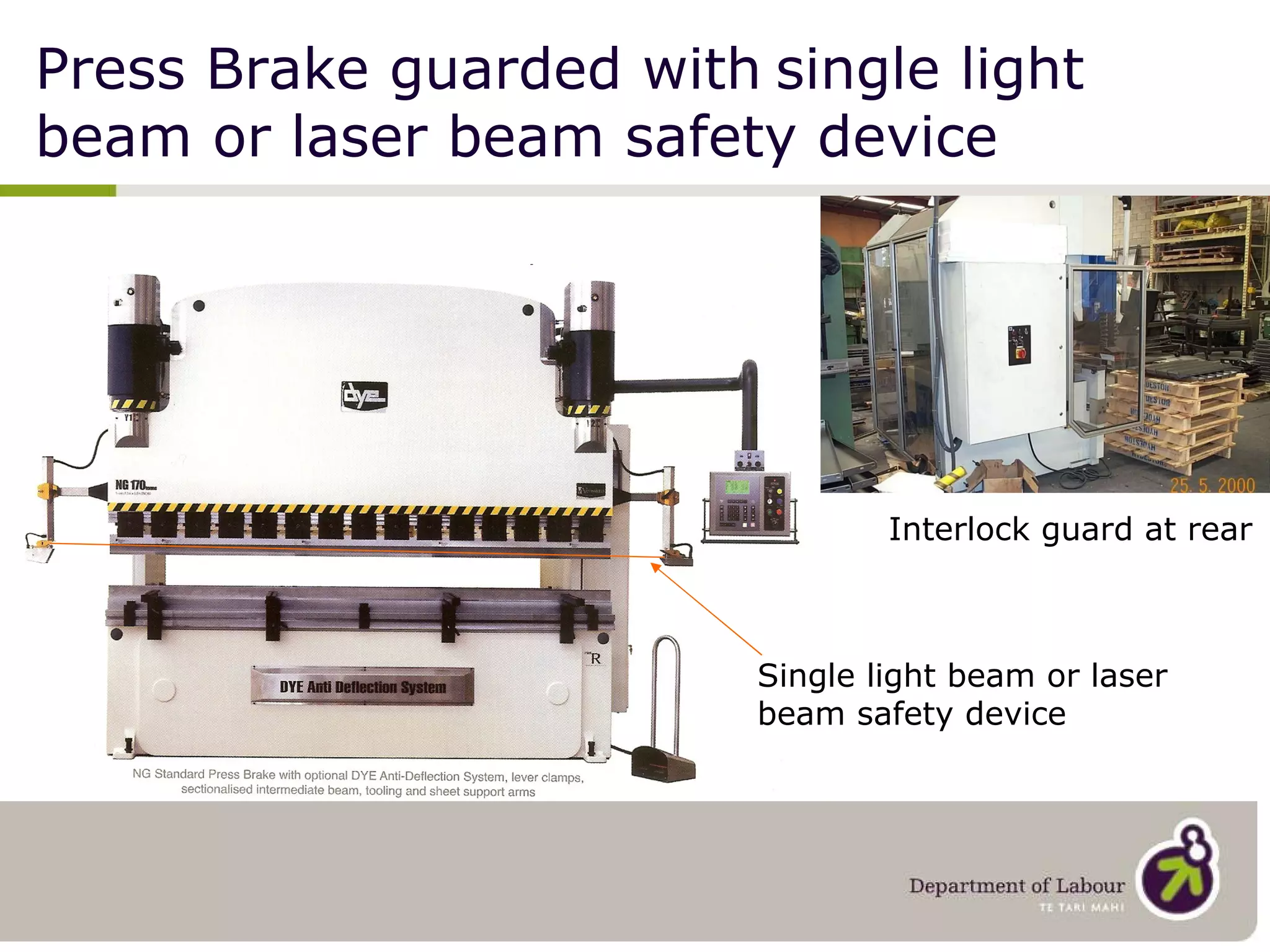
Single light beam or laser beam safety device Press Brake guarded with   single light beam or laser beam safety device Interlock guard at rear
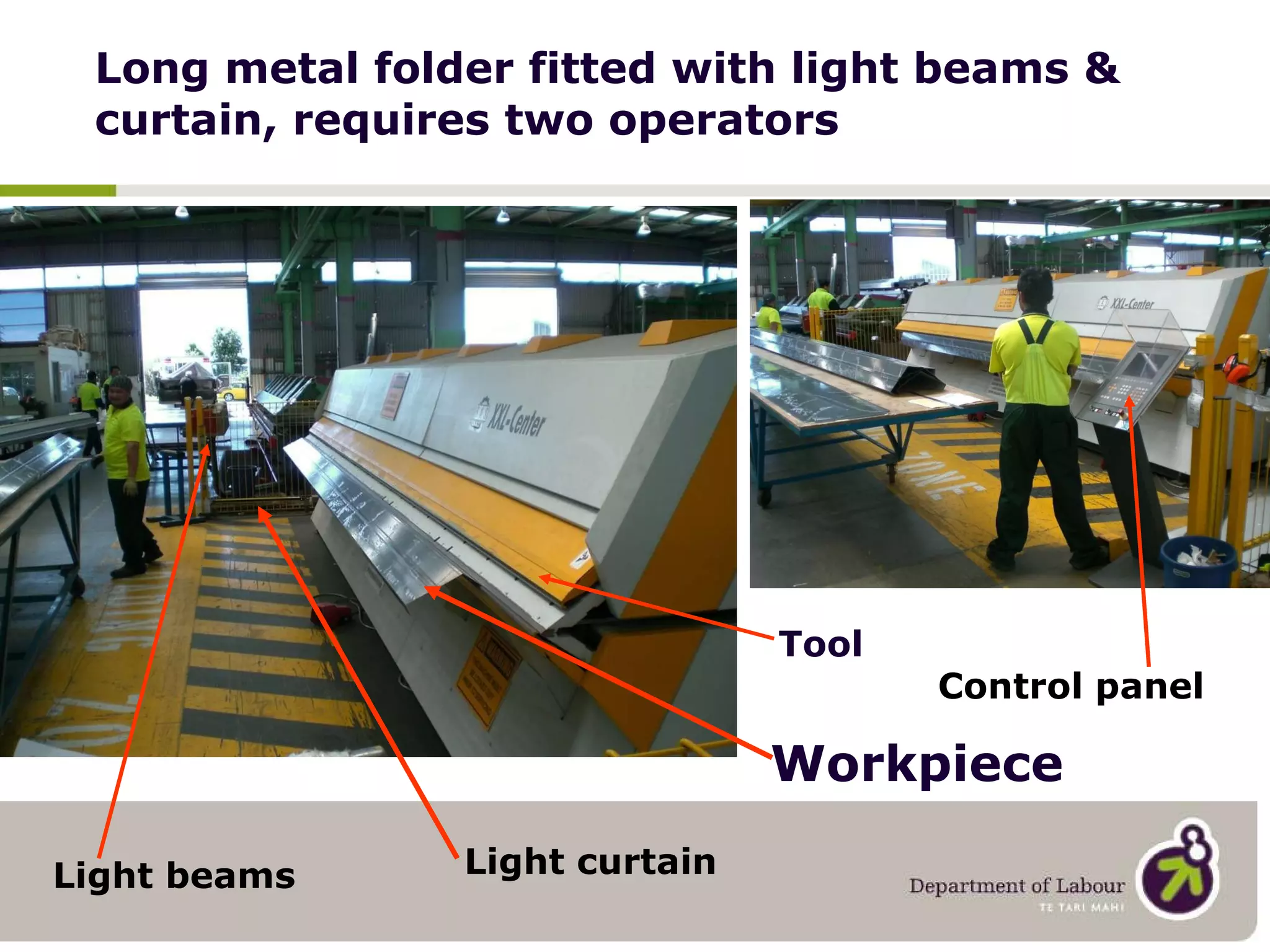
Long metal folder fitted with light beams & curtain, requires two operators  Workpiece Light beams Control panel Light curtain Tool
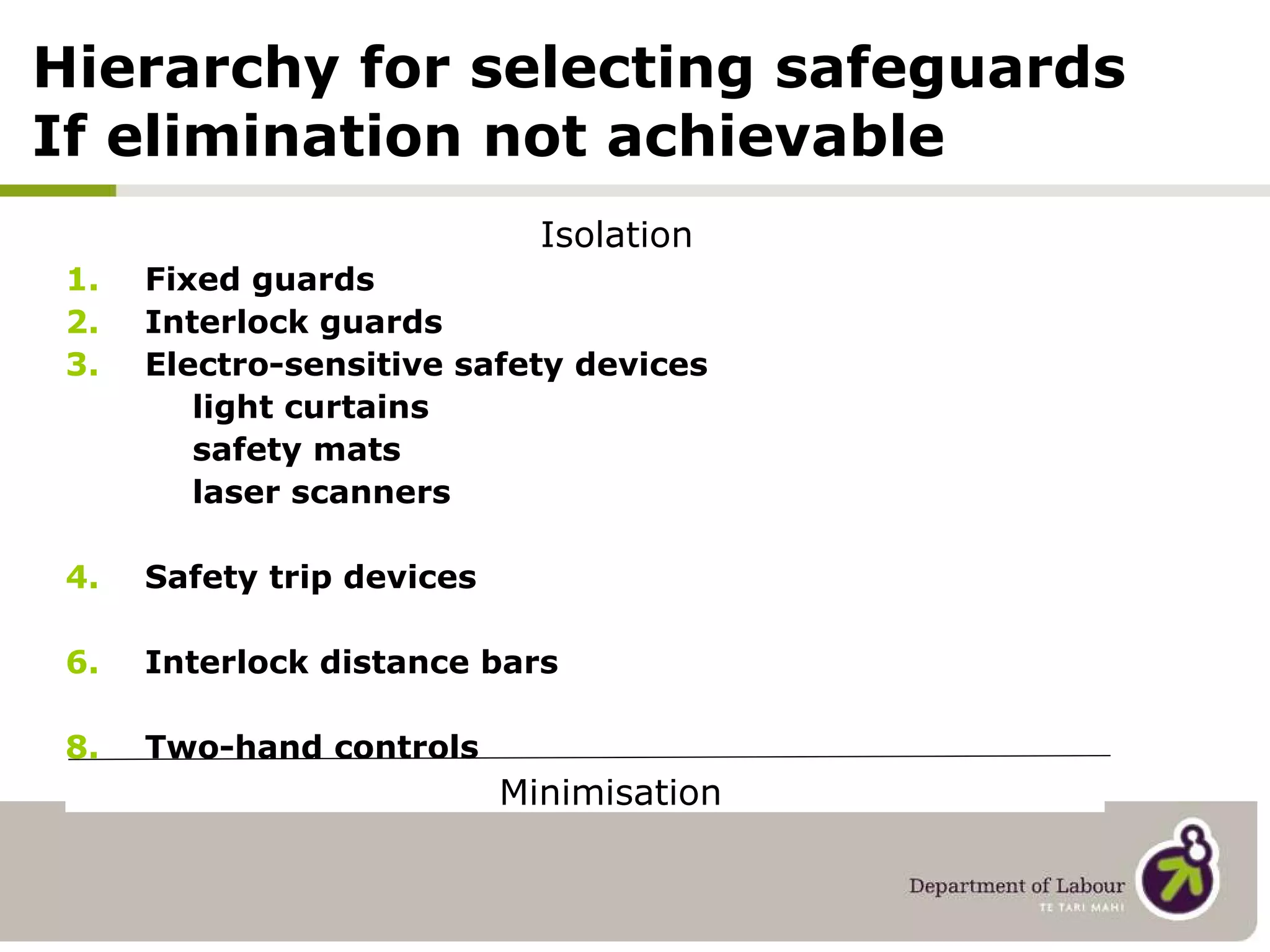
Hierarchy for selecting safeguards If elimination not achievable Isolation Fixed guards Interlock guards Electro-sensitive safety devices light curtains safety mats laser scanners Safety trip devices Interlock distance bars Two-hand controls Minimisation
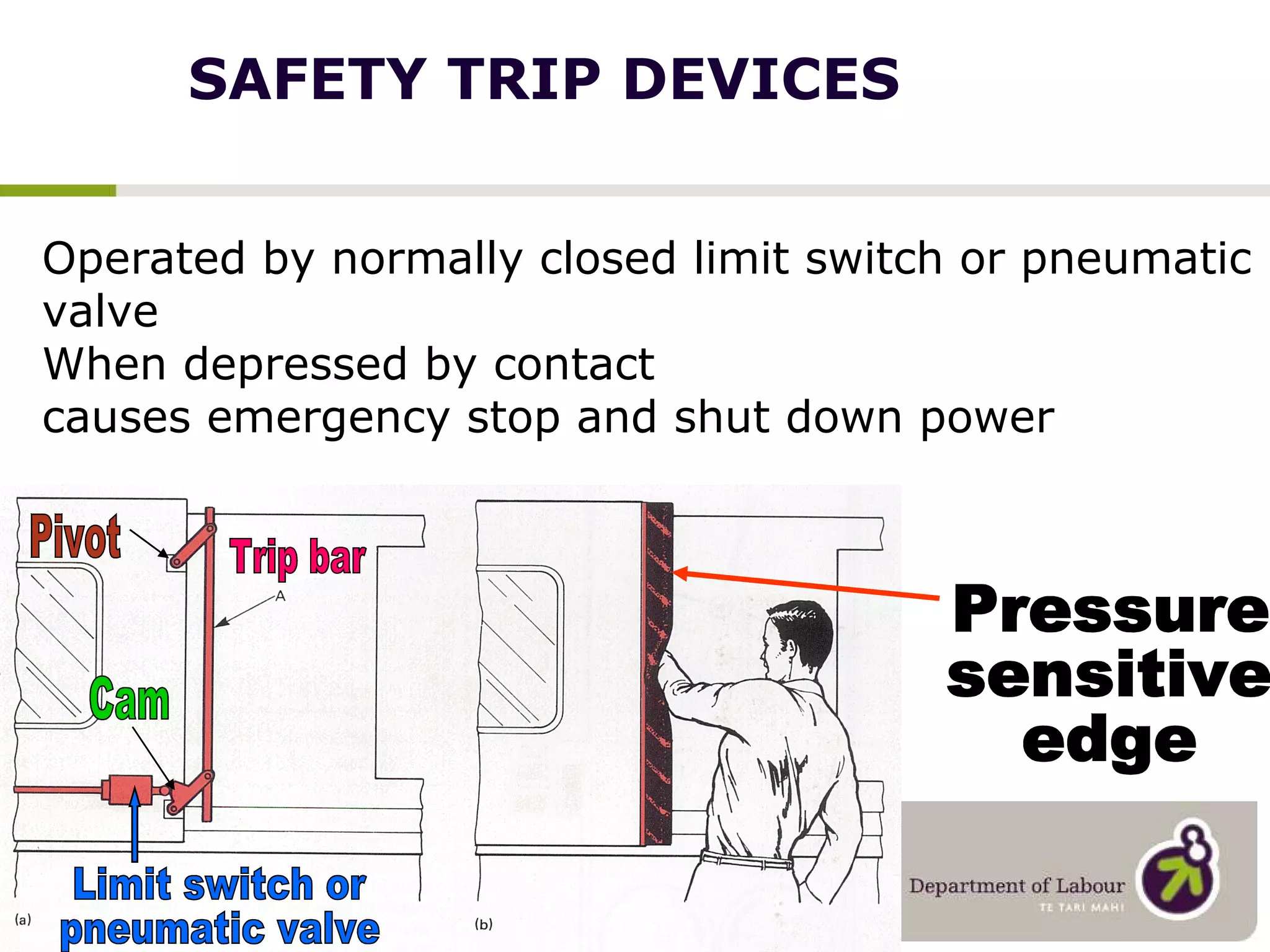
SAFETY TRIP DEVICES Trip bar Limit switch or  pneumatic valve Pivot Cam Pressure  sensitive edge Operated by normally closed limit switch or pneumatic valve When depressed by contact  causes emergency stop and shut down power
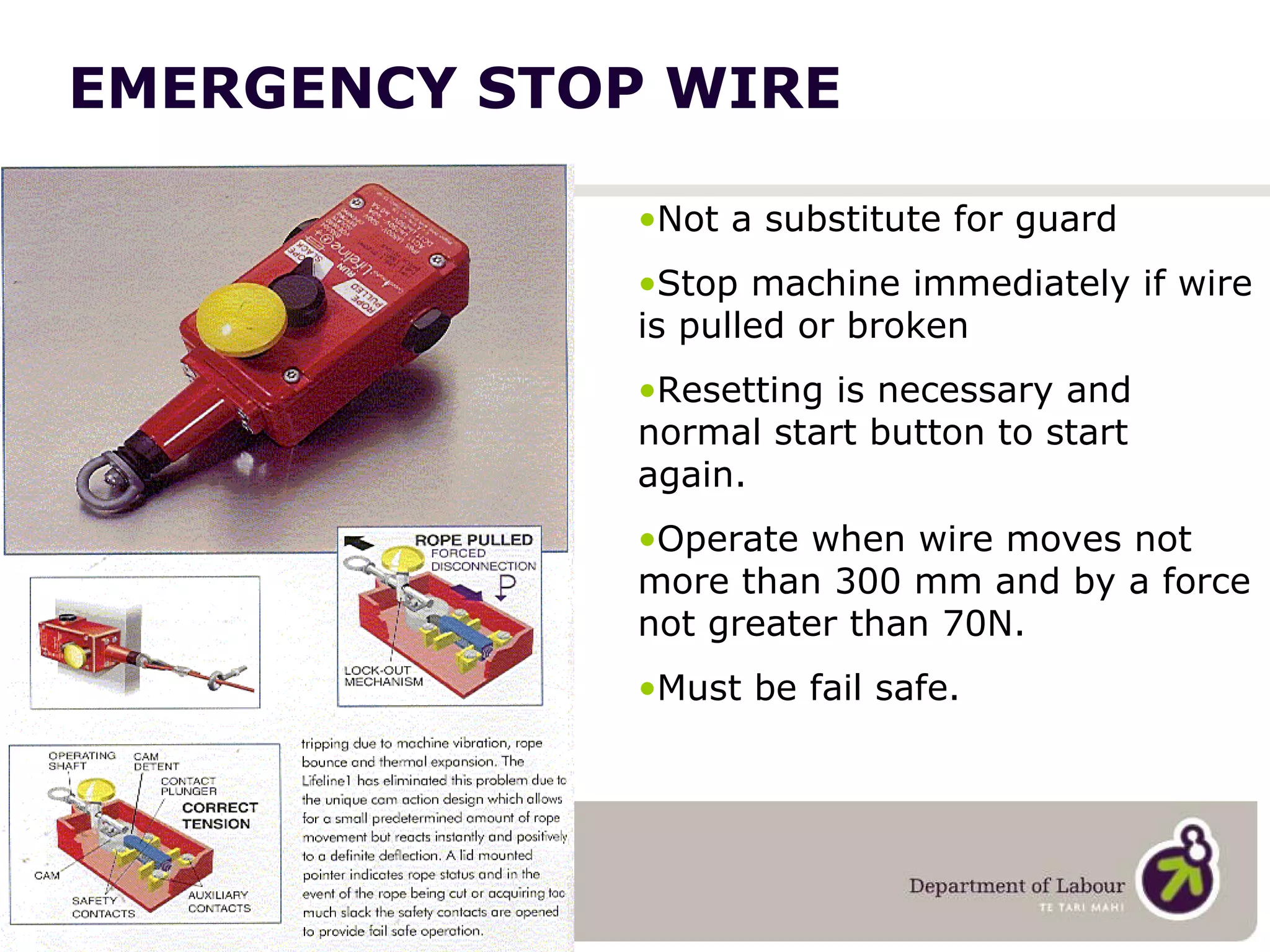
EMERGENCY STOP WIRE Not a substitute for guard Stop machine immediately if wire is pulled or broken Resetting is necessary and normal start button to start  again. Operate when wire moves not more than 300 mm and by a force not greater than 70N. Must be fail safe.
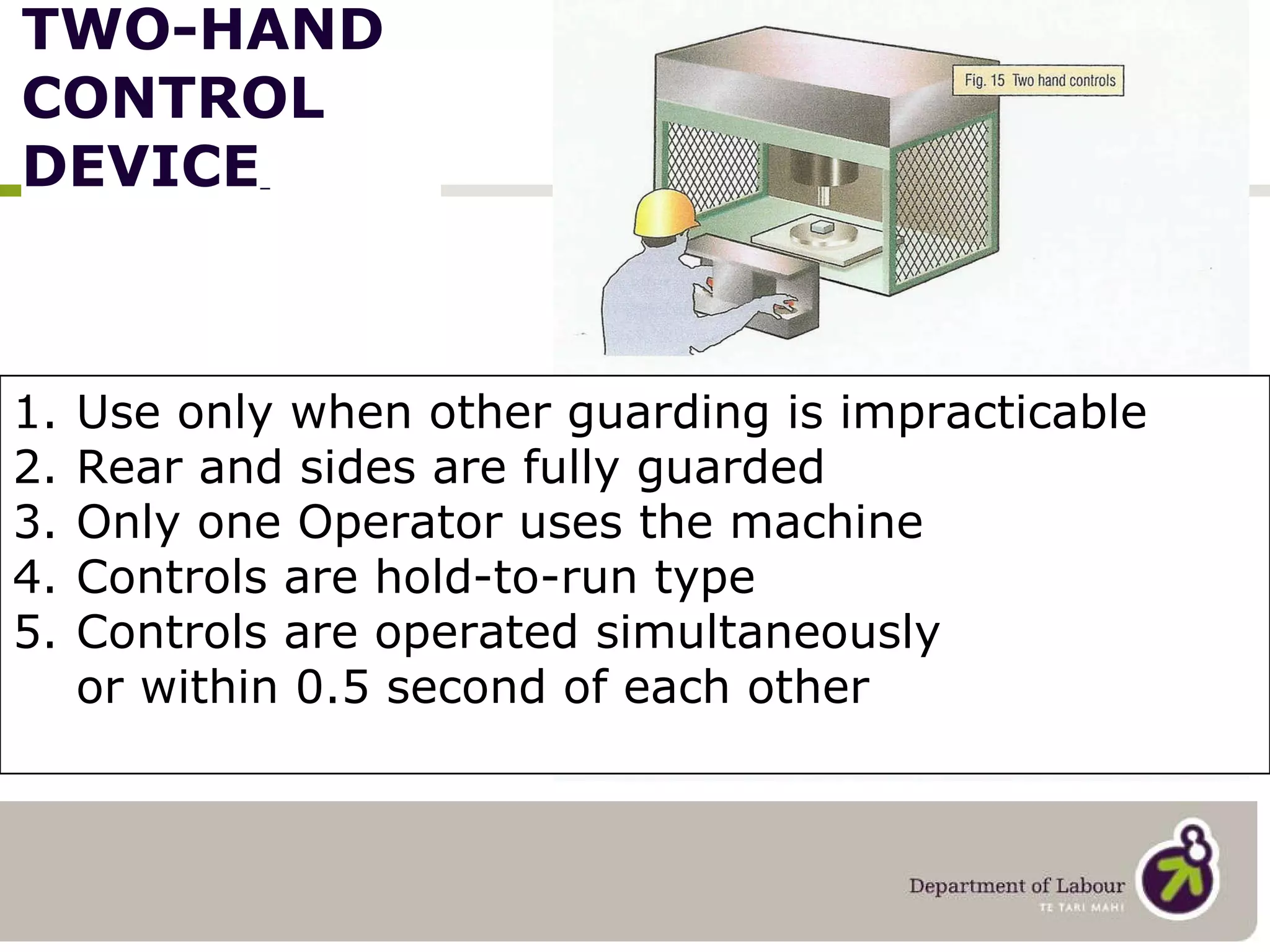
TWO-HAND CONTROL DEVICE   Use only when other guarding is impracticable  Rear and sides are fully guarded Only one Operator uses the machine Controls are hold-to-run type Controls are operated simultaneously or within 0.5 second of each other
Guidelines and Standards Guidance Notes   download free   www.dol.govt.nz Electrical Interlocking For Safety In Industrial Processes The Ergonomics of Machine Guarding Guidelines  download free   www.dol.govt.nz Machinery Woodworking Machinery Factory and Commercial Premises Construction Industry Forestry Work Standards  AS 4024.1-2006  Safety of Machinery and other appropriate standards
 
Where to from here?

Machine Guarding Case Study

  • 1.
    A Machine Guarding Case Study Shona Kelly Occupational Health Nurse Health and Safety Inspector HSNO Enforcement Officer GradDip OSH HR Management GradDip BS Dispute Resolution PostGradDip Arts Human Services OHSIG Conference 2011
  • 2.
    Department of Labour National Machine Guarding Project 2010-2013 The project targets fixed plant in workplaces. To ensure that AS4024.1 -2006 (series) and the Ergonomics of Machine Guarding are complied with for workers’ safety. (All Practicable Steps)
  • 3.
    Who has duties?Any person who works with machinery, and who may have responsibilities for ensuring that machinery in their place of work complies with relevant machine guarding guidelines and standards.
  • 4.
    Guidelines and StandardsGuidance Notes download free www.dol.govt.nz Electrical Interlocking For Safety In Industrial Processes The Ergonomics of Machine Guarding Guidelines download free www.dol.govt.nz Machinery Woodworking Machinery Factory and Commercial Premises Construction Industry Forestry Work Standards AS 4024.1-2006 (series) Safety of Machinery and other appropriate standards
  • 5.
  • 6.
    Proactive Assessment ProcessInformation is provided to the employer Includes a checklist for review to be applied individually to all fixed plant on site Employer is responsible for identifying any deviation from the applicable standards Remedial action is undertaken immediately by employer Inspector returns to review employer’s assessments Identification of any matters not yet addressed Negotiated agreement for smaller upgrades Followed by employer’s written confirmation of actions taken For any significant non-compliance, a Written Warning, Prohibition Notice or Improvement Notice will be issued. Prosecution will be considered for all serious breaches of safety regulations.
  • 7.
    Alternative Proactive AssessmentProcess Site visit by Inspector who provides information and checklists and completes an immediate assessment with the employer on the day. Any breach of safety regulations is addressed immediately by use of Written Warning, Prohibition Notice, Improvement Notice and Any significant breaches will be considered for Prosecution.
  • 8.
  • 9.
    Reactive Site AssessmentSection 6 of the Health and Safety in Employment Act requires that the employer provides a safe place of work, taking ‘all practicable steps’ to ensure the safety of employees while at work. This includes the installation and use of all appropriate guards for work tools. In the event of any serious harm accident associated with machine guarding failure the Inspector will make an assessment for Prosecution.
  • 10.
    Northland District HealthBoard (NDHB) Laundry Whangarei 2011
  • 11.
    Proactive employer engagementsNDHB is one of the Northland’s largest employers. The Occupational Health Manager liaises with the DoL Inspector/OHN at least quarterly to maintain a dialogue around occupational health issues and developments in the organisation. The NDHB was enthusiastic about participating in the MG Project to help ensure that the significant investment of new laundry plant was installed and operating at the highest safety standard.
  • 12.
    NDHB Site visitassessment process Information was provided to the employer Included the checklist template for individual assessment of all fixed plant on site Employer was responsible for identifying any deviation from the applicable standards Remedial action was undertaken by employer Return visit by the Inspector to review assessments Identification of any minor matters not yet addressed Negotiated agreement Written confirmation of subsequent actions
  • 13.
    observations Having suffereda variety of manual handling and other incidents over time, the laundry staff and the engineering/maintenance team were collectively engaged in the process of defining the pre-requisites and implementing each phase of the new installation. Their sense of ownership and pride was reflected in their willingness to share their experience in pictures and words to illustrate their journey in a collaborative workplace.
  • 14.
  • 15.
    Outcomes The workplacehas a team of workers who know that they have helped to shape their work life (and that of their employer) in a constructive and healthy way that benefits all. The DoL machine guarding project provided a useful means by which to evaluate and enhance the remedies the employer had initiated to address longstanding health and safety and wellbeing issues.
  • 16.
    Acknowledgements Thanks toNDHB Laundry Manager Debbie Borovich and Occupational Health Manager Leona Murray for their generosity in sharing their in-house presentation of the laundry project.
  • 17.
    National Compliance Project Machine Guarding 18 th May 2011
  • 18.
    Why machine guarding?The Department of Labour has commenced a national compliance project designed to reduce the unacceptably high level of fatal and serious harm injuries associated with unsafe use of machinery.
  • 19.
    Serious Harm Incidents(Reported) by Industry from July 2006 to June 2009 These statistics show the number of workplace fatalities and serious harm incidents reported to the Department of Labour and investigated under the Health and Safety in Employment (HSE) Act 1992. These statistics are provisional and do not include :- Fatalities in the Maritime or Aviation sectors, or fatalities due to work-related crashes on the road as these are investigated by Maritime New Zealand, the Civil Aviation Authority and the NZ Police respectively. Fatalities or serious harm incidents from long latency diseases caused by exposure to hazardous substances.
  • 20.
    This will bea three-year nationwide project in which Heath and Safety Inspectors across New Zealand will have a clear and sustained focus on both the consistent application of current machine guarding standards and effective implementation of procedures and systems to ensure the safe use of machinery in the workplace. Through an approach which will balance information, assistance and enforcement activity, the Department aims to reduce the severity of serious harm accidents resulting from the unsafe use of machinery. Three Year Nationwide Project
  • 21.
    Focus area Theinitial focus areas for inspectors will be both the common mechanical hazards across all machinery and the common machinery types which are causing death and serious harm and for which there are well known and established standards for guarding.
  • 22.
    Who has duties?Any person who works with machinery, and may have responsibilities for ensuring that machinery in their place of work, complies with relevant machine guarding guidelines and standards.
  • 23.
    Human cost ofunguarded machinery
  • 24.
    Selecting safeguards Fixedguards & interlock guards Types of interlocks Common faults and fail safe interlock Presence Sensing Devices Safety trip devices Interlock distance guards Two hand controls Guidelines & standards PRINCIPLES OF MACHINE GUARDING
  • 25.
    Criteria for selectingSafeguard If hazards cannot be eliminated the question becomes How can we guard the machine? Consider which guard type best suits the need. Is it suitable for the intended use and environment? Is it designed and constructed to meet appropriate standards? Can it be applied according to manufacturer’s instructions? Any material ejected by process? Are new hazards created? Ergonomics? Has motivation to defeat the guard been minimized ?
  • 26.
    Fixed Guard Guardslocked by bolts that require a tool to open are acceptable if access is required no more than once per shift
  • 27.
    Fixed Guard FixedDistance Guard & fence Fixed guard in conjunction with light curtains
  • 28.
    Self Adjustable guardfor cutting saw SELF ADJUSTABLE FIXED GUARD
  • 29.
    Things to checkfor fixed guards Is it securely fixed ? Is opening size appropriate ? Is it strong ?
  • 30.
    Interlock GuardFixed Guard Interlock Guard What is the difference between these two forms of guarding?
  • 31.
    Interlock guard Usedwhen a process requires an operator to open or remove a guard frequently Interfaced with control system to prevent inadvertent access Connect to power control
  • 32.
    Interlock Guard Machinecannot be operated until guard is closed During operation guard cannot be opened Opening a guard will stop dangerous motion immediately Guard remains locked until dangerous motion has stopped Time delay or motion sensing release interlock can be fitted if there is overrun after power is cut off
  • 33.
    Interlock Guard forPrinting Machinery
  • 34.
    Interlock Guards forMeat Slicer and Sellotape Machine Interlock guard opened Magnetic Safety Switch Interlock Guard to prevent access
  • 35.
    Mesh for Guards-Use Black Mesh for Good Visibility and Yellow for the frame.
  • 36.
    Some causes ofinjuries: poorly designed guard insufficient strength or too heavy guards that do not meet requirements of The Ergonomics of Machine Guarding Access to danger area The Ergonomics of Machine Guarding
  • 37.
    Presence Sensing Devicescan be used for frequent reach into machine A device that creates a sensing field, area, or plane to detect the presence of an individual or object Light curtains Multiple/Single Beam Systems Area Scanners Safety Mats
  • 38.
    Presence-sensing devices Advantages Disadvantages No physical guard Allows clear view of operation Fewer moving parts that may wear Work with a variety of machines Can be interfaced with control logic Cannot contain noise, dust, radiation or fumes Failure may be sudden and unexpected Costly to implement to a high standard
  • 39.
    Presence Sensing Devices-using light curtain Light curtain Foot pedal Tool Fixed guard
  • 40.
    Single light beamor laser beam safety device Press Brake guarded with single light beam or laser beam safety device Interlock guard at rear
  • 41.
    Long metal folderfitted with light beams & curtain, requires two operators Workpiece Light beams Control panel Light curtain Tool
  • 42.
    Hierarchy for selectingsafeguards If elimination not achievable Isolation Fixed guards Interlock guards Electro-sensitive safety devices light curtains safety mats laser scanners Safety trip devices Interlock distance bars Two-hand controls Minimisation
  • 43.
    SAFETY TRIP DEVICESTrip bar Limit switch or pneumatic valve Pivot Cam Pressure sensitive edge Operated by normally closed limit switch or pneumatic valve When depressed by contact causes emergency stop and shut down power
  • 44.
    EMERGENCY STOP WIRENot a substitute for guard Stop machine immediately if wire is pulled or broken Resetting is necessary and normal start button to start again. Operate when wire moves not more than 300 mm and by a force not greater than 70N. Must be fail safe.
  • 45.
    TWO-HAND CONTROL DEVICE Use only when other guarding is impracticable Rear and sides are fully guarded Only one Operator uses the machine Controls are hold-to-run type Controls are operated simultaneously or within 0.5 second of each other
  • 46.
    Guidelines and StandardsGuidance Notes download free www.dol.govt.nz Electrical Interlocking For Safety In Industrial Processes The Ergonomics of Machine Guarding Guidelines download free www.dol.govt.nz Machinery Woodworking Machinery Factory and Commercial Premises Construction Industry Forestry Work Standards AS 4024.1-2006 Safety of Machinery and other appropriate standards
  • 47.
  • 48.

Editor's Notes

  • #20 This slide gives a split of serious harm (Reported to DoL) by industry Note – Education have high numbers of reports – we are working with colleges and schools to ensure that the right things are reported. In some cases the incidents are not actually serious harm.