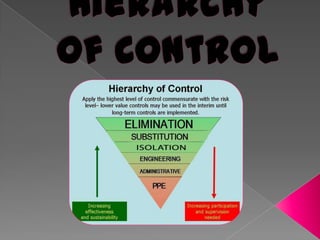
Hierarchy of Control
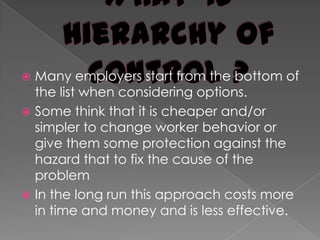
What  Is Hierarchy of Control ?Many employers start from the bottom of the list when considering options.Some think that it is cheaper and/or simpler to change worker behavior or give them some protection against the hazard that to fix the cause of the problemIn the long run this approach costs more in time and money and is less effective.
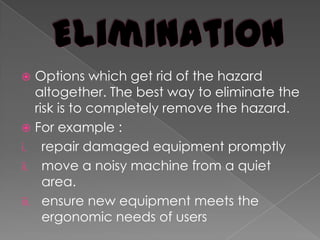
EliminationOptions which get rid of the hazard altogether. The best way to eliminate the risk is to completely remove the hazard.For example :repair damaged equipment promptlymove a noisy machine from a quiet area.ensure new equipment meets the ergonomic needs of users
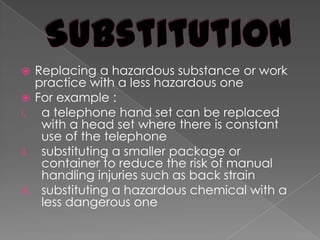
SubstitutionReplacing a hazardous substance or work practice with a less hazardous oneFor example :a telephone hand set can be replaced with a head set where there is constant use of the telephonesubstituting a smaller package or container to reduce the risk of manual handling injuries such as back strainsubstituting a hazardous chemical with a less dangerous one
IsolationIsolate the hazard by controlling or guarding it.place hazardous electrical plant in enclosures with restricted accessplace out-of-service tags on plant.
Engineering ControlsThe provision of mechanical aids, barriers, machine guarding, ventilation or insulation to isolate a hazard from employees.For example;electrical cut out switchesisolating copying equipment in soundproof and ventilated roomsusing trolleys or mechanical lifting aidschanging bench heights to reduce bending
Administrative ControlsEstablishing policies, procedures and work practices designed to reduce a worker’s exposure to a risk. It can also include the provision of specific training and supervision.For example:increasing job variety and introducing job rotation.redesigning jobstraining and education to learn how to be professional workers
Personal Protective Equipment (PPE)Covering and protecting a worker’s body from hazards. It can be used as a short-term control measure until a higher order” control has been provided, or to supplement it. The employer would also have to provide training for workers required to use it, and the employee would have a responsibility to use it properly. Some examples of PPE are:Use ear plugs in noisy areasUse eye protection when working with chemicalsUse gloves to protect against infection
Demonstrate the proper and save methods in deploying portable fire extinguisher

HIERARCHY OF CONTROL

  • 1.
  • 2.
    What IsHierarchy of Control ?Many employers start from the bottom of the list when considering options.Some think that it is cheaper and/or simpler to change worker behavior or give them some protection against the hazard that to fix the cause of the problemIn the long run this approach costs more in time and money and is less effective.
  • 3.
    EliminationOptions which getrid of the hazard altogether. The best way to eliminate the risk is to completely remove the hazard.For example :repair damaged equipment promptlymove a noisy machine from a quiet area.ensure new equipment meets the ergonomic needs of users
  • 4.
    SubstitutionReplacing a hazardoussubstance or work practice with a less hazardous oneFor example :a telephone hand set can be replaced with a head set where there is constant use of the telephonesubstituting a smaller package or container to reduce the risk of manual handling injuries such as back strainsubstituting a hazardous chemical with a less dangerous one
  • 5.
    IsolationIsolate the hazardby controlling or guarding it.place hazardous electrical plant in enclosures with restricted accessplace out-of-service tags on plant.
  • 6.
    Engineering ControlsThe provisionof mechanical aids, barriers, machine guarding, ventilation or insulation to isolate a hazard from employees.For example;electrical cut out switchesisolating copying equipment in soundproof and ventilated roomsusing trolleys or mechanical lifting aidschanging bench heights to reduce bending
  • 7.
    Administrative ControlsEstablishing policies,procedures and work practices designed to reduce a worker’s exposure to a risk. It can also include the provision of specific training and supervision.For example:increasing job variety and introducing job rotation.redesigning jobstraining and education to learn how to be professional workers
  • 8.
    Personal Protective Equipment(PPE)Covering and protecting a worker’s body from hazards. It can be used as a short-term control measure until a higher order” control has been provided, or to supplement it. The employer would also have to provide training for workers required to use it, and the employee would have a responsibility to use it properly. Some examples of PPE are:Use ear plugs in noisy areasUse eye protection when working with chemicalsUse gloves to protect against infection
  • 9.
    Demonstrate the properand save methods in deploying portable fire extinguisher