Machinery
Safety
Machine Guarding for Warehouse and
Maintenance Workers
What is wrong with this picture?
This material was produced and revised
(using information from OSHA’s website, publications and CDC website) under grant
[SH20856SH0] from the Occupational Safety and Health Administration, U.S. Department of
Labor. It does not necessarily reflect the views or policies of the U.S. Department of Labor, nor
does mention of trade names, commercial
products, or organizations imply endorsement by the U.S. Government
2
The Problem
• Workers who operate and maintain
machinery each year suffer
approximately
– 18,000 amputations, lacerations, crushing
injuries, and abrasions
– 800 deaths
OSHA 7100
3
The Problem: Machinery
Associated with Amputations
1. Mechanical power presses
2. Power press brakes
3. Powered and non-powered conveyors
4. Printing presses
5. Roll-forming and roll-bending machines
6. Shearing machines
7. Food slicers
8. Meat grinders
9. Meat-cutting band saws
10.Drill presses
11.Milling machines
12.Grinding machines
4
Causes of Machine Incidents
• Reaching in to “clear” equipment
• Not using Lockout/Tagout
• Unauthorized person doing
maintenance or using the machines
• Missing or loose machine guards
• Lack of training
5
Prevention
• Any machine part, function, or process
which may cause injury must be
safeguarded.
• Where the operation of a machine can
injure the operator or other workers, the
hazard must be controlled or eliminated
6
OSHA Citations
Fiscal Year 2010
• Machines, general requirements
(1910.212)
– 10th most frequently cited standard
– 5th ranked standard in assessed penalties
• Lockout/Tagout (1910.147)
– 5th most frequently cited standard
– 4th ranked standard in assessed penalties
Machine Guarding
OSHA’s 1910 Subpart O
8
Objectives
• Explain the general requirements for
guarding the hazards of machines
• Describe precautions to be taken
around machinery
• Identify important terms associated with
guarding machinery
9
Machine Guarding
Group Worksheet
10
3 Basic Areas To Be
Safeguarded
• Point of Operation
• Power Transmission Apparatus
• Other Moving Parts
11
Hazard Identification
• Motions
– Rotating (including in-
running nip points)
– Transverse
– Reciprocating
• Actions
– Cutting
– Punching
– Shearing
– Bending
12
Rotating Motion
• Hazard –
Machinery grips
and moves
clothing, hair and
body parts into
danger area
• Danger increases
when projections
are present
– Screws, bolts,
nicks, abrasions,
etc.
13
Rotating Parts with Projections
Rotating pulley with spokes and
projecting burr on face of pulley Rotating coupling with
projecting bolt heads
Rotating shaft and pulleys with
projecting key and set screw
BURR
OSHA 3067
14
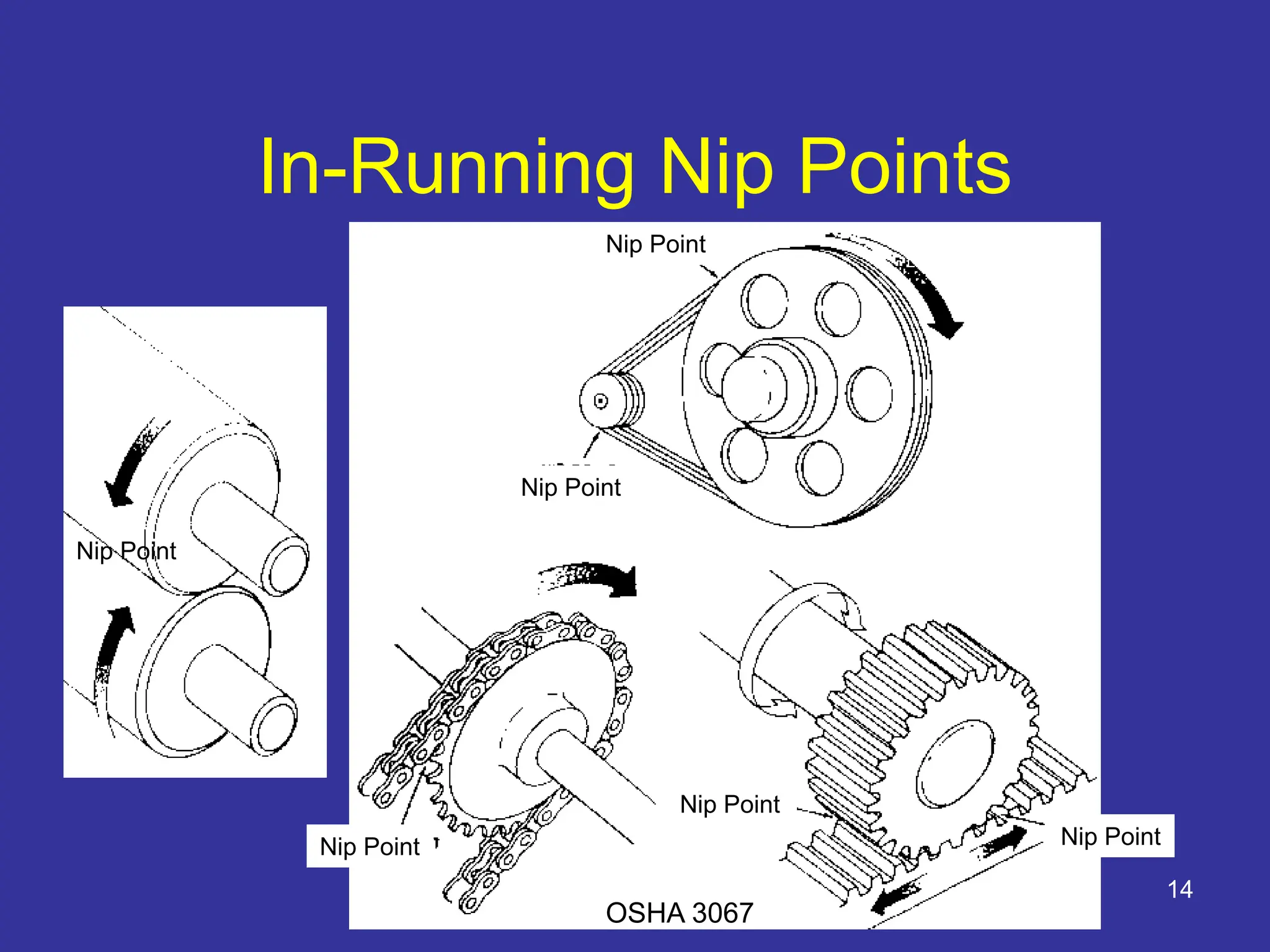
In-Running Nip Points
Nip Point
Nip Point
Nip Point
Nip Point
Nip Point
Nip Point
OSHA 3067
15
In-Running Nip Points
Nip Point
Nip Point
Nip Point
Nip Points
OSHA 3067
16
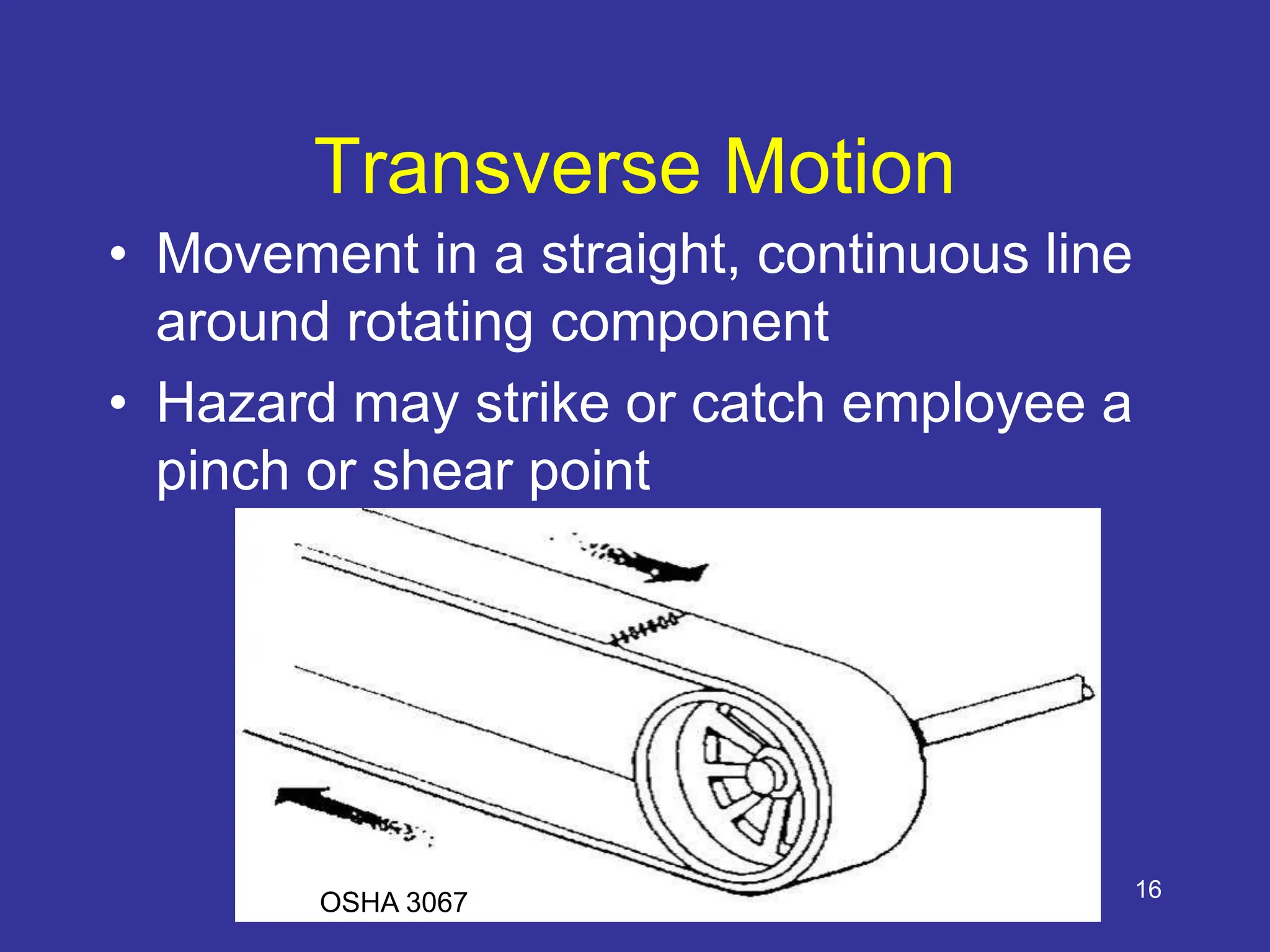
Transverse Motion
• Movement in a straight, continuous line
around rotating component
• Hazard may strike or catch employee a
pinch or shear point
OSHA 3067
17
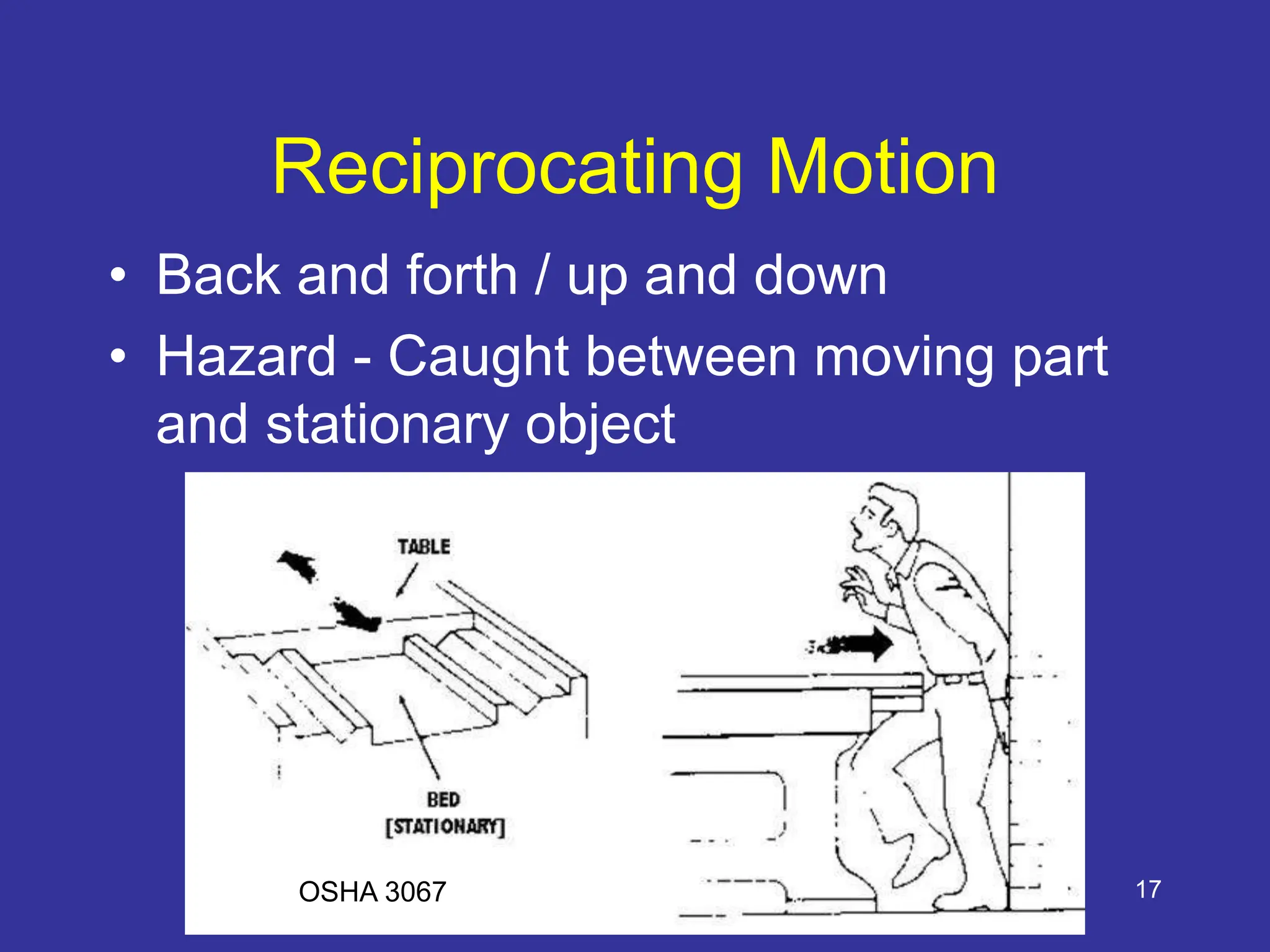
Reciprocating Motion
• Back and forth / up and down
• Hazard - Caught between moving part
and stationary object
OSHA 3067
18
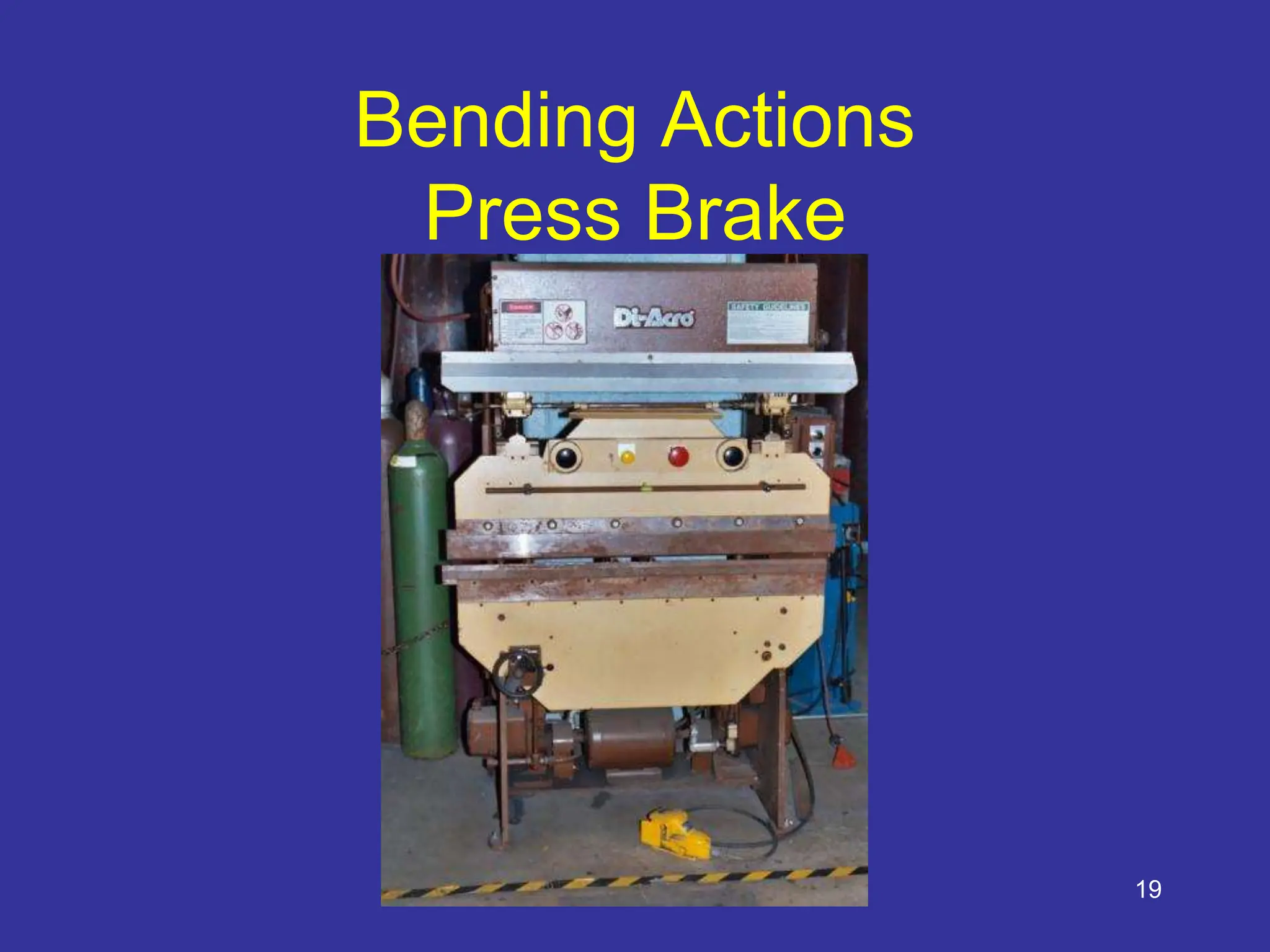
Bending Actions
• Power applied to
slide to draw or
stamp metal or other
materials in a
bending motion
• Example: Press
Brake, Tube
Benders
OSHA 3067
19
Bending Actions
Press Brake
20
Punching Actions
• Power applied to
slide ram for
purpose of blanking,
drawing or stamping
• Example: Power
press
21
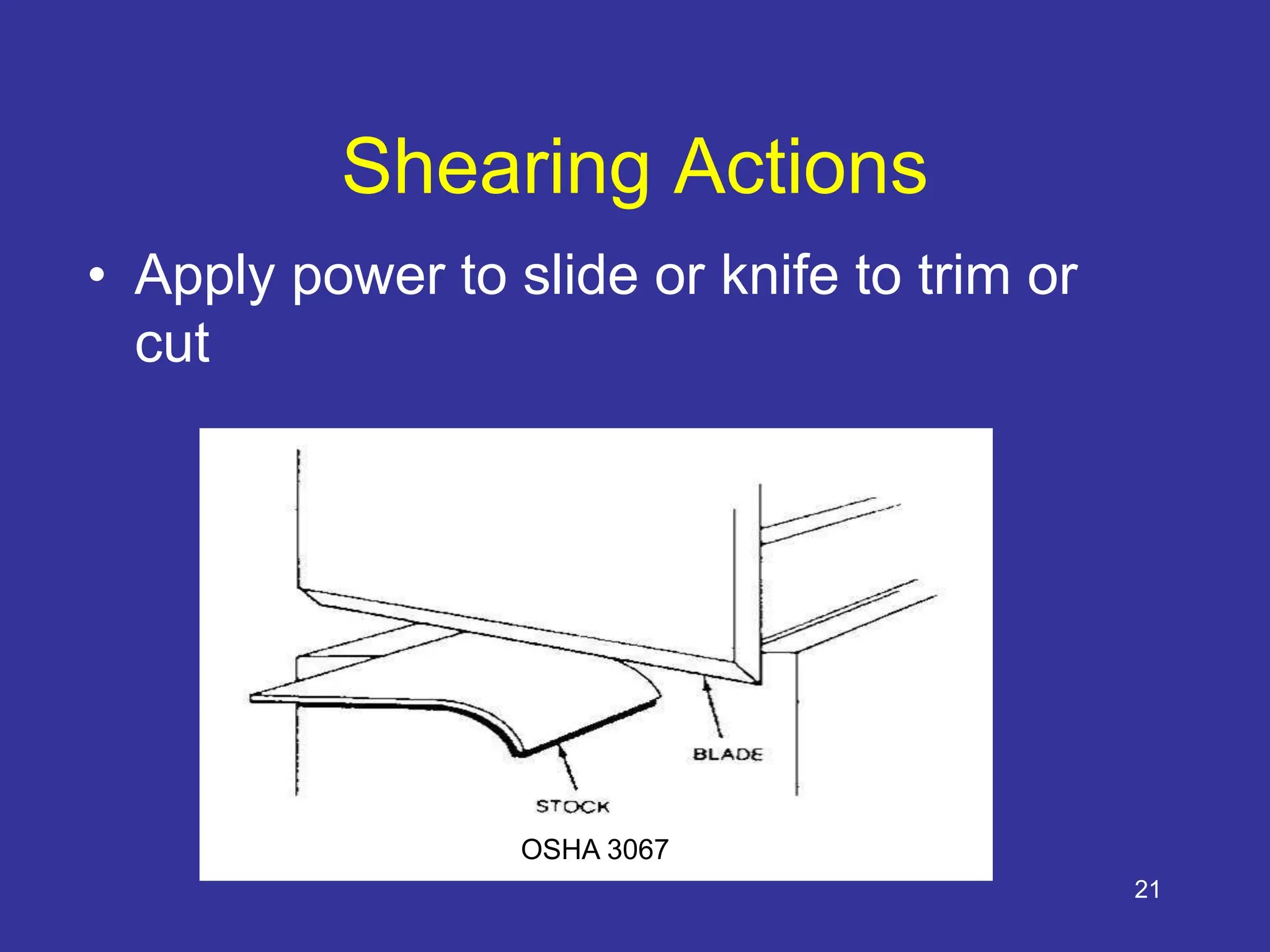
Shearing Actions
• Apply power to slide or knife to trim or
cut
OSHA 3067
22
Shearing Actions
Sheet Metal Shear
OSHA 7100
23
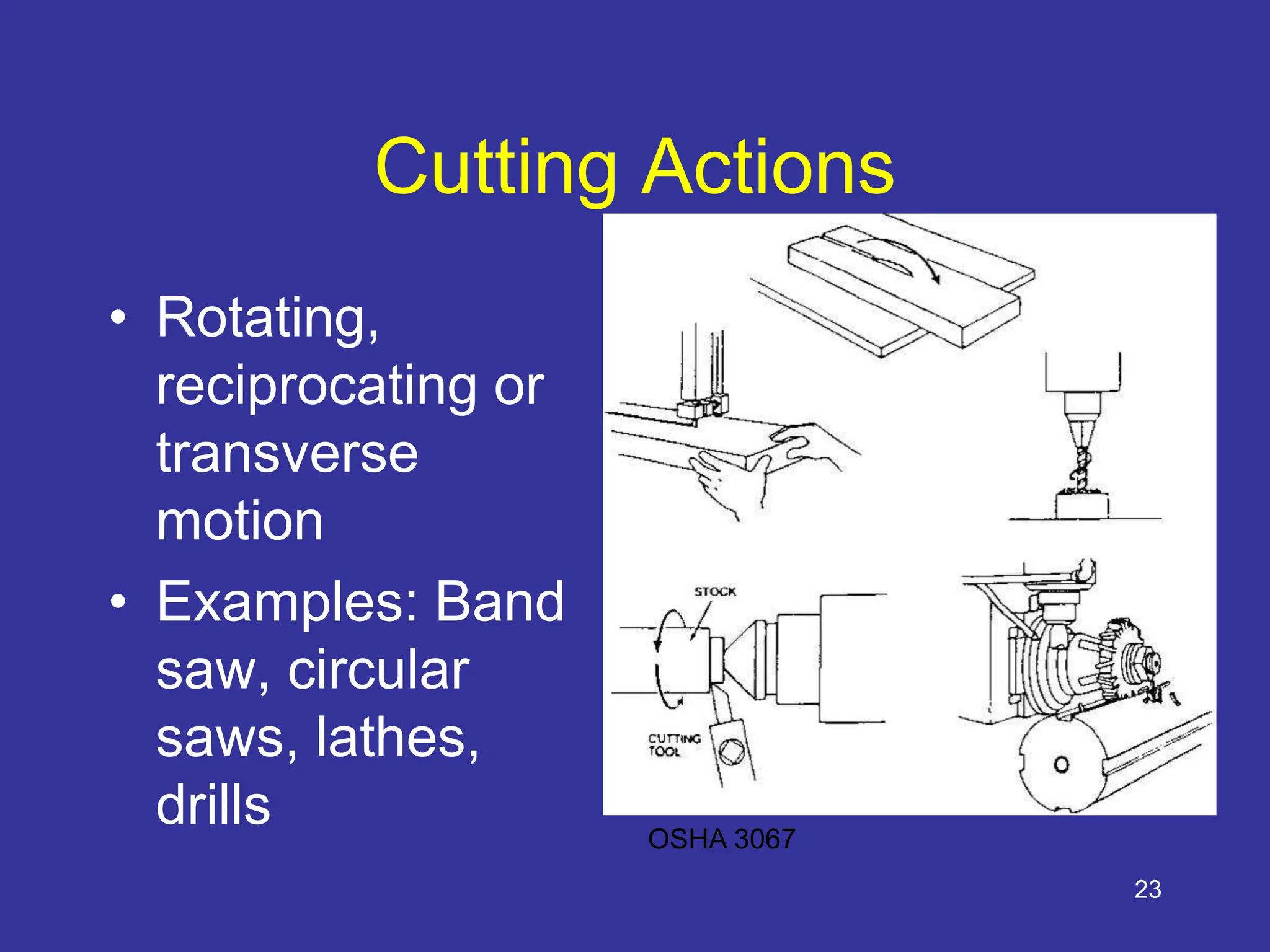
Cutting Actions
• Rotating,
reciprocating or
transverse
motion
• Examples: Band
saw, circular
saws, lathes,
drills OSHA 3067
24
Classification of Safeguards
• Guards
• Devices
• Location/distance
• Automatic/semiautomatic feed or
ejection
• Miscellaneous
25
Types of Guards
• Fixed
– Provide secure barrier
• Interlocked
– Cuts off power when guard opened or removed
• Adjustable
– Barrier manually moved to accommodate stock
or operation
• Self-adjusting
– Barrier automatically moves to accommodate
operation
26
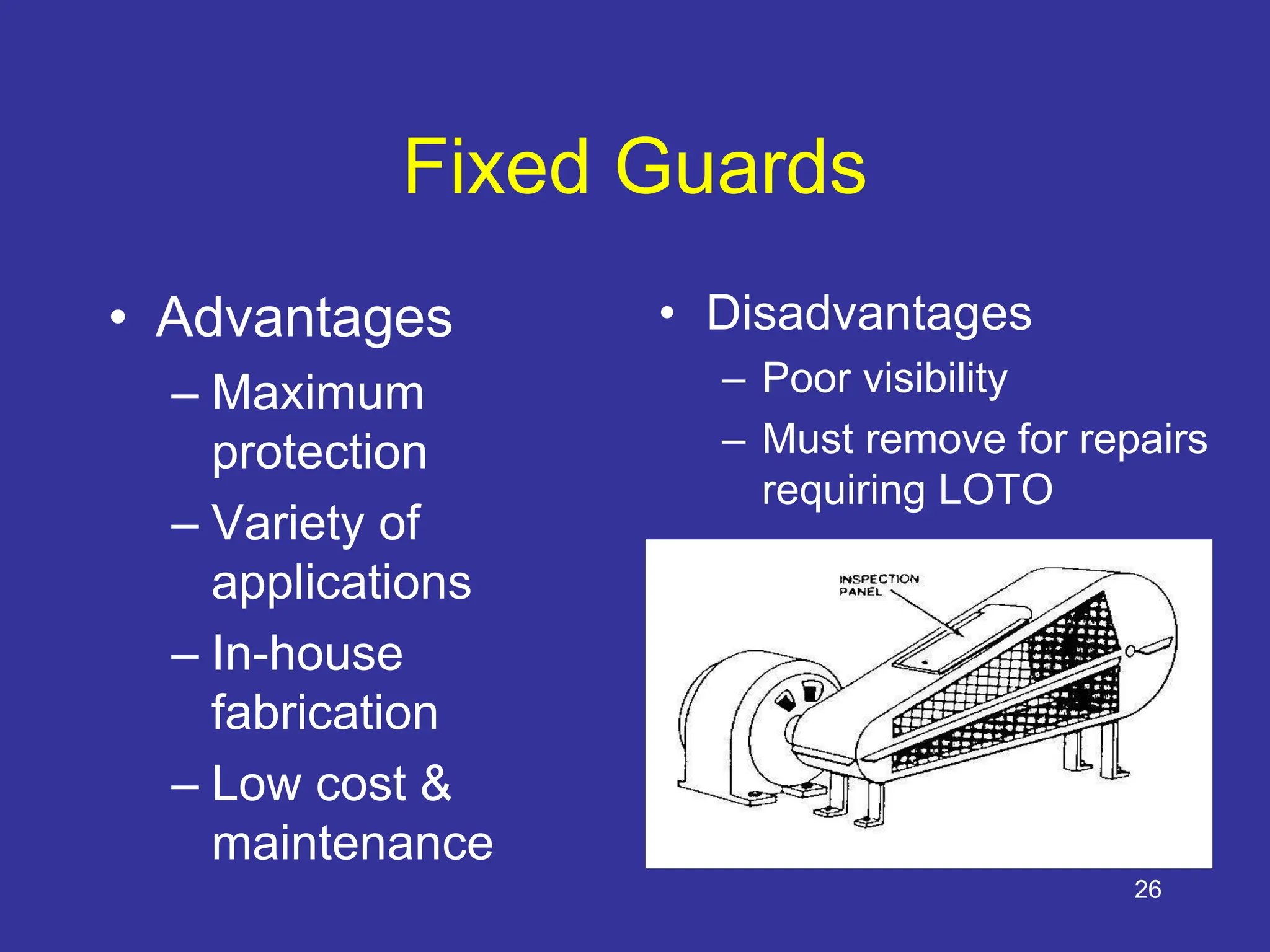
Fixed Guards
• Advantages
– Maximum
protection
– Variety of
applications
– In-house
fabrication
– Low cost &
maintenance
• Disadvantages
– Poor visibility
– Must remove for repairs
requiring LOTO
OSHA 3067
27
Interlocked Guards
• Switch that when opened stops power
• Advantage
– Maximum protection
– Portion of guard easily removed for access
• Disadvantage
– Can be overridden by employee
– High cost
– Maintenance required
28
Adjustable Guards
• Advantage
– Flexibility
– In-house fabrication
• Disadvantage
– Not maximum
protection
– Rely on worker to
properly position
– May prohibit easy
access
Bandsaw blade
adjustable guard
OSHA 3067
29
Self-adjusting Guards
• Advantage
– Employee not
involved in
positioning
– Readily available
• Disadvantage
– Not maximum
protection
– May need frequent
fine tuning OSHA 3067
30
Self-adjusting Guard
Table Circular Saw
OSHA 10 Hour GI Presentation
31
Devices
• Presence sensing
– Photoelectrical
– Radiofrequency
– Electromechanical
• Safety Controls
– Safety trip control
– Two-hand control/trip
• Gates
32
Presence-Sensing Device
www.osha.gov/SLTC/etools/machineguarding/presses/psd.html
33
Two-Hand Control
• Requires constant,
concurrent pressure to
activate the machine
• The operator’s hands are
required to be at a safe
location (on control
buttons) and at a safe
distance from the danger
area while the machine
completes its closing cycle
OSHA 10 hour
34
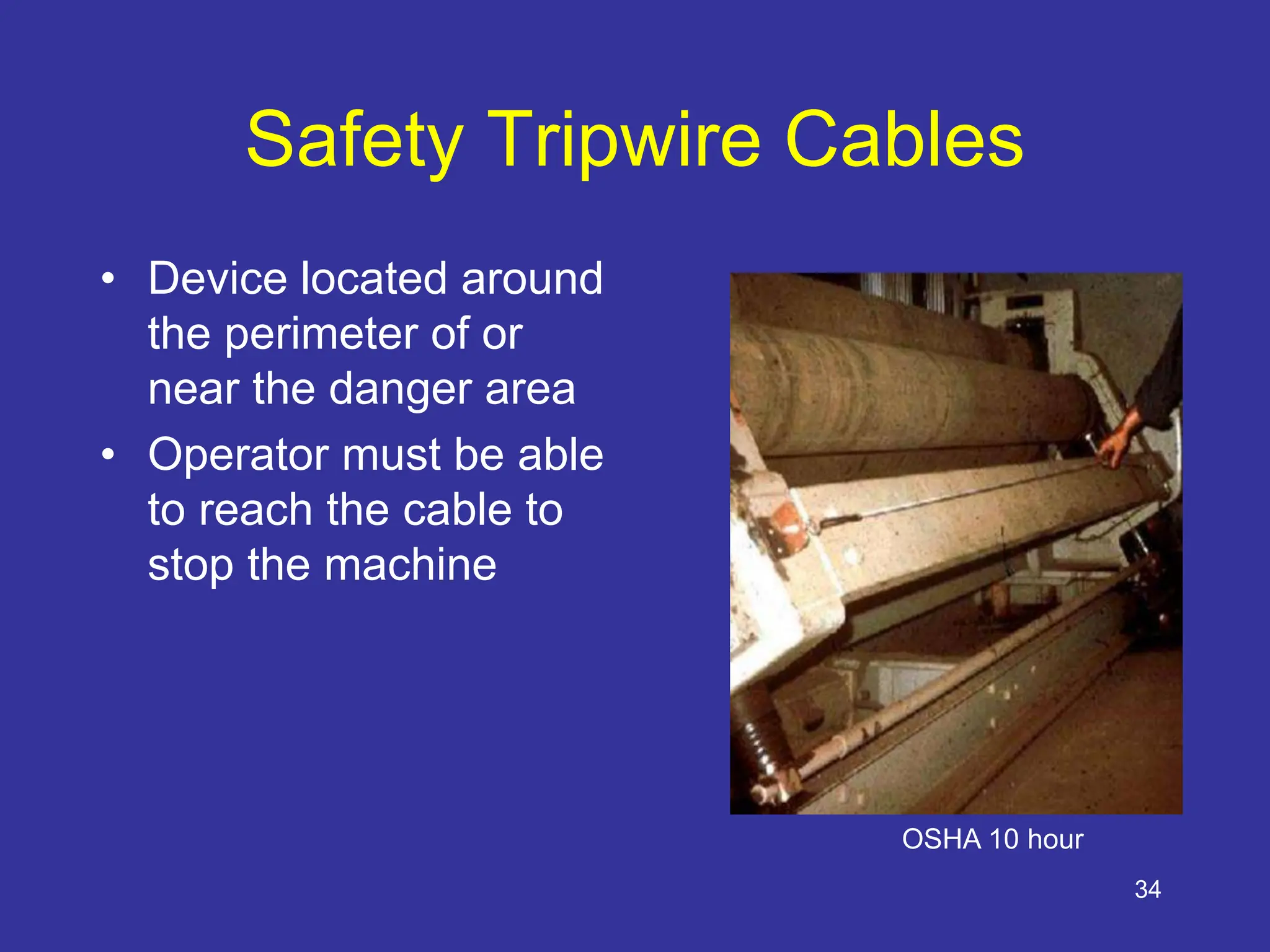
Safety Tripwire Cables
• Device located around
the perimeter of or
near the danger area
• Operator must be able
to reach the cable to
stop the machine
OSHA 10 hour
35
Gate
• Movable barrier device which protects the operator at
the point of operation before the machine cycle can be
started
• If the gate does not fully close, machine will not function
Gate Open Gate Closed
OSHA 10 hour
36
Gate
Vertical Downstroke Baler
www.cdc.gov/niosh/hc14.html
37
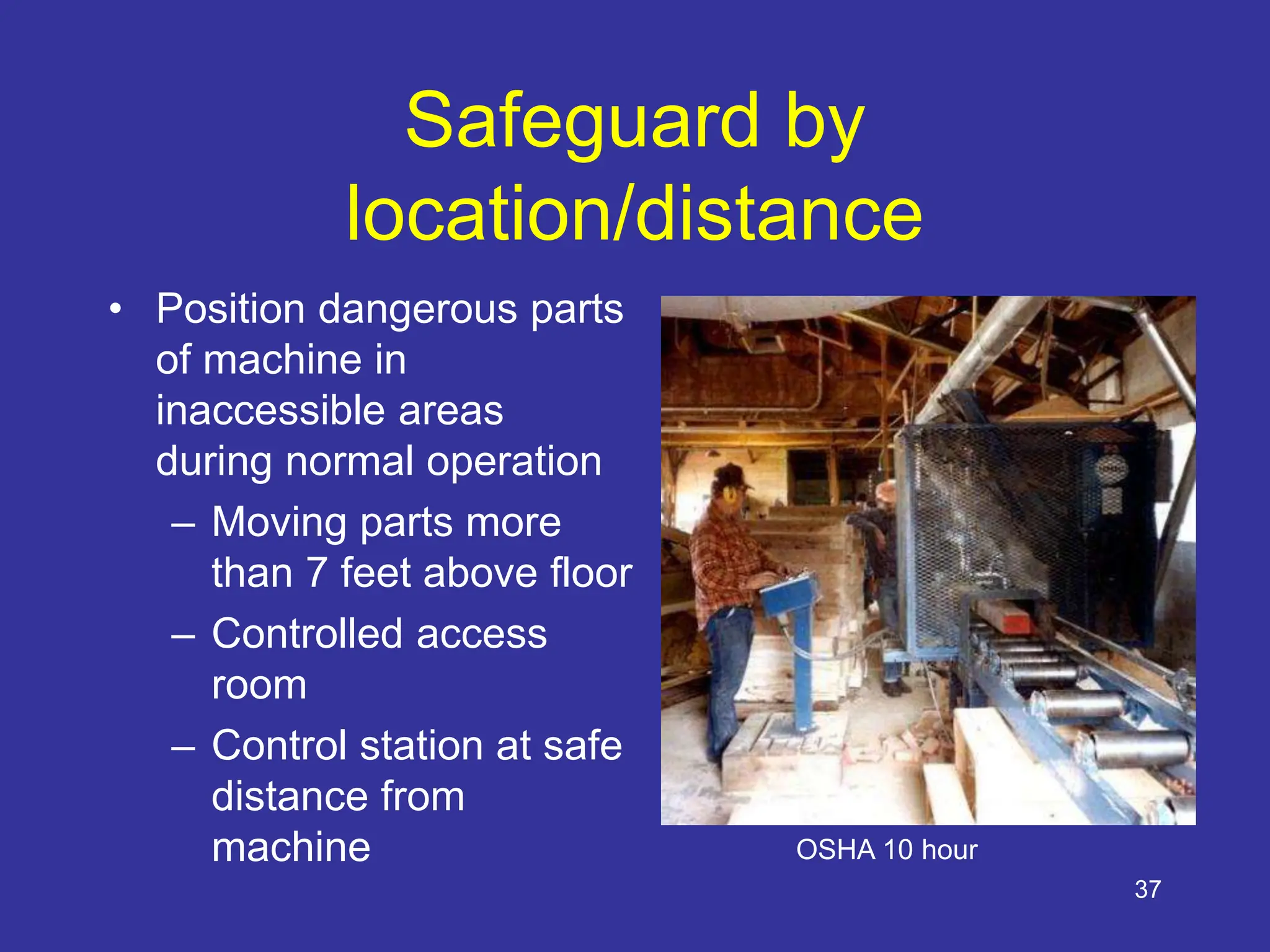
Safeguard by
location/distance
• Position dangerous parts
of machine in
inaccessible areas
during normal operation
– Moving parts more
than 7 feet above floor
– Controlled access
room
– Control station at safe
distance from
machine OSHA 10 hour
38
Feeding and Ejection Methods
• Automatic / semiautomatic feed
• Automatic / semiautomatic ejection
• Robots
39
Automatic Feed
(shown on power press)
Transparent
Enclosure
Guard
Stock Feed
Roll
Dang
er
Area
Completed Work
OSHA 3170
40
Robots
• Machines that load and
unload stock, assemble
parts, transfer objects,
or perform other tasks
• Best used in high-
production processes
requiring repeated
routines where they
prevent other hazards
to employees
Press
Fixed
Barrier
Robot
Stock
Conveyor
OSHA 3170
41
Miscellaneous
• Awareness Barriers
• Protective Shields
• Hand tools
42
Awareness Devices
• Alert employees to hazard
– Signs
– Awareness signals
(audible or visual)
– Awareness barriers (allows access to
machine danger areas, but is designed to
contact employee, creating an awareness that
employee is close to danger point)
43
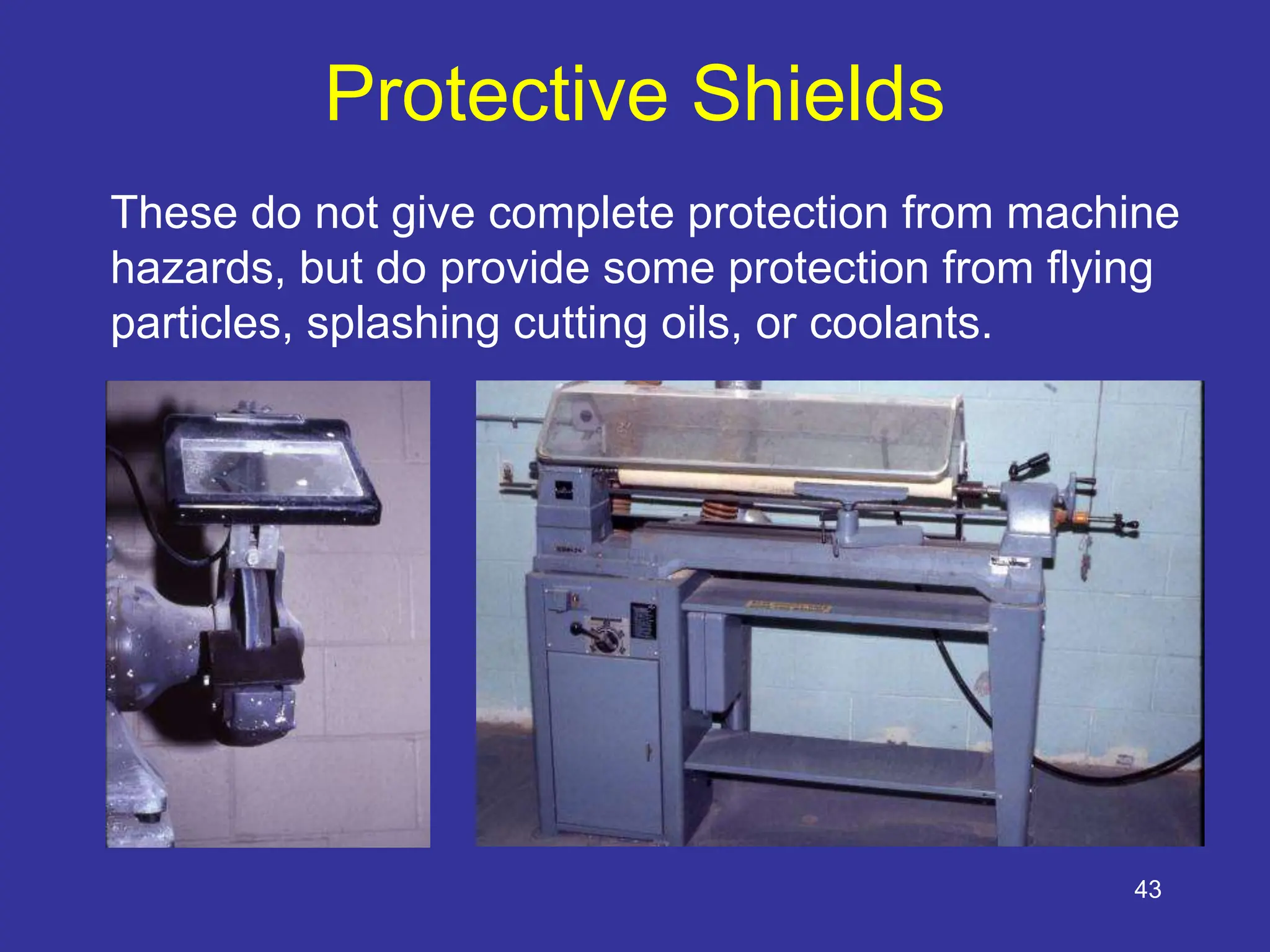
Protective Shields
These do not give complete protection from machine
hazards, but do provide some protection from flying
particles, splashing cutting oils, or coolants.
44
Holding Tools
• Used to place and
remove stock in the
danger area
• Not to be used
instead of other
machine
safeguards, but as a
supplement
OSHA 3067
45
Requirements for Safeguards
• Prevent contact
• Secure, tamper-resistant, and durable
• Protect from falling objects
• Create no new hazards
• Create no interference
• Allow safe lubrication and maintenance
46
Requirements of Safeguards
• Fixed guards should used whenever
possible
• Machines designed for fixed location
shall be secured to prevent movement
• Conform to ANSI and OSHA
requirements
47
Machine Safety
Responsibilities
• Management
– ensure all machinery is properly guarded
• Supervisors
– train employees on specific guard rules in
their areas
– ensure machine guards remain in place and
are functional
– immediately correct machine guard
deficiencies
48
Machine Safety
Responsibilities
• Employees
– do not remove guards unless machine is
locked and tagged
– report machine guard problems to
supervisors immediately
– do not operate equipment unless guards are
in place
49
Employee Training
• Hazards associated with particular machines
• How the safeguards provide protection and
the hazards for which they are intended
• How and why to use the safeguards
• How and when safeguards can be removed
and by whom
• What to do if a safeguard is damaged,
missing, or unable to provide adequate
protection
50
Some Examples of Machine
Guarding
51
Abrasive Wheel Machinery
Improper Work Rest and Tongue
52
Abrasive Wheel Machinery
Work rests on offhand grinding machines must be kept
adjusted closely to the wheel with a maximum opening
of 1/8-inch to prevent the work from being jammed
between the wheel and the rest, which may result in
wheel breakage.
OSHA 3067
53
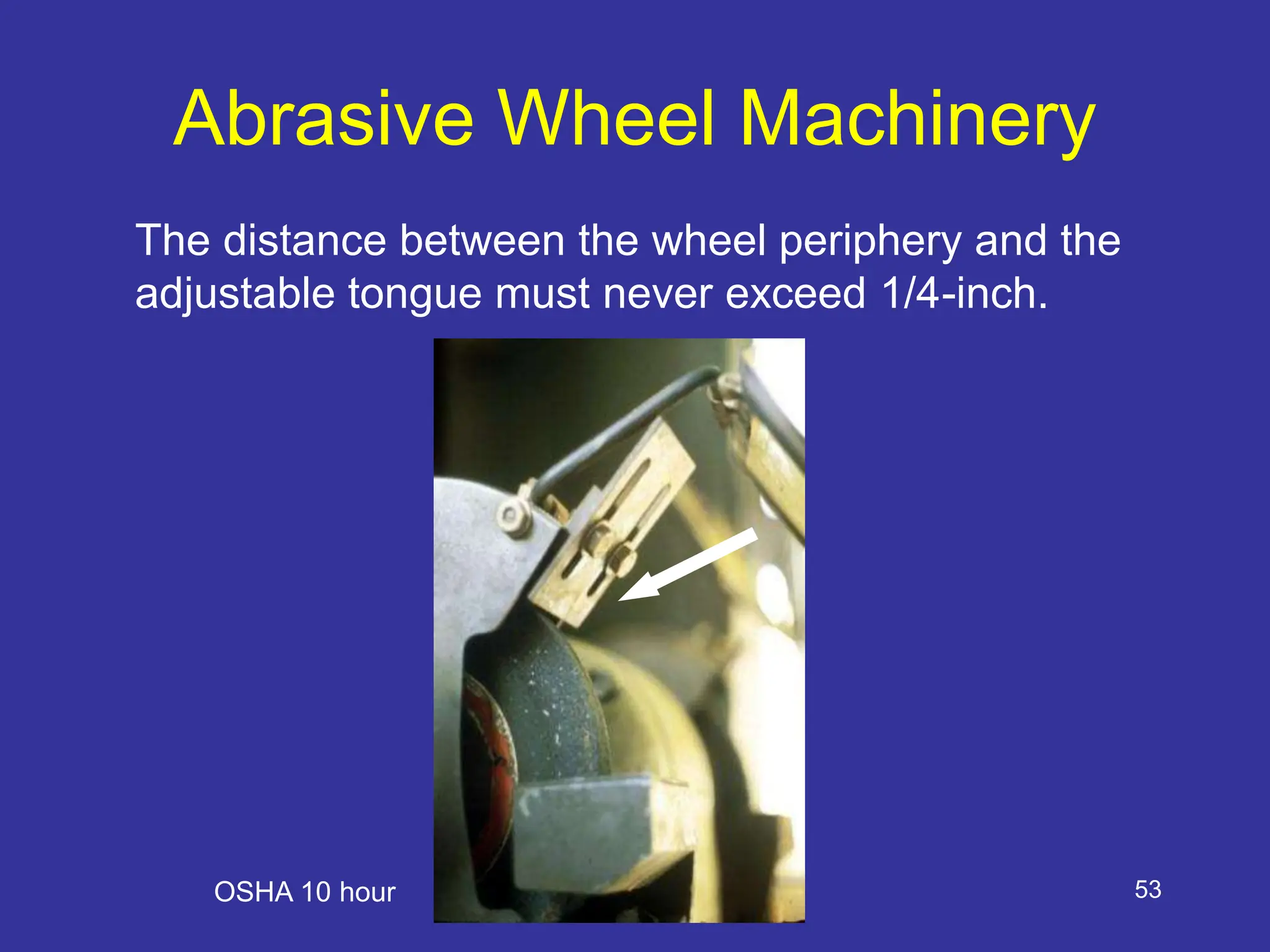
Abrasive Wheel Machinery
The distance between the wheel periphery and the
adjustable tongue must never exceed 1/4-inch.
OSHA 10 hour
54
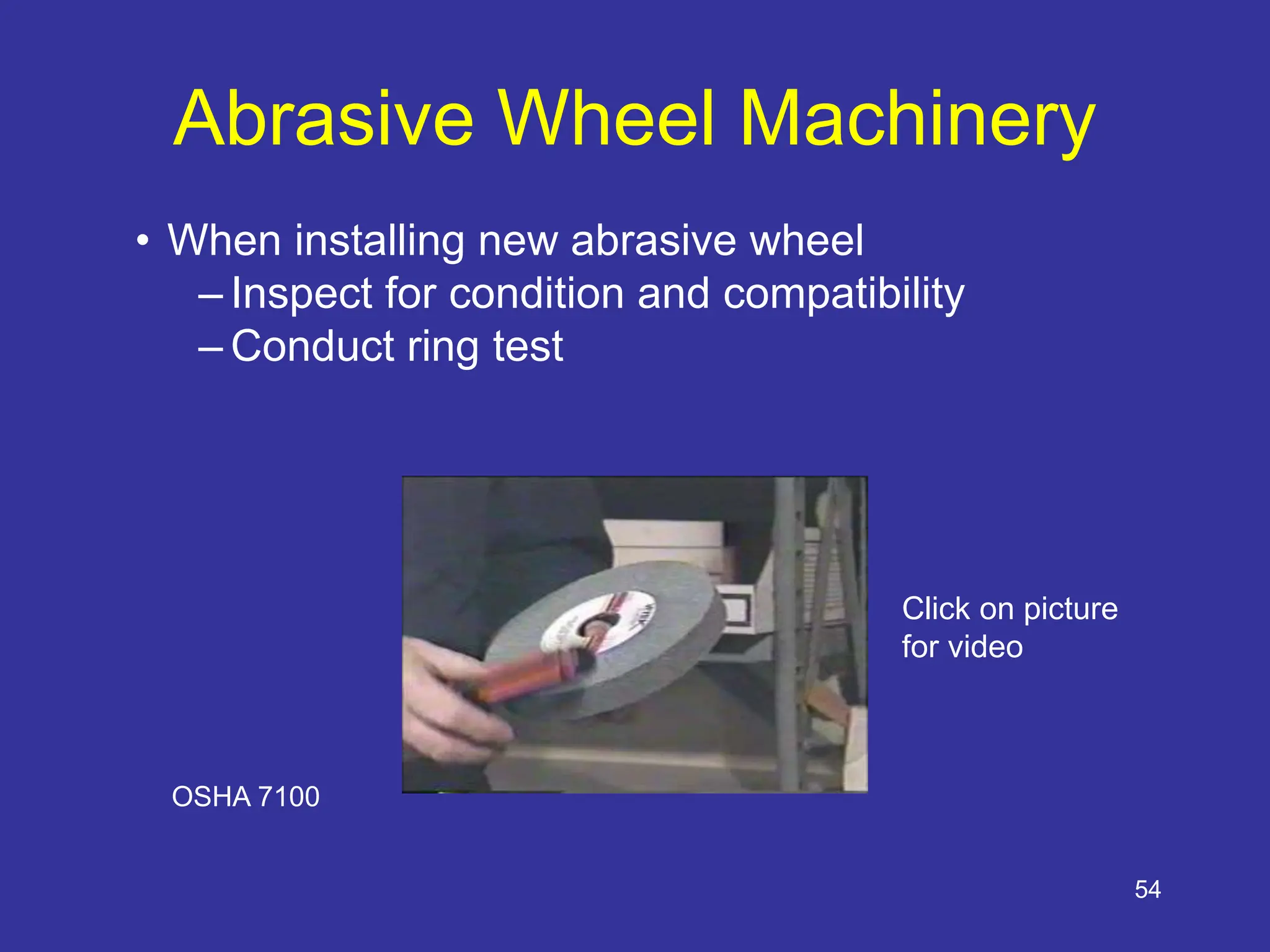
Abrasive Wheel Machinery
• When installing new abrasive wheel
– Inspect for condition and compatibility
– Conduct ring test
Click on picture
for video
OSHA 7100
55
Abrasive Wheel Machinery
Checklist
56
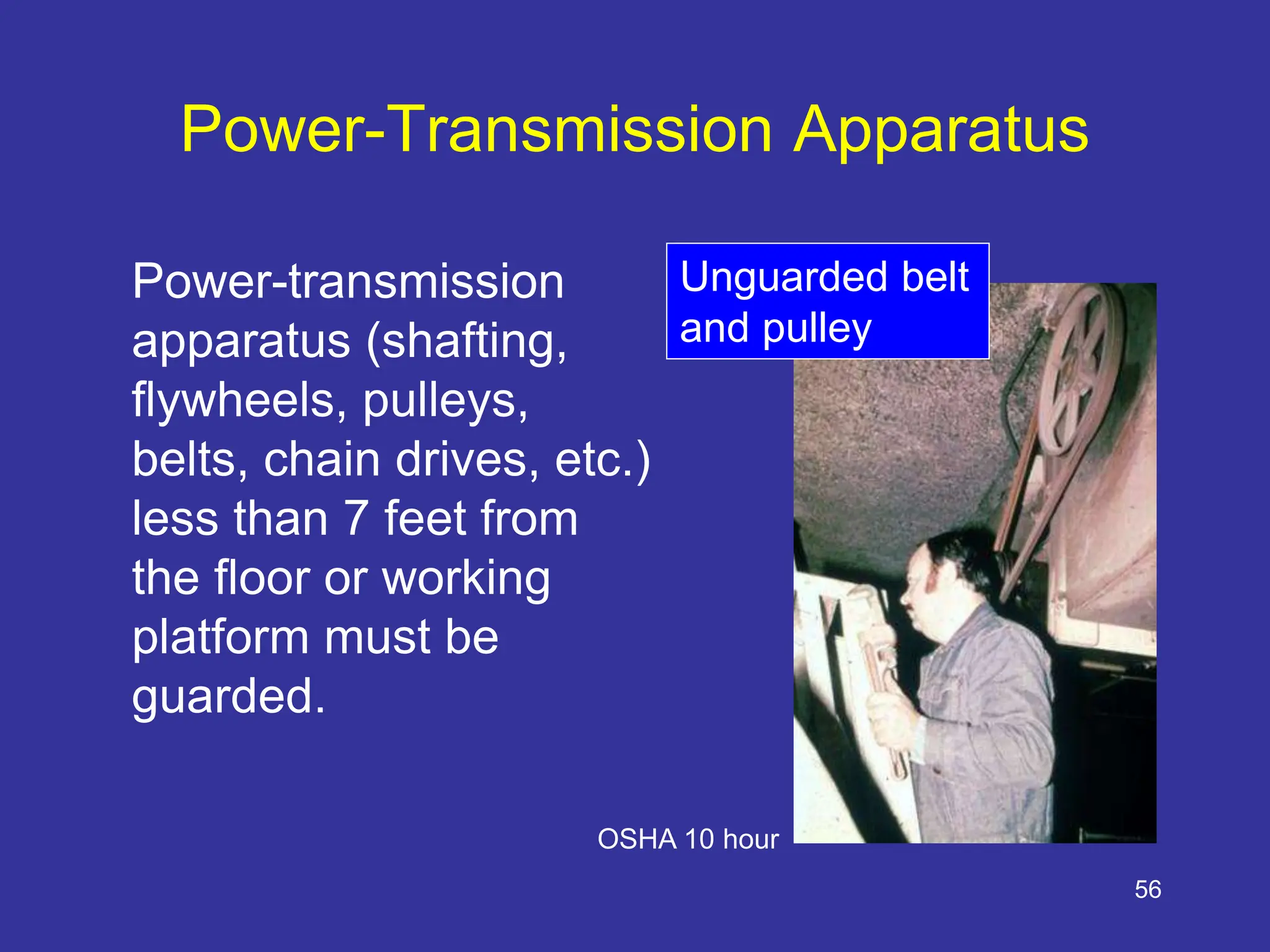
Power-Transmission Apparatus
Power-transmission
apparatus (shafting,
flywheels, pulleys,
belts, chain drives, etc.)
less than 7 feet from
the floor or working
platform must be
guarded.
Unguarded belt
and pulley
OSHA 10 hour
57
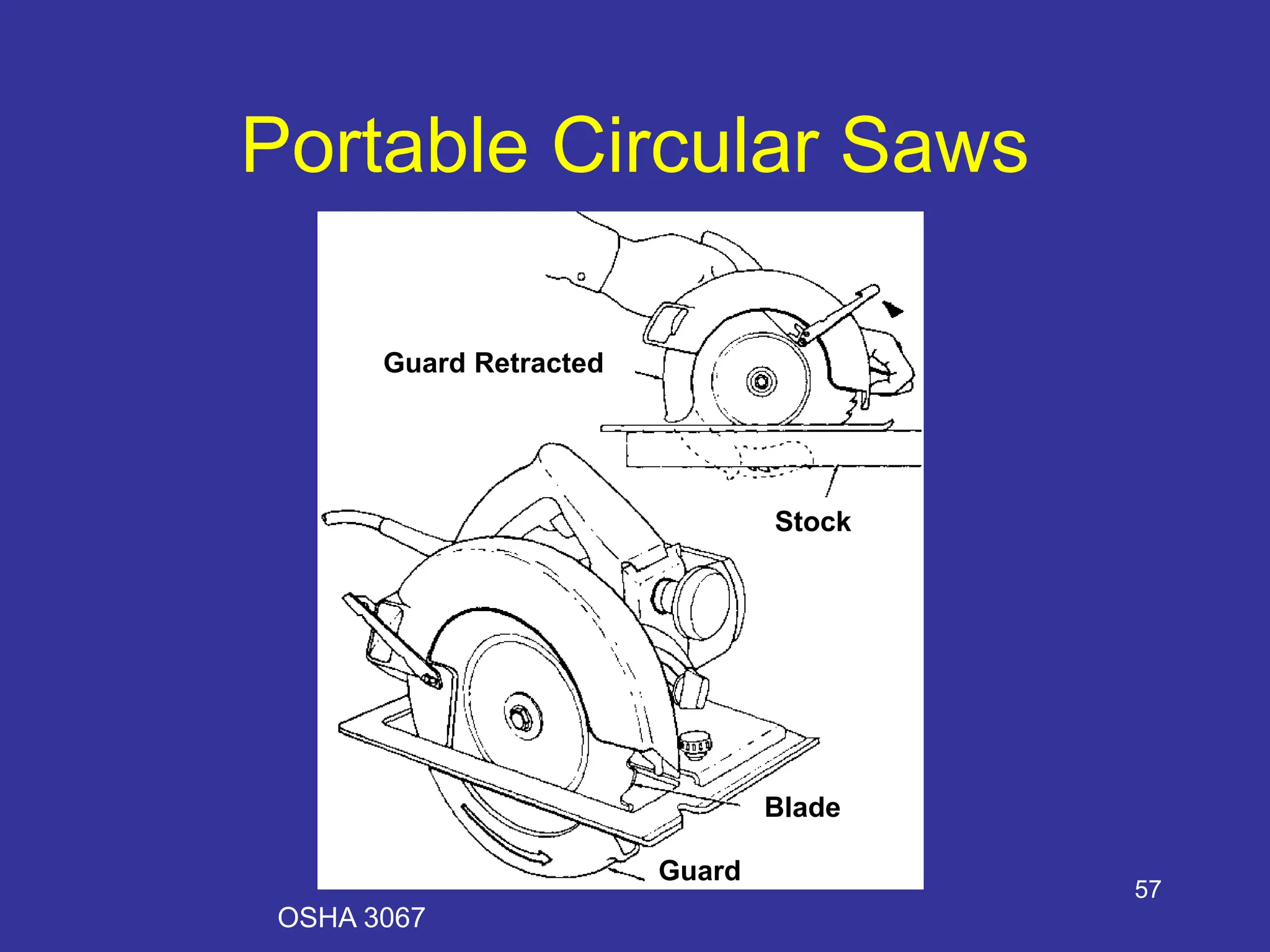
Portable Circular Saws
Stock
Guard
Blade
Guard Retracted
OSHA 3067
58
Table Saw
• On/off switch should
be located at knee
height -- so you can
turn off machine
while your hands
are on the material
• Blade must be
guarded
• Automatic brake a
good safety feature
Guard
www.osha.gov/SLTC/etools/machineguarding/saws/tablesaws.htm
59
Table Saw -- Kickback
• Back of the blade, as it rises out of
table, is the critical “kickback zone”
• Material tends to be lifted off of the table
• If wood moves sideways at this point, it
will be caught by the rotational motion
and will be flung back toward the
operator!
60
Preventing Kickbacks
• Use a splitter or wedge inserted into the
saw kerf to separate material
• Make sure rip fence is perfectly parallel
to the blade
61
Table Saw - Splitters
• Metal fins, secured behind and in line with the
blade -- must move freely & not stick open
• Anti-kickback pawls also attached
Splitter & anti-
kickback pawls
www.orosha.org/pdf/pubs/2980.pdf
62
Table Saw - Push Sticks
Push stick
www.osha.gov/SLTC/etools/machineguarding/saws/tablesaws.html
63
Radial Arm Saw
Anti-
Kickback
Device
Lower Blade Guard
64
Machinery: General Safety
Principles
• Securely fasten equipment to eliminate
movement or “walking”
• No loose clothing, long hair, jewelry, or
gloves around rotating machine parts
• Respect machine guards
• Keep electrical cords and plugs intact
• Inspect machinery before each use
65
Machinery: General Safety
Principles
• Do not leave machines running and
unattended
• Never attend to brush debris from the
table surface while the machine is
running
• An active brake mechanism adds
greatly to safety
• Easily reached “off” switch increases
safety
66
Machine Guarding
Checklist
Case Studies
Quiz
Resources
• OSHA Machine Guarding Website
http://www.osha.gov/SLTC/machineguarding/index.html
• OSHA Machine Guarding eTool
http://www.osha.gov/SLTC/etools/machineguarding/index.html
• OSHA Amputation Fact Sheet
http://www.osha.gov/OshDoc/data_General_Facts/amputation-
factsheet.pdf
• Safeguarding Equipment and Protecting
Employees from Amputations
http://www.osha.gov/Publications/osha3170.pdf
69

fy10_sh-20856-10_Machine_Guarding (1).ppt

  • 1.
    Machinery Safety Machine Guarding forWarehouse and Maintenance Workers What is wrong with this picture? This material was produced and revised (using information from OSHA’s website, publications and CDC website) under grant [SH20856SH0] from the Occupational Safety and Health Administration, U.S. Department of Labor. It does not necessarily reflect the views or policies of the U.S. Department of Labor, nor does mention of trade names, commercial products, or organizations imply endorsement by the U.S. Government
  • 2.
    2 The Problem • Workerswho operate and maintain machinery each year suffer approximately – 18,000 amputations, lacerations, crushing injuries, and abrasions – 800 deaths OSHA 7100
  • 3.
    3 The Problem: Machinery Associatedwith Amputations 1. Mechanical power presses 2. Power press brakes 3. Powered and non-powered conveyors 4. Printing presses 5. Roll-forming and roll-bending machines 6. Shearing machines 7. Food slicers 8. Meat grinders 9. Meat-cutting band saws 10.Drill presses 11.Milling machines 12.Grinding machines
  • 4.
    4 Causes of MachineIncidents • Reaching in to “clear” equipment • Not using Lockout/Tagout • Unauthorized person doing maintenance or using the machines • Missing or loose machine guards • Lack of training
  • 5.
    5 Prevention • Any machinepart, function, or process which may cause injury must be safeguarded. • Where the operation of a machine can injure the operator or other workers, the hazard must be controlled or eliminated
  • 6.
    6 OSHA Citations Fiscal Year2010 • Machines, general requirements (1910.212) – 10th most frequently cited standard – 5th ranked standard in assessed penalties • Lockout/Tagout (1910.147) – 5th most frequently cited standard – 4th ranked standard in assessed penalties
  • 7.
  • 8.
    8 Objectives • Explain thegeneral requirements for guarding the hazards of machines • Describe precautions to be taken around machinery • Identify important terms associated with guarding machinery
  • 9.
  • 10.
    10 3 Basic AreasTo Be Safeguarded • Point of Operation • Power Transmission Apparatus • Other Moving Parts
  • 11.
    11 Hazard Identification • Motions –Rotating (including in- running nip points) – Transverse – Reciprocating • Actions – Cutting – Punching – Shearing – Bending
  • 12.
    12 Rotating Motion • Hazard– Machinery grips and moves clothing, hair and body parts into danger area • Danger increases when projections are present – Screws, bolts, nicks, abrasions, etc.
  • 13.
    13 Rotating Parts withProjections Rotating pulley with spokes and projecting burr on face of pulley Rotating coupling with projecting bolt heads Rotating shaft and pulleys with projecting key and set screw BURR OSHA 3067
  • 14.
    14 In-Running Nip Points NipPoint Nip Point Nip Point Nip Point Nip Point Nip Point OSHA 3067
  • 15.
    15 In-Running Nip Points NipPoint Nip Point Nip Point Nip Points OSHA 3067
  • 16.
    16 Transverse Motion • Movementin a straight, continuous line around rotating component • Hazard may strike or catch employee a pinch or shear point OSHA 3067
  • 17.
    17 Reciprocating Motion • Backand forth / up and down • Hazard - Caught between moving part and stationary object OSHA 3067
  • 18.
    18 Bending Actions • Powerapplied to slide to draw or stamp metal or other materials in a bending motion • Example: Press Brake, Tube Benders OSHA 3067
  • 19.
  • 20.
    20 Punching Actions • Powerapplied to slide ram for purpose of blanking, drawing or stamping • Example: Power press
  • 21.
    21 Shearing Actions • Applypower to slide or knife to trim or cut OSHA 3067
  • 22.
  • 23.
    23 Cutting Actions • Rotating, reciprocatingor transverse motion • Examples: Band saw, circular saws, lathes, drills OSHA 3067
  • 24.
    24 Classification of Safeguards •Guards • Devices • Location/distance • Automatic/semiautomatic feed or ejection • Miscellaneous
  • 25.
    25 Types of Guards •Fixed – Provide secure barrier • Interlocked – Cuts off power when guard opened or removed • Adjustable – Barrier manually moved to accommodate stock or operation • Self-adjusting – Barrier automatically moves to accommodate operation
  • 26.
    26 Fixed Guards • Advantages –Maximum protection – Variety of applications – In-house fabrication – Low cost & maintenance • Disadvantages – Poor visibility – Must remove for repairs requiring LOTO OSHA 3067
  • 27.
    27 Interlocked Guards • Switchthat when opened stops power • Advantage – Maximum protection – Portion of guard easily removed for access • Disadvantage – Can be overridden by employee – High cost – Maintenance required
  • 28.
    28 Adjustable Guards • Advantage –Flexibility – In-house fabrication • Disadvantage – Not maximum protection – Rely on worker to properly position – May prohibit easy access Bandsaw blade adjustable guard OSHA 3067
  • 29.
    29 Self-adjusting Guards • Advantage –Employee not involved in positioning – Readily available • Disadvantage – Not maximum protection – May need frequent fine tuning OSHA 3067
  • 30.
    30 Self-adjusting Guard Table CircularSaw OSHA 10 Hour GI Presentation
  • 31.
    31 Devices • Presence sensing –Photoelectrical – Radiofrequency – Electromechanical • Safety Controls – Safety trip control – Two-hand control/trip • Gates
  • 32.
  • 33.
    33 Two-Hand Control • Requiresconstant, concurrent pressure to activate the machine • The operator’s hands are required to be at a safe location (on control buttons) and at a safe distance from the danger area while the machine completes its closing cycle OSHA 10 hour
  • 34.
    34 Safety Tripwire Cables •Device located around the perimeter of or near the danger area • Operator must be able to reach the cable to stop the machine OSHA 10 hour
  • 35.
    35 Gate • Movable barrierdevice which protects the operator at the point of operation before the machine cycle can be started • If the gate does not fully close, machine will not function Gate Open Gate Closed OSHA 10 hour
  • 36.
  • 37.
    37 Safeguard by location/distance • Positiondangerous parts of machine in inaccessible areas during normal operation – Moving parts more than 7 feet above floor – Controlled access room – Control station at safe distance from machine OSHA 10 hour
  • 38.
    38 Feeding and EjectionMethods • Automatic / semiautomatic feed • Automatic / semiautomatic ejection • Robots
  • 39.
    39 Automatic Feed (shown onpower press) Transparent Enclosure Guard Stock Feed Roll Dang er Area Completed Work OSHA 3170
  • 40.
    40 Robots • Machines thatload and unload stock, assemble parts, transfer objects, or perform other tasks • Best used in high- production processes requiring repeated routines where they prevent other hazards to employees Press Fixed Barrier Robot Stock Conveyor OSHA 3170
  • 41.
    41 Miscellaneous • Awareness Barriers •Protective Shields • Hand tools
  • 42.
    42 Awareness Devices • Alertemployees to hazard – Signs – Awareness signals (audible or visual) – Awareness barriers (allows access to machine danger areas, but is designed to contact employee, creating an awareness that employee is close to danger point)
  • 43.
    43 Protective Shields These donot give complete protection from machine hazards, but do provide some protection from flying particles, splashing cutting oils, or coolants.
  • 44.
    44 Holding Tools • Usedto place and remove stock in the danger area • Not to be used instead of other machine safeguards, but as a supplement OSHA 3067
  • 45.
    45 Requirements for Safeguards •Prevent contact • Secure, tamper-resistant, and durable • Protect from falling objects • Create no new hazards • Create no interference • Allow safe lubrication and maintenance
  • 46.
    46 Requirements of Safeguards •Fixed guards should used whenever possible • Machines designed for fixed location shall be secured to prevent movement • Conform to ANSI and OSHA requirements
  • 47.
    47 Machine Safety Responsibilities • Management –ensure all machinery is properly guarded • Supervisors – train employees on specific guard rules in their areas – ensure machine guards remain in place and are functional – immediately correct machine guard deficiencies
  • 48.
    48 Machine Safety Responsibilities • Employees –do not remove guards unless machine is locked and tagged – report machine guard problems to supervisors immediately – do not operate equipment unless guards are in place
  • 49.
    49 Employee Training • Hazardsassociated with particular machines • How the safeguards provide protection and the hazards for which they are intended • How and why to use the safeguards • How and when safeguards can be removed and by whom • What to do if a safeguard is damaged, missing, or unable to provide adequate protection
  • 50.
    50 Some Examples ofMachine Guarding
  • 51.
  • 52.
    52 Abrasive Wheel Machinery Workrests on offhand grinding machines must be kept adjusted closely to the wheel with a maximum opening of 1/8-inch to prevent the work from being jammed between the wheel and the rest, which may result in wheel breakage. OSHA 3067
  • 53.
    53 Abrasive Wheel Machinery Thedistance between the wheel periphery and the adjustable tongue must never exceed 1/4-inch. OSHA 10 hour
  • 54.
    54 Abrasive Wheel Machinery •When installing new abrasive wheel – Inspect for condition and compatibility – Conduct ring test Click on picture for video OSHA 7100
  • 55.
  • 56.
    56 Power-Transmission Apparatus Power-transmission apparatus (shafting, flywheels,pulleys, belts, chain drives, etc.) less than 7 feet from the floor or working platform must be guarded. Unguarded belt and pulley OSHA 10 hour
  • 57.
  • 58.
    58 Table Saw • On/offswitch should be located at knee height -- so you can turn off machine while your hands are on the material • Blade must be guarded • Automatic brake a good safety feature Guard www.osha.gov/SLTC/etools/machineguarding/saws/tablesaws.htm
  • 59.
    59 Table Saw --Kickback • Back of the blade, as it rises out of table, is the critical “kickback zone” • Material tends to be lifted off of the table • If wood moves sideways at this point, it will be caught by the rotational motion and will be flung back toward the operator!
  • 60.
    60 Preventing Kickbacks • Usea splitter or wedge inserted into the saw kerf to separate material • Make sure rip fence is perfectly parallel to the blade
  • 61.
    61 Table Saw -Splitters • Metal fins, secured behind and in line with the blade -- must move freely & not stick open • Anti-kickback pawls also attached Splitter & anti- kickback pawls www.orosha.org/pdf/pubs/2980.pdf
  • 62.
    62 Table Saw -Push Sticks Push stick www.osha.gov/SLTC/etools/machineguarding/saws/tablesaws.html
  • 63.
  • 64.
    64 Machinery: General Safety Principles •Securely fasten equipment to eliminate movement or “walking” • No loose clothing, long hair, jewelry, or gloves around rotating machine parts • Respect machine guards • Keep electrical cords and plugs intact • Inspect machinery before each use
  • 65.
    65 Machinery: General Safety Principles •Do not leave machines running and unattended • Never attend to brush debris from the table surface while the machine is running • An active brake mechanism adds greatly to safety • Easily reached “off” switch increases safety
  • 66.
  • 67.
  • 68.
  • 69.
    Resources • OSHA MachineGuarding Website http://www.osha.gov/SLTC/machineguarding/index.html • OSHA Machine Guarding eTool http://www.osha.gov/SLTC/etools/machineguarding/index.html • OSHA Amputation Fact Sheet http://www.osha.gov/OshDoc/data_General_Facts/amputation- factsheet.pdf • Safeguarding Equipment and Protecting Employees from Amputations http://www.osha.gov/Publications/osha3170.pdf 69