1
2
Benefits
• Safety Guarantee
• To avoid accidents
• Prevent land contamination
• Reduce oil wastage
• Boost up of employee Morale
• Good impression in front of customers
MACHINE SAFETY
3
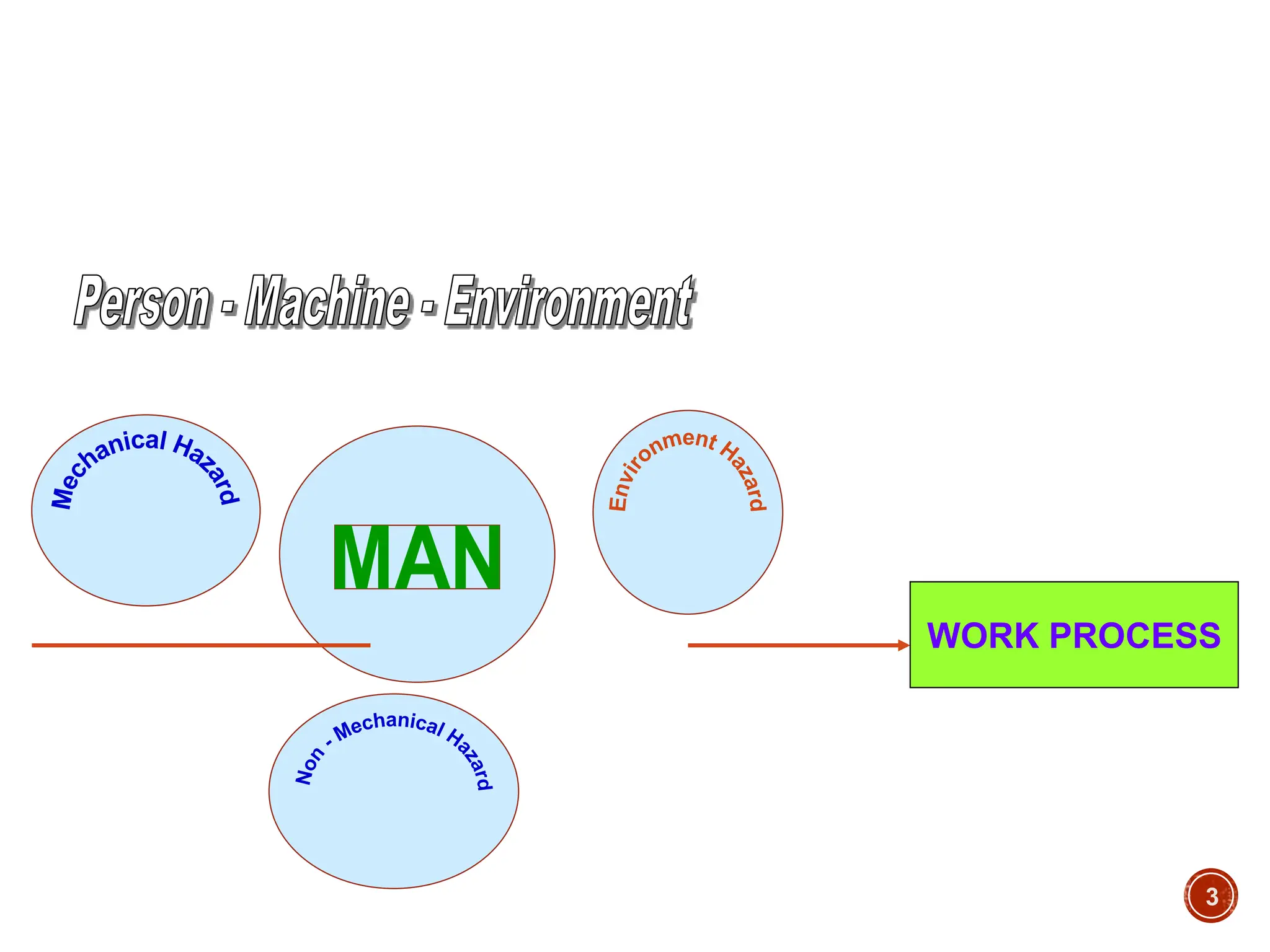
WORK PROCESS
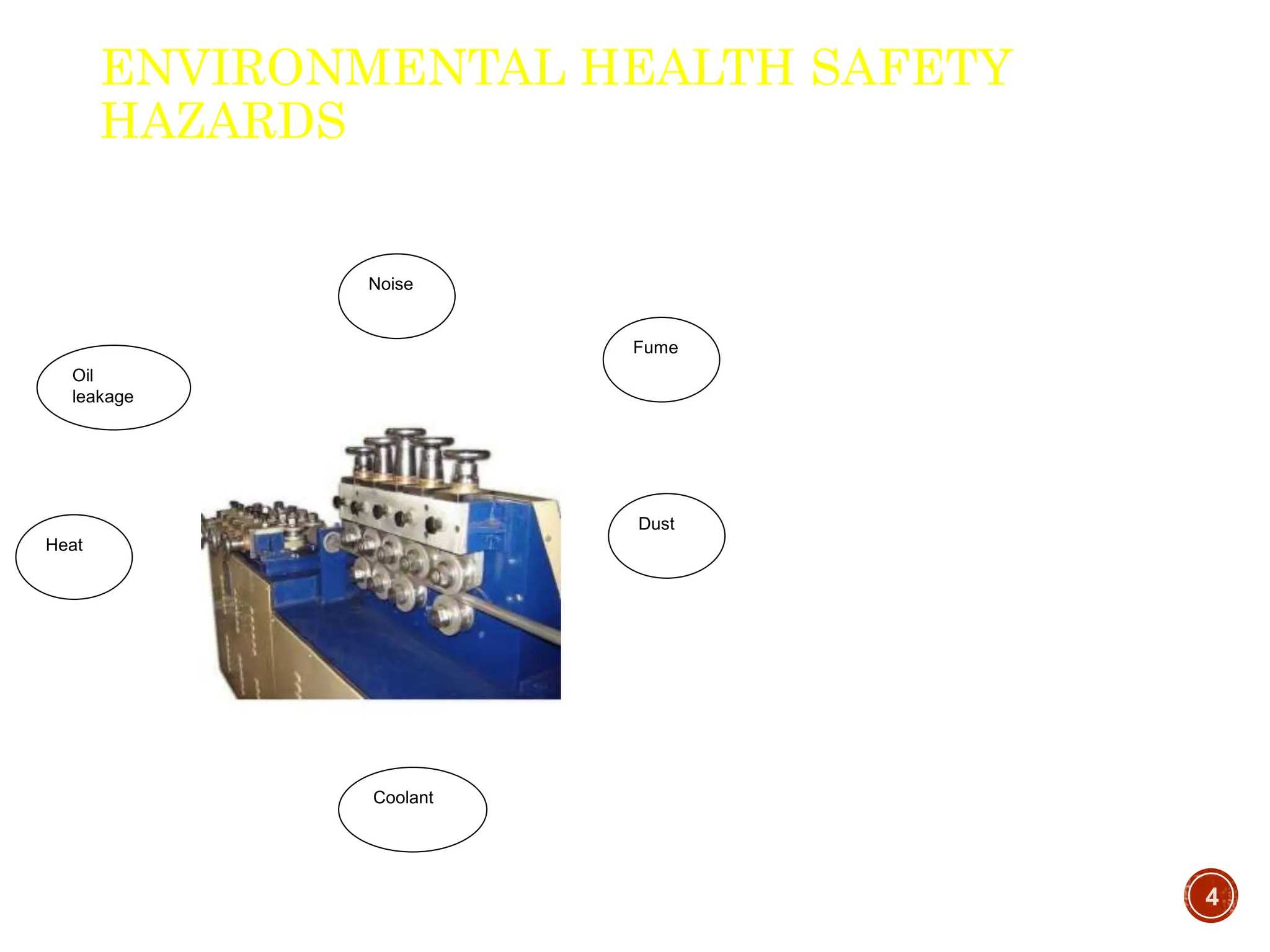
ENVIRONMENTAL HEALTH SAFETY
HAZARDS
4
Fume
Heat
Oil
leakage
Noise
Dust
Coolant
POSSIBLE QUESTIONS, WHICH MAY REVEAL A
HAZARD
5
 Person - Procedure
Are the people familiar with the procedure to be followed for the
job? Is the procedure understandable to the people doing the
job?
 Procedure - Machine
Is the equipment designed for the use explained in the
procedure? Is the machine maintained in good order?
 Machine - Environment
Does the environment prevent the use of certain machinery,
e.g., ground too soft for a mobile crane, or do nearby high
voltage lines require conductive rather than electrically resistive
footwear?
POSSIBLE QUESTIONS, WHICH MAY REVEAL A
HAZARD
6
 Person - Machine
Are the people trained and experience with the equipment they
are working with?
Person - Environment
Does the environment create hazards for the people working
there, e.g., wind, precipitation, temperature, and the people
working above others who may be subjected to falling hazard?
 Procedure - Environment
Does the environment prevent procedures (safe work
procedures) from being followed, e.g., adjacent live apparatus
outside safety limits?
7
“ Machinery” is an assembly of linked parts or
components, at least one of which moves, the the
appropriate actuators, controls and -power circuits,
joined for a specific application in processing,
treatment, moving or packaging materials. This
includes an assembly of machines that to achieve
the same end are arranged and controlled so that
they function as an integral unit.
A PERSON MAY BE INJURED BY MACHINERY
THROUGH:
8
A). Coming into contact with it, or being trapped between the
machinery and any material in or at the machinery or fixed
structure.
B). Being struck by, or becoming entangled in motion in the
machinery.
C). Being struck by parts of the machinery ejected from it.
D). Being struck by material ejected from the machinery.
9
“Design faults in machinery are often responsible for
operating equipment hazards.”
Areas on machinery, which can present a hazard to
operators:
a). A reciprocating trap - a horizontal trap occurs when there is a
vehicle or horizontal motion, for example the
operation of a press.
b). Shearing traps - where one or two parts cut across
each other, for example the action of gardens
shears.
10
c). In-running nips where moving belts or chains meet.
d). Ejection of machinery parts or supplies used on the equipment.
e). Direct contact with machines, which can expose an individual to the
potential for burns.
MACHINE GUARDING
11
“ Should there be contact between people and moving
parts, of machinery, serious injury may occur.”
In general, design and construction requirements involved in
machinery safety guarding can be summarized to include the
following:
 The owner of the machinery shall provide, and always maintain,
safety devices, fences, barriers or guards following the
minimum requirements.
 Safety devices, fences and guards shall be provided on every
dangerous part of machinery.
12
Safe guarding of machinery should be planned into the design of
machinery. Safety devices, fences or barriers, and guards
should not in themselves, create a hazard.
 Safeguarding shall be checked to prevent persons reaching into
the danger area of machinery. Human capabilities have to
be considered when determining minimum clearances.
MACHINE SAFETY CHECKLISTS
13
“ Machine safety checklists can be used to identify
potential and actual hazards in the workplace. Checklists
provide a baseline for hazard identification an action
planning that may be required to correct hazard.”
PRESSURE VESSELS
14
“A pressure vessel is a vessel, which is subjected to
either internal or external pressure. This includes all
parts of the vessel up to the point of connection.
Because such vessels contain compressed gas in come
form, safety is maximized through correct handling,
maintenance, storage, use and work within the
workplace.”
PRESSURE VESSELS
15
The most common pressure vessels in the workplace:
Boiler - a closed vessel in which water is heater by
combustion of fuel or heat from other sources to
form steam, hot water, or high temperature water
under pressure.
Gas Cylinders, may vary depending on the type of fuel,
which is under pressure and may include:
 LPG gas cylinders
 Oxygen and acetylene cylinders
 Nitrous oxide cylinders
 Helium cylinders
PRESSURE VESSELS
16
Risk associated with pressure systems can be
summarized to include:
 The release of stored energy which is uncontrolled.
(May result from structural or corrosion damage to the
cylinder or boiler).
Unsafe operating and handling practices.
PRESSURE VESSELS
17
Principles in safe storage and handling of pressure
vessel:
 Secure gas cylinders to prevent cylinders from falling and
accumulating damage.
 Keep grease away from cylinder connections.
 Stored cylinders in an upright position to prevent safety valves
from being blocked by liquid.
 Do not fill damaged, corroded or out of test cylinders.
 Store cylinders in a cool area to prevent gas expansion.
 Do not overfill gas cylinders as this may result in the safety valve
opening or a weak cylinder splitting.
Notes: Refer to OSH Rule 1170
MACHINE GUARDING
18
General Guarding Requirements
The purpose of machine guarding is to prevent any part
of person’s body or clothing from coming into contact
with any dangerous moving part of the machine.
Guards should be designed and constructed to satisfy
the following criteria:
 Provide positive protection
 Prevent all access to the danger area during operation
 Cause compatible with the production process
 Operate with minimum effort
19
 Preferably be built in
 Provide for maintenance, inspection and servicing
 Be durable enough to withstand extreme conditions
 Not to constitute a hazard themselves
 Protect against unforseen operational conditions
 Comply with relevant standards and legal requirements
 NOTE: Please see OSH Rule 1200
BASIC PRINCIPLES OF MACHINE GUARDING
20
“The type of guard necessary to be fitted to a particular
part of the machine depends on the design purpose of
that part.”
Non-Operational - for use on transmission gears, belt
drives, shafts and parts that usually do not require
frequent adjustments or approach by the operator.
 Operational - where part performs the function or
purpose of the machine, such as cutters, blades
and chucks.
BASIC PRINCIPLES OF MACHINE GUARDING
21
Safety of machinery maybe provided through several
options. (Includes specific technique, or where
necessary, combination of different methods.
 Tool or Machine Design Operational
Tools or machine design can eliminate , the need for
separate guards. Using remote control, automatic feeding or
enclosure, the operator is isolated from dangerous area.
 Fixed Guards
Fixed guard enclosures provide a high level of protection,
advantage include; no moving parts, enclosure of dangerous
area always, allowing feeding and ejecting of material but
preventing hands entering the danger zone.
22
Essential requirements of a fixed guard:
 Effective prevention of access of any part of the
body to the danger area from any direction
 Strong rigid construction
 Effective attachment
Basic Principles of Machine Guarding
23
Basic Principles of Machine Guarding
 Adjustable Fixed Guards
(T(The method, while increasing flexibility, increases the potential
for error)
 Interlocked Guards
Provides access to the danger area when the moving parts of the
machinery come to rest the guard is required to:
 Shut of or isolate the power source to prevent operation when
guard is open.
 Remain closed until the moving parts have stopped.
 Stop the machine immediately when guard is opened.
 Completely enclose the moving parts in the danger area.
24
Basic Principles of Machine Guarding
 Automatic Guards
The machine itself through connection to the operating system
activates the automatic guard. The guard is linked to the working
cycle of the machine and is designed to protect the operator even in
the event of a machine fault.
 Trip or Quick-Stop Guards
In special circumstances, where physical guarding is not fully
possible, the application of quick-stop devices can be incorporated.
In particular, use is made of photoelectric beams.
25
Basic Principles of Machine Guarding
 Maintenance of Guards
 Fence Around Machines
26

404106149-Day-2-Machine-Safety-ppt.ppt

  • 1.
  • 2.
    2 Benefits • Safety Guarantee •To avoid accidents • Prevent land contamination • Reduce oil wastage • Boost up of employee Morale • Good impression in front of customers
  • 3.
  • 4.
  • 5.
    POSSIBLE QUESTIONS, WHICHMAY REVEAL A HAZARD 5  Person - Procedure Are the people familiar with the procedure to be followed for the job? Is the procedure understandable to the people doing the job?  Procedure - Machine Is the equipment designed for the use explained in the procedure? Is the machine maintained in good order?  Machine - Environment Does the environment prevent the use of certain machinery, e.g., ground too soft for a mobile crane, or do nearby high voltage lines require conductive rather than electrically resistive footwear?
  • 6.
    POSSIBLE QUESTIONS, WHICHMAY REVEAL A HAZARD 6  Person - Machine Are the people trained and experience with the equipment they are working with? Person - Environment Does the environment create hazards for the people working there, e.g., wind, precipitation, temperature, and the people working above others who may be subjected to falling hazard?  Procedure - Environment Does the environment prevent procedures (safe work procedures) from being followed, e.g., adjacent live apparatus outside safety limits?
  • 7.
    7 “ Machinery” isan assembly of linked parts or components, at least one of which moves, the the appropriate actuators, controls and -power circuits, joined for a specific application in processing, treatment, moving or packaging materials. This includes an assembly of machines that to achieve the same end are arranged and controlled so that they function as an integral unit.
  • 8.
    A PERSON MAYBE INJURED BY MACHINERY THROUGH: 8 A). Coming into contact with it, or being trapped between the machinery and any material in or at the machinery or fixed structure. B). Being struck by, or becoming entangled in motion in the machinery. C). Being struck by parts of the machinery ejected from it. D). Being struck by material ejected from the machinery.
  • 9.
    9 “Design faults inmachinery are often responsible for operating equipment hazards.” Areas on machinery, which can present a hazard to operators: a). A reciprocating trap - a horizontal trap occurs when there is a vehicle or horizontal motion, for example the operation of a press. b). Shearing traps - where one or two parts cut across each other, for example the action of gardens shears.
  • 10.
    10 c). In-running nipswhere moving belts or chains meet. d). Ejection of machinery parts or supplies used on the equipment. e). Direct contact with machines, which can expose an individual to the potential for burns.
  • 11.
    MACHINE GUARDING 11 “ Shouldthere be contact between people and moving parts, of machinery, serious injury may occur.” In general, design and construction requirements involved in machinery safety guarding can be summarized to include the following:  The owner of the machinery shall provide, and always maintain, safety devices, fences, barriers or guards following the minimum requirements.  Safety devices, fences and guards shall be provided on every dangerous part of machinery.
  • 12.
    12 Safe guarding ofmachinery should be planned into the design of machinery. Safety devices, fences or barriers, and guards should not in themselves, create a hazard.  Safeguarding shall be checked to prevent persons reaching into the danger area of machinery. Human capabilities have to be considered when determining minimum clearances.
  • 13.
    MACHINE SAFETY CHECKLISTS 13 “Machine safety checklists can be used to identify potential and actual hazards in the workplace. Checklists provide a baseline for hazard identification an action planning that may be required to correct hazard.”
  • 14.
    PRESSURE VESSELS 14 “A pressurevessel is a vessel, which is subjected to either internal or external pressure. This includes all parts of the vessel up to the point of connection. Because such vessels contain compressed gas in come form, safety is maximized through correct handling, maintenance, storage, use and work within the workplace.”
  • 15.
    PRESSURE VESSELS 15 The mostcommon pressure vessels in the workplace: Boiler - a closed vessel in which water is heater by combustion of fuel or heat from other sources to form steam, hot water, or high temperature water under pressure. Gas Cylinders, may vary depending on the type of fuel, which is under pressure and may include:  LPG gas cylinders  Oxygen and acetylene cylinders  Nitrous oxide cylinders  Helium cylinders
  • 16.
    PRESSURE VESSELS 16 Risk associatedwith pressure systems can be summarized to include:  The release of stored energy which is uncontrolled. (May result from structural or corrosion damage to the cylinder or boiler). Unsafe operating and handling practices.
  • 17.
    PRESSURE VESSELS 17 Principles insafe storage and handling of pressure vessel:  Secure gas cylinders to prevent cylinders from falling and accumulating damage.  Keep grease away from cylinder connections.  Stored cylinders in an upright position to prevent safety valves from being blocked by liquid.  Do not fill damaged, corroded or out of test cylinders.  Store cylinders in a cool area to prevent gas expansion.  Do not overfill gas cylinders as this may result in the safety valve opening or a weak cylinder splitting. Notes: Refer to OSH Rule 1170
  • 18.
    MACHINE GUARDING 18 General GuardingRequirements The purpose of machine guarding is to prevent any part of person’s body or clothing from coming into contact with any dangerous moving part of the machine. Guards should be designed and constructed to satisfy the following criteria:  Provide positive protection  Prevent all access to the danger area during operation  Cause compatible with the production process  Operate with minimum effort
  • 19.
    19  Preferably bebuilt in  Provide for maintenance, inspection and servicing  Be durable enough to withstand extreme conditions  Not to constitute a hazard themselves  Protect against unforseen operational conditions  Comply with relevant standards and legal requirements  NOTE: Please see OSH Rule 1200
  • 20.
    BASIC PRINCIPLES OFMACHINE GUARDING 20 “The type of guard necessary to be fitted to a particular part of the machine depends on the design purpose of that part.” Non-Operational - for use on transmission gears, belt drives, shafts and parts that usually do not require frequent adjustments or approach by the operator.  Operational - where part performs the function or purpose of the machine, such as cutters, blades and chucks.
  • 21.
    BASIC PRINCIPLES OFMACHINE GUARDING 21 Safety of machinery maybe provided through several options. (Includes specific technique, or where necessary, combination of different methods.  Tool or Machine Design Operational Tools or machine design can eliminate , the need for separate guards. Using remote control, automatic feeding or enclosure, the operator is isolated from dangerous area.  Fixed Guards Fixed guard enclosures provide a high level of protection, advantage include; no moving parts, enclosure of dangerous area always, allowing feeding and ejecting of material but preventing hands entering the danger zone.
  • 22.
    22 Essential requirements ofa fixed guard:  Effective prevention of access of any part of the body to the danger area from any direction  Strong rigid construction  Effective attachment Basic Principles of Machine Guarding
  • 23.
    23 Basic Principles ofMachine Guarding  Adjustable Fixed Guards (T(The method, while increasing flexibility, increases the potential for error)  Interlocked Guards Provides access to the danger area when the moving parts of the machinery come to rest the guard is required to:  Shut of or isolate the power source to prevent operation when guard is open.  Remain closed until the moving parts have stopped.  Stop the machine immediately when guard is opened.  Completely enclose the moving parts in the danger area.
  • 24.
    24 Basic Principles ofMachine Guarding  Automatic Guards The machine itself through connection to the operating system activates the automatic guard. The guard is linked to the working cycle of the machine and is designed to protect the operator even in the event of a machine fault.  Trip or Quick-Stop Guards In special circumstances, where physical guarding is not fully possible, the application of quick-stop devices can be incorporated. In particular, use is made of photoelectric beams.
  • 25.
    25 Basic Principles ofMachine Guarding  Maintenance of Guards  Fence Around Machines
  • 26.