Do experienced workers adopt different manual 
materials handling techniques compared to novices 
and can these be used as examples for training? A 
literature review 
Mark Boocock, Grant Mawston, Liz Ashby and 
Fiona Trevelyan 
mark.boocock@aut.ac.nz 
Health & Rehabilitation Research Institute / 
Centre for Occupational Health & Safety Research 
Auckland University of Technology 
New Zealand
Epidemiology and back pain 
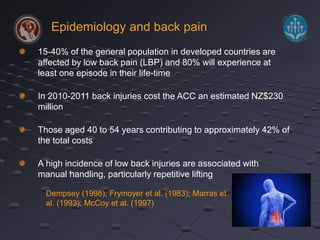
15-40% of the general population in developed countries are 
affected by low back pain (LBP) and 80% will experience at 
least one episode in their life-time 
In 2010-2011 back injuries cost the ACC an estimated NZ$230 
million 
Those aged 40 to 54 years contributing to approximately 42% of 
the total costs 
A high incidence of low back injuries are associated with 
manual handling, particularly repetitive lifting 
Dempsey (1998); Frymoyer et al. (1983); Marras et 
al. (1993); McCoy et al. (1997)
Manual handling training 
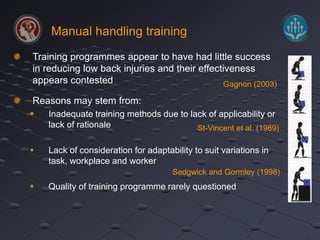
Training programmes appear to have had little success 
in reducing low back injuries and their effectiveness 
appears contested 
Gagnon (2003) 
Reasons may stem from: 
 Inadequate training methods due to lack of applicability or 
lack of rationale 
St-Vincent et al. (1989) 
 Lack of consideration for adaptability to suit variations in 
task, workplace and worker 
Sedgwick and Gormley (1998) 
 Quality of training programme rarely questioned
Manual handling training 
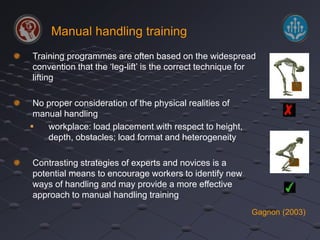
Training programmes are often based on the widespread 
convention that the ‘leg-lift’ is the correct technique for 
lifting 
No proper consideration of the physical realities of 
manual handling 
 workplace: load placement with respect to height, 
depth, obstacles; load format and heterogeneity 
Contrasting strategies of experts and novices is a 
potential means to encourage workers to identify new 
ways of handling and may provide a more effective 
approach to manual handling training 
Gagnon (2003)
Manual handling fail
Aims and objectives 
To undertake a detailed and systematic literature review 
to identify experimental studies that have compared 
experts and novices performing manual materials 
handling tasks 
To identify individual and workplace factors that are 
important to a workplace training programme
Methods: inclusion/exclusion 
Keywords – drawn from major publications and systematic reviews, 
terms inclusive of: 
 Experience: e.g. novice, expert, skill 
 Manual handling: e.g. lifting, patient transfer, psychophysical 
 Training: e.g. education, learning, teaching, knowledge transfer 
EBSCO electronic database searched (incl. Academic Search 
Premier, CINAHL, Medline, AMED, Health source, Ergonomic 
abstracts, Psych and Behav Sci collection) 
Inclusion criteria Exclusion criteria 
Experimental studies Observational studies 
Comparison between experts and novices or 
different skill levels 
Training techniques of experts performed by 
novices 
Manual handling (lifting, lowering, push/pull, 
carry) 
Not published in English 
Biomechanical, physiological and/or 
psychophysical measures 
Completed early Aug 2014
Results: studies identified 
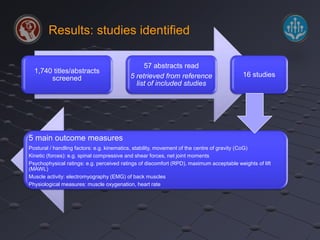
1,740 titles/abstracts 
screened 
57 abstracts read 
5 retrieved from reference 
list of included studies 
16 studies 
5 main outcome measures 
Postural / handling factors: e.g. kinematics, stability, movement of the centre of gravity (CoG) 
Kinetic (forces): e.g. spinal compressive and shear forces, net joint moments 
Psychophysical ratings: e.g. perceived ratings of discomfort (RPD), maximum acceptable weights of lift 
(MAWL) 
Muscle activity: electromyography (EMG) of back muscles 
Physiological measures: muscle oxygenation, heart rate
Results: tasks / activities 
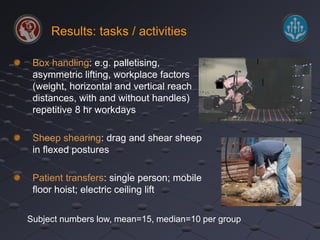
Box handling: e.g. palletising, 
asymmetric lifting, workplace factors 
(weight, horizontal and vertical reach 
distances, with and without handles) 
repetitive 8 hr workdays 
Sheep shearing: drag and shear sheep 
in flexed postures 
Patient transfers: single person; mobile 
floor hoist; electric ceiling lift 
Subject numbers low, mean=15, median=10 per group
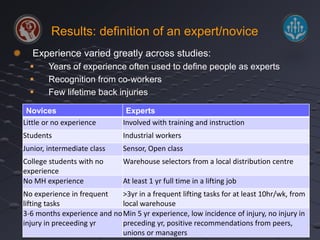
Results: definition of an expert/novice 
Experience varied greatly across studies: 
 Years of experience often used to define people as experts 
 Recognition from co-workers 
 Few lifetime back injuries 
Novices Experts 
Little or no experience Involved with training and instruction 
Students Industrial workers 
Junior, intermediate class Sensor, Open class 
College students with no 
experience 
Warehouse selectors from a local distribution centre 
No MH experience At least 1 yr full time in a lifting job 
No experience in frequent 
lifting tasks 
>3yr in a frequent lifting tasks for at least 10hr/wk, from 
local warehouse 
3-6 months experience and no 
injury in preceeding yr 
Min 5 yr experience, low incidence of injury, no injury in 
preceding yr, positive recommendations from peers, 
unions or managers
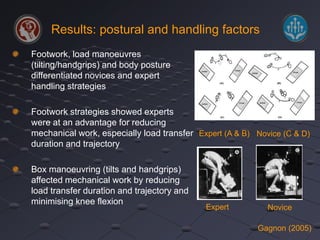
Results: postural and handling factors 
Footwork, load manoeuvres 
(tilting/handgrips) and body posture 
differentiated novices and expert 
handling strategies 
Footwork strategies showed experts 
were at an advantage for reducing 
mechanical work, especially load transfer 
duration and trajectory 
Box manoeuvring (tilts and handgrips) 
affected mechanical work by reducing 
load transfer duration and trajectory and 
minimising knee flexion 
Expert (A & B) Novice (C & D) 
Expert Novice 
Gagnon (2005)
Results: kinetic factors 
Effect of experience appears weak to moderate for spinal 
compression and shear forces, and lumbar moments 
Experienced workers have been shown in some studies to increase 
spinal compression loading (20%) and have higher spine extension 
moments than novices 
Suggested to stem from muscle co-activity (spine stability) and better 
balance maintenance 
Granata et al. (1999); Lee and Nussbaum (2014) 
Rate of lifting may be important – experienced 
workers increased spinal loading when forced to 
work at slower rates and novices increased loading 
when forced to work at faster rates 
Marras et al. (2006)
Results: physiological responses 
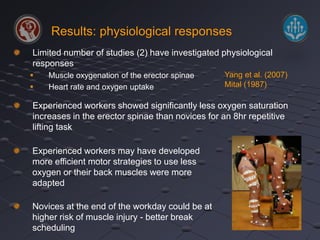
Limited number of studies (2) have investigated physiological 
responses 
 Muscle oxygenation of the erector spinae 
 Heart rate and oxygen uptake 
Experienced workers showed significantly less oxygen saturation 
increases in the erector spinae than novices for an 8hr repetitive 
lifting task 
Experienced workers may have developed 
more efficient motor strategies to use less 
oxygen or their back muscles were more 
adapted 
Novices at the end of the workday could be at 
higher risk of muscle injury - better break 
scheduling 
Yang et al. (2007) 
Mital (1987)
Results: psychophysical (perceptions) 
Discomfort reporting appears to be more a reflection of 
experience than work risk factors 
Novice workers report much higher discomfort levels than their 
experienced counterparts 
Experienced subjects may have more efficient motor patterns 
which reduces spinal load and thus discomfort 
Parakkat (2007) 
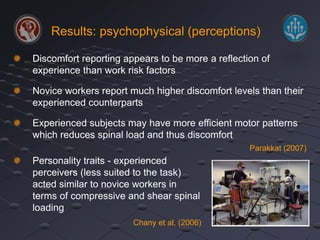
Personality traits - experienced 
perceivers (less suited to the task) 
acted similar to novice workers in 
terms of compressive and shear spinal 
loading 
Chany et al. (2006)
Discussion: approach to training 
“Bend your knees not your back” or 
“lift with your legs not your back” 
Experts may use this strategy, but only in a specific condition 
Plamondon et al (2014) 
Promoting this slogan without any context (work task, work 
environment, etc) would be a mistake because work conditions 
change and preclude the application of this rule 
Graveling (1991) 
An expert handler is not only skilful in handling loads but also 
extremely wise in planning his work and avoiding stressful work 
situations 
Lortie (2001)
Discussion: what to teach? 
The degree to which the task is meaningful, challenging and 
familiar contributes to task realism 
A need for clear definitions of novices and experts 
 “naivette” – one who is completely ignorant about a domain 
 “apprentice” – one who is learning about a domain 
 “master” – elite group of experts 
Farrington-Darby and Wilson (2001) 
A better understanding of ‘expert’ techniques could 
help in redesigning efficient training programmes 
Involvement of knowledgeable employees, 
ergonomic assessment of tasks and quality of 
training appear important when developing training 
programmes

Do experienced and novice workers adopt different materials handling techniques

  • 1.
    Do experienced workersadopt different manual materials handling techniques compared to novices and can these be used as examples for training? A literature review Mark Boocock, Grant Mawston, Liz Ashby and Fiona Trevelyan mark.boocock@aut.ac.nz Health & Rehabilitation Research Institute / Centre for Occupational Health & Safety Research Auckland University of Technology New Zealand
  • 2.
    Epidemiology and backpain 15-40% of the general population in developed countries are affected by low back pain (LBP) and 80% will experience at least one episode in their life-time In 2010-2011 back injuries cost the ACC an estimated NZ$230 million Those aged 40 to 54 years contributing to approximately 42% of the total costs A high incidence of low back injuries are associated with manual handling, particularly repetitive lifting Dempsey (1998); Frymoyer et al. (1983); Marras et al. (1993); McCoy et al. (1997)
  • 3.
    Manual handling training Training programmes appear to have had little success in reducing low back injuries and their effectiveness appears contested Gagnon (2003) Reasons may stem from:  Inadequate training methods due to lack of applicability or lack of rationale St-Vincent et al. (1989)  Lack of consideration for adaptability to suit variations in task, workplace and worker Sedgwick and Gormley (1998)  Quality of training programme rarely questioned
  • 4.
    Manual handling training Training programmes are often based on the widespread convention that the ‘leg-lift’ is the correct technique for lifting No proper consideration of the physical realities of manual handling  workplace: load placement with respect to height, depth, obstacles; load format and heterogeneity Contrasting strategies of experts and novices is a potential means to encourage workers to identify new ways of handling and may provide a more effective approach to manual handling training Gagnon (2003)
  • 5.
  • 6.
    Aims and objectives To undertake a detailed and systematic literature review to identify experimental studies that have compared experts and novices performing manual materials handling tasks To identify individual and workplace factors that are important to a workplace training programme
  • 7.
    Methods: inclusion/exclusion Keywords– drawn from major publications and systematic reviews, terms inclusive of:  Experience: e.g. novice, expert, skill  Manual handling: e.g. lifting, patient transfer, psychophysical  Training: e.g. education, learning, teaching, knowledge transfer EBSCO electronic database searched (incl. Academic Search Premier, CINAHL, Medline, AMED, Health source, Ergonomic abstracts, Psych and Behav Sci collection) Inclusion criteria Exclusion criteria Experimental studies Observational studies Comparison between experts and novices or different skill levels Training techniques of experts performed by novices Manual handling (lifting, lowering, push/pull, carry) Not published in English Biomechanical, physiological and/or psychophysical measures Completed early Aug 2014
  • 8.
    Results: studies identified 1,740 titles/abstracts screened 57 abstracts read 5 retrieved from reference list of included studies 16 studies 5 main outcome measures Postural / handling factors: e.g. kinematics, stability, movement of the centre of gravity (CoG) Kinetic (forces): e.g. spinal compressive and shear forces, net joint moments Psychophysical ratings: e.g. perceived ratings of discomfort (RPD), maximum acceptable weights of lift (MAWL) Muscle activity: electromyography (EMG) of back muscles Physiological measures: muscle oxygenation, heart rate
  • 9.
    Results: tasks /activities Box handling: e.g. palletising, asymmetric lifting, workplace factors (weight, horizontal and vertical reach distances, with and without handles) repetitive 8 hr workdays Sheep shearing: drag and shear sheep in flexed postures Patient transfers: single person; mobile floor hoist; electric ceiling lift Subject numbers low, mean=15, median=10 per group
  • 10.
    Results: definition ofan expert/novice Experience varied greatly across studies:  Years of experience often used to define people as experts  Recognition from co-workers  Few lifetime back injuries Novices Experts Little or no experience Involved with training and instruction Students Industrial workers Junior, intermediate class Sensor, Open class College students with no experience Warehouse selectors from a local distribution centre No MH experience At least 1 yr full time in a lifting job No experience in frequent lifting tasks >3yr in a frequent lifting tasks for at least 10hr/wk, from local warehouse 3-6 months experience and no injury in preceeding yr Min 5 yr experience, low incidence of injury, no injury in preceding yr, positive recommendations from peers, unions or managers
  • 11.
    Results: postural andhandling factors Footwork, load manoeuvres (tilting/handgrips) and body posture differentiated novices and expert handling strategies Footwork strategies showed experts were at an advantage for reducing mechanical work, especially load transfer duration and trajectory Box manoeuvring (tilts and handgrips) affected mechanical work by reducing load transfer duration and trajectory and minimising knee flexion Expert (A & B) Novice (C & D) Expert Novice Gagnon (2005)
  • 12.
    Results: kinetic factors Effect of experience appears weak to moderate for spinal compression and shear forces, and lumbar moments Experienced workers have been shown in some studies to increase spinal compression loading (20%) and have higher spine extension moments than novices Suggested to stem from muscle co-activity (spine stability) and better balance maintenance Granata et al. (1999); Lee and Nussbaum (2014) Rate of lifting may be important – experienced workers increased spinal loading when forced to work at slower rates and novices increased loading when forced to work at faster rates Marras et al. (2006)
  • 13.
    Results: physiological responses Limited number of studies (2) have investigated physiological responses  Muscle oxygenation of the erector spinae  Heart rate and oxygen uptake Experienced workers showed significantly less oxygen saturation increases in the erector spinae than novices for an 8hr repetitive lifting task Experienced workers may have developed more efficient motor strategies to use less oxygen or their back muscles were more adapted Novices at the end of the workday could be at higher risk of muscle injury - better break scheduling Yang et al. (2007) Mital (1987)
  • 14.
    Results: psychophysical (perceptions) Discomfort reporting appears to be more a reflection of experience than work risk factors Novice workers report much higher discomfort levels than their experienced counterparts Experienced subjects may have more efficient motor patterns which reduces spinal load and thus discomfort Parakkat (2007) Personality traits - experienced perceivers (less suited to the task) acted similar to novice workers in terms of compressive and shear spinal loading Chany et al. (2006)
  • 15.
    Discussion: approach totraining “Bend your knees not your back” or “lift with your legs not your back” Experts may use this strategy, but only in a specific condition Plamondon et al (2014) Promoting this slogan without any context (work task, work environment, etc) would be a mistake because work conditions change and preclude the application of this rule Graveling (1991) An expert handler is not only skilful in handling loads but also extremely wise in planning his work and avoiding stressful work situations Lortie (2001)
  • 16.
    Discussion: what toteach? The degree to which the task is meaningful, challenging and familiar contributes to task realism A need for clear definitions of novices and experts  “naivette” – one who is completely ignorant about a domain  “apprentice” – one who is learning about a domain  “master” – elite group of experts Farrington-Darby and Wilson (2001) A better understanding of ‘expert’ techniques could help in redesigning efficient training programmes Involvement of knowledgeable employees, ergonomic assessment of tasks and quality of training appear important when developing training programmes