Machine Guarding
Disclaimer
This material was produced under grant number
SH-05029-SH8 from the Occupational Safety and
Health Administration, U.S. Department of Labor.
It does not necessarily reflect the views or
policies of the U.S. Department of Labor, nor
does mention of trade names, commercial
products, or organizations imply endorsement
by the U.S. Government..
3
 With the Occupational Safety and Health Act
of 1970, Congress created the Occupational
Safety and Health Administration (OSHA) to
assure safe and healthful working conditions
for working men and women by setting and
enforcing standards, providing training,
outreach, education and assistance.
Additional information can be found on the
OSHA Website at https://www.osha.gov/
OSHA’s Mission
OSHA’s Whistleblower Protection
Program
 This program enforces the whistleblower
provisions of more than 20 whistleblower
statutes protecting employees who report various
workplace violations. In general, the
whistleblower anti-retaliation provision provide
that employers may not discharge or otherwise
retaliate against an employee because the
employee has filed a complaint or exercised any
rights provided to employees. More information
can be found on the Whistleblowers Website at
https://www.whistleblowers.gov/
4
Agenda
 Accidents Related to Unguarded Equipment
 Elements of a Machine Guarding Program
 OSHA Regulations for Machine Guarding
 Types of Guards and Devices
 Guarding by Location and Distance
 Robots in the Workplace
 Hazards of Unguarded Machines
 Requirements for Guarding
 Workshop discussion for practical application
of various type of guards and devices
5
OSHA Data – Accident Search Results
(Keyword: machine guarding)
 Event Date: 01/26/2018 – Employee is killed
by tire recycling shredder
 Event Date: 01/25/2018 – Employee dies
after being caught in auger
 Event Date: 11/17/2017 – Employee
amputates three fingertips clearing jammed
vacuum sealer
 Event Date: 11/16/2017 – Employee catches
gloved hand on a rotating shaft and suffered
a compound fracture to his left wrist
6
OSHA Data – Accident Search Results
(Keyword: machine guarding) (continued)
 Event Date: 11/07/2017 – Employee fractures
skull while operating a CNC machine
 Event Date: 11/06/2017 – Employee’s right
ring finger is amputated by hydraulic press
 Event Date: 11/03/2017 – Employee is
troubleshooting equipment and amputated
the tip of middle finger and broke his ring
finger
 Event Date: Employee catches finger between
chain and sprocket and amputates his right
hand index finger
7
Statistics
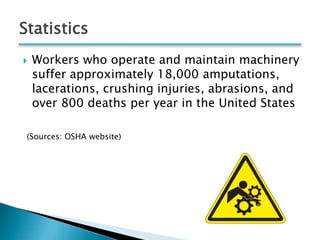
 Workers who operate and maintain machinery
suffer approximately 18,000 amputations,
lacerations, crushing injuries, abrasions, and
over 800 deaths per year in the United States
(Sources: OSHA website)
Statistics – National Safety Council-Injury
Facts - 2016
 The top three leading causes of work-related
injuries:
◦ #1 Overexertion, bodily reaction
◦ #2 Contact with objects/equipment
◦ #3 Falls, slips, trips
9
Statistics – National Safety Council-Injury
Facts – 2016 (continued)
 Contact with objects/equipment
◦ Injury rate: 23.9 per 10,000 full-time workers
◦ Age group most at risk 16 to 24
◦ Industry most at risk: agriculture, construction and
extraction, and transportation and warehousing
◦ Typical days lost: 5
◦ Most frequent type of injury: cuts, lacerations,
punctures
10
Common Machine-related Injuries
 Death
 Crushing wounds
 Cutting and tearing
 Puncture wounds
 Shearing wounds
 Spraining and straining
 PTSD*
11
PTSD – Workers don’t return from injury
 Did you know that many workers who sustain both
minor and major injuries, including compensable
injuries, within weeks or months suffer from
episodes of depression?
 A study, “Incidence of Depression After
Occupational Injury,” conducted by the U.S. Centers
for Disease Control and Prevention (CDC) and
drawing on nearly 367,900 injured and non-injured
workers from a 2005 database, found that the odds
of injured workers being treated for depression
were 45% higher than those of non-injured
workers.
12
Machines are essential
 How do we prevent injuries, amputations, and
even death when working with machinery?
13
Machine Guarding Safety Program
 Compliance with:
◦ 29 CFR 1910 Subpart O (General Industry)
◦ 29 CFR 1926 Subpart I (Construction Industry)
◦ 29 CFR 1928 Subpart D (Agriculture Industry)
 Lockout/Tagout
 Safe Work Practices
 Warnings
 Inspections
 Enforcement
 Training
14
1910.212 – General requirements for all
machines (horizontal standard)
 1910.212(a)(1) Types of guarding. One or more methods of
machine guarding shall be provided to protect the operator
and other employees in the machine area from hazards such
as those created by point of operation, ingoing nip points,
rotating parts, flying chips and sparks. Examples of guarding
methods are-barrier guards, two-hand tripping devices,
electronic safety devices, etc.
 19210.212(a)(2) General requirements for machine guards.
Guards shall be affixed to the machine where possible and
secured elsewhere if for any reason attachment to the
machine is not possible. The guard shall be such that it does
not offer an accident hazard in itself
15
Check Your Knowledge
 Machinery, such as grinders or buffers when
secured to a work bench, the work bench
must be securely anchored to prevent walking
or moving?
 (reference standard interpretations/Interlock requirements for
access door(s) of trash compactor)
16
1926.300 General requirements
 1926.300(b)(1) When power operated tools are designed to
accommodate guards, they shall be equipped with such
guards when in use.
 1926.300(b)(2) Belts, gears, shafts, pulleys, sprockets,
spindles, drums, fly wheels, chains, or other reciprocating,
rotating or moving parts of equipment shall be guarded if
such parts are exposed to contact by employees or otherwise
create a hazard. Guarding shall meet the requirements as set
forth in American National Standards Institute, B15.1-1953
(R1958), Safety Code for Mechanical Power-Transmission
Apparatus.
17
1928.57 – Guarding of farm field equipment,
farmstead equipment, and cotton gins.
 1928.57(a)(1) Purpose. The purpose of this section is to
provide for the protection from the hazards associated with
moving machinery parts of farm field equipment, farmstead
equipment, and cotton gins used in any agricultural
operations.
 1928.57(a)(6)(i) Keep all guards in place when the machine is
in operation;
 1928.57(a)(7) Methods of guarding….
 1928.57(a)(8) Strength and design of guards
18
1928.57 – Guarding of farm field equipment,
farmstead equipment, and cotton gins. (continued)
 1928.57(b) Farm field equipment
 1928.57(b)(2) Other power transmission
components
 1928.57(c) Farmstead equipment
 1928.57(d) Cotton gin equipment
19
Check Your Knowledge
 Per the OSHA Agriculture regulations,
employees operating or servicing all covered
equipment all required to receive operating
instructions at the time of initial assignment?
 (reference 1928.57(a)(6))
20
Check Your Knowledge
 Per the OSHA Agriculture regulations, unless
otherwise specified, each guard and its
support shall be capable of withstanding the
force that a (XXX) pound individual, leaning
against the guard, would exert upon the
guard?
 (reference 1928.57(a)(8)(ii))
21
Check Your Knowledge
 All tractors shall be equipped with an
agricultural tractor master shield on the rear
power take-off with no exceptions?
 (reference 1928.57(b)(1)(i))
22
Types of Guards
 Fixed
 Interlocked
 Adjustable
 Self-adjusting
23
Fixed
 What is the purpose?
◦ Provides a barrier
 Advantages
◦ Suitable for many applications
◦ In-house fabrication
◦ Provides maximum protection
◦ Usually requires minimum maintenance
◦ Suitable for high production, repetitive operations
24
Fixed (continued 1)
 What is the purpose?
◦ Provides a barrier
 Limitations
◦ Interferes with visibility
◦ Limited to specific operations
◦ Machine adjustments and repair often requires its
removal
25
Fixed (continued 2)
 What is the purpose?
◦ Provides a barrier
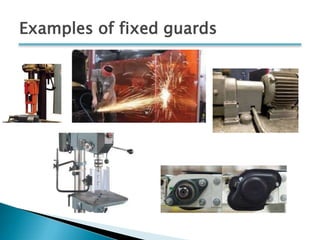
Examples of fixed guards
27
Interlocked
 What is the purpose?
◦ Shuts off or disengages power and prevents
starting of machine when guard is open
 Advantages
◦ Can provide maximum protection
◦ Allows access to machine for making minor
adjustments or removing jams without removal of
fixed guards
28
Interlocked (continued 1)
 What is the purpose?
◦ Shuts off or disengages power and prevents
starting of machine when guard is open
 Limitations
◦ Requires careful adjustment and maintenance
29
Interlocked (continued 2)
 What is the purpose?
◦ Shuts off or disengages power and prevents
starting of machine when guard is open
30
Check Your Knowledge
 Is an interlock required on the side door of a
trash compactor, if the side door is located
55 inches from ground level, and the door is
closed and lathed while the compactor is
cycling
 (reference standard interpretations/Guarding machines on
moveable benches and pedestals)
31
Adjustable
 What is the purpose?
◦ Provides a barrier that may be adjusted to facilitate
a variety of production operations
 Advantages
◦ Can construct to suit many specific operations
◦ Adjustable to allow for varying sizes of material
32
Adjustable (continued 1)
 What is the purpose?
◦ Provides a barrier that may be adjusted to facilitate
a variety of production operations
 Limitations
◦ Hands may enter danger area
◦ May require frequent maintenance and adjustment
◦ The guard may be tampered with by the operator
33
Adjustable (continued 2)
 What is the purpose?
◦ Provides a barrier that may be adjusted to facilitate
a variety of production operations
34
Check Your Knowledge
 Cutting saw blade or abrasive wheels: Is
D’AX wheels considered to be cutting or
abrasive wheels in regards to OSHA guarding
requirements?
 (reference standard interpretations/D’AX wheels are to be
guarded as cutting saws)
35
Self-adjusting
 What is the purpose?
◦ Provides barrier that moves according to size of
material entering the danger zone
 Advantages
◦ Off-the-shelf guards often commercially available
36
Self-adjusting (continued 1)
 What is the purpose?
◦ Provides barrier that moves according to size of
material entering the danger zone
 Limitations
◦ Does not always provide maximum protection
◦ May interfere with visibility
◦ May require frequent maintenance and adjustment
37
Self-adjusting (continued 2)
 What is the purpose?
◦ Provides barrier that moves according to size of
material entering the danger zone
38
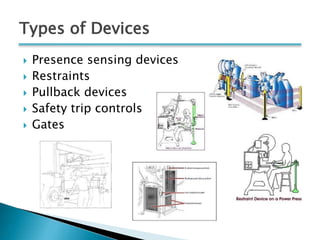
Types of Devices
 Presence sensing devices
 Restraints
 Pullback devices
 Safety trip controls
 Gates
39
Presence Sensing Devices (continued 1)
 What is the purpose?
◦ Disengage the machine when something is detected
in the hazard zone
 Types
◦ Photoelectric
◦ Radiofrequency
◦ Electromagnetic
40
Presence Sensing Devices (continued 2)
 What is the purpose?
◦ Disengage the machine when something is detected
in the hazard zone
 Advantages
◦ All three types can allow free movement for
operator
◦ Simplicity of use
◦ Photo electrics requires no adjustment
 Limitations
◦ Failures of input/output devices resulting in no
detection when something is in the danger zone
41
Presence Sensing Devices (continued 3)
 What is the purpose?
◦ Disengage the machine when something is detected
in the hazard zone
 Limitations
◦ Does not protect against mechanical failure
◦ Limited to equipment that can be stopped
◦ Sensitivity of antennae may be an issue
◦ Contact bar or probe must be properly adjusted for
each application(electro-mechanical)
42
Check Your Knowledge
 Does OSHA have any prohibition on the use
of Presense Sensing Device Initiation (PSDI)
light curtains in regard to: Mechanical Power
Presses, and Hydraulic Welding Presses?
 (reference standard interpretations/The use of Presense
Sensing Device Initiation light curtains in regard to
Mechanical Power Presses, Hydraulic Power Presses and
Hydraulic Welding Presses)
43
Restraint
 What is the purpose?
◦ Prevents the operator from reaching into the danger
area
 Advantages
◦ Little risk of mechanical failure
44
Restraint (continued)
 What is the purpose?
◦ Prevents the operator from reaching into the danger
area
 Limitations
◦ Limits movements of operator
◦ Requires close supervision of operator’s use of
equipment
◦ Requires frequent inspection, maintenance and
adjustments
45
Check Your Knowledge
 Does OSHA have a regulation for machine
guarding specific to the bowling pin setting
machinery?
 (reference standard interpretations/OSHA ARCHIVE regarding
the subject of guarding machinery in bowling centers)
46
Pullback
 What is the purpose?
◦ As the machine cycle, the operator’s hands are
pulled out of the danger zone
 Advantages
◦ Eliminates the needs for guards at the danger zone
47
Pullback (continued)
 What is the purpose?
◦ As the machine cycle, the operator’s hands are
pulled out of the danger zone
 Limitations
◦ Limits movements of operator
48
Safety trip controls
 What is the purpose?
◦ Stops machine when controls tripped
 Types
◦ Pressure sensitive body bar
◦ Safety triprod
◦ Two-hand control
◦ Two-hand trip
49
Safety trip controls (continued 1)
 What is the purpose?
◦ Stops machine when controls tripped
 Advantages
◦ Simplicity in use
◦ Concurrent use of both hands on separated
controls prevent hands from being in danger zone
50
Check Your Knowledge
 Does machine safeguarding requirements
apply to refuse balers, compactors and
garbage trucks?
 (reference standard interpretations/Machine safeguarding
requirements apply to refuse industry balers, compactors,
and garbage trucks)
51
Safety trip controls (continued 2)
 What is the purpose?
◦ Stops machine when controls tripped
 Limitations
◦ Only protects the operator
◦ May require a machine brake
◦ Operator may block one control open
52
Gates
 What is the purpose?
◦ Provided a barrier between danger area and
operator or other personnel
 Advantages
◦ Can prevent reaching into or walking into the
danger zone
53
Gates (continued)
 What is the purpose?
◦ Provided a barrier between danger area and
operator or other personnel
 Limitations
◦ May require frequent inspection and regular
maintenance
◦ May interfere with the operator’s ability to see the
work
54
Guarding by Location and Distance
 Location
◦ Position machines so that the dangerous moving
parts of a machine are not accessible, or do not
present a hazard to the worker during the normal
operation of the machine
 Minimum distance required from floor to danger zone
is 7 feet.
 Distance
◦ D = 63 in/s x Ts
 D is inches from the point of operation
 63 in/s is an assumed hand speed
 Ts is the stopping time of the machine in seconds
55
Check Your Knowledge
 Are barrier chains or fencing surrounding the
working envelope and employer training and
work procedures which prohibit employee
access into the work area be considered
adequate machine guarding?
 (reference standard interpretations/machine guarding and exposure
to hazards from robotic laundry shuttles)
56
Types of Machine Motion
 1 Rotating
◦ List examples of rotating motion at your place of
employment
◦ Identify hazards resulting for rotating motion
 Point of operation, In-running nib points, chips, sparks
◦ Are the examples listed; guarded or unguarded?
 If not Why?
◦ Share examples of how rotating motion are guarded
at your place of employment
◦ Discussion of Requirements for machine guards
57
Discussion on Requirements for
Machine Guarding (rotating)
 Does the current guarding method prevent
contact?
◦ Does the guard openings width meet the
requirement for the distance a guard must be from
a danger line?
 Is the machine guard secure?
 Does the machine guard create no new
Hazards?
58
Discussion on Requirements for
Machine Guarding (rotating continued 1)
 Does the guard protect from falling objects?
 Does the guard create no interference?
 Does the guard allow for safe lubrication?
 Does the guarding method allow for work to
be done?
59
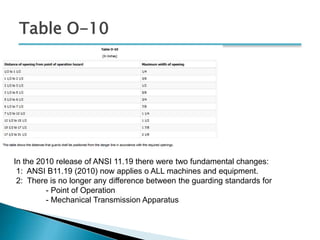
Table O-10
60
In the 2010 release of ANSI 11.19 there were two fundamental changes:
1: ANSI B11.19 (2010) now applies o ALL machines and equipment.
2: There is no longer any difference between the guarding standards for
- Point of Operation
- Mechanical Transmission Apparatus
Types of Machine Motion (tranverse)
 2 Transverse Motions
◦ List examples of transverse motion at your place of
employment
◦ Identify hazards resulting for tranverse motion
◦ Are the examples listed; guarded or unguarded?
 If not Why?
◦ Share examples of how transverse motion are
guarded at your place of employment
◦ Share concerns/issues with current guarding
methods
61
Discussion on Requirements for
Machine Guarding (tranverse)
 Does the current guarding method prevent
contact?
◦ Does the guard openings width meet the
requirement for the distance a guard must be from
a danger line?
 Is the machine guard secure?
 Does the machine guard create no new
Hazards?
 Does the guard protect from falling objects?
 Does the guard create no interference?
 Does the guard allow for safe lubrication?
62
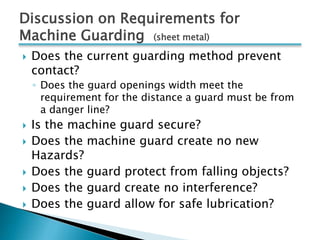
Types of Machine Motion (cutting)
 3 Cutting Action
◦ List examples of cutting action at your place of
employment
◦ Identify hazards resulting for cutting action
◦ Are the examples listed; guarded or unguarded?
 If not Why?
◦ Share examples of how cutting actions are guarded
at your place of employment
◦ Share concerns/issues with current guarding
methods
63
Discussion on Requirements for
Machine Guarding (cutting)
 Does the current guarding method prevent
contact?
◦ Does the guard openings width meet the
requirement for the distance a guard must be from
a danger line?
 Is the machine guard secure?
 Does the machine guard create no new
Hazards?
 Does the guard protect from falling objects?
 Does the guard create no interference?
 Does the guard allow for safe lubrication?
64
Types of Machine Motion (sheet metal)
 4 Punching, Shearing, and Bending
◦ List examples of punching, shearing and bending at
your place of employment
◦ Identify hazards resulting for punching, shearing
and bending
◦ Are the examples listed; guarded or unguarded?
 If not Why?
◦ Share examples of how cutting actions are guarded
at your place of employment
◦ Share concerns/issues with current guarding
methods
65
Discussion on Requirements for
Machine Guarding (sheet metal)
 Does the current guarding method prevent
contact?
◦ Does the guard openings width meet the
requirement for the distance a guard must be from
a danger line?
 Is the machine guard secure?
 Does the machine guard create no new
Hazards?
 Does the guard protect from falling objects?
 Does the guard create no interference?
 Does the guard allow for safe lubrication?
66
Robots in the Workplace
 What are industrial robots?
◦ Programmable multifunctional mechanical devices
◦ Designed to move:
 Material
 Parts
 Tools
 Specialized devices
 An industrial robot system
◦ Includes an industrial robot
◦ devices and/or sensors
◦ Sequencing or monitoring communication devices
67
Robots in the Workplace (continue)
 Why robots?
◦ Used to perform work that is unsafe, hazardous for
humans
◦ Highly repetitive and unpleasant tasks
 Features of robots
◦ Small to large lifting capacity
◦ High speed
◦ High torque
◦ Six-axis articulation
◦ High payload positioning accuracy
68
Types and Classification of Robots
69
Source: OSHA web site
Accidents related to Robots
 Studies in Sweden and Japan indicates that many
robot accidents do not occur under normal
operating conditions but, instead during:
◦ Programming
◦ Program refinement
◦ Maintenance and repair
◦ Testing
◦ Setup and adjustment
 All these operations may require personnel to be
temporarily within the robot’s working envelope
70
Typical accidents related to robots
 A robot’s arm functioned erratically during
programming sequence and struck operator
 A materials handling robot operator entered a
robot’s work envelope during operations and
was pinned between the back end of the
robot and safety pole
 A fellow employee accidentally tripped the
power switch while a maintenance worker was
servicing an assembly door. The robot’s arm
struck the maintenance worker’s hand
71
Sources of hazards
 Moving mechanical components causing:
◦ Trapping
◦ Crushing
◦ Death
 Stored energy
◦ electrical,
◦ Hydraulic
◦ Pneumatic
◦ Gravity
 NOTE: unexpected release of stored energy can result
in sudden drop of payload, axis arms, etc.
72
Sources of hazards (continued1)
 Hazardous atmospheres,
explosive/combustible materials, high or low
temperatures
◦ The use of industrial robots to eliminate safety
concerns to employees, does not eliminate the
safety concerns for those doing maintenance or
programming of the robots
 Inadvertent operation caused by equipment
failure
 Actions by personnel, either unintended or
deliberate
73
Eliminating the hazards
 Barrier guards, fixed and interlocked
 Safety light curtains/screens
 Area scanning safeguarding devices
 Radio frequency/capacitance safeguarding
devices
 Safety mat systems
 Single and multiple beam safety systems
 Two hand control systems
74
Questions

Machine Guarding.pptx

  • 1.
  • 2.
    Disclaimer This material wasproduced under grant number SH-05029-SH8 from the Occupational Safety and Health Administration, U.S. Department of Labor. It does not necessarily reflect the views or policies of the U.S. Department of Labor, nor does mention of trade names, commercial products, or organizations imply endorsement by the U.S. Government..
  • 3.
    3  With theOccupational Safety and Health Act of 1970, Congress created the Occupational Safety and Health Administration (OSHA) to assure safe and healthful working conditions for working men and women by setting and enforcing standards, providing training, outreach, education and assistance. Additional information can be found on the OSHA Website at https://www.osha.gov/ OSHA’s Mission
  • 4.
    OSHA’s Whistleblower Protection Program This program enforces the whistleblower provisions of more than 20 whistleblower statutes protecting employees who report various workplace violations. In general, the whistleblower anti-retaliation provision provide that employers may not discharge or otherwise retaliate against an employee because the employee has filed a complaint or exercised any rights provided to employees. More information can be found on the Whistleblowers Website at https://www.whistleblowers.gov/ 4
  • 5.
    Agenda  Accidents Relatedto Unguarded Equipment  Elements of a Machine Guarding Program  OSHA Regulations for Machine Guarding  Types of Guards and Devices  Guarding by Location and Distance  Robots in the Workplace  Hazards of Unguarded Machines  Requirements for Guarding  Workshop discussion for practical application of various type of guards and devices 5
  • 6.
    OSHA Data –Accident Search Results (Keyword: machine guarding)  Event Date: 01/26/2018 – Employee is killed by tire recycling shredder  Event Date: 01/25/2018 – Employee dies after being caught in auger  Event Date: 11/17/2017 – Employee amputates three fingertips clearing jammed vacuum sealer  Event Date: 11/16/2017 – Employee catches gloved hand on a rotating shaft and suffered a compound fracture to his left wrist 6
  • 7.
    OSHA Data –Accident Search Results (Keyword: machine guarding) (continued)  Event Date: 11/07/2017 – Employee fractures skull while operating a CNC machine  Event Date: 11/06/2017 – Employee’s right ring finger is amputated by hydraulic press  Event Date: 11/03/2017 – Employee is troubleshooting equipment and amputated the tip of middle finger and broke his ring finger  Event Date: Employee catches finger between chain and sprocket and amputates his right hand index finger 7
  • 8.
    Statistics  Workers whooperate and maintain machinery suffer approximately 18,000 amputations, lacerations, crushing injuries, abrasions, and over 800 deaths per year in the United States (Sources: OSHA website)
  • 9.
    Statistics – NationalSafety Council-Injury Facts - 2016  The top three leading causes of work-related injuries: ◦ #1 Overexertion, bodily reaction ◦ #2 Contact with objects/equipment ◦ #3 Falls, slips, trips 9
  • 10.
    Statistics – NationalSafety Council-Injury Facts – 2016 (continued)  Contact with objects/equipment ◦ Injury rate: 23.9 per 10,000 full-time workers ◦ Age group most at risk 16 to 24 ◦ Industry most at risk: agriculture, construction and extraction, and transportation and warehousing ◦ Typical days lost: 5 ◦ Most frequent type of injury: cuts, lacerations, punctures 10
  • 11.
    Common Machine-related Injuries Death  Crushing wounds  Cutting and tearing  Puncture wounds  Shearing wounds  Spraining and straining  PTSD* 11
  • 12.
    PTSD – Workersdon’t return from injury  Did you know that many workers who sustain both minor and major injuries, including compensable injuries, within weeks or months suffer from episodes of depression?  A study, “Incidence of Depression After Occupational Injury,” conducted by the U.S. Centers for Disease Control and Prevention (CDC) and drawing on nearly 367,900 injured and non-injured workers from a 2005 database, found that the odds of injured workers being treated for depression were 45% higher than those of non-injured workers. 12
  • 13.
    Machines are essential How do we prevent injuries, amputations, and even death when working with machinery? 13
  • 14.
    Machine Guarding SafetyProgram  Compliance with: ◦ 29 CFR 1910 Subpart O (General Industry) ◦ 29 CFR 1926 Subpart I (Construction Industry) ◦ 29 CFR 1928 Subpart D (Agriculture Industry)  Lockout/Tagout  Safe Work Practices  Warnings  Inspections  Enforcement  Training 14
  • 15.
    1910.212 – Generalrequirements for all machines (horizontal standard)  1910.212(a)(1) Types of guarding. One or more methods of machine guarding shall be provided to protect the operator and other employees in the machine area from hazards such as those created by point of operation, ingoing nip points, rotating parts, flying chips and sparks. Examples of guarding methods are-barrier guards, two-hand tripping devices, electronic safety devices, etc.  19210.212(a)(2) General requirements for machine guards. Guards shall be affixed to the machine where possible and secured elsewhere if for any reason attachment to the machine is not possible. The guard shall be such that it does not offer an accident hazard in itself 15
  • 16.
    Check Your Knowledge Machinery, such as grinders or buffers when secured to a work bench, the work bench must be securely anchored to prevent walking or moving?  (reference standard interpretations/Interlock requirements for access door(s) of trash compactor) 16
  • 17.
    1926.300 General requirements 1926.300(b)(1) When power operated tools are designed to accommodate guards, they shall be equipped with such guards when in use.  1926.300(b)(2) Belts, gears, shafts, pulleys, sprockets, spindles, drums, fly wheels, chains, or other reciprocating, rotating or moving parts of equipment shall be guarded if such parts are exposed to contact by employees or otherwise create a hazard. Guarding shall meet the requirements as set forth in American National Standards Institute, B15.1-1953 (R1958), Safety Code for Mechanical Power-Transmission Apparatus. 17
  • 18.
    1928.57 – Guardingof farm field equipment, farmstead equipment, and cotton gins.  1928.57(a)(1) Purpose. The purpose of this section is to provide for the protection from the hazards associated with moving machinery parts of farm field equipment, farmstead equipment, and cotton gins used in any agricultural operations.  1928.57(a)(6)(i) Keep all guards in place when the machine is in operation;  1928.57(a)(7) Methods of guarding….  1928.57(a)(8) Strength and design of guards 18
  • 19.
    1928.57 – Guardingof farm field equipment, farmstead equipment, and cotton gins. (continued)  1928.57(b) Farm field equipment  1928.57(b)(2) Other power transmission components  1928.57(c) Farmstead equipment  1928.57(d) Cotton gin equipment 19
  • 20.
    Check Your Knowledge Per the OSHA Agriculture regulations, employees operating or servicing all covered equipment all required to receive operating instructions at the time of initial assignment?  (reference 1928.57(a)(6)) 20
  • 21.
    Check Your Knowledge Per the OSHA Agriculture regulations, unless otherwise specified, each guard and its support shall be capable of withstanding the force that a (XXX) pound individual, leaning against the guard, would exert upon the guard?  (reference 1928.57(a)(8)(ii)) 21
  • 22.
    Check Your Knowledge All tractors shall be equipped with an agricultural tractor master shield on the rear power take-off with no exceptions?  (reference 1928.57(b)(1)(i)) 22
  • 23.
    Types of Guards Fixed  Interlocked  Adjustable  Self-adjusting 23
  • 24.
    Fixed  What isthe purpose? ◦ Provides a barrier  Advantages ◦ Suitable for many applications ◦ In-house fabrication ◦ Provides maximum protection ◦ Usually requires minimum maintenance ◦ Suitable for high production, repetitive operations 24
  • 25.
    Fixed (continued 1) What is the purpose? ◦ Provides a barrier  Limitations ◦ Interferes with visibility ◦ Limited to specific operations ◦ Machine adjustments and repair often requires its removal 25
  • 26.
    Fixed (continued 2) What is the purpose? ◦ Provides a barrier
  • 27.
  • 28.
    Interlocked  What isthe purpose? ◦ Shuts off or disengages power and prevents starting of machine when guard is open  Advantages ◦ Can provide maximum protection ◦ Allows access to machine for making minor adjustments or removing jams without removal of fixed guards 28
  • 29.
    Interlocked (continued 1) What is the purpose? ◦ Shuts off or disengages power and prevents starting of machine when guard is open  Limitations ◦ Requires careful adjustment and maintenance 29
  • 30.
    Interlocked (continued 2) What is the purpose? ◦ Shuts off or disengages power and prevents starting of machine when guard is open 30
  • 31.
    Check Your Knowledge Is an interlock required on the side door of a trash compactor, if the side door is located 55 inches from ground level, and the door is closed and lathed while the compactor is cycling  (reference standard interpretations/Guarding machines on moveable benches and pedestals) 31
  • 32.
    Adjustable  What isthe purpose? ◦ Provides a barrier that may be adjusted to facilitate a variety of production operations  Advantages ◦ Can construct to suit many specific operations ◦ Adjustable to allow for varying sizes of material 32
  • 33.
    Adjustable (continued 1) What is the purpose? ◦ Provides a barrier that may be adjusted to facilitate a variety of production operations  Limitations ◦ Hands may enter danger area ◦ May require frequent maintenance and adjustment ◦ The guard may be tampered with by the operator 33
  • 34.
    Adjustable (continued 2) What is the purpose? ◦ Provides a barrier that may be adjusted to facilitate a variety of production operations 34
  • 35.
    Check Your Knowledge Cutting saw blade or abrasive wheels: Is D’AX wheels considered to be cutting or abrasive wheels in regards to OSHA guarding requirements?  (reference standard interpretations/D’AX wheels are to be guarded as cutting saws) 35
  • 36.
    Self-adjusting  What isthe purpose? ◦ Provides barrier that moves according to size of material entering the danger zone  Advantages ◦ Off-the-shelf guards often commercially available 36
  • 37.
    Self-adjusting (continued 1) What is the purpose? ◦ Provides barrier that moves according to size of material entering the danger zone  Limitations ◦ Does not always provide maximum protection ◦ May interfere with visibility ◦ May require frequent maintenance and adjustment 37
  • 38.
    Self-adjusting (continued 2) What is the purpose? ◦ Provides barrier that moves according to size of material entering the danger zone 38
  • 39.
    Types of Devices Presence sensing devices  Restraints  Pullback devices  Safety trip controls  Gates 39
  • 40.
    Presence Sensing Devices(continued 1)  What is the purpose? ◦ Disengage the machine when something is detected in the hazard zone  Types ◦ Photoelectric ◦ Radiofrequency ◦ Electromagnetic 40
  • 41.
    Presence Sensing Devices(continued 2)  What is the purpose? ◦ Disengage the machine when something is detected in the hazard zone  Advantages ◦ All three types can allow free movement for operator ◦ Simplicity of use ◦ Photo electrics requires no adjustment  Limitations ◦ Failures of input/output devices resulting in no detection when something is in the danger zone 41
  • 42.
    Presence Sensing Devices(continued 3)  What is the purpose? ◦ Disengage the machine when something is detected in the hazard zone  Limitations ◦ Does not protect against mechanical failure ◦ Limited to equipment that can be stopped ◦ Sensitivity of antennae may be an issue ◦ Contact bar or probe must be properly adjusted for each application(electro-mechanical) 42
  • 43.
    Check Your Knowledge Does OSHA have any prohibition on the use of Presense Sensing Device Initiation (PSDI) light curtains in regard to: Mechanical Power Presses, and Hydraulic Welding Presses?  (reference standard interpretations/The use of Presense Sensing Device Initiation light curtains in regard to Mechanical Power Presses, Hydraulic Power Presses and Hydraulic Welding Presses) 43
  • 44.
    Restraint  What isthe purpose? ◦ Prevents the operator from reaching into the danger area  Advantages ◦ Little risk of mechanical failure 44
  • 45.
    Restraint (continued)  Whatis the purpose? ◦ Prevents the operator from reaching into the danger area  Limitations ◦ Limits movements of operator ◦ Requires close supervision of operator’s use of equipment ◦ Requires frequent inspection, maintenance and adjustments 45
  • 46.
    Check Your Knowledge Does OSHA have a regulation for machine guarding specific to the bowling pin setting machinery?  (reference standard interpretations/OSHA ARCHIVE regarding the subject of guarding machinery in bowling centers) 46
  • 47.
    Pullback  What isthe purpose? ◦ As the machine cycle, the operator’s hands are pulled out of the danger zone  Advantages ◦ Eliminates the needs for guards at the danger zone 47
  • 48.
    Pullback (continued)  Whatis the purpose? ◦ As the machine cycle, the operator’s hands are pulled out of the danger zone  Limitations ◦ Limits movements of operator 48
  • 49.
    Safety trip controls What is the purpose? ◦ Stops machine when controls tripped  Types ◦ Pressure sensitive body bar ◦ Safety triprod ◦ Two-hand control ◦ Two-hand trip 49
  • 50.
    Safety trip controls(continued 1)  What is the purpose? ◦ Stops machine when controls tripped  Advantages ◦ Simplicity in use ◦ Concurrent use of both hands on separated controls prevent hands from being in danger zone 50
  • 51.
    Check Your Knowledge Does machine safeguarding requirements apply to refuse balers, compactors and garbage trucks?  (reference standard interpretations/Machine safeguarding requirements apply to refuse industry balers, compactors, and garbage trucks) 51
  • 52.
    Safety trip controls(continued 2)  What is the purpose? ◦ Stops machine when controls tripped  Limitations ◦ Only protects the operator ◦ May require a machine brake ◦ Operator may block one control open 52
  • 53.
    Gates  What isthe purpose? ◦ Provided a barrier between danger area and operator or other personnel  Advantages ◦ Can prevent reaching into or walking into the danger zone 53
  • 54.
    Gates (continued)  Whatis the purpose? ◦ Provided a barrier between danger area and operator or other personnel  Limitations ◦ May require frequent inspection and regular maintenance ◦ May interfere with the operator’s ability to see the work 54
  • 55.
    Guarding by Locationand Distance  Location ◦ Position machines so that the dangerous moving parts of a machine are not accessible, or do not present a hazard to the worker during the normal operation of the machine  Minimum distance required from floor to danger zone is 7 feet.  Distance ◦ D = 63 in/s x Ts  D is inches from the point of operation  63 in/s is an assumed hand speed  Ts is the stopping time of the machine in seconds 55
  • 56.
    Check Your Knowledge Are barrier chains or fencing surrounding the working envelope and employer training and work procedures which prohibit employee access into the work area be considered adequate machine guarding?  (reference standard interpretations/machine guarding and exposure to hazards from robotic laundry shuttles) 56
  • 57.
    Types of MachineMotion  1 Rotating ◦ List examples of rotating motion at your place of employment ◦ Identify hazards resulting for rotating motion  Point of operation, In-running nib points, chips, sparks ◦ Are the examples listed; guarded or unguarded?  If not Why? ◦ Share examples of how rotating motion are guarded at your place of employment ◦ Discussion of Requirements for machine guards 57
  • 58.
    Discussion on Requirementsfor Machine Guarding (rotating)  Does the current guarding method prevent contact? ◦ Does the guard openings width meet the requirement for the distance a guard must be from a danger line?  Is the machine guard secure?  Does the machine guard create no new Hazards? 58
  • 59.
    Discussion on Requirementsfor Machine Guarding (rotating continued 1)  Does the guard protect from falling objects?  Does the guard create no interference?  Does the guard allow for safe lubrication?  Does the guarding method allow for work to be done? 59
  • 60.
    Table O-10 60 In the2010 release of ANSI 11.19 there were two fundamental changes: 1: ANSI B11.19 (2010) now applies o ALL machines and equipment. 2: There is no longer any difference between the guarding standards for - Point of Operation - Mechanical Transmission Apparatus
  • 61.
    Types of MachineMotion (tranverse)  2 Transverse Motions ◦ List examples of transverse motion at your place of employment ◦ Identify hazards resulting for tranverse motion ◦ Are the examples listed; guarded or unguarded?  If not Why? ◦ Share examples of how transverse motion are guarded at your place of employment ◦ Share concerns/issues with current guarding methods 61
  • 62.
    Discussion on Requirementsfor Machine Guarding (tranverse)  Does the current guarding method prevent contact? ◦ Does the guard openings width meet the requirement for the distance a guard must be from a danger line?  Is the machine guard secure?  Does the machine guard create no new Hazards?  Does the guard protect from falling objects?  Does the guard create no interference?  Does the guard allow for safe lubrication? 62
  • 63.
    Types of MachineMotion (cutting)  3 Cutting Action ◦ List examples of cutting action at your place of employment ◦ Identify hazards resulting for cutting action ◦ Are the examples listed; guarded or unguarded?  If not Why? ◦ Share examples of how cutting actions are guarded at your place of employment ◦ Share concerns/issues with current guarding methods 63
  • 64.
    Discussion on Requirementsfor Machine Guarding (cutting)  Does the current guarding method prevent contact? ◦ Does the guard openings width meet the requirement for the distance a guard must be from a danger line?  Is the machine guard secure?  Does the machine guard create no new Hazards?  Does the guard protect from falling objects?  Does the guard create no interference?  Does the guard allow for safe lubrication? 64
  • 65.
    Types of MachineMotion (sheet metal)  4 Punching, Shearing, and Bending ◦ List examples of punching, shearing and bending at your place of employment ◦ Identify hazards resulting for punching, shearing and bending ◦ Are the examples listed; guarded or unguarded?  If not Why? ◦ Share examples of how cutting actions are guarded at your place of employment ◦ Share concerns/issues with current guarding methods 65
  • 66.
    Discussion on Requirementsfor Machine Guarding (sheet metal)  Does the current guarding method prevent contact? ◦ Does the guard openings width meet the requirement for the distance a guard must be from a danger line?  Is the machine guard secure?  Does the machine guard create no new Hazards?  Does the guard protect from falling objects?  Does the guard create no interference?  Does the guard allow for safe lubrication? 66
  • 67.
    Robots in theWorkplace  What are industrial robots? ◦ Programmable multifunctional mechanical devices ◦ Designed to move:  Material  Parts  Tools  Specialized devices  An industrial robot system ◦ Includes an industrial robot ◦ devices and/or sensors ◦ Sequencing or monitoring communication devices 67
  • 68.
    Robots in theWorkplace (continue)  Why robots? ◦ Used to perform work that is unsafe, hazardous for humans ◦ Highly repetitive and unpleasant tasks  Features of robots ◦ Small to large lifting capacity ◦ High speed ◦ High torque ◦ Six-axis articulation ◦ High payload positioning accuracy 68
  • 69.
    Types and Classificationof Robots 69 Source: OSHA web site
  • 70.
    Accidents related toRobots  Studies in Sweden and Japan indicates that many robot accidents do not occur under normal operating conditions but, instead during: ◦ Programming ◦ Program refinement ◦ Maintenance and repair ◦ Testing ◦ Setup and adjustment  All these operations may require personnel to be temporarily within the robot’s working envelope 70
  • 71.
    Typical accidents relatedto robots  A robot’s arm functioned erratically during programming sequence and struck operator  A materials handling robot operator entered a robot’s work envelope during operations and was pinned between the back end of the robot and safety pole  A fellow employee accidentally tripped the power switch while a maintenance worker was servicing an assembly door. The robot’s arm struck the maintenance worker’s hand 71
  • 72.
    Sources of hazards Moving mechanical components causing: ◦ Trapping ◦ Crushing ◦ Death  Stored energy ◦ electrical, ◦ Hydraulic ◦ Pneumatic ◦ Gravity  NOTE: unexpected release of stored energy can result in sudden drop of payload, axis arms, etc. 72
  • 73.
    Sources of hazards(continued1)  Hazardous atmospheres, explosive/combustible materials, high or low temperatures ◦ The use of industrial robots to eliminate safety concerns to employees, does not eliminate the safety concerns for those doing maintenance or programming of the robots  Inadvertent operation caused by equipment failure  Actions by personnel, either unintended or deliberate 73
  • 74.
    Eliminating the hazards Barrier guards, fixed and interlocked  Safety light curtains/screens  Area scanning safeguarding devices  Radio frequency/capacitance safeguarding devices  Safety mat systems  Single and multiple beam safety systems  Two hand control systems 74
  • 75.

Editor's Notes

  • #16 There are two type of standards: Horizontal and Vertical Standard. Horizontal standards are standards that apply across the many different types of industries. Vertical standards are standards that apply to specific industries, such as: wood working, hydraulic presses, etc.. In General Industry 1910, standard 1910.212(a)(1) and 1910.212(a)(2) are board in nature and encompasses all industries that fall under the 1910 standard. In summary if any part of your body can come into contact with a moving part and/or you can be exposed to flying debris, there must be a guard to protect the workers.