Ladder Safety
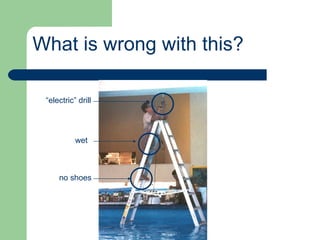
What is wrong with this? “ electric” drill wet no shoes
Overview Background Types Selection Climbing/Working Guidelines Inspection Safety carry Storage Examples Quiz
Background 1 Death/ Day  -Ladder Fall  (Http://www.signweb.com) 65,000 Injuries/Year   ( Http://www.signweb.com )
Regulations Cal OSHA Title 8, Subchapter 7, Group 1, Article 4 Section 3276 Use of Ladders Section 3277 Fixed Ladders Section 3278 Portable Wood Ladders Section 3279 Portable Metal Ladders Section 3280 Portable Reinforced Plastic Ladders Source:  http://www.dir.ca.gov/title8/sb7g1a4.html
Types of Ladders (1) Fixed ladders
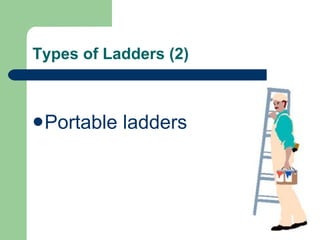
Types of Ladders (2) Portable ladders
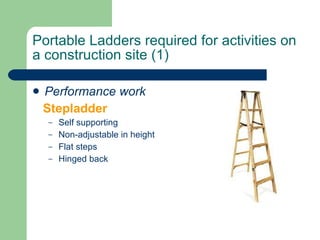
Portable Ladders required for activities on a construction site (1) Performance work Stepladder Self supporting  Non-adjustable in height Flat steps Hinged back
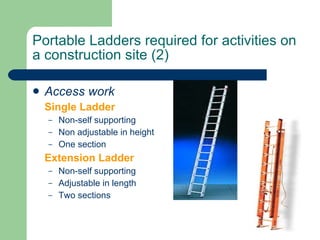
Portable Ladders required for activities on a construction site (2) Access work Single Ladder Non-self supporting Non adjustable in height One section Extension Ladder Non-self supporting Adjustable in length Two sections
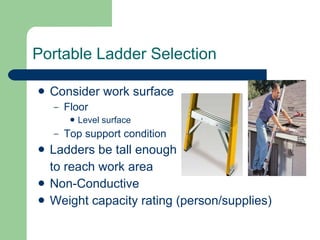
Portable Ladder Selection Consider work surface Floor  Level surface Top support condition Ladders be tall enough  to reach work area Non-Conductive  Weight capacity rating (person/supplies)
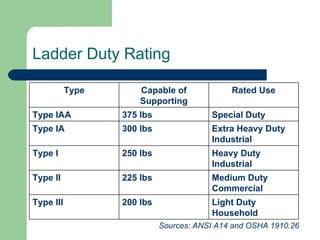
Ladder Duty Rating   Sources: ANSI A14 and OSHA 1910.26 Type Capable of Supporting Rated Use Type IAA 375 lbs Special Duty Type IA 300 lbs Extra Heavy Duty Industrial Type I 250 lbs Heavy Duty Industrial Type II 225 lbs Medium Duty Commercial Type III 200 lbs Light Duty Household
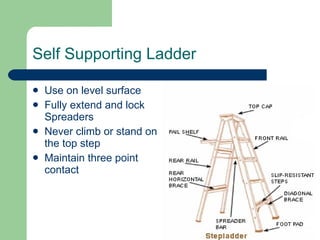
Self Supporting Ladder Use on level surface Fully extend and lock Spreaders Never climb or stand on the top step Maintain three point contact
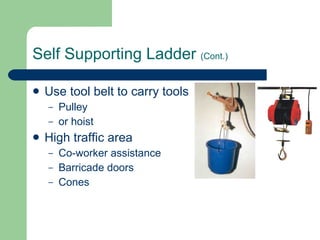
Self Supporting Ladder  (Cont.) Use tool belt to carry tools Pulley  or hoist High traffic area Co-worker assistance Barricade doors Cones
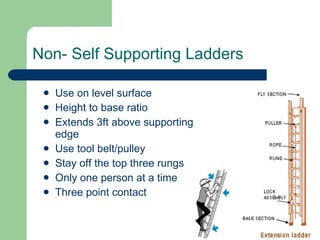
Non- Self Supporting Ladders Use on level surface Height to base ratio Extends 3ft above supporting edge Use tool belt/pulley Stay off the top three rungs Only one person at a time Three point contact
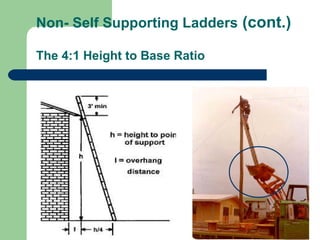
  Non- Self Supporting Ladders  (cont.)    The 4:1 Height to Base Ratio
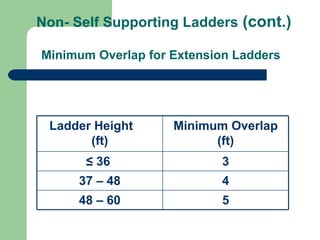
  Non- Self Supporting Ladders  (cont.)    Minimum Overlap for Extension Ladders Ladder Height  (ft) Minimum Overlap (ft) ≤  36  3 37 – 48 4 48 – 60 5
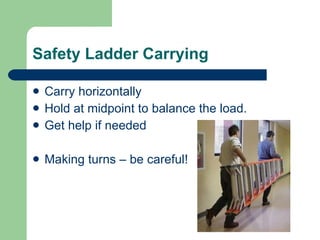
Safety Ladder Carrying Carry horizontally Hold at midpoint to balance the load. Get help if needed  Making turns – be careful!
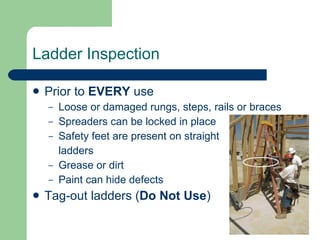
Ladder Inspection Prior to  EVERY  use Loose or damaged rungs, steps, rails or braces Spreaders can be locked in place Safety feet are present on straight  ladders Grease or dirt Paint can hide defects Tag-out ladders ( Do Not Use )
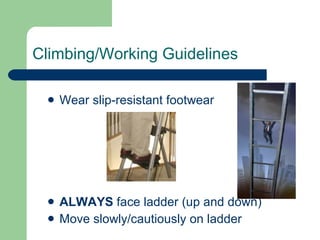
Climbing/Working Guidelines Wear slip-resistant footwear ALWAYS  face ladder (up and down) Move slowly/cautiously on ladder
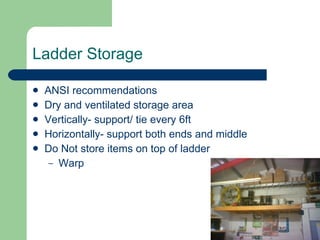
Ladder Storage ANSI recommendations Dry and ventilated storage area Vertically- support/ tie every 6ft Horizontally- support both ends and middle Do Not store items on top of ladder Warp
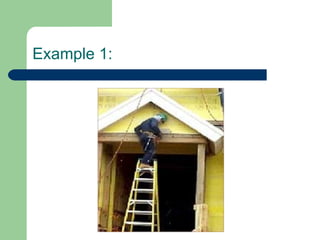
Example 1:
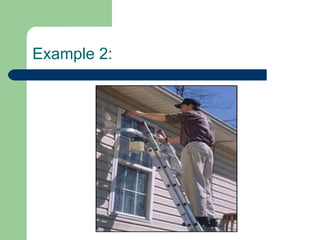
Example 2:
Example 3:
WATCH YOUR STEP
Contacts David Wei, Safety Specialist 310-206-4189;  [email_address]

Ladder Safety- Safety First!

  • 1.
  • 2.
    What is wrongwith this? “ electric” drill wet no shoes
  • 3.
    Overview Background TypesSelection Climbing/Working Guidelines Inspection Safety carry Storage Examples Quiz
  • 4.
    Background 1 Death/Day -Ladder Fall (Http://www.signweb.com) 65,000 Injuries/Year ( Http://www.signweb.com )
  • 5.
    Regulations Cal OSHATitle 8, Subchapter 7, Group 1, Article 4 Section 3276 Use of Ladders Section 3277 Fixed Ladders Section 3278 Portable Wood Ladders Section 3279 Portable Metal Ladders Section 3280 Portable Reinforced Plastic Ladders Source: http://www.dir.ca.gov/title8/sb7g1a4.html
  • 6.
    Types of Ladders(1) Fixed ladders
  • 7.
    Types of Ladders(2) Portable ladders
  • 8.
    Portable Ladders requiredfor activities on a construction site (1) Performance work Stepladder Self supporting Non-adjustable in height Flat steps Hinged back
  • 9.
    Portable Ladders requiredfor activities on a construction site (2) Access work Single Ladder Non-self supporting Non adjustable in height One section Extension Ladder Non-self supporting Adjustable in length Two sections
  • 10.
    Portable Ladder SelectionConsider work surface Floor Level surface Top support condition Ladders be tall enough to reach work area Non-Conductive Weight capacity rating (person/supplies)
  • 11.
    Ladder Duty Rating Sources: ANSI A14 and OSHA 1910.26 Type Capable of Supporting Rated Use Type IAA 375 lbs Special Duty Type IA 300 lbs Extra Heavy Duty Industrial Type I 250 lbs Heavy Duty Industrial Type II 225 lbs Medium Duty Commercial Type III 200 lbs Light Duty Household
  • 12.
    Self Supporting LadderUse on level surface Fully extend and lock Spreaders Never climb or stand on the top step Maintain three point contact
  • 13.
    Self Supporting Ladder (Cont.) Use tool belt to carry tools Pulley or hoist High traffic area Co-worker assistance Barricade doors Cones
  • 14.
    Non- Self SupportingLadders Use on level surface Height to base ratio Extends 3ft above supporting edge Use tool belt/pulley Stay off the top three rungs Only one person at a time Three point contact
  • 15.
    Non-Self Supporting Ladders (cont.) The 4:1 Height to Base Ratio
  • 16.
    Non-Self Supporting Ladders (cont.) Minimum Overlap for Extension Ladders Ladder Height (ft) Minimum Overlap (ft) ≤ 36 3 37 – 48 4 48 – 60 5
  • 17.
    Safety Ladder CarryingCarry horizontally Hold at midpoint to balance the load. Get help if needed Making turns – be careful!
  • 18.
    Ladder Inspection Priorto EVERY use Loose or damaged rungs, steps, rails or braces Spreaders can be locked in place Safety feet are present on straight ladders Grease or dirt Paint can hide defects Tag-out ladders ( Do Not Use )
  • 19.
    Climbing/Working Guidelines Wearslip-resistant footwear ALWAYS face ladder (up and down) Move slowly/cautiously on ladder
  • 20.
    Ladder Storage ANSIrecommendations Dry and ventilated storage area Vertically- support/ tie every 6ft Horizontally- support both ends and middle Do Not store items on top of ladder Warp
  • 21.
  • 22.
  • 23.
  • 24.
  • 25.
    Contacts David Wei,Safety Specialist 310-206-4189; [email_address]

Editor's Notes

  • #7 Cal OSHA: “A fixed ladder is a ladder permanently attached to a structure, building, or equipment. “
  • #9 Performance work = need to reach out or move frequently
  • #10 Access work: use ladders to reach upper working levels
  • #11 Top support condition = condition of the building or edge of the roof.
  • #16 Non-self supporting ladders must be placed at a proper angle. The foot/base of the ladder should stand 1 foot out from the wall for every 4 ft up.
  • #18 Ladder will take a corner before you do.