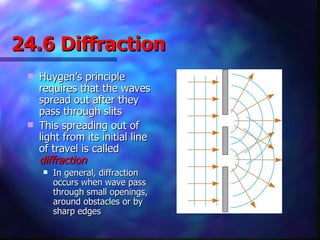
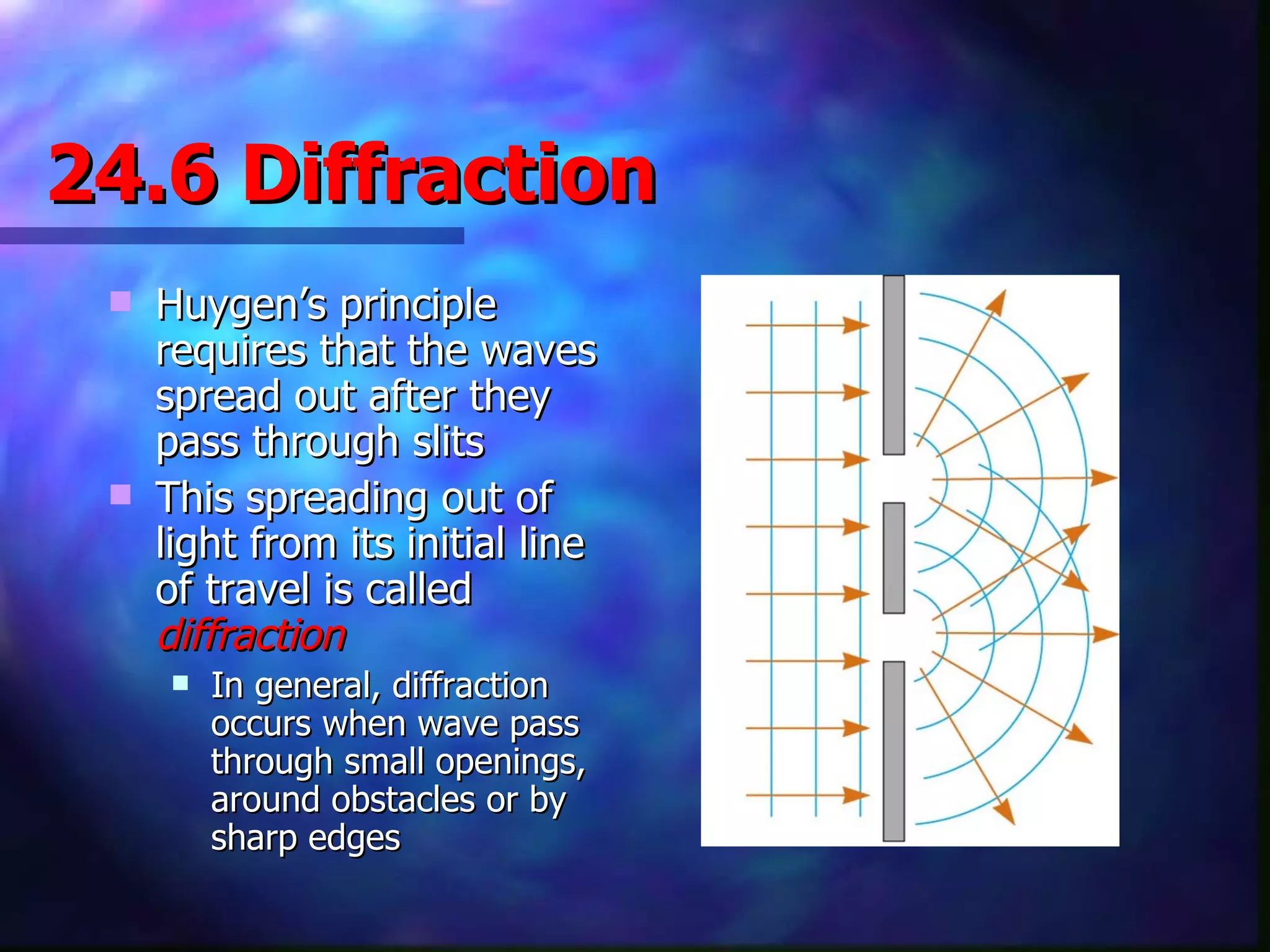
24.6 Diffraction Huygen’s principle requires that the waves spread out after they pass through slits This spreading out of light from its initial line of travel is called  diffraction In general, diffraction occurs when wave pass through small openings, around obstacles or by sharp edges
Diffraction, 2 A single slit placed between a distant light source and a screen produces a diffraction pattern It will have a broad, intense central band The central band will be flanked by a series of narrower, less intense secondary bands Called secondary maxima The central band will also be flanked by a series of dark bands Called minima
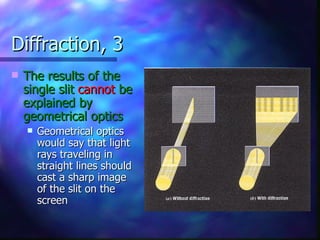
Diffraction, 3 The results of the single slit   cannot  be explained by geometrical optics Geometrical optics would say that light rays traveling in straight lines should cast a sharp image of the slit on the screen
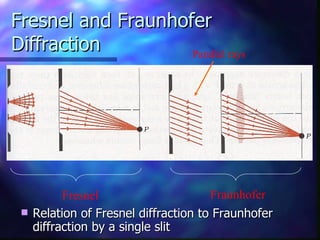
Fresnel and Fraunhofer Diffraction Relation of Fresnel diffraction to Fraunhofer diffraction by a single slit   Fresnel   Fraunhofer Parallel rays
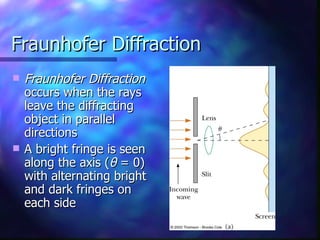
Fraunhofer Diffraction Fraunhofer Diffraction  occurs when the rays leave the diffracting object in parallel directions A bright fringe is seen along the axis ( θ  = 0) with alternating bright and dark fringes on each side
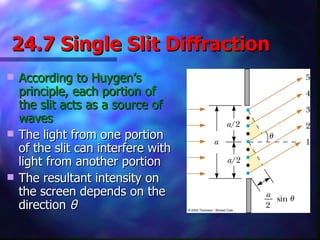
24.7 Single Slit Diffraction According to Huygen’s principle, each portion of the slit acts as a source of waves The light from one portion of the slit can interfere with light from another portion The resultant intensity on the screen depends on the direction  θ
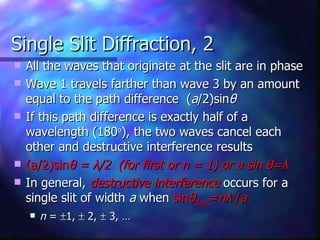
Single Slit Diffraction, 2 All the waves that originate at the slit are in phase Wave 1 travels farther than wave 3 by an amount equal to the path difference  ( a /2)sin θ   If this path difference is exactly half of a wavelength (180 o ), the two waves cancel each other and destructive interference results (a/2)sin θ =   λ/2  (for first or n = 1) or a sin θ=λ In general,  destructive interference  occurs for a single slit of width  a  when  sin θ dark = nλ  / a n  =   1,    2,    3, …
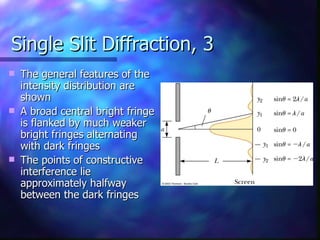
Single Slit Diffraction, 3 The general features of the intensity distribution are shown A broad central bright fringe is flanked by much weaker bright fringes alternating with dark fringes The points of constructive interference lie approximately halfway between the dark fringes
In a single-slit diffraction experiment, as the width of the slit is made smaller, the width of the central maximum of the diffraction pattern becomes (a) smaller, (b) larger, or (c) remains the same. QUICK QUIZ 24.1
24.8 Diffraction Grating The diffracting grating consists of many equally spaced parallel slits A typical grating contains several thousand lines per centimeter The intensity of the pattern on the screen is the result of the combined effects of interference and diffraction
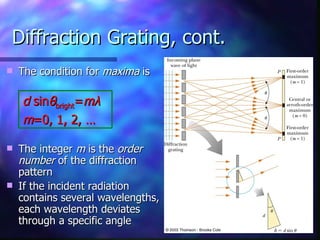
Diffraction Grating, cont. The condition for  maxima  is d  sin θ bright = mλ m =0, 1, 2, … The integer  m  is the  order number  of the diffraction pattern If the incident radiation contains several wavelengths, each wavelength deviates through a specific angle
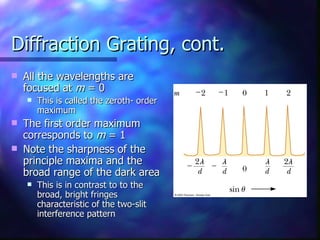
Diffraction Grating, cont. All the wavelengths are focused at  m  = 0 This is called the zeroth- order maximum The first order maximum corresponds to  m  = 1 Note the sharpness of the principle maxima and the broad range of the dark area This is in contrast to to the broad, bright fringes characteristic of the two-slit interference pattern
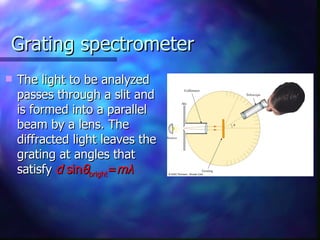
Grating spectrometer The light to be analyzed passes through a slit and is formed into a parallel beam by a lens. The diffracted light leaves the grating at angles that satisfy  d  sin θ bright = mλ
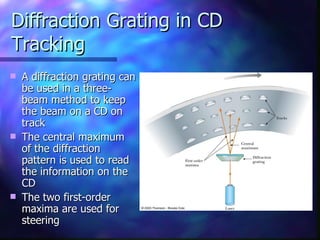
Diffraction Grating in CD Tracking A diffraction grating can be used in a three-beam method to keep the beam on a CD on track The central maximum of the diffraction pattern is used to read the information on the CD The two first-order maxima are used for steering

Diffraction

  • 1.
    24.6 Diffraction Huygen’sprinciple requires that the waves spread out after they pass through slits This spreading out of light from its initial line of travel is called diffraction In general, diffraction occurs when wave pass through small openings, around obstacles or by sharp edges
  • 2.
    Diffraction, 2 Asingle slit placed between a distant light source and a screen produces a diffraction pattern It will have a broad, intense central band The central band will be flanked by a series of narrower, less intense secondary bands Called secondary maxima The central band will also be flanked by a series of dark bands Called minima
  • 3.
    Diffraction, 3 Theresults of the single slit cannot be explained by geometrical optics Geometrical optics would say that light rays traveling in straight lines should cast a sharp image of the slit on the screen
  • 4.
    Fresnel and FraunhoferDiffraction Relation of Fresnel diffraction to Fraunhofer diffraction by a single slit Fresnel Fraunhofer Parallel rays
  • 5.
    Fraunhofer Diffraction FraunhoferDiffraction occurs when the rays leave the diffracting object in parallel directions A bright fringe is seen along the axis ( θ = 0) with alternating bright and dark fringes on each side
  • 6.
    24.7 Single SlitDiffraction According to Huygen’s principle, each portion of the slit acts as a source of waves The light from one portion of the slit can interfere with light from another portion The resultant intensity on the screen depends on the direction θ
  • 7.
    Single Slit Diffraction,2 All the waves that originate at the slit are in phase Wave 1 travels farther than wave 3 by an amount equal to the path difference ( a /2)sin θ If this path difference is exactly half of a wavelength (180 o ), the two waves cancel each other and destructive interference results (a/2)sin θ = λ/2 (for first or n = 1) or a sin θ=λ In general, destructive interference occurs for a single slit of width a when sin θ dark = nλ / a n =  1,  2,  3, …
  • 8.
    Single Slit Diffraction,3 The general features of the intensity distribution are shown A broad central bright fringe is flanked by much weaker bright fringes alternating with dark fringes The points of constructive interference lie approximately halfway between the dark fringes
  • 9.
    In a single-slitdiffraction experiment, as the width of the slit is made smaller, the width of the central maximum of the diffraction pattern becomes (a) smaller, (b) larger, or (c) remains the same. QUICK QUIZ 24.1
  • 10.
    24.8 Diffraction GratingThe diffracting grating consists of many equally spaced parallel slits A typical grating contains several thousand lines per centimeter The intensity of the pattern on the screen is the result of the combined effects of interference and diffraction
  • 11.
    Diffraction Grating, cont.The condition for maxima is d sin θ bright = mλ m =0, 1, 2, … The integer m is the order number of the diffraction pattern If the incident radiation contains several wavelengths, each wavelength deviates through a specific angle
  • 12.
    Diffraction Grating, cont.All the wavelengths are focused at m = 0 This is called the zeroth- order maximum The first order maximum corresponds to m = 1 Note the sharpness of the principle maxima and the broad range of the dark area This is in contrast to to the broad, bright fringes characteristic of the two-slit interference pattern
  • 13.
    Grating spectrometer Thelight to be analyzed passes through a slit and is formed into a parallel beam by a lens. The diffracted light leaves the grating at angles that satisfy d sin θ bright = mλ
  • 14.
    Diffraction Grating inCD Tracking A diffraction grating can be used in a three-beam method to keep the beam on a CD on track The central maximum of the diffraction pattern is used to read the information on the CD The two first-order maxima are used for steering