
ARRHYTHMIA
CONFERENCE
Elino Meccar Moniem H
IM Resident 2nd Year
Southern Philippines Medical Center
Reference
s
Diagnosing
Ventricular Tachycardia
using
Brugada Algorithm
&
Vereckei Algorithm
Objectives
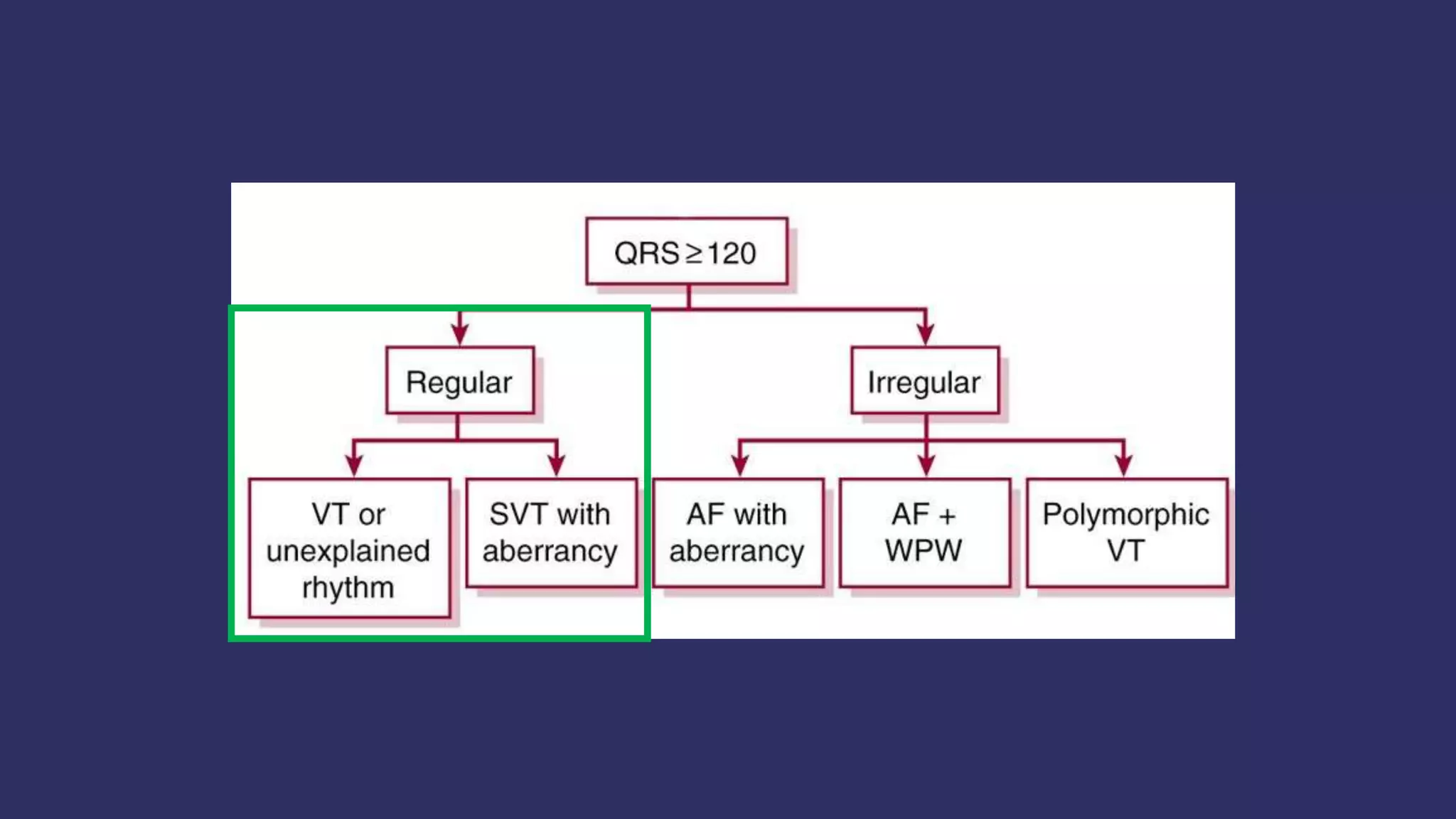
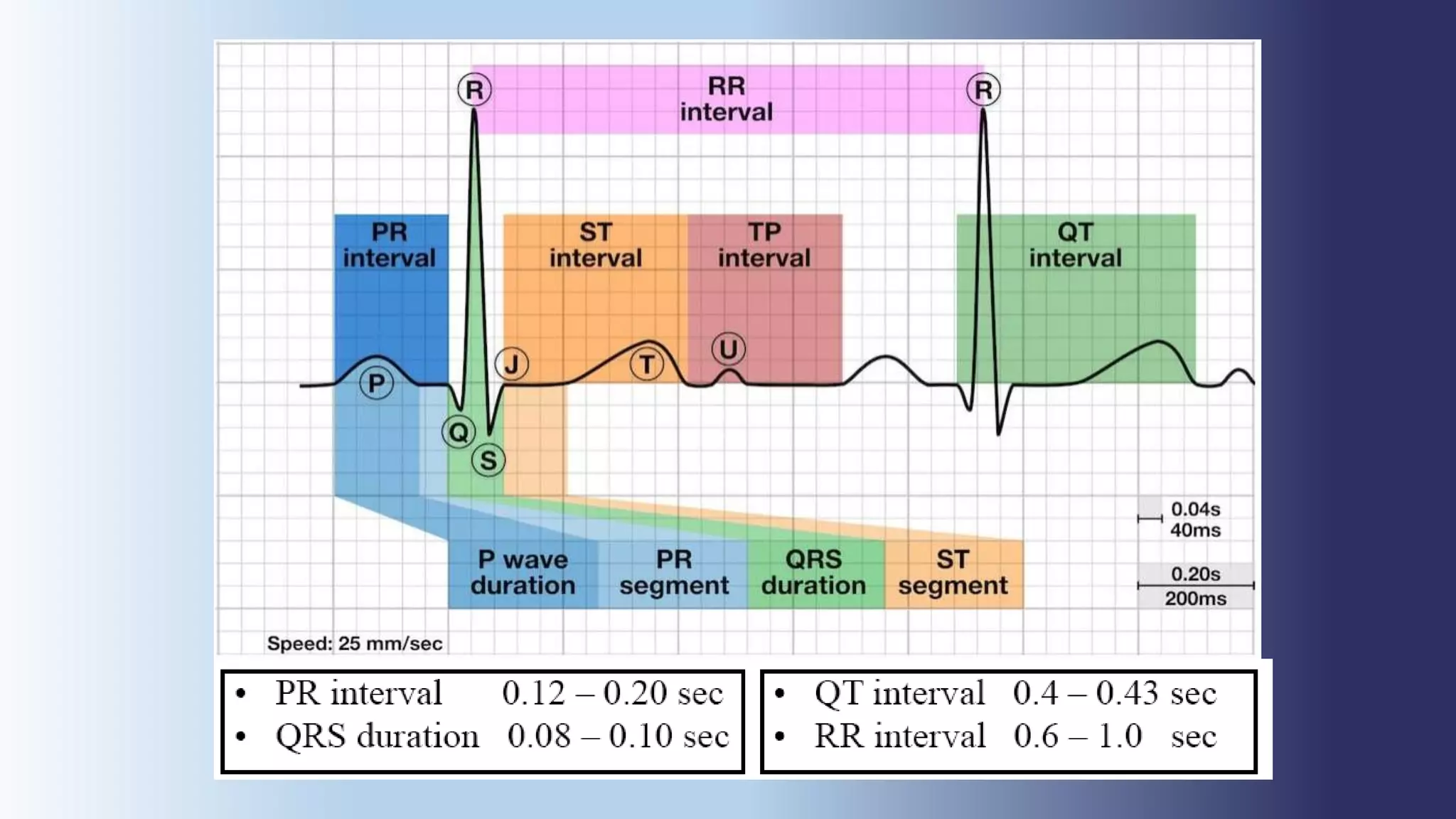
• To review the different types of tachycardia and their
differentials
• To discuss the diagnostic algorithm for Ventricular
Tachycardia: the Brugada Algorithm and Vereckei
Algorithm
Condori Leandro, H. I., Lebedev, D. S., & Mikhaylov, E. N. (2019).
Discrimination of ventricular tachycardia and localization of its
exit site using surface electrocardiography. Journal of geriatric
cardiology : JGC, 16(4), 362–377. doi:10.11909/j.issn.1671-
5411.2019.04.008
B Garner, J., & M Miller, J. (2013). Wide Complex Tachycardia - Ventricular Tachycardia or Not Ventricular Tachycardia, That
Remains the Question. Arrhythmia & electrophysiology review, 2(1), 23–29.
https://doi.org/10.15420/aer.2013.2.1.23
1
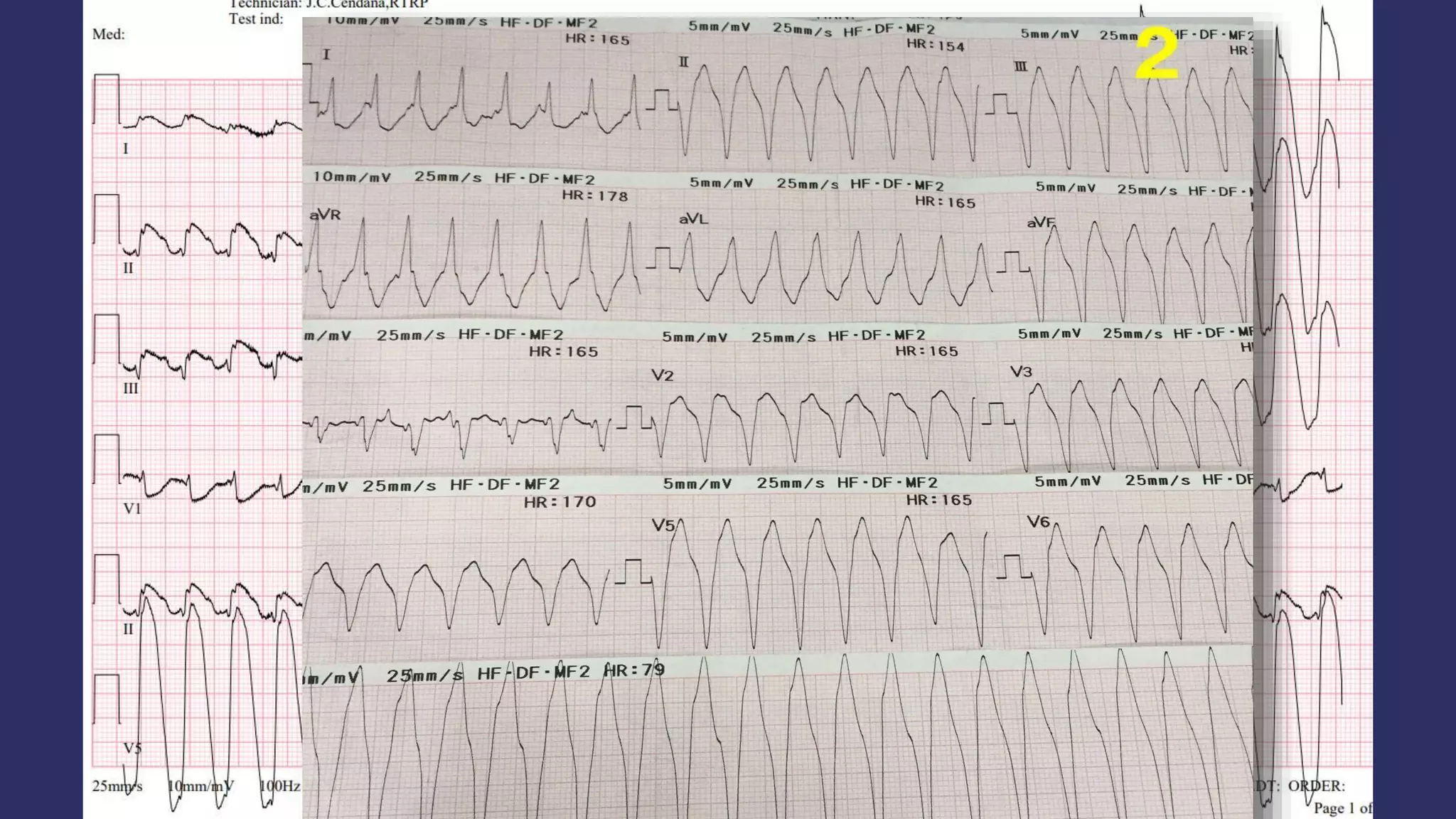
•Absence of RS complex anywhere in V1–V6 = Ventricular
Tachycardia
2
•Onset of R to nadir of S in any precordial lead >100 ms =
Ventricular Tachycardia
3
•AV dissociation = Ventricular Tachycardia
4
•Morphology criteria
1
• An initial, dominant R in aVR = Ventricular Tachycardia
2
• An initial, non-dominant q or r in aVR >40 ms =
Ventricular Tachycardia
3
• Notching on an initial downstroke in aVR = Ventricular
Tachycardia
4
• Vt≥Vi in aVR = Ventricular Tachycardia
Brugada Algorithm Vereckei Algorithm
Brugada P, Brugada J, Mont L, Smeets J, Andries EW. (1991) A new approach to the differential diagnosis of a regular tachycardia with a wide QRS complex. Circulation.
;83:1649–59. [PubMed] [Google Scholar]
Step 1.
Absence of RS
Brugada P, Brugada J, Mont L, Smeets J, Andries EW. A new approach to the differential diagnosis of a regular tachycardia with a wide QRS complex. Circulation.
1991;83:1649–59. [PubMed] [Google Scholar]
Step 1. Absence of RS = V T
If RS complex present, Proceed
to Step 2
Brugada P, Brugada J, Mont L, Smeets J, Andries EW. A new approach to the differential diagnosis of a regular tachycardia with a wide QRS complex. Circulation.
1991;83:1649–59. [PubMed] [Google Scholar]
Step 2.
Is the R to S greater than 100ms?
Brugada P, Brugada J, Mont L, Smeets J, Andries EW. A new approach to the differential diagnosis of a regular tachycardia with a wide QRS complex. Circulation.
1991;83:1649–59. [PubMed] [Google Scholar]
Step 2.
Is the R to S greater than 100ms?
Brugada Sign:
q to nadir of S > 100ms
Josephson
Sign: slurring of S
wave
Brugada P, Brugada J, Mont L, Smeets J, Andries EW. A new approach to the differential diagnosis of a regular tachycardia with a wide QRS complex. Circulation.
1991;83:1649–59. [PubMed] [Google Scholar]
Step 2.
Is the R to S greater than 100ms?
If not, proceed to Step 3.
Brugada P, Brugada J, Mont L, Smeets J, Andries EW. A new approach to the differential diagnosis of a regular tachycardia with a wide QRS complex. Circulation.
1991;83:1649–59. [PubMed] [Google Scholar]
Step 3.
Is there AV dissociation?
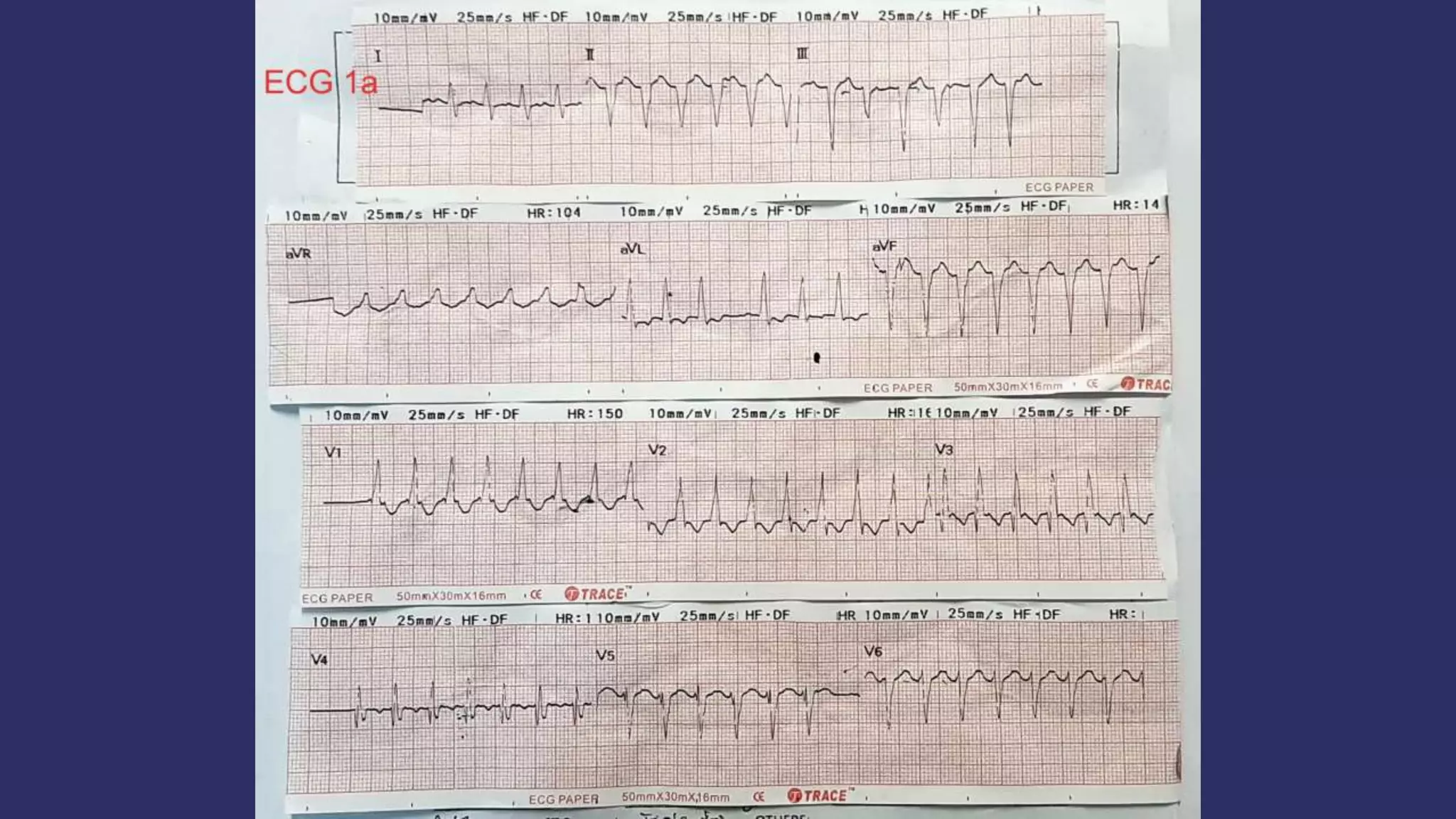
ECG 26
ECG 26
R to S > 100ms ? Is there AV D
Josephson Sign: slurring of
Brugada P, Brugada J, Mont L, Smeets J, Andries EW. A new approach to the differential diagnosis of a regular tachycardia with a wide QRS complex. Circulation.
1991;83:1649–59. [PubMed] [Google Scholar]
Step 4.
Look for the Morphology Criteria
B Garner, J., & M Miller, J. (2013). Wide Complex Tachycardia - Ventricular Tachycardia or Not Ventricular Tachycardia, That
Remains the Question. Arrhythmia & electrophysiology review, 2(1), 23–29.
https://doi.org/10.15420/aer.2013.2.1.23
B Garner, J., & M Miller, J. (2013). Wide Complex Tachycardia - Ventricular Tachycardia or Not Ventricular Tachycardia, That
Remains the Question. Arrhythmia & electrophysiology review, 2(1), 23–29.
https://doi.org/10.15420/aer.2013.2.1.23
Predictive Values and Accuracies of the Most
Common Ventricular Tachycardia Criteria
B Garner, J., & M Miller, J. (2013). Wide Complex Tachycardia - Ventricular Tachycardia or Not Ventricular Tachycardia, That
Remains the Question. Arrhythmia & electrophysiology review, 2(1), 23–29.
https://doi.org/10.15420/aer.2013.2.1.23
1
•Absence of RS complex anywhere in V1–V6 = Ventricular
Tachycardia
2
•Onset of R to nadir of S in any precordial lead >100 ms =
Ventricular Tachycardia
3
•AV dissociation = Ventricular Tachycardia
4
•Morphology criteria
1
• An initial, dominant R in aVR = Ventricular Tachycardia
2
• An initial, non-dominant q or r in aVR >40 ms =
Ventricular Tachycardia
3
• Notching on an initial downstroke in aVR = Ventricular
Tachycardia
4
• Vt≥Vi in aVR = Ventricular Tachycardia
Brugada Algorithm Vereckei Algorithm
Vereckei A, Duray G, Szénási G, Altemose GT, Miller JM. A new algorithm using only lead aVR for the differential diagnosis of
wide QRS complex tachycardia. Heart Rhythm. 2008;5:89–98. [PubMed] [Google Scholar]
Step 1.
Initial R wave in aVR
Vereckei A, Duray G, Szénási G, Altemose GT, Miller JM. A new algorithm using only lead aVR for the differential diagnosis of
wide QRS complex tachycardia. Heart Rhythm. 2008;5:89–98. [PubMed] [Google Scholar]
Step 1.
Initial R wave in aVR
Present in our ECG
Vereckei A, Duray G, Szénási G, Altemose GT, Miller JM. A new algorithm using only lead aVR for the differential diagnosis of
wide QRS complex tachycardia. Heart Rhythm. 2008;5:89–98. [PubMed] [Google Scholar]
If there is no
Initial R wave in aVR
Assess the width of
initial r wave or q wave > 40ms
Vereckei A, Duray G, Szénási G, Altemose GT, Miller JM. A new algorithm using only lead aVR for the differential diagnosis of
wide QRS complex tachycardia. Heart Rhythm. 2008;5:89–98. [PubMed] [Google Scholar]
If the width of
initial r wave or q wave
doesn’t reach 1 small box
(40ms)
see the notching of initial downstroke
Vereckei A, Duray G, Szénási G, Altemose GT, Miller JM. A new algorithm using only lead aVR for the differential diagnosis of
wide QRS complex tachycardia. Heart Rhythm. 2008;5:89–98. [PubMed] [Google Scholar]
If there’s no notching of
QRS downstroke
Compute for V initial / V terminal
A value of lesser than 1 = V
Tach
Harrison's Principles of Internal Medicine, 20th. ed. Author: Jameson, et. al.
Publisher: McGraw-Hill. Publish Year: 2018. Chapter 249 Page 1757
Harrison's Principles of Internal Medicine, 20th. ed. Author: Jameson, et. al.
Publisher: McGraw-Hill. Publish Year: 2018. Chapter 247 Page 1753
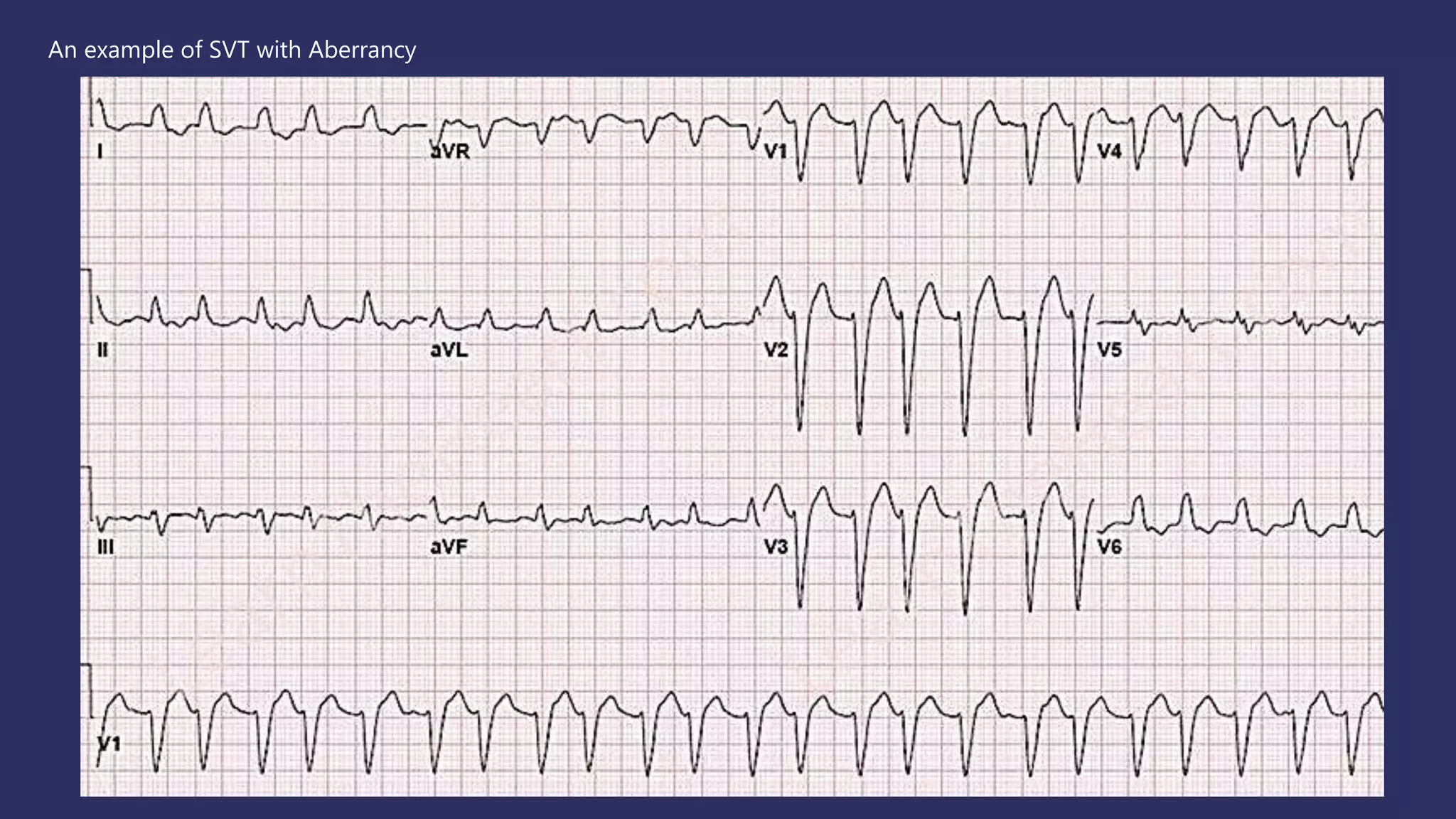
An example of SVT with Aberrancy
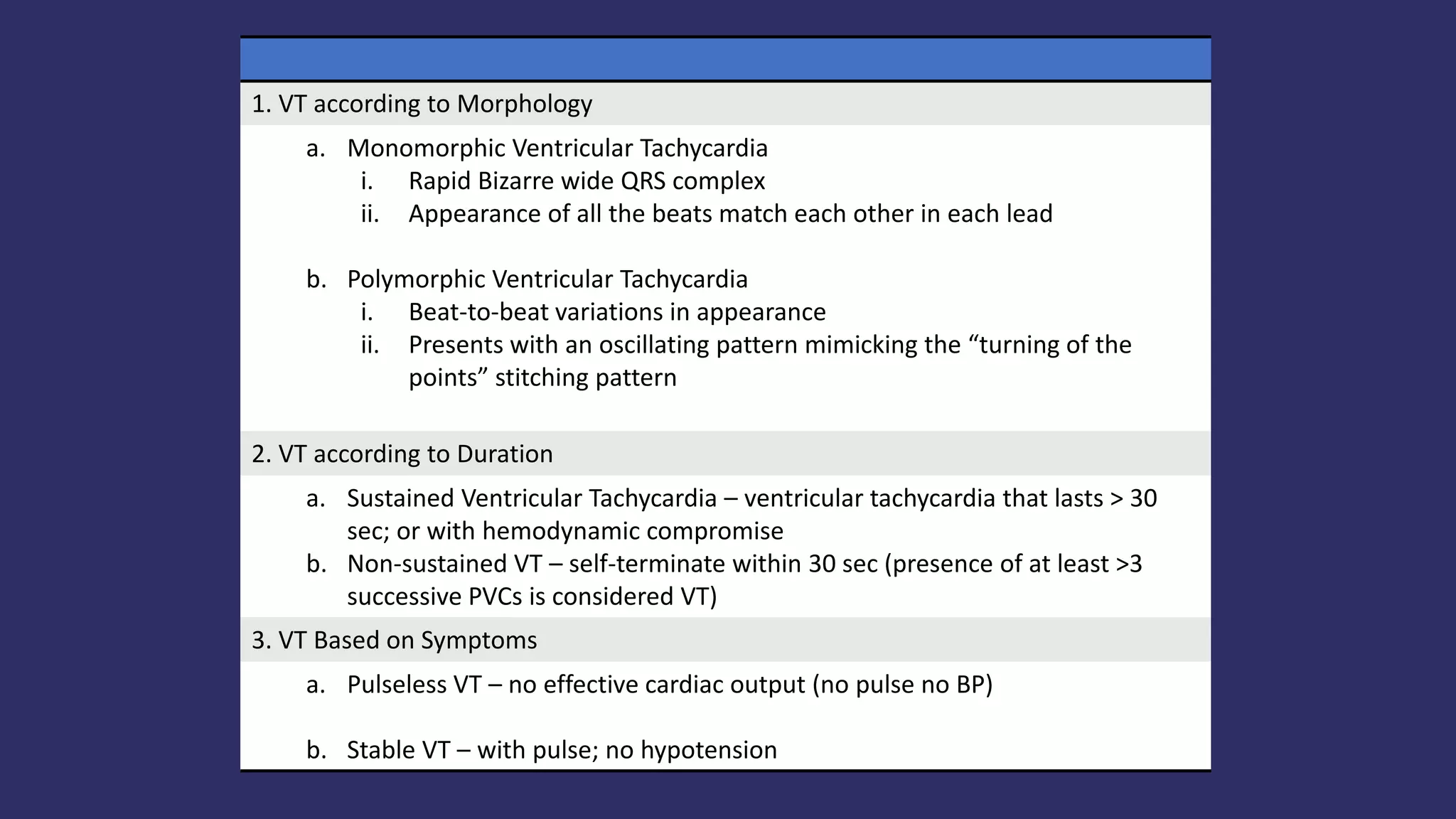
1. VT according to Morphology
a. Monomorphic Ventricular Tachycardia
i. Rapid Bizarre wide QRS complex
ii. Appearance of all the beats match each other in each lead
b. Polymorphic Ventricular Tachycardia
i. Beat-to-beat variations in appearance
ii. Presents with an oscillating pattern mimicking the “turning of the
points” stitching pattern
2. VT according to Duration
a. Sustained Ventricular Tachycardia – ventricular tachycardia that lasts > 30
sec; or with hemodynamic compromise
b. Non-sustained VT – self-terminate within 30 sec (presence of at least >3
successive PVCs is considered VT)
3. VT Based on Symptoms
a. Pulseless VT – no effective cardiac output (no pulse no BP)
b. Stable VT – with pulse; no hypotension
Thank you

Ecg vtach brugada & vereckei algorithm mec elino

  • 1.
    ARRHYTHMIA CONFERENCE Elino Meccar MoniemH IM Resident 2nd Year Southern Philippines Medical Center
  • 2.
  • 3.
  • 4.
    Objectives • To reviewthe different types of tachycardia and their differentials • To discuss the diagnostic algorithm for Ventricular Tachycardia: the Brugada Algorithm and Vereckei Algorithm
  • 11.
    Condori Leandro, H.I., Lebedev, D. S., & Mikhaylov, E. N. (2019). Discrimination of ventricular tachycardia and localization of its exit site using surface electrocardiography. Journal of geriatric cardiology : JGC, 16(4), 362–377. doi:10.11909/j.issn.1671- 5411.2019.04.008
  • 12.
    B Garner, J.,& M Miller, J. (2013). Wide Complex Tachycardia - Ventricular Tachycardia or Not Ventricular Tachycardia, That Remains the Question. Arrhythmia & electrophysiology review, 2(1), 23–29. https://doi.org/10.15420/aer.2013.2.1.23 1 •Absence of RS complex anywhere in V1–V6 = Ventricular Tachycardia 2 •Onset of R to nadir of S in any precordial lead >100 ms = Ventricular Tachycardia 3 •AV dissociation = Ventricular Tachycardia 4 •Morphology criteria 1 • An initial, dominant R in aVR = Ventricular Tachycardia 2 • An initial, non-dominant q or r in aVR >40 ms = Ventricular Tachycardia 3 • Notching on an initial downstroke in aVR = Ventricular Tachycardia 4 • Vt≥Vi in aVR = Ventricular Tachycardia Brugada Algorithm Vereckei Algorithm
  • 13.
    Brugada P, BrugadaJ, Mont L, Smeets J, Andries EW. (1991) A new approach to the differential diagnosis of a regular tachycardia with a wide QRS complex. Circulation. ;83:1649–59. [PubMed] [Google Scholar] Step 1. Absence of RS
  • 18.
    Brugada P, BrugadaJ, Mont L, Smeets J, Andries EW. A new approach to the differential diagnosis of a regular tachycardia with a wide QRS complex. Circulation. 1991;83:1649–59. [PubMed] [Google Scholar] Step 1. Absence of RS = V T If RS complex present, Proceed to Step 2
  • 19.
    Brugada P, BrugadaJ, Mont L, Smeets J, Andries EW. A new approach to the differential diagnosis of a regular tachycardia with a wide QRS complex. Circulation. 1991;83:1649–59. [PubMed] [Google Scholar] Step 2. Is the R to S greater than 100ms?
  • 20.
    Brugada P, BrugadaJ, Mont L, Smeets J, Andries EW. A new approach to the differential diagnosis of a regular tachycardia with a wide QRS complex. Circulation. 1991;83:1649–59. [PubMed] [Google Scholar] Step 2. Is the R to S greater than 100ms? Brugada Sign: q to nadir of S > 100ms Josephson Sign: slurring of S wave
  • 23.
    Brugada P, BrugadaJ, Mont L, Smeets J, Andries EW. A new approach to the differential diagnosis of a regular tachycardia with a wide QRS complex. Circulation. 1991;83:1649–59. [PubMed] [Google Scholar] Step 2. Is the R to S greater than 100ms? If not, proceed to Step 3.
  • 24.
    Brugada P, BrugadaJ, Mont L, Smeets J, Andries EW. A new approach to the differential diagnosis of a regular tachycardia with a wide QRS complex. Circulation. 1991;83:1649–59. [PubMed] [Google Scholar] Step 3. Is there AV dissociation?
  • 25.
  • 26.
    ECG 26 R toS > 100ms ? Is there AV D Josephson Sign: slurring of
  • 30.
    Brugada P, BrugadaJ, Mont L, Smeets J, Andries EW. A new approach to the differential diagnosis of a regular tachycardia with a wide QRS complex. Circulation. 1991;83:1649–59. [PubMed] [Google Scholar] Step 4. Look for the Morphology Criteria
  • 31.
    B Garner, J.,& M Miller, J. (2013). Wide Complex Tachycardia - Ventricular Tachycardia or Not Ventricular Tachycardia, That Remains the Question. Arrhythmia & electrophysiology review, 2(1), 23–29. https://doi.org/10.15420/aer.2013.2.1.23
  • 34.
    B Garner, J.,& M Miller, J. (2013). Wide Complex Tachycardia - Ventricular Tachycardia or Not Ventricular Tachycardia, That Remains the Question. Arrhythmia & electrophysiology review, 2(1), 23–29. https://doi.org/10.15420/aer.2013.2.1.23 Predictive Values and Accuracies of the Most Common Ventricular Tachycardia Criteria
  • 35.
    B Garner, J.,& M Miller, J. (2013). Wide Complex Tachycardia - Ventricular Tachycardia or Not Ventricular Tachycardia, That Remains the Question. Arrhythmia & electrophysiology review, 2(1), 23–29. https://doi.org/10.15420/aer.2013.2.1.23 1 •Absence of RS complex anywhere in V1–V6 = Ventricular Tachycardia 2 •Onset of R to nadir of S in any precordial lead >100 ms = Ventricular Tachycardia 3 •AV dissociation = Ventricular Tachycardia 4 •Morphology criteria 1 • An initial, dominant R in aVR = Ventricular Tachycardia 2 • An initial, non-dominant q or r in aVR >40 ms = Ventricular Tachycardia 3 • Notching on an initial downstroke in aVR = Ventricular Tachycardia 4 • Vt≥Vi in aVR = Ventricular Tachycardia Brugada Algorithm Vereckei Algorithm
  • 36.
    Vereckei A, DurayG, Szénási G, Altemose GT, Miller JM. A new algorithm using only lead aVR for the differential diagnosis of wide QRS complex tachycardia. Heart Rhythm. 2008;5:89–98. [PubMed] [Google Scholar] Step 1. Initial R wave in aVR
  • 39.
    Vereckei A, DurayG, Szénási G, Altemose GT, Miller JM. A new algorithm using only lead aVR for the differential diagnosis of wide QRS complex tachycardia. Heart Rhythm. 2008;5:89–98. [PubMed] [Google Scholar] Step 1. Initial R wave in aVR Present in our ECG
  • 40.
    Vereckei A, DurayG, Szénási G, Altemose GT, Miller JM. A new algorithm using only lead aVR for the differential diagnosis of wide QRS complex tachycardia. Heart Rhythm. 2008;5:89–98. [PubMed] [Google Scholar] If there is no Initial R wave in aVR Assess the width of initial r wave or q wave > 40ms
  • 41.
    Vereckei A, DurayG, Szénási G, Altemose GT, Miller JM. A new algorithm using only lead aVR for the differential diagnosis of wide QRS complex tachycardia. Heart Rhythm. 2008;5:89–98. [PubMed] [Google Scholar] If the width of initial r wave or q wave doesn’t reach 1 small box (40ms) see the notching of initial downstroke
  • 42.
    Vereckei A, DurayG, Szénási G, Altemose GT, Miller JM. A new algorithm using only lead aVR for the differential diagnosis of wide QRS complex tachycardia. Heart Rhythm. 2008;5:89–98. [PubMed] [Google Scholar] If there’s no notching of QRS downstroke Compute for V initial / V terminal A value of lesser than 1 = V Tach
  • 43.
    Harrison's Principles ofInternal Medicine, 20th. ed. Author: Jameson, et. al. Publisher: McGraw-Hill. Publish Year: 2018. Chapter 249 Page 1757
  • 44.
    Harrison's Principles ofInternal Medicine, 20th. ed. Author: Jameson, et. al. Publisher: McGraw-Hill. Publish Year: 2018. Chapter 247 Page 1753
  • 46.
    An example ofSVT with Aberrancy
  • 47.
    1. VT accordingto Morphology a. Monomorphic Ventricular Tachycardia i. Rapid Bizarre wide QRS complex ii. Appearance of all the beats match each other in each lead b. Polymorphic Ventricular Tachycardia i. Beat-to-beat variations in appearance ii. Presents with an oscillating pattern mimicking the “turning of the points” stitching pattern 2. VT according to Duration a. Sustained Ventricular Tachycardia – ventricular tachycardia that lasts > 30 sec; or with hemodynamic compromise b. Non-sustained VT – self-terminate within 30 sec (presence of at least >3 successive PVCs is considered VT) 3. VT Based on Symptoms a. Pulseless VT – no effective cardiac output (no pulse no BP) b. Stable VT – with pulse; no hypotension
  • 48.

Editor's Notes

  • #43 To apply, measure the total vertical distance covered by the final 40 ms of the QRS in aVR. If this is equal to or more than the vertical distance covered by the first 40 ms of the aVR QRS, VT is diagnosed. The concept is that with aberration, ventricular activation during the first portion of the QRS is mediated by the His-Purkinje system, whereas in VT, the His-Purkinje system is engaged later in the QRS complex.